
Which taxes a new Sri Lankan business must register for
Practical tax registration checklist for Sri Lankan businesses covering sequence, ownership, document controls, and setup errors that delay compliance.

On this page
Last verified against the primary sources on 15 October 2026.
Pay APIT to the Inland Revenue Department (IRD) late, after the 15th of the month following the deduction, and interest at 1.5 percent a month or part of a month runs from the due date under section 159(1) [1]. Leave it unpaid fourteen days after the due date and a penalty of 20 percent of the tax due but not paid under section 179(1) of the Inland Revenue Act applies as well [1] [2]. Miss VAT registration once your taxable supplies cross Rs 15 million in a quarter, and the Commissioner-General can register you from a date he determines, which can be in the past, so VAT falls due on sales you have already invoiced without it [3]. Most businesses do not get hit by tax complexity. They get hit by starting the registration sequence in the wrong order, or too late.
This guide turns tax registration into a staged checklist. Use it when opening a new company, activating new tax types, or cleaning up a business that was registered in pieces.
Quick answer: Start with one verified entity data pack, register for a TIN and get PIN access first (a company within 30 days of incorporation), add only the tax types your business is actually liable for, set up payroll registrations in parallel if you employ staff, and finish with a first-filing readiness review before the next statutory deadline.
Tax registration sequence: complete these steps in order
Step 1: TIN registration (mandatory for all businesses)
- A company must register with the Commissioner-General not later than 30 days from the date of incorporation [4]. Failing to register carries a penalty of up to Rs 50,000 [1].
- Prepare the documents: for a company, the certificate of incorporation, Form 1, 5 or 40 and all Form 20s certified by the Registrar of Companies, the NIC or passport of every director, and the Articles of Association; for an individual, the NIC or passport [5].
- Register through Taxpayer Registration on the IRD e-Services portal; a company chooses REGISTERED COMPANY and adds each director by TIN, NIC or passport [5].
- Make sure each director has a TIN first, or the company application stops at the "add director" screen.
See the TIN certificate and company TIN guide and the company registration guide for entity setup context.
Step 2: e-Services access
- Request a PIN through PIN Request; a company uses its Registrar of Companies registration number [5]
- Register a company email address, not a director's personal one, so access does not leave with the director
- Authorise staff or your tax agent through Authorisation of Staff/Tax Agent [5]
Once a company has its TIN, corporate income tax is registered automatically; VAT, SSCL and APIT are separate registrations if they apply [5].
Step 3: VAT registration (if you are liable)
- Confirm whether your taxable supplies have exceeded Rs 15 million in a quarter or Rs 60 million in the twelve months then ending, or are likely to [3]. The proposed 2026 cut was abandoned and these thresholds remain [6].
- If you import or export goods for commercial purposes, you must register whatever your turnover [3].
- Apply to the Commissioner-General not later than 15 days from the date you became liable [3].
- Charge VAT from the effective date on the certificate.
The VAT registration thresholds guide sets out the tests step by step, and the VAT registration and compliance guide covers returns and invoices. Also review the WHT registration guide once your payment map is ready.
Step 4: APIT registration (employers with employees only)
- Confirm your first APIT deduction month
- Register for APIT with the IRD as a withholding agent
- Set up your payroll system to apply the IRD's APIT deduction tables
- Pay the APIT withheld each month within 15 days after the end of the month [1] [7]
- Collect each employee's TIN now: Schedule 01 is part of the APIT Annual Statement, filed electronically by 30 April after the year of assessment, and a Schedule 01 record without a TIN is rejected and the employee loses the APIT credit [8] [9]
See the APIT and PAYE registration guide, the EPF and ETF guide, the salary calculator and the payroll setup checklist for new employers for the full payroll onboarding cycle.
Step 5: SSCL registration (if above the Rs 9 million a quarter line)
- Check whether your quarterly turnover exceeds, or is likely to exceed, Rs 9 million, or four consecutive quarters exceed or are likely to exceed Rs 36 million; this test applies to periods from 1 July 2026, and you must apply within 15 days [10]
- Apply on form TPR_005 (SSCL), lodged at an IRD help desk or sent by post or email [11] [12]
- Set up the calendar: the levy is paid monthly, by the 20th of the following month, and the return is filed quarterly, by the 20th of the month after the quarter [13]
The SSCL registration guide covers the test and the form in detail. Use the tax compliance calendar 2026 for Sri Lanka to set the live calendar.
After completing the registrations, run a recurring compliance-risk review to identify missing returns, records and responsibilities.
Six registration mistakes that create penalties before you file your first return
Do not use this checklist as a race to activate the maximum number of tax types.
Avoid these patterns:
- registering for VAT because someone assumes every company should have it
- activating WHT before mapping payment categories
- waiting to think about APIT, EPF and ETF until the first salary is due
- storing acknowledgements in personal email only
- leaving the first filing date undefined after approval
- relying on one accountant or one director as the only person who understands the setup
Registration should reduce risk. Those habits increase it.
The clean registration order for a new Sri Lankan business
For most new small or mid-sized businesses, the clean order is:
- TIN and PIN access, within 30 days of incorporation for a company.
- Income tax registration, which follows automatically for a company.
- VAT if liability exists, or at once if you import or export goods commercially.
- WHT if the payment model requires it.
- APIT and EPF/ETF if staff are hired.
- SSCL if turnover crosses the line.
- First-filing readiness review, then calendar and archive handover to operations.
That order keeps the legal identity, tax types, payroll and first filings connected.
If the business also needs the labour-law side of hiring, attendance, leave and employee records built at the same time, pair this checklist with the labour law guide for employers.
Talk to us. If you are starting a new business or cleaning up an incomplete registration, our tax team can work through the sequence with you; book a consultation at our contact page.
This guide is general information on the law as at 15 October 2026 and is not advice on your specific situation.
For an online shop, map registrations to the tax obligations of an e-commerce business, not just the payment platform it uses.
References
- Inland Revenue Department. Inland Revenue Act, No. 24 of 2017, consolidated, ss.86(1), 159(1), 177 and 179. https://www.ird.gov.lk/en/publications/Acts_Income%20Tax_2017/IRA_Cons_Act_-_2025_Changes.pdf . Primary. Accessed 15 October 2026.
- Inland Revenue Department. Guide to the Return of Income Tax, Y/A 2025/26, Section 09, penalty of 20 percent of tax due but not paid, 10 percent on a late instalment, interest at 1.5 percent a month or part of a month. https://www.ird.gov.lk/en/Downloads/IT_Individuals_Doc/Asmt_IIT_004_2025_2026_E.pdf . Primary. Accessed 15 October 2026.
- Inland Revenue Department. Value Added Tax Act, No. 14 of 2002, consolidated version up to 2025, ss.10(1)(viii) and (ix), 10(2) and 14(1). https://www.ird.gov.lk/en/publications/Value%20Added%20Tax_Acts/VAT_Act_No_14%5BE%5D_2002_%28Consolidation_2025%29.pdf . Primary. Accessed 15 October 2026.
- Parliament of Sri Lanka. Inland Revenue (Amendment) Act, No. 11 of 2026, certified 3 June 2026, s.23 (new s.102(1A)). https://www.ird.gov.lk/en/publications/Acts_Income%20Tax_2017/IR_Act_No_11-2026_E.pdf . Primary. Accessed 15 October 2026.
- Inland Revenue Department. Taxpayer Guidelines for Registration and Update (2026). https://www.ird.gov.lk/en/Downloads/SiteAssets/TPR_Guidelines_2026_E.pdf . Primary. Accessed 15 October 2026.
- Inland Revenue Department. Notice to the Taxpayers: Amendments to the Value Added Tax Act, SEC/PN/VAT/2026-03 (3 July 2026), item 3. https://www.ird.gov.lk/en/Lists/Latest%20News%20%20Notices/Attachments/799/PN_VAT_2026-03_New_E.pdf . Primary. Accessed 15 October 2026.
- Inland Revenue Department. Tax Calendar 2026. https://www.ird.gov.lk/en/publications/Tax%20Calendar_Documents/Tax_Calendar_2026_E.pdf . Primary. Accessed 15 October 2026.
- Inland Revenue Department. APIT Annual Statement of Employers, Y/A 2025/2026 (Asmt_APIT_001). https://www.ird.gov.lk/en/Downloads/Other_PAYE_Doc/Asmt_APIT_001_2025_2026_E.pdf . Primary. Accessed 15 October 2026.
- Inland Revenue Department. Notice SEC/PN/APIT/2026-01 (24 February 2026), TIN in Schedule 01. https://www.ird.gov.lk/en/Lists/Latest%20News%20%20Notices/Attachments/764/SEC_PN_APIT_2026-01_E.pdf . Primary. Accessed 15 October 2026.
- Parliament of Sri Lanka. Social Security Contribution Levy (Amendment) Act, No. 10 of 2026, certified 9 April 2026, s.2. https://www.ird.gov.lk/en/publications/Acts_SSCL/SSCL_Act_No_10-2026_E.pdf . Primary. Accessed 15 October 2026.
- Inland Revenue Department. Application for Tax Type Registration, Social Security Contribution Levy, Form TPR_005(SSCL)_E. https://www.ird.gov.lk/en/Downloads/TaxpayerRegistrationDocs/TPR_005%28SSCL%29_E.pdf . Primary. Accessed 15 October 2026.
- Inland Revenue Department. Notice to Taxpayers: Registration for Social Security Contribution Levy, PN/SSCL/2022-02 (7 October 2022). https://www.ird.gov.lk/en/Lists/Latest%20News%20%20Notices/Attachments/757/PN_SSL_2022-02_07102022_E.pdf . Primary. Accessed 15 October 2026.
- Inland Revenue Department. Social Security Contribution Levy Act, No. 25 of 2022, consolidated up to 2026, ss.8(1) and 17(1). https://www.ird.gov.lk/si/publications/Acts_SSCL/SSCL_Cons_Act_-_2026_Changes.pdf . Primary. Accessed 15 October 2026.
Put these insights to work
WinCore specialists can review your current workflow, document gaps, and build a practical 90-day action plan.
Book a free consultationContinue reading
Explore more WinCore analysis to keep your finance, tax, and compliance roadmap moving.
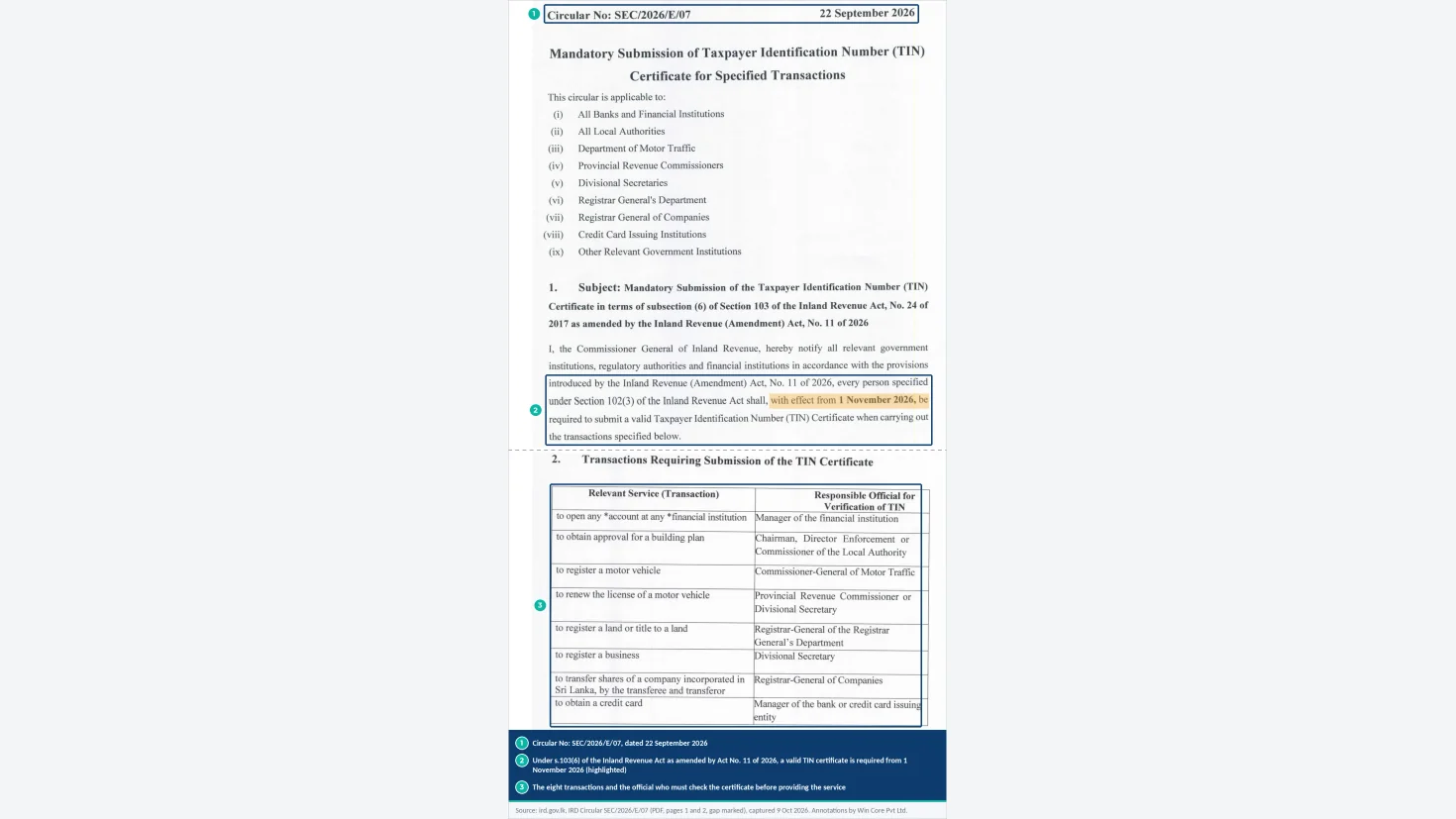
From 1 November 2026 individuals need a TIN certificate for eight transactions. Who needs one, how to get it, and TINs for companies and staff.
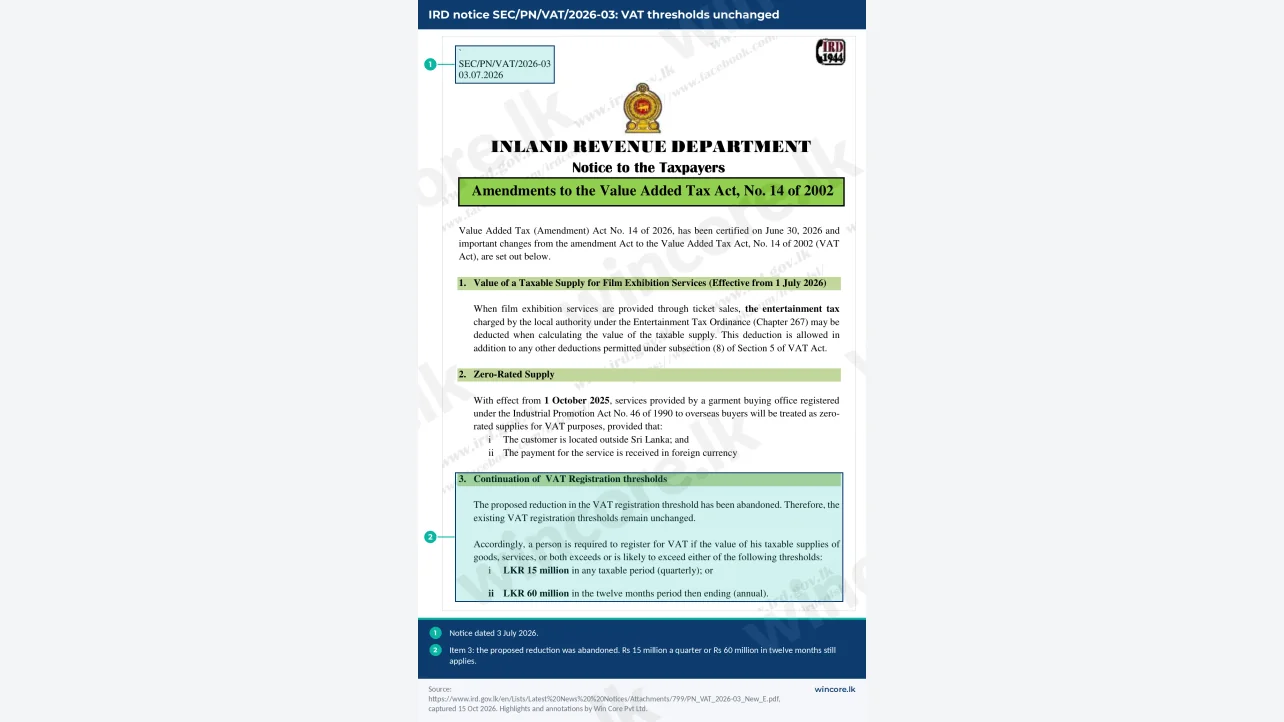
The VAT registration tests are Rs 15 million a quarter or Rs 60 million over 12 months. How the tests run, the 15 day rule and who must register.
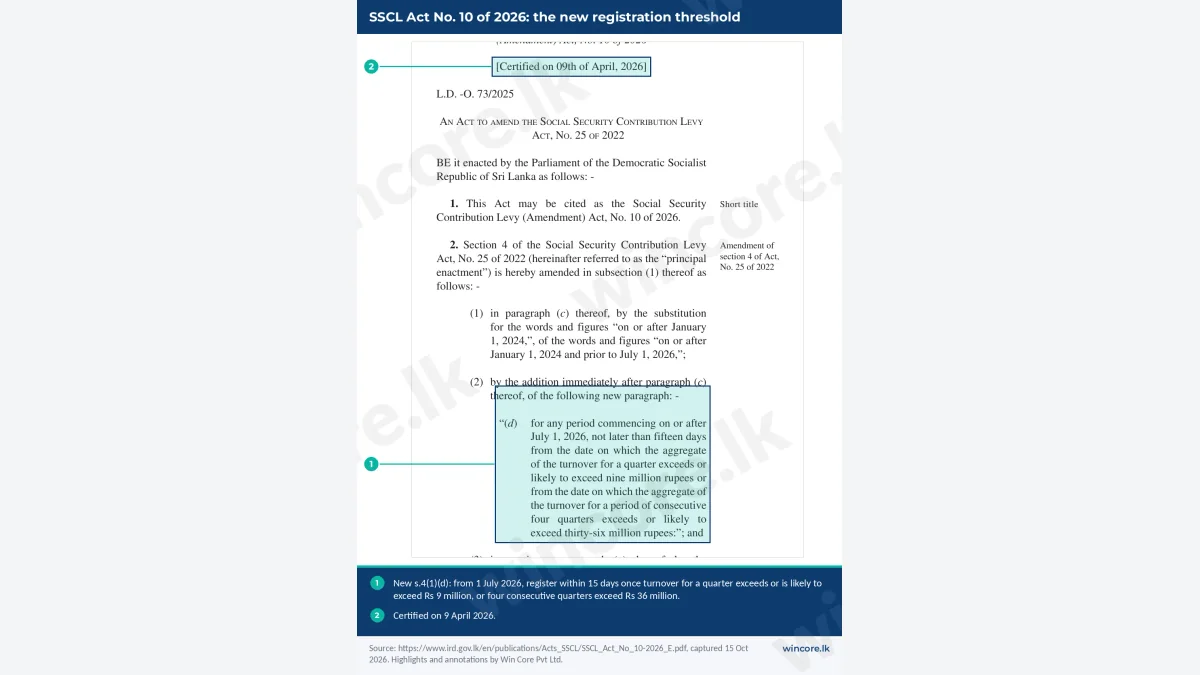
SSCL registration now starts at Rs 9 million a quarter or Rs 36 million a year from 1 July 2026. How to test, register and pay monthly.