
Five compliance gaps to check in a Sri Lankan business
A five-area compliance self-check for Sri Lankan businesses: VAT and SSCL registration, APIT, EPF and ETF, the Form 15 annual return and secretarial records.

On this page
Last verified against the primary sources on 15 October 2026.
Most compliance failures in a growing Sri Lankan business sit in five places: VAT (and now SSCL) registration, APIT, EPF and ETF, the annual return to the Registrar of Companies, and the company's own secretarial records. Each has a fixed rule. VAT registration is required once taxable supplies exceed Rs 15 million in a quarter or Rs 60 million in twelve months [1]. APIT withheld is paid within 15 days after the month ends [2]. EPF and ETF are due by the last day of the following month [3] [4]. Form 15 is due within thirty working days of the AGM [5].
You can also try our compliance risk check tool. Your answers are self-reported, so treat any result as a starting point for a review, not a clearance.
Take a hypothetical hardware shop in Kandy with 8 staff. It pays salaries on time, but its taxable supplies passed Rs 15 million in one festive quarter and it has not registered for VAT, it has paid EPF a few weeks late twice, and a director who resigned two years ago is still on the Registrar's record because no Form 20 was filed. None of those is unusual, and each has a cost that grows with time. The questions below are designed to find gaps like these.
Why compliance gaps are costly
The cost of a gap usually grows with time. A business that should have registered for VAT owes VAT for the period it should have been registered, with penalties under the VAT Act on top [1]. Unpaid income tax carries interest at 1.5 percent a month [2]. Late EPF and ETF contributions attract a surcharge that rises with the delay, from 5 percent for up to ten days to 50 percent beyond twelve months [3] [4]. A late annual return is an offence, usually compounded for a sum the Registrar sets [5].
There is one time-limited relief worth knowing: interest on income tax up to the year of assessment 2024/25 is written off if the tax and any applicable penalties are paid by 2 December 2026 [6].
The five risk areas
1. VAT and SSCL registration
The VAT registration threshold is Rs 15 million in taxable supplies in a quarter, or Rs 60 million in the twelve months then ending [1]. A proposed 2026 cut was abandoned [7]. A business that crosses the threshold must apply within 15 days of becoming liable [1]. SSCL has a lower threshold: from 1 July 2026, Rs 9 million in a quarter or Rs 36 million over four consecutive quarters [8].
Questions to ask:
- What is your taxable turnover for each of the last four quarters?
- Are you registered for VAT and for SSCL, and from what dates?
- If registered, are your returns and payments up to date?
Common risk flags: businesses that crossed the threshold during rapid growth and did not register on time; businesses that are registered but not filing returns; businesses treating exempt supplies as taxable or taxable supplies as exempt. If you have been over the threshold for some time without registering, get advice before you register. See our guides to the VAT thresholds and the SSCL threshold.
2. APIT registration and payment
Advance Personal Income Tax (APIT) is the tax employers deduct from employees' pay and pay to the Inland Revenue Department. APIT has been mandatory since 1 January 2023 [9]. The personal relief is Rs 1,800,000 a year (Rs 150,000 a month) [2]. Tax withheld is paid within 15 days after the end of each month, and the employer files an annual statement for the year to 31 March by 30 April [2]. The T-10 is a different document: it is the certificate of tax deducted that the employer gives each employee [10].
Questions to ask:
- Do any employees earn above Rs 150,000 a month?
- Are you registered for APIT and deducting it every month?
- Are you paying it within 15 days after each month ends?
- Have you filed the APIT annual statement by 30 April for each recent year, and issued T-10 certificates?
Common risk flags: employers with salaried staff who never registered; employers who deduct APIT but pay it late; employers who confuse the T-10 with the annual statement. If you fail to deduct, you must pay the tax yourself [2].
3. EPF and ETF registration and contributions
An employer with even one employee registers as an employer with the EPF Department on Form D, through the Labour Office, within two weeks of becoming liable to contribute, which in practice is the day the first employee joins [11] [12]. Unlike EPF, ETF has no registration procedure before contributions are made; the ETF Board uses the EPF number [13].
Contribution rates are fixed: 12 percent from the employer and 8 percent from the employee to EPF, and 3 percent from the employer to ETF, all on total earnings, due by the last day of the following month [3] [4].
Questions to ask:
- How many employees do you have, and do you hold an EPF employer number?
- Are contributions worked out on total earnings, not basic salary alone?
- Are payments made by the last day of the following month?
Common risk flags: sole traders who have hired staff without registering; contributions at incorrect rates or on the wrong base; late payments building up surcharges; businesses that stopped trading without closing their EPF registration. See our EPF and ETF guide.
4. Annual return filing
Every company incorporated under the Companies Act No. 7 of 2007 files an annual return on Form 15 with the Registrar of Companies. There is no return in the year of incorporation; the first AGM is due within eighteen months of incorporation, and the return within thirty working days of each AGM [5]. The return records, among other things, the shares issued, the directors, the shareholders and their holdings, the secretary, the auditor, charges, and the date of the AGM. A BO 4 beneficial ownership form goes in with it [14].
Questions to ask:
- Is your business a registered company?
- When did you last hold an AGM and file Form 15?
- Have there been director or secretary changes that should have been notified on Form 20?
Common risk flags: companies where the secretary changed and filings lapsed; director or shareholder changes not reported; returns filed without the BO 4. Our Form 15 guide covers the filing.
5. Company secretarial obligations
Beyond the annual return, companies have ongoing secretarial obligations under the Companies Act: keeping the statutory registers and minutes, notifying the Registrar of changes, and issuing shares in line with the Articles. A company above the section 222 thresholds must have a qualified secretary [5]. Every company must also keep a register of its beneficial owners [15].
Questions to ask:
- Does the company have a qualified company secretary?
- Are board and shareholder minutes maintained?
- Have the registers, including the beneficial ownership register, been updated after every change this year?
- Are all director appointments and resignations documented and filed?
See our guides to changing your company secretary and beneficial ownership.
What to do with a gap
If everything checks out: document your position and set reminders for the next deadlines in our tax calendar.
If something is uncertain: review the area with your accountant or company secretary. Often a registration or a late filing closes the gap before it becomes a formal problem.
If you find a clear gap: deal with it promptly. Register, file and pay what is outstanding, starting with the item whose cost grows fastest. For income tax arrears from before 2025/26, the 2 December 2026 deadline for the interest write-off, which needs the tax and any applicable penalties paid, is a reason to act now [6].
Talk to us. If a check turns up a gap, our tax, payroll and company secretarial teams can work through it with you; book a consultation at our contact page.
This guide is general information on the law as at 15 October 2026 and is not advice on your specific situation.
References
- Inland Revenue Department. Value Added Tax Act, No. 14 of 2002, consolidated version up to 2025, s.10. https://www.ird.gov.lk/en/publications/Value%20Added%20Tax_Acts/VAT_Act_No_14%5BE%5D_2002_%28Consolidation_2025%29.pdf . Primary. Accessed 15 October 2026.
- Inland Revenue Department. Inland Revenue Act, No. 24 of 2017, consolidated, ss.86(1) to (3), 157, 159 and the First Schedule. https://www.ird.gov.lk/en/publications/Acts_Income%20Tax_2017/IRA_Cons_Act_-_2025_Changes.pdf . Primary. Accessed 15 October 2026.
- Central Bank of Sri Lanka. Employees' Provident Fund Act, No. 15 of 1958 (reprint), ss.10 and 16. https://www.cbsl.gov.lk/sites/default/files/cbslweb_documents/laws/acts/en/epf_act.pdf . Primary. Accessed 15 October 2026.
- Employees' Trust Fund Board. Employees' Trust Fund Act, No. 46 of 1980, ss.16 and 27. https://etfb.lk/wp-content/uploads/2021/03/ETF-Act.pdf . Primary. Accessed 15 October 2026.
- Parliament of Sri Lanka. Companies Act, No. 7 of 2007, ss.131(2) to (4), 133(2), 222 and 514. https://drc.gov.lk/en/wp-content/uploads/2018/04/Act-7-of-2007-English.pdf . Primary. Accessed 15 October 2026.
- Inland Revenue Department. Notice to Taxpayers SEC/PN/IT/2026/02 (8 June 2026), on the Inland Revenue (Amendment) Act No. 11 of 2026. https://www.ird.gov.lk/en/Lists/Latest%20News%20%20Notices/Attachments/794/SEC_PN_IT_2026-02_E.pdf . Primary. Accessed 15 October 2026.
- Inland Revenue Department. Notice to the Taxpayers: Amendments to the Value Added Tax Act, SEC/PN/VAT/2026-03 (3 July 2026), item 3. https://www.ird.gov.lk/en/Lists/Latest%20News%20%20Notices/Attachments/799/PN_VAT_2026-03_New_E.pdf . Primary. Accessed 15 October 2026.
- Parliament of Sri Lanka. Social Security Contribution Levy (Amendment) Act, No. 10 of 2026, s.2. https://www.ird.gov.lk/en/publications/Acts_SSCL/SSCL_Act_No_10-2026_E.pdf . Primary. Accessed 15 October 2026.
- Inland Revenue Department. Notice PN_IT_2022-03 (15 December 2022), APIT mandatory from 1 January 2023. https://www.ird.gov.lk/en/Lists/Latest%20News%20%20Notices/Attachments/479/PN_IT_2022-03_15122022_E.pdf . Primary. Accessed 15 October 2026.
- Inland Revenue Department. Guide to the APIT Annual Statement, Y/A 2025/2026. https://www.ird.gov.lk/en/Downloads/Other_PAYE_Doc/Asmt_APIT_Guide_2025_2026_E.pdf . Primary. Accessed 15 October 2026.
- Department of Labour. Employees' Provident Fund Regulations, 1958, regulation 8 (Form D within two weeks of becoming liable). https://labourdept.gov.lk/downloads/labour_code/48.pdf . Primary. Accessed 15 October 2026.
- Employees' Provident Fund Department. Registration of employers (Form D), web page. https://epf.lk/?p=163 . Primary. Accessed 15 October 2026.
- Employees' Trust Fund Board. Payment of contributions, web page. https://etfb.lk/payment-of-contributions/ . Primary. Accessed 15 October 2026.
- Minister of Trade, Commerce, Food Security and Cooperative Development. Companies (Beneficial Ownership) Regulations, No. 1(I) of 2026, Gazette Extraordinary No. 2509/67 (9 October 2026), reg 3, as posted by the Registrar. https://drc.gov.lk/en/?p=5001 . Primary. Accessed 15 October 2026.
- Parliament of Sri Lanka. Companies (Amendment) Act, No. 12 of 2025, s.130A. https://www.parliament.lk/uploads/acts/gbills/english/6389.pdf . Primary. Accessed 15 October 2026.
Put these insights to work
WinCore specialists can review your current workflow, document gaps, and build a practical 90-day action plan.
Book a free consultationContinue reading
Explore more WinCore analysis to keep your finance, tax, and compliance roadmap moving.
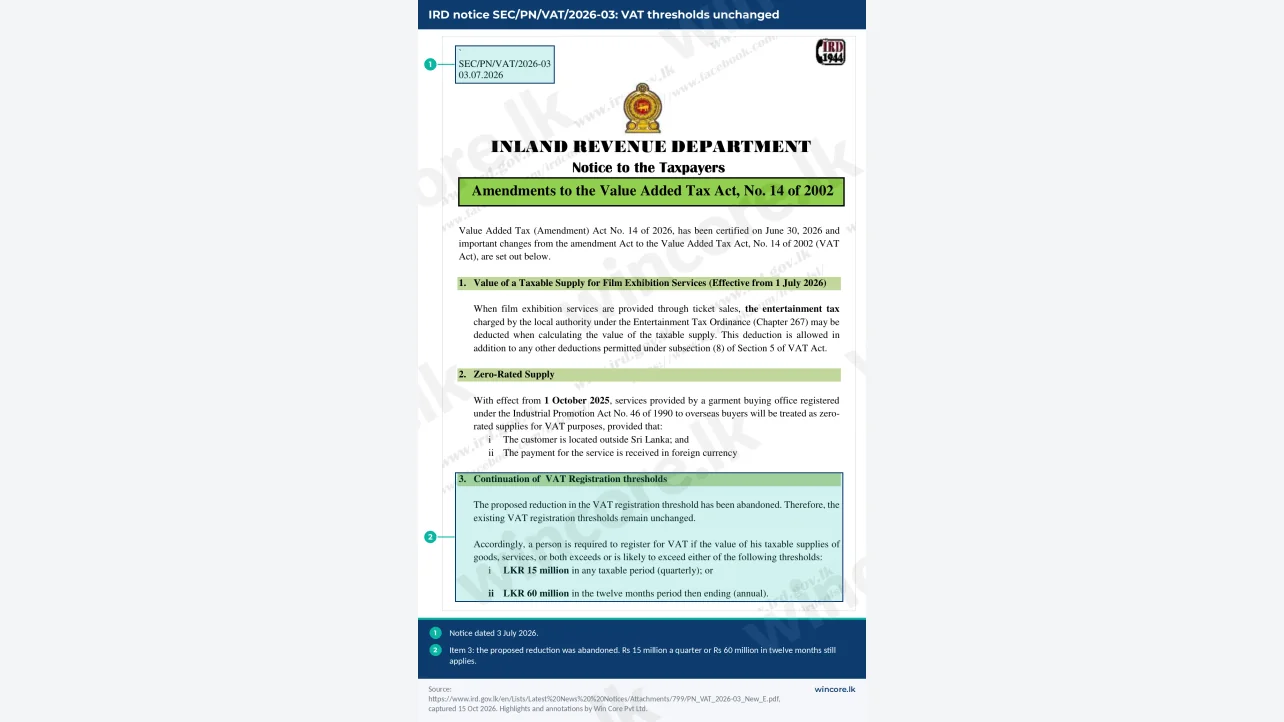
The VAT registration tests are Rs 15 million a quarter or Rs 60 million over 12 months. How the tests run, the 15 day rule and who must register.

The employer's guide to EPF and ETF in Sri Lanka for 2026: who is covered, 8, 12 and 3 percent, what counts as earnings, the due date, the surcharge ladder and forms.
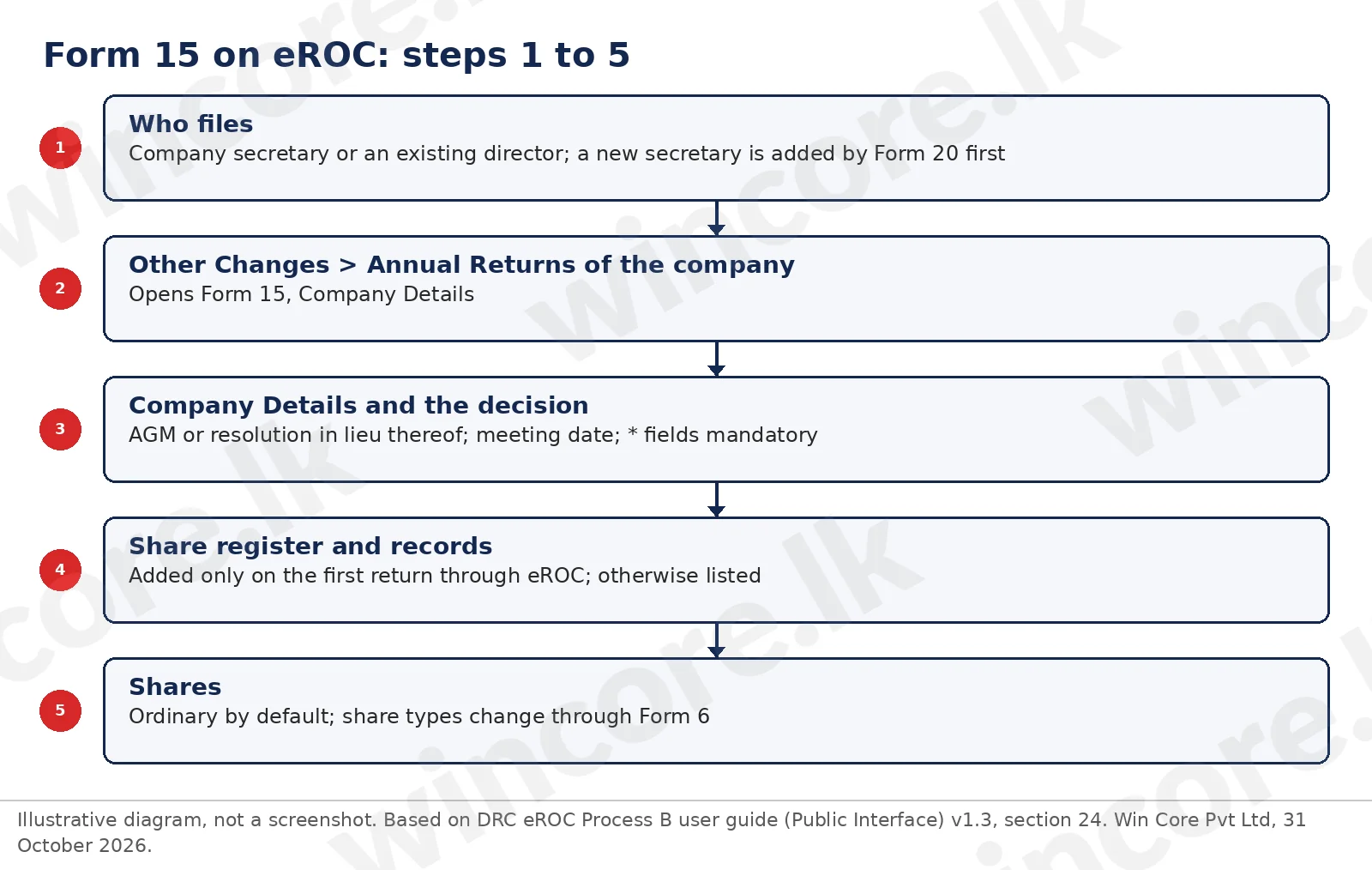
Treat Form 15 as a live governance filing: the 30-working-day clock from the AGM, the BO 4 that goes with it, the fee, and the controls that keep it on time.