
How to file Form 15 in Sri Lanka: 30 working days and eROC steps
Treat Form 15 as a live governance filing: the 30-working-day clock from the AGM, the BO 4 that goes with it, the fee, and the controls that keep it on time.
On this page
Last verified against the primary sources on 3 November 2026.
Complete the annual return on Form 15 within thirty working days from the company's annual general meeting (AGM), then forthwith forward a copy signed by a director and the secretary to the Registrar [1]. Failure to comply is an offence: on conviction the fine is up to Rs 100,000 for the company and up to Rs 50,000 for each officer in default. For a filing default, the Registrar may accept a composition sum under section 514 instead of starting or continuing proceedings [1].
WinCore can prepare the Form 15 and BO 4 with you: see our annual return filing service.
Take a hypothetical company that has held its AGM. It completes its return within thirty working days from that date and forwards the signed copy forthwith. The company delivers beneficial ownership Form BO 4 together with its annual return [2]. Separate beneficial ownership changes can also trigger the fourteen working day notification duty in section 130A(7) after the company receives the relevant details [7]. The Form 15 fee is Rs 7,900 excluding VAT [3]. The BO regulations list Rs 2,300 for the annual return beneficial ownership filing, though the fee schedule appears to transpose the descriptions of BO 4 and BO 5; check applicable taxes and the amount shown when paying [2].
Form 15 works best when you treat it as the confirmation of records you have kept properly throughout the year. If the statutory books are current, the filing is controlled. If they are not, the deadline becomes risky very quickly.
The 30-working-day clock starts at your AGM
The most important practical point is timing.
Under section 131(2) of the Companies Act No. 7 of 2007, the annual return must be completed within thirty working days from the AGM. The company must then forthwith forward a copy signed by a director and the secretary to the Registrar [1]. A working day excludes Saturday, Sunday and a public holiday. Prepare before the meeting so the signed return can be forwarded promptly after completion.
Section 144(3) permits a company to do everything required at the AGM by a qualifying written resolution instead. Section 131(2) refers to the AGM date without expressly setting a date for that case. On our reading, use the resolution date to work out the thirty working days, then forward the signed return forthwith [1]. The eROC screen also asks for the date of the resolution in lieu [5].
Two further dates decide whether you are late at all. A company does not file an annual return in its year of incorporation, and its first AGM must be held within eighteen months of incorporation [1]. After that, each AGM must be held no later than six months after the balance sheet date and no more than fifteen months after the previous one [1].
Filing Form 15 on eROC takes ten steps from Other Changes to payment
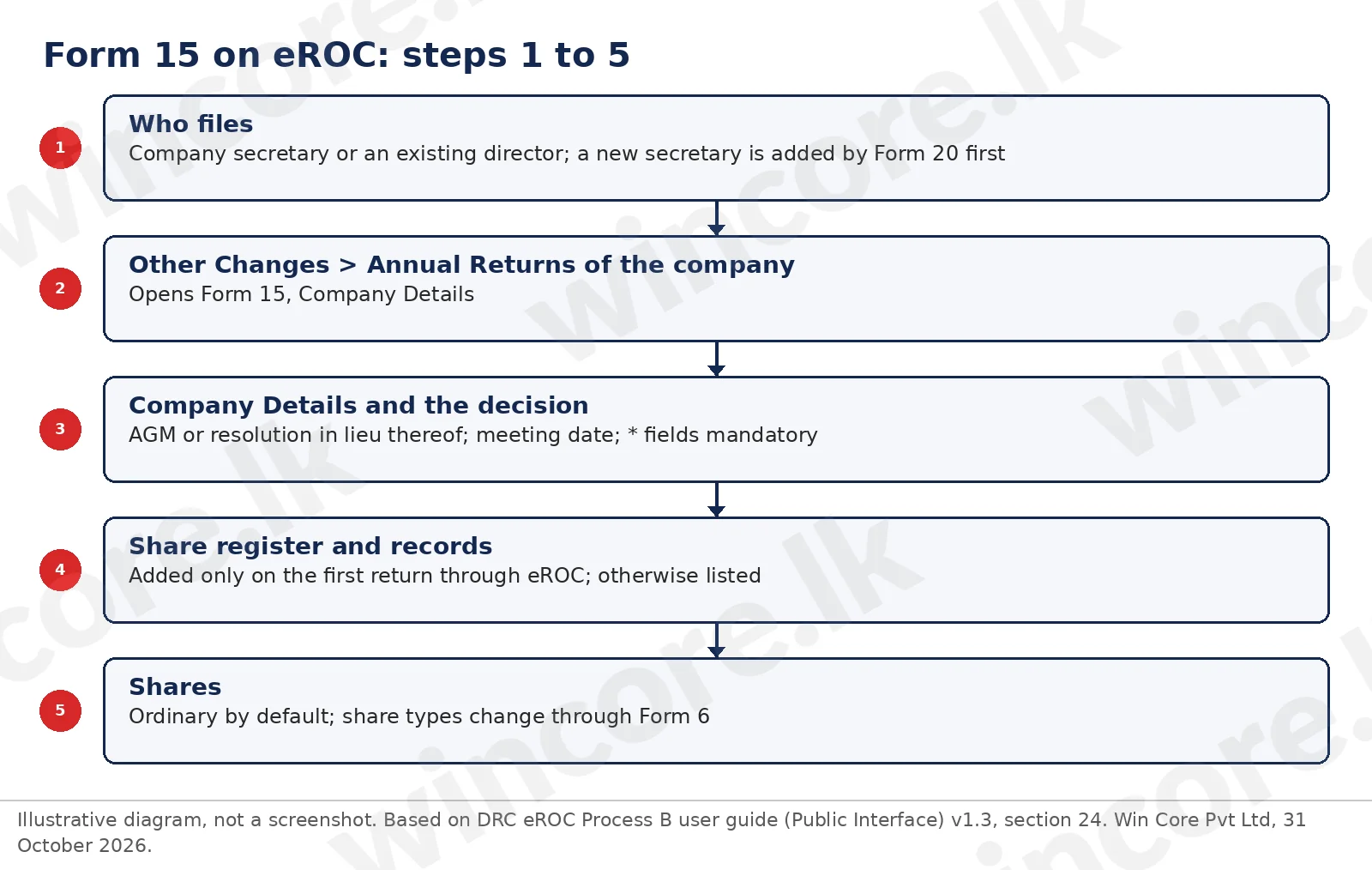
The Department of the Registrar of Companies (DRC) Process B guide describes the following Form 15 workflow. The screens may change; the figures show the supplied eROC captures dated 31 October 2026 [4] [5].
- Check who can file. The guide says a company secretary or an existing director can submit the return. If the secretary in the system is not current, it says a director must first appoint the new secretary through Form 20 before that secretary can file [4].
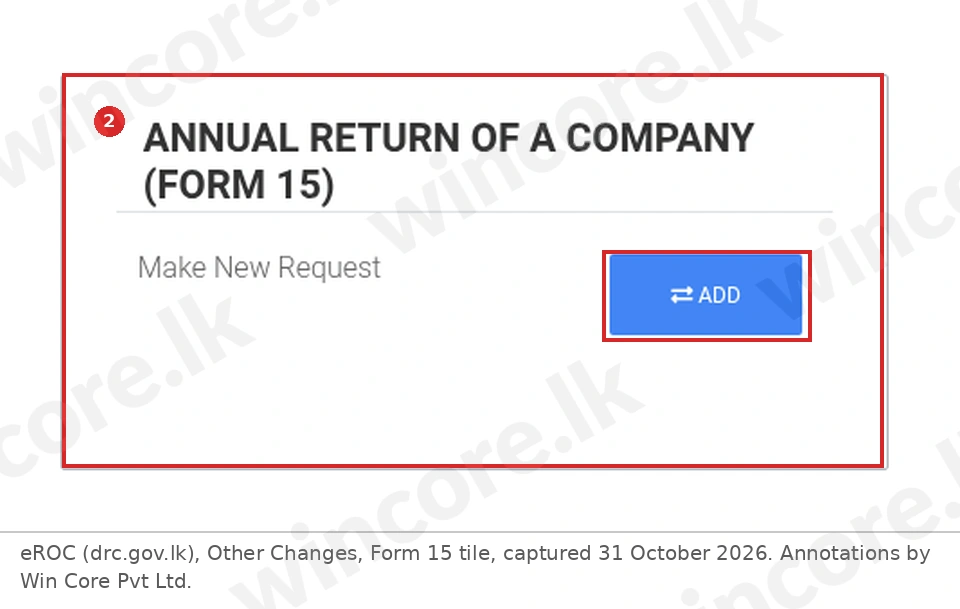
- Open the form. On the company, select Other Changes, then Annual Returns of the company. The captured banner asks that prior Forms 3, 6, 8, 9, 10, 12A, 13, 14, 16 and 20 be in approved status before starting Form 15 [4] [5].
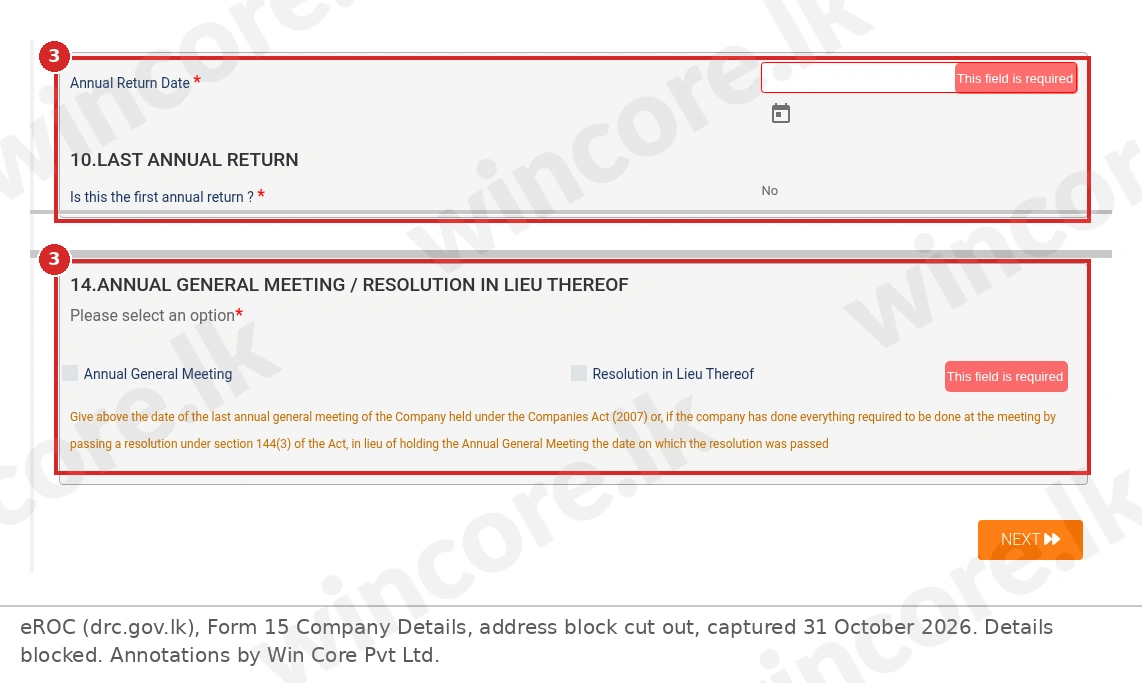
- Complete Company Details. Fill the fields marked with a star. Select the AGM or the resolution in lieu and enter the relevant date. The captured screen also asks for the annual return date and whether this is the first annual return [4] [5].
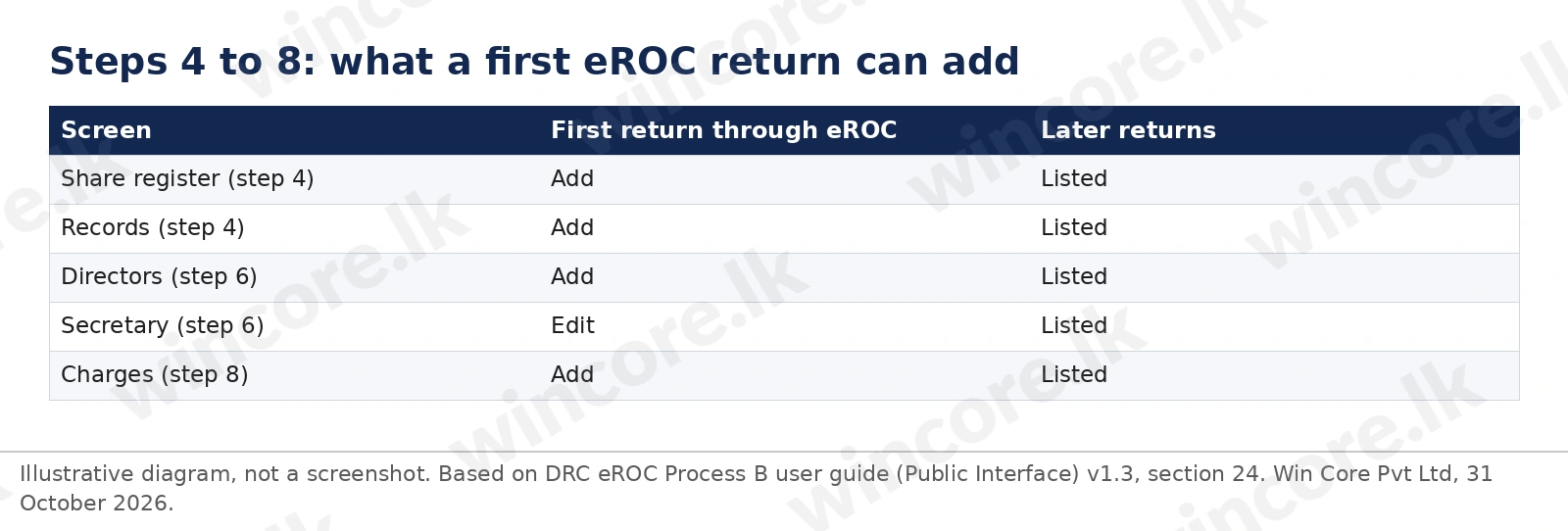
- Review the share register and records. The guide says these can be added on a first return through eROC and are listed on later returns. A first eROC return is not necessarily the company's first statutory annual return [4].
- Check the shares. The guide says shares are displayed as ordinary shares by default and directs users to Form 6 to change share types. Check the recorded shares against the company's records [4].
The following captures show the Form 15 tile, navigation and Company Details fields.
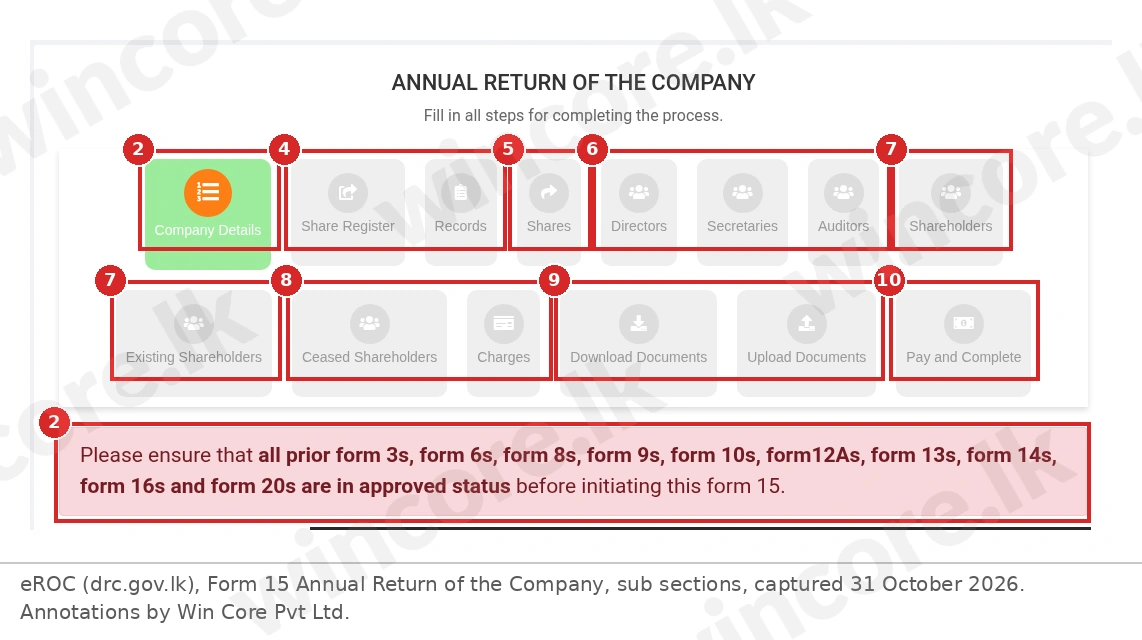
- Review directors, secretaries and auditors. The guide describes add, edit and remove controls. It says directors can be added and secretary details edited on the first eROC return; on later returns those details are listed. It describes adding an alternate director on the director screen [4].
- Enter shareholder details. The guide describes the shareholder screens, a CSV upload and a separate downloadable list for public companies. It says the system asks for NIC details for Sri Lankan shareholders. Check the details and totals against the company's records [4].
- Review ceased shareholders and charges. The guide says approved, unsettled Form 10 charges are listed. It says charges can be added on a first eROC return and are listed on later returns [4].
- Download, sign, scan and upload the return. Agree to the terms shown in the upload section [4]. Section 131(2) requires the copy forwarded to the Registrar to be signed by both a director and the secretary [1].
- Pay and complete. Gazette 2496/03, Schedule item 6, sets Rs 7,900 excluding VAT for registration of an annual return [3].
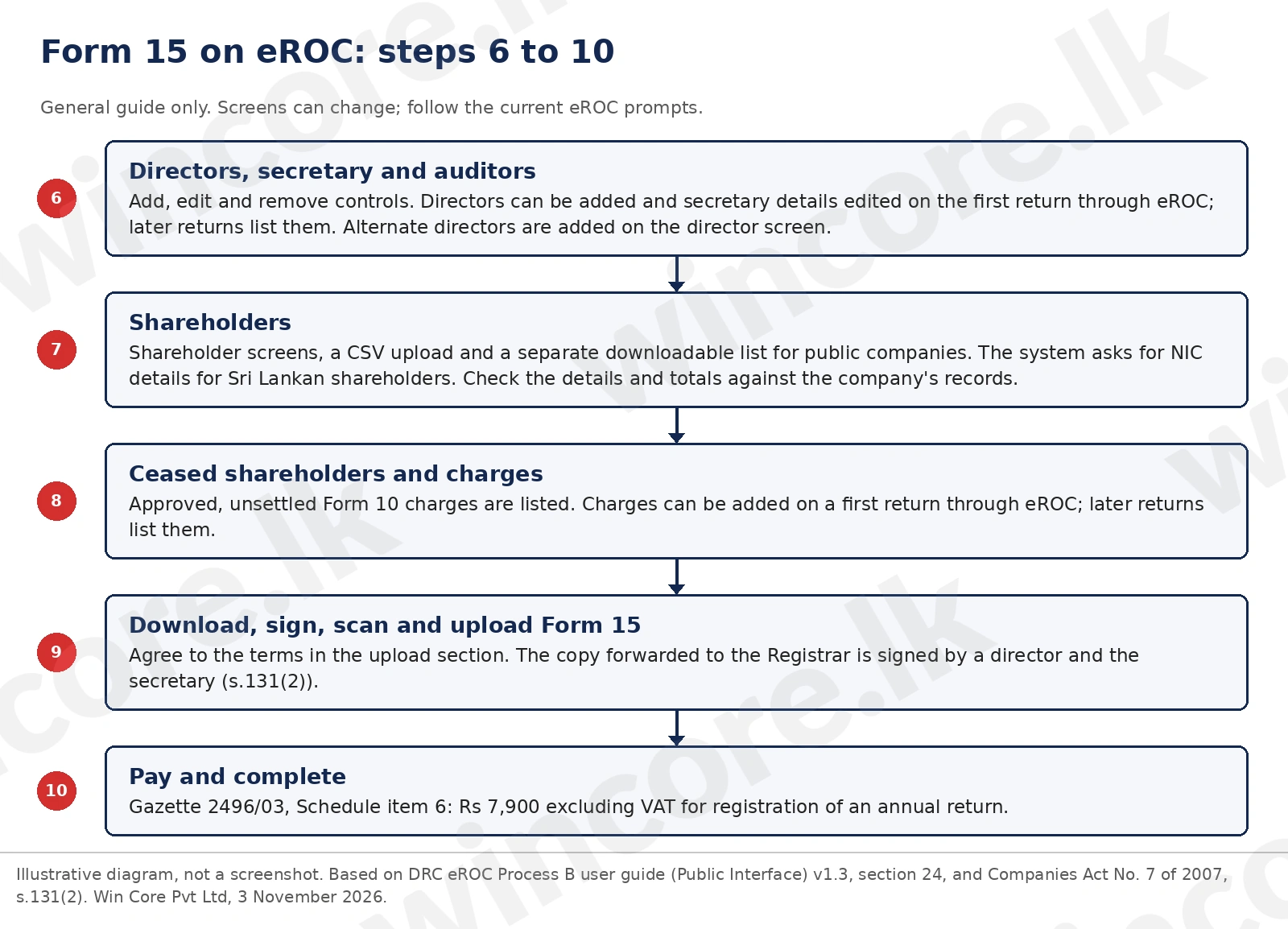
The guide distinguishes the first return through eROC from later returns for certain screens. Keep separate filings for changes, such as a director or secretary change on Form 20, up to date rather than waiting for the annual return [4].
Outdated statutory registers make Form 15 unfixable at the last minute
You cannot build an accurate annual return from memory.
Before filing, confirm that your company records reflect all material changes to:
- directors and their appointment details
- the company secretary
- the registered office
- issued shares and share transfers
- mortgages or charges, where relevant
- the beneficial owners, because the BO 4 goes in with the return
If those records are incomplete, fix the registers first. Keep the registers current rather than using the annual return as the place where corrections begin. A change of director or secretary has its own Form 20 deadline; our guide on changing your company secretary covers it.
Stage your filing pack before the AGM, not after it
The cleanest filing process starts before the AGM, not after it.
Have a pre-filing pack ready that includes:
- the latest register extracts
- the current shareholding position
- any director or secretary changes recorded during the year
- the beneficial ownership details for the BO 4
- meeting minutes and approvals that support those changes
This gives the compliance team the records it needs before the AGM. If the records are fragmented, use secretarial support to consolidate them before the deadline becomes critical.
Use the correct forms and signatures
Check the Registrar's current forms and eROC instructions before each filing cycle. The Form 15 guide describes a system-generated return that is signed and uploaded before payment. The payment screen shows the amount due.
A filing can be delayed for process reasons even when the company facts are correct. The eROC steps above explain what the DRC guide says about a secretary who is not current in the system. Our ROC fees guide covers government filing fees.
Form 15 is not difficult. The failures come from broken governance habits
The recurring problems are operational:
- the AGM date is not escalated early enough
- director and shareholder changes are not logged when they happen
- scanned supporting documents are not prepared in submission-ready form
- the company waits for someone else to own the filing
Form 15 is not inherently difficult. It becomes difficult when governance work is postponed until the end of the cycle.
Build one secretarial calendar so Form 15 is never an isolated scramble
The annual return should sit alongside the rest of the company's compliance calendar, not outside it.
Build a single workflow that covers:
- AGM planning
- statutory register maintenance
- annual-return and BO 4 drafting
- review and sign-off
- submission evidence storage
Keep the AGM date, return completion deadline and other compliance milestones in one timeline.
Once that structure is in place, the annual return stops being an annual scramble. It becomes a controlled checkpoint in the same compliance system that supports board decisions, shareholder changes and future filings. For the incorporation side of the same records, see our guide on how to register a company in Sri Lanka.
Frequently asked questions
When is Form 15 due?
Complete it within thirty working days from the AGM, then forthwith forward the copy signed by a director and the secretary. On our reading, where a qualifying written resolution replaces the AGM, use the resolution date for the thirty working days [1].
Does a company file Form 15 in the calendar year of its incorporation?
No. There is no annual return in the year of incorporation, and the first AGM is due within eighteen months of incorporation [1].
What does it cost?
The annual return fee is Rs 7,900 excluding VAT [3]. The BO schedule lists Rs 2,300 for the annual return beneficial ownership filing, but appears to transpose the BO 4 and BO 5 descriptions; check applicable taxes when paying [2]. A late prescribed BO form attracts Rs 1,000 per week, with part of a week counted as a full week, under the amended regulation [6]. Separately, section 514 permits the Registrar to compound certain filing offences; its interaction with the BO penalty is not resolved here [1].
Who can file Form 15 on eROC?
The DRC Process B guide says the company secretary or an existing director can submit it. Where the secretary shown in the system is not the current secretary, the guide says a director must first file Form 20. For a company registered outside eROC, the guide describes a request to connect the company to the secretary's profile [4].
Open points
Section 131(2) names the AGM date, while section 144(3) allows a qualifying written resolution instead. The use of the resolution date as the start of the thirty working days is our reading; the Act does not expressly say so in section 131(2).
The beneficial ownership fee schedule appears to transpose the descriptions attached to BO 4 and BO 5. Both rows state Rs 2,300; the applicable tax on the annual return beneficial ownership filing should be checked.
Talk to us. If your registers need bringing up to date before the AGM, our company secretarial team can prepare the Form 15 and BO 4 with you; see our annual return filing service or book a consultation at our contact page.
This guide is general information on the law as at 3 November 2026 and is not advice on your specific situation.
References
- Parliament of Sri Lanka. Companies Act, No. 7 of 2007, ss.131(2) to (4), 133(1) and (2), 144(3), 514 and 529. https://drc.gov.lk/en/wp-content/uploads/2018/04/Act-7-of-2007-English.pdf . Primary. Supplied PDF checked 3 November 2026.
- Minister of Trade, Commerce, Food Security and Cooperative Development. Companies (Beneficial Ownership) Regulations, No. 1(I) of 2026, Gazette Extraordinary No. 2509/67 (9 October 2026), reg 3 and Schedule II, as posted by the Registrar. https://drc.gov.lk/en/?p=5001 . Primary. Scanned regulations checked 3 November 2026; effective 9 October 2026.
- Department of the Registrar of Companies. Companies (Fees) Orders, Gazette Extraordinary No. 2496/03 (6 July 2026), item 6. https://drc.gov.lk/en/wp-content/uploads/2026/07/2496-03_E.pdf . Primary. Supplied Gazette checked 3 November 2026.
- Department of the Registrar of Companies. eROC Process B user guide (Public Interface), version 1.3, section 24. https://erocapiv2.drc.gov.lk/pdf/Process%20b_frontend_V1.3.pdf . Primary. Supplied text extract checked 3 November 2026.
- Department of the Registrar of Companies. eROC Form 15 screens. https://eroc.drc.gov.lk/ . Captures supplied with this update, dated 31 October 2026.
- Minister of Trade, Commerce, Food Security and Cooperative Development. Companies (Beneficial Ownership) Regulations, No. 1(II) of 2026, Gazette Extraordinary No. 2511/47, regulations 1 and 3. https://drc.gov.lk/en/?p=5007 . Primary. Scanned regulations checked 3 November 2026; effective 22 October 2026.
- Parliament of Sri Lanka. Companies (Amendment) Act, No. 12 of 2025, section 7 inserting sections 130A(7) and (8), effective 30 March 2026 under Gazette Extraordinary No. 2480/47. https://www.parliament.lk/uploads/acts/gbills/english/6389.pdf . Primary. Read 3 November 2026.
Put these insights to work
WinCore specialists can review your current workflow, document gaps, and build a practical 90-day action plan.
Book a free consultationContinue reading
Explore more WinCore analysis to keep your finance, tax, and compliance roadmap moving.
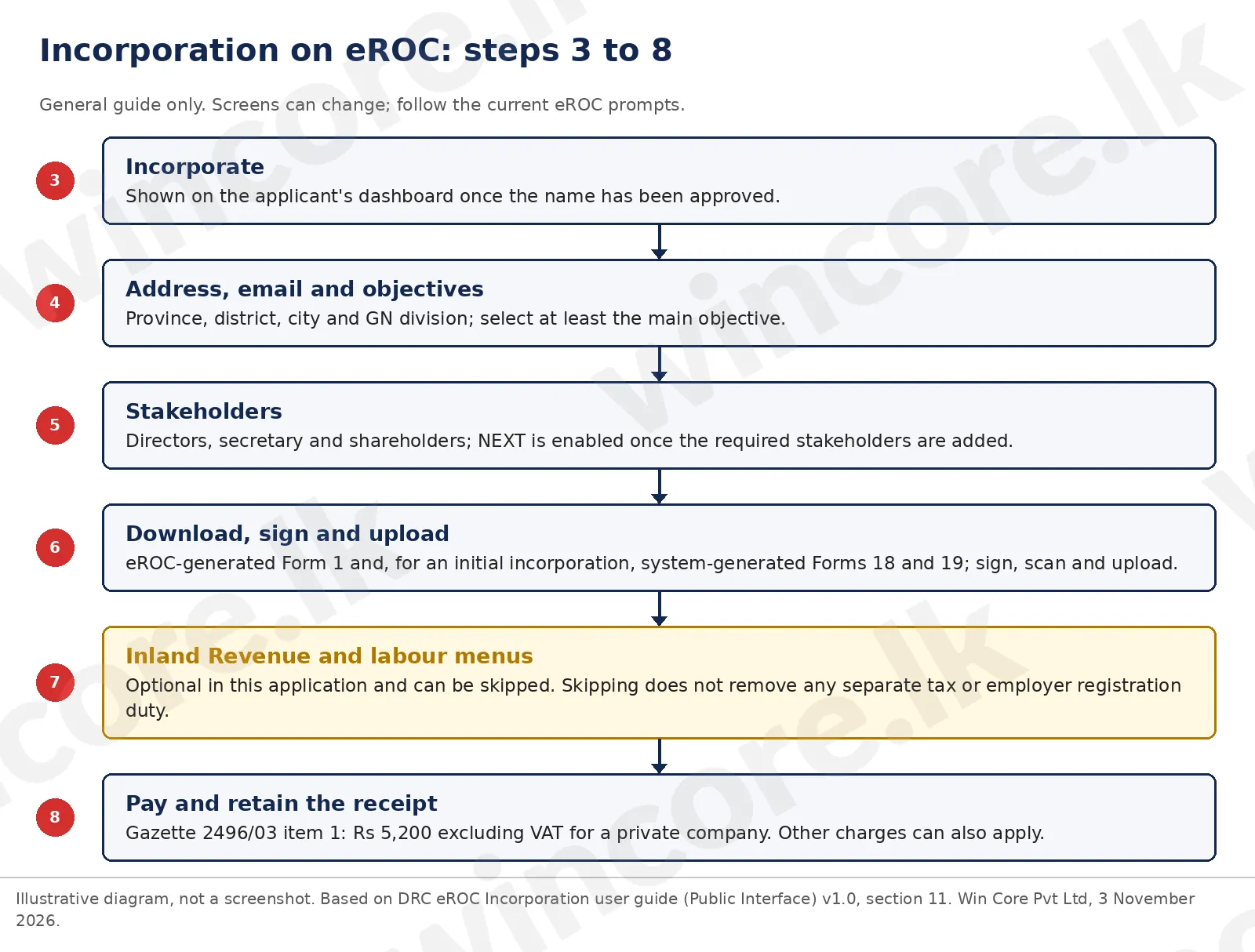
Registering a private limited company in Sri Lanka in 2026: structure, name approval, the eROC filing with BO 1 and BO 5, the TIN and the first year.
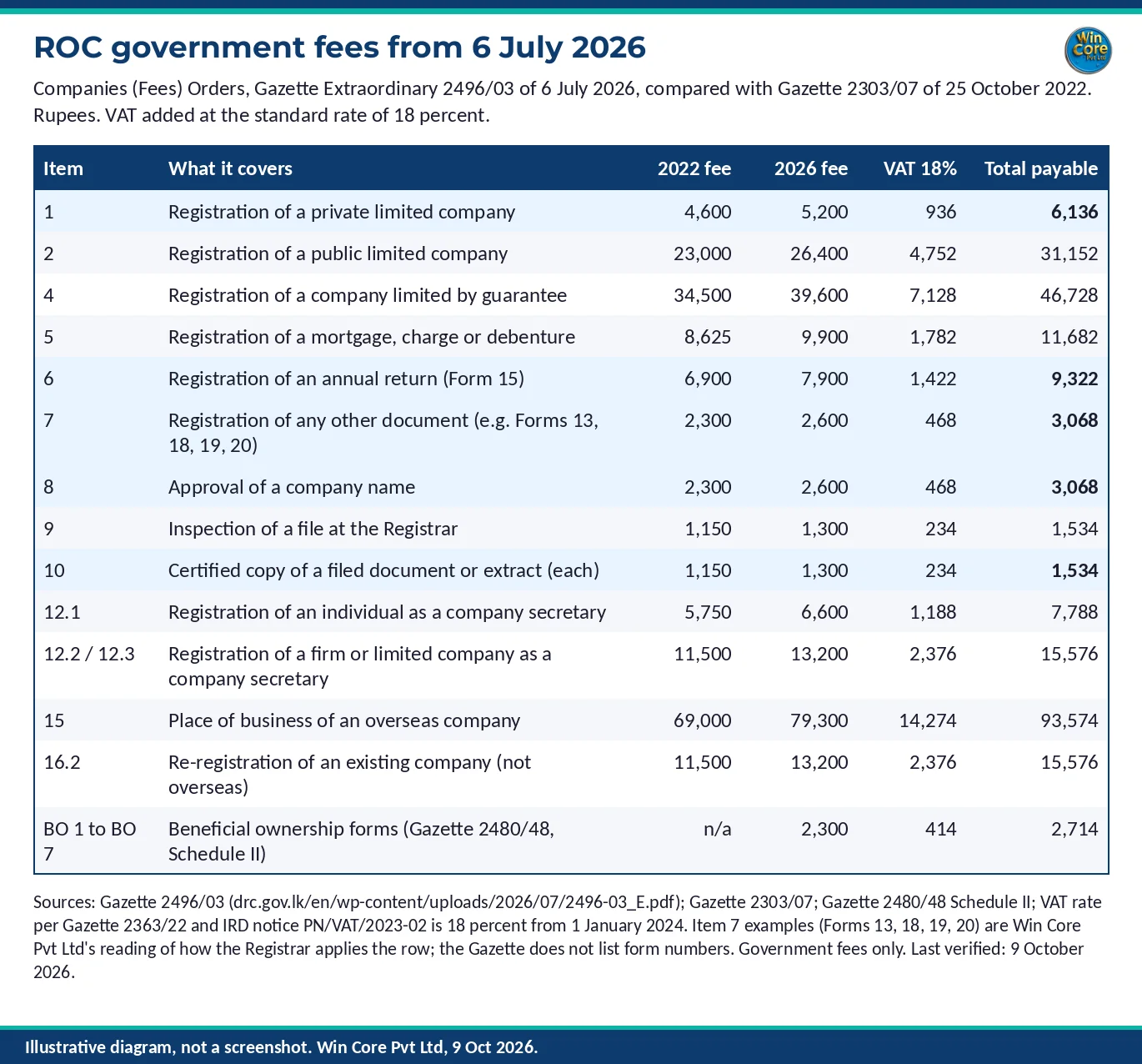
Every Registrar of Companies fee from 6 July 2026 with VAT added, and worked costs for an incorporation, a late Form 15 and a secretary change.
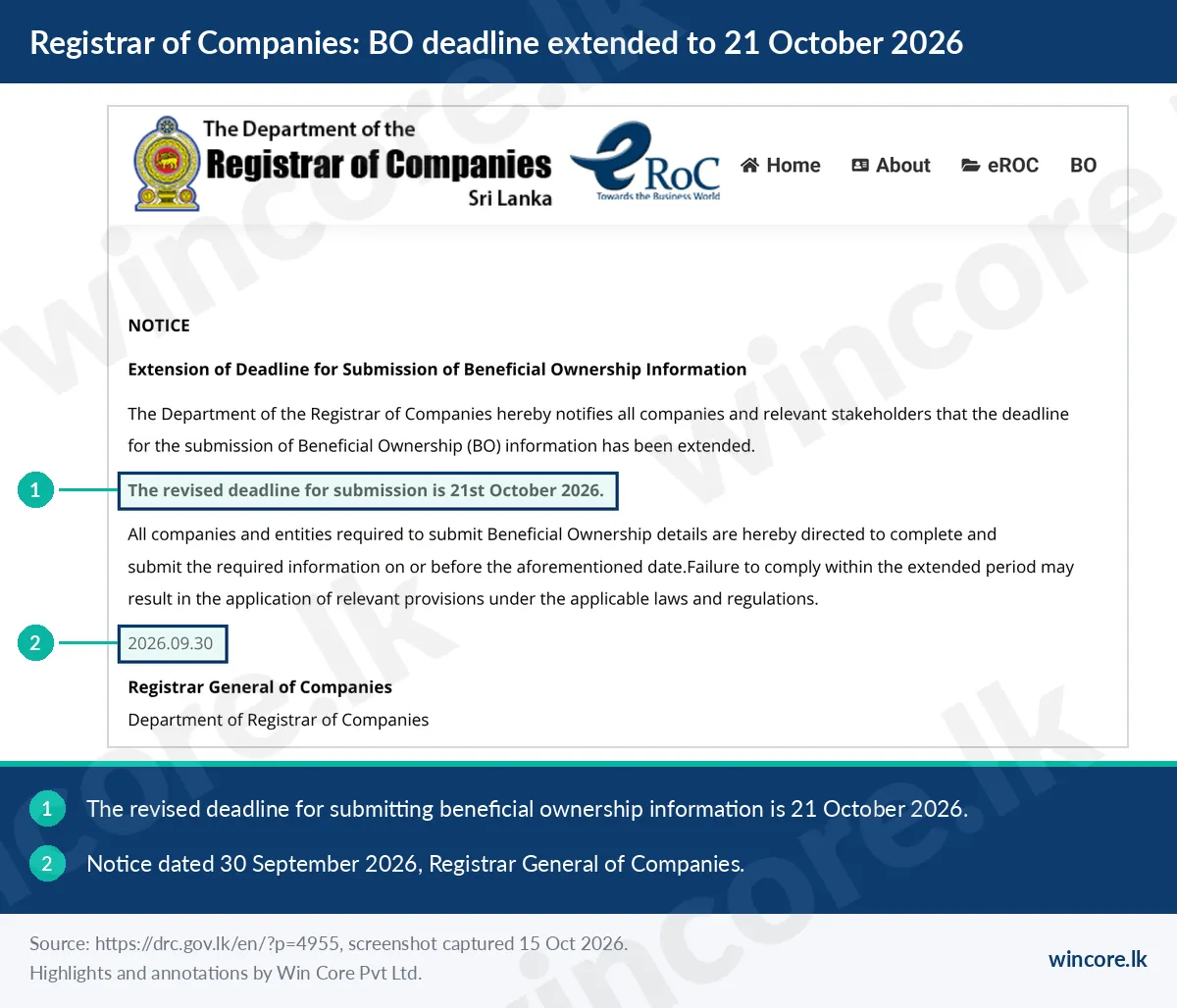
Who counts as a beneficial owner at 10 percent, the forms in the October 2026 regulations, and what existing companies face after the 21 October deadline.