
How to Register a Company in Sri Lanka (2026 Step-by-Step Guide)
Registering a private limited company in Sri Lanka in 2026: structure, name approval, the eROC filing with BO 1 and BO 5, the TIN and the first year.
On this page
Last verified against the primary sources on 15 October 2026. The eROC walkthrough was checked on 3 November 2026.
Registering a private limited company in Sri Lanka involves an incorporation application and beneficial ownership submission, followed by other registrations and filings. The incorporation application is made on eROC with the Department of the Registrar of Companies: name approval, the Articles, Form 1, a Form 18 for each director and a Form 19 for the secretary. The beneficial ownership submission uses Forms BO 5 and BO 1 on the separate BO System as part of incorporation [17] [4]. A single shareholder is enough [1]. Once the company exists it must register with the Inland Revenue Department (IRD) for a TIN within 30 days [2], and its first annual general meeting (AGM) is due within eighteen months [1].
Take a hypothetical Colombo trading company with two founders who are both shareholders and directors, and a qualified company secretary. The registration fee for a private limited company is Rs 5,200 before VAT under Gazette 2496/03 of 6 July 2026. Name approval and other documents attract separate charges [3]. Our guide to ROC government fees explains the fee categories.
This guide covers the choice of structure, the name, the incorporation documents, the filing, and the registrations and filings of the first year. It does not cover professional fees, BOI approvals, branches of overseas companies or public listed companies.
Checklist: documents and details needed
- Two or three possible company names, checked against existing names
- Each director's and shareholder's full name, NIC or passport, address and contact details
- The registered office address and evidence of it (lease, deed or consent letter)
- The shareholding and the stated capital each shareholder will contribute
- The Articles of association (the model Articles or your own)
- Each director's signed Form 18 and the secretary's signed Form 19
- Details of each beneficial owner and of the authorised person for Forms BO 1 and BO 5
- A director's or secretary's eROC login and a payment card
Step 1. Choose the right structure
What to do. Decide between a sole proprietorship, a partnership and a private limited company. A sole proprietorship or partnership is registered as a business name with the Divisional Secretariat, not with the Registrar of Companies, and the owners carry the business's debts personally. A private limited company is a separate legal person registered under the Companies Act No. 7 of 2007.
| Factor | Sole proprietor | Partnership | Private limited company |
|---|---|---|---|
| Liability | Unlimited, personal | Unlimited, partners | Limited; the company is a separate legal person |
| Where registered | Divisional Secretariat | Divisional Secretariat | Registrar of Companies (eROC) |
| How profits are taxed | Owner's personal income tax | Partnership tax rules | Corporate income tax |
| Bringing in investors | Not possible | Only as partners | Shares can be issued |
A sole proprietor pays personal income tax on the business profit: after the personal relief of Rs 1,800,000, at 6, 18, 24, 30 and 36 percent in bands of Rs 1 million and then Rs 500,000 [5]. A company pays corporate income tax at 30 percent standard, 15 percent on specified concessionary income and 45 percent on liquor, tobacco, betting and similar activities [5]. There is no separate SME rate.
Where. Your business plan.
What you need. A view on liability, on how you will draw money out, and on whether you will bring in a partner or investor.
What goes wrong. Starting as a sole proprietorship and later expecting to "convert" it. A sole proprietorship does not convert: you incorporate a new company and move the business into it. Our guide to sole proprietorship registration covers that route. For how the owner is taxed, see sole proprietor income tax.
How long. A decision, not a filing.
Public companies are governed by the same Act but carry heavier disclosure duties and are mostly used by businesses planning a listing. For most new founders a private company is the starting point.
Instrument: Inland Revenue Act, No. 24 of 2017, First Schedule. Official link: Inland Revenue Act, consolidated to 2025. Last verified: 15 Oct 2026.
Step 2. Choose the name and get it approved
What to do. Pick a name that ends in "(Private) Limited" or the abbreviation "(Pvt) Ltd" [1]. The Registrar will not register a name identical with that of another company or a registered overseas company, a name containing "Chamber of Commerce" outside a section 34 licence, or a name the Registrar considers misleading [1]. Names containing words such as "President", "Municipal", "Co-operative", "Society", "National", "State" or "Sri Lanka", or other words suggesting a connection with the Government, need the Minister's consent [1]. Then apply for name approval on eROC.
Where. eROC, after testing name variants on the system. Our guide to the company name check explains the rules in more detail.
What you need. Two or three names in order of preference.
What goes wrong. Choosing a name with "Sri Lanka" or "National" in it and then waiting on a ministerial consent. A name without those words avoids the step.
How long. Name approval sits with the Registrar, so do not plan a completion date until the name has cleared. The fee is Rs 2,600 plus VAT, Rs 3,068 in all [3]. The Act sets no expiry for an approved name; the three months often quoted is Registrar practice, so check the approval on eROC if you are filing late.
Instrument: Companies Act No. 7 of 2007, ss.6 and 7; Gazette 2496/03, item 8. Official link: Companies Act on drc.gov.lk. Last verified: 15 Oct 2026.
Step 3. Prepare the incorporation documents
What to do. Prepare the Articles, Form 1, the Forms 18 and 19, and the beneficial ownership details.
- Articles of association. You may adopt the model Articles in the First Schedule to the Act or write your own [1]. The model Articles suit most single-founder and family companies; investors usually want their own terms on share transfers and voting.
- Form 1, application for registration. It records the name, registered office, directors, secretary, shareholders and the shares each takes. Shares under the 2007 Act have no par value and there is no authorised capital, so the older "Rs 1,000,000 divided into 100,000 shares of Rs 10" format no longer applies. The Act sets no minimum stated capital.
- Form 18 for each director. Each director consents to act and signs by hand. The Act requires at least one director and has no residency test [1], but the Registrar requires a resident director in filing practice.
- Form 19 for the secretary. The Companies (Secretaries) Regulations, No. 1 of 2023, made under section 222, apply to a company with stated capital of Rs 500,000 or more or annual turnover of Rs 1 million or more (regulation 2). Its secretary, if an individual, must be over eighteen, a citizen of Sri Lanka, hold a Certificate of Practice issued by the Registrar, and be an Attorney-at-Law or a member of CA Sri Lanka, the Institute of Chartered Corporate Secretaries of Sri Lanka, CIMA (UK), CMA Sri Lanka or the Chartered Governance Institute of the UK and Ireland (regulation 3(1)) [16]. Almost every trading company crosses the threshold at once.
- BO 1 and BO 5. BO 1 reports the beneficial owners at incorporation and BO 5 names the authorised person, who must be a natural person residing in Sri Lanka [4]. Our guide to beneficial ownership explains the 10 percent test.
Where. eROC generates Form 1 and, for an initial incorporation, Forms 18 and 19 for signature.
What you need. The details in the checklist above.
What goes wrong. Small inconsistencies between documents: a registered address on Form 1 that differs from the lease, or shareholdings that do not add up. Coordinating the resident director's signature is the most common cause of delay.
How long. A few days to collect signatures, longer if a foreign director's documents must be certified abroad.
Instrument: Companies Act No. 7 of 2007, ss.4, 14, 201, 222, 130A and 130C; the latter two were inserted by the Companies (Amendment) Act No. 12 of 2025. Official link: Companies (Amendment) Act No. 12 of 2025. Last verified: 15 Oct 2026.
Step 4. File the incorporation application and beneficial ownership details
The DRC incorporation guide describes the eROC application from name reservation through payment. Its beneficial ownership guide then shows BO 05 before BO 01 on the separate BO System. These are practical screen steps, not a promise that payment alone completes registration. The company receives its certificate when the Registrar registers it [1] [17] [18].
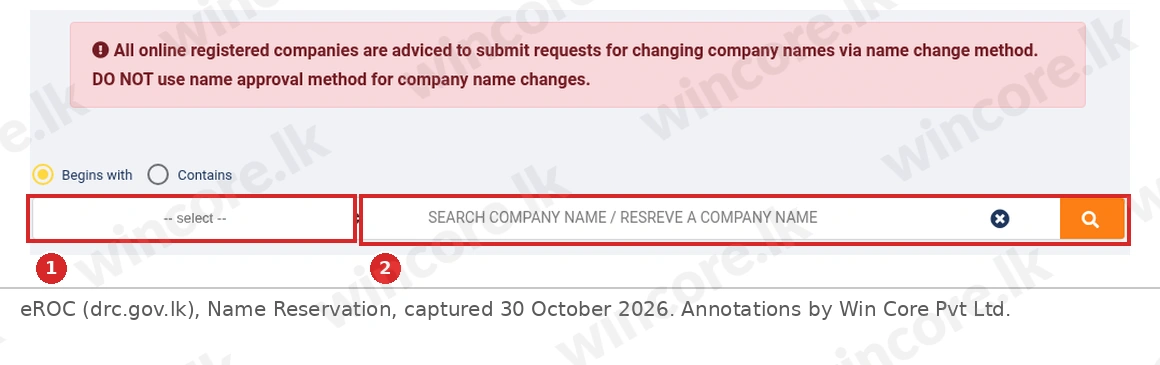
- Choose the company type. Select the type in the Name Reservation screen (1).
- Search the proposed name. Enter the name, choose the suffix, and follow the name reservation and payment prompts (2). The guide says the company type and suffix selected in the initial application cannot be edited on a name resubmission [18].
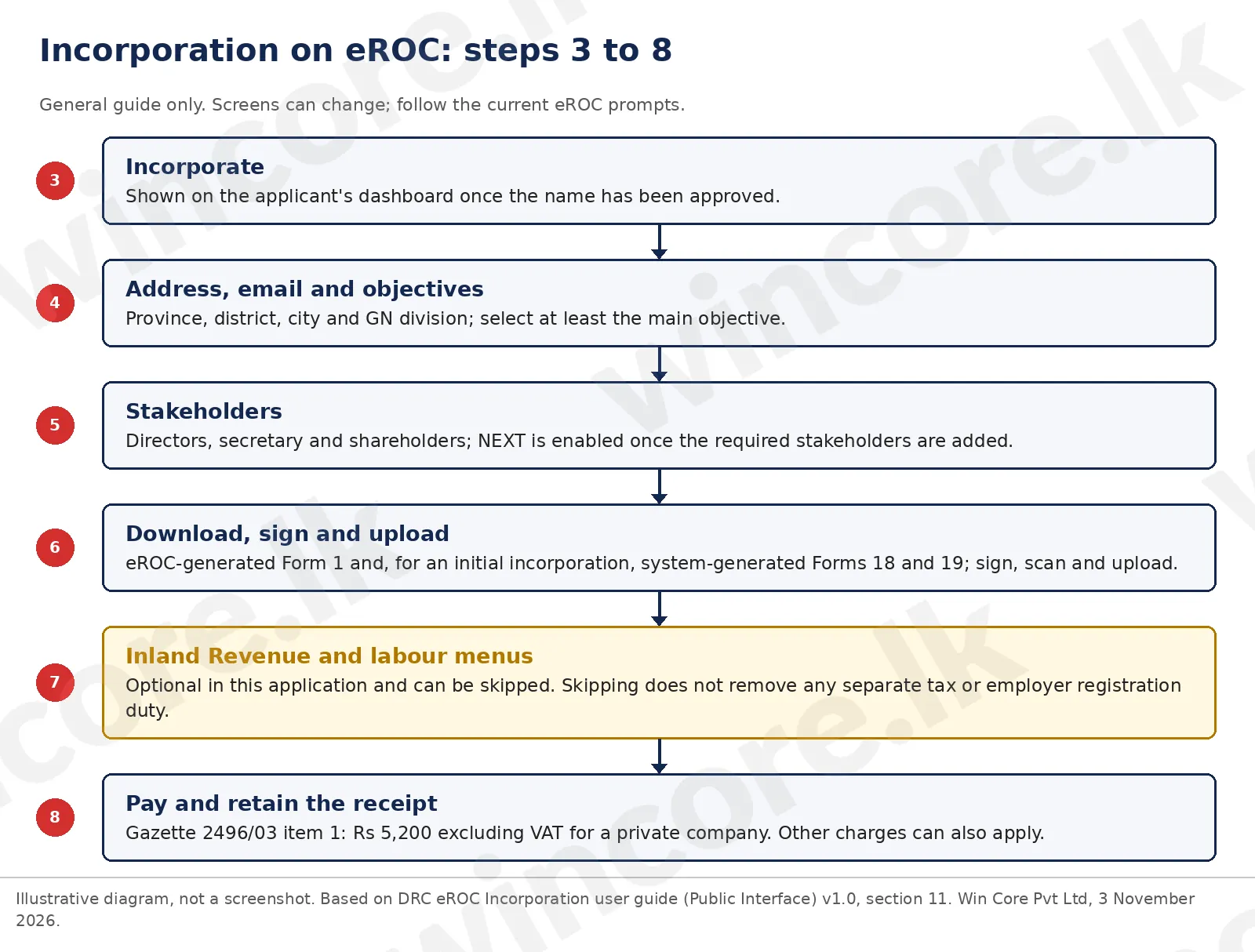
- Choose Incorporate after name approval. The incorporation option appears on the applicant's dashboard when the name has been approved.
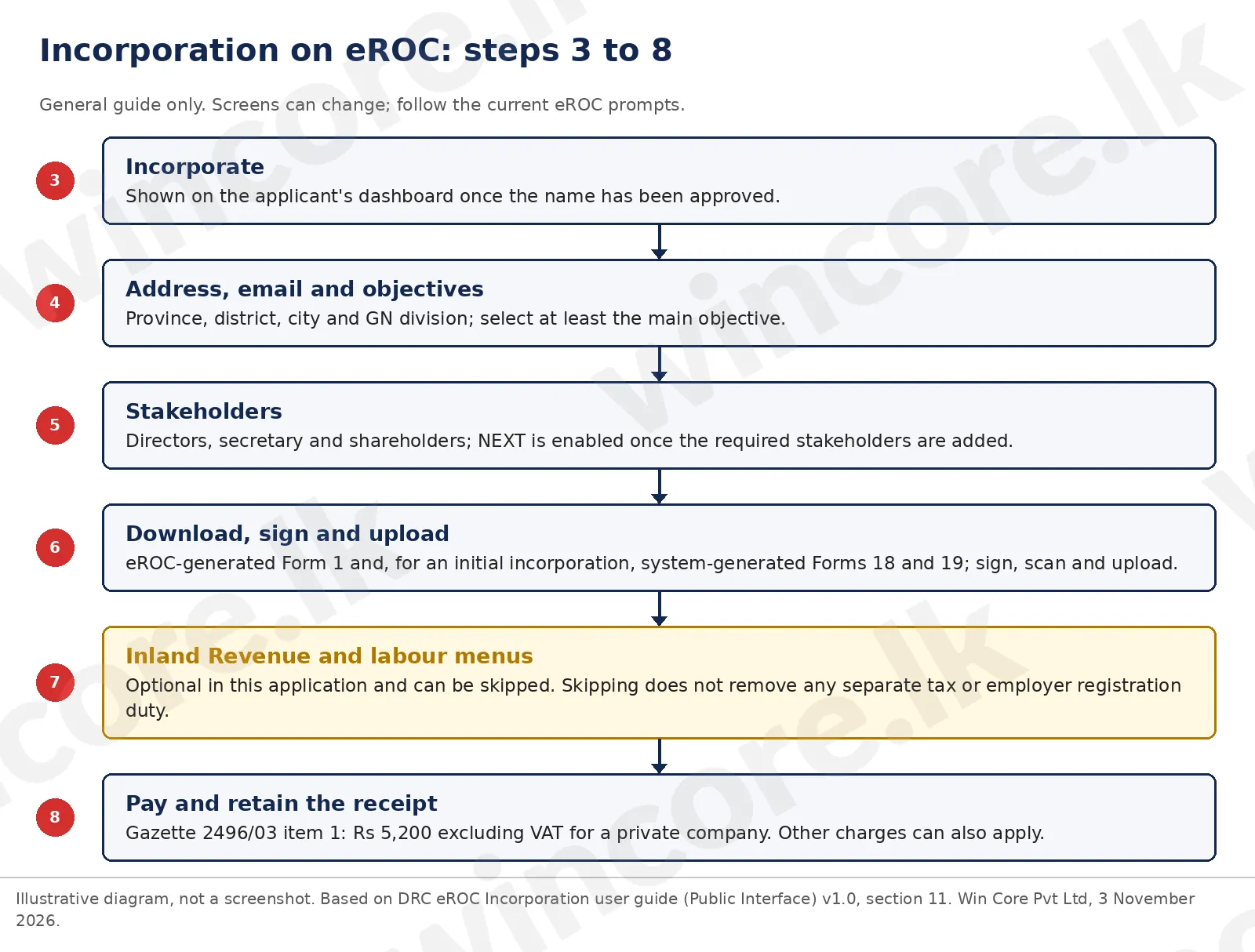
- Enter the address, email and objectives. Select the relevant province, district, city and GN division. The guide says to select at least the main objective.
- Add the stakeholders. Enter the directors, secretary and shareholders. The guide says Next is enabled when the required stakeholders have been added.
- Download, sign and upload the documents. The DRC says to use eROC-generated Form 1 and, for an initial incorporation, system-generated Forms 18 and 19 [19].
- Complete or skip the optional eROC menus. The guide allows the Inland Revenue and labour menus in this application to be skipped. That does not remove any separate tax or employer registration duty.
- Pay and retain the receipt. Item 1 of Gazette 2496/03 sets the registration fee for a private limited company at Rs 5,200 excluding VAT. Other charges can also apply [3].
- Sign in to the BO System. Go to bo.drc.gov.lk, enter the eROC email and password, and select Company User if shown.
- Complete BO 05 first. Choose Manage Authorized Person if shown, then follow the BO 05 prompts [17].
- Complete BO 01, pay and submit. Enter the beneficial owner details, then complete payment and final submission. Keep the acknowledgement [17].
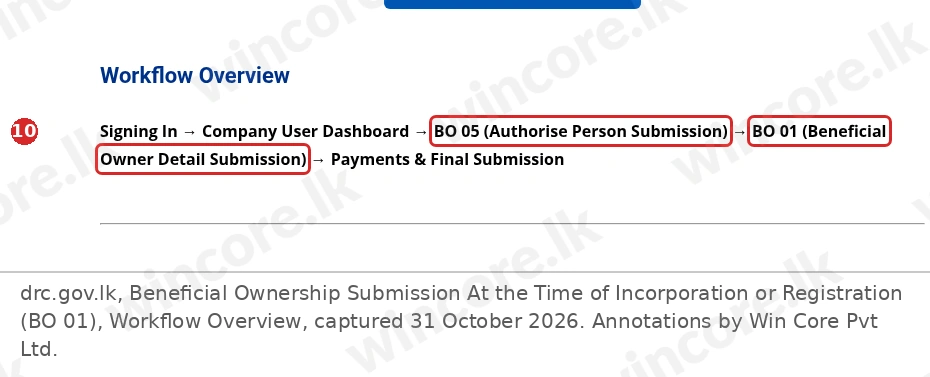
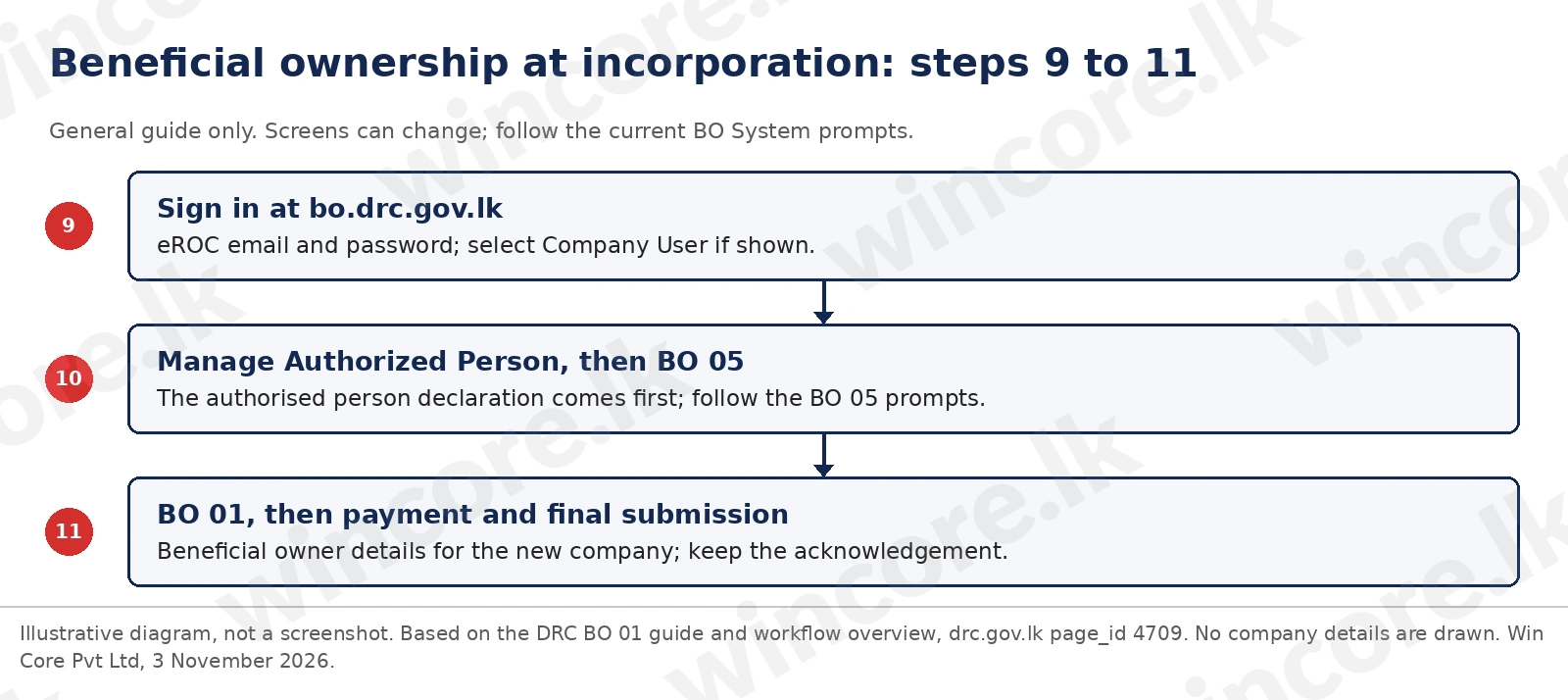
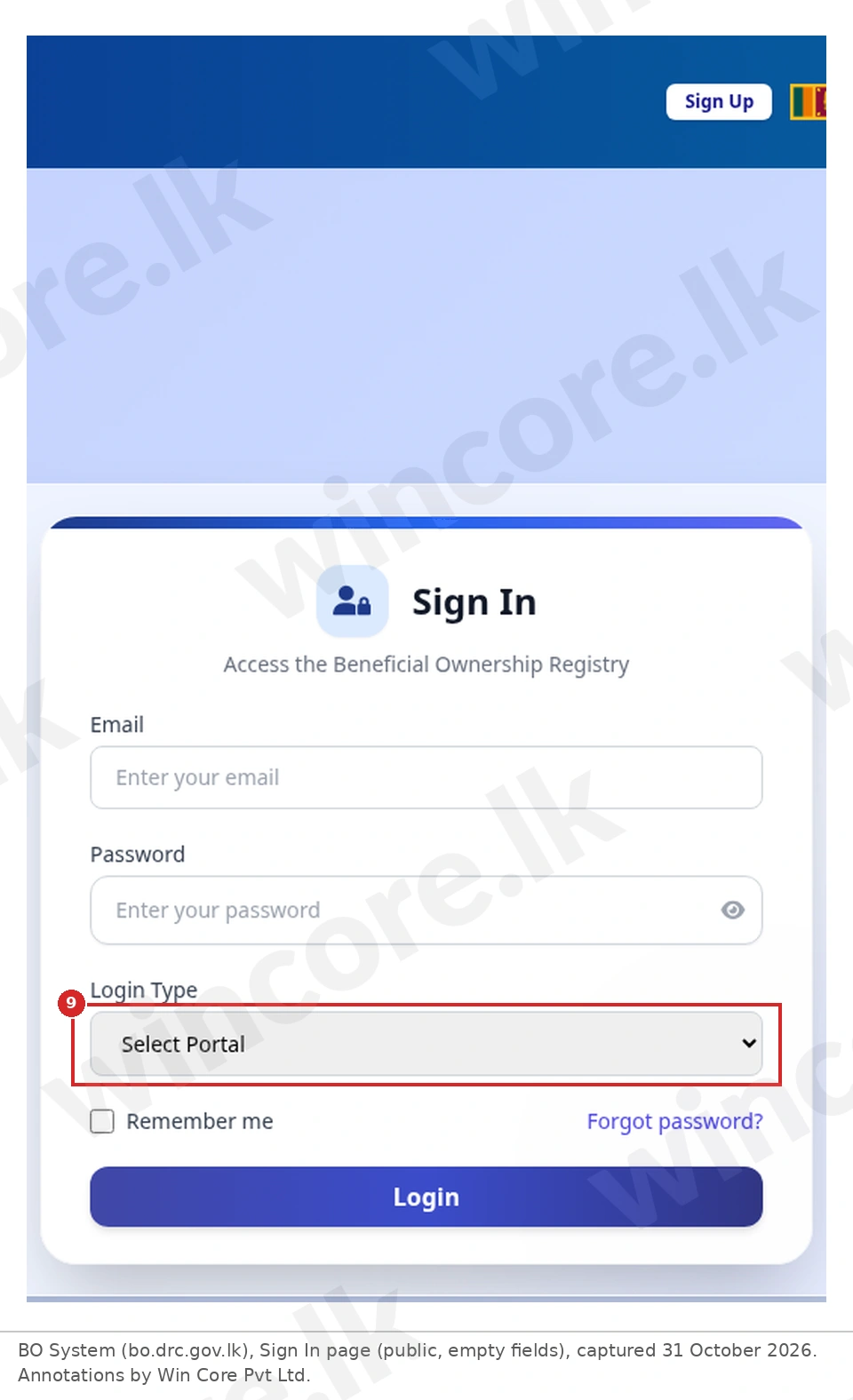
The Companies (Amendment) Act No. 12 of 2025 came into operation on 30 March 2026. Sections 130A(1) and 130C(2) provide for beneficial ownership and authorised person details at incorporation [4]. The DRC's sequence is administrative guidance on using the systems. The eROC payment screen shows the charges for the application. Name approval, registration and documents have separate fees under the Gazette [3].
Step 5. Register with the IRD within 30 days
What to do. Register the company for a Taxpayer Identification Number (TIN) not later than 30 days after incorporation [2]. From 1 November 2026 resident individuals must show a TIN certificate for listed transactions such as opening a bank account; entities other than individuals, including companies, are exempt from that check [6]. Directors and shareholders acting in their own names are not. Our TIN certificate guide covers both. For what comes next, see the first 90 days after company registration.
Where. IRD e-services.
What you need. The Certificate of Incorporation, Form 1 and the directors' details.
What goes wrong. Leaving the TIN until the first tax payment falls due.
How long. Apply in the first week.
Instrument: Inland Revenue Act, s.102(1A), inserted by Act No. 11 of 2026 s.23; IRD Circular SEC/2026/E/07. Official link: Act No. 11 of 2026. Last verified: 15 Oct 2026.
Step 6. Open the bank account and register as an employer
What to do. Open the company's bank account with the Certificate of Incorporation, the Articles, a certified board resolution on the account and its signatories, and identification for the directors and beneficial owners. If you employ anyone, register as an employer with the Employees' Provident Fund on Form D through the Labour Office within two weeks of becoming liable to contribute, in practice of the first employee joining [7] [8]. The Employees' Trust Fund has no separate registration; it uses the EPF number [9]. Contributions are 8 percent from the employee and 12 percent from the employer to EPF, and 3 percent from the employer to ETF, on total earnings, due by the last day of the following month [10] [11].
Where. The bank, and the Labour Office for the area.
What you need. Board resolutions, the company seal if your Articles use one, and each employee's details.
What goes wrong. Paying the first salaries before the EPF registration is in place. Form D is due within two weeks of the first employee joining [7]. Rates and the late surcharge are in our EPF and ETF guide, and the registration steps in our EPF employer registration guide.
How long. The bank sets its own timeline; ask when you submit.
Instrument: Employees' Provident Fund Act No. 15 of 1958, s.10; Employees' Trust Fund Act No. 46 of 1980, s.16. Official link: EPF Department, employer registration. Last verified: 15 Oct 2026.
Step 7. Watch the VAT and SSCL thresholds
What to do. Register for VAT once taxable supplies exceed Rs 15 million in a quarter or Rs 60 million in twelve months [12]. From 1 July 2026, register for the Social Security Contribution Levy once turnover exceeds or is likely to exceed Rs 9 million in a quarter or Rs 36 million over four consecutive quarters [13]. The tests, the registration periods and worked cases are in our guides to the VAT registration thresholds and the SSCL threshold.
Where. IRD e-services.
What you need. Monthly turnover figures from the first month of trading.
What goes wrong. Checking the threshold only at the year end.
How long. A monthly check.
Instrument: VAT Act No. 14 of 2002, s.10; SSCL (Amendment) Act No. 10 of 2026, s.2. Official link: SSCL (Amendment) Act No. 10 of 2026. Last verified: 15 Oct 2026.
Step 8. Plan the first AGM, Form 15 and the year-one calendar
What to do. A company does not file an annual return in its year of incorporation, and its first AGM must be held within eighteen months of incorporation [1]. After that, each AGM must be held no later than six months after the balance sheet date and no more than fifteen months after the previous one [1]. The annual return on Form 15 is due within thirty working days of the AGM [1], with a BO 4 [4]. Every company appoints an auditor at each AGM [1]. Our Form 15 guide covers the filing.
| Frequency | What | When |
|---|---|---|
| Monthly | EPF and ETF contributions | By the last day of the following month [10] |
| Monthly | APIT and other tax withheld, paid to the IRD | Within 15 days after the month ends [5] |
| Monthly and quarterly | VAT and SSCL, once registered | See the threshold guides |
| Quarterly | Income tax instalments, now based on the prior year's tax | The Statement of Estimated Tax (SET) is discontinued [2] |
| Annually | Withholding (including APIT) annual statement | 30 April [5] |
| Annually | Income tax return, for a 31 March year end | 30 November [14] |
| Annually | AGM, then Form 15 with BO 4 | Form 15 within 30 working days of the AGM [1] |
Where. A shared diary.
What you need. The incorporation date and the chosen financial year end.
What goes wrong. Treating eighteen months as the annual return deadline. Eighteen months is the AGM deadline; Form 15 follows within thirty working days of it. The instalment rules are in our guide to quarterly instalments after SET.
How long. An hour to set up.
Instrument: Companies Act No. 7 of 2007, ss.131(2) and (3), 133(1) and (2), 154(1). Official link: Companies Act on drc.gov.lk. Last verified: 15 Oct 2026.
Frequently asked questions
How much does it cost to register a private limited company in Sri Lanka in 2026?
The government registration fee for a private company is Rs 5,200 before VAT, or Rs 6,136 with VAT at 18 percent [3]. Name approval and other documents attract separate charges. See our ROC fees guide, and review the amounts shown before payment.
How long does company registration take?
There is no published turnaround. It depends on name approval, the directors' signatures and the BO filings, so set a working date only once the name has cleared.
Can a company have one shareholder, and what is the minimum share capital?
Yes. A company may have a single shareholder, who can be an individual or a body corporate. The Act sets no minimum stated capital, and shares have no par value [1]. The qualified secretary rule applies when stated capital reaches Rs 500,000 or annual turnover reaches Rs 1 million [16]. For how much capital to put in, see the share capital requirement for a new company.
Do I need a Sri Lankan resident director?
The Act has no residency test for directors. In filing practice, the Registrar requires at least one director resident in Sri Lanka. Separately, above the threshold in the 2023 Secretaries Regulations the secretary must be a Sri Lankan citizen with a Certificate of Practice [16], and the beneficial ownership authorised person must reside in Sri Lanka [1] [4].
Which beneficial ownership form comes first for a new company?
BO 05 comes first in the DRC's published workflow. Complete the authorised person process, then BO 01 for beneficial owner details, followed by payment and final submission. Follow the BO 05 prompts shown on the system, and keep the submission acknowledgement with the incorporation records [17].
Can a foreigner own 100 percent of a Sri Lankan private company?
Yes, unless the company carries on an activity on one of three lists. Pawn broking, coastal fishing and retail trade with less than USD 5 million of non-resident capital are closed; ten activities, including mass communication, education and travel agencies, are capped at 40 percent unless the BOI approves more; and for seven others, such as arms manufacture and lotteries, the relevant authority sets the limit [15]. Our guide to 100 percent foreign ownership walks through the lists.
Talk to us. If you want the name, the documents and the BO forms checked before you file, our company registration team can take the incorporation through eROC, and our company secretarial team can keep the filings current after it; book a consultation at our contact page.
This guide is general information and is not advice on your specific situation. The main guide was verified as at 15 October 2026; the eROC update was checked on 3 November 2026.
References
- Parliament of Sri Lanka. Companies Act, No. 7 of 2007, ss.4(2), 6, 7, 14, 131(2) and (3), 133(1) and (2), 154(1), 201, 202, 222 and the First Schedule. https://drc.gov.lk/en/wp-content/uploads/2018/04/Act-7-of-2007-English.pdf . Primary. Accessed 15 October 2026.
- Parliament of Sri Lanka. Inland Revenue (Amendment) Act, No. 11 of 2026, certified 3 June 2026, ss.16 and 23 (new s.102(1A)). https://www.ird.gov.lk/en/publications/Acts_Income%20Tax_2017/IR_Act_No_11-2026_E.pdf . Primary. Accessed 15 October 2026.
- Department of the Registrar of Companies. Companies (Fees) Orders, Gazette Extraordinary No. 2496/03 (6 July 2026), items 1, 7 and 8. https://drc.gov.lk/en/wp-content/uploads/2026/07/2496-03_E.pdf . Primary. Accessed 15 October 2026.
- Parliament of Sri Lanka. Companies (Amendment) Act, No. 12 of 2025, ss.130A and 130C, in operation from 30 March 2026. https://www.parliament.lk/uploads/acts/gbills/english/6389.pdf . Primary. Accessed 3 November 2026.
- Inland Revenue Department. Inland Revenue Act, No. 24 of 2017, consolidated, s.86(1) and (2) and the First Schedule. https://www.ird.gov.lk/en/publications/Acts_Income%20Tax_2017/IRA_Cons_Act_-_2025_Changes.pdf . Primary. Accessed 15 October 2026.
- Inland Revenue Department. Circular SEC/2026/E/07: Mandatory Submission of TIN Certificate for Specified Transactions (22 September 2026), exemption (v). https://www.ird.gov.lk/en/publications/Circulars_Circulars/SEC_2026_E_07_E.pdf . Primary. Accessed 15 October 2026.
- Department of Labour. Employees' Provident Fund Regulations, 1958, regulation 8 (Form D within two weeks of becoming liable). https://labourdept.gov.lk/downloads/labour_code/48.pdf . Primary. Accessed 15 October 2026.
- Employees' Provident Fund Department. Registration of employers (Form D), web page. https://epf.lk/?p=163 . Primary. Accessed 15 October 2026.
- Employees' Trust Fund Board. Payment of contributions, web page. https://etfb.lk/payment-of-contributions/ . Primary. Accessed 15 October 2026.
- Central Bank of Sri Lanka. Employees' Provident Fund Act, No. 15 of 1958 (reprint), s.10. https://www.cbsl.gov.lk/sites/default/files/cbslweb_documents/laws/acts/en/epf_act.pdf . Primary. Accessed 15 October 2026.
- Employees' Trust Fund Board. Employees' Trust Fund Act, No. 46 of 1980, s.16. https://etfb.lk/wp-content/uploads/2021/03/ETF-Act.pdf . Primary. Accessed 15 October 2026.
- Inland Revenue Department. Value Added Tax Act, No. 14 of 2002, consolidated version up to 2025, s.10. https://www.ird.gov.lk/en/publications/Value%20Added%20Tax_Acts/VAT_Act_No_14%5BE%5D_2002_%28Consolidation_2025%29.pdf . Primary. Accessed 15 October 2026.
- Parliament of Sri Lanka. Social Security Contribution Levy (Amendment) Act, No. 10 of 2026, s.2. https://www.ird.gov.lk/en/publications/Acts_SSCL/SSCL_Act_No_10-2026_E.pdf . Primary. Accessed 15 October 2026.
- Inland Revenue Department. Tax Calendar 2026. https://www.ird.gov.lk/en/publications/Tax%20Calendar_Documents/Tax_Calendar_2026_E.pdf . Primary. Accessed 15 October 2026.
- Central Bank of Sri Lanka. Foreign Exchange (Classes of Capital Transactions Undertaken in Sri Lanka by a Person Resident Outside Sri Lanka) Regulations No. 2 of 2021, Gazette Extraordinary No. 2213/35 (3 February 2021), Schedule Part I, paras 7 and 8. https://www.cbsl.gov.lk/sites/default/files/cbslweb_documents/laws/acts/en/dfe_gazette_20210203_2213_35_e.pdf . Primary. Accessed 15 October 2026.
- Minister of Industries. Companies (Secretaries) Regulations, No. 1 of 2023, Gazette Extraordinary No. 2323/41 (17 March 2023), regulations 2 and 3. https://iccslk.org/en/wp-content/uploads/2024/07/ROC-Gazette-17-March-2023.pdf . Primary (Government Printer's Gazette text, hosted by the Institute of Chartered Corporate Secretaries of Sri Lanka). Accessed 22 October 2026.
- Department of the Registrar of Companies. Beneficial Ownership Submission At the Time of Incorporation or Registration (BO 01), workflow and sections 1 to 5. https://drc.gov.lk/en/?page_id=4709 . Administrative guidance; workflow capture dated 31 October 2026.
- Department of the Registrar of Companies. eROC Incorporation user guide (Public Interface), version 1.0, sections 7, 9 and 11. https://erocapiv2.drc.gov.lk/pdf/3.6.1%28a%29Incorporation_Frontend.pdf . Administrative guidance. Accessed 3 November 2026.
- Department of the Registrar of Companies. Download Forms. https://drc.gov.lk/en/?page_id=1998 . Administrative guidance. DRC search page checked 3 November 2026.
Put these insights to work
WinCore specialists can review your current workflow, document gaps, and build a practical 90-day action plan.
Book a free consultationContinue reading
Explore more WinCore analysis to keep your finance, tax, and compliance roadmap moving.
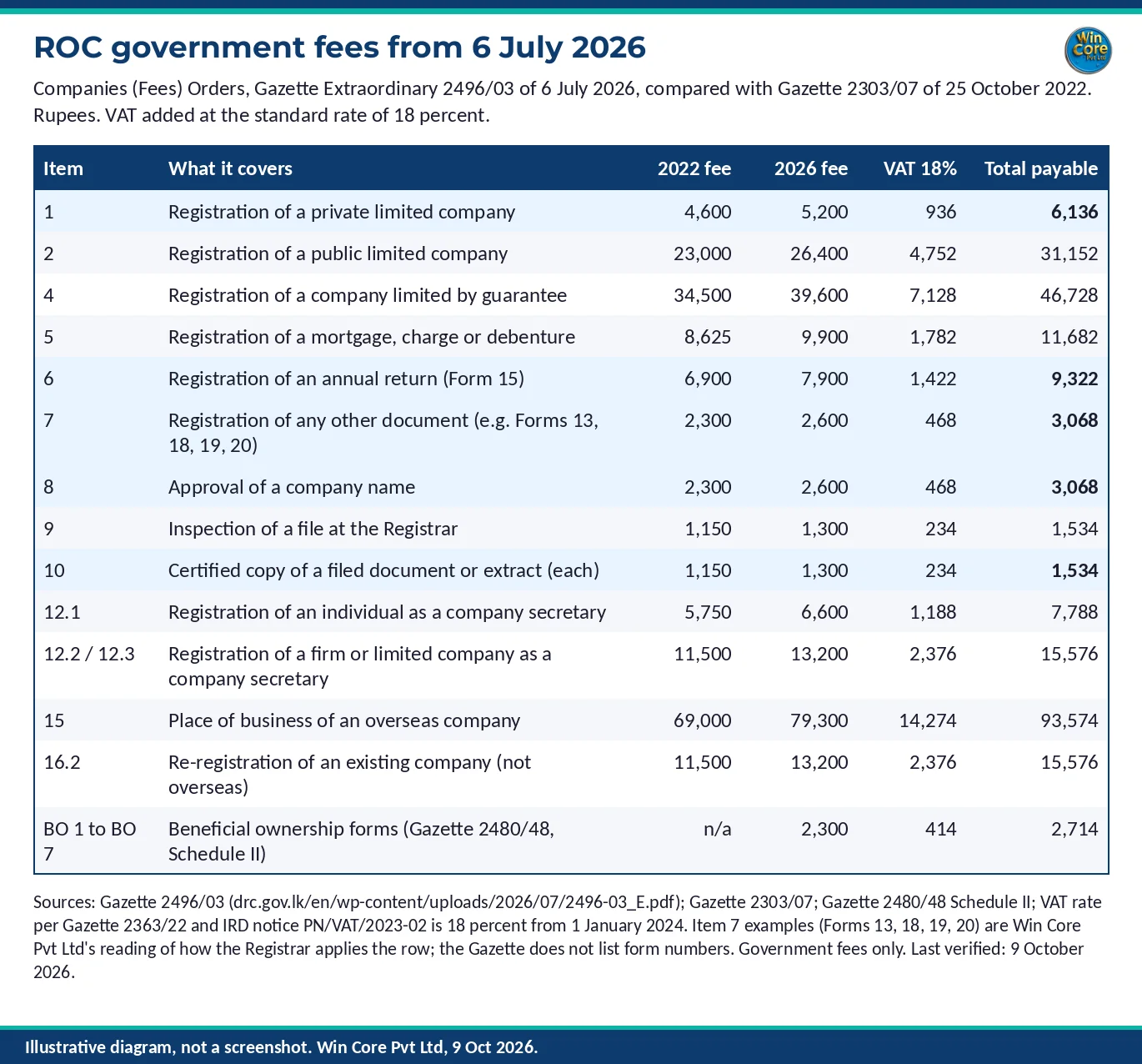
Every Registrar of Companies fee from 6 July 2026 with VAT added, and worked costs for an incorporation, a late Form 15 and a secretary change.
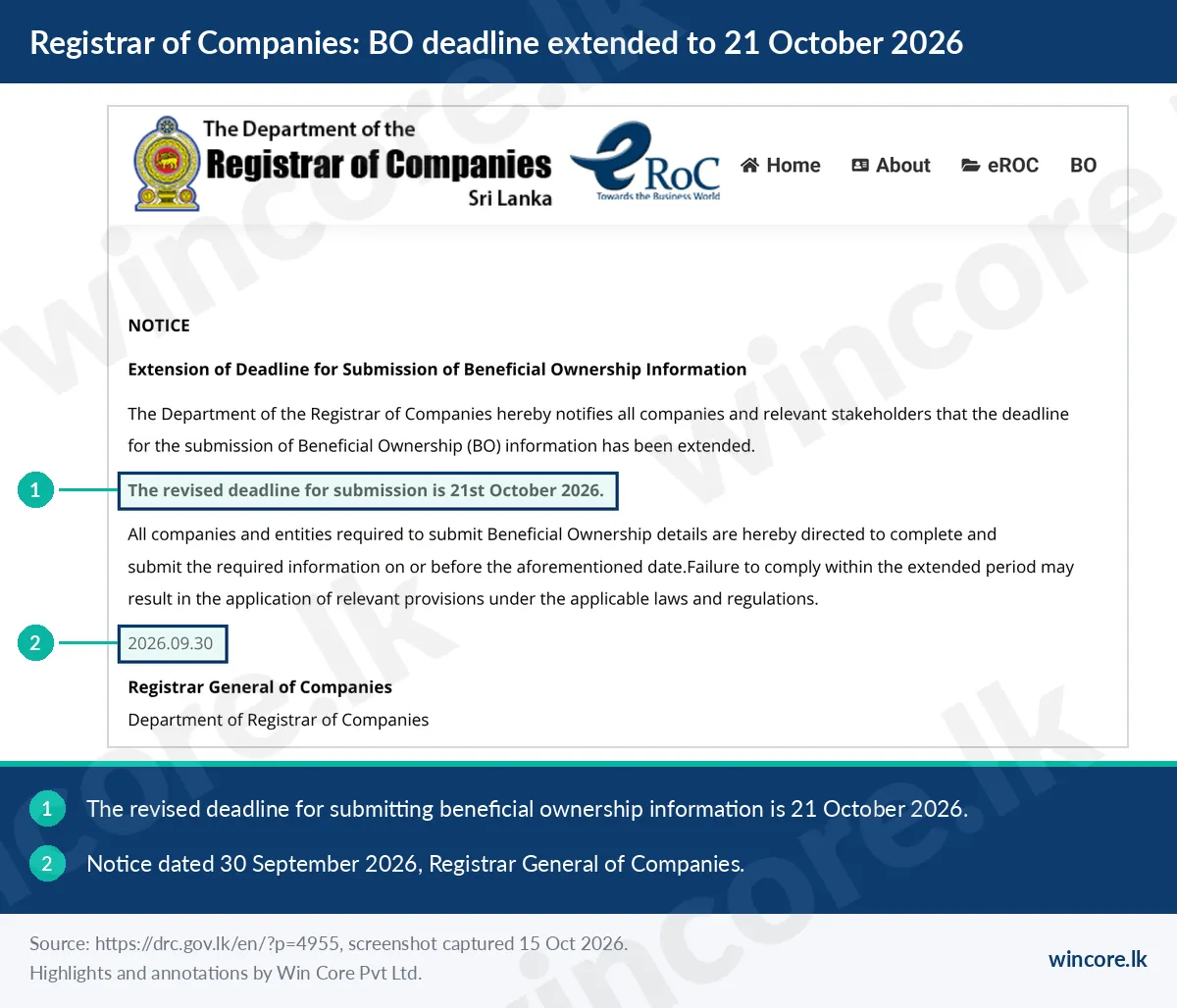
Who counts as a beneficial owner at 10 percent, the forms in the October 2026 regulations, and what existing companies face after the 21 October deadline.
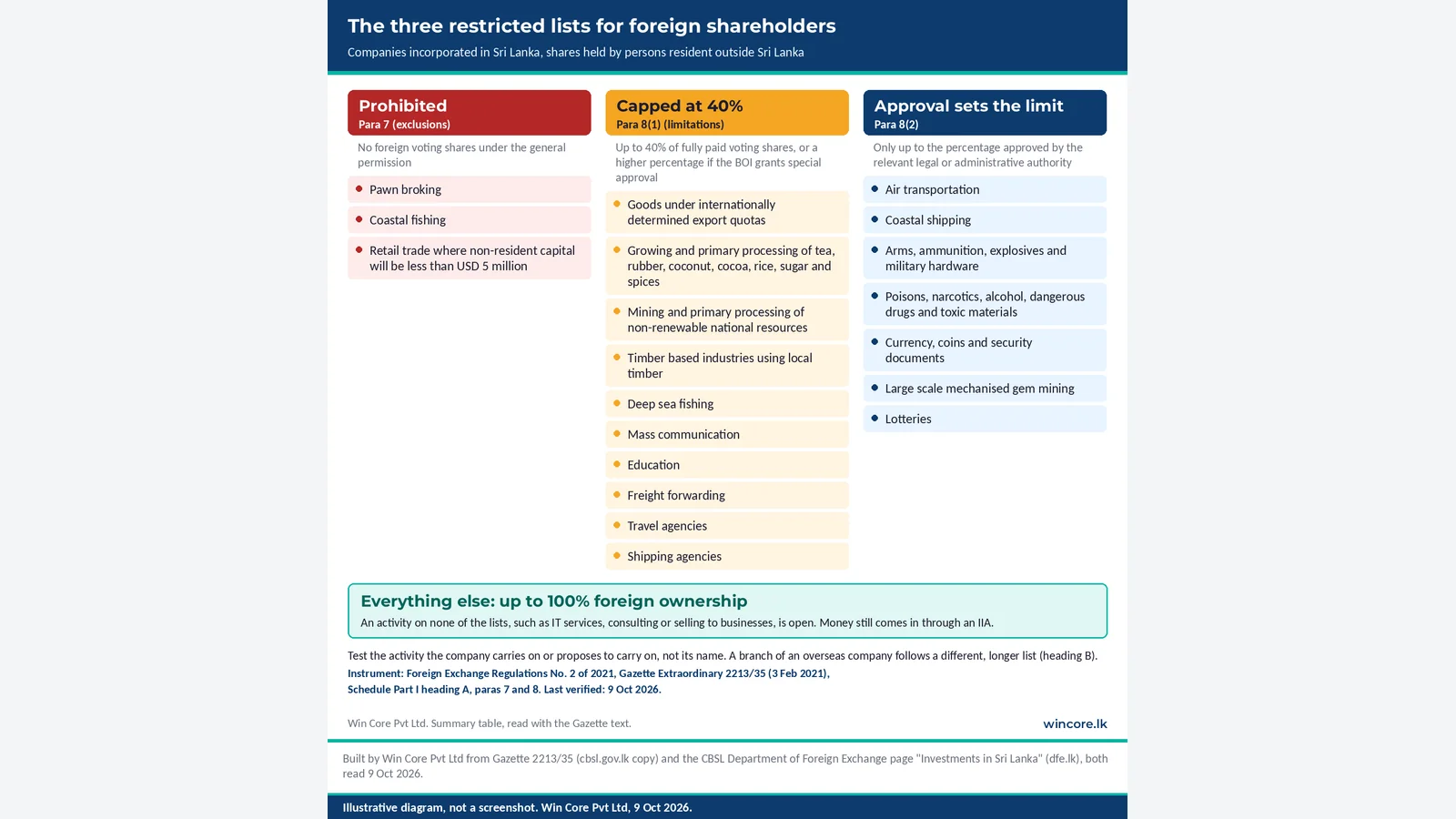
Most Sri Lankan companies can be 100 percent foreign owned. The three restricted lists in Gazette 2213/35, the retail test and the BOI route.