
ROC government fees from 6 July 2026, with a worked calculator
Every Registrar of Companies fee from 6 July 2026 with VAT added, and worked costs for an incorporation, a late Form 15 and a secretary change.
On this page
By WinCore Pvt Ltd. Last verified: 9 October 2026.
Every Registrar of Companies payment rests on two documents. The first is the price list: a Gazette that says what each kind of filing costs. The second is the bill: the payment screen on eROC that adds up what you are actually filing that day. Most confusion about "what does the ROC charge?" comes from mixing them up, or from reading a price list that has since been replaced.
The price list changed this year. Gazette Extraordinary No. 2496/03, published on 6 July 2026, amended the Companies (Fees) Orders that had stood since October 2022. Every figure went up, and every figure is stated before VAT.
Here is how that plays out in practice. Any budget for government fees that was built from the 2022 schedule, or from a receipt issued before July 2026, will now come in short, because every figure in the 2026 schedule went up and is stated before VAT.
So this guide does three things. It shows you where the official schedule lives and how to read it, it gives you a five-step method for turning the price list into a bill, and it works three common cases through to the rupee. Only government fees appear here. Professional fees, notarisation, courier and bank charges are separate and are not covered.
For the all-in cost, with professional fees and stamp duty, see company registration cost in Sri Lanka.
What changed on 6 July 2026
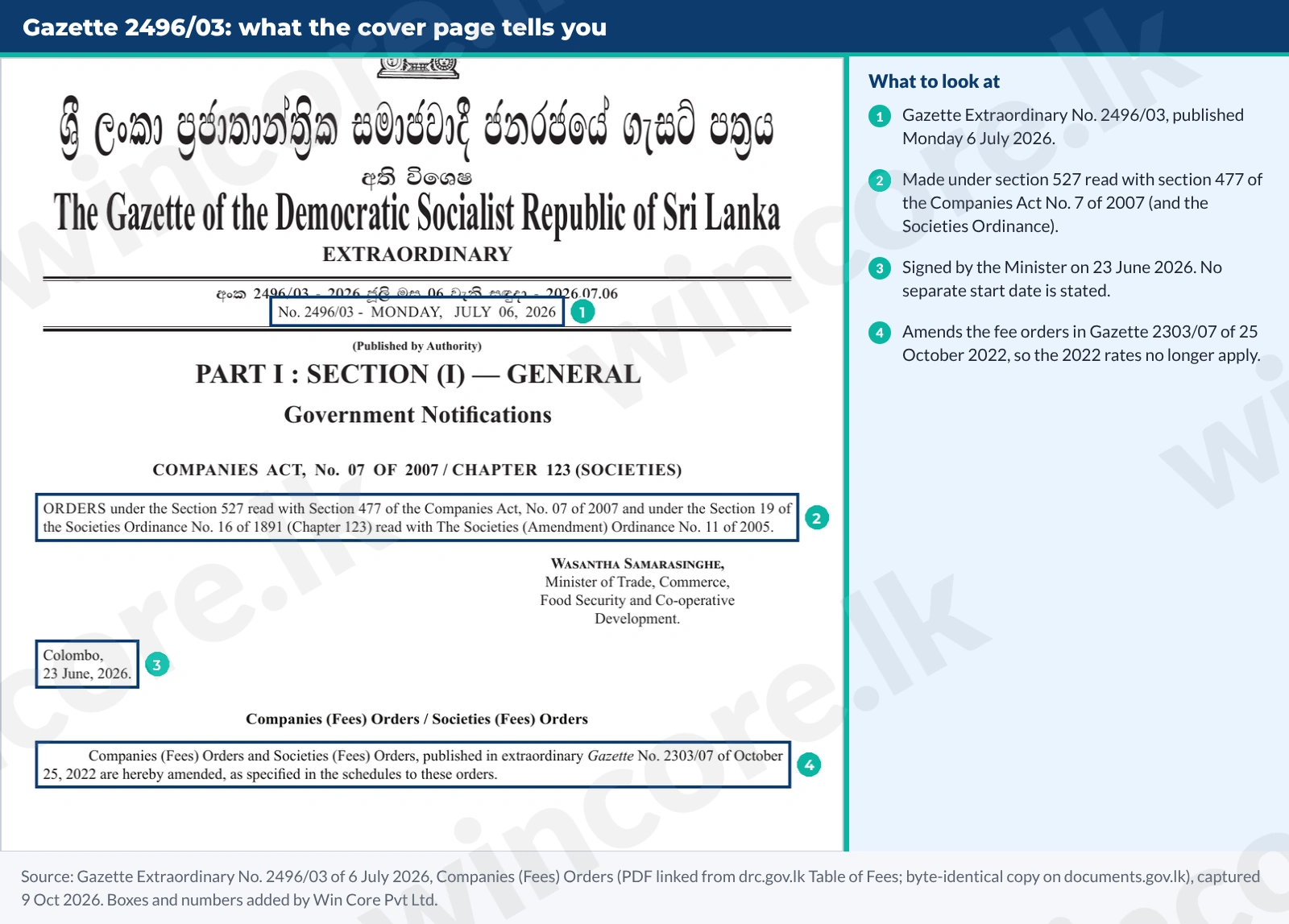
Gazette 2496/03 carries Companies (Fees) Orders made under section 527 read with section 477 of the Companies Act No. 7 of 2007, signed by the Minister on 23 June 2026. It states that the orders in Gazette 2303/07 of 25 October 2022 "are hereby amended, as specified in the schedules to these orders." The Gazette gives no separate start date, so treat the new rates as applying from publication.
The fees that most private companies meet in a normal year:
| Gazette item | What it covers | 2022 fee (Rs) | 2026 fee (Rs) | 2026 fee plus 18% VAT (Rs) |
|---|---|---|---|---|
| 1 | Registration of a private limited company | 4,600 | 5,200 | 6,136 |
| 6 | Registration of an annual return (Form 15) | 6,900 | 7,900 | 9,322 |
| 7 | Registration of any other document | 2,300 | 2,600 | 3,068 |
| 8 | Approval of a company name | 2,300 | 2,600 | 3,068 |
| 9 | Inspection of a file | 1,150 | 1,300 | 1,534 |
| 10 | Certified copy of a document or extract, each | 1,150 | 1,300 | 1,534 |
| 12.1 | Registering an individual as a company secretary | 5,750 | 6,600 | 7,788 |
| 12.2, 12.3 | Registering a firm or limited company as a company secretary | 11,500 | 13,200 | 15,576 |
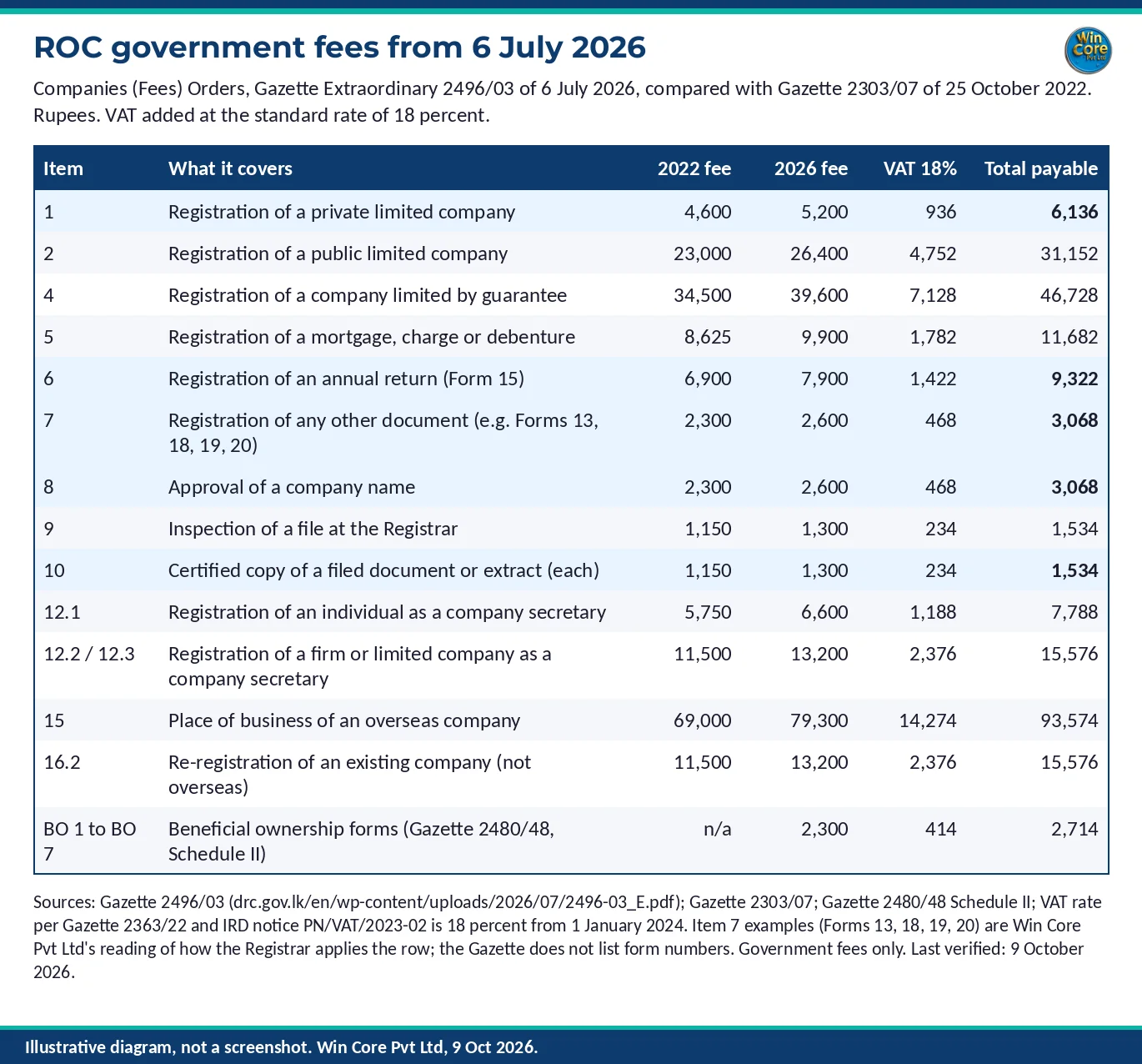
The full table, including public companies, guarantee companies, charges, overseas companies and re-registration, is in the image below.
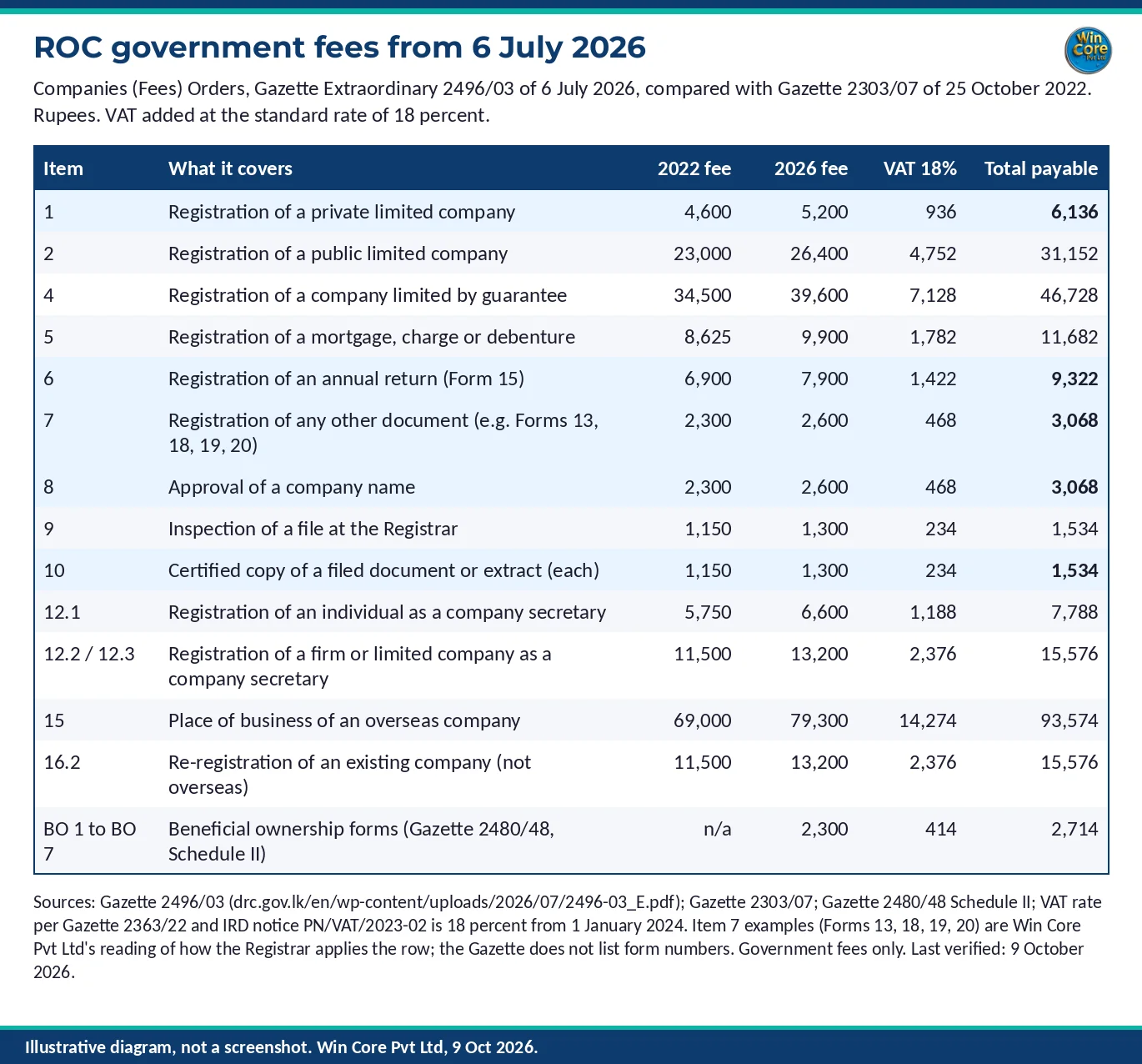
Two related charges sit outside 2496/03. Beneficial ownership forms are priced in Schedule II of the Companies (Beneficial Ownership) Regulations No. 1(I) of 2026 (Gazette 2509/67, in force 9 October 2026, which replaced Gazette 2480/48 with the same Rs 2,300 fee) at Rs 2,300 each, "subject to applicable taxes". From 22 October 2026, Regulations No. 1(II) of 2026 (Gazette 2511/47) set a certified copy of any one form at Rs 2,300, down from Rs 5,000, and add a Rs 2,300 fee to search one form. And VAT is added at the standard rate, which has been 18 percent since 1 January 2024 under Gazette 2363/22.
Instrument: Companies (Fees) Orders, Gazette Extraordinary 2496/03 of 6 July 2026, official PDF. Last verified: 9 October 2026.
Where the official schedule lives
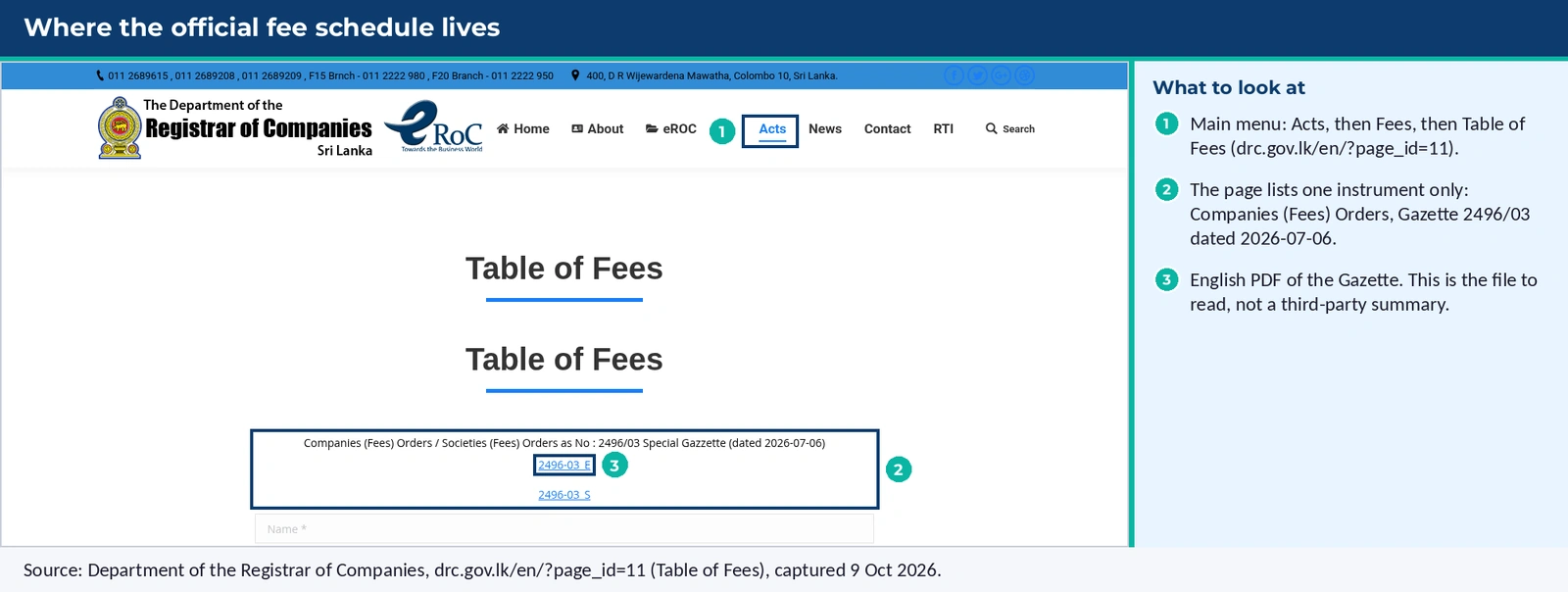
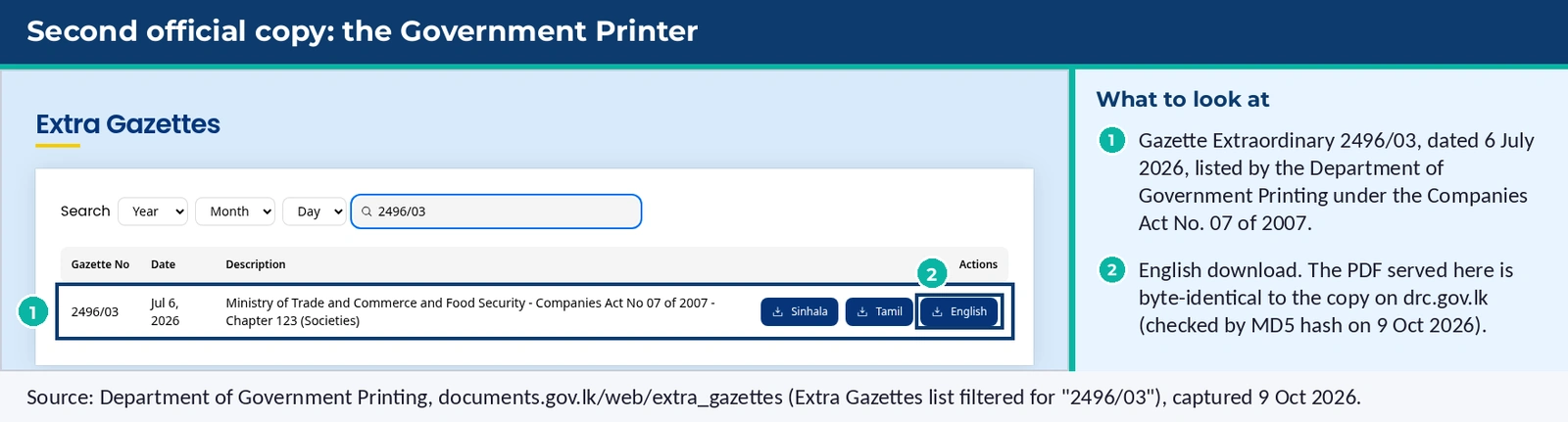
The Department of the Registrar of Companies (DRC) publishes one instrument on its Table of Fees page, and it is 2496/03. The Department of Government Printing lists the same Gazette on documents.gov.lk. We downloaded both copies on 9 October 2026 and they are the same file.
Is there anywhere you should not look? Yes, and it is on the DRC's own site. The Guidelines and Necessary Documents page still shows incorporation and Form 20 fees at amounts that match neither the 2022 nor the 2026 schedule, with VAT at 8 percent. It is useful for one thing only: it shows how the Registrar breaks an incorporation into separate documents (Articles, Form 1, a Form 18 for each director, a Form 19). The rupee amounts should be ignored.
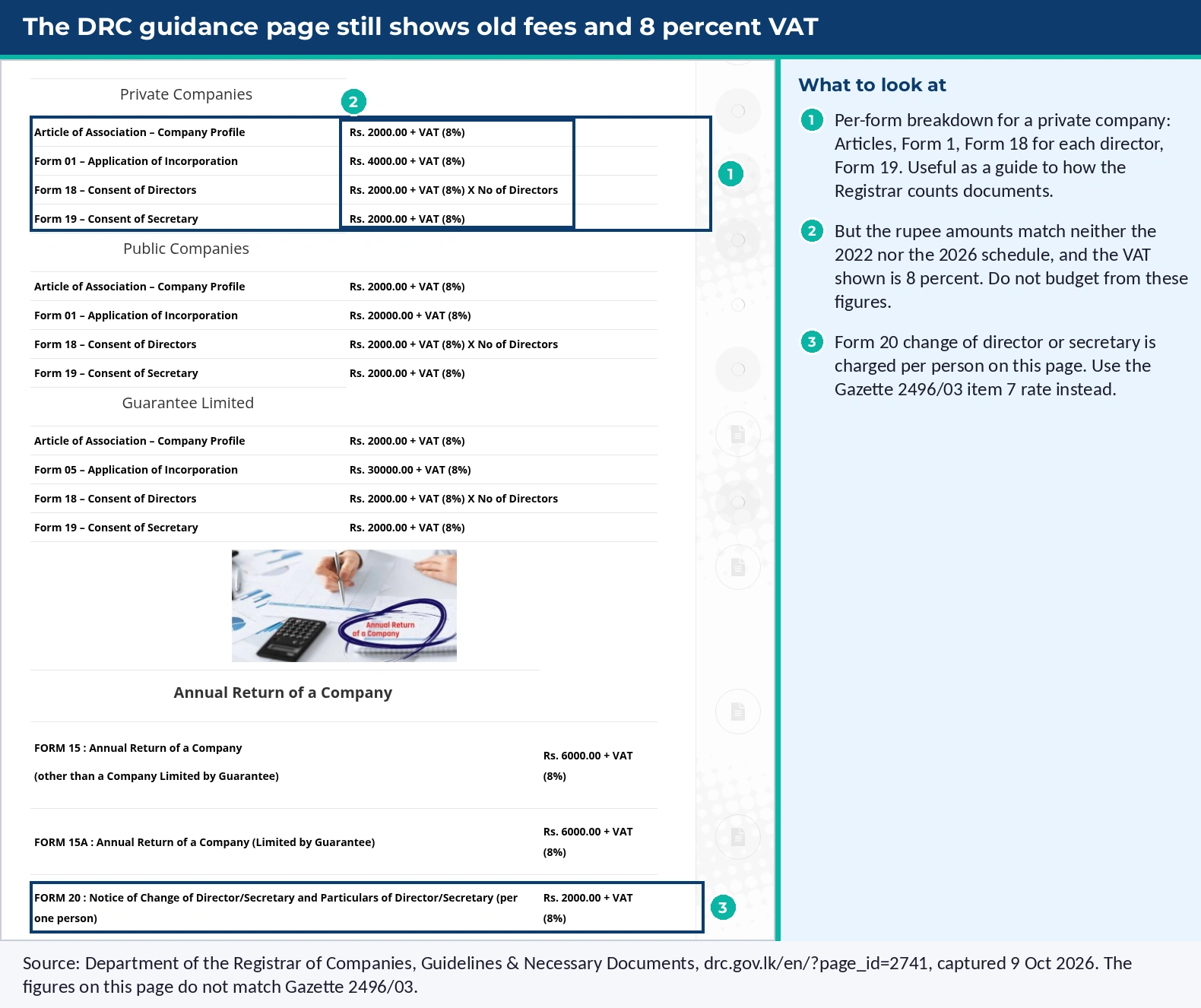
A short detour, because this page explains a lot of bad quotes. A government website showing two different prices for the same thing is not unusual; web pages are updated by whoever has time, Gazettes are law. When a third-party blog copies the guidance page rather than the Gazette, the 8 percent VAT figure travels with it, and it keeps turning up in budgets long after the rate moved to 18 percent. The rule we follow is simple: the Gazette PDF decides, and any other page is a pointer to it. Back to the price list.
Read the schedule in two minutes
Open the English PDF and go to page 2. The schedule has 25 rows; a private company in a normal year touches perhaps five of them.
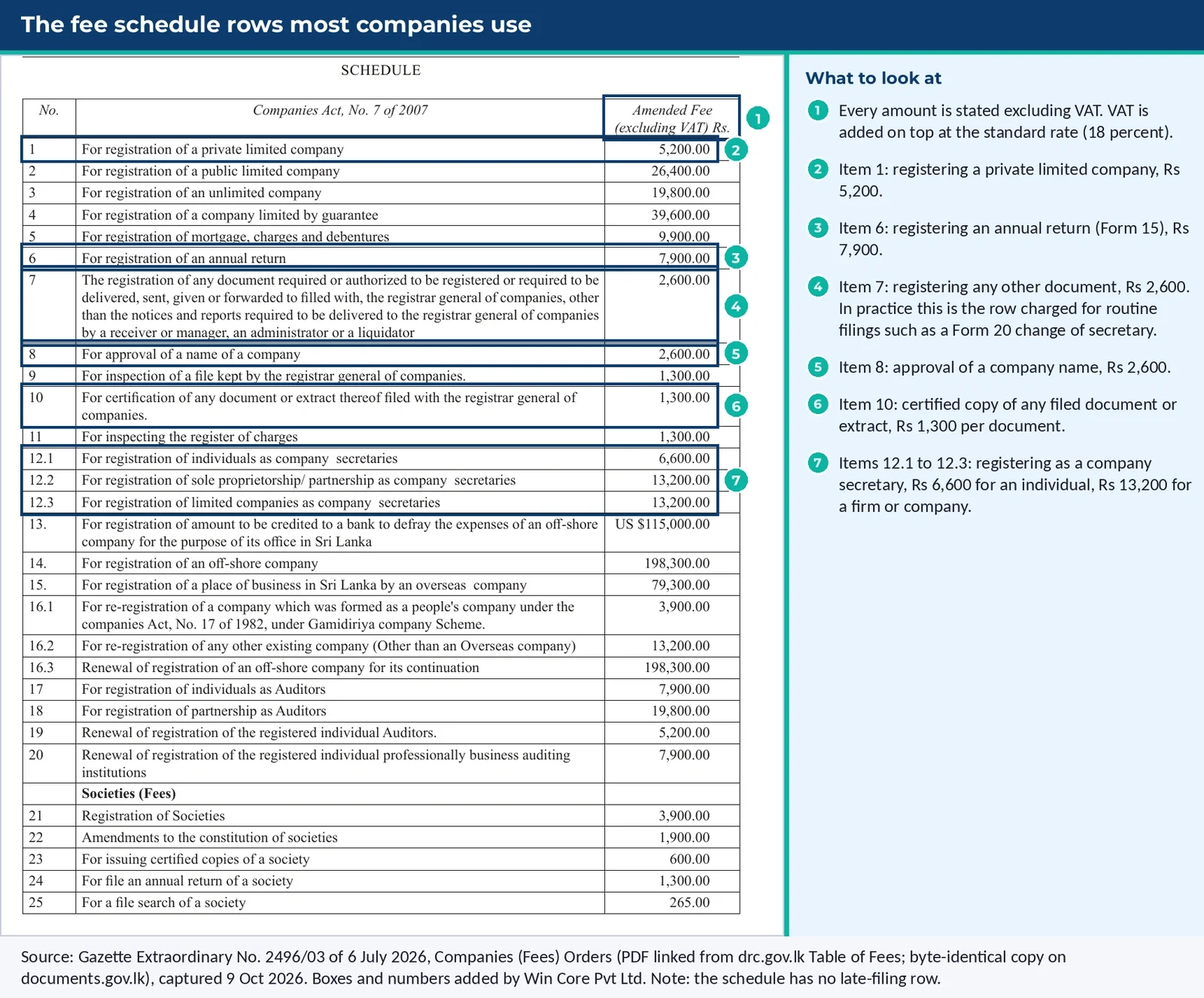
Three things are worth knowing before you use it.
- The column heading says "excluding VAT". Every rupee figure needs VAT added.
- Item 7 is the catch-all. It covers "the registration of any document required or authorized to be registered" with the Registrar, other than receiver, administrator and liquidator reports. That is where routine filings land: a Form 20 change of director or secretary, a Form 13 change of registered office, the Form 18 and Form 19 consents. The Gazette does not list form numbers; this is our reading of how the row is applied, and it matches the per-form method on the DRC guidance page.
- There is no late-filing row. Nothing in 2496/03 prices a late annual return. That charge comes from somewhere else, covered below.
How to work out your government fee in five steps
Step 1: list every filing you are making
What to do. Write down each form the transaction needs. An incorporation is not one filing; it is a name approval followed by a set of documents. A change of secretary is a Form 20 with a Form 19 annexed.
Where. The DRC Download Forms page (drc.gov.lk/en/?page_id=1998) lists the forms by number. On eROC most of them are system-generated.
What you need. The company's current eROC record, so you know what is already on file.
What goes wrong. Forgetting the beneficial ownership form that now travels with most filings: BO 1 at incorporation, BO 4 with every annual return, BO 5 when the authorised person changes.
How long. Ten minutes.
Step 2: count the documents, not the transaction
What to do. For each form, decide whether it is charged once or per person. The DRC guidance page charges Form 18 "X No of Directors" and Form 20 "per one person".
Where. DRC Guidelines page (method only) and the eROC payment screen (final figure).
What you need. The number of directors, secretaries and shareholders affected.
What goes wrong. Budgeting one Form 18 for a two-director company.
How long. Five minutes.
Step 3: apply the Gazette 2496/03 rate to each line
What to do. Match each line to its Gazette item and multiply by the quantity.
Where. Page 2 of the Gazette PDF, or the fee table above.
What you need. The right item number. Item 1 for a private company, item 4 for a guarantee company, item 6 for Form 15, item 7 for other documents, item 8 for name approval, item 10 for certified copies.
What goes wrong. Using a figure from the superseded 2022 schedule.
How long. Five minutes.
Step 4: add VAT at 18 percent
What to do. Multiply the total by 1.18. Rs 2,600 becomes Rs 3,068; Rs 7,900 becomes Rs 9,322.
Where. The VAT rate is in Gazette 2363/22 of 19 December 2023 and IRD notice PN/VAT/2023-02.
What you need. Your subtotal from step 3.
What goes wrong. Using 8 percent from the DRC guidance page or 15 percent from a pre-2024 source.
How long. One minute.
Step 5: check the eROC payment screen and keep the receipt
What to do. Compare your figure with the amount eROC shows at payment. If it differs, find out why before paying.
Where. eroc.drc.gov.lk, after login. The DRC's public user guides show the payment step for each process.
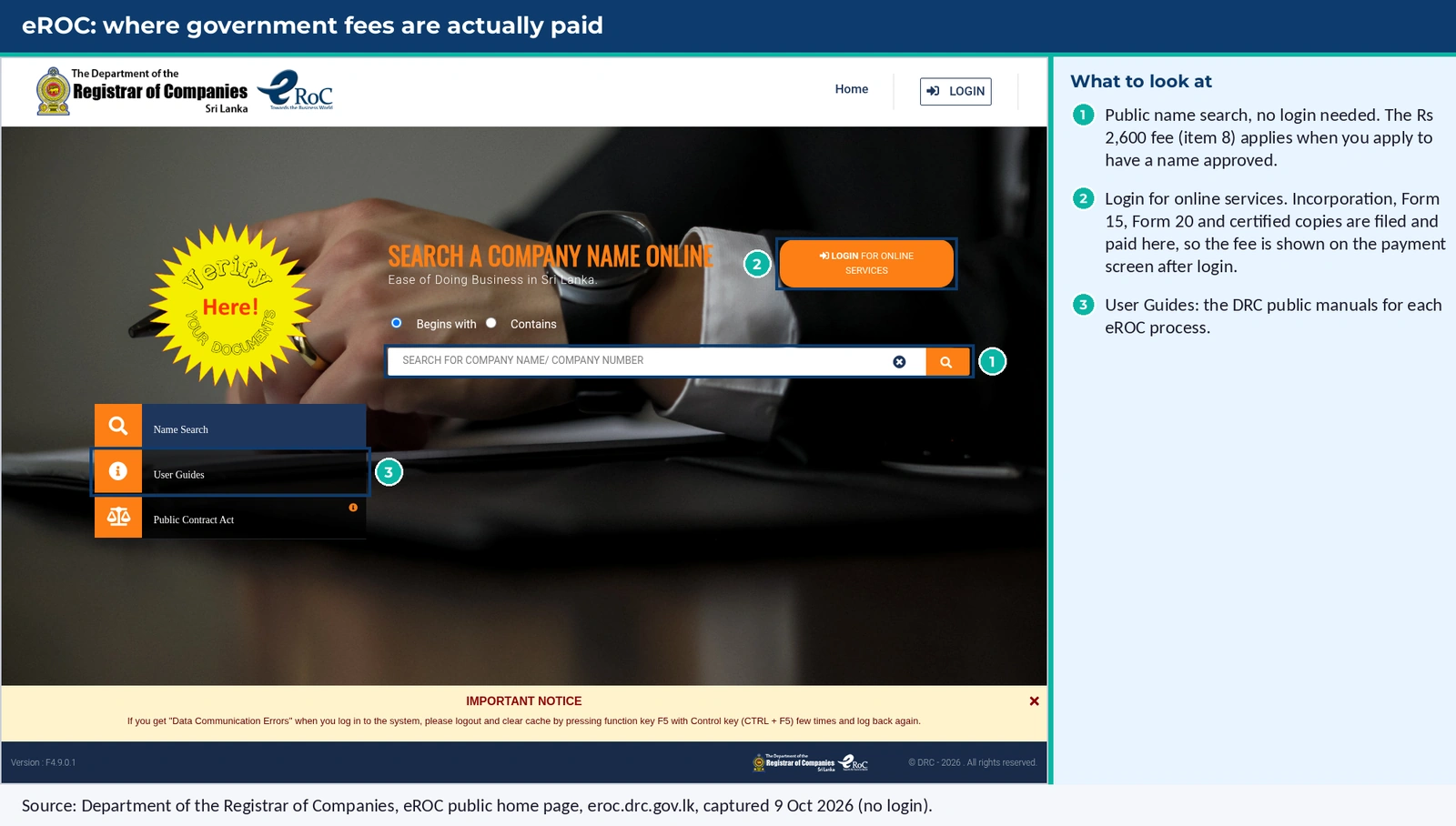
What you need. A director's or secretary's eROC login and a payment card.
What goes wrong. A difference usually means a compounding charge for a late filing, or a form counted per person.
How long. Payment takes minutes. We do not quote Registrar processing times, because they move; plan around name approval, which sits with the Registrar.
Three worked examples
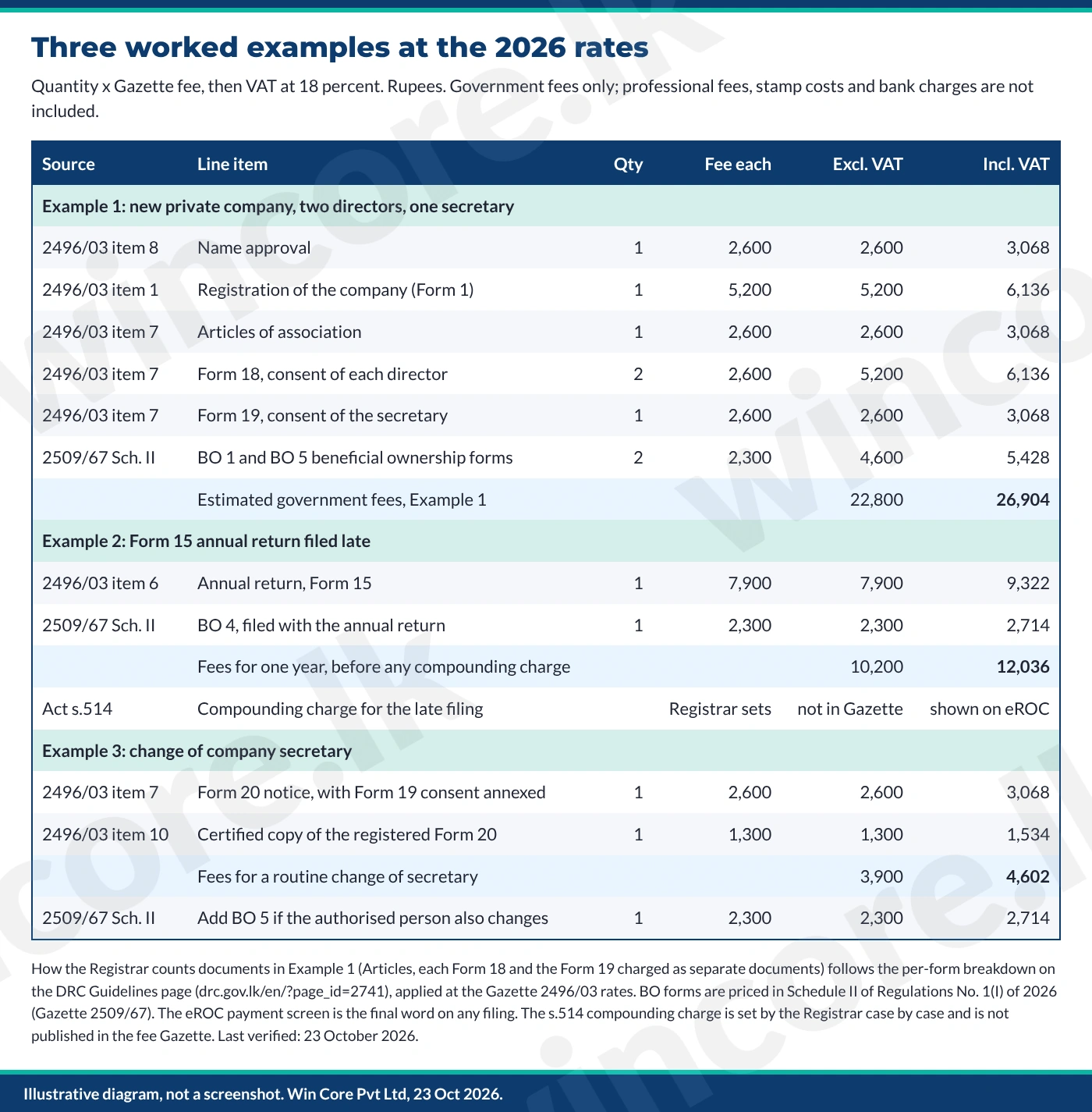
Example 1: a new private company with two directors and one secretary
| Line | Gazette source | Qty | Rs each | Rs excl. VAT |
|---|---|---|---|---|
| Name approval | 2496/03 item 8 | 1 | 2,600 | 2,600 |
| Registration (Form 1) | 2496/03 item 1 | 1 | 5,200 | 5,200 |
| Articles of association | 2496/03 item 7 | 1 | 2,600 | 2,600 |
| Form 18, consent of each director | 2496/03 item 7 | 2 | 2,600 | 5,200 |
| Form 19, consent of secretary | 2496/03 item 7 | 1 | 2,600 | 2,600 |
| BO 1 and BO 5 | 2509/67 Schedule II | 2 | 2,300 | 4,600 |
| Total | 22,800 | |||
| Total with VAT at 18% | 26,904 |
The floor, if the Registrar charged only the registration, the name and the two BO forms, would be Rs 12,400 before VAT (Rs 14,632 with VAT). We use the per-document figure for budgeting because that is how the DRC itself breaks an incorporation down. Each extra director adds one Form 18: Rs 3,068 with VAT.
Example 2: a Form 15 annual return filed late
The ordinary cost of one year's return is item 6 plus a BO 4:
| Line | Source | Rs excl. VAT |
|---|---|---|
| Form 15 annual return | 2496/03 item 6 | 7,900 |
| BO 4 beneficial ownership details | 2509/67 Schedule II | 2,300 |
| Total for one year | 10,200 | |
| With VAT at 18% | 12,036 |
A company two years behind pays that twice, Rs 24,072, before anything for lateness.
So what does lateness cost? The fee Gazette does not say, because the late charge is not a fee. Section 131(2) of the Companies Act requires the annual return within thirty working days of the AGM, and section 131(4) makes missing it an offence: a fine of up to Rs 100,000 for the company and up to Rs 50,000 for each officer in default, on conviction. Section 514 lets the Registrar, instead of prosecuting, "accept from the company or the officer, such sum of money as the Registrar may think proper in composition of the offence." That compounding sum is what appears on eROC when you file late. It is set by the Registrar and is not published in a schedule, so nobody can honestly give you a fixed late fee in advance.
Two timing points from the Act decide whether you are late at all. A company does not file an annual return in its year of incorporation (section 131(3)), and its first AGM must be held within eighteen months of incorporation (section 133(2)). Our company secretarial service handles the filing itself, and the BO 4 that travels with it is explained in our guide to beneficial ownership filings for existing companies.
Instrument: Companies Act No. 7 of 2007, ss.131, 133 and 514, official PDF on drc.gov.lk. Last verified: 9 October 2026.
Example 3: a change of company secretary
| Line | Source | Rs excl. VAT |
|---|---|---|
| Form 20 notice, Form 19 consent annexed | 2496/03 item 7 | 2,600 |
| Certified copy of the registered Form 20 | 2496/03 item 10 | 1,300 |
| Total | 3,900 | |
| With VAT at 18% | 4,602 |
Add a BO 5 (Rs 2,300, Rs 2,714 with VAT) if the outgoing secretary was also the company's beneficial ownership authorised person. If the eROC screen counts the outgoing and incoming secretary as two persons, as the DRC guidance page's "per one person" wording suggests it might, the Form 20 line doubles to Rs 6,136 with VAT. The full procedure is in our companion guide, how to change your company secretary in Sri Lanka.
After budgeting incorporation, diarise the first AGM and annual-return timetable rather than treating registration as the final filing.
A calculator you can copy
For any filing, the arithmetic is the same:
Government fee = (sum of each Gazette item x quantity) x 1.18, plus any compounding charge eROC shows for a late filing.
| Your line | Gazette item | Rs each (excl. VAT) | Qty | Line total |
|---|---|---|---|---|
| Name approval | 8 | 2,600 | ||
| Private company registration | 1 | 5,200 | ||
| Other document (Articles, Form 18, 19, 20, 13 and the like) | 7 | 2,600 | ||
| Annual return, Form 15 | 6 | 7,900 | ||
| Certified copy, per document | 10 | 1,300 | ||
| File inspection | 9 | 1,300 | ||
| BO form | 2509/67 | 2,300 | ||
| Subtotal | ||||
| x 1.18 = total with VAT |
Documents and details you need before you calculate
Checklist
- The company number and its current eROC record (directors, secretary, last Form 15 on file)
- The list of forms the transaction needs, from the DRC Download Forms page
- The number of directors, secretaries or persons each form covers
- The date of the last AGM, to see whether a Form 15 is late
- Whether the beneficial ownership authorised person is changing (BO 5)
- The Gazette 2496/03 PDF, not a summary
- A director's or secretary's eROC login for the payment step
Older fee figures you may have seen
Any fee figure published before July 2026 comes from the superseded 2022 schedule, and the DRC guidance page described above is older still. If a quote, an invoice or a blog post gives you a figure from the 2022 column, re-price it from the table above before you budget. If you are setting up from scratch, our company registration services page covers the process, and the company name check tool helps before you pay for name approval.
We should admit this is not the most exciting page we publish. Fee tables never are. But a correct fee table is the difference between a budget that holds and a filing that stalls at the payment screen while someone finds another few thousand rupees.
Frequently asked questions
How much does it cost to register a private limited company in Sri Lanka in 2026?
The Gazette fee for registering a private company is Rs 5,200 plus VAT (Rs 6,136). A full incorporation also pays for name approval, the Articles and each director's and secretary's consent, plus two beneficial ownership forms. For two directors we budget about Rs 26,904 in government fees including VAT. The eROC payment screen gives the final figure.
Are ROC fees inclusive of VAT?
No. Gazette 2496/03 states every fee "excluding VAT". Add VAT at the standard rate of 18 percent.
What is the fee for filing Form 15 now?
Rs 7,900 plus VAT (Rs 9,322), under item 6. A BO 4 at Rs 2,300 plus VAT goes with every annual return under the beneficial ownership regulations.
Is there a fixed penalty for a late annual return?
Not in the fee Gazette. The late charge is a sum the Registrar accepts to compound the offence under section 514 of the Companies Act, and it is shown on eROC when you file. The statutory fines if prosecuted go up to Rs 100,000 for the company and Rs 50,000 per officer.
How much is a certified copy?
Rs 1,300 per document plus VAT (Rs 1,534), under item 10. A printout from a file search is not a certified copy.
The DRC website shows different fees. Which is right?
The Gazette. The DRC Table of Fees page links to 2496/03, which is the law. The Guidelines page still shows older amounts and 8 percent VAT and should not be used for budgeting.
Sources
- Companies (Fees) Orders, Gazette Extraordinary 2496/03 of 6 July 2026: https://drc.gov.lk/en/wp-content/uploads/2026/07/2496-03_E.pdf (also on documents.gov.lk, Extra Gazettes). Verified 9 October 2026.
- Companies (Fees) Regulations amendment, Gazette Extraordinary 2303/07 of 25 October 2022: documents.gov.lk, Extra Gazettes. Verified 9 October 2026.
- Companies (Beneficial Ownership) Regulations No. 1(I) of 2026, Gazette 2509/67 of 9 October 2026, Schedule II (Rs 2,300 a form), as posted by the Registrar: https://drc.gov.lk/en/?p=5001. Verified 15 October 2026. They replaced Regulations No. 01 of 2026, Gazette 2480/48, from 8 October 2026.
- Companies (Beneficial Ownership) Regulations No. 1(II) of 2026, Gazette 2511/47 of 21 October 2026, reg 4 and Schedule I (certified copy Rs 2,300, search Rs 2,300, from 22 October 2026), as posted by the Registrar: https://drc.gov.lk/en/?p=5007. Verified 22 October 2026.
- Companies Act No. 7 of 2007, ss.131, 133, 514: https://drc.gov.lk/en/wp-content/uploads/2018/04/Act-7-of-2007-English.pdf. Verified 9 October 2026.
- VAT rate order, Gazette 2363/22 of 19 December 2023: https://www.ird.gov.lk/en/publications/Gazette_Documents/2023_2363-22_E.pdf; IRD notice PN/VAT/2023-02: https://www.ird.gov.lk/en/Lists/Latest%20News%20%20Notices/Attachments/557/PN_VAT_2023-02_28122023_E.pdf. Verified 9 October 2026.
- DRC Table of Fees, https://drc.gov.lk/en/?page_id=11; DRC Guidelines and Necessary Documents, https://drc.gov.lk/en/?page_id=2741; DRC Download Forms, https://drc.gov.lk/en/?page_id=1998; eROC, https://eroc.drc.gov.lk/. Verified 9 October 2026.
Instrument: Gazette Extraordinary 2496/03 of 6 July 2026, official link. Last verified: 9 October 2026.
The Gazette gives you the price list; count the documents, add the VAT, and the bill stops being a surprise.
Need a second pair of eyes on a filing? If you want us to check the government fees and the forms for a registration, an annual return backlog or a secretary change before you pay, book a consultation at our contact page.
WinCore Pvt Ltd
Put these insights to work
WinCore specialists can review your current workflow, document gaps, and build a practical 90-day action plan.
Book a free consultationContinue reading
Explore more WinCore analysis to keep your finance, tax, and compliance roadmap moving.
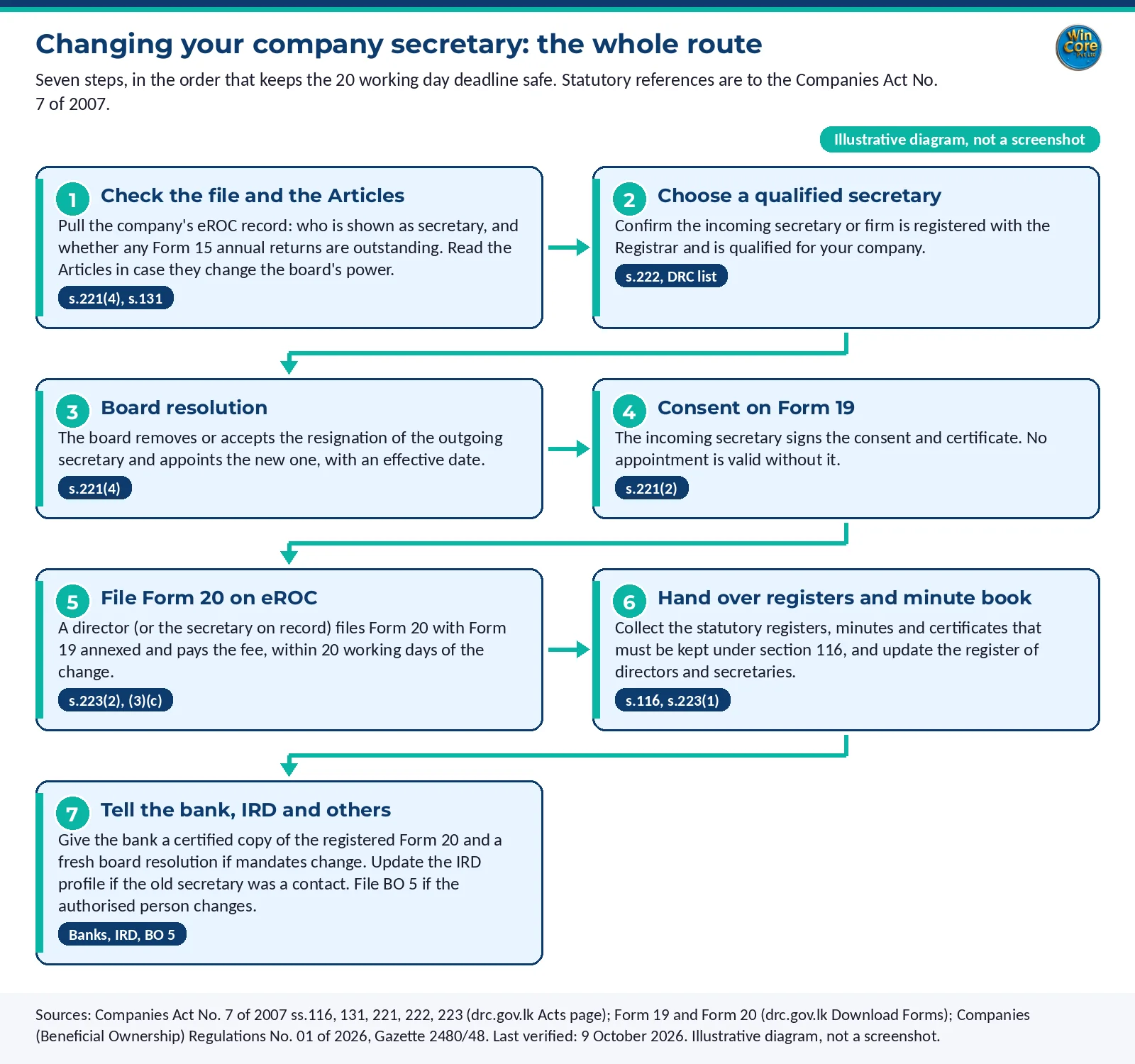
Changing a company secretary step by step: the board resolution, Form 19 consent, Form 20 within 20 working days, the fee and the handover.
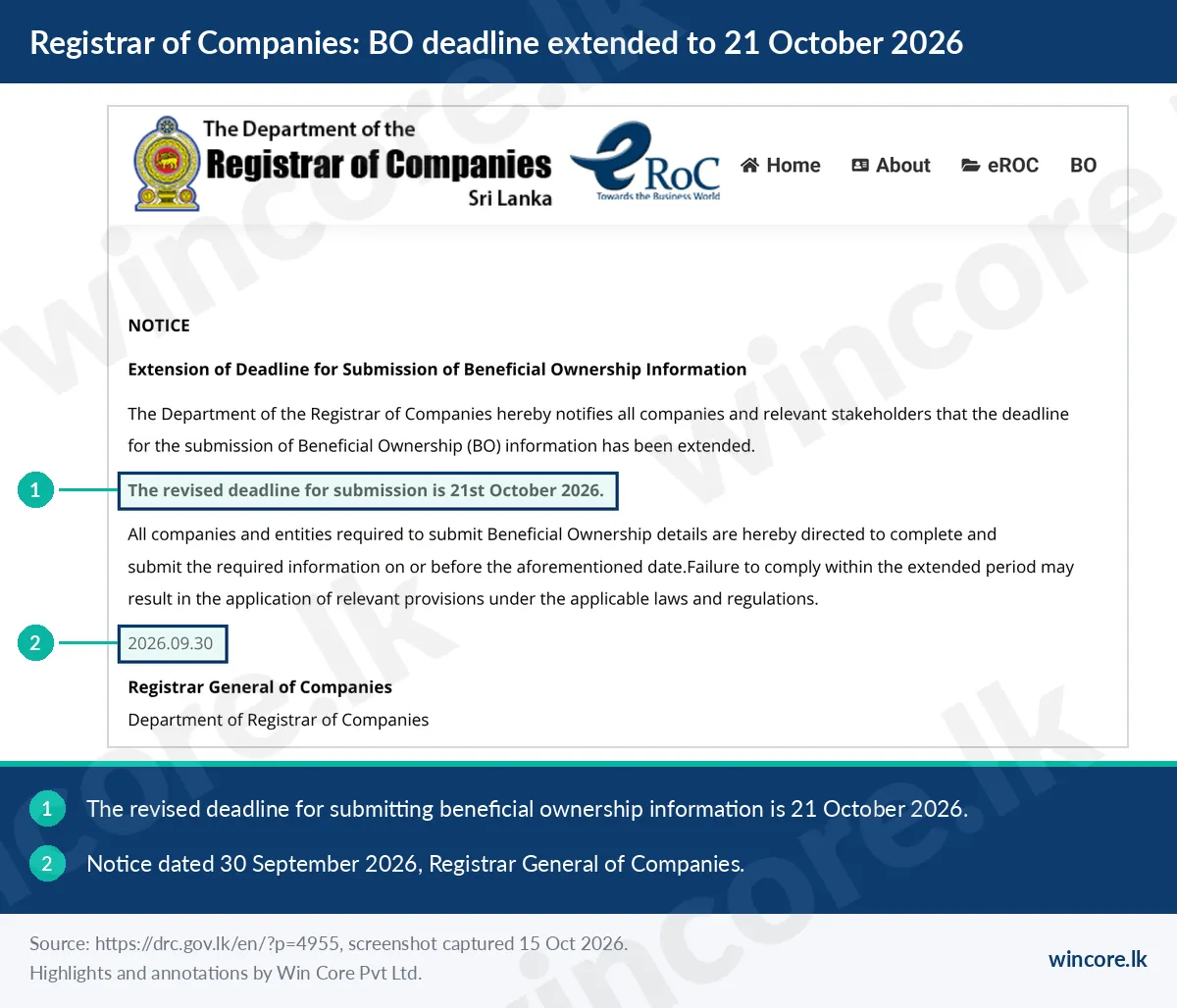
Who counts as a beneficial owner at 10 percent, the forms in the October 2026 regulations, and what existing companies face after the 21 October deadline.
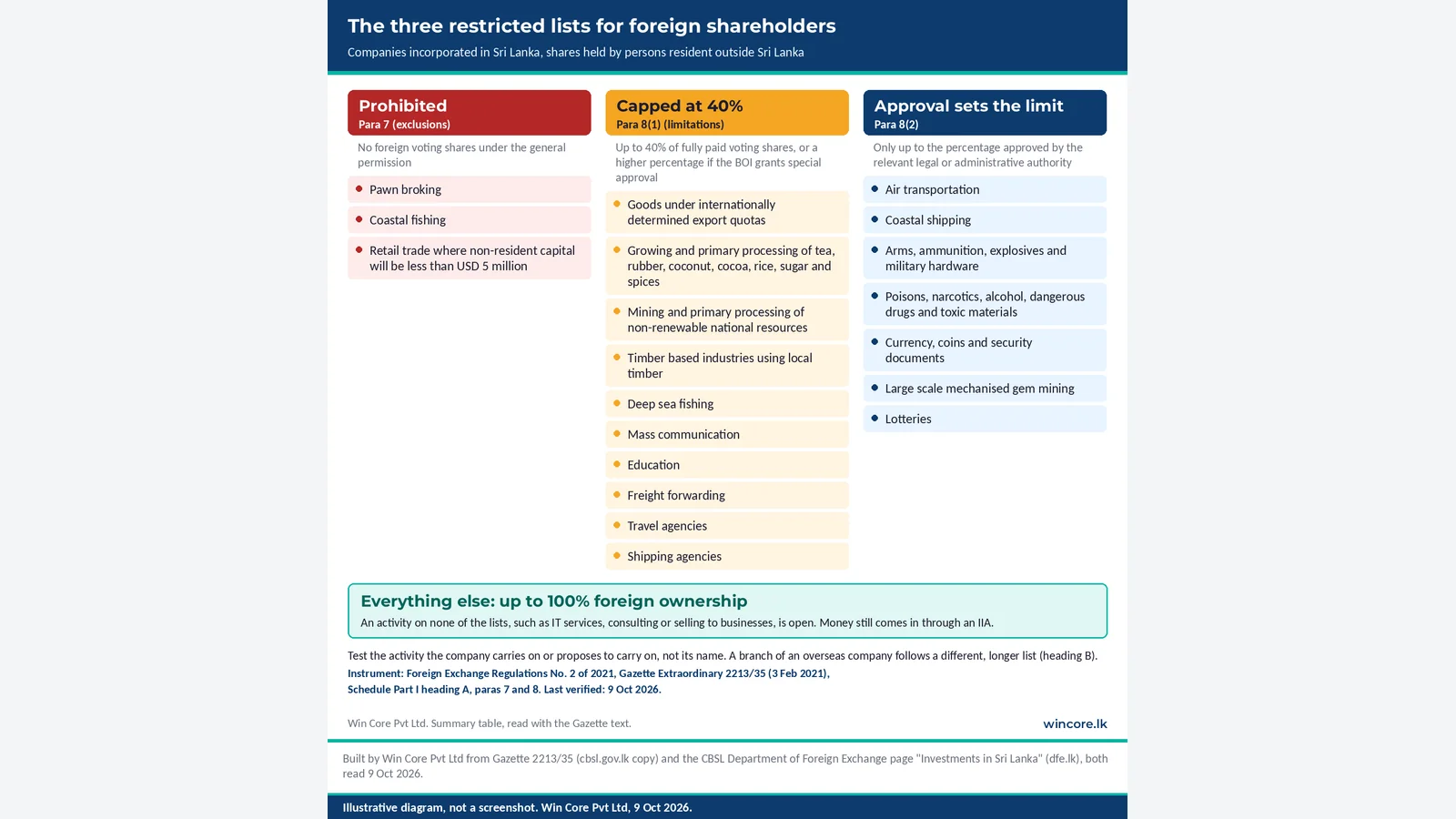
Most Sri Lankan companies can be 100 percent foreign owned. The three restricted lists in Gazette 2213/35, the retail test and the BOI route.