
First AGM Sri Lanka: the 18-month rule and late Form 15 fines
A new company's first AGM, worked from the incorporation date: the eighteen month limit, the six month question, and what a late annual return costs.
On this page
Last verified against the primary sources on 22 October 2026.
A company in Sri Lanka does not have to hold an annual general meeting (AGM) in the calendar year it is incorporated, but it must hold its first AGM within eighteen months of incorporation (Companies Act, No. 7 of 2007, s.133(2)). No annual return is due for the year of incorporation (s.131(3)). After each AGM, the annual return on Form 15 must be completed within thirty working days (s.131(2)). A late return is an offence: on conviction, up to Rs 100,000 for the company and Rs 50,000 for each officer in default (s.131(4)), unless the Registrar accepts a composition sum instead (s.514). For the steps from notice to minutes, see how to hold an AGM.
This piece is about the first AGM and what lateness costs. For the routine filing itself, the fee and the beneficial ownership form that goes with it, see our guide to Form 15 annual return filing.
The annual return is a snapshot of who owns and runs the company, not a report on the year. It hangs off the AGM, not off the year end, so get the AGM date wrong and every later date moves with it.
Take a hypothetical private company incorporated on 1 June 2025 with a 31 March balance sheet date. When must it hold its first AGM, when is its first annual return due, and what happens if both slip?
The first AGM in Sri Lanka is due within eighteen months of incorporation
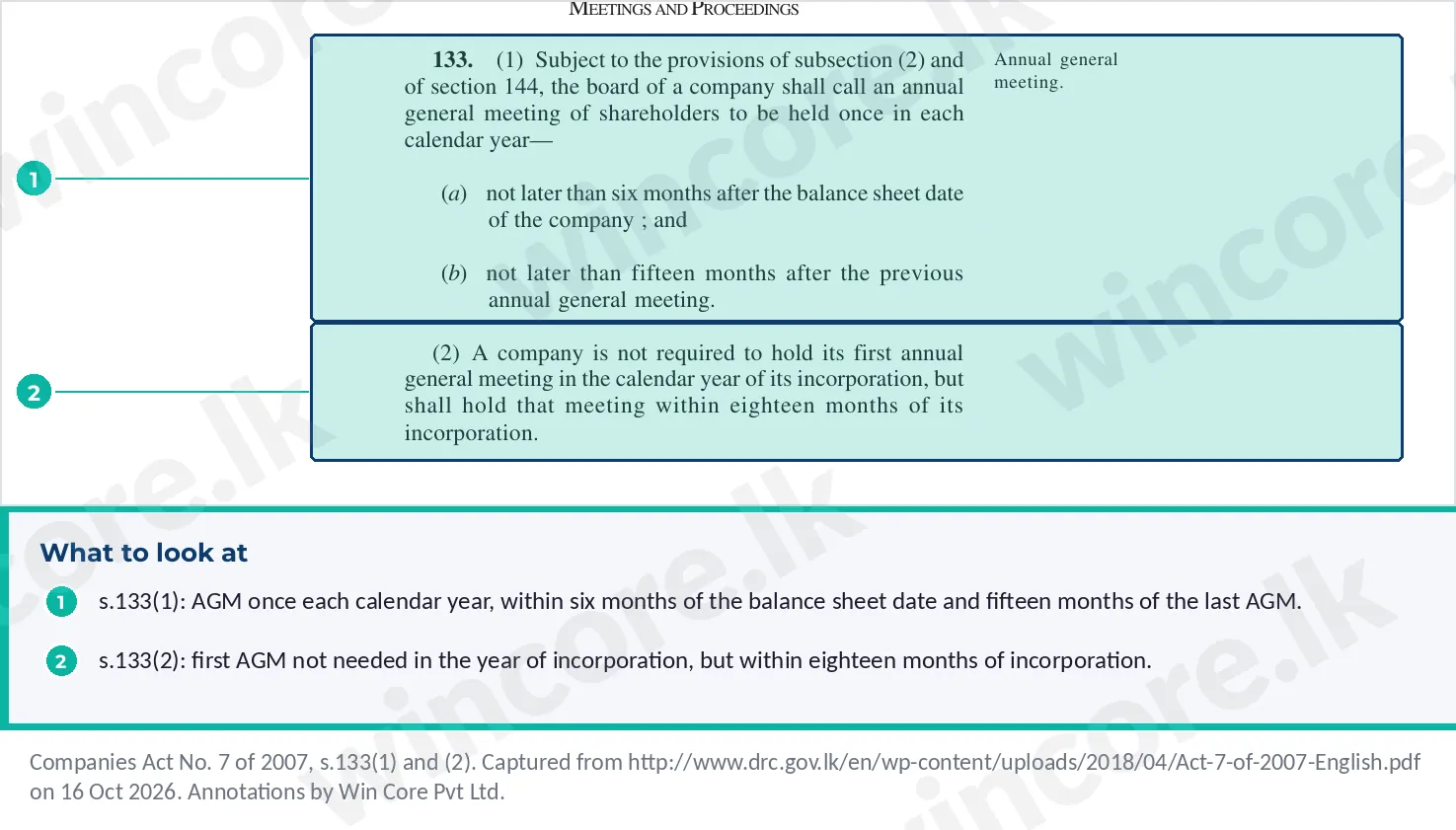
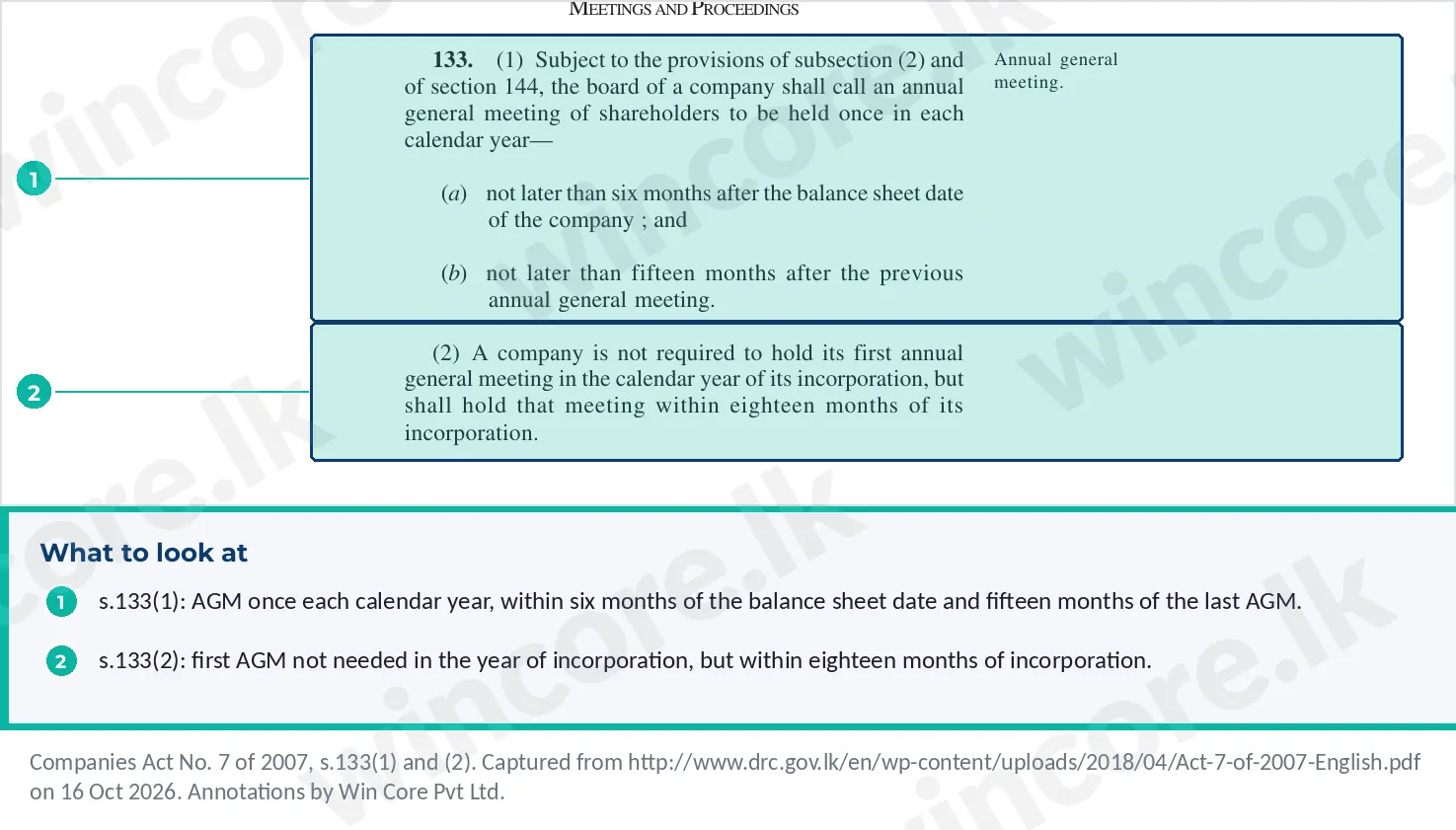
Section 133(1) says: "Subject to the provisions of subsection (2) and of section 144, the board of a company shall call an annual general meeting of shareholders to be held once in each calendar year (a) not later than six months after the balance sheet date of the company ; and (b) not later than fifteen months after the previous annual general meeting" [1].
Section 133(2) deals with the first meeting: "A company is not required to hold its first annual general meeting in the calendar year of its incorporation, but shall hold that meeting within eighteen months of its incorporation" [1].
For our hypothetical company, incorporated on 1 June 2025:
- No AGM is needed in calendar year 2025, the year of incorporation.
- The first AGM must be held within eighteen months of incorporation: 1 June 2025 plus eighteen months is 1 December 2026 (our count).
- No annual return is needed for 2025 under section 131(3).
- The first annual return is completed within thirty working days of the first AGM.
Its first balance sheet date of 31 March 2026 is allowed: it falls in the calendar year after incorporation and within fifteen months of it, as section 171(2) requires. Our companion piece on whether a first financial year can run 15 months works through that rule.
When six months and eighteen months disagree, hold the earlier date
Here the Act does not settle the question in so many words. Section 133(1)(a) says six months after the balance sheet date. For a first balance sheet date of 31 March 2026, that is 30 September 2026. Section 133(2) says eighteen months from incorporation, which is 1 December 2026.
Because subsection (1) is expressly "Subject to the provisions of subsection (2)", on our reading the eighteen month rule governs the first meeting. That is our reading, not a ruling of the Registrar. The cautious course is to hold the first AGM by the earlier of the two dates.
The accounts do not wait for the meeting in either case. Section 150(1) requires the financial statements to be completed "within six months or within such extended period as may be determined by the Registrar after the balance sheet date", and section 150(2) makes each director in default liable on conviction to a fine not exceeding Rs 100,000 [1]. Section 166(1) sets the same six months for the board's annual report [1]. So for our company the accounts and the annual report are due by 30 September 2026 whatever date the AGM takes.
A written resolution can replace the AGM, and the clock question stays open
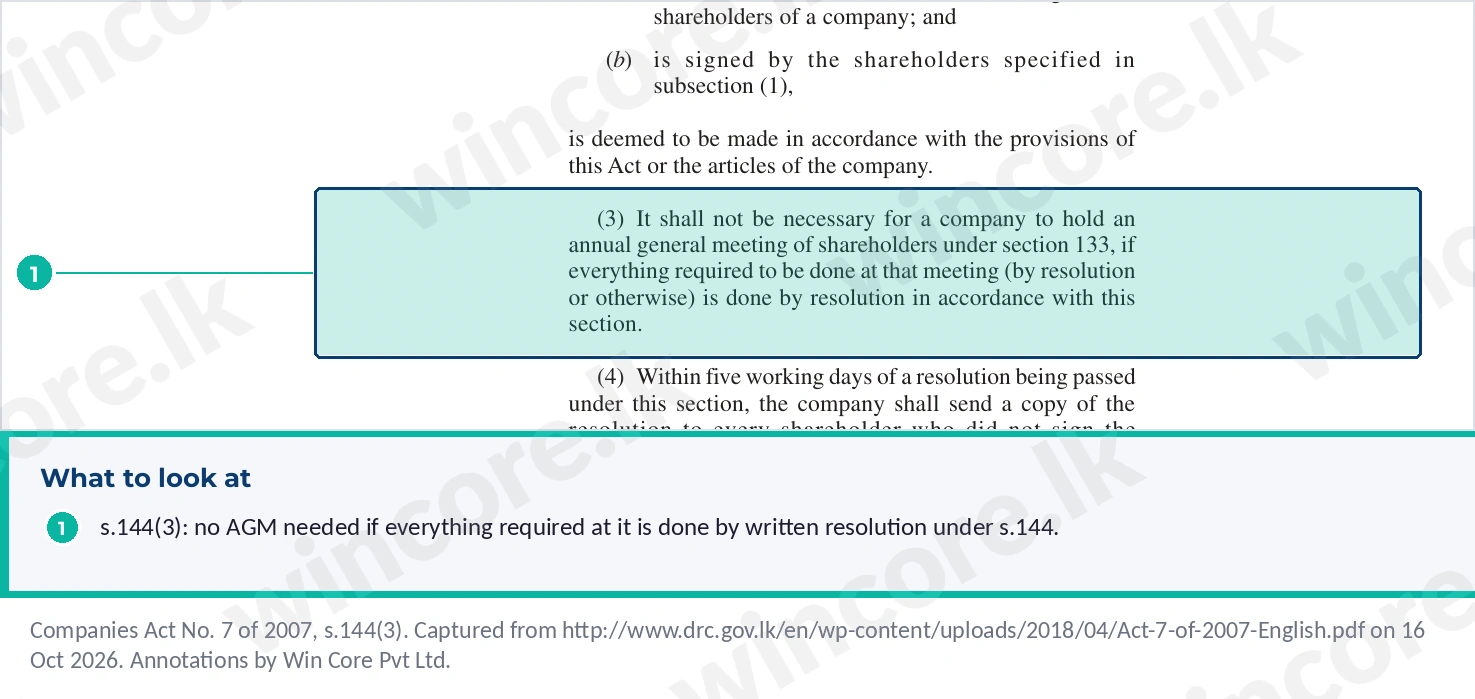
Section 133(1) is also subject to section 144. Section 144(3) says: "It shall not be necessary for a company to hold an annual general meeting of shareholders under section 133, if everything required to be done at that meeting (by resolution or otherwise) is done by resolution in accordance with this section" [1].
Under section 144(1), and subject to the articles, the resolution must be "signed by not less than eighty-five per centum of the shareholders who would be entitled to vote on that resolution at a meeting of shareholders, who together hold not less than eighty-five per centum of the votes entitled to be cast on that resolution" [1]. Section 144(4) then requires a copy to be sent within five working days to every shareholder who did not sign, and section 144(5) allows signing without prior notice.
Where no meeting is held, the Act does not say in terms which date starts the section 131(2) clock. On our reading, the date the resolution is passed takes the place of the meeting date. That is not a quoted rule, and we keep it as an open point below.
Thirty working days after the AGM, the annual return is due
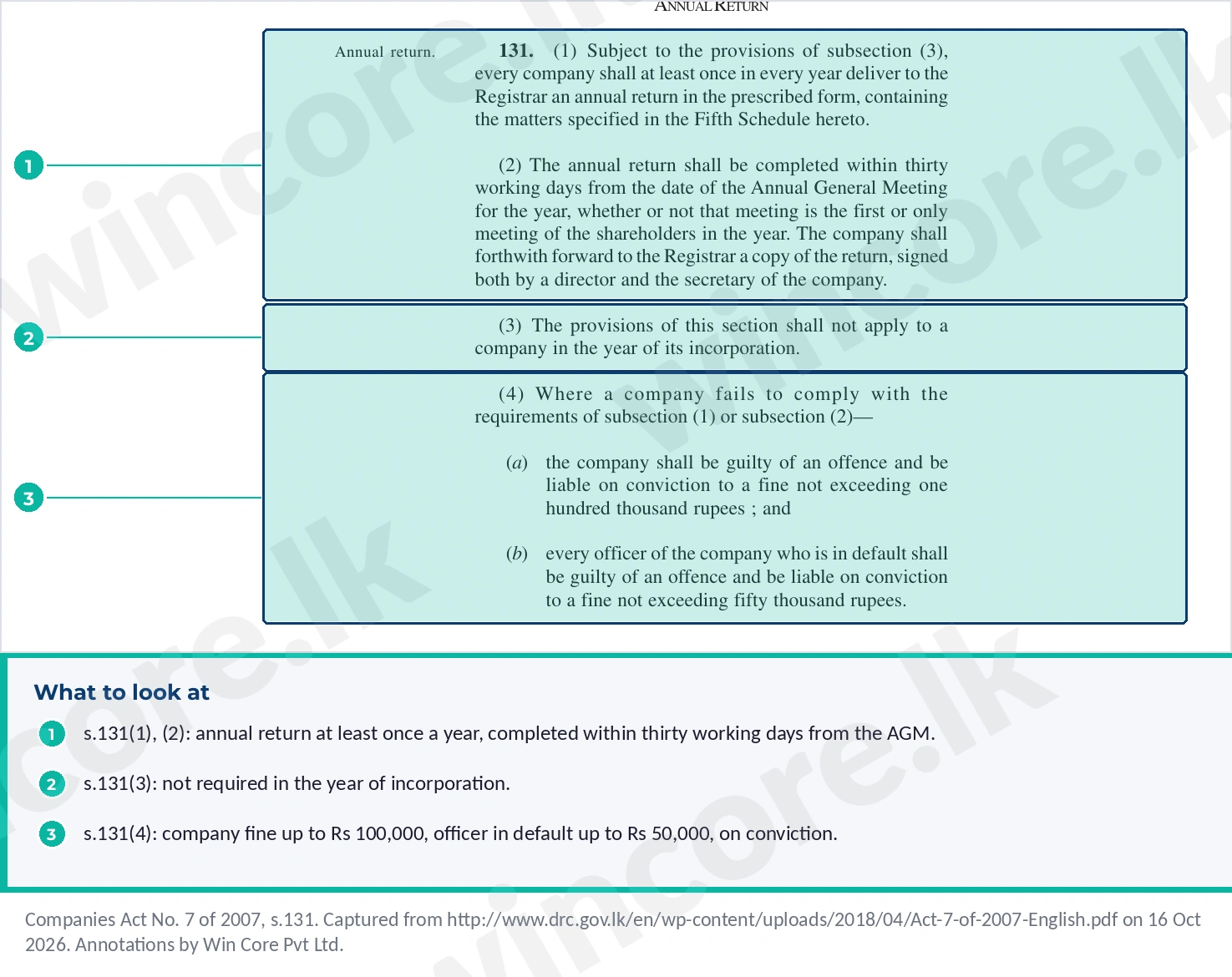
Section 131(1) requires "every company" to "deliver to the Registrar an annual return in the prescribed form, containing the matters specified in the Fifth Schedule hereto", subject to subsection (3) [1]. Section 131(2) sets the clock: "The annual return shall be completed within thirty working days from the date of the Annual General Meeting for the year, whether or not that meeting is the first or only meeting of the shareholders in the year. The company shall forthwith forward to the Registrar a copy of the return, signed both by a director and the secretary of the company" [1]. Section 131(3) adds: "The provisions of this section shall not apply to a company in the year of its incorporation."
The deadline counts working days. Section 529(1) defines "working day" as "a day other than Saturday, Sunday or a public holiday" [1]. The Registrar's guidelines page names the form: "FORM 15 : Annual Return of a Company (other than a Company Limited by Guarantee)" [3].
With the return, every private company also sends, under section 132, a directors' declaration that "to the best of their knowledge and belief, they have done all things required to be done by them by or under this Act", and a certificate by a director and the secretary that the company has not invited the public to subscribe for its shares or debentures since the last return (or, for a first return, since incorporation), plus a note on any excess over fifty shareholders [1].
The Fifth Schedule decides what the return contains
The Fifth Schedule lists the matters, "other than any matters which are specified in regulations made under this Act, as matters which all companies or any class of companies may omit from their annual return" [1]. In short:
- (a) the shareholders "on the fourteenth day from the date of the first or only ordinary general meering in the year" (the misprint is the Act's), and those who ceased to be shareholders since the last return or, for a first return, since incorporation;
- (b) names and addresses of past and present shareholders, shares held, and transfers with their registration dates;
- (c) date of incorporation and any change of name;
- (d) the registered office address;
- (e) to (j) shares issued, stated capital, forfeited shares and share warrant details;
- (k) the particulars of directors and the secretary required in the register of directors and secretaries;
- (l) "the total amount of the indebtedness of the company in respect of all mortgages and charges which are required to be registered with the Registrar under this Act";
- (m) "the name and address of the auditor of the company, at the date of the return" [1].
The Third Schedule says sub-paragraphs (b) and (e) to (j) do not apply to companies limited by guarantee [1], which have no shares. Regulations can allow omissions for a class of companies; we have not reviewed any such regulations for this piece.
The list is built from the share register, the register of directors and secretaries, and the charges on file. If those are out of date, the return cannot be right.
Late filing is a fine on conviction, set by the section you missed
The Companies (Fees) Orders in Gazette 2496/03 list "For registration of an annual return" at Rs 7,900.00, excluding VAT [2]. We read the whole two-page schedule on 22 October 2026 and it has no separate late-filing item. The cost of lateness under the Act is a criminal fine, imposed by a court on conviction, and it depends on which duty was missed:
| Default | Section | What the section says |
|---|---|---|
| Annual return not delivered, or not completed within thirty working days of the AGM | s.131(4) | Company: "liable on conviction to a fine not exceeding one hundred thousand rupees"; every officer in default: "a fine not exceeding fifty thousand rupees" [1] |
| AGM not held as section 133(1) requires, Registrar's directions under s.133(3) not followed, or s.133(4) not complied with | s.133(6) | Company: fine not exceeding Rs 100,000; every officer in default: fine not exceeding Rs 50,000, on conviction [1] |
| Copy of a section 144 resolution not sent to non-signing shareholders within five working days | s.144(6) | Company: fine not exceeding Rs 100,000; every officer in default: Rs 50,000, on conviction [1] |
| Financial statements not completed within six months (or the Registrar's extended period) | s.150(2) | Every director in default: fine not exceeding Rs 100,000, on conviction [1] |
In practice the Registrar need not go to court. Section 514(1) applies where a company has defaulted on a duty to "file with or deliver or send to the Registrar any account, document or return": the Registrar "may, if he thinks fit, instead of instituting proceedings in court", accept from the company or the officer "such sum of money as the Registrar may think proper in composition of the offence" [1]. Once a composition sum is accepted, section 514(2) bars proceedings for that offence; if it is not paid within one month of the date fixed, section 514(3) lets the Registrar report the default to a Magistrate and recover it as if it were a fine. The Act sets no amount for the composition sum, so check the figure on the eROC payment screen.
What about the general penalty added in 2025? Section 513A, inserted by the Companies (Amendment) Act, No. 12 of 2025 (in operation from 30 March 2026), applies to a contravention "for which no punishment is expressly provided for such offence" [4]. Sections 131(4), 133(6) and 144(6) each provide a punishment, so on our reading section 513A does not apply to these defaults. Do not quote its Rs 1,000,000 maximum for a late annual return. Our explainer on the Companies (Amendment) Act No. 12 of 2025 covers section 513A in full.
A missed first AGM has its own consequences
If the AGM is missed, section 133(3) lets "any shareholder of the company" apply to the Registrar, who may "call or direct the calling of an annual general meeting" and give ancillary directions, including that one shareholder present is deemed to be a meeting [1]. That power applies "Where default is made in holding a meeting of the company in accordance with the provisions of this section", which on our reading includes the first AGM under subsection (2).
Under section 133(4), a meeting held under the Registrar's direction in a later year is not treated as the AGM for the year in which it is held "unless at that meeting the company resolves that it shall be so treated", and section 133(5) requires a copy of that resolution to reach the Registrar within ten working days [1].
One gap to note. The fine in section 133(6) applies to default "in accordance with the provisions of subsection (1)", and to subsections (3) and (4). It does not name subsection (2). Whether missing the eighteen month first AGM is itself caught by section 133(6), or falls to the general penalty in section 513A, is an open point.
Checklist: documents needed
- Certificate of incorporation, to fix the eighteen month date
- The first balance sheet date and the six month date that follows it
- The share register, updated for every transfer and allotment
- The register of directors and secretaries, with all Form 20 changes filed
- Details of registered charges and the amount outstanding
- The auditor's name and address at the date of the return
- Minutes of the AGM, or the signed section 144 resolution with its date
- The section 132 directors' declaration and the director and secretary certificate
What this means for you
Put the first AGM date in the diary the day the company is incorporated. Count eighteen months from incorporation, then count six months from the first balance sheet date, and hold the meeting by the earlier of the two if you want no argument. The accounts and the board's annual report are due six months after the balance sheet date in any case.
Count thirty working days from the AGM, or on our reading from a section 144 resolution, to complete the return, and forward it to the Registrar straight away. Update the registers before you start, because the Fifth Schedule is built from them. Our annual filing checklist lays out the dates.
If you are already late, file. The fines are on conviction, set by the specific section, and the Registrar may accept a composition sum under section 514 instead of prosecuting. Our company secretarial services team prepares AGM papers, written resolutions and Form 15, and our annual return filing service covers catch-up filings. For the 2026 fee schedule, see our piece on the Companies (Fees) Orders in Gazette 2496/03.
Open points we have not settled
- Whether the six month rule in section 133(1)(a) or the eighteen month rule in section 133(2) governs the first AGM where they differ: our reading is section 133(2), not confirmed by the Registrar.
- Which date starts the section 131(2) clock when the AGM is replaced by a section 144 resolution.
- Whether missing the first AGM under section 133(2) is caught by the fine in section 133(6).
- Any regulations allowing classes of companies to omit Fifth Schedule matters: not reviewed.
- How the Registrar sets the composition sum under section 514: the Act gives no figure, and we have not found a published scale.
FAQ
When must a new company in Sri Lanka hold its first AGM?
Within eighteen months of incorporation, under section 133(2) of the Companies Act. The company need not hold it in the calendar year of incorporation. Where six months after the first balance sheet date falls earlier, our reading is that the eighteen months governs, but holding the meeting by the earlier date avoids any argument with the Registrar.
Do we file an annual return in the year we incorporate?
No. Section 131(3) says the annual return section does not apply to a company in the year of its incorporation. The first Form 15 follows the first AGM and is completed within thirty working days of that meeting. A company incorporated in mid-2025, for example, files its first return after its first AGM in 2026.
Can a small company skip the AGM?
Yes, if everything required at the meeting is done by a written resolution under section 144, signed by shareholders holding at least 85 percent of the votes, subject to the articles. A copy must go to every shareholder who did not sign within five working days, and missing that is an offence under section 144(6).
What is the penalty for a late Form 15 in Sri Lanka?
A fine on conviction of up to Rs 100,000 for the company and Rs 50,000 for each officer in default, under section 131(4). Gazette 2496/03 has no separate late fee. Instead of prosecuting, the Registrar may accept a composition sum under section 514, which eROC shows at payment.
Are the thirty days counted in calendar days?
No. Section 131(2) says thirty working days from the AGM, and section 529 defines a working day as a day other than Saturday, Sunday or a public holiday. Count forward from the meeting date and keep the count with the AGM minutes, so the deadline can be shown later.
Talk to us. If your first AGM is coming up, or a return has already slipped, book a consultation at our contact page.
WinCore Pvt Ltd
This article is general information on the law as at 22 October 2026 and is not advice on your specific position.
References
- Parliament of Sri Lanka. Companies Act, No. 7 of 2007, ss.131, 132, 133, 144, 150, 166, 171, 514 and 529, Third and Fifth Schedules. http://www.drc.gov.lk/en/wp-content/uploads/2018/04/Act-7-of-2007-English.pdf . Primary. Accessed 22 October 2026.
- Minister of Trade, Commerce, Food Security and Co-operative Development. Companies (Fees) Orders, Gazette Extraordinary No. 2496/03 (6 July 2026), item 6. https://documents.gov.lk/api/content-file-proxy?file=/extra-gazette-content/2496-03_E_1786417202.pdf . Primary. Accessed 22 October 2026.
- Department of the Registrar of Companies. Guidelines and Necessary Documents. https://drc.gov.lk/en/?page_id=2741 . Primary (form name only; fees on this page are out of date). Accessed 15 October 2026.
- Parliament of Sri Lanka. Companies (Amendment) Act, No. 12 of 2025, s.19 inserting s.513A. https://www.parliament.lk/uploads/acts/gbills/english/6389.pdf . Primary. Accessed 22 October 2026.
Put these insights to work
WinCore specialists can review your current workflow, document gaps, and build a practical 90-day action plan.
Book a free consultationContinue reading
Explore more WinCore analysis to keep your finance, tax, and compliance roadmap moving.
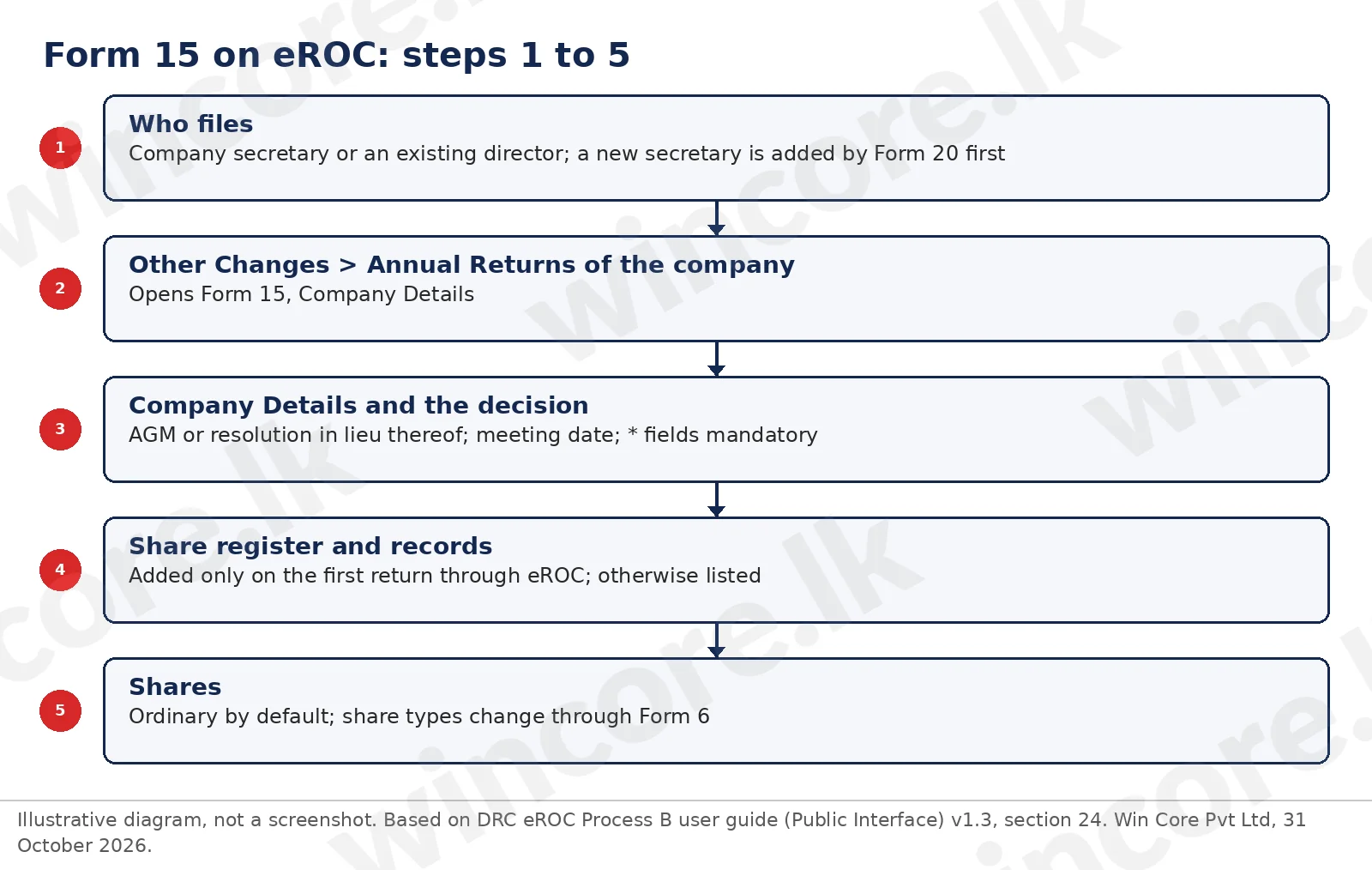
Treat Form 15 as a live governance filing: the 30-working-day clock from the AGM, the BO 4 that goes with it, the fee, and the controls that keep it on time.
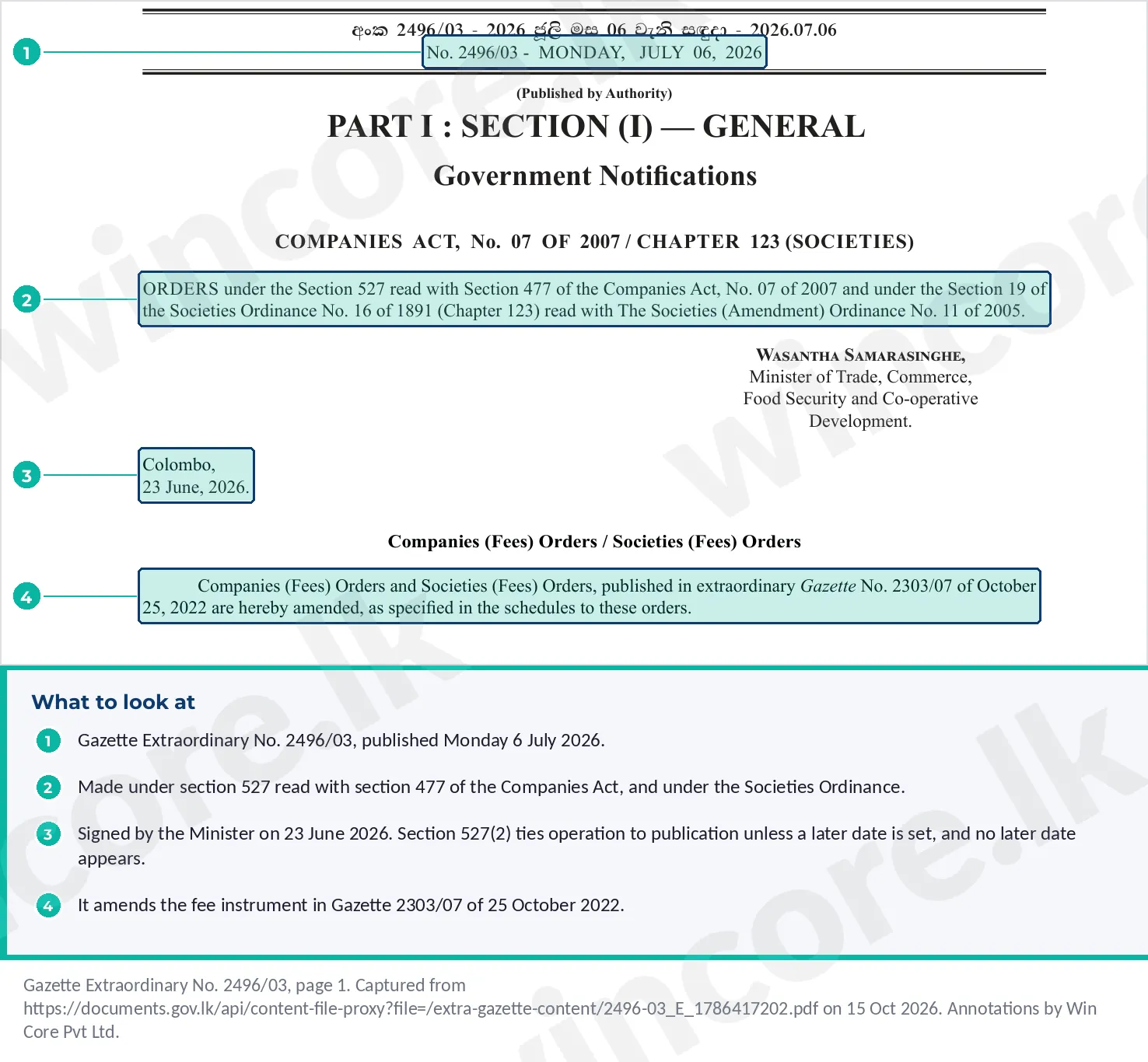
The instrument behind this year's Registrar of Companies fee rise: what it amends, when it took effect, the Parliament step still open and the odd item 13.
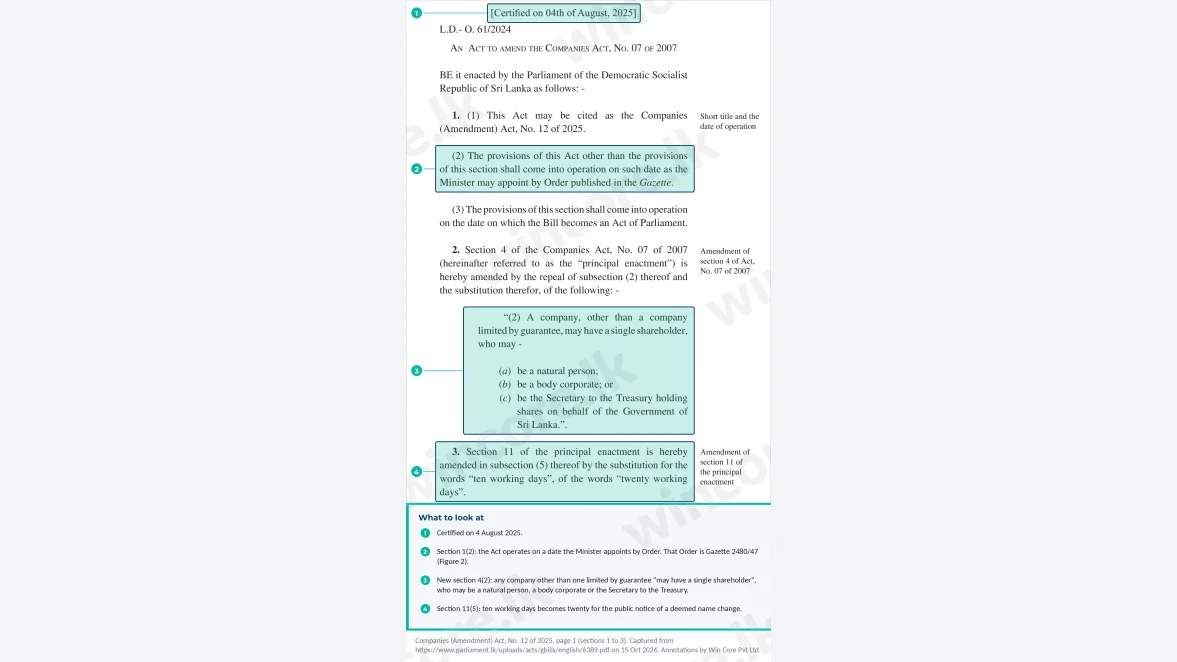
Beyond beneficial ownership, the 2025 amending Act ended bearer shares, moved allotments to working days and added a Rs 1 million general penalty.