
First financial year 15 months Sri Lanka: the section 171 test
A new company's first year end, counted from incorporation: when the Companies Act allows a long first period, and why the tax year does not stretch.
On this page
Last verified against the primary sources on 22 October 2026.
A new company's first financial year can run up to 15 months in Sri Lanka, but only on two conditions in section 171(2) of the Companies Act, No. 7 of 2007: the first balance sheet date must fall in the calendar year after incorporation, and it must be "not later than fifteen months" after incorporation. If either fails, section 171(1) requires a balance sheet date in the year of incorporation itself. The tax year does not stretch with it: section 20(1) of the Inland Revenue Act fixes the year of assessment at 1 April to 31 March. For what comes next, see the first 90 days after company registration.
The first accounting period of a new company is a fence post problem. The company starts on the day it is incorporated, but the law wants a year end in every calendar year. The first period is the gap between the start and the first post, and its length depends on where you put that post.
Founders often hear that "the first year can be up to fifteen months". Sometimes it can. With the usual 31 March year end, though, the first period often turns out shorter than twelve months. This piece works through three hypothetical companies, counted date by date, from section 171 of the Companies Act and section 20 of the Inland Revenue Act, No. 24 of 2017.
Section 171 allows a 15 month first financial year only in a narrow window
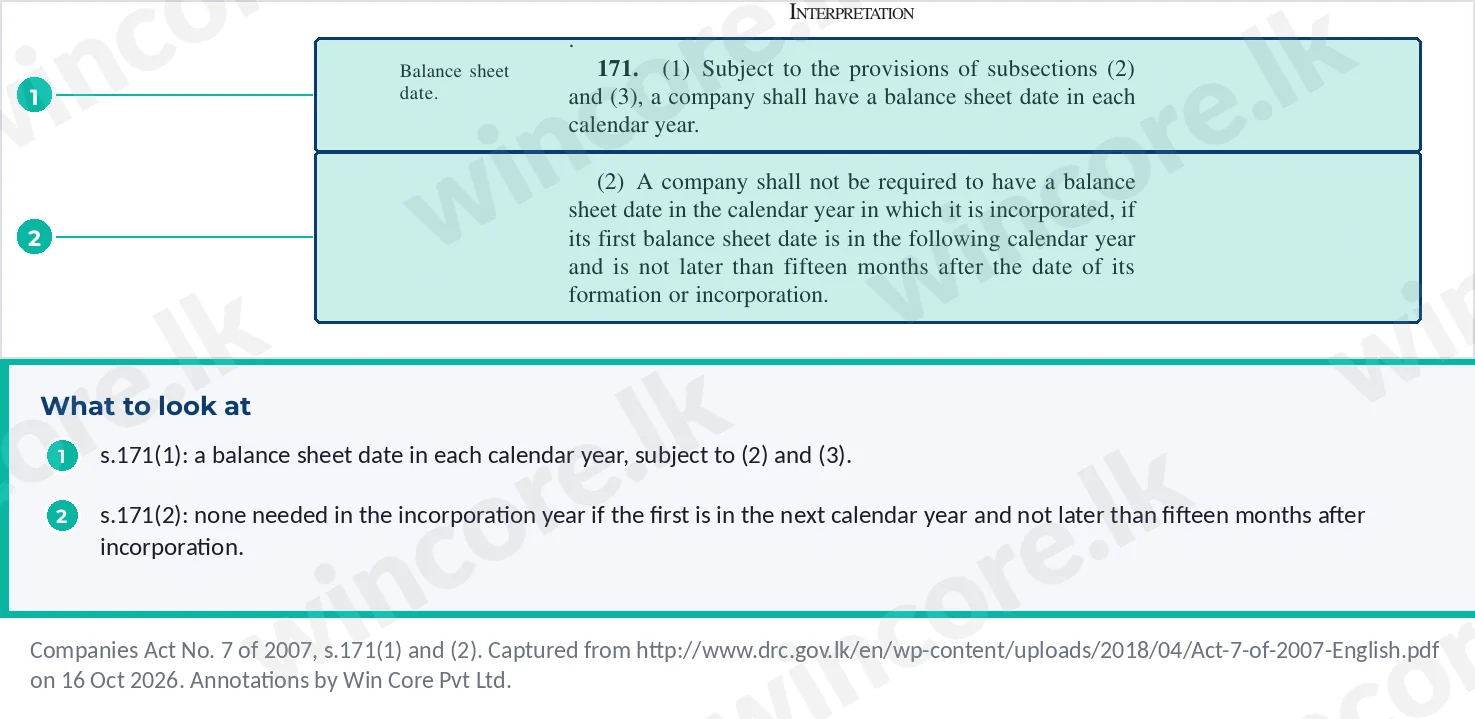
Section 171(1) says: "Subject to the provisions of subsections (2) and (3), a company shall have a balance sheet date in each calendar year" [1].
Section 171(2) is the first year exception: "A company shall not be required to have a balance sheet date in the calendar year in which it is incorporated, if its first balance sheet date is in the following calendar year and is not later than fifteen months after the date of its formation or incorporation" [1].
Read the exception closely. It has two conditions, and both must hold:
- the first balance sheet date is "in the following calendar year"; and
- it is "not later than fifteen months after the date of its formation or incorporation".
If either fails, the exception does not apply and section 171(1) requires a balance sheet date in the calendar year of incorporation.
Counting the dates shows when the long first period works
All three companies are hypothetical. Each date is our count.
Incorporated 1 December 2025, wants a 31 March year end. Fifteen months from 1 December 2025 is 1 March 2027. A first balance sheet date of 31 March 2027 is later than that, so condition 2 fails. It is also in 2027, two calendar years after incorporation, so condition 1 fails too. A first balance sheet date of 31 March 2026 meets both conditions, so no balance sheet date is needed in 2025, and the first period runs four months, from 1 December 2025 to 31 March 2026. To adopt or change the date, see the Form 17 steps on eROC.
Incorporated 1 June 2025, wants a 31 March year end. Fifteen months from 1 June 2025 is 1 September 2026. A first balance sheet date of 31 March 2026 is in the following calendar year and within fifteen months, so it works, and the first period is ten months. 31 March 2027 would be twenty-two months and fails both conditions.
Incorporated 1 October 2025, wants a 31 December year end. Fifteen months from 1 October 2025 is 1 January 2027. A first balance sheet date of 31 December 2026 is in the following calendar year, 2026, and before 1 January 2027, so both conditions hold. No balance sheet date is needed in 2025, and the first period is fifteen months. (It could also choose 31 December 2025, a three month first period, since section 171(1) is satisfied either way.)
So the answer to the headline question is yes, but only in a narrow window. The first balance sheet date must land in the next calendar year and within fifteen months, so a first period longer than twelve months needs incorporation in the three months up to the chosen year end date: October to December for a 31 December year end, January to March for a 31 March year end. With a 31 March year end, a first period of more than twelve months is possible only for a company incorporated between January and March. A company incorporated from April to December with a 31 March year end has a first period of twelve months or less.
Changing the balance sheet date later needs the Registrar's prior approval
Section 171(3) reads, as printed: "Where a company changes its balance sheet date, it shall be required to have a balance sheet date in a calendar year if (a) the period between any two balance sheet dates does not exceed fifteen months ; and (b) the Registrar approves the change of balance sheet date before it is made" [1]. The wording is awkward and we do not paraphrase it; the two conditions, a fifteen month limit and prior approval, are clear. For the request on eROC, see how to ask the Registrar for prior approval.
Section 171(4) says the Registrar "may approve a change of balance sheet date for the purposes of subsection (3), with or without conditions", and section 171(5) adds that "the period between any two balance sheet dates shall not exceed fifteen months" [1]. Section 171(6) says the adoption or change "shall have effect upon receipt of a notice by the Registrar to that effect". Subsections (7) and (8) deal with subsidiaries' balance sheet dates [1].
So who decides? The Registrar approves, before the change. A board resolution alone does not change the date, and on our reading a change approved after the old date has passed is not what section 171(3)(b) describes.
The tax year stays 1 April to 31 March whatever the accounts say
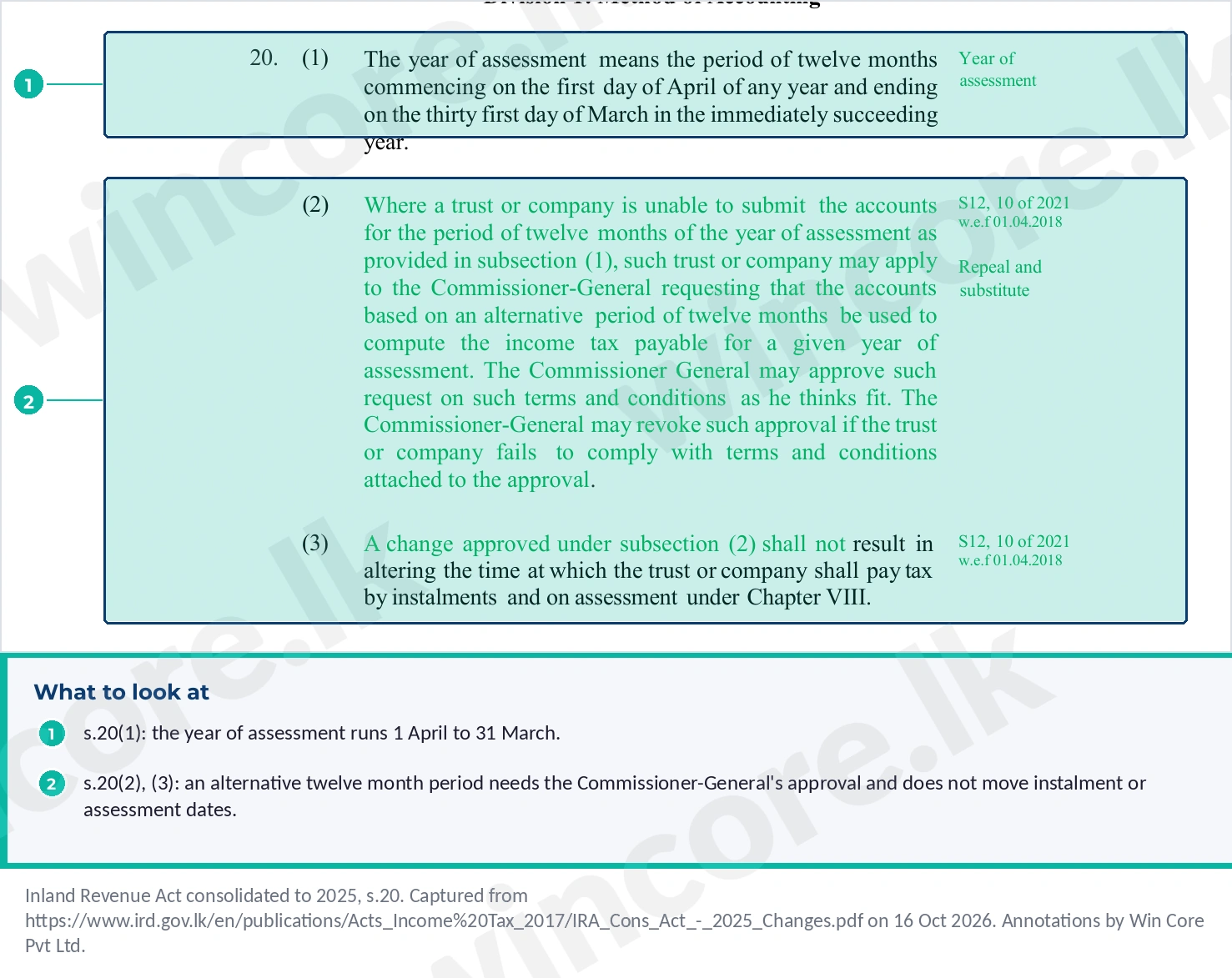
Company law and tax law count years differently. Section 20(1) of the Inland Revenue Act says "The year of assessment means the period of twelve months commencing on the first day of April of any year and ending on the thirty first day of March in the immediately succeeding year" [2].
Section 20(2) allows a company that "is unable to submit the accounts for the period of twelve months of the year of assessment" to apply to the Commissioner-General "requesting that the accounts based on an alternative period of twelve months be used to compute the income tax payable for a given year of assessment". The Commissioner-General "may approve such request on such terms and conditions as he thinks fit" and "may revoke such approval if the trust or company fails to comply with terms and conditions attached to the approval" [2]. Section 20(3) adds that an approved change "shall not result in altering the time at which the trust or company shall pay tax by instalments and on assessment under Chapter VIII" [2].
Two points follow. First, the alternative period in section 20(2) is "an alternative period of twelve months", not fifteen. Second, a fifteen month first accounting period, such as 1 October 2025 to 31 December 2026, covers part of the year of assessment 2025/2026 (1 October 2025 to 31 March 2026) and part of 2026/2027. Section 20 does not say how such a period is split between years of assessment. On our reading the income of each year of assessment has to be identified, but the method is not set out in section 20, so we keep it as an open point. A company planning a long first period, or any year end other than 31 March, should settle this before the year end; our piece on changing your financial year-end covers the section 20(2) application, and our income tax services team handles it.
The first balance sheet date starts the AGM and accounts clocks
Section 150(1) requires the financial statements "within six months or within such extended period as may be determined by the Registrar after the balance sheet date" [1]. Section 133(2) requires the first annual general meeting (AGM) "within eighteen months of its incorporation" [1].
A long first period squeezes the gap between the year end and the first AGM. For the company incorporated on 1 October 2025, the first balance sheet date is 31 December 2026. Eighteen months from incorporation is 1 April 2027, so the first AGM deadline falls three months after the year end, before the section 150 accounts deadline of 30 June 2027 (our counts). The accounts have to be ready for that meeting, so the long first period gives the accountant three months, not six. Our companion piece on the first AGM within eighteen months works through the AGM rules.
Section 171 has no penalty of its own, so section 513A fills the gap
We read all eight subsections of section 171 on 22 October 2026; none states a penalty. The Companies (Amendment) Act, No. 12 of 2025 inserted section 513A, in operation from 30 March 2026. Section 513A(1) applies where "A person, a director, a secretary or an officer ... contravenes or fails to comply with any provisions of this Act or any regulation made thereunder for which no punishment is expressly provided for such offence", with a fine "not exceeding one million rupees" or imprisonment "not exceeding six months", or both, on conviction [3]. Section 513A(2) adds that where a body corporate is in breach and no punishment is expressly provided, every director, manager or secretary is deemed to have committed an offence, with a fine not exceeding Rs 500,000 or imprisonment not exceeding one year, or both [3]. That subsection continues with a proviso we did not read in full today; our explainer on the Companies (Amendment) Act No. 12 of 2025 records it as a defence for those who prove no knowledge or due diligence.
On our reading section 513A is the penalty that would apply to a breach of section 171. Late financial statements are a separate default with their own penalty under section 150(2): a fine not exceeding Rs 100,000 for each director in default, on conviction [1].
Checklist: documents needed
- Certificate of incorporation showing the incorporation date
- Board resolution fixing the first balance sheet date
- A dated count from incorporation to the proposed first balance sheet date
- Any Registrar approval of a change of balance sheet date, obtained before the change
- Any Commissioner-General approval of an alternative twelve month tax period
- A diary of the section 150 accounts date and the section 133(2) first AGM date
What this means for you
Count the months before you pick the date. The fifteen month first financial year is real, but it needs the first balance sheet date to be in the calendar year after incorporation and within fifteen months. With a 31 March year end, expect a short first period unless you incorporate between January and March.
Do not assume a long first period changes the tax year. The year of assessment is fixed at 1 April to 31 March, and an alternative period under section 20(2) is twelve months and needs the Commissioner-General's approval. If you want to change the balance sheet date later, apply to the Registrar first.
If you are setting up now, our private limited company registration service fixes the first balance sheet date with you at incorporation, and our accounting services team prepares the first accounts. For the wider set-up, see our startup accounting guide, and use the annual filing checklist to diary the dates.
Open points we have not settled
- How income in a first accounting period longer than twelve months is split between years of assessment: not set out in section 20.
- Whether the Registrar has issued any guidance on applying section 171(2): not found.
- Whether section 513A is applied to section 171 breaches in practice: our reading only.
- The full text of the proviso to section 513A(2): not read today.
FAQ
Can our first financial year be fifteen months in Sri Lanka?
Yes, but only if the first balance sheet date is in the calendar year after incorporation and not later than fifteen months after incorporation, under section 171(2). Both conditions must hold. With a 31 March year end that works only for companies incorporated between January and March; later incorporations get a shorter first period.
We were incorporated in December. Can we use 31 March of the year after next?
No. That date is more than fifteen months away and falls two calendar years after incorporation, so both conditions in section 171(2) fail. You need a balance sheet date in the next calendar year, which with a 31 March year end means a first period of about four months.
Can the board change the year end by resolution?
Not by itself. Section 171(3)(b) requires the Registrar to approve the change of balance sheet date before it is made, and section 171(5) caps the gap between any two balance sheet dates at fifteen months. The change takes effect when the Registrar receives notice of it, under section 171(6).
Does a fifteen month accounting period mean a fifteen month tax year?
No. Section 20(1) of the Inland Revenue Act fixes the year of assessment as 1 April to 31 March. Section 20(2) allows an alternative period, but only of twelve months and only with the Commissioner-General's approval, and section 20(3) keeps instalment and assessment payment dates where they were.
What happens if we get the first balance sheet date wrong?
Section 171 states no penalty of its own. On our reading the general penalty in section 513A, added in 2025, would apply: up to Rs 1 million or six months for a person, and up to Rs 500,000 or one year for directors where the company is in breach. Late accounts carry their own fine under section 150(2).
Talk to us. If you are choosing a first year end, or need to move one, book a consultation at our contact page.
WinCore Pvt Ltd
This article is general information on the law as at 22 October 2026 and is not advice on your specific position.
References
- Parliament of Sri Lanka. Companies Act, No. 7 of 2007, ss.133, 150 and 171. http://www.drc.gov.lk/en/wp-content/uploads/2018/04/Act-7-of-2007-English.pdf . Primary. Accessed 22 October 2026 (s.171(2) read from the captured page, Figure 1).
- Inland Revenue Department. Inland Revenue Act, No. 24 of 2017, consolidated with amendments to 2025, s.20. https://www.ird.gov.lk/en/publications/Acts_Income%20Tax_2017/IRA_Cons_Act_-_2025_Changes.pdf . Primary (consolidation). Accessed 22 October 2026.
- Parliament of Sri Lanka. Companies (Amendment) Act, No. 12 of 2025, s.19 inserting s.513A. https://www.parliament.lk/uploads/acts/gbills/english/6389.pdf . Primary. Accessed 22 October 2026.
Put these insights to work
WinCore specialists can review your current workflow, document gaps, and build a practical 90-day action plan.
Book a free consultationContinue reading
Explore more WinCore analysis to keep your finance, tax, and compliance roadmap moving.

Changing a company's year-end in Sri Lanka: the section 20(2) application to the IRD, what does not move, the AGM consequence and the controls to rebuild.

New companies in Sri Lanka face eight or more compliance registrations in year one. Here is how to set up your books, register for taxes, and stay clean.
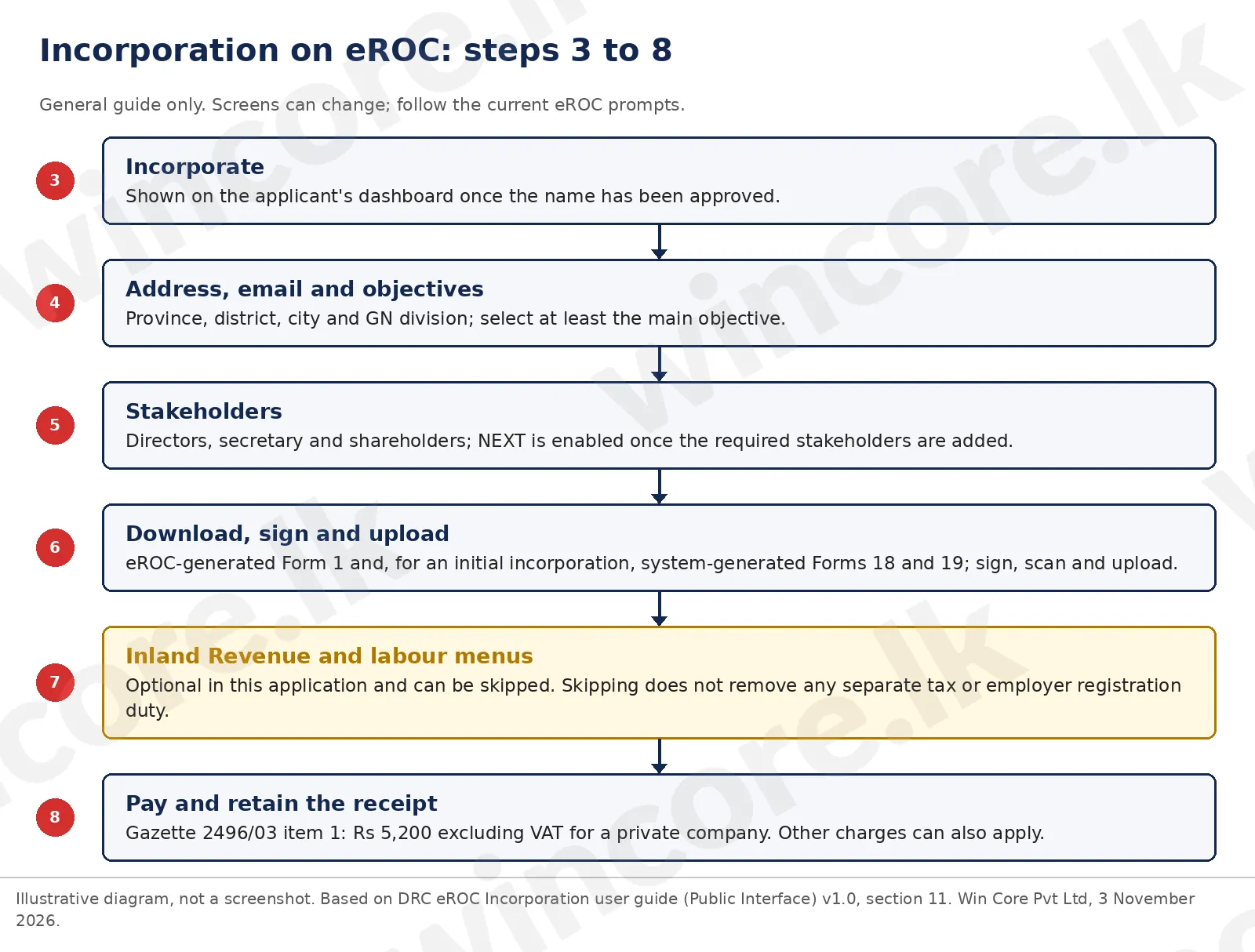
Registering a private limited company in Sri Lanka in 2026: structure, name approval, the eROC filing with BO 1 and BO 5, the TIN and the first year.