
Startup accounting in Sri Lanka: bookkeeping, tax registrations, and first-year compliance guide 2026
New companies in Sri Lanka face eight or more compliance registrations in year one. Here is how to set up your books, register for taxes, and stay clean.

On this page
Last verified against the primary sources on 15 October 2026.
Getting a company registered with the Registrar of Companies (ROC) is straightforward. What trips up most Sri Lankan startups is what comes after: the company TIN, which must be obtained within 30 days of incorporation [1]; RAMIS access; APIT registration before the first payroll; EPF registration and ETF contributions, which apply from the first employee with no minimum headcount [2]; SSCL registration once quarterly turnover exceeds or is likely to exceed Rs 9 million [3]; and VAT registration once taxable supplies exceed Rs 15 million in a quarter [4]. Miss any of these, and back-assessments, penalties and interest start accumulating quietly.
The accounting and compliance setup for a new Sri Lankan company is not complicated, but it is time-sequenced. Certain registrations must happen before you make your first payment to an employee. Others are triggered when you cross a revenue threshold. Understanding the sequence, and acting on it in the right order, keeps your first year clean.
This guide covers the registrations, the records you must keep, and the deadlines you will face in year one, in the order they happen.
What accounting records every Sri Lanka startup must keep by law
From the day your company begins trading, it must keep books of account. Section 120 of the Inland Revenue Act No. 24 of 2017 requires a taxpayer engaged in business to keep and maintain in Sri Lanka records and accounts sufficient to record all transactions and to ascertain the gains and profits made or the loss incurred, and to retain the source documents behind them [5].
In practice, that means:
- A record of all income received, by source and date
- A record of all expenses paid, with supporting invoices and receipts
- A bank account used only for business transactions
- A payroll register if you have employees
- An asset register if you purchase fixed assets
- A VAT input and output record if you are VAT-registered
Records must be kept for five years from the date of the transaction, or longer where the time limit for assessing the relevant tax period has not expired or related proceedings are still running [5]. Do not dispose of early-year records assuming the company has moved on.
Setting up your bookkeeping system: options for new companies
The choice of bookkeeping system matters less than consistency and correctness. The most common setups used by Sri Lankan companies are:
Spreadsheets (limited): Fine for a sole trader or micro-business with under 50 transactions per month. Breaks down under volume, hard to audit, and creates reconciliation problems at VAT filing time.
Cloud accounting software: The recommended approach for any company that intends to scale. Xero, QuickBooks Online and Zoho Books are all used by Sri Lankan accountants. Bank feeds or statement imports cut manual data entry, multi-user access means your accountant can work in the same file, and VAT reports can be compiled directly from the system.
Local ERP or industry software: Some manufacturing, retail and hospitality businesses use industry-specific software with integrated accounting modules. These work, but check what the system can export for your returns before committing.
Whatever system you choose, the golden rule for Sri Lanka startups is: run a separate business bank account from day one. Mixing personal and business transactions through one account is the most common cause of bookkeeping problems when it is time to file.
Tax registrations every new company needs, and when
The registrations below apply to nearly every private limited company incorporated in Sri Lanka. Complete them in this sequence.
1. TIN from the IRD: within 30 days of incorporation
Every company must register with the IRD not later than 30 days after incorporation [1]. Without a TIN you cannot pay APIT, file VAT returns or file an income tax return. Apply through IRD e-services immediately after incorporation; the application needs your Certificate of Incorporation and the directors' details. The company itself is exempt from the TIN certificate check that applies to individuals from 1 November 2026, but its directors and shareholders are not [6]. See our TIN certificate guide.
2. RAMIS portal access: as soon as the TIN is issued
RAMIS (Revenue Administration Management Information System) is the IRD's e-filing portal. Income tax, VAT, APIT and WHT returns are filed through it. Set up the company's access as soon as the TIN is issued.
3. APIT registration as employer: before your first payroll
When your company hires its first employee, it becomes an APIT (Advance Personal Income Tax) withholding agent. Register for APIT before the first salary payment. Tax withheld each month is paid within 15 days after the end of the month [5]. Late payment carries a penalty of 20 percent of the tax due but not paid under section 179(1) if the tax is still unpaid fourteen days after the due date [5] [7], plus interest at 1.5 percent a month or part of a month under section 159(1) [5]. See the APIT registration guide for the registration process.
4. EPF registration: when your first employee starts
The Employees' Provident Fund (EPF) applies from your first employee; there is no minimum headcount. The EPF Department states that an employer "having even one employee is legally bound to pay contributions to EPF" [2]. Register by sending Form D to the nearest Labour Office, and you receive an EPF employer number [2]. Form D is due within two weeks of becoming liable to contribute, which in practice is the day the first employee joins [8]; the EPF Department puts it as within 14 days of recruiting the first employee [2]. The employer contributes 12 percent and the employee 8 percent of total earnings, due by the last day of the following month [9]. Registering late means back-payment of contributions and surcharges for the unregistered period.
5. ETF contributions: from the first employee
The Employees' Trust Fund (ETF) also applies from your first employee. Unlike EPF, ETF has no registration procedure before contributions are made; contributions are paid under your EPF employer number [10]. The employer contributes 3 percent of each employee's total earnings, by the last day of the following month [11]. The 15-employee figure you may have seen relates only to the payment method: from July 2026 contributions, employers with 15 or more employees must pay ETF and file ETF returns electronically [12].
6. VAT registration: when taxable supplies exceed Rs 15 million in a quarter
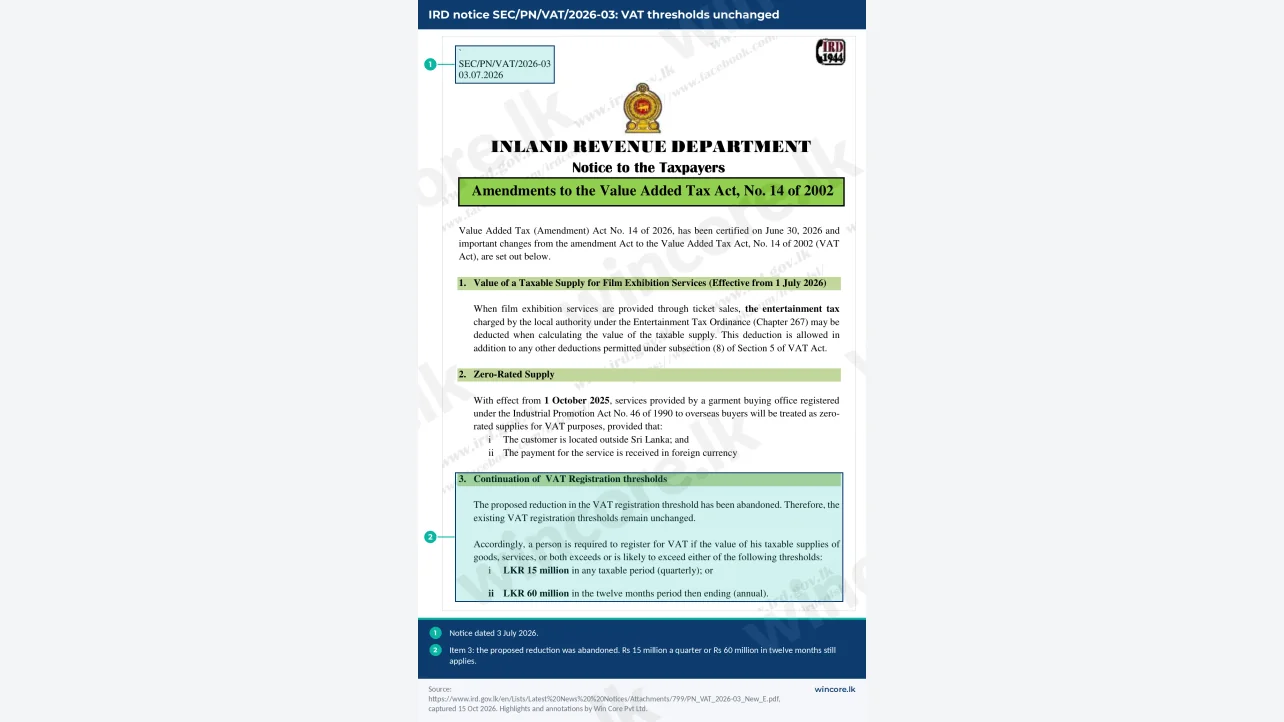
The VAT registration threshold is Rs 15 million in a quarter or Rs 60 million in the twelve months then ending [4]. A cut to Rs 9 million per quarter was proposed but abandoned; the VAT (Amendment) Act No. 14 of 2026 kept the existing threshold [13]. Apply within 15 days of becoming liable [4]. The standard VAT rate is 18 percent [14]. The VAT return is due by the last day of the month after the end of each taxable period [4]. See our guide to the VAT registration thresholds for the tests and worked cases.
7. SSCL (Social Security Contribution Levy): when quarterly turnover exceeds or is likely to exceed Rs 9 million
From 1 July 2026, SSCL at 2.5 percent applies once turnover exceeds, or is likely to exceed, Rs 9 million in a quarter (Rs 36 million over four consecutive quarters) [3]. That is lower than the VAT threshold, so a startup can need SSCL registration before it needs VAT registration. Register within 15 days of crossing, or expecting to cross, the threshold [3]. The levy is paid monthly by the 20th of the following month and the return is filed quarterly by the 20th of the month after the quarter [15]. See the SSCL threshold guide.
8. Annual return to the Registrar: Form 15 after each AGM
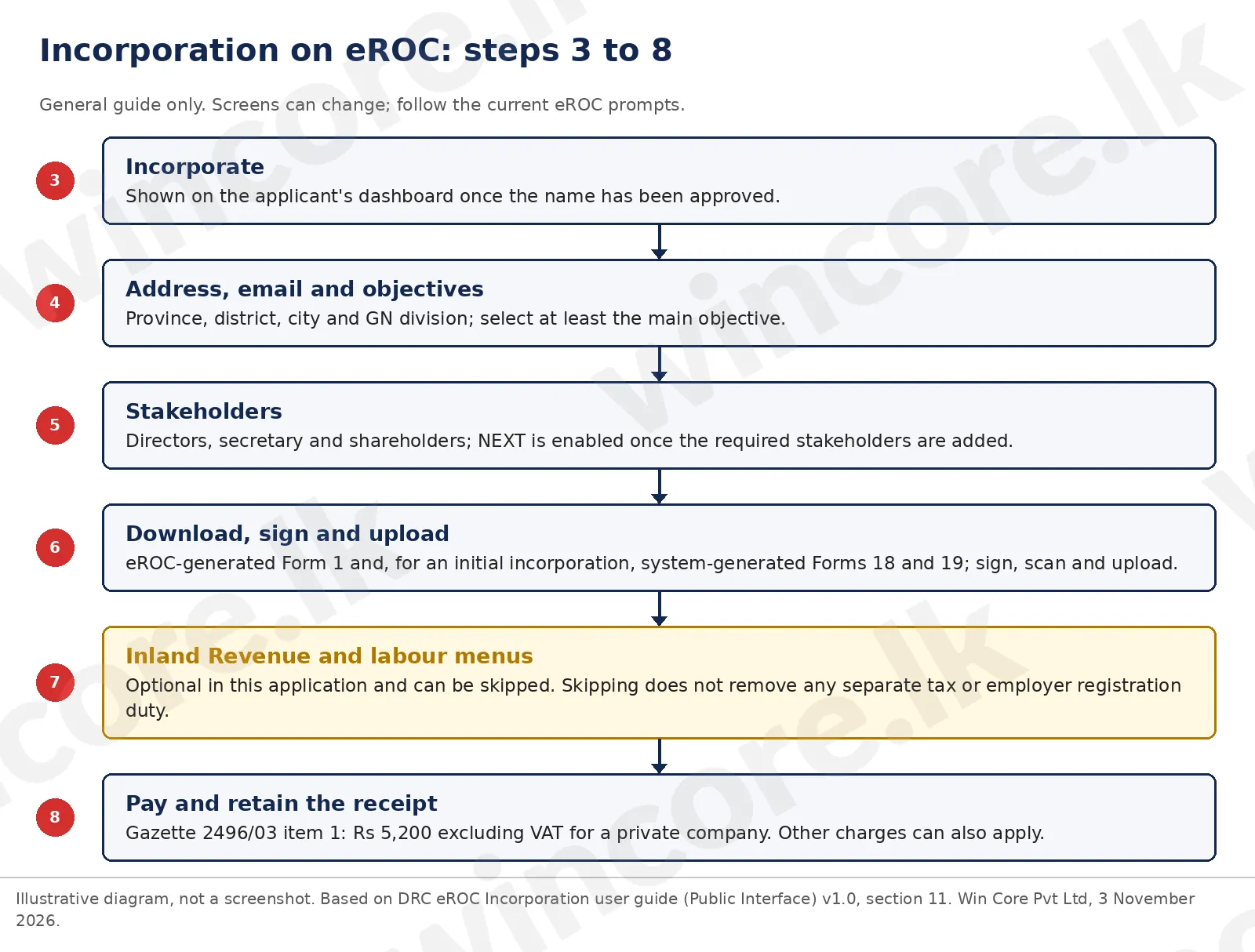
A company does not file an annual return in its year of incorporation. Its first AGM must be held within 18 months of incorporation, and the annual return on Form 15 is due within 30 working days of each AGM [16]. This is a company law obligation, not a tax one, and a late return is an offence [16]. See our Form 15 guide and our guide on how to register a company in Sri Lanka.
Your first-year compliance calendar: deadlines by month
The table below maps the most common deadlines a new Sri Lanka company faces in its first operating year.
| Obligation | Who it applies to | Deadline |
|---|---|---|
| TIN registration | All companies | Within 30 days of incorporation [1] |
| EPF registration (Form D) | Companies with 1 or more employees | Within two weeks of the first employee joining [8] |
| APIT registration | Companies with 1 or more employees | Before first payroll |
| APIT monthly payment | All employers | Within 15 days after the month ends [5] |
| EPF and ETF monthly payment | All employers | Last day of following month [9] |
| SSCL registration | Turnover of Rs 9 million a quarter (from 1 July 2026) | Within 15 days of crossing [3] |
| VAT registration | Over Rs 15 million a quarter or Rs 60 million in 12 months | Within 15 days of becoming liable [4] |
| VAT return | VAT-registered | Last day of the month after the period ends [4] |
| Income tax quarterly instalment | All instalment payers | Quarterly, on the prior year's tax; dates in the IRD Tax Calendar [17] |
| APIT annual statement | All employers | 30 April [5] |
| Income tax return | All companies (31 March year end) | 30 November [17] |
| First AGM, then Form 15 | All companies | AGM within 18 months of incorporation; Form 15 within 30 working days of it [16] |
The Statement of Estimated Tax (SET) has been discontinued; instalments are worked out from the previous year's tax [1]. Our guide to quarterly instalments after SET explains the calculation, and the tax compliance calendar 2026 gives a consolidated view.
Common mistakes that create problems in year one
Registering for VAT late: Many founders wait until they have "comfortably" crossed the threshold before registering. VAT liability runs from when you became liable to register, not from the date you registered, so the IRD can assess VAT for the period you should have been registered, with penalties and interest on top.
Assuming EPF or ETF only starts at 15 employees: Both schemes apply from the first employee; the 15-employee figure is only the ETF Board's cut-off for mandatory electronic payment and returns [12]. Companies that delayed EPF registration or ETF payments face back-contributions and surcharges from the date the first employee started.
No T/D/16 declaration from employees: The T/D/16 is the employee's declaration to the employer on how APIT should be withheld. Without it, the employer must treat the job as secondary employment and deduct under IRD APIT Tax Table No. 07, at up to 36 percent where the employee's primary employment income is not disclosed. Collect this from every employee before the first payroll run.
Using last year's APIT tables: The five-band APIT structure (6 to 36 percent with Rs 1,800,000 personal relief) has been in effect since 1 April 2025 [5]. If your payroll system defaulted to pre-2025 tables, with a 12 percent band and the old relief amount, every deduction since April 2025 has been wrong. See the APIT deduction guide for the current tables.
Mixing personal and business accounts: Every expense claimed as a business deduction should trace to the company's bank account. Mixed accounts make it hard to reconstruct the accounts accurately and invite queries from the IRD.
When to outsource accounting versus hire in-house
The break-even point between outsourcing and hiring in-house depends on transaction volume, employee count and tax complexity.
As a practical guide for Sri Lankan startups:
| Stage | Employee count | Recommended model |
|---|---|---|
| Early / pre-revenue | 0 to 5 | Full outsourcing; no volume to justify in-house cost |
| Growth | 5 to 15 | Outsourced bookkeeping and tax; in-house admin assistant |
| Scaling | 15 to 50 | Hybrid: outsourced tax compliance, part-time in-house accounts executive |
| Established | 50+ | In-house accountant plus outsourced tax advisory and audit coordination |
Compare the fully loaded monthly cost of an in-house accountant (salary, the employer's EPF and ETF contributions and overheads) with the quoted cost of an outsourced service for the same scope.
The operational risk of in-house at the early stage is also single-point-of-failure: if your only accountant is sick, on leave or resigns mid-quarter, your APIT payments and VAT filings are at risk. Outsourcing spreads that risk.
Frequently asked questions
Does my company need to register for VAT on the day of incorporation?
No. Only if you expect to exceed Rs 15 million of taxable supplies in a quarter (or Rs 60 million over twelve months), or once you exceed it in a later quarter [4]. If your first quarter's turnover is nil, VAT registration is not yet required.
When does EPF registration become mandatory?
When your first employee starts; there is no minimum headcount [2]. Send Form D to the Labour Office within two weeks of the first employee joining [8]. ETF contributions (3 percent, employer only) also apply from the first employee, regardless of total headcount. The only 15-employee rule is that, from July 2026 contributions, employers with 15 or more employees must pay ETF and file ETF returns electronically [12].
Do I need a statutory audit in my first year?
Every company must appoint an auditor at each AGM under section 154(1) of the Companies Act No. 7 of 2007 [16], so plan for audited financial statements. The audit is separate from the tax return obligation.
What happens if we do not keep proper accounting records?
The Commissioner-General can direct you to keep specified records, in addition to prosecution [5]. The Assistant Commissioner is not bound by your return and may determine your tax from any information available, and if no return is filed may raise a default assessment to the best of his or her judgement [5]. A late return also attracts the section 178 penalty: the greater of 5 percent of the tax owing plus 1 percent a month, or Rs 50,000 plus Rs 10,000 a month, capped at Rs 400,000 a return [5].
Can I use the same accountant for both audit and bookkeeping?
Professional independence rules generally prevent the statutory auditor from also keeping the books of the same company, so plan for a separate auditor.
Talk to us. If you want the registrations, the chart of accounts and the first payroll set up in the right order, our accounting team can work through the first year with you; book a consultation at our contact page.
This guide is general information on the law as at 15 October 2026 and is not advice on your specific situation.
References
- Parliament of Sri Lanka. Inland Revenue (Amendment) Act, No. 11 of 2026, certified 3 June 2026, ss.16 and 23 (new s.102(1A)). https://www.ird.gov.lk/en/publications/Acts_Income%20Tax_2017/IR_Act_No_11-2026_E.pdf . Primary. Accessed 15 October 2026.
- Employees' Provident Fund Department. Registration of employers (Form D), web page. https://epf.lk/?p=163 . Primary. Accessed 15 October 2026.
- Parliament of Sri Lanka. Social Security Contribution Levy (Amendment) Act, No. 10 of 2026, ss.2 and 3. https://www.ird.gov.lk/en/publications/Acts_SSCL/SSCL_Act_No_10-2026_E.pdf . Primary. Accessed 15 October 2026.
- Inland Revenue Department. Value Added Tax Act, No. 14 of 2002, consolidated version up to 2025, s.10 and the return provisions. https://www.ird.gov.lk/en/publications/Value%20Added%20Tax_Acts/VAT_Act_No_14%5BE%5D_2002_%28Consolidation_2025%29.pdf . Primary. Accessed 15 October 2026.
- Inland Revenue Department. Inland Revenue Act, No. 24 of 2017, consolidated, ss.86(1) and (2), 120(1), (3), (5) and (6), 126(3), 133(1), 157, 159, 178, 179 and the First Schedule. https://www.ird.gov.lk/en/publications/Acts_Income%20Tax_2017/IRA_Cons_Act_-_2025_Changes.pdf . Primary. Accessed 15 October 2026.
- Inland Revenue Department. Circular SEC/2026/E/07: Mandatory Submission of TIN Certificate for Specified Transactions (22 September 2026), exemption (v). https://www.ird.gov.lk/en/publications/Circulars_Circulars/SEC_2026_E_07_E.pdf . Primary. Accessed 15 October 2026.
- Inland Revenue Department. Guide to the Return of Income Tax, Y/A 2025/26, Section 09, penalty of 20 percent of tax due but not paid, 10 percent on a late instalment, interest at 1.5 percent a month or part of a month. https://www.ird.gov.lk/en/Downloads/IT_Individuals_Doc/Asmt_IIT_004_2025_2026_E.pdf . Primary. Accessed 15 October 2026.
- Department of Labour. Employees' Provident Fund Regulations, 1958, regulation 8 (Form D within two weeks of becoming liable). https://labourdept.gov.lk/downloads/labour_code/48.pdf . Primary. Accessed 15 October 2026.
- Central Bank of Sri Lanka. Employees' Provident Fund Act, No. 15 of 1958 (reprint), s.10. https://www.cbsl.gov.lk/sites/default/files/cbslweb_documents/laws/acts/en/epf_act.pdf . Primary. Accessed 15 October 2026.
- Employees' Trust Fund Board. Payment of contributions, web page. https://etfb.lk/payment-of-contributions/ . Primary. Accessed 15 October 2026.
- Employees' Trust Fund Board. Employees' Trust Fund Act, No. 46 of 1980, s.16. https://etfb.lk/wp-content/uploads/2021/03/ETF-Act.pdf . Primary. Accessed 15 October 2026.
- Employees' Trust Fund Board. Notice: mandatory electronic payment of contributions and returns (April 2026). https://etfb.lk/wp-content/uploads/2026/04/NOTICE-Mandatory-Electronic-Payment-English.pdf . Primary. Accessed 15 October 2026.
- Inland Revenue Department. Notice to the Taxpayers: Amendments to the Value Added Tax Act, SEC/PN/VAT/2026-03 (3 July 2026), item 3. https://www.ird.gov.lk/en/Lists/Latest%20News%20%20Notices/Attachments/799/PN_VAT_2026-03_New_E.pdf . Primary. Accessed 15 October 2026.
- Inland Revenue Department. VAT rate order, Gazette Extraordinary No. 2363/22 (19 December 2023). https://www.ird.gov.lk/en/publications/Gazette_Documents/2023_2363-22_E.pdf . Primary. Accessed 15 October 2026.
- Inland Revenue Department. Social Security Contribution Levy Act, No. 25 of 2022, consolidated up to 2026, ss.8(1) and 17(1). https://www.ird.gov.lk/si/publications/Acts_SSCL/SSCL_Cons_Act_-_2026_Changes.pdf . Primary. Accessed 15 October 2026.
- Parliament of Sri Lanka. Companies Act, No. 7 of 2007, ss.131(2) to (4), 133(2) and 154(1). https://drc.gov.lk/en/wp-content/uploads/2018/04/Act-7-of-2007-English.pdf . Primary. Accessed 15 October 2026.
- Inland Revenue Department. Tax Calendar 2026. https://www.ird.gov.lk/en/publications/Tax%20Calendar_Documents/Tax_Calendar_2026_E.pdf . Primary. Accessed 15 October 2026.
Put these insights to work
WinCore specialists can review your current workflow, document gaps, and build a practical 90-day action plan.
Book a free consultationContinue reading
Explore more WinCore analysis to keep your finance, tax, and compliance roadmap moving.
Registering a private limited company in Sri Lanka in 2026: structure, name approval, the eROC filing with BO 1 and BO 5, the TIN and the first year.
The VAT registration tests are Rs 15 million a quarter or Rs 60 million over 12 months. How the tests run, the 15 day rule and who must register.

The employer's guide to EPF and ETF in Sri Lanka for 2026: who is covered, 8, 12 and 3 percent, what counts as earnings, the due date, the surcharge ladder and forms.