
VAT registration: the thresholds that still apply
The VAT registration tests are Rs 15 million a quarter or Rs 60 million over 12 months. How the tests run, the 15 day rule and who must register.
On this page
Last verified against the primary sources on 15 October 2026.
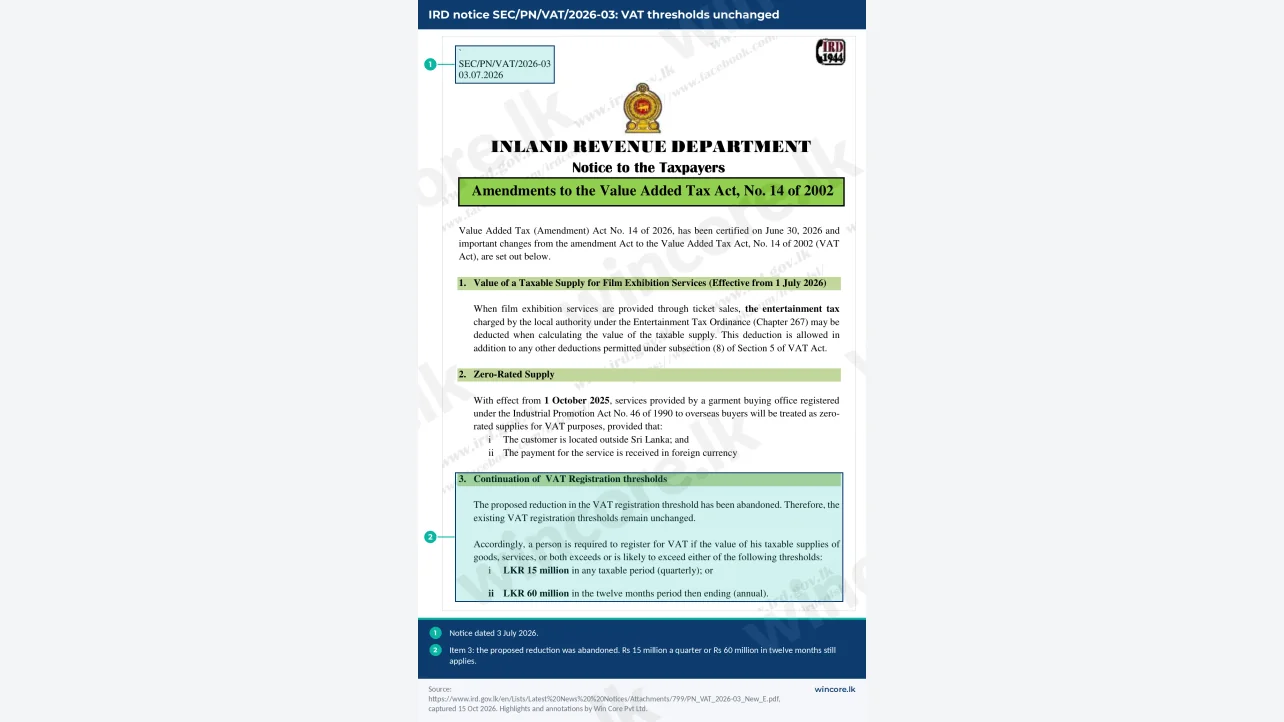
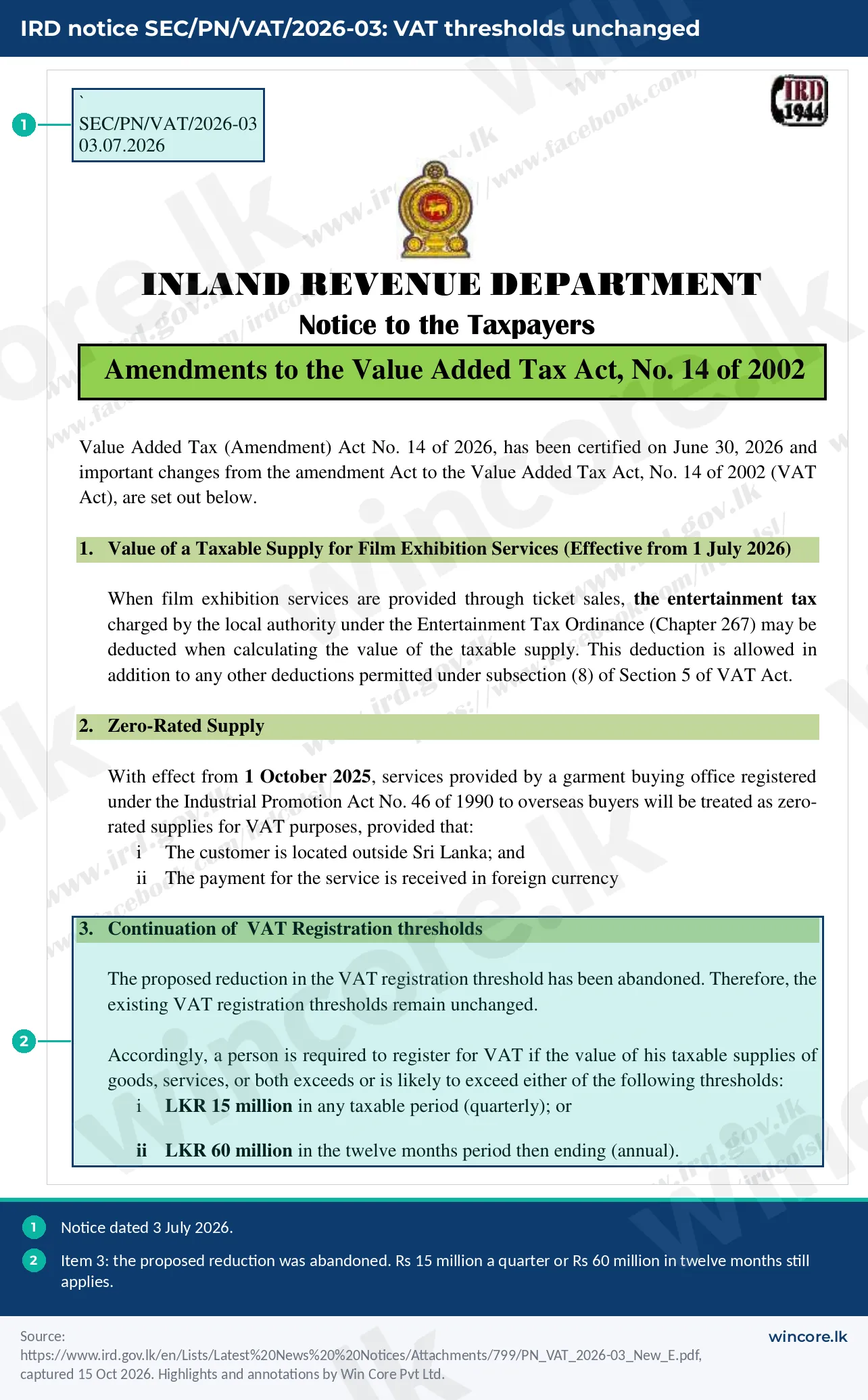
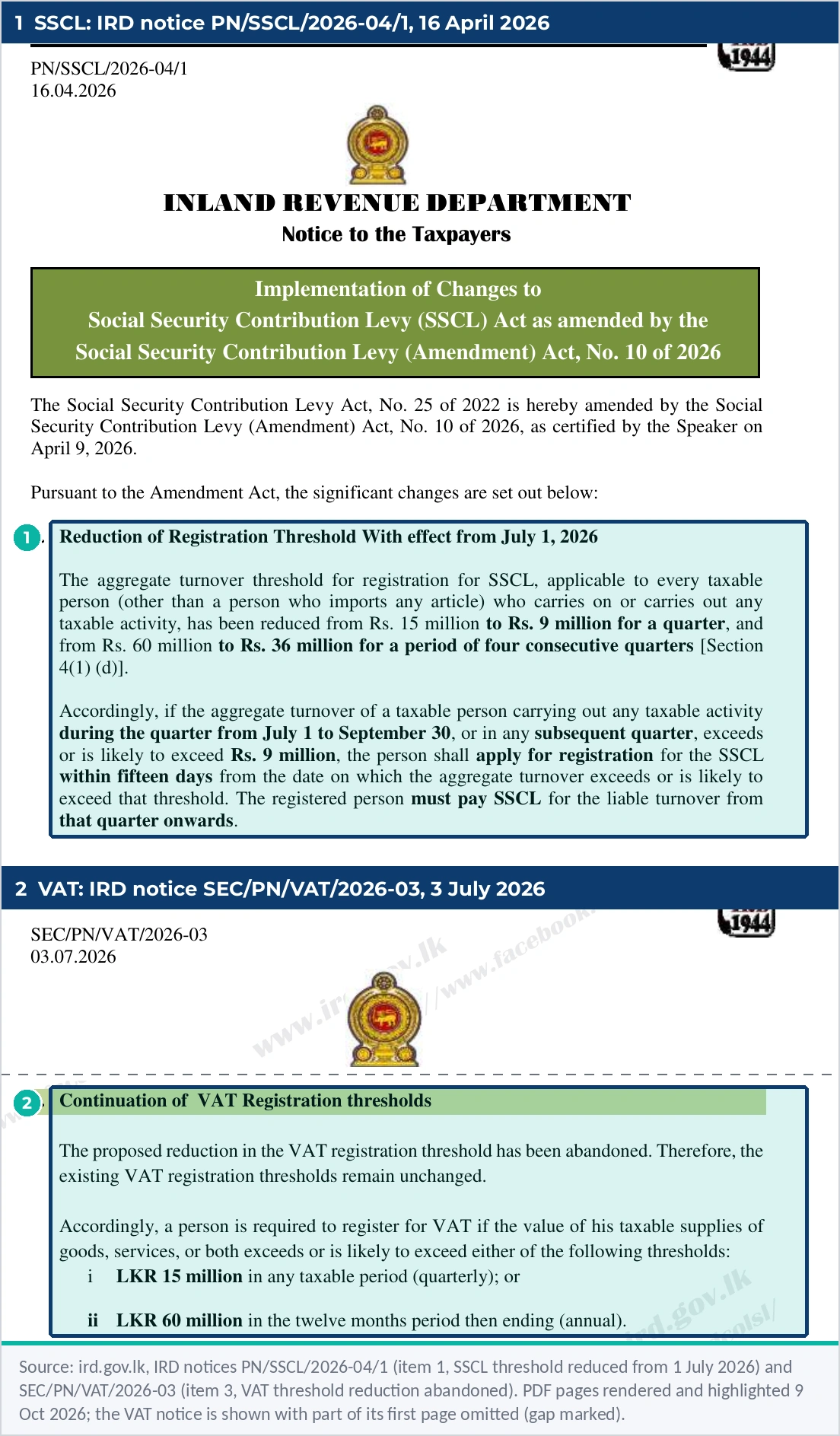
VAT registration asks two questions at the end of every taxable period, and one about the future. Have your taxable supplies in the period exceeded Rs 15 million? Have they exceeded Rs 60 million in the twelve months then ending? Are there reasonable grounds to expect either line to be crossed next? A yes to any of them means you must apply to register within 15 days [1]. The rate is 18 percent [1]. A Budget proposal to cut the thresholds to Rs 9 million a quarter and Rs 36 million a year was not carried into the VAT Act; the Inland Revenue Department (IRD) says the proposed reduction "has been abandoned" and the existing thresholds "remain unchanged" [2] [6].
Take a hypothetical retailer. In one quarter its taxable supplies reach Rs 16 million while its twelve-month total is still Rs 48 million. The quarterly test alone requires registration. Now take a steady business with quarters of Rs 14 million, Rs 14 million, Rs 14 million and then Rs 20 million. Nothing trips for three quarters: the twelve-month total after the third quarter is Rs 42 million. In the fourth quarter both tests trip at once, at Rs 20 million for the quarter and Rs 62 million for the year. The twelve-month test did not get there first, and with quarterly periods it never can: four quarters of Rs 15 million or less cannot add up to more than Rs 60 million.
This guide covers the two tests and the forward-looking limb, the persons who must register whatever their turnover, the difference from SSCL, and the application. It does not cover input tax recovery or the Simplified VAT scheme.
Checklist: documents needed
- Monthly sales ledger split between taxable and exempt supplies
- Totals for the current taxable period and the twelve months then ending
- Forecast for the next period and the next twelve months
- Signed contracts that will change the forecast
- TIN and a description of the taxable activity
- Separate SSCL working (different thresholds)
- Proof of the date you applied
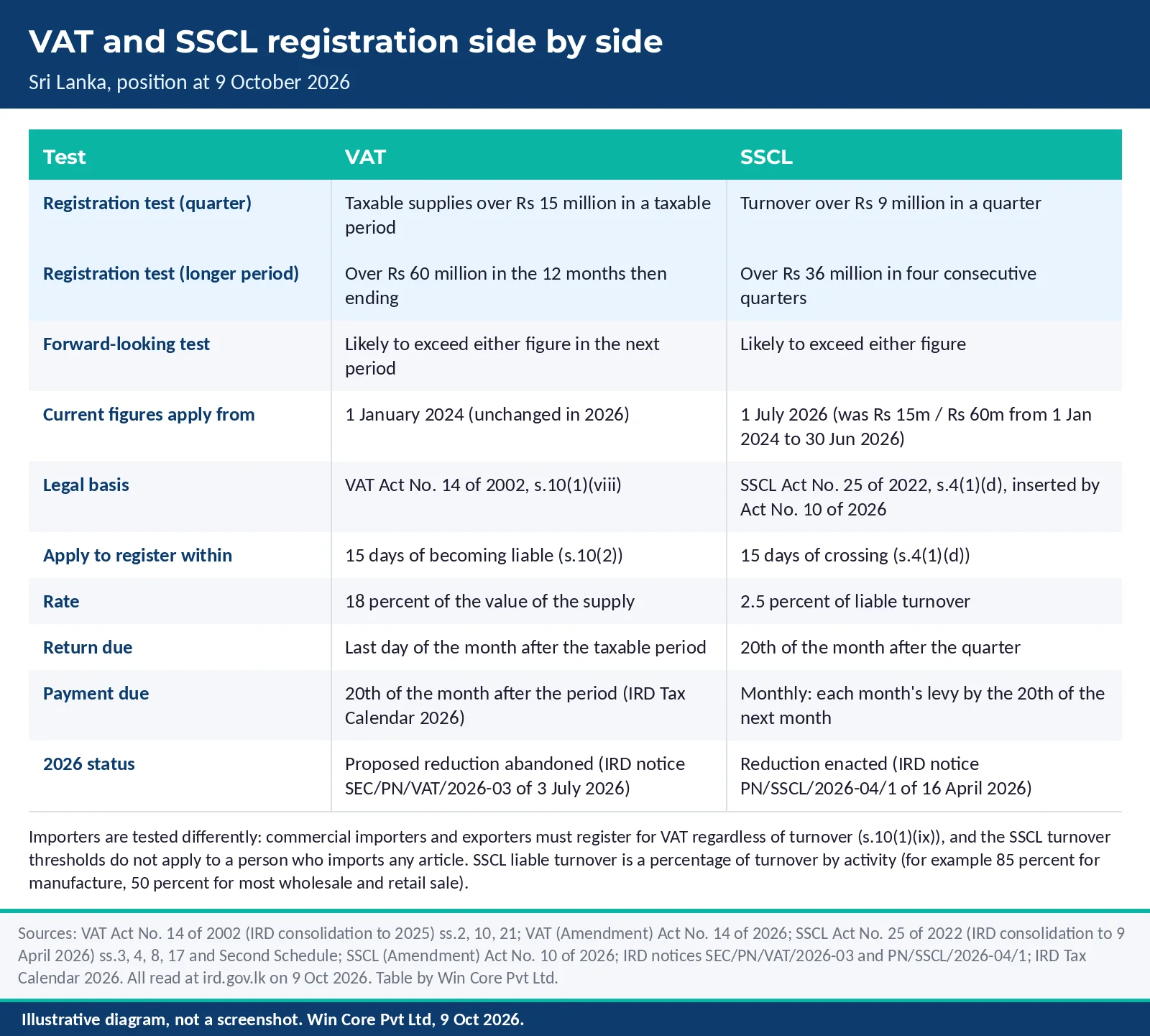
The current position, in one table
Step 1. Test both thresholds at the end of every period
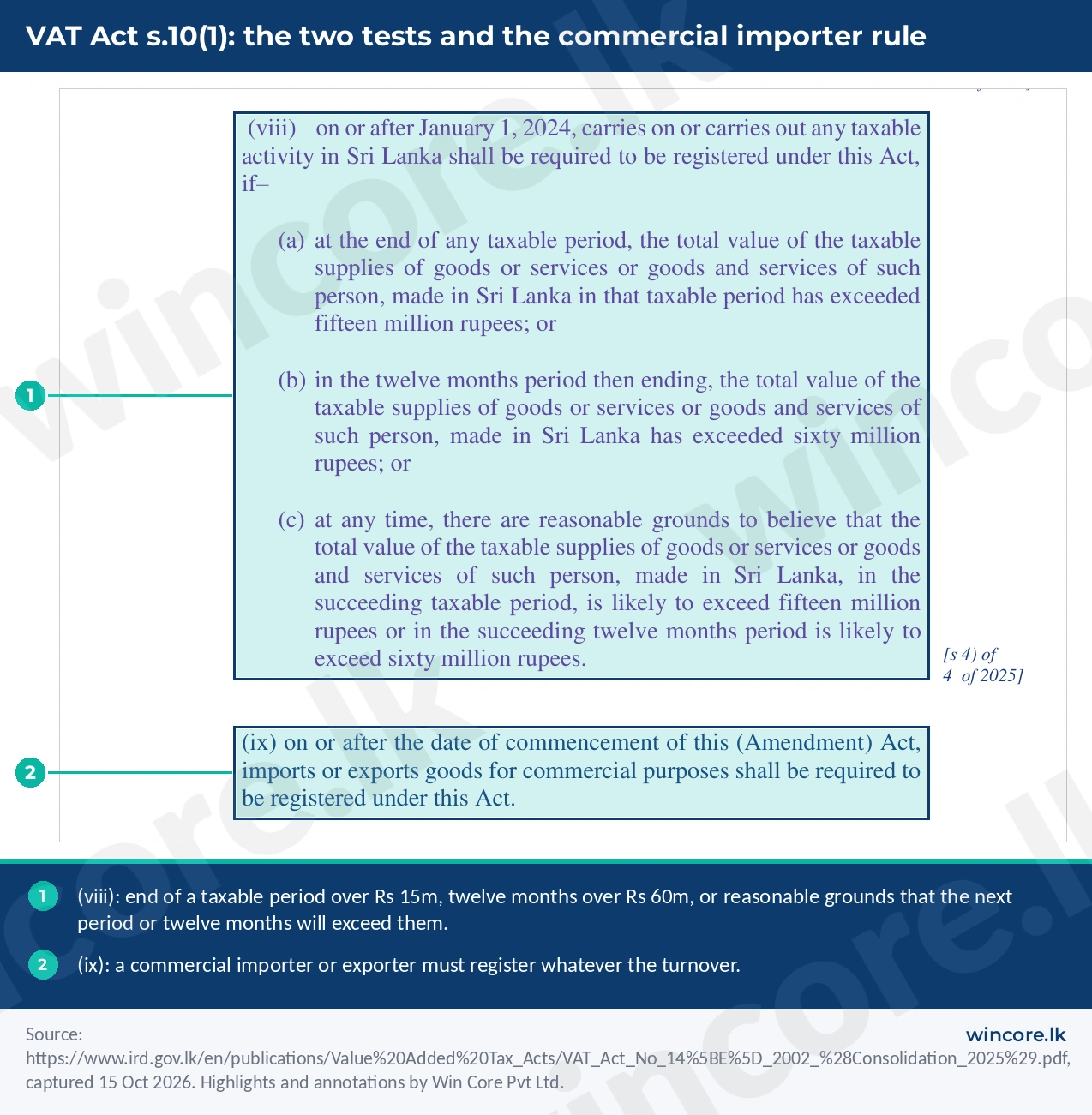
What to do. At the end of each taxable period, add your taxable supplies for that period and for the twelve months then ending. Exclude exempt supplies. Under s.10(1)(viii) of the VAT Act, registration is required if the period's total "has exceeded fifteen million rupees", or the twelve-month total "has exceeded sixty million rupees" [1]. The two tests are independent; either one is enough. For a wholesale or retail trader, s.10 also leaves out the value of goods bought locally and sold without any process, "unless" the trader's total supplies for a three-month period, counting excluded and exempt supplies, reach a set level; the last level in the consolidated text is Rs 12.5 million a quarter for periods from 1 November 2016 [1]. The provision has been amended five times and its wording is hard to apply to periods after 2020, so a trader relying on it should check its position with us before deciding not to register.
Where. Your sales ledger.
What you need. An accurate split of taxable and exempt supplies.
What goes wrong. Using the old Rs 80 million figure, or the Rs 36 million proposal that never became law. Watching only the annual figure and missing one strong quarter. Including exempt supplies. Treating exactly Rs 15 million as over the line: the Act says "exceeded".
How long. Part of the monthly close.
Instrument: Value Added Tax Act, No. 14 of 2002, s.10(1)(viii)(a) and (b) (consolidated to 2025); IRD Notice SEC/PN/VAT/2026-03, item 3. Official link: VAT Act, consolidation 2025. Last verified: 15 Oct 2026.
Where registration follows earlier purchases, review the special rules for pre-registration input VAT instead of assuming every old invoice is claimable.
If the test was crossed in an earlier period, follow the late-registration review and evidence checklist instead of using the current quarter alone.
Step 2. Look forward as well as back
What to do. Under s.10(1)(viii)(c) you are also liable "at any time" there are reasonable grounds to believe that taxable supplies in the next taxable period are likely to exceed Rs 15 million, or in the next twelve months are likely to exceed Rs 60 million [1]. A signed contract, a confirmed order book or a new branch can create those grounds before a single invoice is raised.
Where. Your forecast and contract register.
What you need. A forecast for the next quarter and the next twelve months, updated when a large contract is signed.
What goes wrong. Waiting for the ledger to show the crossing when the contract already showed it. The 15 days can start on the day you sign.
How long. A short review whenever a large contract is signed.
Instrument: VAT Act, s.10(1)(viii)(c). Official link: VAT Act, consolidation 2025. Last verified: 15 Oct 2026.
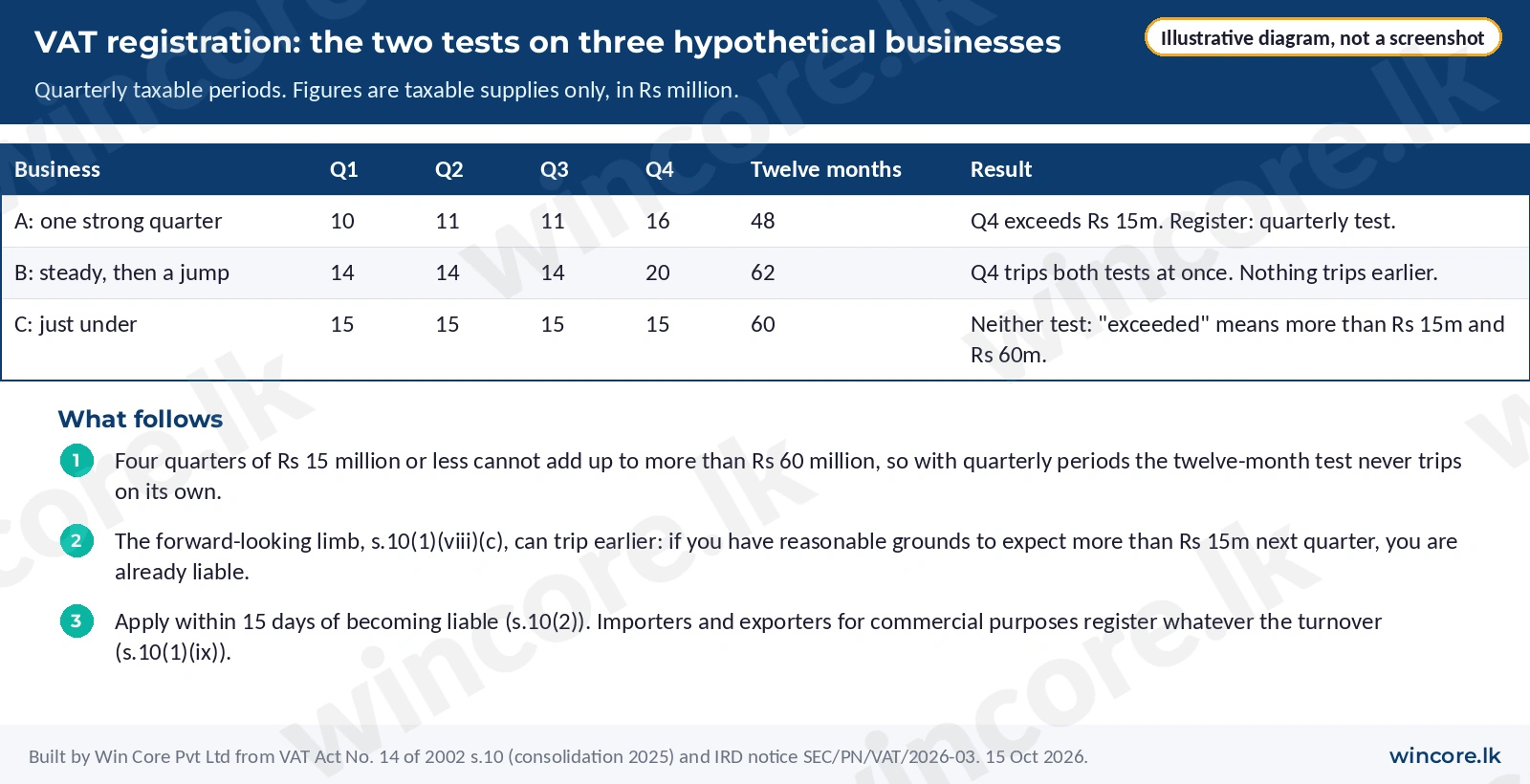
Business C in Figure 3 is the edge case people ask about. Four quarters of exactly Rs 15 million each give Rs 60 million for the year. Neither figure has "exceeded" its line, so on actual figures neither test is met. That business is one invoice away from registration, though, and if its forecast shows the next quarter above Rs 15 million, the forward-looking limb already applies. We would not run a business that close to the line without a dated forecast on file.
Step 3. Check whether you must register whatever your turnover
What to do. Some persons register regardless of the thresholds. Under s.10(1)(ix), a person who "imports or exports goods for commercial purposes shall be required to be registered" [1]. From 1 July 2026, a non-resident supplying services to persons in Sri Lanka through an electronic platform has its own test in new s.25L: Rs 60 million in the twelve months then ending or Rs 15 million in a quarter, with an electronic application within three months [3].
Where. Your import and export records, and for a non-resident platform, its Sri Lankan sales report.
What you need. Customs declarations, and a clear statement of what you import or export and why.
What goes wrong. Assuming a small importer is outside VAT because its turnover is low. Applying the 15 day rule to a non-resident digital supplier, whose period is three months.
How long. A short check once a year, and whenever the business starts importing.
Instrument: VAT Act, s.10(1)(ix); VAT (Amendment) Act, No. 14 of 2026, new s.25L. Official link: VAT (Amendment) Act No. 14 of 2026. Last verified: 15 Oct 2026.
Step 4. Keep VAT and SSCL apart
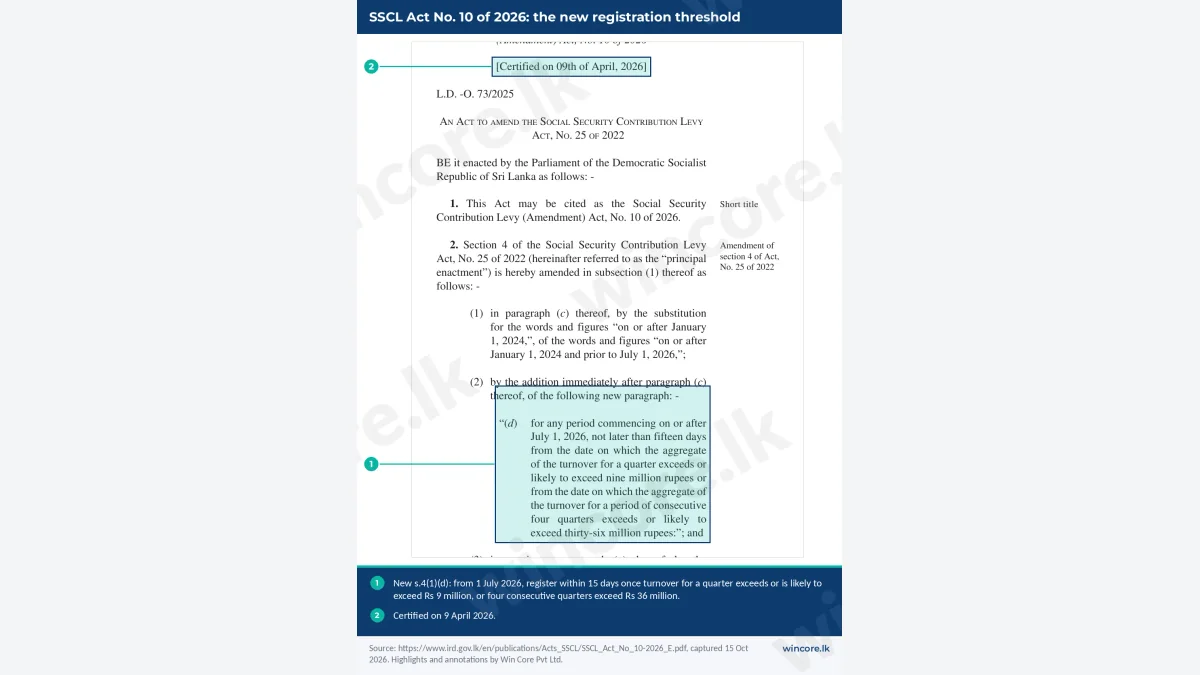
What to do. The SSCL registration threshold fell to Rs 9 million a quarter or Rs 36 million over four quarters from 1 July 2026 [4] [5]. The VAT thresholds did not [2]. A business can be required to register for one, both or neither. An events company invoicing Rs 12 million in a quarter is over the SSCL line and under the VAT line.
Where. Your compliance calendar.
What you need. Separate workings: taxable supplies for VAT, aggregate turnover for SSCL.
What goes wrong. Applying the new SSCL figures to VAT, or the VAT figures to SSCL. Several reports in 2026 mixed the two.
How long. A short comparison once both workings exist.
Instrument: SSCL Act, No. 25 of 2022, s.4(1)(d), inserted by Act No. 10 of 2026; IRD Notice PN/SSCL/2026-04/1. Official link: SSCL (Amendment) Act No. 10 of 2026. Last verified: 15 Oct 2026.
Step 5. Apply within 15 days and act on registration
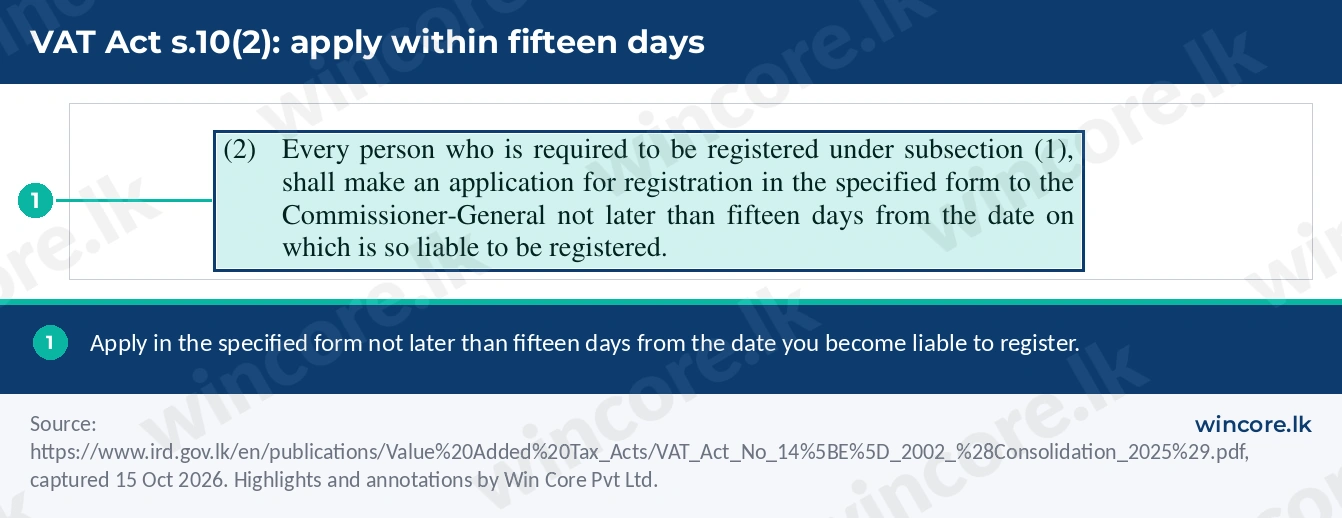
What to do. Apply "in the specified form" to the Commissioner-General "not later than fifteen days" from the date you became liable [1]. Charge VAT from the date the registration takes effect, which is shown on the certificate, and display the certificate "at a conspicuous place" where you carry on the taxable activity [1].
Where. The IRD, through your tax file.
What you need. TIN, the turnover workings from Steps 1 and 2, and the activity description.
What goes wrong. Waiting until the end of the year. Missing the 15 days because the crossing was read off a forecast nobody dated. Continuing to issue invoices without VAT after the registration date.
How long. The application itself is a short task; allow time for the IRD to process it.
Instrument: VAT Act, s.10(2) and s.15 (consolidated to 2025). Official link: VAT Act, consolidation 2025. Last verified: 15 Oct 2026.
Step 6. Keep the workings that date the crossing
What to do. Keep, for each period, the taxable supplies total, the twelve-month total, the forecast and the date you applied. If the IRD later says you crossed earlier, these are what you will rely on.
Where. Your compliance folder.
What you need. The items in the checklist above.
What goes wrong. Overwriting the forecast each month so that nobody can show what you knew and when.
How long. Ten minutes a month.
Instrument: VAT Act, s.10. Official link: VAT Act, consolidation 2025. Last verified: 15 Oct 2026.
Step 7. Know what happens if you do not apply, or later fall below the line
What to do. Two rules sit at either end of registration. If you should be registered and have not applied, s.14(1) lets the Commissioner-General register you, after giving you an opportunity to be heard, "with effect from such date as may be determined by him" [1]. That date can be in the past, which means VAT on sales you have already invoiced without it. At the other end, s.16(1) lets a registered person apply to cancel the registration at any time after twelve months from the date of registration, if it has ceased the taxable activity or its supplies do not exceed the values in s.10 [1]. On cancellation the certificate must be returned [1].
Where. The IRD, through your tax file.
What you need. For a cancellation, the turnover workings that show you are below both lines, and a forecast that shows you will stay there.
What goes wrong. Treating a quiet quarter as a reason to cancel when the forecast says the next one will be busy. Ignoring an IRD letter proposing registration; the opportunity to be heard is the time to put your figures forward.
How long. Cancellation cannot be sought within the first twelve months; after that, allow time for the IRD to process the application.
Instrument: VAT Act, ss.14(1), 16 and 17 (consolidated to 2025). Official link: VAT Act, consolidation 2025. Last verified: 15 Oct 2026.
How one proposal became two different answers
So which number is right? Both of them, for different taxes, and that is the whole answer. The confusion comes from the order in which things happened.
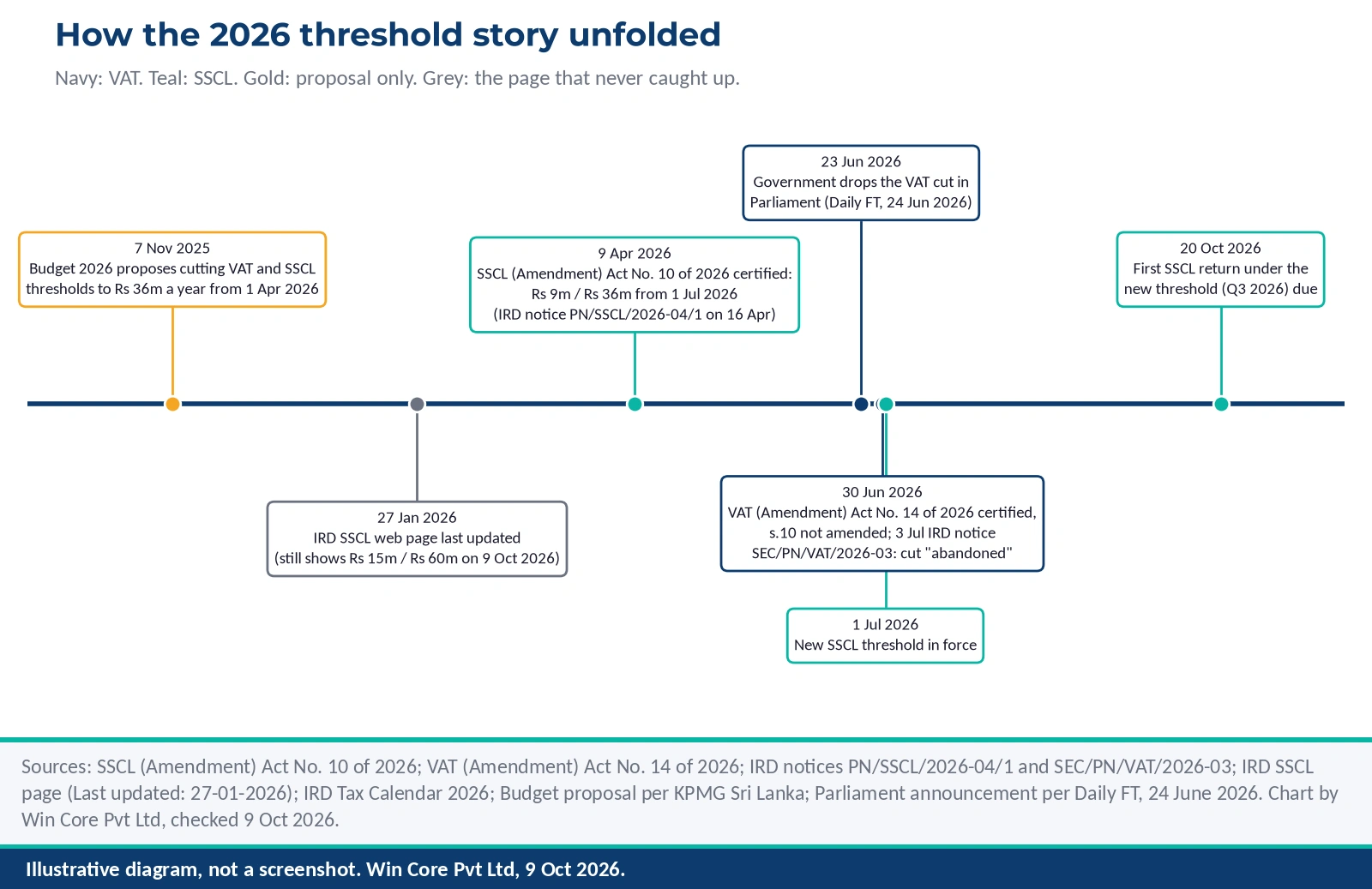
The 2026 Budget, presented in November 2025, proposed cutting both the VAT and SSCL registration thresholds to Rs 36 million a year, or Rs 9 million a quarter, from 1 April 2026 [6]. On that day the sketch showed two roads, side by side. Then the two roads were built on different timetables. The SSCL cut was enacted in April, but from 1 July rather than 1 April; KPMG's summary of the Act notes that the start date was deferred by three months and that the old figures applied until 30 June 2026 [7]. The VAT cut was dropped. The Daily FT reported on 24 June 2026 that the government had retreated on the VAT threshold cut during the second reading of the VAT amendment, and quoted a rise in VAT files from about 18,000 to more than 35,000 [8]. The VAT (Amendment) Act was certified six days later, without the cut [3], and the IRD's notice of 3 July confirmed it [2].
Anyone who wrote about thresholds between November 2025 and June 2026 was copying a map of roads that had not yet been built, and half of them never were.
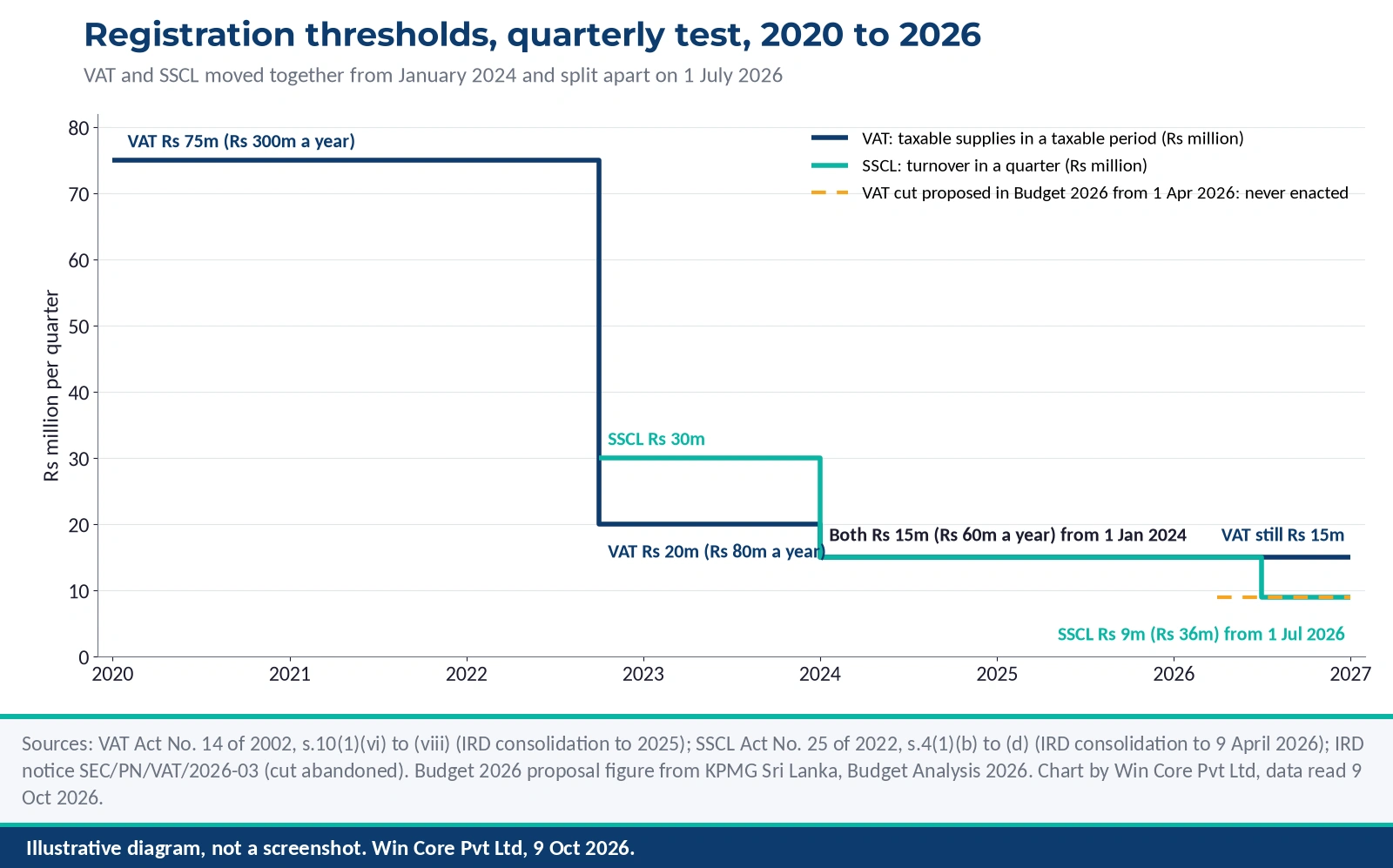
A short digression, because the history explains why people keep a number in their heads long after it changes. The VAT threshold has been redrawn four times in a decade. It was Rs 3 million a quarter from April 2016, jumped to Rs 75 million a quarter (Rs 300 million a year) from January 2020, fell to Rs 20 million a quarter (Rs 80 million a year) from October 2022, and settled at Rs 15 million (Rs 60 million) from January 2024 [1]. A business owner who registered in 2016, deregistered in 2020 and came back in 2023 has carried three different numbers in that time, each one correct when it was learned. Memory is a map too, and nobody puts a date on it.
Which brings us back to the present, and to the sources that are still showing old roads.
Why the sources you find still disagree
There are five reasons, and only one of them is carelessness.
1. Proposals get reported as law. Budget coverage reports what was proposed, often in the present tense. A proposal is a sketch. Until an Act is certified, it is not the ground.
2. Reports describe the right event with the wrong scope. The Daily FT report of June 2026 is a good example of an accurate story with a misleading line. Its summary said the government "abandons plan to lower VAT registration and SSCL threshold to Rs. 36 m" [8]. The VAT part was right. The SSCL cut had been law since April [4]. A reader who took the headline bullet at face value would conclude that SSCL had stayed at Rs 60 million.
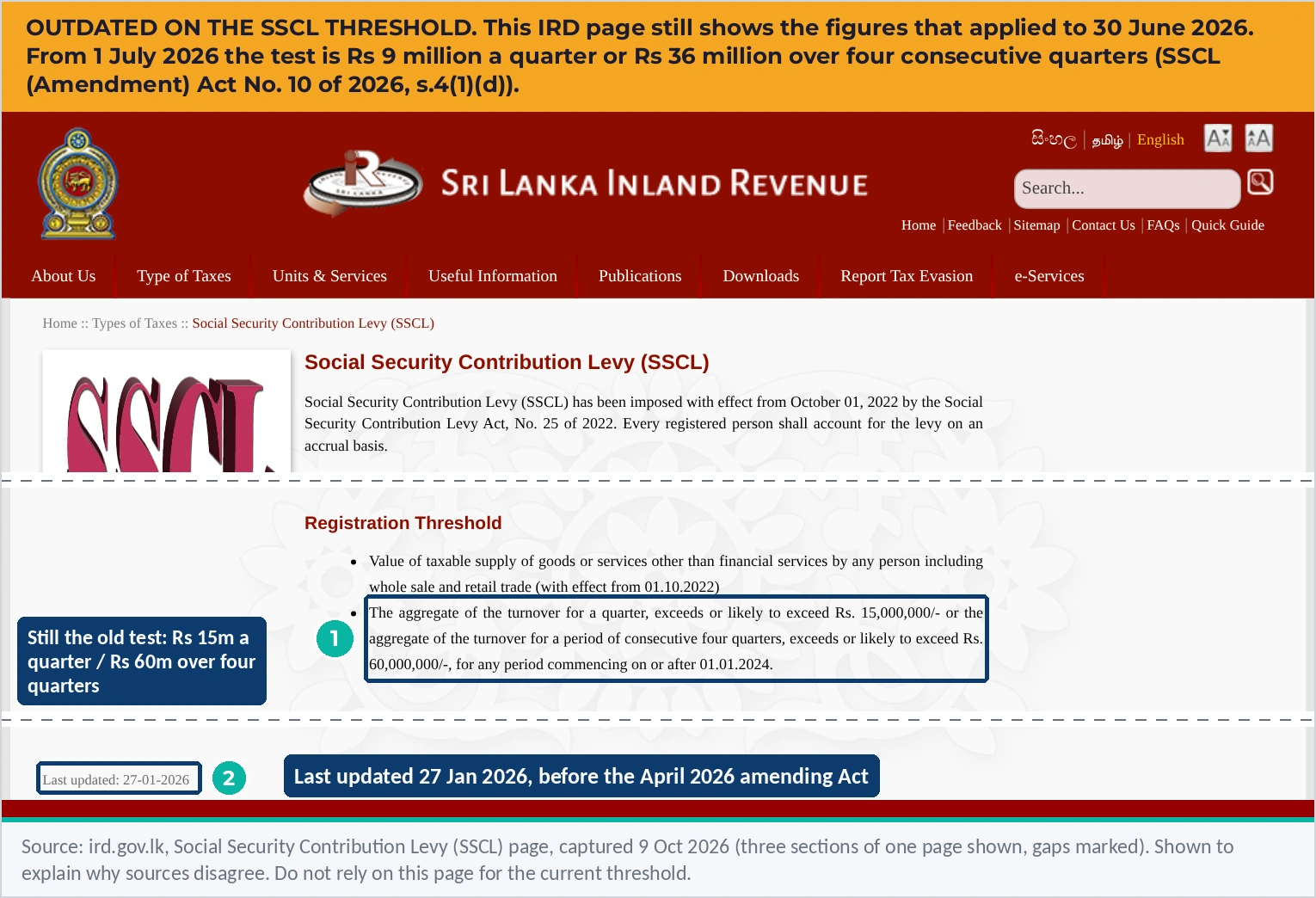
3. Official web pages are not always redrawn when the law changes. As at 9 October 2026 the IRD's own SSCL page still describes the registration test as Rs 15,000,000 a quarter or Rs 60,000,000 for four quarters "for any period commencing on or after 01.01.2024", and shows "Last updated: 27-01-2026", before the April Act [9]. The IRD's VAT page, by contrast, is current [10]. Do not cite the SSCL page for the threshold. Cite the Act and notice PN/SSCL/2026-04/1.
4. Consolidations are convenience copies. The IRD publishes consolidated texts of the VAT and SSCL Acts, and they are very useful, but the VAT consolidation states that it "is not a statutory consolidation, but rather a convenient reference" [1]. A consolidation is a tracing of the map. When the tracing and the Amendment Act differ, the Act wins.
5. Old pages stay online. Search engines keep serving whatever ranks, and a well-ranked 2023 article will keep quoting a 2023 threshold. Competitor sites and personal blogs are not authorities on this, ours included. Our own older VAT guide quoted the Rs 80 million figure that applied from October 2022 to December 2023. It was right when it was written, we are replacing it, and it is a fair warning that the date on a page matters more than the name on it.
Frequently asked questions
Was the VAT threshold reduced to Rs 36 million?
No. The 2026 Budget proposed it [6], but the IRD says the proposed reduction has been abandoned and the existing thresholds remain unchanged [2].
What is the current rate?
18 percent for taxable periods from 1 January 2024 [1].
Can the twelve-month test catch me before the quarterly test?
Not with quarterly periods, on actual figures. Four quarters at or below Rs 15 million cannot exceed Rs 60 million. The forward-looking limb can catch you earlier [1].
Do non-resident digital service providers use the same thresholds?
The same figures, Rs 15 million a quarter or Rs 60 million in twelve months, in their own section from 1 July 2026, with three months to apply electronically [3].
Can the IRD register me from an earlier date?
Yes. Under s.14(1) the Commissioner-General may register a person who should be registered, after a hearing, from a date he determines [1].
Is an importer exempt from registration because its turnover is small?
No. A person who imports or exports goods for commercial purposes must register [1].
Our quarter was Rs 11 million. Do we register for anything?
On those facts, SSCL yes, VAT no, unless you are a commercial importer or exporter or another limb of the VAT Act applies [1] [4]. Register for SSCL within fifteen days of the date turnover exceeded, or became likely to exceed, Rs 9 million [4].
Is the threshold tested on turnover or on liable turnover?
The registration test in section 4(1)(d) is worded on "the aggregate of the turnover" [4]. The 2.5 per cent is charged on liable turnover, the activity percentage of that turnover [11]. Exempt items are carved out of turnover by the Act's definitions, so check yours.
The IRD website says Rs 60 million for SSCL. Who is right?
The Act and the IRD's own April 2026 notice. The SSCL page was last updated in January 2026, before the change [4] [5] [9].
Talk to us. If your quarterly figures are approaching either line, our tax services team can run both tests and prepare the application; book a consultation at our contact page. Keeping the split between taxable and exempt sales clean is easier with the routines in our bookkeeping practices guide, and our business registration team handles new tax types.
WinCore Pvt Ltd
This guide is general information on the law as at 15 October 2026 and is not advice on your specific situation.
References
- Inland Revenue Department. Value Added Tax Act, No. 14 of 2002, consolidated version up to 2025, ss.2, 10, 14, 15 and 16. https://www.ird.gov.lk/en/publications/Value%20Added%20Tax_Acts/VAT_Act_No_14%5BE%5D_2002_%28Consolidation_2025%29.pdf . Primary. Accessed 15 October 2026.
- Inland Revenue Department. Notice to the Taxpayers: Amendments to the Value Added Tax Act, No. 14 of 2002, SEC/PN/VAT/2026-03 (3 July 2026), item 3. https://www.ird.gov.lk/en/Lists/Latest%20News%20%20Notices/Attachments/799/PN_VAT_2026-03_New_E.pdf . Primary. Accessed 15 October 2026.
- Parliament of Sri Lanka. Value Added Tax (Amendment) Act, No. 14 of 2026, certified 30 June 2026, new s.25L. https://www.ird.gov.lk/en/publications/Value%20Added%20Tax_Acts/VAT_Act_No_14-2026_E.PDF . Primary. Accessed 15 October 2026.
- Parliament of Sri Lanka. Social Security Contribution Levy (Amendment) Act, No. 10 of 2026, s.2. https://www.ird.gov.lk/en/publications/Acts_SSCL/SSCL_Act_No_10-2026_E.pdf . Primary. Accessed 15 October 2026.
- Inland Revenue Department. Notice to the Taxpayers, PN/SSCL/2026-04/1 (16 April 2026). https://www.ird.gov.lk/en/Lists/Latest%20News%20%20Notices/Attachments/780/PN_SSCL_2026-04_1_E.pdf . Primary. Accessed 15 October 2026.
- KPMG Sri Lanka. Budget Analysis 2026: Key Insights (proposed VAT and SSCL thresholds of Rs 9 Mn a period and Rs 36 Mn a year). https://assets.kpmg.com/content/dam/kpmgsites/lk/pdf/2026/Budget_Analysis_2026_Key_Insights.pdf.coredownload.inline.pdf . Secondary (proposal only). Accessed 15 October 2026.
- KPMG Sri Lanka. Tax Flash: Social Security Contribution Levy (Amendment) Act No. 10 of 2026. https://assets.kpmg.com/content/dam/kpmgsites/lk/pdf/kpmg-tax-news/2026/april/Social_Security_Contribution_Levy_%28Amendment%29_Act_No_10_of_2026.pdf . Secondary. Accessed 9 October 2026.
- Daily FT. Govt. retreats on VAT threshold cut (24 June 2026). https://www.ft.lk/top-story/Govt-retreats-on-VAT-threshold-cut/26-793693 . Secondary. Accessed 9 October 2026.
- Inland Revenue Department. Social Security Contribution Levy (SSCL) web page ("Last updated: 27-01-2026"; outdated on the threshold, cited only to show the discrepancy). https://www.ird.gov.lk/en/type%20of%20taxes/sitepages/social%20security%20contribution%20levy%20%28sscl%29.aspx . Primary (outdated). Accessed 9 October 2026.
- Inland Revenue Department. Value Added Tax (VAT) web page ("Last updated: 19-11-2025"). https://www.ird.gov.lk/en/Type%20of%20Taxes/SitePages/Value%20Added%20Tax%20%28VAT%29.aspx?menuid=1204 . Primary. Accessed 9 October 2026.
- Inland Revenue Department, Tax Policy and Legislation Unit. Social Security Contribution Levy Act No. 25 of 2022, consolidated up to 2026, ss.3(1), 4(1), 4(2), 8(1), 17(1) and Second Schedule. https://www.ird.gov.lk/si/publications/Acts_SSCL/SSCL_Cons_Act_-_2026_Changes.pdf . Primary. Accessed 9 October 2026.
Put these insights to work
WinCore specialists can review your current workflow, document gaps, and build a practical 90-day action plan.
Book a free consultationContinue reading
Explore more WinCore analysis to keep your finance, tax, and compliance roadmap moving.

VAT guide for Sri Lanka covering who must register, zero rating and exemptions, tax invoices, filing and payment dates, input tax credits, penalties, and deregistration.
SSCL registration now starts at Rs 9 million a quarter or Rs 36 million a year from 1 July 2026. How to test, register and pay monthly.
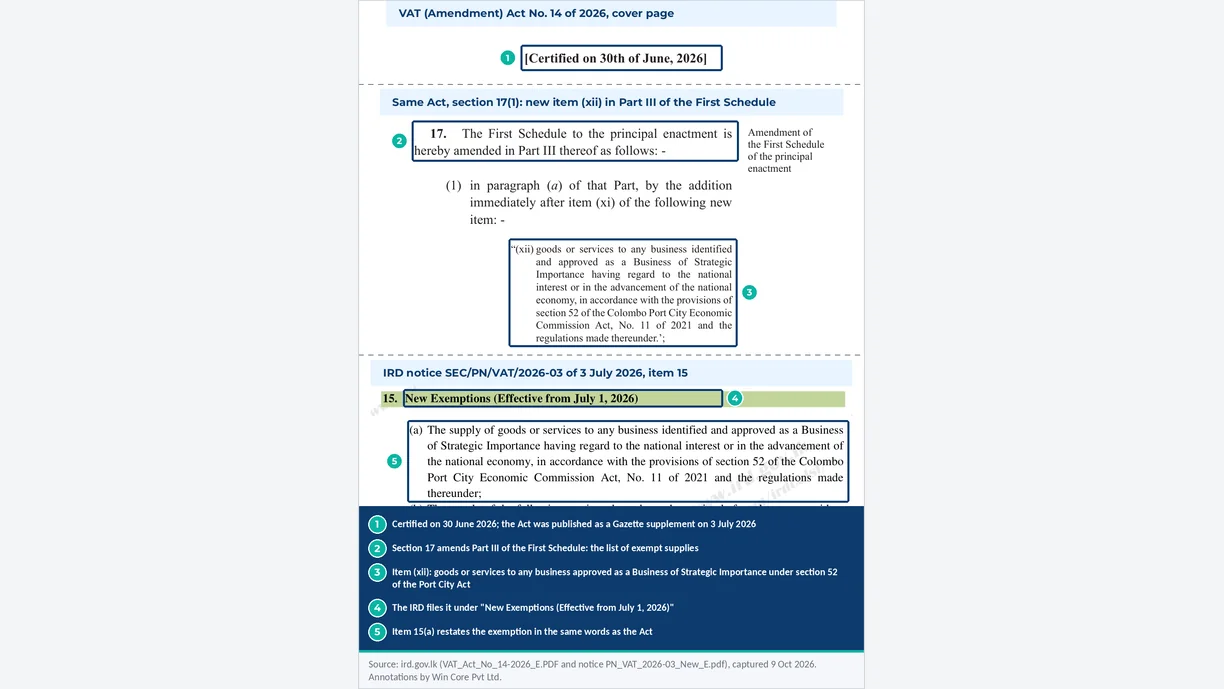
From 1 July 2026 supplies to a Port City Business of Strategic Importance are VAT exempt. The legal basis, invoicing and the input VAT effect.