
Late VAT registration in Sri Lanka: no auto step, no 18-month grace
Crossed the VAT line without applying? Why nothing registers you for you, where the 18 months really comes from, and what s.14 and s.67 mean now.
On this page
Last verified against the primary sources on 22 October 2026.
Late VAT registration in Sri Lanka starts the day you miss a fifteen-day deadline, not eighteen months later. Under section 10(2) of the Value Added Tax Act No. 14 of 2002, a person who becomes liable must apply "not later than fifteen days" from the date of liability [1]. Liability arises when taxable supplies exceed Rs 15 million in a taxable period or Rs 60 million in the twelve months then ending, or are reasonably expected to (s.10(1)(viii)) [1]. The Inland Revenue Department (IRD) does not register you on its own; failing to apply is an offence under s.67(a), with a fine of up to Rs 1 million for periods from 1 October 2025 [3].
A belief that circulates online is that a new company has an eighteen-month grace period before tax registration. There is no such period, and this piece shows where that number really comes from and what a business that is already late should do.
The thresholds themselves, and how to run the quarterly and twelve-month tests, are covered in our guide to VAT registration thresholds that still apply. This piece is about the person who has already crossed the line.
Late VAT registration starts fifteen days after liability, not eighteen months
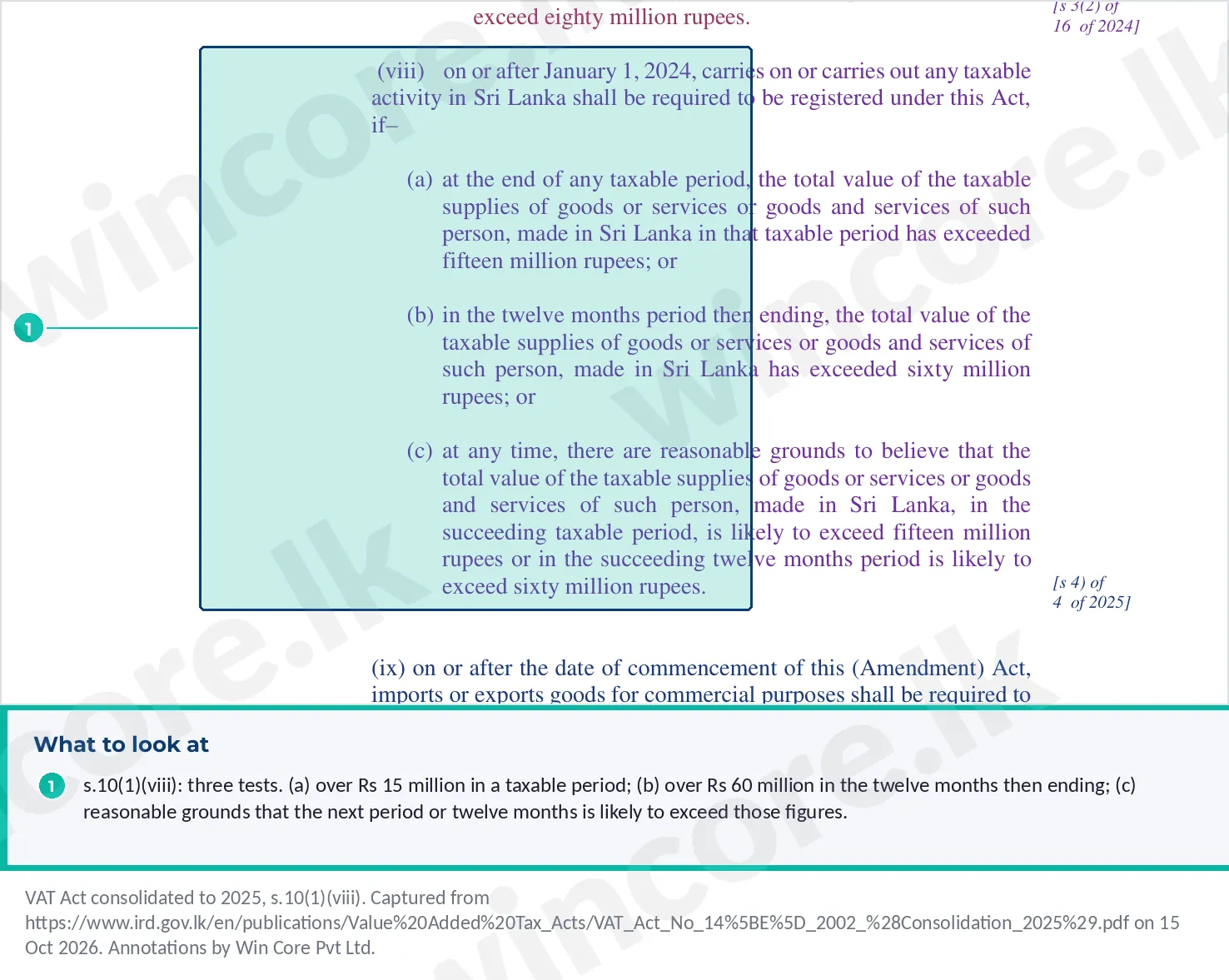
Section 10(1)(viii) requires registration if any one of these is true [1]:
- (a) at the end of any taxable period, taxable supplies in that period "has exceeded fifteen million rupees";
- (b) in "the twelve months period then ending", taxable supplies "has exceeded sixty million rupees"; or
- (c) "at any time, there are reasonable grounds to believe" that supplies in the succeeding taxable period are likely to exceed Rs 15 million, or in the succeeding twelve months Rs 60 million.
The paragraph opens with "on or after January 1, 2024", and a proviso to s.10(1) adds that for paragraph (viii) "the requirement for the registration shall arise from the date on which this (Amendment) Act comes into operation" [1]. For a business looking at 2026 figures, both dates are in the past.
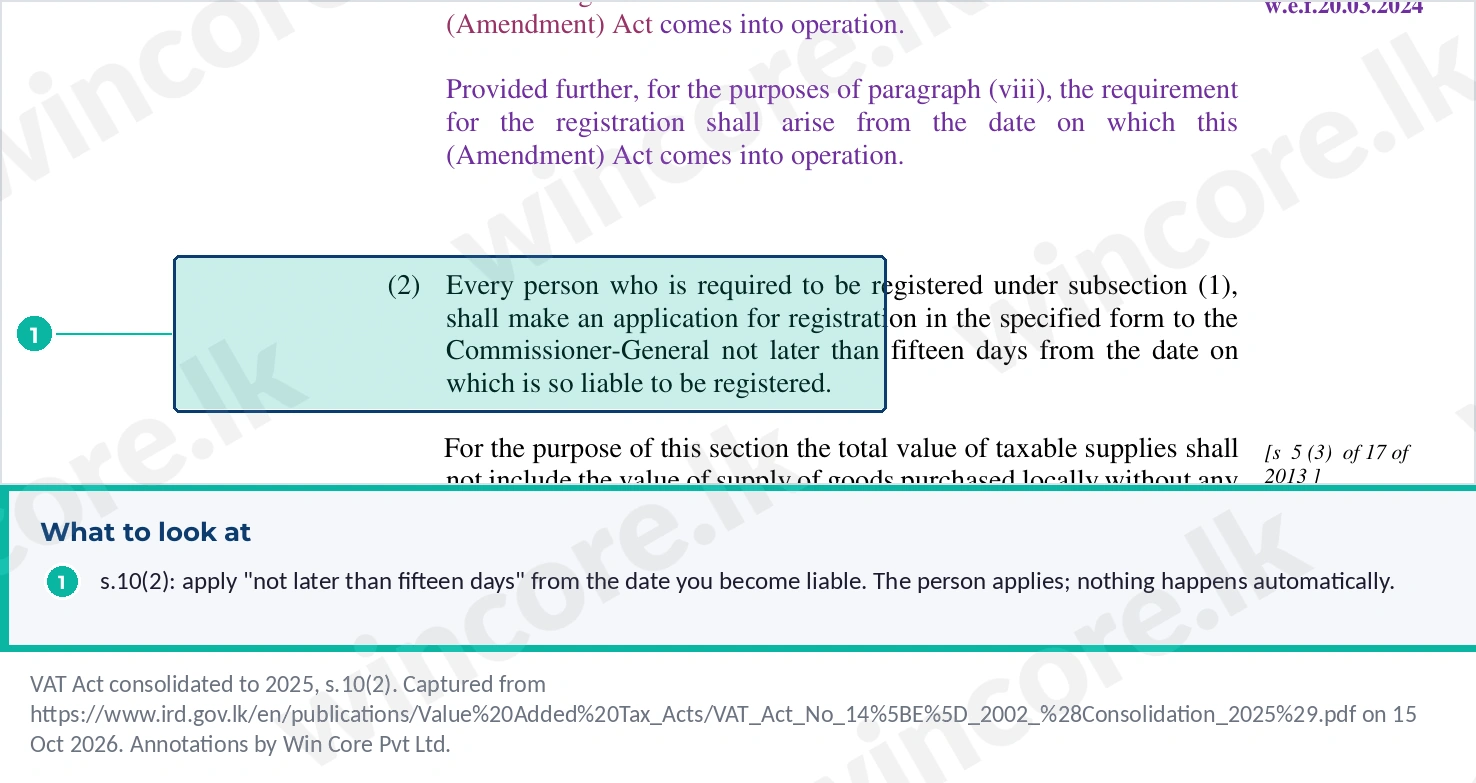
Section 10(2) then sets the clock: every person required to register "shall make an application for registration in the specified form to the Commissioner-General not later than fifteen days from the date on which is so liable to be registered" [1]. Fifteen days is the only registration period in the VAT Act for a person carrying on a taxable activity in Sri Lanka.
One rule ignores turnover entirely. Since the VAT (Amendment) Act No. 4 of 2025, a person who "imports or exports goods for commercial purposes shall be required to be registered" (s.10(1)(ix)) [1] [2]. Our Regulation Desk note on VAT Amendment Act No. 4 of 2025 covers that change.
The IRD does not register you on its own
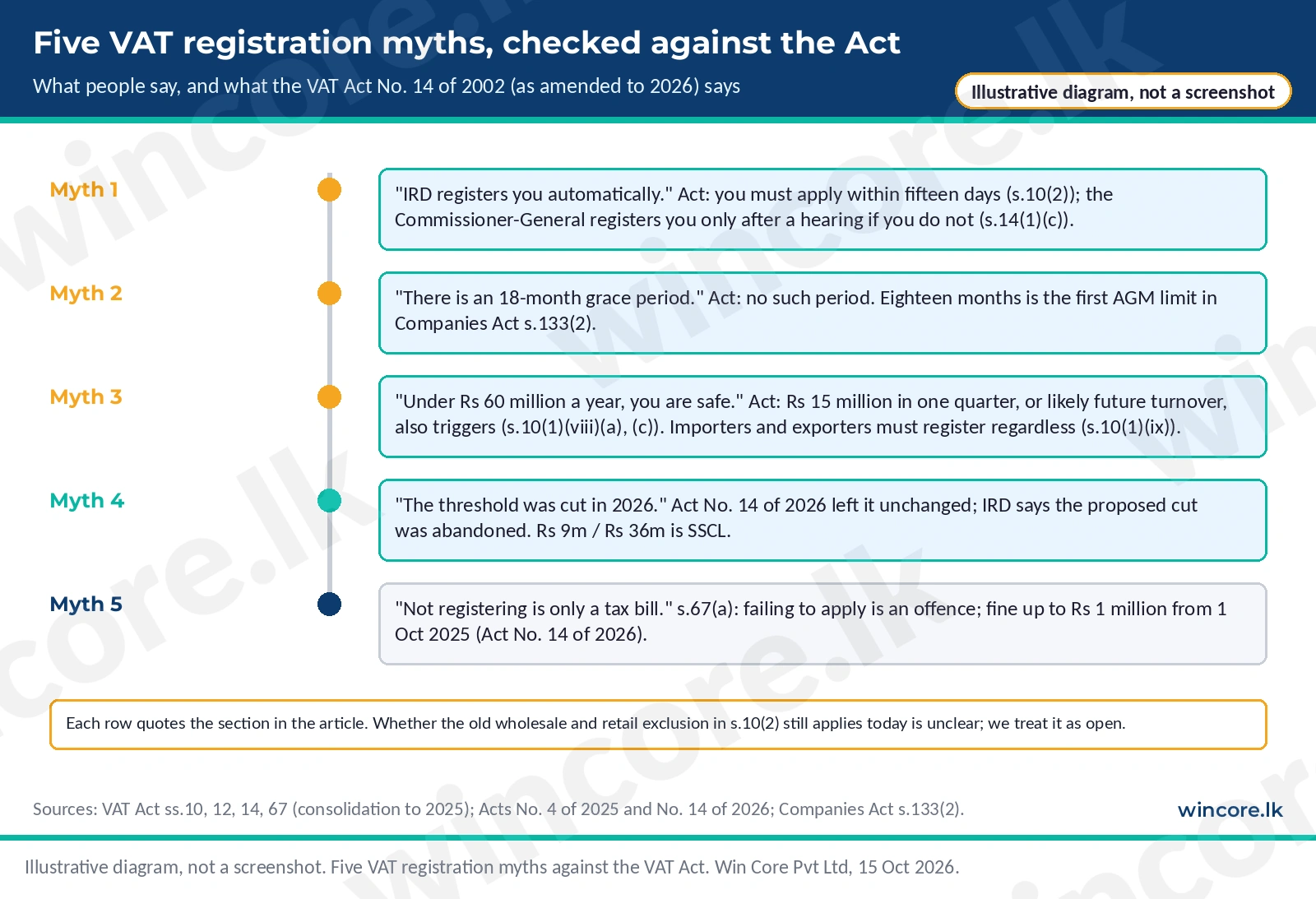
Section 14(1) lists three routes to registration: an application under section 10, a voluntary application under section 12, or, where "an application for registration, has not been made", registration by the Commissioner-General if he is of opinion that the person is required to be registered, "after affording such person an opportunity of being heard", "with effect from such date as may be determined by him" (s.14(1)(c)) [1].
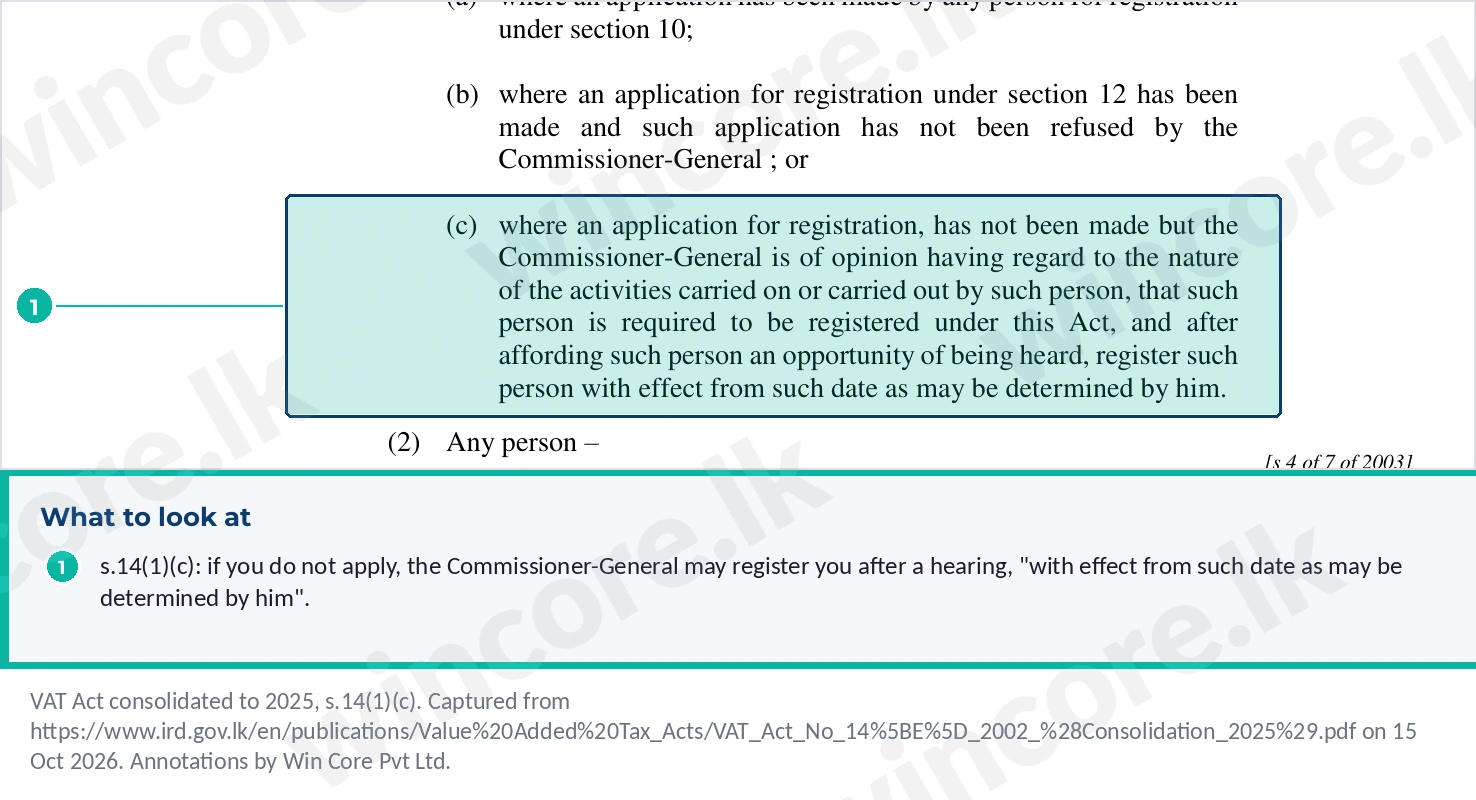
So the third route exists, but it is the Department acting against a person who did not apply, after a hearing, from a date the Commissioner-General picks. That is enforcement, not automatic registration. On our reading the date can be earlier than the decision, because the Act sets no limit on it; how far back it may reach is an open point.
The IRD's own registration guide also expects you to ask. For turnover-basis VAT it lists a "Formal request letter for VAT registration" and a "Sales schedule for the last three (03) months, certified by a director or the business owner ... confirming that taxable supplies exceed LKR 15 million per quarter" [5]. That is administrative practice, not statute, but it points the same way: you apply.
Part of the myth comes from income tax. The same guide says "For corporate entities, once TIN is obtained, Corporate Income Tax (CIT) is automatically registered" [5]. That is income tax only. VAT is listed separately, for "Those with taxable supplies above threshold or on voluntary basis", with its own documents.
The eighteen months comes from company law, not the VAT Act
There is no eighteen-month period in the VAT Act. The figure belongs to the Companies Act No. 7 of 2007, which requires a company to hold its first annual general meeting within eighteen months of incorporation (s.133(2)) [4]. That is a deadline for a shareholders' meeting. It does not delay any tax registration.
The two calendars start on the same day, which is why they get mixed up. Form 1, the secretary and the first AGM are the first deadlines a new company meets, and it is natural to assume tax follows the same timetable. It does not. VAT runs on turnover, from the first taxable period in which a test is met, whatever the date of incorporation. Getting a TIN is a separate step again.
Two other beliefs keep businesses waiting:
- "Under Rs 60 million a year you are safe." Not on the wording. Test (a) is one taxable period above Rs 15 million, and test (c) looks forward [1]. A business can be under Rs 60 million for the year so far and still be liable.
- "The threshold was cut in 2026." It was proposed, not enacted. The IRD's notice on the VAT (Amendment) Act No. 14 of 2026 says: "The proposed reduction in the VAT registration threshold has been abandoned. Therefore, the existing VAT registration thresholds remain unchanged" [6]. The Rs 9 million and Rs 36 million figures are the SSCL thresholds from 1 July 2026; see our guide to SSCL registration when turnover crosses Rs 9 million.
Two exclusions sit in section 10 and neither is a general way under the line. The first proviso to s.10(1) lets the Commissioner-General exclude the value of goods where he "is of opinion that the supply of goods relate to a single isolated transaction" [1]. It is discretionary and covers goods only. Section 10(2) also leaves out goods "purchased locally without any process in a wholesale or retail trading activity" unless three-month supplies reach set amounts, but the amounts are written "for any period prior to January 1, 2020", with a last band of Rs 12.5 million a quarter from 1 November 2016 [1]. How that applies to current periods is unclear on the text, so a trader relying on it should take advice before deciding not to register.
Failing to apply is an offence under s.67(a)
Section 67(a) applies to every person who "fails to apply for registration as required under section 10 or section 25A" [1]. The VAT (Amendment) Act No. 14 of 2026 replaced the penalty words at the end of section 67 [3]. The Act ties the bands to "any period" before or after 1 October 2025; the IRD notice describes them as offences committed before or after that date [6].
| Default | Section | Consequence |
|---|---|---|
| Failing to apply within fifteen days of becoming liable | s.10(2) read with s.67(a) | Offence. For any period prior to 1 October 2025: fine not exceeding Rs 25,000, or imprisonment up to six months, or both. For any period on or after 1 October 2025: fine "not exceeding one million rupees", or imprisonment up to six months, or both (s.67 as amended by Act No. 14 of 2026, s.13) |
| Not applying at all | s.14(1)(c) | Commissioner-General may register you after a hearing, from a date he determines |
| Issuing a tax invoice while not registered | s.67(l) | Offence; same s.67 bands |
| Tax evaded | s.66(2) and (3), inserted by Act No. 14 of 2026 | Separate evasion offence; not mapped here because it depends on intent and amount |
We do not borrow the evasion penalty for a late application. The specific default is section 67(a). Prosecutions under the amended section 68 are brought by the Attorney-General in the name of the Commissioner-General [3].
Registration from a past date reaches back into your invoices
The charge to VAT in s.2(1)(a) falls on taxable supplies "made in a taxable period, by a registered person" [1]. That is why the effective date matters. If the Commissioner-General registers you under s.14(1)(c) from a date in the past, on our reading sales you have already invoiced without VAT from that date fall within the charge, and the VAT on them comes out of your margin unless your contracts let you recover it.
Two cautions follow. First, do not assume that VAT you paid to suppliers before registration nets everything off. Credit for input tax is governed by section 22, and s.22(6)(v) bars credit on "any tax invoice issued prior to the commencement of the liability to tax" unless it is connected to a business approved under s.22(7) [1]. Our companion piece on input VAT before registration covers that rule. Second, even invoices dated after the effective date must be claimed in a return for a period ending within twelve months of the invoice date (s.22(6)(iv)(a)) [1]. On our reading, a registration backdated more than a year can leave some of those invoices outside the window.
Voluntary registration does not change this. Section 12 lets a person apply "Notwithstanding anything to the contrary in sections 3 and 10" [1], but it does not suspend the fifteen-day duty in s.10(2) for a person already required to register.
What a business that is already late should do
- Date the crossing. Work out the first taxable period in which test (a), (b) or (c) was met. Keep the sales ledger split between taxable and exempt supplies, and the forecast as it stood at the time.
- Apply now, with the IRD's documents. The fifteen days have passed; each further period adds to the exposure. Apply with the request letter, sales schedule and other items in the IRD registration guide [5].
- Expect an effective date to be fixed. Whether you apply late or the Department acts first, the certificate shows "the date on which registration comes into effect" (s.15(2)) [1]. Plan for VAT on sales from that date.
- Register before importing or exporting goods commercially, whatever your turnover (s.10(1)(ix)).
- Get invoicing ready from day one. The tax invoice format rules in our note on the tax invoice format under Gazette 2481/22 apply once you are registered.
- Take advice on the s.67(a) exposure before you file the first return.
Our VAT services team can date the crossing, prepare the application and work through the first returns. To check the VAT element on a price, use our VAT calculator.
Checklist: documents needed
- Sales ledger by taxable period, split into taxable and exempt supplies
- Rolling twelve-month totals and the forecast as it stood each quarter
- Formal request letter for VAT registration, stating the reason and the business
- Sales schedule for the last three months, certified by a director
- Bank statements for the last three months and proof of business address
- Copies of Form 1 or Form 40, directors' identity documents and the latest sales invoice
- Customs documents, if you import or export goods
What this means for you
If your taxable supplies passed Rs 15 million in any taxable period, or Rs 60 million over twelve months, or you could reasonably expect them to, you were required to apply within fifteen days. If you import or export goods commercially, you must register whatever your turnover. Nothing in the VAT Act registers you for you, and there is no eighteen-month grace period anywhere in it. A late business should apply now, plan for VAT from the effective date the Commissioner-General fixes, and not count on pre-registration input tax without checking section 22.
Open points we keep open:
- How far back s.14(1)(c) can reach. The Act says "with effect from such date as may be determined by him" and sets no limit; we have not found an IRD statement on backdating.
- "Section 10C" in the IRD guide. The IRD registration guide refers to voluntary registration "under Section 10C of VAT Act (Special for new business)" [5]. We searched the IRD's 2025 consolidation on 22 October 2026 and found no section 10C; the amending Acts No. 4 of 2025 and No. 14 of 2026 do not insert one either.
- Which taxable period counts for an unregistered person. The "taxable period" definition in s.83 speaks of registered persons; for a person not yet registered, on our reading the test runs on calendar quarters.
- The old wholesale and retail exclusion in s.10(2). Its amounts are written for periods before 1 January 2020; how it applies now is unclear on the text.
FAQ
Is VAT registration automatic in Sri Lanka?
No. A person who becomes liable must apply within fifteen days under s.10(2) of the VAT Act. If no application is made, the Commissioner-General may register the person under s.14(1)(c), but only after giving an opportunity to be heard and from a date he determines. For companies, only corporate income tax is registered automatically with the TIN; VAT needs its own application.
Is there an eighteen-month grace period for VAT registration?
No. The VAT Act gives fifteen days from the date you become liable. Eighteen months is the Companies Act limit for a company's first annual general meeting under s.133(2). It is a company law deadline for a shareholders' meeting and does not delay VAT, SSCL or income tax registration in any way.
What is the penalty for late VAT registration in Sri Lanka?
Failing to apply is an offence under s.67(a) of the VAT Act. For any period on or after 1 October 2025, the penalty on conviction is a fine not exceeding Rs 1 million, imprisonment up to six months, or both. For earlier periods the fine limit is Rs 25,000. The Commissioner-General can also register you from a date he fixes.
Can the IRD backdate my VAT registration?
On our reading, yes. Section 14(1)(c) lets the Commissioner-General register a person who should have applied "with effect from such date as may be determined by him", after a hearing. The Act sets no limit on how far back that date may go, and we have not found an IRD statement on it, so treat the exposure as running from the date you first became liable.
Can I claim the VAT I paid before registration?
Not as a matter of course. Section 22(6)(v) bars input credit on tax invoices issued before your liability to tax commenced, unless they are connected to a business approved under s.22(7). Invoices after that date still face the twelve-month claim limit in s.22(6)(iv). Check each invoice against section 22 before you count on any credit.
We read the IRD consolidation of the VAT Act, the VAT (Amendment) Act No. 14 of 2026, IRD notice SEC/PN/VAT/2026-03 and the IRD registration guide on 22 October 2026. Act No. 4 of 2025 was read through the consolidation, which carries its amendments. Companies Act s.133(2) was verified on 15 October 2026 and not re-read today.
Talk to us. If you think you crossed the VAT threshold without applying, book a consultation at our contact page.
WinCore Pvt Ltd
This article is general information on the law as at 22 October 2026 and is not advice on your specific position.
References
- Inland Revenue Department. Value Added Tax Act, No. 14 of 2002, consolidated to 2025, ss.2(1), 10(1)(viii), (ix) and provisos, 10(2), 12(1), 14(1), 15, 22(6) and 67. https://www.ird.gov.lk/en/publications/Value%20Added%20Tax_Acts/VAT_Act_No_14%5BE%5D_2002_%28Consolidation_2025%29.pdf . Primary (official, non-statutory consolidation). Accessed 22 October 2026.
- Parliament of Sri Lanka. Value Added Tax (Amendment) Act, No. 4 of 2025, s.4 (inserting s.10(1)(ix)), as carried in the IRD consolidation [1]. Primary. Read through [1] on 22 October 2026.
- Parliament of Sri Lanka. Value Added Tax (Amendment) Act, No. 14 of 2026 (certified 30 June 2026), ss.12, 13 and 14 (amending ss.66 and 67, replacing s.68). https://www.ird.gov.lk/en/publications/Value%20Added%20Tax_Acts/VAT_Act_No_14-2026_E.PDF . Primary. Accessed 22 October 2026.
- Parliament of Sri Lanka. Companies Act, No. 07 of 2007, s.133(2). https://drc.gov.lk/en/wp-content/uploads/2018/04/Act-7-of-2007-English.pdf . Primary. Verified 15 October 2026.
- Inland Revenue Department. Taxpayer Guidelines for Registration and Update (2026), Registration of Tax Types. https://ird.gov.lk/en/Downloads/SiteAssets/TPR_Guidelines_2026_E.pdf . Primary (administrative). Accessed 22 October 2026.
- Inland Revenue Department. Notice to the Taxpayers, SEC/PN/VAT/2026-03 (3 July 2026), items 3 and 11. https://www.ird.gov.lk/en/Lists/Latest%20News%20%20Notices/Attachments/799/PN_VAT_2026-03_New_E.pdf . Primary (administrative). Accessed 22 October 2026.
Put these insights to work
WinCore specialists can review your current workflow, document gaps, and build a practical 90-day action plan.
Book a free consultationContinue reading
Explore more WinCore analysis to keep your finance, tax, and compliance roadmap moving.
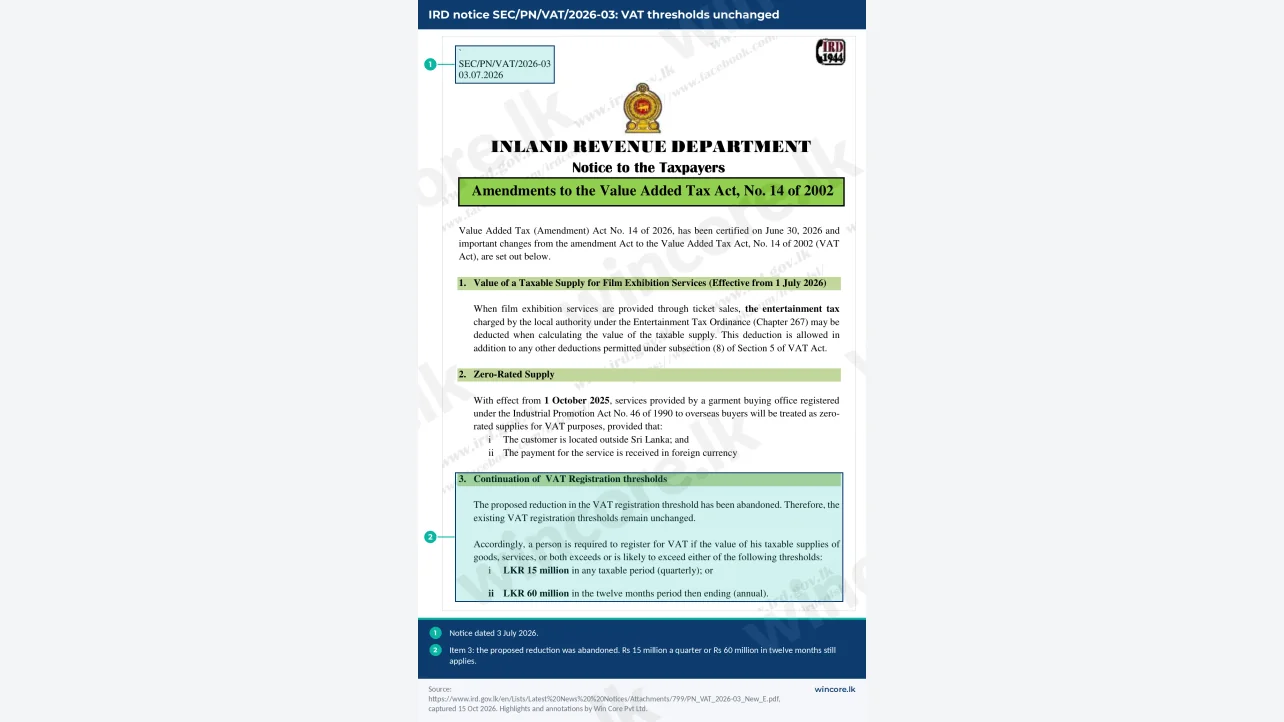
The VAT registration tests are Rs 15 million a quarter or Rs 60 million over 12 months. How the tests run, the 15 day rule and who must register.
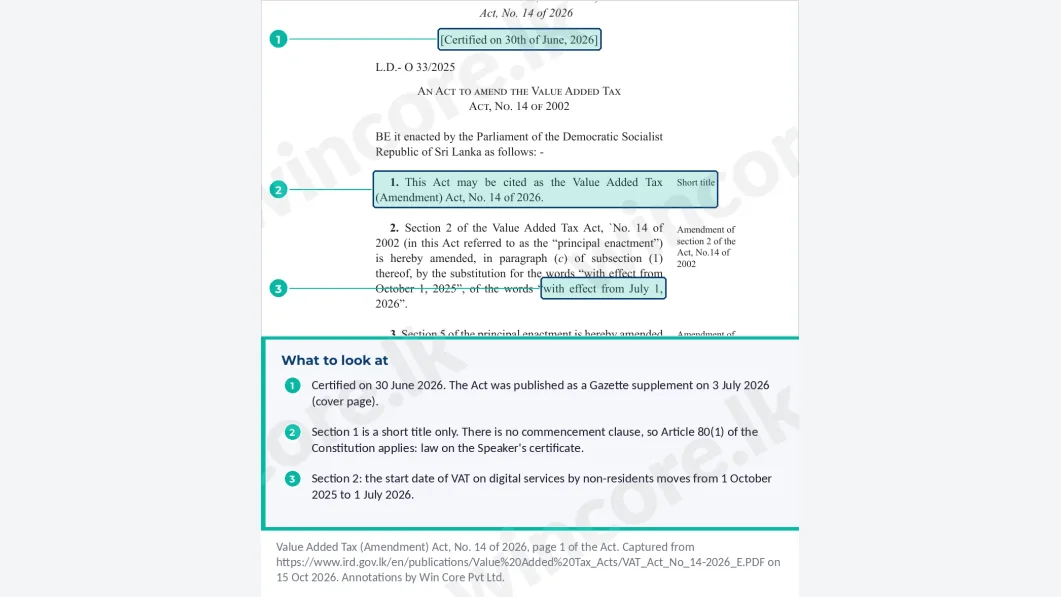
Digital services VAT, a 20.5 percent rate for financial services and Rs 1 million fines: each change in the 2026 VAT Act, with its own start date.
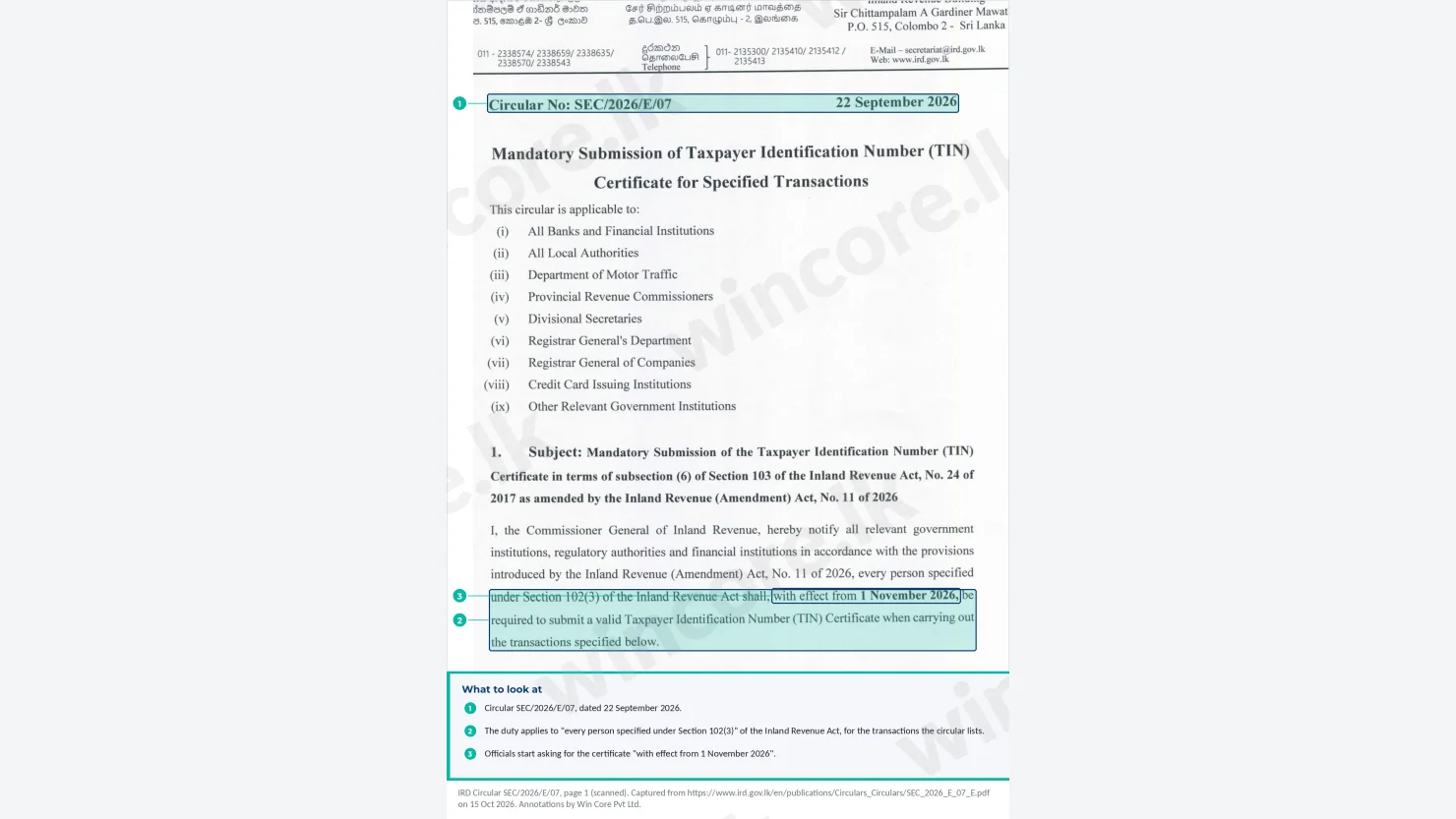
What the IRD circular says, clause by clause: eight transactions, five exemptions, the 1 April and 1 November dates, and why a company still needs a TIN.