
TIN certificate circular SEC/2026/E/07: what changes on 1 November
What the IRD circular says, clause by clause: eight transactions, five exemptions, the 1 April and 1 November dates, and why a company still needs a TIN.
On this page
Last verified against the primary sources on 28 October 2026.
Updated 28 October 2026: rechecked the circular and the IRD notices page; the certificate rule applies from 1 November 2026 and no later IRD notice changes it.
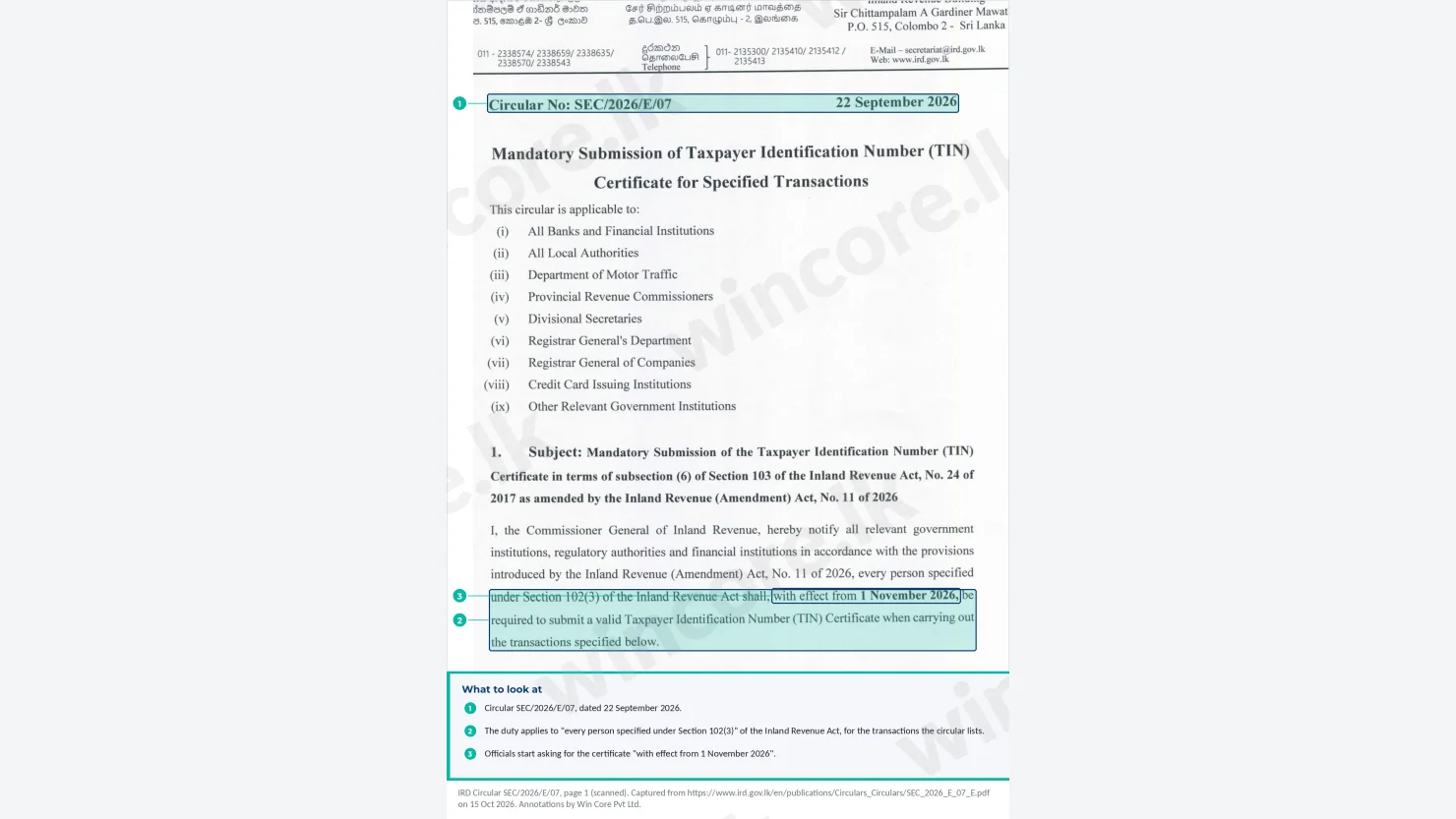
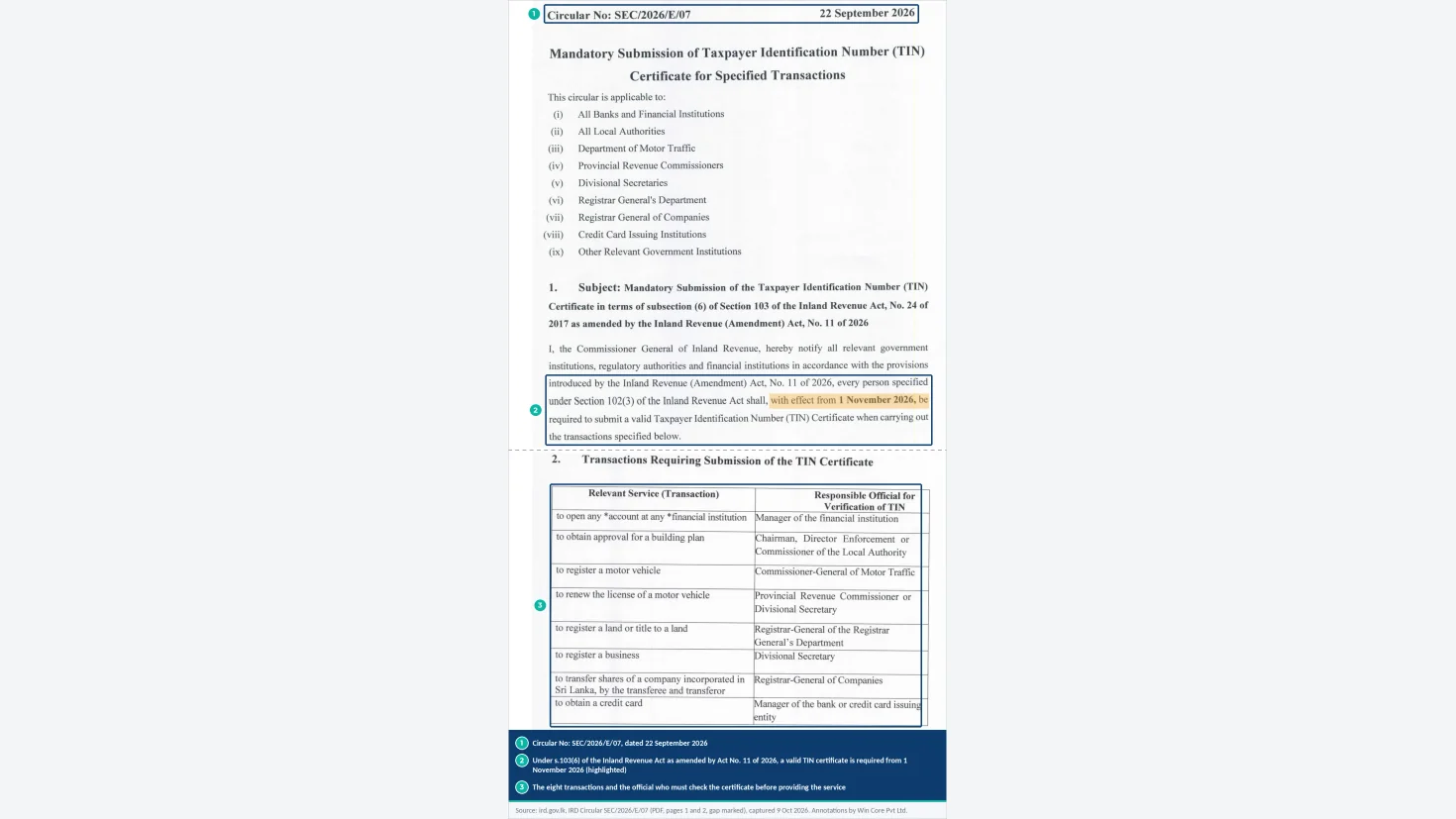
The TIN certificate circular SEC/2026/E/07, issued by the Commissioner General of Inland Revenue on 22 September 2026, says that from 1 November 2026 every resident individual aged 18 or over must show a valid TIN certificate for eight transactions: opening an account at a financial institution, building plan approval, registering a vehicle, renewing a vehicle licence, registering land, registering a business, transferring shares in a Sri Lankan company, and obtaining a credit card [1]. Companies and other entities are exempt from showing a certificate, but a company must still register for a TIN within thirty days of incorporation [3]. The Act behind the circular carries an earlier date, 1 April 2026, and both dates matter.
This article reads the circular itself. For the step by step route to getting a TIN and the printout, see our guide to the TIN certificate from 1 November 2026.
Take a hypothetical tile laying company with three resident shareholders. In November it opens a second bank account, and one shareholder sells part of her shares to another. The company opening its account is outside the circular. The share transfer is inside it, and both shareholders, as transferor and transferee, must show a TIN certificate. Same company, same month, two different answers.
The TIN certificate circular SEC/2026/E/07 covers eight transactions
The circular is titled "Mandatory Submission of Taxpayer Identification Number (TIN) Certificate for Specified Transactions" and is addressed to banks and financial institutions, local authorities, the Department of Motor Traffic, Provincial Revenue Commissioners, Divisional Secretaries, the Registrar General's Department, the Registrar General of Companies, credit card issuers and other relevant government institutions [1]. The IRD's notice to the public, SEC/PN/IT/2026/05 of the same date, repeats it [2]. On 21 October 2026 the IRD circulars page still listed E/07 as the latest circular, with no revision [7].
It rests on section 103(6) of the Inland Revenue Act, No. 24 of 2017, inserted by section 24 of the Inland Revenue (Amendment) Act, No. 11 of 2026, certified on 3 June 2026 [3]. Section 103(6)(a) says the Commissioner-General "shall issue a TIN Certificate to every person who is assigned a TIN". Section 103(6)(b) requires "a person specified under subsection (3) of section 102" to submit it for each listed purpose, and makes the listed official responsible for compliance. Section 103(6)(c) lets the Commissioner-General agree an alternative verification method with an official, and section 103(6)(d) lets the Commissioner-General "issue guidelines for the effective implementation" of the subsection [3].
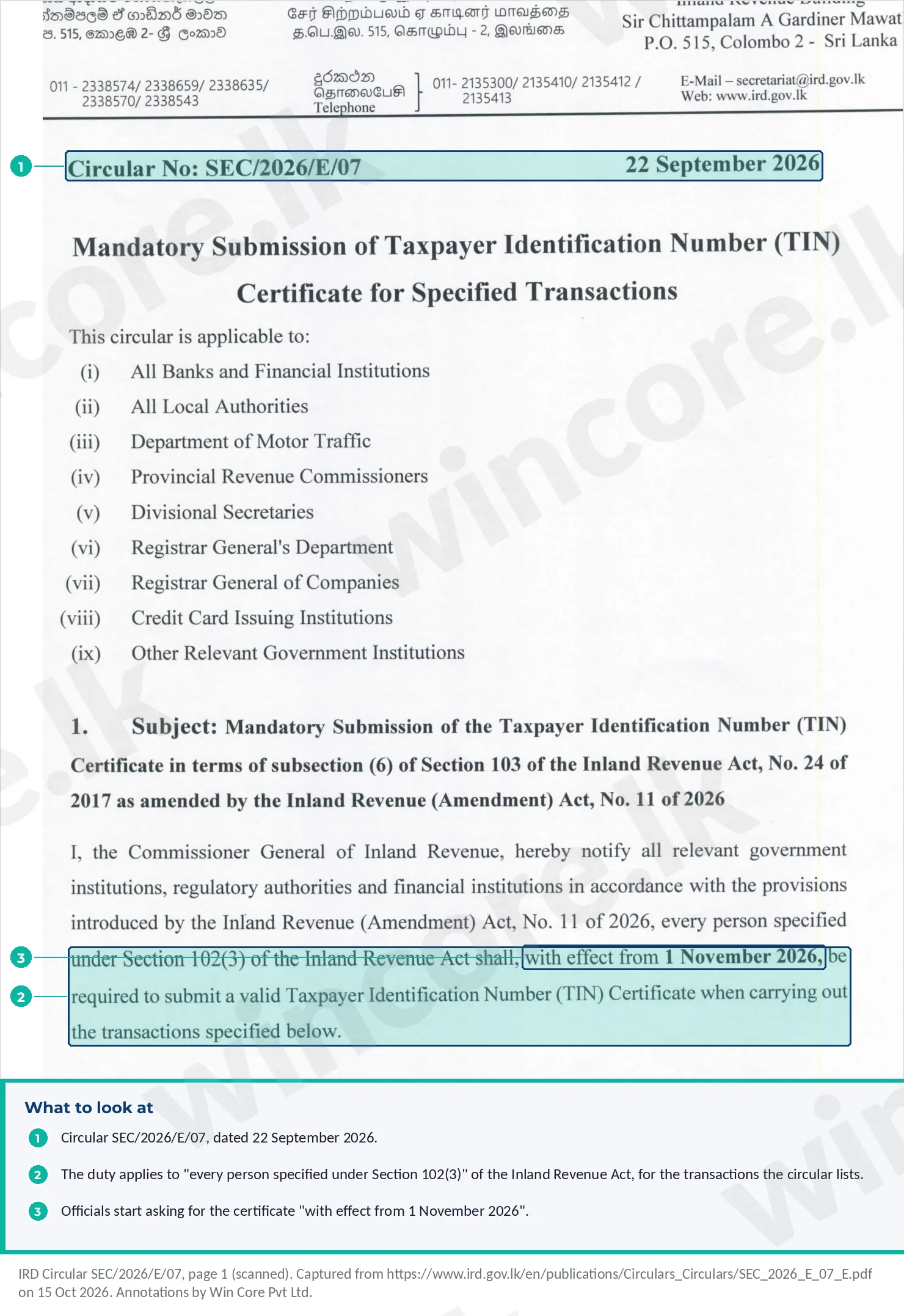
The eight transactions and the official who checks are the same in the Act's table and in the circular [1] [3]:
| Transaction | Official who checks |
|---|---|
| Open any account at any financial institution | Manager of the financial institution |
| Obtain approval for a building plan | Chairman, Director Enforcement or Commissioner of the Local Authority |
| Register a motor vehicle | Commissioner-General of Motor Traffic |
| Renew the licence of a motor vehicle | Provincial Revenue Commissioner or Divisional Secretary |
| Register a land or title to a land | Registrar-General of the Registrar General's Department |
| Register a business | Divisional Secretary |
| Transfer shares of a company incorporated in Sri Lanka, by the transferee and transferor | Registrar-General of Companies |
| Obtain a credit card | Manager of the bank or credit card issuing entity |
"Account" covers savings, term deposit, current and any other deposit account, and in a joint account "all joint account holders shall be considered separately" [1].
Instruments: Inland Revenue Act No. 24 of 2017, ss.102(3) and 103(6) to (8) as amended by Act No. 11 of 2026, s.24; IRD Circular SEC/2026/E/07; Gazette 2334/21. Official source: ird.gov.lk. Last verified: 21 October 2026.
The duty falls on resident adults, and five groups are exempt
The duty falls on "every person specified under Section 102(3)" [1]. Section 102(3) lets the Minister, with the Commissioner-General's consent, "specify additional classes of persons required to register under this section" [4]. The Minister did that in Gazette Extraordinary No. 2334/21 of 31 May 2023, which names "the resident persons specified in PART - A or PART - B" [5]. Part A, from 1 June 2023, lists fourteen classes, among them doctors registered with the Medical Council, members of the Institute of Chartered Accountants, attorneys-at-law, persons who registered businesses at Divisional Secretariats, persons with registered vehicles (other than three wheelers, motor bicycles and hand tractors) and individuals who obtain building plan approval. Part B, from 1 January 2024, covers every other individual aged 18 or over [5].
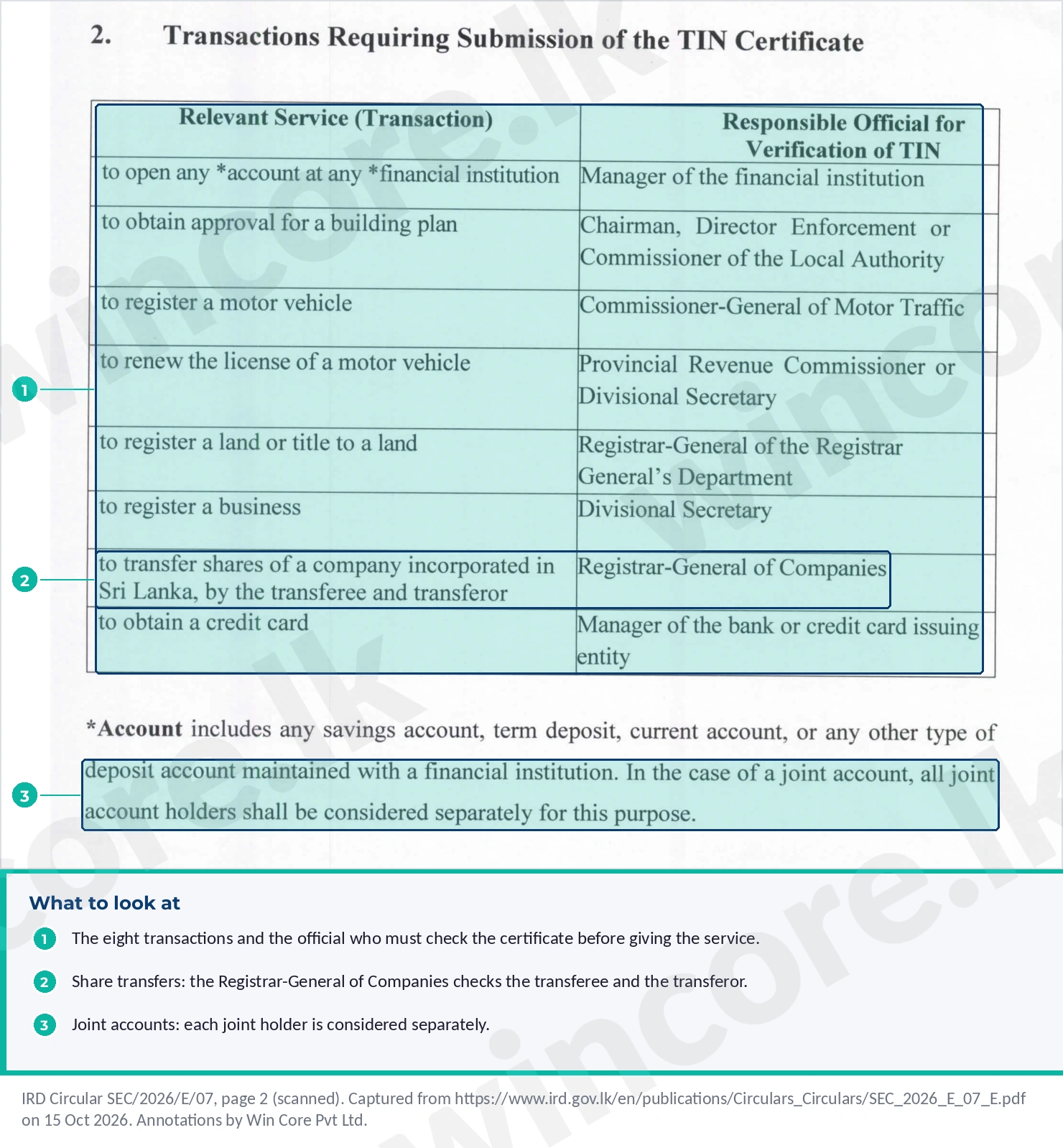
The circular then takes five groups out [1]:
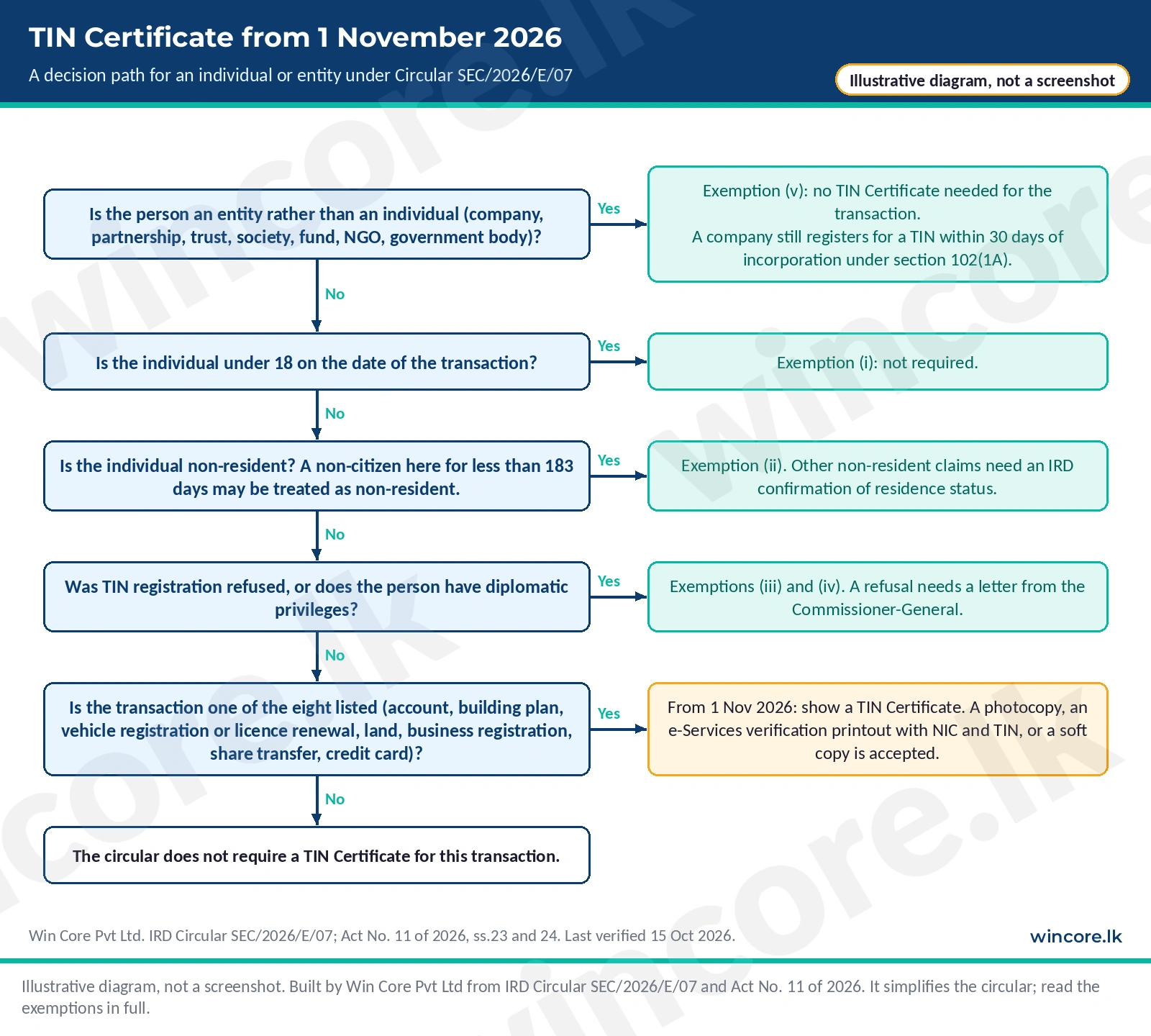
- An individual under 18 on the date of the transaction.
- A non-resident individual. A non-citizen who has stayed in Sri Lanka for less than 183 days at the date of the transaction "may be treated as a non-resident individual". Any other individual claiming non-residence must produce an IRD confirmation of residence status, requested by email to itp@ird.gov.lk.
- An individual whose registration the Commissioner-General refused, who must obtain a letter of refusal.
- An individual or organisation entitled to diplomatic privileges.
- "Any Entity other than an individual (Company, Partnership, Government Institutions, Societies, Funds, Trust, Unit Trust, Non-Governmental Organizations, Other Institutes)".
Section 103(7) of the Act adds its own carve out: the provisions do not apply to a person whose registration was refused under section 102, or to a person restrained from obtaining a TIN Certificate by any other written law [3].
The Act says 1 April 2026; the circular says 1 November 2026
Section 103(6)(b) opens with "With effect from April 1, 2026" [3]. The circular says the requirement applies "with effect from 1 November 2026", and paragraph 4 repeats: "The procedure shall take effect from 1 November 2026" [1]. The first is the statutory date. The second is the date the Commissioner-General has told officials to start checking.
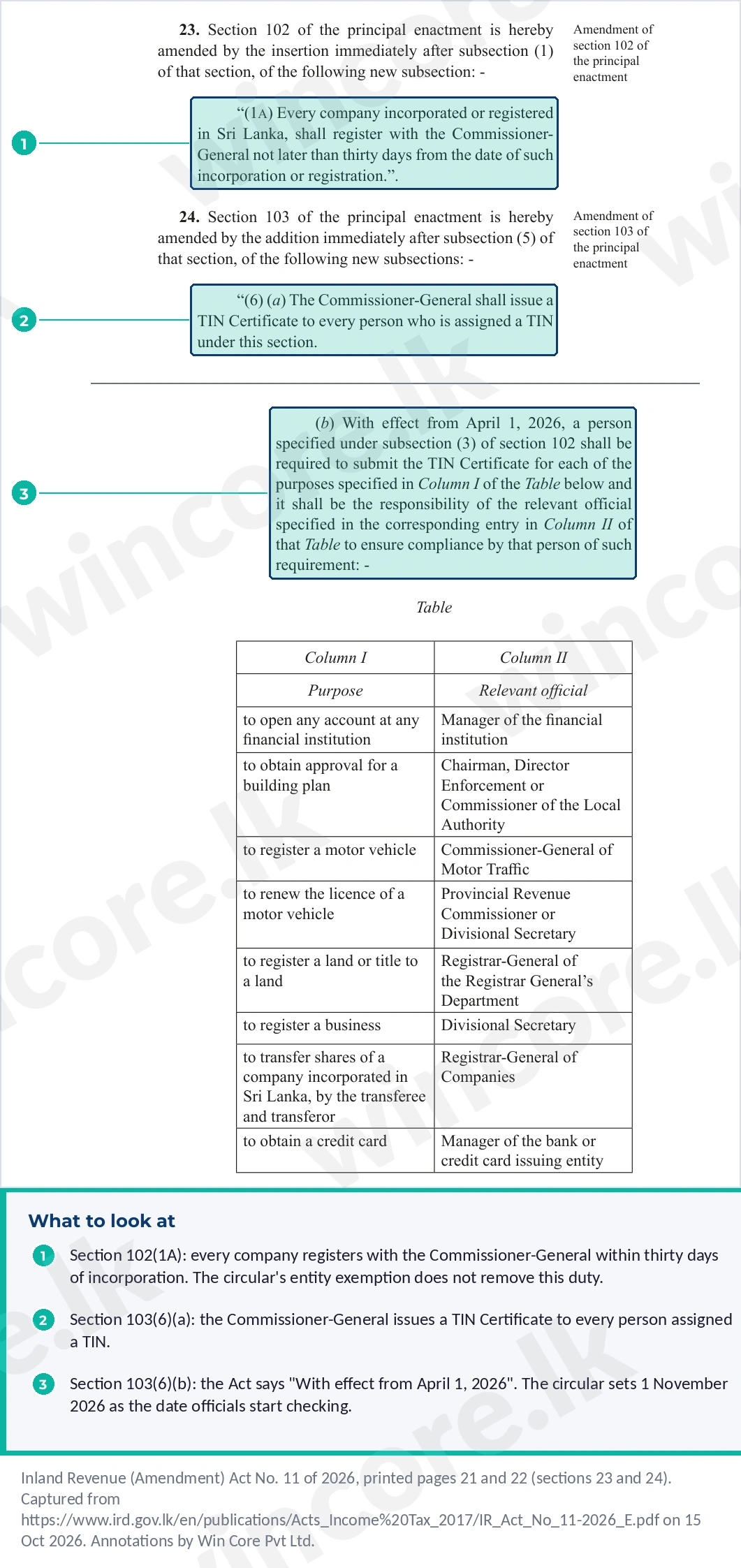
Why would an Act certified on 3 June 2026 carry a date already in the past? Section 1(2) of Act No. 11 of 2026 brings its provisions into operation on the date the Bill becomes an Act, other than those listed in the section 1(3) table, and section 24 is not in that table [3]. So section 103(6) itself came into operation on 3 June 2026 with an April date written inside it.
The IRD bridged the gap in its notice SEC/PN/IT/2026/02 of 8 June 2026. It listed the eight purposes and said "The procedure for verifying the TIN by the relevant officials will be specified by the Commissioner-General" and that "these requirements will take effect upon the issuance of those specifications" [9]. The specifications are the circular, so the IRD's own position is that checking starts on 1 November 2026. On our reading the April date has no practical bite for a bank account opened or a share transfer registered before November; the IRD has not said otherwise, and nothing in the Act unwinds a completed transaction.
To check the underlying statutory power, consult the consolidated Act together with subsequent amendments, not the circular in isolation.
Officials must refuse the transaction, but the circular sets no fine
Officials must ask for "a valid TIN Certificate before processing the relevant transaction", verify its authenticity, ensure that no transaction is completed without compliance "except where an exemption applies", and keep a copy or record the TIN [1]. The circular accepts three forms of proof: a photocopy of the TIN certificate; a printout of the IRD e-Services verification screen, which "along with the individual's National Identity Card (NIC) number and TIN can be accepted as an alternative"; and soft copies of either [1]. The IRD's verification guide says the check needs the NIC, an email address or mobile number, and a one-time password [6]. Registration itself runs through the e-Services TIN registration page [2] [8].
What if you do not have one? The circular sets no fine for failing to show a certificate, and we have not found a penalty in section 103 aimed at that default. The consequence is practical: the official should not complete the transaction.
Failing to register at all is a separate default with its own sections. Section 177 makes a person who fails to register as required by section 102 "liable for a penalty not exceeding fifty thousand rupees" [4]. New section 185A lets the Commissioner-General serve a notice giving thirty days to register, and a person who fails "without reasonable cause" to comply with that notice commits an offence, with a fine of up to Rs 400,000, imprisonment of up to six months, or both [3]. Neither section is a penalty for a certificate left at home.
A company is exempt from the TIN certificate check, not from registering for a TIN
From the certificate requirement, yes, a company is exempt. Exemption (v) names companies first [1]. A company opening a bank account, registering a vehicle in its own name or buying land is not asked for a TIN certificate under this circular.
From registration, no. Section 102(1A), inserted by section 23 of Act No. 11 of 2026, says every company incorporated or registered in Sri Lanka "shall register with the Commissioner-General not later than thirty days from the date of such incorporation or registration" [3]. The company still needs a TIN; it does not need to show the certificate at these eight transactions. Our guide on how to register a company in Sri Lanka places that step in the incorporation sequence.
The people behind the company are not exempt. On our reading, directors signing a bank mandate are not the account holder, but founders transferring shares are each a transferor or transferee in their own right. A sole proprietor registering a business name at the Divisional Secretariat is an individual, so the check applies; see sole proprietorship registration in Sri Lanka. For directors who still have no TIN of their own, see our piece on director TINs and the first e-services login.
An open point: can a circular exempt where the Act does not?
The Act ties the duty to persons specified under section 102(3), and Gazette 2334/21 speaks of "resident persons". Some Part A items, such as persons who registered businesses at Divisional Secretariats, persons with registered vehicles and persons who acquired land by deed, are not limited to individuals [5]. Section 103(6)(c) and (d) let the Commissioner-General agree verification methods and issue guidelines [3]; neither paragraph, on our reading, expressly gives power to exempt a class the Act covers. In practice officials follow the circular, so an entity will not be asked. If a dispute ever turned on it, the legal footing of exemption (v) would be the question. On 21 October 2026 we searched ird.gov.lk and found no IRD ruling or notice addressing it, so the point stays open.
Five common misreadings
- "Every company needs a TIN certificate to open a bank account." Exemption (v) exempts entities [1].
- "A company does not need a TIN at all." Section 102(1A) requires registration within thirty days of incorporation [3].
- "The rule started on 1 April 2026." That is the Act's date; officials check from 1 November 2026 [1] [9].
- "Only the buyer of shares needs a certificate." The Act and the circular say "by the transferee and transferor" [1] [3].
- "Every foreign national is exempt." Only non-resident individuals are; the 183 day test is a "may be treated" concession for non-citizens, and others need IRD confirmation [1].
What this means for you
- Check each founder's, director's and shareholder's TIN on the IRD e-Services verification page now, and save the printout showing the NIC and TIN.
- Confirm your company registered for a TIN within thirty days of incorporation, as section 102(1A) requires, and register it if not.
- Ask every individual on both sides of a planned share transfer to bring a TIN certificate before the transfer goes to the Registrar of Companies.
- Tell anyone opening a joint account that each holder is checked separately.
- Request an IRD confirmation of residence status at itp@ird.gov.lk before November if you claim non-residence and are not a non-citizen here under 183 days.
- Keep the refusal letter safe if the Commissioner-General has refused your registration.
Our income tax services include TIN registration for the company and for individuals, including founders, shareholders and directors. Our company secretarial services prepare share transfers for the Registrar.
Checklist: documents needed
- NIC (or passport) for every individual at one of the eight transactions
- TIN certificate photocopy, or the e-Services verification printout showing NIC and TIN, or a soft copy of either
- Email address or mobile number that can receive the IRD one-time password
- Transferor's and transferee's TIN proof for any share transfer
- The company's own TIN, registered within thirty days of incorporation
- IRD confirmation of residence status, if claiming non-residence beyond the 183 day concession
- Commissioner-General's letter of refusal, if registration was refused
Frequently asked questions
Does my company need a TIN certificate to open a bank account?
No, a company does not have to show a TIN certificate to open a bank account under the circular. Exemption (v) covers any entity other than an individual, and names companies first. The company must still register for its own TIN within thirty days of incorporation under section 102(1A). The individuals behind it are not exempt for their own transactions, such as a share transfer [1] [3].
Is a printout from IRD e-Services enough instead of the certificate?
Yes, the circular accepts a printout of the e-Services verification screen as an alternative to the certificate. The printout must show your NIC number and TIN. A photocopy of the certificate itself, or a soft copy of either document, is also accepted. The verification needs your NIC and an email address or mobile number to receive a one-time password [1] [6].
I am a foreign national working in Colombo. Am I exempt from the TIN certificate?
Only if you are non-resident for Inland Revenue Act purposes. The circular lets a non-citizen who has stayed in Sri Lanka for less than 183 days at the transaction date be treated as non-resident. Anyone else claiming non-residence must produce an IRD confirmation of residence status, which is requested by email to itp@ird.gov.lk, so leave time before the transaction [1].
What is the fine for not showing a TIN certificate?
The circular sets no fine for failing to show a certificate; the official should simply not complete the transaction. Failing to register for a TIN at all is a separate default: section 177 sets a penalty of up to Rs 50,000, and section 185A allows prosecution after a thirty day notice is ignored without reasonable cause [1] [3] [4].
Does the TIN certificate rule apply to transactions before 1 November 2026?
In practice, no: the circular tells officials to apply the check from 1 November 2026. The Act's own text says 1 April 2026, but the IRD's June 2026 notice said the requirements take effect when the Commissioner-General issues the verification specifications, and the circular is those specifications. On our reading, transactions completed earlier are not reopened [1] [3] [9].
Telling people to carry a document is plain advice, and it is still the advice that gets a share transfer registered on the first visit. From 1 November the check is on people, not companies, so make sure every individual involved has the certificate or the printout. This article is general information on the law as at 21 October 2026 and is not advice on a specific transaction.
Talk to us. If you want the TIN position of your company, its directors and its shareholders checked before a share transfer or a new account, or need a TIN registered for a founder, shareholder or director, book a consultation at our contact page.
WinCore Pvt Ltd
References
- Commissioner General of Inland Revenue. Mandatory Submission of Taxpayer Identification Number (TIN) Certificate for Specified Transactions, Circular No. SEC/2026/E/07 (22 September 2026), paras 1 to 4 and exemptions (i) to (v). https://www.ird.gov.lk/en/publications/Circulars_Circulars/SEC_2026_E_07_E.pdf . Primary. Accessed 21 October 2026.
- Inland Revenue Department. Notice to the General Public: Mandatory Submission of the TIN Certificate for Specified Transactions, SEC/PN/IT/2026/05 (22 September 2026). https://www.ird.gov.lk/en/Lists/Latest%20News%20%20Notices/Attachments/811/SEC_PN_IT_2026-05_E.pdf . Primary. Accessed 15 October 2026.
- Parliament of Sri Lanka. Inland Revenue (Amendment) Act, No. 11 of 2026 (certified 3 June 2026), ss.1, 23, 24 (new ss.102(1A) and 103(6) to (8)) and 31 (new s.185A). https://www.ird.gov.lk/en/publications/Acts_Income%20Tax_2017/IR_Act_No_11-2026_E.pdf . Primary. Accessed 21 October 2026.
- Inland Revenue Department. Inland Revenue Act, No. 24 of 2017, consolidated up to 2025, ss.102(3) and 177. https://www.ird.gov.lk/en/publications/Acts_Income%20Tax_2017/IRA_Cons_Act_-_2025_Changes.pdf . Primary. Accessed 21 October 2026.
- Minister of Finance, Economic Stabilization and National Policies. Notice under Section 102 of the Inland Revenue Act, Gazette Extraordinary No. 2334/21 (31 May 2023), Schedule Parts A and B. https://documents.gov.lk/api/content-file-proxy?file=/extra-gazette-content/2334-21_E_1784564941.pdf . Primary. Accessed 21 October 2026.
- Inland Revenue Department. TIN Verification through IRD e-Services (2 October 2026). https://www.ird.gov.lk/en/Lists/Latest%20News%20%20Notices/Attachments/814/REG_02102026_E.pdf . Primary. Accessed 15 October 2026.
- Inland Revenue Department. Circulars page, listing SEC/2026/E/07 as the latest circular. https://www.ird.gov.lk/en/publications/SitePages/Circulars.aspx . Primary. Accessed 21 October 2026.
- Inland Revenue Department. e-Services TIN registration request. https://eservices.ird.gov.lk/Registration/TINRegistration/ShowRequestHeader . Primary. Accessed 15 October 2026.
- Inland Revenue Department. Notice to the Taxpayers, SEC/PN/IT/2026/02 (8 June 2026), section 15 "Registrations and the Use of Taxpayer Identification Number (TIN)". https://www.ird.gov.lk/en/Lists/Latest%20News%20%20Notices/Attachments/788/SEC_PN_IT_2026-02.pdf . Primary. Accessed 21 October 2026.
Put these insights to work
WinCore specialists can review your current workflow, document gaps, and build a practical 90-day action plan.
Book a free consultationContinue reading
Explore more WinCore analysis to keep your finance, tax, and compliance roadmap moving.
From 1 November 2026 individuals need a TIN certificate for eight transactions. Who needs one, how to get it, and TINs for companies and staff.
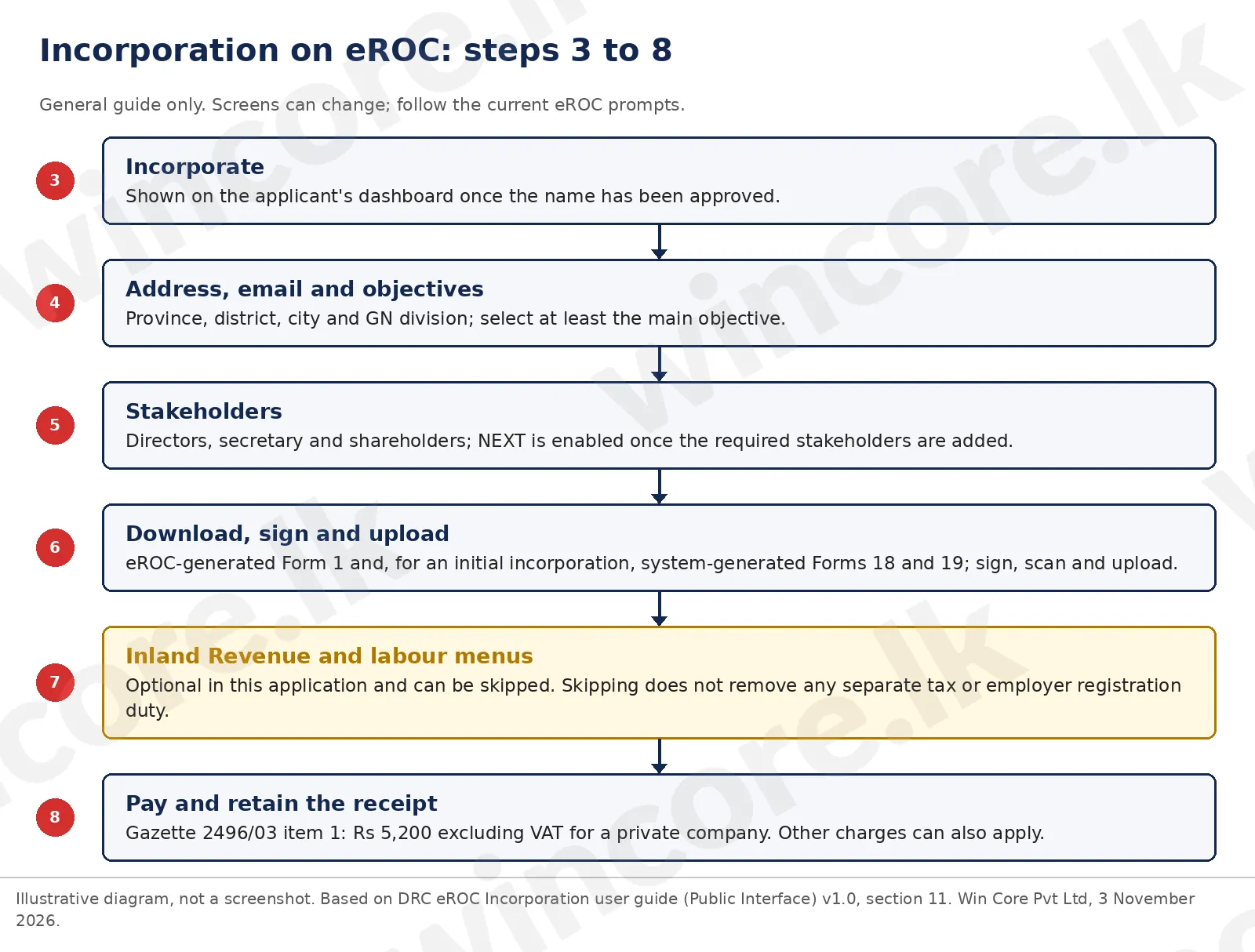
Registering a private limited company in Sri Lanka in 2026: structure, name approval, the eROC filing with BO 1 and BO 5, the TIN and the first year.

Registering a sole proprietorship in Sri Lanka: the business name at the Divisional Secretariat, the TIN certificate, income tax, VAT, SSCL and EPF.