
Director TIN in Sri Lanka: who registers and how first login works
Directors register as resident adults, not as directors. What the IRD asks a new company for, when a letter is needed and how the PIN and SSIDs work.
On this page
Last verified against the primary sources on 22 October 2026.
A director TIN in Sri Lanka is not required because someone is a director; we found no rule that says so. The Inland Revenue Act ties registration to persons. Under Gazette 2334/21, every resident individual aged 18 or over must register, with effect from 1 January 2024, and under s.102(1A) every company must register within 30 days of incorporation, a rule in force since 3 June 2026. When the company registers, the IRD asks for each director's NIC or passport. The company's first e-Services login then runs on a PIN, followed by staff IDs (SSIDs) for the people who prepare and approve returns.
Take a hypothetical new private company with two directors: one lives in Kandy, the other is not a Sri Lankan citizen and lives in Dubai. Which of them needs a TIN, what does the IRD ask for when the company registers, and who logs in first? This piece separates what the Act requires from what the IRD's guides and circulars ask for.
The Act and Gazette 2334/21 decide who registers; IRD guides decide how
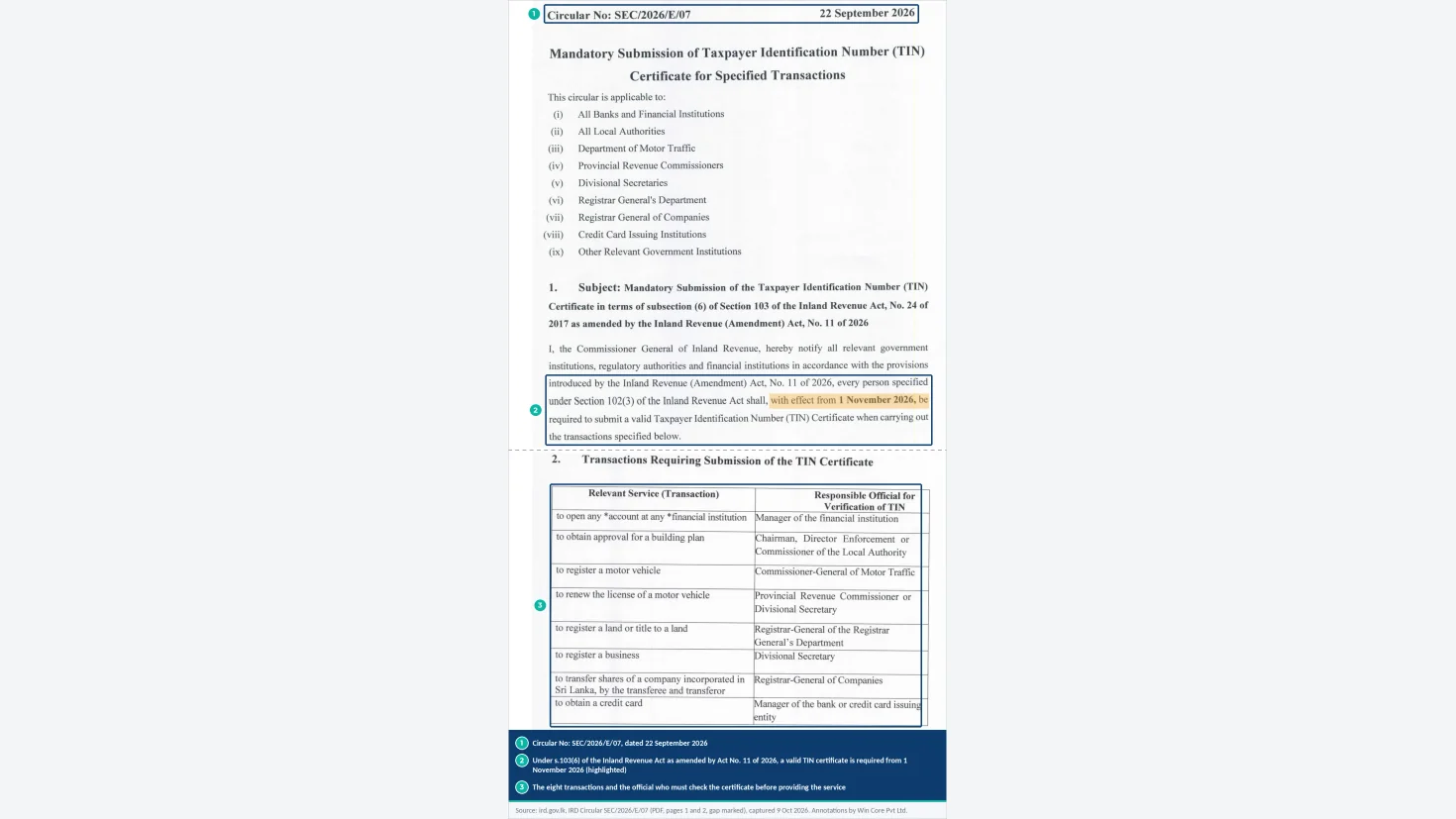
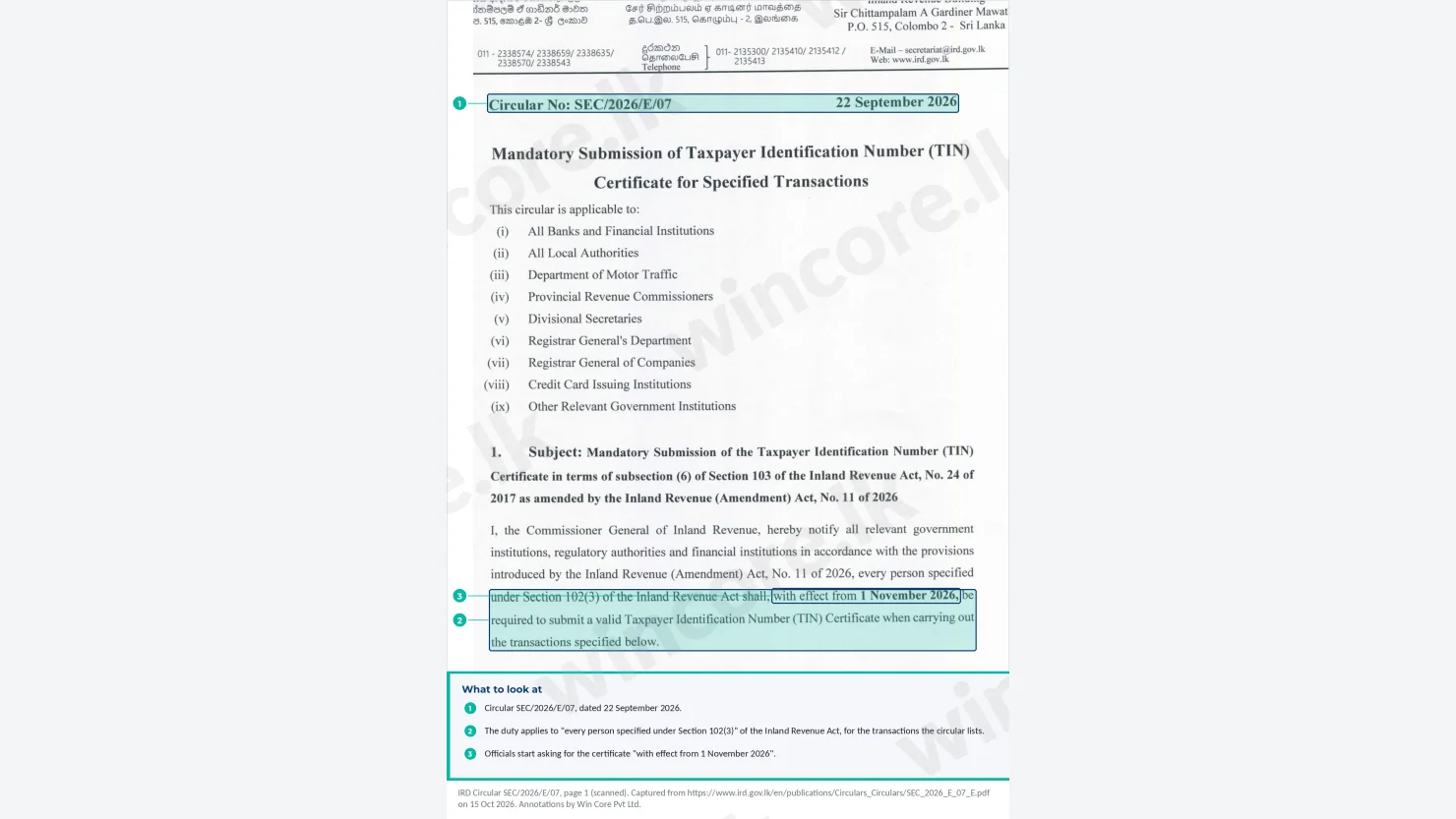
The statutory rules are ss.102 and 103 of the Inland Revenue Act, No. 24 of 2017, as amended by Act No. 11 of 2026, and the Minister's order in Gazette 2334/21 under s.102(3) [1] [2] [3]. The administrative rules are the IRD's Taxpayer Registration Guidelines (2026), its e-Services quick guides, and Circular SEC/2026/E/07 on TIN certificates [4] [5] [7] [8]. The guides are not law and can change without a Gazette. The Companies Act sets the director rules the IRD's documents rely on [6].
Director TIN in Sri Lanka follows residence and age, not the role
No statutory provision we found makes a directorship a reason to register. Registration duties attach to persons in classes:
- Return filers. "Every person liable to furnish a return of income ... shall register ... not later than thirty days after the end of the basis period" (s.102(1)) [1].
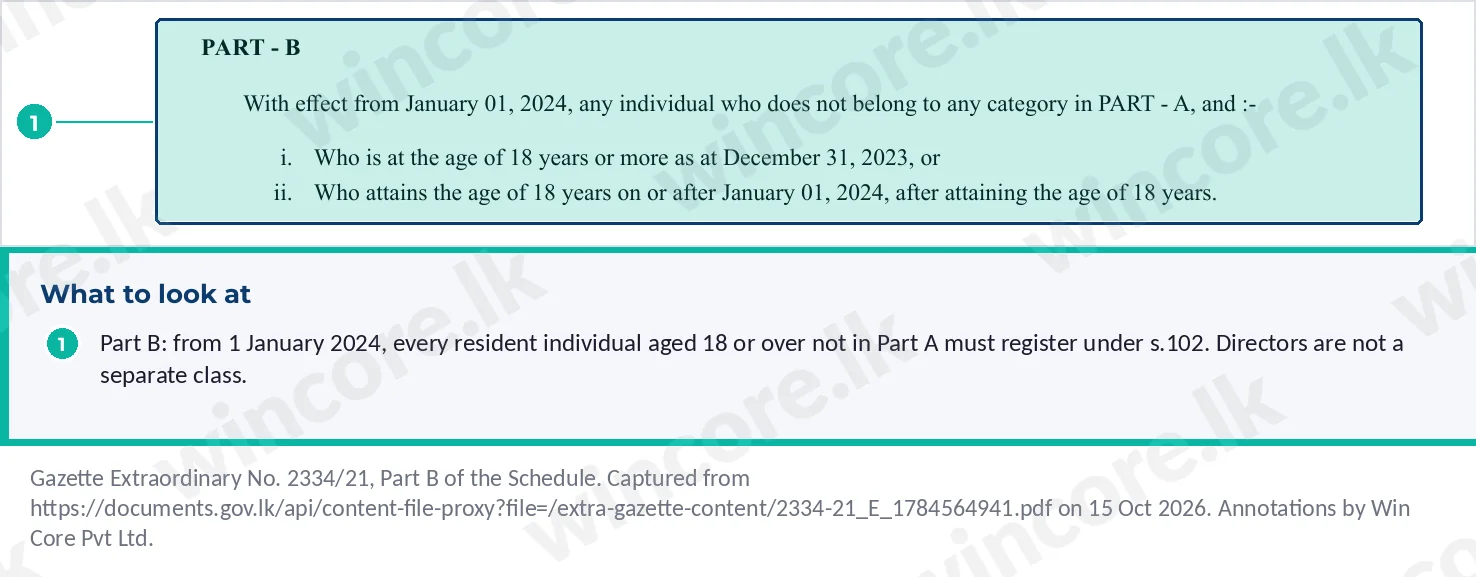
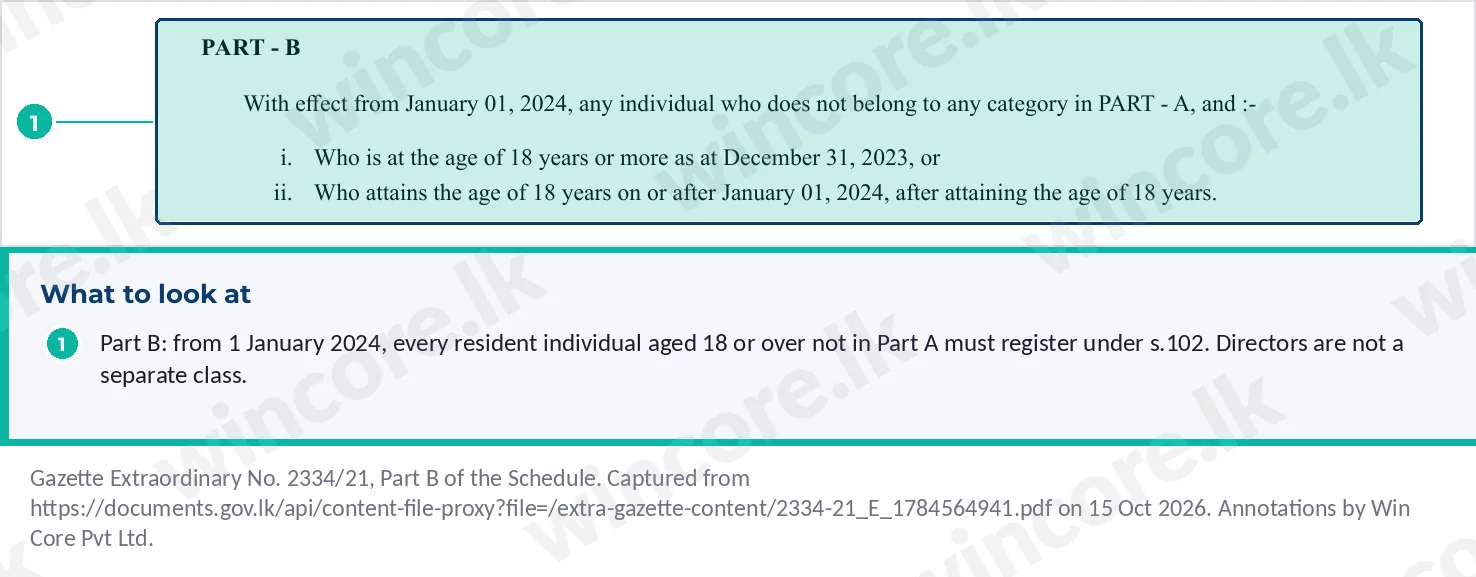
- Classes specified by the Minister. Section 102(3) lets the Minister "specify additional classes of persons required to register" [1]. Gazette 2334/21 did so for "resident persons". Part A lists professions and transactions; Part B covers, from 1 January 2024, "any individual who does not belong to any category in PART - A" and who is 18 or over [3].
- Companies. New s.102(1A): "Every company incorporated or registered in Sri Lanka, shall register with the Commissioner-General not later than thirty days from the date of such incorporation or registration" [2].
So the Kandy director must register, because she is a resident adult, not because she is a director. The Dubai director is outside 2334/21 while he is not resident, since the order covers "resident persons" [3]. He needs a TIN only if another rule catches him, for example if he must file a return under s.102(1). For the TIN certificate check, Circular E/07 says a non-citizen who has been in Sri Lanka for less than 183 days at the date of a transaction "may be treated" as non-resident; anyone else claiming non-residence needs the IRD's confirmation [5]. If he starts spending long periods here, check his position again.
What about a "forced" TIN? Section 103(2) says the Commissioner-General "may assign a TIN to a person who is not a taxpayer" but who, among other things, "is required to register under subsection (3) of section 102" [1]. That is a power, not a duty, and the Act does not say it is used for directors in particular. The IRD does run a Forced Registration Unit: its notice SEC/PN/APIT/2026-02 lets employers ask it to issue TINs to employees who have none [9]. We found no IRD notice saying director TINs are issued automatically from company filings, so we keep that open. A director who is unsure whether a TIN already exists can check through e-Services, Verify Registration, using an NIC and a one-time code, as our guide to the TIN certificate from 1 November 2026 shows step by step.
The company registration asks for directors' identity, not their TINs
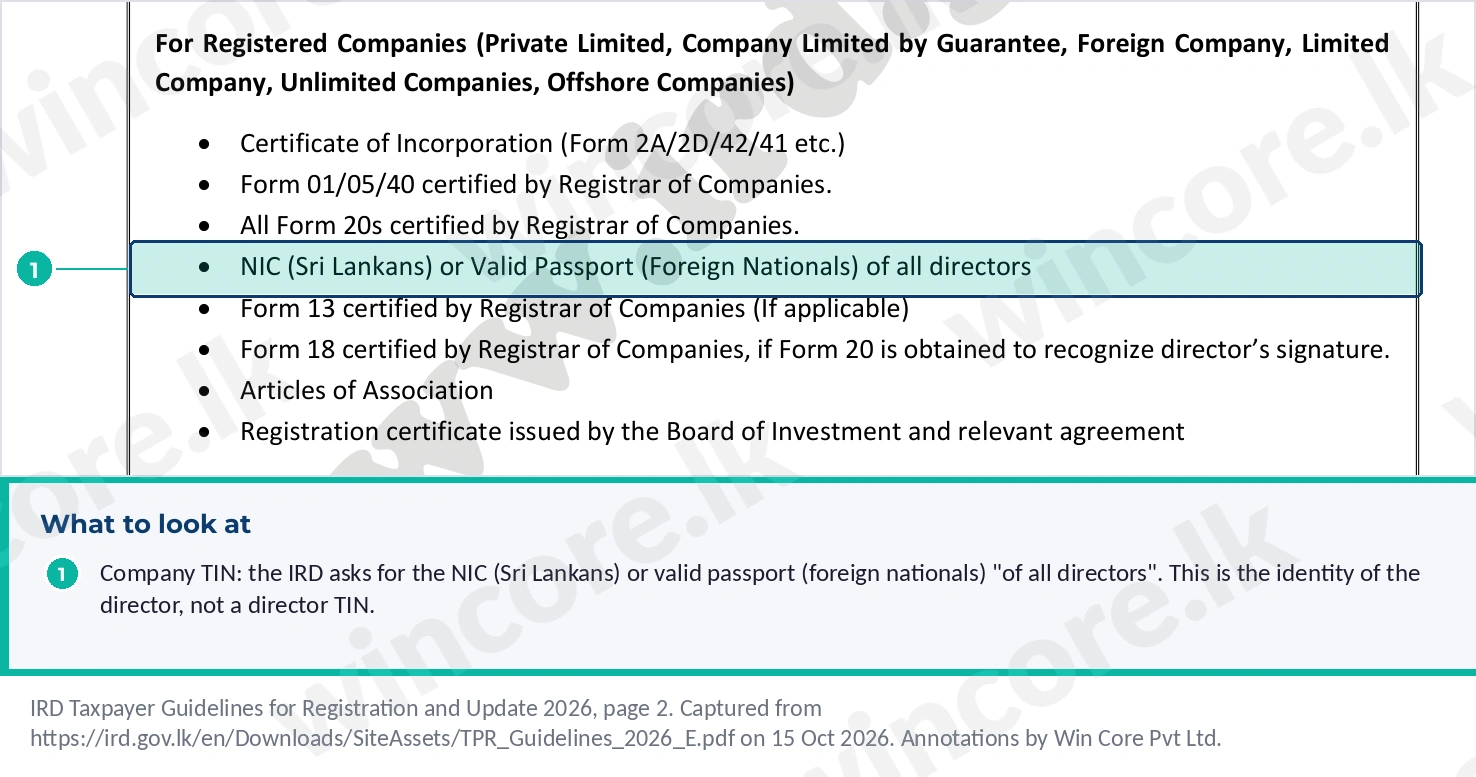
The IRD guide lists, "For Registered Companies": the certificate of incorporation, "Form 01/05/40 certified by Registrar of Companies", "All Form 20s certified by Registrar of Companies", and the "NIC (Sri Lankans) or Valid Passport (Foreign Nationals) of all directors" [4]. That is identity, not a director TIN. Form 18 is listed "if Form 20 is obtained to recognize director's signature" [4]. The IRD's online registration has the company add each director by TIN, NIC or passport, so it helps to confirm each resident director's own TIN status before starting.
Those forms come from the Companies Act. A person cannot be appointed a director "unless he has, in the prescribed form" consented to be a director and certified that he is not disqualified (s.203) [6]. The register of directors and secretaries under s.223 holds each director's name, usual residential address and business occupation [6]. Neither section mentions a TIN. Our statutory secretarial services prepare and certify the Form 20s the IRD asks for.
The guide also says: "For corporate entities, once TIN is obtained, Corporate Income Tax (CIT) is automatically registered" [4].
An authorisation letter is needed for VAT and for a company PIN, not for the TIN
Where does the "authorisation letter" come in? In the registration guide, it appears in the VAT registration lists: "Company authorization letter, together with a copy of the National Identity Card (NIC) of the authorized signatory", alongside "Copies of the NIC, valid passport, or valid driving license of all directors" [4]. For SVAT, the guide refers to "A Director who is authorized by the board resolution to apply for SVAT" [4]. We did not find an authorisation letter in the guide's list for obtaining the company TIN itself. The IRD's PIN guide adds the second place a letter is needed: "You will need to present a letter of authorization if you are requesting the PIN on behalf of your company", and a person collecting a PIN at IRD head office presents an NIC or passport [7]. Neither guide prescribes a format. As practice, not a legal requirement, a short letter on the company's letterhead signed by a director is the usual form.
The first e-Services login runs on a PIN, then staff IDs
The IRD's public guides give the sequence. We describe it from those guides only; we have not reproduced portal screens.
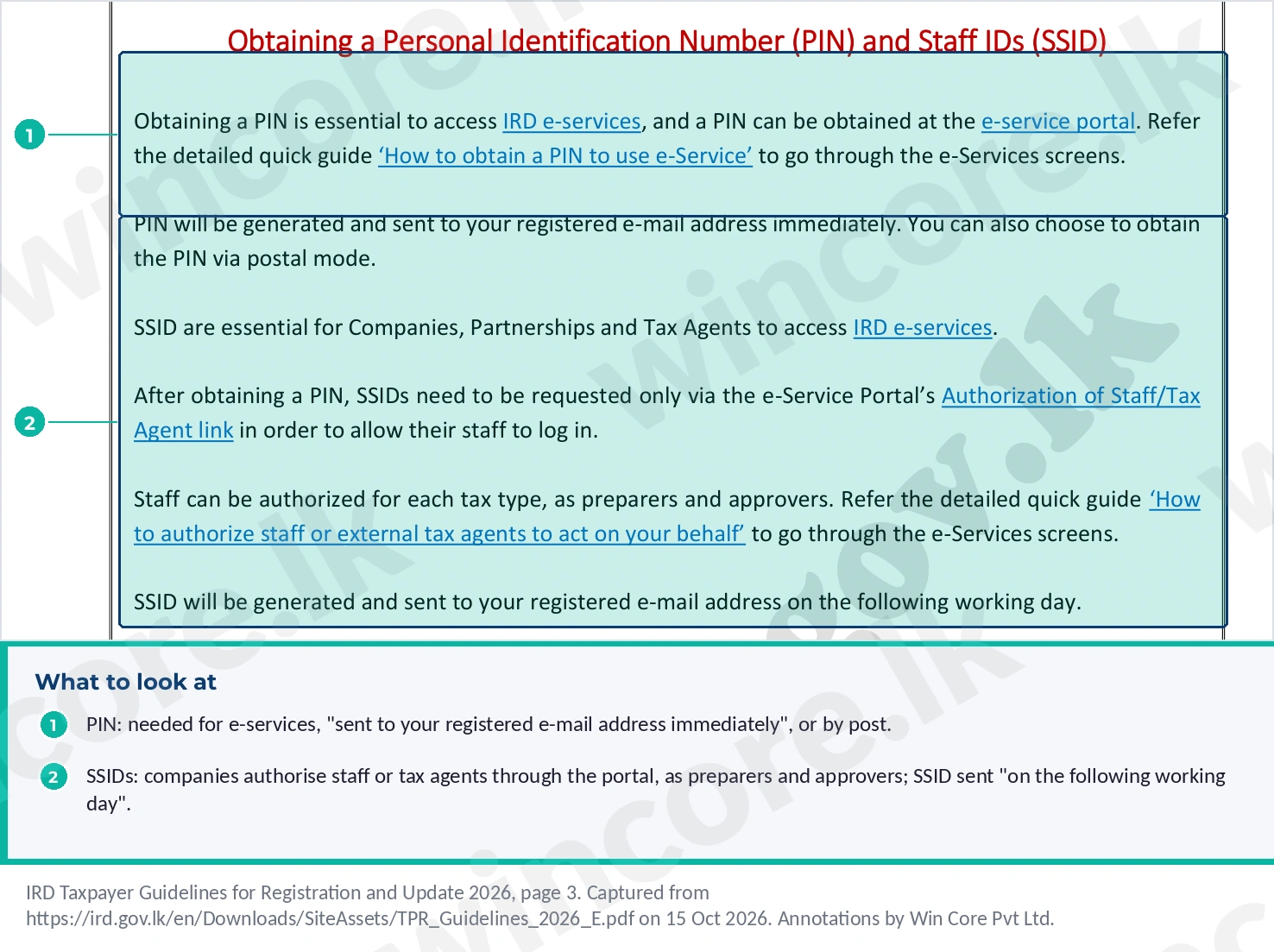
- Request the PIN. Through PIN Request on e-Services, an individual enters an NIC or TIN and a company enters its Registrar of Companies number [7]. The 2026 registration guide says the PIN "will be generated and sent to your registered e-mail address immediately", with a postal option [4]; the older PIN guide describes posting it [7].
- Change it at first login. The IRD's maintenance guide says the system "doesn't allow to proceed to next page without changing the system generated PIN" [8].
- Do not ask twice. The same guide says "Please avoid submitting multiple PIN requests", and once a new PIN is requested, earlier PINs "can no longer be used". Five wrong entries lock the account [8].
- Request SSIDs. After the PIN, "SSIDs need to be requested only via the e-Service Portal's Authorization of Staff/Tax Agent link". Staff "can be authorized for each tax type, as preparers and approvers", and the SSID follows "on the following working day" [4]. The SSID password must also be changed on first access [8]. For who may act for you before the IRD, see the authorised representative rules in section 195.
The practical point: the PIN goes to the e-mail address registered for the company. Whoever controls that mailbox controls the first login. As practice, use a company-controlled address, not a director's personal one. The IRD's circulars call the same portal RAMIS; the guides call it IRD e-Services.
The Act and the circular give different start dates
| Rule | Statutory source and date | Administrative source and date |
|---|---|---|
| Resident adults register | Gazette 2334/21 Part B, 1 January 2024 [3] | None |
| Company registers | s.102(1A), 30 days from incorporation [2] | Guide lists the documents [4] |
| TIN certificate for listed transactions, including share transfers by transferor and transferee | s.103(6)(b), "With effect from April 1, 2026" [2] | Circular E/07, "with effect from 1 November 2026" [5] |
| Notify changes of name, address, place of business or activity | s.103(5), 30 days [1] | Guide lists Form 20 for director updates [4] |
For a share transfer, Circular E/07 requires the certificate from "the transferee and transferor", and exempts "Any non-resident individual" [5]. A resident director buying or selling shares will need one from 1 November 2026; the Dubai director, if non-resident, should not.
Penalties fall on the person who failed to register
| Default | Section | Consequence |
|---|---|---|
| Failing to register under s.102, or to notify changes under s.103(5) | s.177 | "a penalty not exceeding fifty thousand rupees" [1] |
| Failing, "without reasonable cause", to comply with a Commissioner-General notice to register | s.185A(1)(c), (2) | Offence: "a fine not exceeding four hundred thousand rupees or to imprisonment of either description for a term not exceeding six months or to both" [2] |
| No TIN certificate at a listed transaction | Circular E/07 | No fine in the circular; the official should not complete the transaction [5] |
These apply to the person who failed to register. Being a director does not by itself attract them. Section 185A applies only after a written notice and a 30-day window, as our note on the Inland Revenue Amendment Act No. 11 of 2026 explains.
Four common misreadings
- "Every director needs a TIN." Only those caught by a registration class. Residency and age matter; the role does not.
- "The company's TIN covers the directors." No. It is the company's.
- "Any director can log in." Access is by PIN and SSIDs, issued to the registered e-mail and to authorised staff [4].
- "The TIN certificate rule started on 1 April 2026." That is the statutory date; the circular applies the procedure from 1 November 2026 [2] [5].
What this means for you
Treat director TINs as a personal question for each director, and the company's TIN and login as a company question. For the hypothetical company: register it within 30 days of incorporation with the certified forms and both directors' identity documents; confirm the Kandy director has her own TIN; take only a passport copy from the Dubai director while he is non-resident; use a finance mailbox the company controls; authorise a preparer and an approver for each tax type; and from 1 November 2026 collect TIN certificates from resident individuals on any share transfer. Whether a change of directors must be notified within the 30 days in s.103(5) is open, so update the IRD with the certified Form 20 promptly.
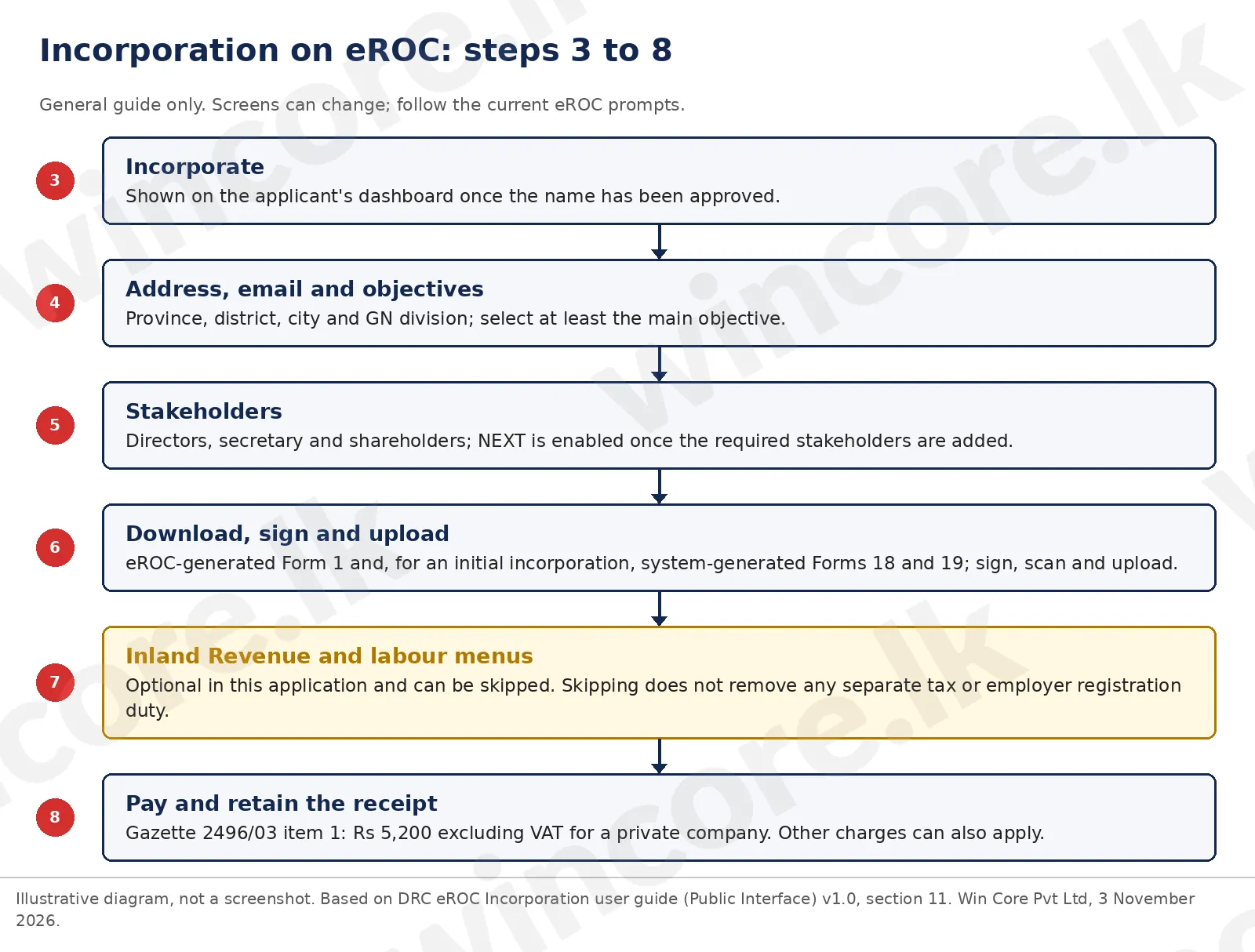
Our income tax compliance services include TIN registration for the company and for individuals, including founders, shareholders and directors, and the PIN and staff set-up that follows. The incorporation steps that come first are in our guide on how to register a company in Sri Lanka.
Checklist: documents needed
- Certificate of incorporation
- Form 1 (or Form 5 or 40) and all Form 20s, certified by the Registrar of Companies
- NIC of each Sri Lankan director, or valid passport of each foreign director
- Form 13 and Form 18 if they apply, and the Articles of Association
- A company-controlled e-mail address for the IRD registration
- Letter of authorisation if someone requests or collects the company PIN
- Each resident director's own TIN, or a dated check that one exists
- Names of the staff to be authorised as preparers and approvers, by tax type
FAQ
Does a foreign director need a Sri Lankan TIN?
Not because of the directorship. Gazette 2334/21 covers resident persons, so a non-resident foreign director needs a TIN only if another rule applies, such as a duty to file a return. For the TIN certificate check, a non-citizen here for less than 183 days may be treated as non-resident under Circular E/07 [3] [5].
What does the IRD want about directors when the company registers?
The NIC of each Sri Lankan director or the valid passport of each foreign director, with all Form 20s certified by the Registrar of Companies. The guide also lists the certificate of incorporation, Form 1, 5 or 40, the Articles, and Form 13 and Form 18 where they apply. It does not ask for a TIN for each director [4].
Who receives the company's IRD PIN?
The e-mail address registered for the company. The IRD's 2026 guide says the PIN is generated and sent there immediately, or by post if chosen. Whoever controls that mailbox controls the first login, which is why we use a company address. The system then forces a change of the PIN on first access [4] [8].
Is there a fine for a director who has no TIN?
Only if that director was required to register. Section 177 then allows a penalty of up to Rs 50,000, and ignoring a Commissioner-General's 30-day notice to register can become an offence under s.185A, with a fine of up to Rs 400,000, up to six months, or both. A non-resident director outside any registration class faces neither [1] [2].
Do I need a TIN certificate to become a director?
No. Circular E/07 lists eight transactions, including opening an account at a financial institution and transferring shares in a Sri Lankan company, but appointment as a director is not one of them. A resident director who buys or sells shares from 1 November 2026 will need a certificate for that transfer [5].
Open points
- Automatic director TINs. We found no IRD notice that the IRD assigns TINs to directors from company data under s.103(2); the Forced Registration Unit notice covers employees. Unconfirmed.
- Authorisation letter format. The guides name the letter but set no template.
- Who must be the first approver. The guide does not say whether a director must hold the approver SSID.
- Section 103(5) and directors. It covers changes in "name ... address, place of business, or nature of the taxable activity" [1]. Whether a change of directors falls within it is not explicit; the guide's Form 20 list suggests the IRD expects an update.
Talk to us. If you are setting up a company and want the company TIN, each director's own TIN and the first IRD login done in one sequence, our contact page.
WinCore Pvt Ltd
References
- Inland Revenue Department. Inland Revenue Act, No. 24 of 2017, consolidated with amendments to 2025, ss.102, 103 and 177. https://www.ird.gov.lk/en/publications/Acts_Income%20Tax_2017/IRA_Cons_Act_-_2025_Changes.pdf . Primary. Accessed 15 October 2026 (ss.102(1), 102(3) and 177 cross-checked against our circular note verified 21 October 2026).
- Parliament of Sri Lanka. Inland Revenue (Amendment) Act, No. 11 of 2026, ss.23, 24 and 31 (new ss.102(1A), 103(6) and 185A). https://www.ird.gov.lk/en/publications/Acts_Income%20Tax_2017/IR_Act_No_11-2026_E.pdf . Primary. Accessed 15 October 2026.
- Government of Sri Lanka. Gazette Extraordinary No. 2334/21, order under s.102(3), Parts A and B. https://documents.gov.lk/api/content-file-proxy?file=/extra-gazette-content/2334-21_E_1784564941.pdf . Primary. Accessed 22 October 2026.
- Inland Revenue Department. Taxpayer Registration Guidelines (2026), pp.2 to 6 and 10. https://ird.gov.lk/en/Downloads/SiteAssets/TPR_Guidelines_2026_E.pdf . Primary. Accessed 21 October 2026.
- Inland Revenue Department. Circular SEC/2026/E/07: Mandatory Submission of the TIN Certificate (22 September 2026), paras 1 to 4. https://www.ird.gov.lk/en/publications/Circulars_Circulars/SEC_2026_E_07_E.pdf . Primary. Accessed 15 October 2026.
- Parliament of Sri Lanka. Companies Act, No. 7 of 2007, ss.203 and 223. http://www.drc.gov.lk/en/wp-content/uploads/2018/04/Act-7-of-2007-English.pdf . Primary. Accessed 15 October 2026. Both sections read again on 22 October 2026 at https://srilaws.com/legislation/companies-act-no-7-of-2007/section-203 and section-223 (Secondary reproduction of the official English text).
- Inland Revenue Department. Obtaining a PIN (e-Services quick guide, v0.12). https://www.ird.gov.lk/en/eServices/Lists/Registration/Attachments/2/Obtaining%20a%20PIN%20v0%2012.pdf . Primary. Accessed 22 October 2026.
- Inland Revenue Department. Instructions on TIN/PIN and Staff ID (SSID)/Password Maintenance (v1.0, undated). https://www.ird.gov.lk/en/eServices/Lists/Registration/Attachments/10/Quick_Guide_-_TIN-PIN_SSID-PW_Maintenance%20v1.0.pdf . Primary. Accessed 22 October 2026.
- Inland Revenue Department. Notice SEC/PN/APIT/2026-02 (forced registration of employees). https://www.ird.gov.lk/en/Lists/Latest%20News%20%20Notices/Attachments/770/SEC_PN_APIT_2026-02_E.pdf . Primary. Not re-fetched; as cited in our TIN certificate guide (verified 9 October 2026).
Put these insights to work
WinCore specialists can review your current workflow, document gaps, and build a practical 90-day action plan.
Book a free consultationContinue reading
Explore more WinCore analysis to keep your finance, tax, and compliance roadmap moving.
From 1 November 2026 individuals need a TIN certificate for eight transactions. Who needs one, how to get it, and TINs for companies and staff.
What the IRD circular says, clause by clause: eight transactions, five exemptions, the 1 April and 1 November dates, and why a company still needs a TIN.
Registering a private limited company in Sri Lanka in 2026: structure, name approval, the eROC filing with BO 1 and BO 5, the TIN and the first year.