
Inland Revenue Amendment Act No. 11 of 2026: what changed and when
Certified 3 June 2026, Act No. 11 carries nine start dates. Here is each change, the date it bites, the penalty attached and the 2 December write-off.
On this page
Last verified against the primary sources on 21 October 2026.
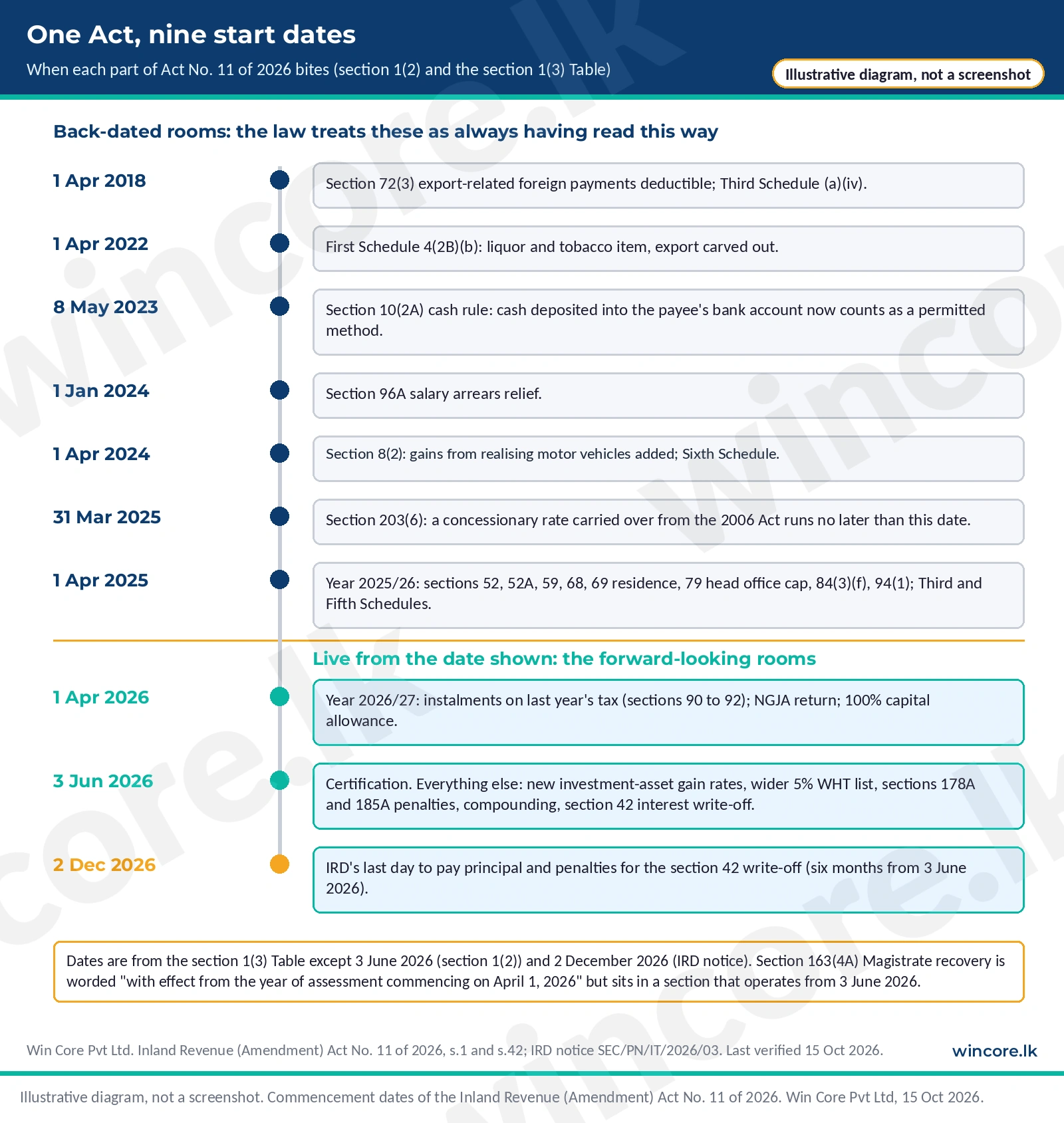
The Inland Revenue Amendment Act No. 11 of 2026 was certified on 3 June 2026, and most of it applies from that day. Gains on investment assets are now taxed at 15 percent for individuals and partnerships and 30 percent for trusts, unit trusts and NGOs, 29 more services come under the 5 percent withholding rule, and interest owed for years up to 2024/25 is written off if the tax and unwaived penalties are paid within six months, which the IRD puts at 2 December 2026 [1] [4]. Other sections are dated back as far as 1 April 2018, and quarterly instalments from 2026/27 start from last year's tax.
Take a hypothetical furniture maker in Kandy. It has an unpaid 2022/23 balance carrying interest, pays a resident freelance photographer Rs 150,000 a month, and its director sold a plot of land held as an investment in July 2026.
Inland Revenue Amendment Act No. 11 of 2026 has nine start dates
The Act amends the Inland Revenue Act, No. 24 of 2017 (the IRA) [1]. The IRD summarised it in a notice to taxpayers dated 8 June 2026, explained the interest write-off in a second notice the same day, and explained the prosecution rules in a third notice dated 10 July 2026 [3] [4] [5].
Who it affects. Anyone who sells investment assets, pays quarterly instalments, pays service fees to resident individuals, holds deposits, still owes interest for years up to 2024/25, runs a non-resident's Sri Lankan permanent establishment, or works abroad.
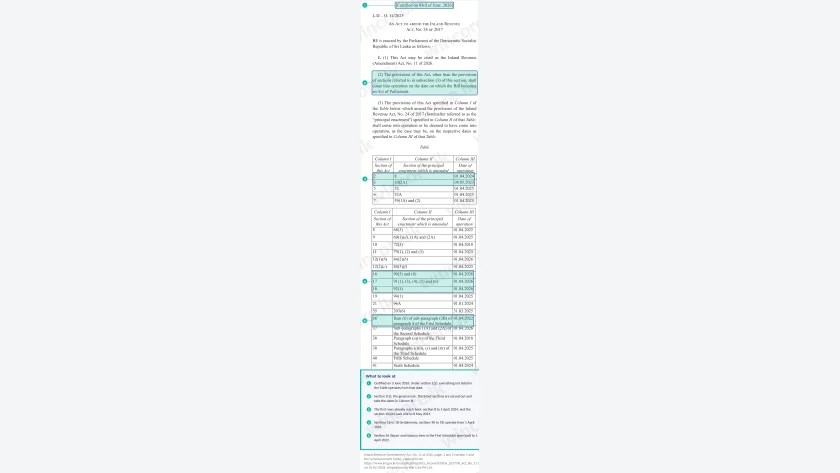
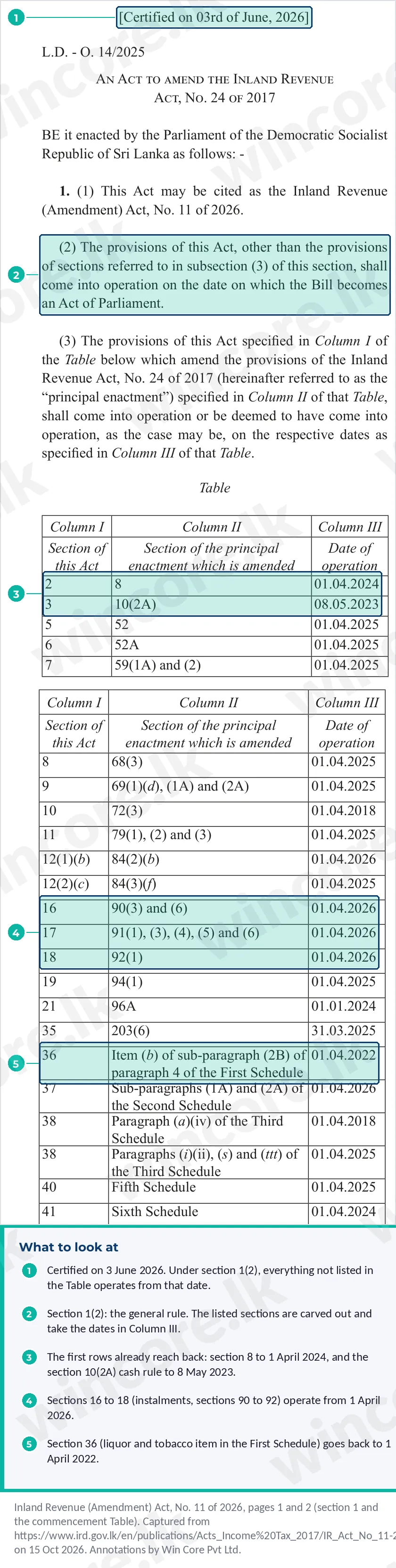
Section 1(2) brings the Act into operation "on the date on which the Bill becomes an Act of Parliament", which the IRD reads as 3 June 2026 [1] [4] [5]. Section 1(3) lists the exceptions in a Table: each listed section "shall come into operation or be deemed to have come into operation" on its own date [1].
Place this amendment alongside the wider 2026 tax-law changes before updating the compliance checklist.
From 3 June 2026, gains tax rises and the 5 percent WHT list widens
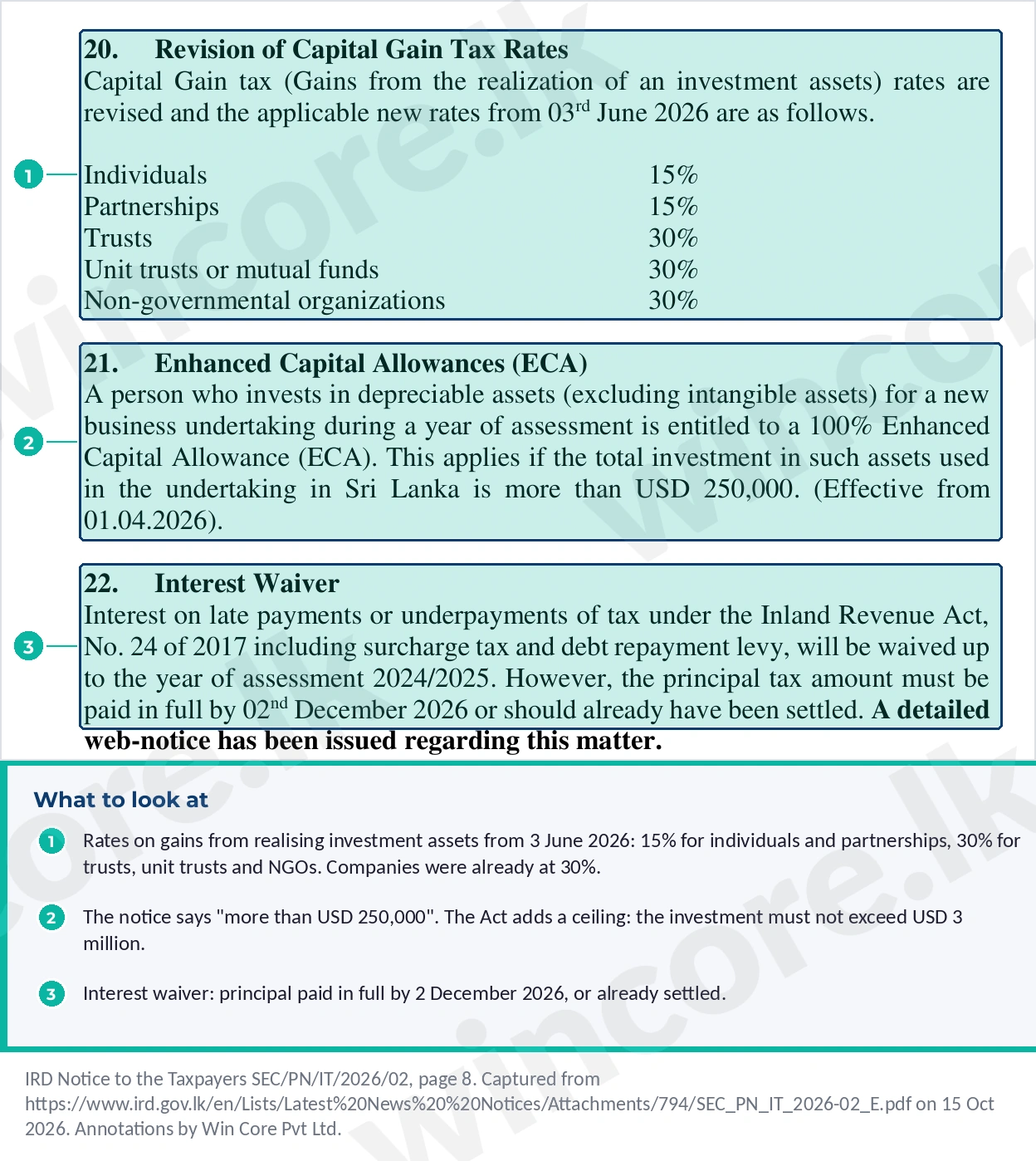
Gains on investment assets. The First Schedule rate on gains from realising investment assets changes from 10 percent to "15%, with effect from the date on which the provisions referred to in subsection (2) of section 1 come into operation" for individuals and for the firms taxed under paragraph 2, and to 30 percent for trusts, unit trusts and mutual funds, and non-governmental organisations [1]. Companies were already taxed on these gains at "30% with effect from October 1, 2022" [2]. The Act does not amend the 10 percent rate for charitable institutions in paragraph 6 [1] [2]. Our capital gains tax guide covers the exemptions and the 30-day return.
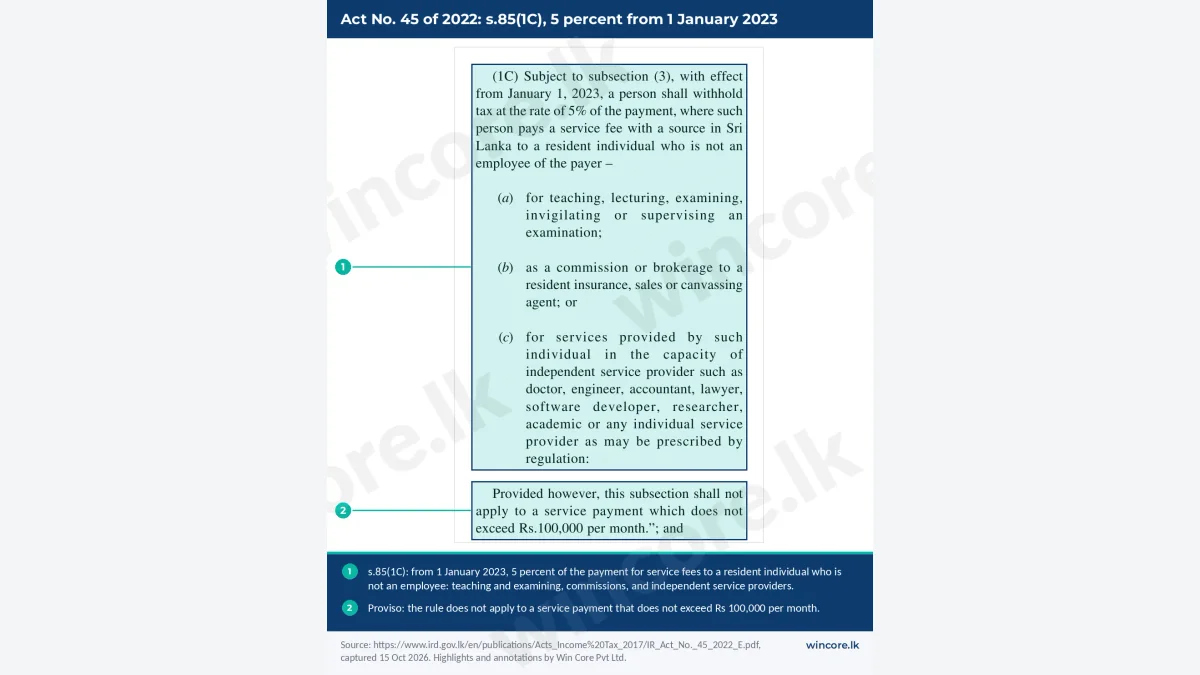
A wider 5 percent withholding list. Section 85(1C) already required tax at 5 percent on service fees to a resident individual who is not an employee, with the proviso that it "shall not apply to a service payment which does not exceed Rs.100,000 per month" [2]. The Act adds 29 named service providers to paragraph (c), from auditor and photographer to advisor, writer and "debt collector" [1]. Section 85(3)(b) still excludes "payments made by individuals, unless made in conducting a business" [2]. The IRD's withholding agent circular, SEC/2026/E/04, took effect on 8 June 2026 [7]; our guide to 5 percent WHT on service fees covers the monthly threshold and the certificate.
Withholding agent duties. New s.86(9) obliges every withholding agent to follow "the procedures, formats and forms" the Commissioner-General specifies for withholding statements, and new s.87(6) requires certificates to be served "free of any charge or payment" [1].
Magistrate recovery. New s.163(4A) lets the Commissioner-General send a certificate of tax in default to the Magistrate, after which "the tax in default shall be deemed to be a fine", but not while a s.139 administrative review or a s.140(1) appeal "is pending" [1]. Once a certificate is filed, "any plea that the tax is excessive, incorrect, or under appeal, shall not be entertained" (s.163(4H)).
Also from 3 June 2026: company registration with the Commissioner-General "not later than thirty days" from incorporation (s.102(1A)), TIN certificates (s.103, see our guide to the TIN certificate from 1 November 2026), gifts to the Government or a university treated as realised at net cost (s.46(3A)), and newspaper service of summons (s.175A) [1].
Instalments move to last year's tax, and other changes reach back to 2018
Instalments, from 2026/27. For any year of assessment commencing on or after 1 April 2026, item A in the s.90(3) formula is "the amount of tax payable by the instalment payer with respect to the taxable income ... in the immediately preceding year of assessment" [1]. The statement of estimated tax under s.91 is limited to earlier years. If there was no taxable income last year, or you expect less this year, the current estimate is used "as per the procedure, and on the basis, specified by the Commissioner-General". Item C of the formula now also counts tax withheld during the year from payments included in your income (new paragraph (ba)) [1]. The IRD set the estimate method in Circular SEC/2026/E/06, re-revised on 12 August 2026 [6]; see our explainer on Circular SEC/2026/E/06 and the guide to quarterly instalments after the SET form.
The 120 percent safe harbour, from 2025/26. Under new s.135(7), an individual's return is "accepted as filed, and no amended or additional assessment shall be made" if the declared tax is at least 120 percent of "the tax payable on the taxable income" of the previous year, the tax is paid in full "without claiming a tax refund", and an affidavit of no fraud, evasion or wilful default is furnished [1]. The IRD says the affidavit format "will be specified in due course" [3].
Residence, from 2025/26. A holder of an Investor Category Residence Visa "shall not be a resident in Sri Lanka for a year of assessment" (s.69(1A)), and nor is an individual who leaves for at least one year's contract employment with an unassociated employer, from the first day of the year of departure until the contract expires (s.69(2A)) [1].
Life insurance, from 2025/26. New s.52A excludes amounts an individual receives under a life insurance policy on death, maturity or surrender, but not employment or business income, annuities, pensions, or "any payment made under a life insurance policy otherwise than on the death of the insured person or maturity of the policy" [1]. Read literally, that last carve-out catches surrender, which subsection (1) excludes. We treat the position of surrender payments as open.
Other back-dated changes. The s.10(2A) cash rule, back to 8 May 2023, now accepts cash deposited "in the second mentioned person's bank account" [1]. Head office expenditure of a non-resident's permanent establishment is capped, from 2025/26, at the lesser of the actual amount and "ten per centum of such person's assessable income from such business" (s.79(2)). From 1 April 2026, new Second Schedule paragraph 1(2A) gives a 100 percent allowance on depreciable assets, other than intangibles, in a new undertaking [1]; see the misreadings below for its ceiling.
Why back-dating matters. The word "deemed" in s.1(3) is what allows back-dating. Most of the back-dated changes help the taxpayer: a carry-forward of qualifying payments that could not be deducted (s.52(4)), a deduction for foreign-source payments incurred in exporting (s.72(3)), and a wider s.10(2A) exemption, now "any payment to or by" the Government or a bank [1]. The head office cap cuts the other way for 2025/26, a year whose instalments were paid on the old basis. Before relying on a back-dated change, check whether you filed that year's return before 3 June 2026.
The interest write-off needs full payment by 2 December 2026
Section 42 is not an amendment to the IRA; it stands on its own. The Commissioner-General "shall write off" outstanding interest under s.157 "up to the year of assessment ending on March 31, 2025", under the Surcharge Tax Act No. 14 of 2022, and on the debt repayment levy under the Finance Act No. 35 of 2018 [1].
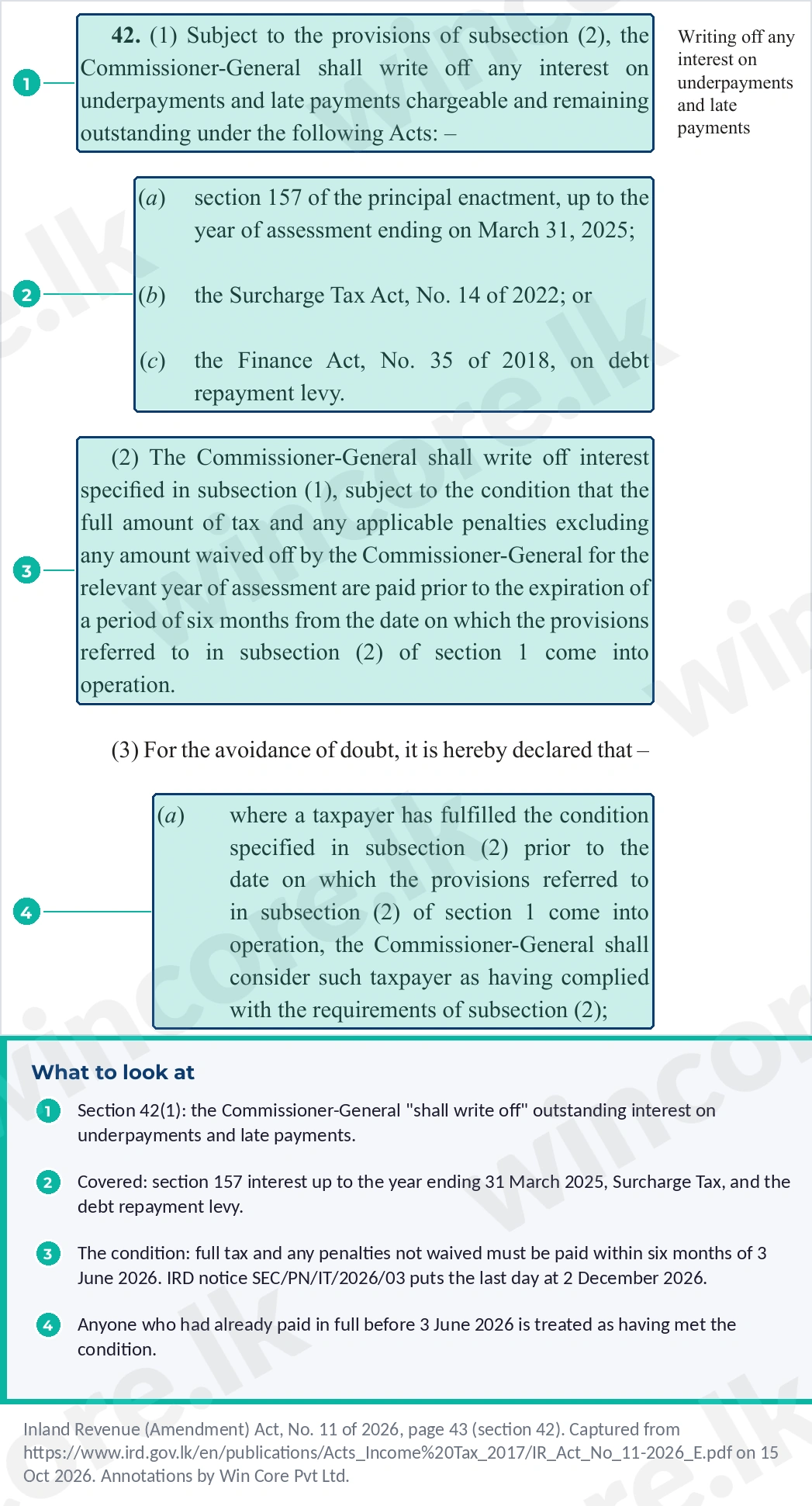
The condition is that "the full amount of tax and any applicable penalties excluding any amount waived off by the Commissioner-General for the relevant year of assessment are paid prior to the expiration of a period of six months" from 3 June 2026 [1]. The IRD says "the final date for settlement of the full tax amount to qualify for this relief is 02.12.2026" [4]. Each year is considered separately. A taxpayer who had already paid in full before 3 June 2026 is treated as compliant. Principal that the IRD had applied to interest under s.154 counts as principal [1].
The IRD adds two practice points not in the Act: penalty waiver requests go in writing "after payment of the full tax amount", and "any payment made as 'interest' prior to 03.06.2026 will not be refunded" [4].
The IRD's 2 December 2026 counts 3 June 2026 as day one; the Act says "prior to the expiration of a period of six months". We would pay in November.
Each new penalty is tied to one specific default
| Default | Section | What follows |
|---|---|---|
| Not following the Commissioner-General's procedures, formats and forms for withholding statements (s.86(9)) | s.178A(1) and (2) | Penalty "not exceeding two hundred thousand rupees for a year of assessment", only after a notice of warning; none if you comply "within fourteen days from the date of service" |
| False or misleading deposit-interest self-declaration (s.84(3)(f)) | s.178A(3) to (5) | Penalty up to Rs 200,000 after a notice; no further self-declaration in place of that one |
| Not filing the s.86 annual statement, the s.93 return, s.102 registration, s.123 appearance or s.126 return, then ignoring the 30-day notice "without reasonable cause" | s.185A(2) | On conviction, "a fine not exceeding four hundred thousand rupees or ... imprisonment of either description for a term not exceeding six months or ... both" |
| Tax in default, with no review or appeal pending | s.163(4A) to (4H) | Recovery as a deemed fine through the Magistrate's Court |
| Paying tax late (not changed by the Act) | s.179(1); s.179(2) for a quarterly instalment | 20 percent of the tax due but not paid if it is not paid within fourteen days of the due date, or by the due date in a notice of assessment if later; 10 percent on an instalment not paid within fourteen days of its due date; interest at 1.5 percent a month or part month runs separately from the due date (ss.157, 159) |
Sources: [1] [2] [9]. Our penalty calculator applies the late payment rules to your own figures. The IRD calls prosecution "a measure of last resort" and says individuals with no tax liability who only need a TIN "will not be subject to these legal proceedings ... at this time" [5]. That is policy, not law, and "at this time" matters.
Four common misreadings of the Act, and a worked example
- "Capital gains tax went up for everyone." Not for companies, which were already at 30 percent, and not for charitable institutions, which the Act leaves at 10 percent [2].
- "The new capital allowance applies to any project above USD 250,000." The IRD notice says "more than USD 250,000" [3]. The Act adds "but does not exceed USD 3 million" [1]. Our Enhanced Capital Allowance guide covers the BOI condition for expansions.
- "The 120 percent rule is based on tax paid last year." The IRD notice says "tax paid". The Act says "tax payable on the taxable income" of the preceding year [1] [3].
- "The 30 days run from the date on the notice." The IRD notice says "from the date of the notice" [5]. Section 185A(1) says "within thirty days of serving the notice" [1]. Count from the earlier date to be safe.
Worked example: the furniture maker
All figures are invented.
- Its 2022/23 assessment shows principal of Rs 1,800,000, a late payment penalty of Rs 360,000 (20 percent of the tax due but not paid, s.179(1)) and interest of Rs 950,000 [9]. If the company pays the Rs 1,800,000 and the penalty (or whatever is left after any waiver) before the deadline, s.42 requires the Commissioner-General to write off the Rs 950,000 [1].
- The photographer's Rs 150,000 fee for August 2026 exceeds Rs 100,000 for the month, so the company withholds 5 percent, Rs 7,500, and gives a free certificate [1] [2]. Our WHT calculator runs the same check.
- The director's land is realised when the director parts with ownership (s.39(a)), here July 2026, so on our reading the 15 percent rate applies [2]. Had it been shares quoted on a licensed stock exchange, the gain would be exempt under Third Schedule paragraph (h), which the Act does not touch.
What this means for you
If you owe old interest, the write-off closes on 2 December 2026. If you pay freelancers, your withholding list changed on 3 June 2026. If you pay instalments, last year's tax is now the default. If you get an IRD notice, its clock now leads to a penalty or prosecution. Our income tax compliance services cover all four. The personal bands were set by Act No. 2 of 2025, not this Act; see our income tax bands for 2026. For what the next Budget proposes, see the Budget 2027 tax proposals for companies and employers.
What a business must do now
- List interest still owed for 2024/25 or earlier, by year, and pay principal and unwaived penalties well before 2 December 2026 [4].
- Recompute 2026/27 instalments under the re-revised Circular SEC/2026/E/06 [6].
- Add the 29 new professions to your withholding checks [7].
- Answer every IRD notice in time, above all a 30-day s.185A notice or a 14-day s.178A warning.
- Review 2025/26 positions on residence, life insurance, head office expenses and salary arrears; the IRD issued Circular SEC/2026/E/05 on s.96A arrears on 26 June 2026 [8].
Checklist: documents needed
- IRD assessments or statements of account for each year up to 2024/25, showing principal, penalty and interest
- Proof of tax and penalties already paid, and any penalty waiver request or decision
- The final 2025/26 tax computation, which is the base for 2026/27 instalments
- A list of service providers paid more than Rs 100,000 in a month, with the withholding certificates issued
- Deeds and cost records for any investment asset realised on or after 3 June 2026
- Any IRD notice under s.178A or s.185A, with the date it was served
Open points we are keeping open
- The exact day the s.42 window closes. We rely on the IRD's 2 December 2026.
- Whether surrender payments under a life insurance policy are excluded under s.52A, given the wording of s.52A(2)(b).
- How s.163(4A), worded "with effect from the year of assessment commencing on April 1, 2026", applies to tax for earlier years. Section 163(4B) lets the certificate include amounts payable before the subsection came into operation.
- How the two gains rates apply within 2026/27. On our reading the date of realisation under s.39 decides the rate, but the Act states no apportionment rule for a year that contains both.
FAQ
When did the Inland Revenue Amendment Act No. 11 of 2026 come into force?
It came into force on 3 June 2026, the date it was certified, for every section not listed in the s.1(3) Table [1]. Listed sections take their own dates, from 1 April 2018 to 1 April 2026, so the instalment rules start with 2026/27.
What is the last date for the IRD interest write-off?
The IRD says 2 December 2026 [4]. The Act requires the full tax and any unwaived penalties for each year up to 2024/25 to be paid "prior to the expiration of a period of six months" from 3 June 2026, so paying in November avoids any argument about the last day.
Do I still need to file a Statement of Estimated Tax?
No, not for 2026/27 or any later year. Section 91 now applies only to years commencing before 1 April 2026, and each instalment starts from last year's tax under s.90(3) [1]. If you expect lower income, Circular SEC/2026/E/06 sets the estimate method [6].
Can the IRD prosecute me for not filing a tax return?
Yes, under the new s.185A, but only after a written notice and a 30-day window to comply. A person who then fails "without reasonable cause" faces, on conviction before a Magistrate, a fine of up to Rs 400,000, up to six months in prison, or both [1].
Last verified: we checked the Act and IRD notices SEC/PN/IT/2026/03 and 2026-04 at source on 21 October 2026; the other sources were checked on 15 October 2026.
This article is general information on the law as at 21 October 2026 and is not advice on your specific position.
Talk to us. If you would like us to check your old balances against the s.42 write-off, recompute your 2026/27 instalments or update your withholding list, book a consultation at our contact page.
WinCore Pvt Ltd
References
- Parliament of Sri Lanka. Inland Revenue (Amendment) Act, No. 11 of 2026 (certified 3 June 2026), ss.1 to 4, 6, 9, 11 to 18, 23, 24, 26, 28 to 31, 36, 37, 42 and 43. https://www.ird.gov.lk/en/publications/Acts_Income%20Tax_2017/IR_Act_No_11-2026_E.pdf . Primary. Accessed 21 October 2026.
- Inland Revenue Department. Inland Revenue Act, No. 24 of 2017, consolidated with amendments to 2025, ss.10(2A), 39, 85(1C) and (3); First Schedule paras 4(4) and 6(2); Third Schedule para (h). https://www.ird.gov.lk/en/publications/Acts_Income%20Tax_2017/IRA_Cons_Act_-_2025_Changes.pdf . Primary. Accessed 15 October 2026.
- Inland Revenue Department. Notice to the Taxpayers: Amendments to the Inland Revenue Act, No. 24 of 2017, SEC/PN/IT/2026/02 (8 June 2026), items 16, 20 and 21. https://www.ird.gov.lk/en/Lists/Latest%20News%20%20Notices/Attachments/794/SEC_PN_IT_2026-02_E.pdf . Primary. Accessed 15 October 2026.
- Inland Revenue Department. Notice to the Taxpayers: Interest Relief for Underpayments and Late Payments, SEC/PN/IT/2026/03 (8 June 2026). https://www.ird.gov.lk/en/Lists/Latest%20News%20%20Notices/Attachments/789/SEC_PN_IT_2026-03.pdf . Primary. Accessed 21 October 2026.
- Inland Revenue Department. Notice to the Public: Implementation of Prosecution Provisions under the Inland Revenue (Amendment) Act, No. 11 of 2026, SEC/PN/IT/2026-04 (10 July 2026). https://www.ird.gov.lk/en/Lists/Latest%20News%20%20Notices/Attachments/800/SEC_PN_IT_2026-04_E.pdf . Primary. Accessed 21 October 2026.
- Inland Revenue Department. Circular to Taxpayers: Calculating Quarterly Income Tax Instalments, SEC/2026/E/06 (Re-Revised) (12 August 2026). https://www.ird.gov.lk/en/publications/Circulars_Circulars/SEC_2026_E_06_ReRiv_E.pdf . Primary. Accessed 15 October 2026.
- Inland Revenue Department. Circular to Withholding Agents: Deduction of Withholding Tax and Advance Income Tax, SEC/2026/E/04 (8 June 2026), p.1. https://www.ird.gov.lk/en/publications/Circulars_Circulars/SEC_2026_E_04_E.PDF . Primary. Accessed 15 October 2026.
- Inland Revenue Department. List of Circulars (lists SEC/2026/E/04 to E/07, including E/05 on salary arrears under s.96A, 26 June 2026). https://www.ird.gov.lk/en/publications/SitePages/Circulars.aspx . Primary. Accessed 15 October 2026.
- Inland Revenue Department. Guide to the Return of Income Tax, Y/A 2025/26, Section 09 (penalty of 20 percent of the tax due but not paid; 10 percent on a late instalment; interest at 1.5 percent a month or part month). https://www.ird.gov.lk/en/Downloads/IT_Individuals_Doc/Asmt_IIT_004_2025_2026_E.pdf . Primary. Accessed 21 October 2026.
Put these insights to work
WinCore specialists can review your current workflow, document gaps, and build a practical 90-day action plan.
Book a free consultationContinue reading
Explore more WinCore analysis to keep your finance, tax, and compliance roadmap moving.

The SET filing requirement is gone from Y/A 2026/27. Quarterly instalments now follow a formula based on the previous year's tax. Here is how it works.
Sri Lanka taxes gains on investment assets at a flat rate, separate from your other income: 15% for individuals from 3 June 2026 (10% before). Here is what is exempt and how to file the capital gains tax return.
When a payer must withhold 5 percent on service fees, the services added in June 2026, payment within 15 days and the certificate rules.