
5 percent WHT on service fees to resident individuals
When a payer must withhold 5 percent on service fees, the services added in June 2026, payment within 15 days and the certificate rules.
On this page
Last verified against the primary sources on 15 October 2026, with the additions verified on 22 October 2026.
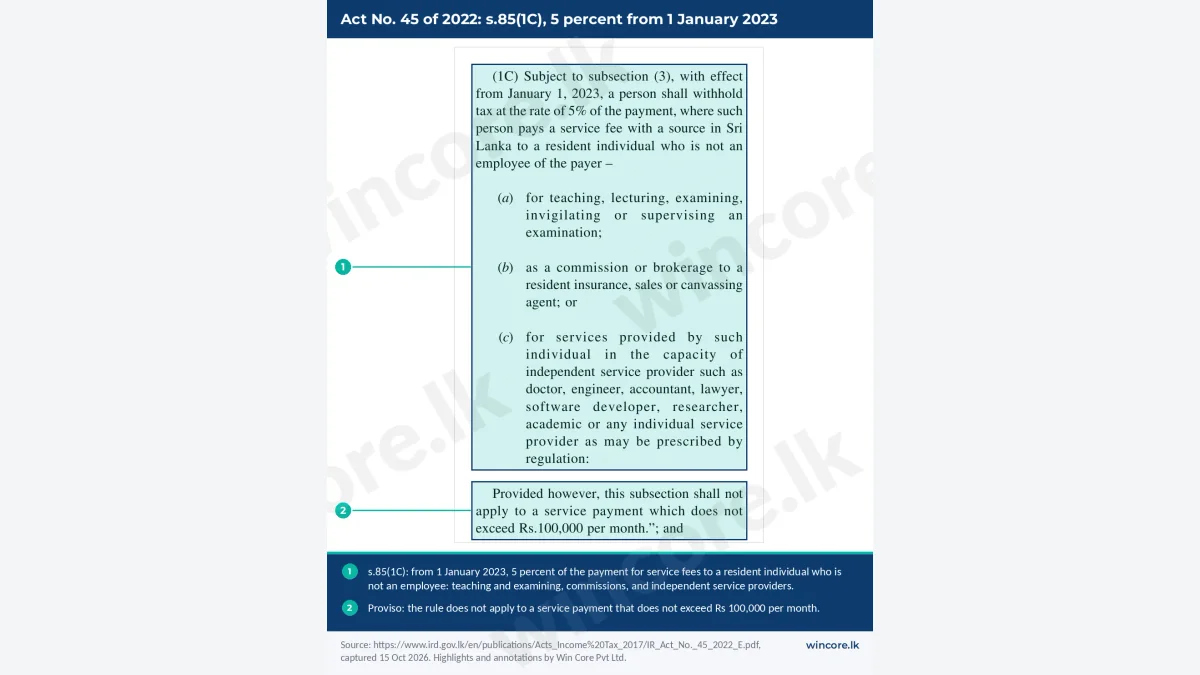
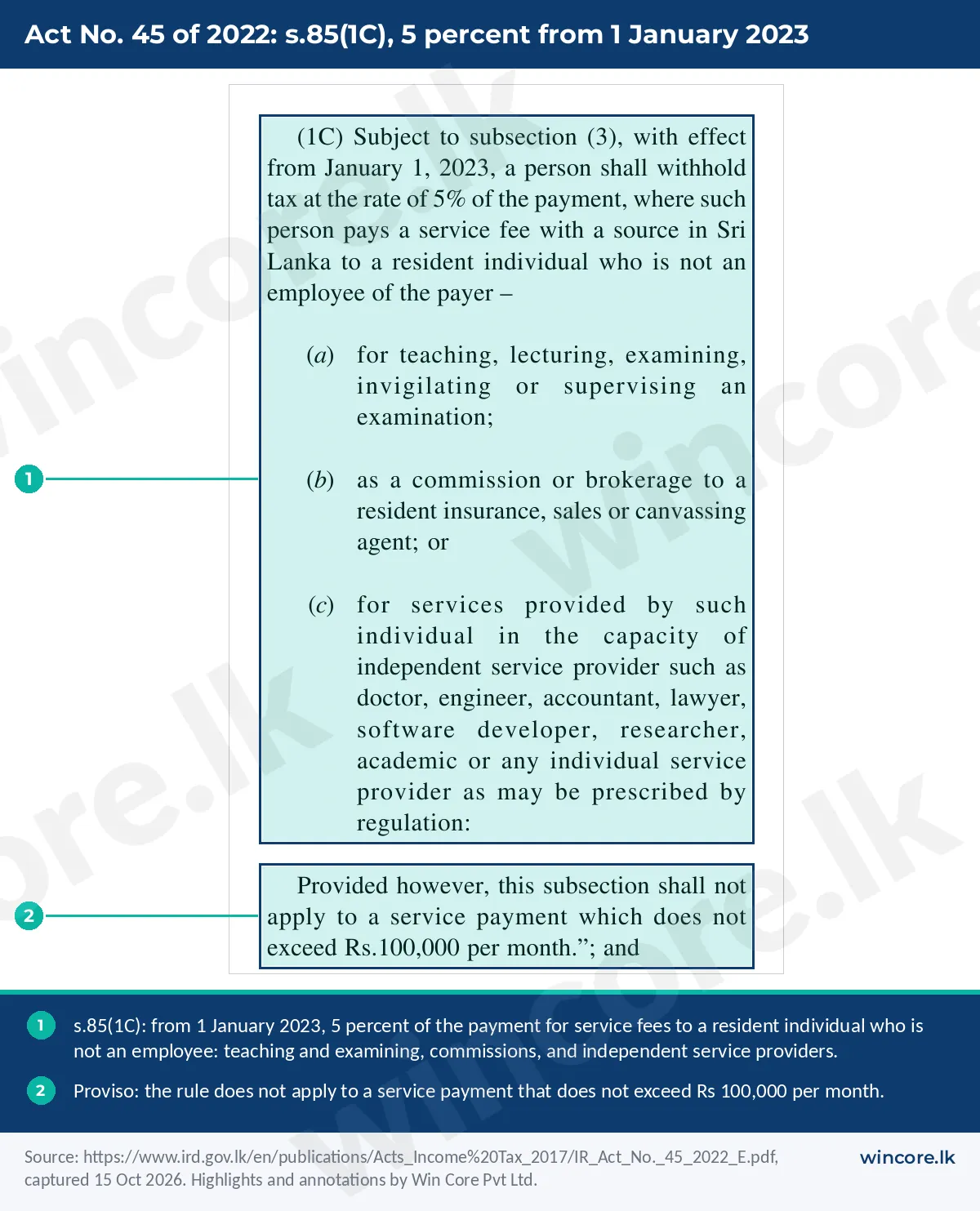
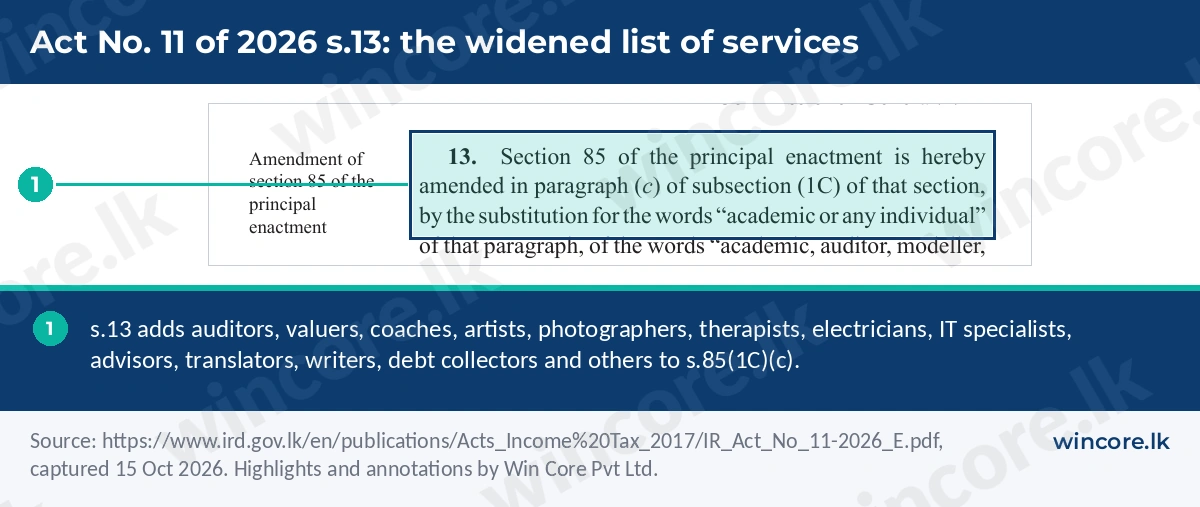
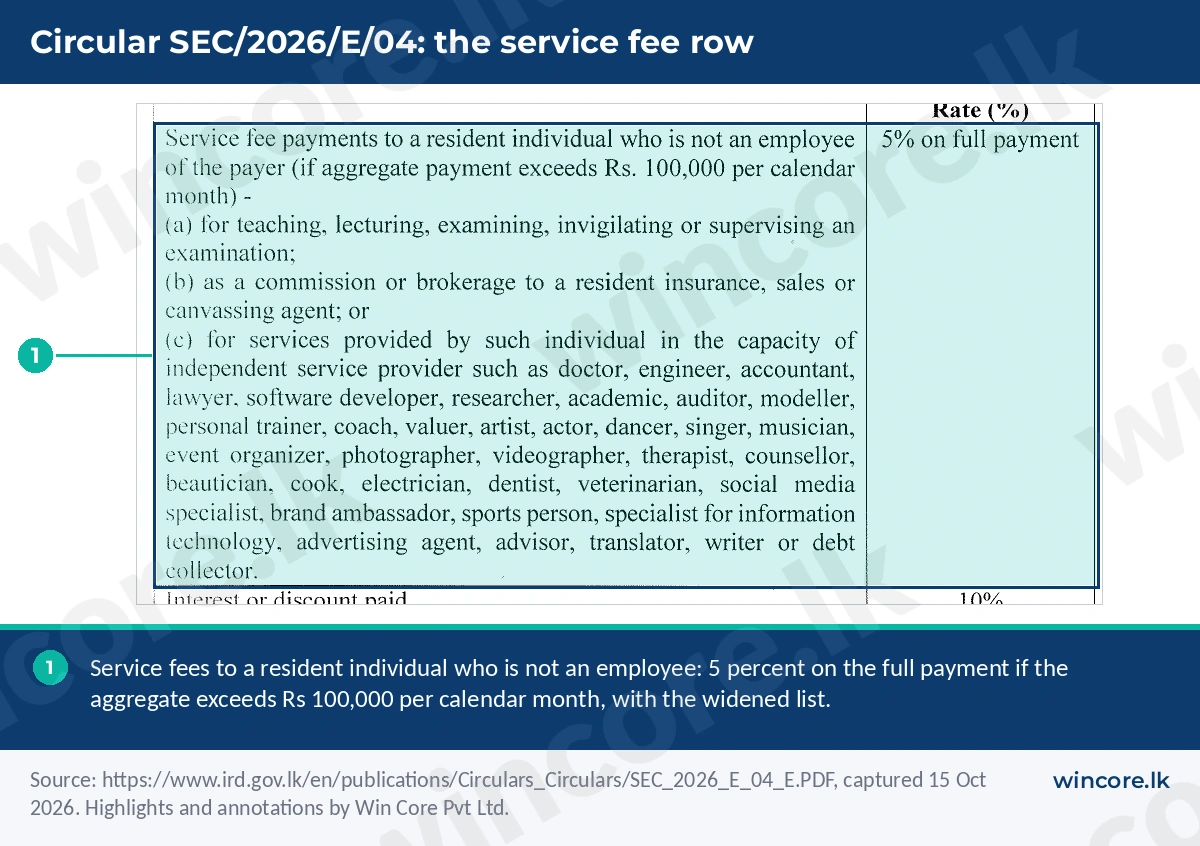
When a business pays a resident individual for services and the payments in a calendar month add up to more than Rs 100,000, it deducts withholding tax at 5 percent of the full payment, not only the excess. A payment of Rs 120,000 in one month to a freelance event organizer means Rs 6,000 goes to the Inland Revenue Department (IRD). The rule has applied since 1 January 2023 under section 85(1C) of the Inland Revenue Act, inserted by Act No. 45 of 2022 [1]. Section 13 of Act No. 11 of 2026 widened the list of services from 3 June 2026 [2]. The IRD's Circular SEC/2026/E/04 of 8 June 2026 sets out the rate as "5% on full payment" where the "aggregate payment exceeds Rs. 100,000 per calendar month" [3].
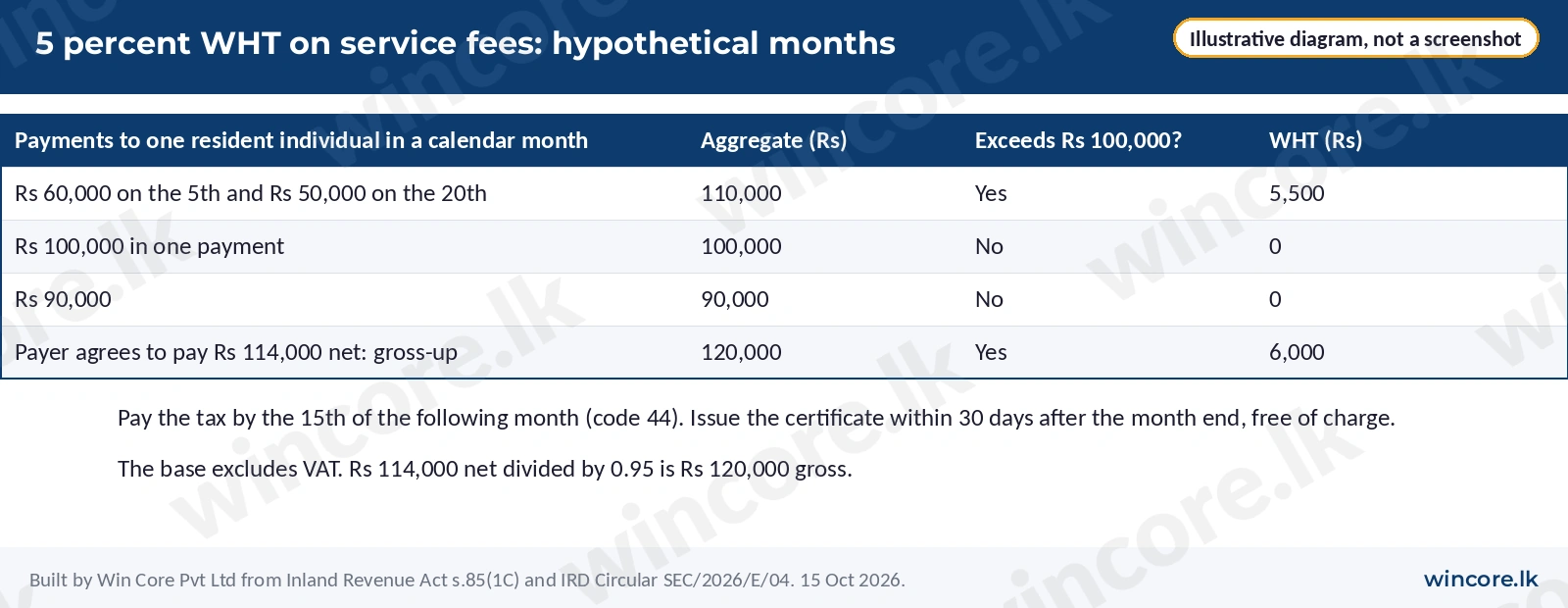
Take a hypothetical company that pays a freelance photographer Rs 60,000 on the 5th and Rs 50,000 on the 20th of the same month. The aggregate is Rs 110,000. It exceeds Rs 100,000, so 5 percent is deducted on the full Rs 110,000: Rs 5,500. A month in which the photographer is paid exactly Rs 100,000 attracts nothing, because the rule does not apply to a service payment that "does not exceed Rs.100,000 per month" [1].
This guide covers who must deduct, which payees and services are covered, the monthly test, the base and gross-up, payment and certificates. It does not cover payments to non-residents, employment income (APIT), or the payee's own income tax return.
Checklist: documents needed
- Engagement letter or invoice describing the service
- Evidence the payee is a resident individual and not your employee
- The payee's name, address and TIN, for the certificate and the annual statement
- A monthly schedule of all service fee payments to each individual
- Your own withholding tax registration with the IRD
- Payment receipts (OTPP or People's Bank) and copies of certificates issued
Step 1. Check you are a payer that must deduct
What to do. Section 85 does not apply to payments made by individuals "unless made in conducting a business", to payments already subject to withholding under section 83 (employment), 83A or 84A, or to exempt amounts [4]. A company, partnership or sole proprietor paying in the course of business is in scope. An individual paying a private tutor for their own child is not.
The IRD's circular adds one more carve-out. WHT is not required on "payments made by the Sri Lanka Government including any local authority and Government Departments (other than Public Corporations, Universities and Government owned entities and businesses)" [3]. A public corporation, a state university or a state-owned business that engages a freelance lecturer, engineer or translator deducts like any other business payer.
Where. Your own records.
What you need. Your WHT registration.
What goes wrong. Assuming the rule is only for large companies, or registering only after the first deduction falls due. A sole proprietor who pays a freelance designer for the business is a payer in scope; the same person paying a music teacher for a child at home is not. Reading the Government carve-out as covering every state body: the bracketed words keep public corporations, universities and Government owned businesses in.
How long. Minutes.
Instrument: Inland Revenue Act, No. 24 of 2017, s.85(3); IRD Circular SEC/2026/E/04, Government payer exception. Official link: Inland Revenue Act, consolidated to 2025 and Circular SEC/2026/E/04. Last verified: 15 Oct 2026; Government exception 22 Oct 2026.
Step 2. Confirm the payee is a resident individual who is not your employee
What to do. The rule covers a service fee with a source in Sri Lanka paid "to a resident individual who is not an employee of the payer" [1]. Pay to a company, and section 85(1C) does not apply. Pay to an employee, and the payment belongs in APIT under section 83A [4].
Where. The engagement letter or invoice.
What you need. Evidence of residence and of an independent engagement.
What goes wrong. Treating a long-term contractor who works set hours under your direction as independent. Applying 5 percent to a non-resident: a service fee with a source in Sri Lanka paid to a non-resident person falls under section 85(1B) at 14 percent, with no monthly threshold [4]. If in substance the person is an employee, the payment is employment income and APIT applies instead.
How long. Minutes per payee.
Instrument: Inland Revenue Act, s.85(1C), inserted by Act No. 45 of 2022. Official link: Act No. 45 of 2022. Last verified: 15 Oct 2026.
Step 3. Check the service is on the list
What to do. There are three groups [1] [2]:
- (a) teaching, lecturing, examining, invigilating or supervising an examination;
- (b) commission or brokerage to a resident insurance, sales or canvassing agent;
- (c) services as an independent service provider. Act No. 45 of 2022 named doctors, engineers, accountants, lawyers, software developers, researchers and academics. From 3 June 2026, Act No. 11 of 2026 added auditors, modellers, personal trainers, coaches, valuers, artists, actors, dancers, singers, musicians, event organizers, photographers, videographers, therapists, counsellors, beauticians, cooks, electricians, dentists, veterinarians, social media specialists, brand ambassadors, sports persons, IT specialists, advertising agents, advisors, translators, writers and debt collectors.
Group (c) still ends with "or any individual service provider as may be prescribed by regulation" [2].
Where. The engagement description and the statutory list.
What you need. A clear description of the service on the invoice.
What goes wrong. Working from the pre-June 2026 list, and missing a photographer, coach or translator who is now covered. Section 13 is not in the commencement table of Act No. 11 of 2026, so it took effect when the Act was certified on 3 June 2026 [2].
How long. A short check against the current text. Words such as "advisor" and "writer" are broad, and the list is introduced by "such as", so on our reading it gives examples rather than a closed list. A freelance professional whose service is not named is still likely to be caught as an independent service provider; record why you treated a payee as in or out, and keep that note with the invoice.
Instrument: Inland Revenue (Amendment) Act, No. 11 of 2026, ss.1 and 13. Official link: Act No. 11 of 2026. Last verified: 15 Oct 2026.
Step 4. Add up the month and deduct 5 percent on the full amount
What to do. Add every service fee payment to the same individual in the calendar month. If the total exceeds Rs 100,000, deduct 5 percent on the full amount [3]. If it is Rs 100,000 or less, deduct nothing.
Example 1. Rs 60,000 and Rs 50,000 in the same month: Rs 110,000, tax Rs 5,500.
Example 2. Exactly Rs 100,000: no deduction.
Example 3. Rs 90,000: no deduction.
Example 4, where the month crosses the line late. Rs 80,000 paid on the 5th without deduction, because at that point the month was under Rs 100,000, then Rs 30,000 on the 25th. The month's total is Rs 110,000, so tax of Rs 5,500 is due on the full amount. On our reading, the practical course is to deduct the whole Rs 5,500 from the second payment, so the payee receives Rs 24,500 on the 25th. If you cannot recover it, you still owe it [4]. Where a payee is likely to exceed the threshold, many payers deduct from the first payment and avoid the problem.
Where. Accounts payable, in the payment run.
What you need. The monthly schedule for each payee.
What goes wrong. Deducting only on the excess over Rs 100,000. Missing a second invoice that pushes the month over the line, and then not deducting on either payment. If the first payment was made without deduction, the payer still owes the tax that should have been withheld [4].
How long. Part of the payment run.
Instrument: Inland Revenue Act, s.85(1C) and proviso; s.86(3); IRD Circular SEC/2026/E/04, para 1. Official link: Circular SEC/2026/E/04. Last verified: 15 Oct 2026.
Step 5. Use the right base, and gross up if you pay the full invoice
What to do. The base is the "gross amount excluding any Value Added Tax payable" [3]. If you agree to pay the whole invoice without deduction, the circular treats the invoiced amount as the net amount and the tax is calculated on the grossed-up amount [3]. An invoice of Rs 114,000 paid in full grosses up to Rs 120,000 (114,000 divided by 0.95), and the tax is Rs 6,000.
Where. The invoice and your working paper.
What you need. The invoice, split between fee and VAT if the payee is VAT registered.
What goes wrong. Deducting on an amount that includes VAT. Paying the full invoice and remitting 5 percent of the invoice instead of the grossed-up tax: on the example that is Rs 5,700 instead of Rs 6,000.
How long. Minutes.
Instrument: IRD Circular SEC/2026/E/04, paras 3(i) and 3(ii). Official link: Circular SEC/2026/E/04. Last verified: 15 Oct 2026.
Step 6. Pay within 15 days, issue the certificate, file the annual statement
What to do. Pay the tax withheld to the Commissioner-General "within fifteen days after the end of each calendar month" [4]. The circular allows payment through the Online Tax Payments Platform (OTPP) or manually at People's Bank under tax type code 44, "WHT on Other Payments" [3]. Give the payee a withholding certificate covering the calendar month, within thirty days after the month ends [4], free of any charge [2]. By 30 April, file the annual statement for the year to 31 March, listing payments, payees with their TINs, and tax withheld [4].
Two more rules turn on paying on time. First, your own expense deduction waits for the payment: where a payer must withhold under this Division, "the deduction shall not be allowed until the tax withheld has been paid to the Commissioner General" (s.10(2)) [4]. Second, the payee needs the certificate for its own return. Section 93 lists, with the return, "any withholding certificates supplied to the person under section 87 with respect to payments derived by the person during the year" [4]. A payee who agreed to one certificate for the 2026/27 year of assessment should have it well before its 2026/27 return falls due.
Where. OTPP or People's Bank; the certificate goes to the payee.
What you need. The month's working, the payment reference and the certificate.
What goes wrong. Paying late. Refusing a monthly or printed certificate when the payee asks for one: a certificate covering a longer period, up to a full year of assessment, or an electronic one, is allowed only if the payee agrees to accept it [3]. Charging the payee for the certificate.
How long. Same monthly cycle.
Instrument: Inland Revenue Act, ss.10(2), 86(1) and (2), 87(3), 93, and 87(6) inserted by Act No. 11 of 2026 s.15. Official link: Inland Revenue Act, consolidated to 2025. Last verified: 15 Oct 2026; ss.10(2) and 93 22 Oct 2026.
Each default has its own penalty section
A missed or late deduction is not one penalty. Each default maps to its own section, and the heaviest penalty in the Act does not apply to every slip.
| Default | Section | Consequence |
|---|---|---|
| 5 percent not withheld | IRA s.86(3), (4) | The payer still owes the tax, and the payee is "jointly and severally liable with the withholding agent" [4] |
| Withheld tax paid late | IRA s.157, s.159(1) | Interest at "one and one-half per cent per month or part month, computed monthly" [4] |
| Withheld tax still unpaid fourteen days after the due date | IRA s.179(1) | Penalty of 20 percent of the tax due but not paid [4] [5] |
| Fee claimed as an expense before the WHT is paid | IRA s.10(2) | The deduction is not allowed until the WHT is paid [4] |
| Annual statement late, in the wrong form, or not filed after notice | IRA ss.178, 178A and 185A | Set out in our guide to the withholding tax circular and the yearly certificate |
Take a hypothetical consultancy that pays a freelance translator Rs 140,000 in July 2026 and deducts Rs 7,000. The Rs 7,000 is due by 15 August 2026. Paid on 10 September instead, it is late by part of a month, which counts as a full month: interest at 1.5 percent is Rs 105. That is 26 days after the due date, past the fourteen day window in s.179(1), so the 20 percent penalty, Rs 1,400, applies as well [4]. And the consultancy cannot deduct the July fee until the Rs 7,000 reaches the IRD.
Instrument: Inland Revenue Act, ss.10(2), 86(3) and (4), 157, 159(1) and 179(1). Official link: Inland Revenue Act, consolidated to 2025 and IRD guide to the return, Section 09. Last verified: 22 Oct 2026, including the s.179(1) wording; s.86(3) 15 Oct 2026.
Frequently asked questions
Has the 5 percent rate changed?
No. It has applied since 1 January 2023 [1]. Act No. 11 of 2026 widened the list of services, not the rate [2].
Does it apply to payments of Rs 100,000 or less in a month?
No. The proviso excludes a service payment that does not exceed Rs 100,000 per month [1].
Do payments earlier in the month count once the total crosses Rs 100,000?
Yes. The test is the aggregate for the calendar month, and the 5 percent applies to the full payment [3]. See Example 4 in Step 4.
Is this the same as APIT?
No. APIT under section 83A applies to employment income, and section 85 does not apply to payments already subject to section 83 or 83A [4].
Does it apply to a payment to a company?
No. Section 85(1C) covers payments to a resident individual [1].
Can the payee use the tax withheld?
Yes. Tax withheld from a payment that is not a final withholding payment is treated as paid by the payee and credited in the year of assessment [4]; the certificate is the evidence.
We pay a freelance designer Rs 120,000 a month. Do we deduct?
On our reading, yes, if the designer is a resident individual and not your employee. "Designer" is not named in limb (c), but the list is introduced by "such as", so we read it as examples [2]. Rs 120,000 is over Rs 100,000, so deduct Rs 6,000 and pay it by the 15th of the next month [3]. Keep a note of your reasoning with the invoice.
Talk to us. If you regularly engage independent professionals, our tax team can set up the monthly test and certificates with you; book a consultation at our contact page. If a contractor looks more like an employee, our payroll team can take APIT over.
WinCore Pvt Ltd
This guide is general information on the law as at 15 October 2026 and is not advice on your specific situation.
References
- Parliament of Sri Lanka. Inland Revenue (Amendment) Act, No. 45 of 2022, inserting s.85(1C) into the Inland Revenue Act, No. 24 of 2017. https://www.ird.gov.lk/en/publications/Acts_Income%20Tax_2017/IR_Act_No._45_2022_E.pdf . Primary. Accessed 15 October 2026.
- Parliament of Sri Lanka. Inland Revenue (Amendment) Act, No. 11 of 2026, certified 3 June 2026, ss.1, 13 and 15. https://www.ird.gov.lk/en/publications/Acts_Income%20Tax_2017/IR_Act_No_11-2026_E.pdf . Primary. Accessed 15 October 2026.
- Inland Revenue Department. Circular SEC/2026/E/04, Withholding Tax / Advance Income Tax (8 June 2026), rate table, Government payer exception and paras 3 to 7. https://www.ird.gov.lk/en/publications/Circulars_Circulars/SEC_2026_E_04_E.PDF . Primary. Accessed 15 October 2026; Government payer exception re-read 22 October 2026.
- Inland Revenue Department. Inland Revenue Act, No. 24 of 2017, consolidated, ss.10(2), 85(3), 86(1) to (4), 87(3), 89, 93, 157, 159(1) and 179(1). https://www.ird.gov.lk/en/publications/Acts_Income%20Tax_2017/IRA_Cons_Act_-_2025_Changes.pdf . Primary. Accessed 15 October 2026; ss.10(2), 86(4), 93 and 159(1) re-read 22 October 2026.
- Inland Revenue Department. Guide to the Return of Income Tax, Y/A 2025/26, Section 09 (penalty of 20 percent of tax due but not paid). https://www.ird.gov.lk/en/Downloads/IT_Individuals_Doc/Asmt_IIT_004_2025_2026_E.pdf . Primary (administrative). Accessed 22 October 2026.
Put these insights to work
WinCore specialists can review your current workflow, document gaps, and build a practical 90-day action plan.
Book a free consultationContinue reading
Explore more WinCore analysis to keep your finance, tax, and compliance roadmap moving.
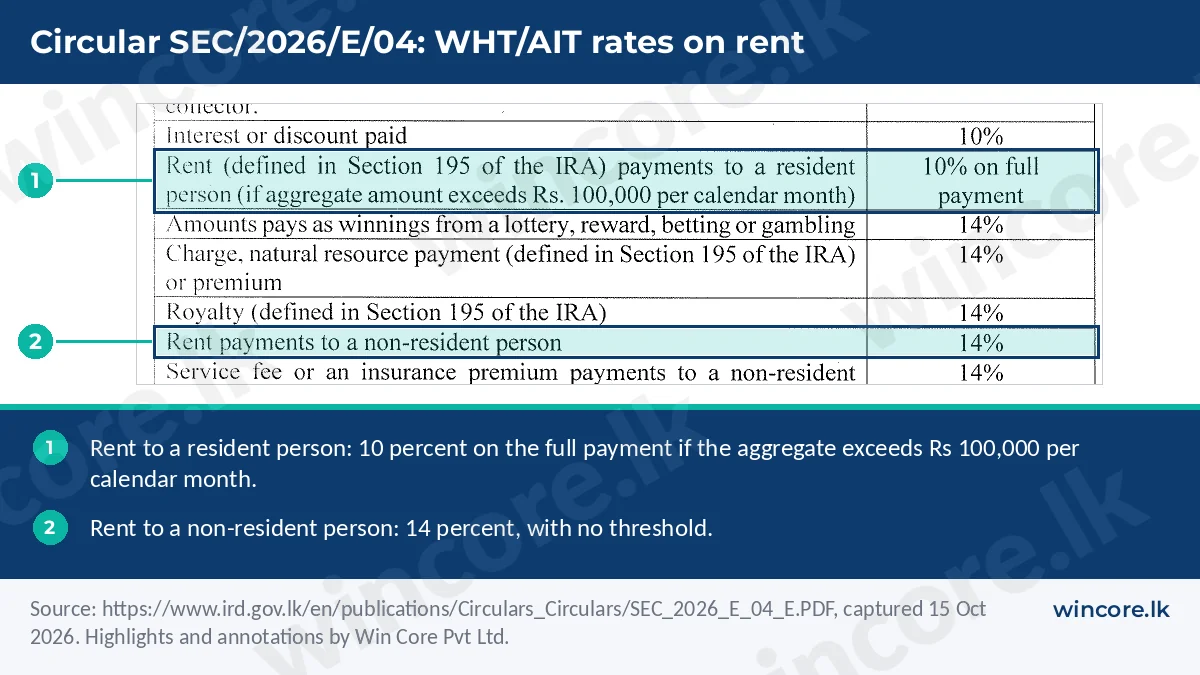
When a tenant must deduct 10 percent AIT from rent, the base excluding VAT, payment within 15 days, certificates and worked examples.
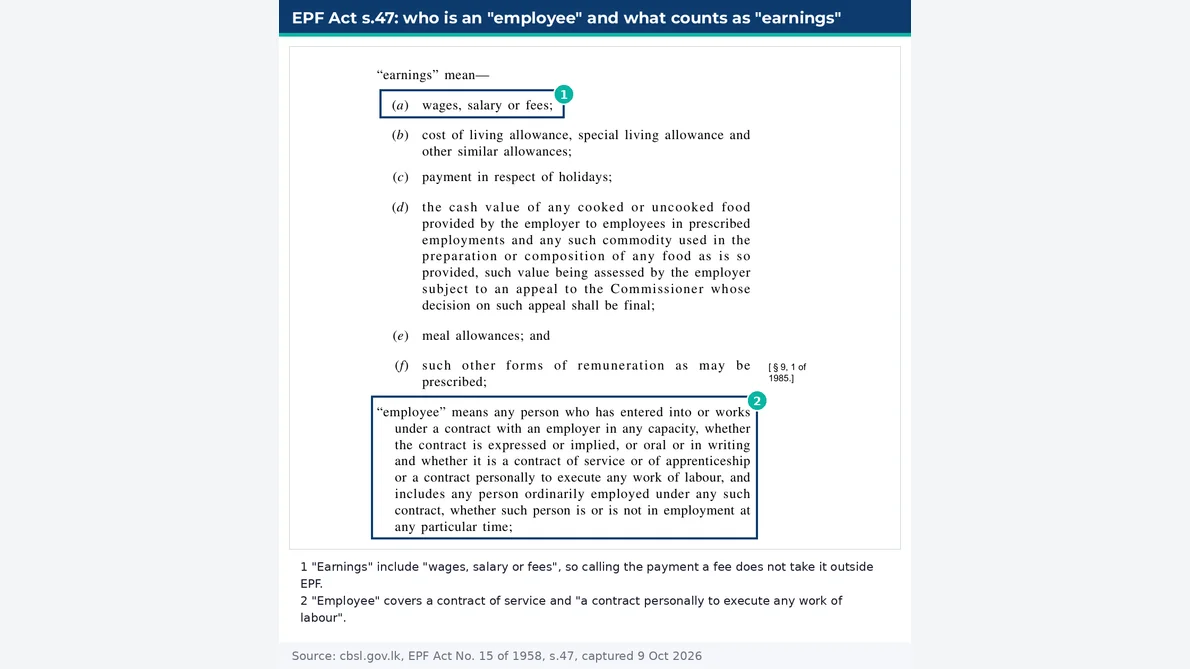
When a consultant is legally an employee in Sri Lanka: the tests under EPF, ETF, gratuity and tax law, and what misclassification costs.
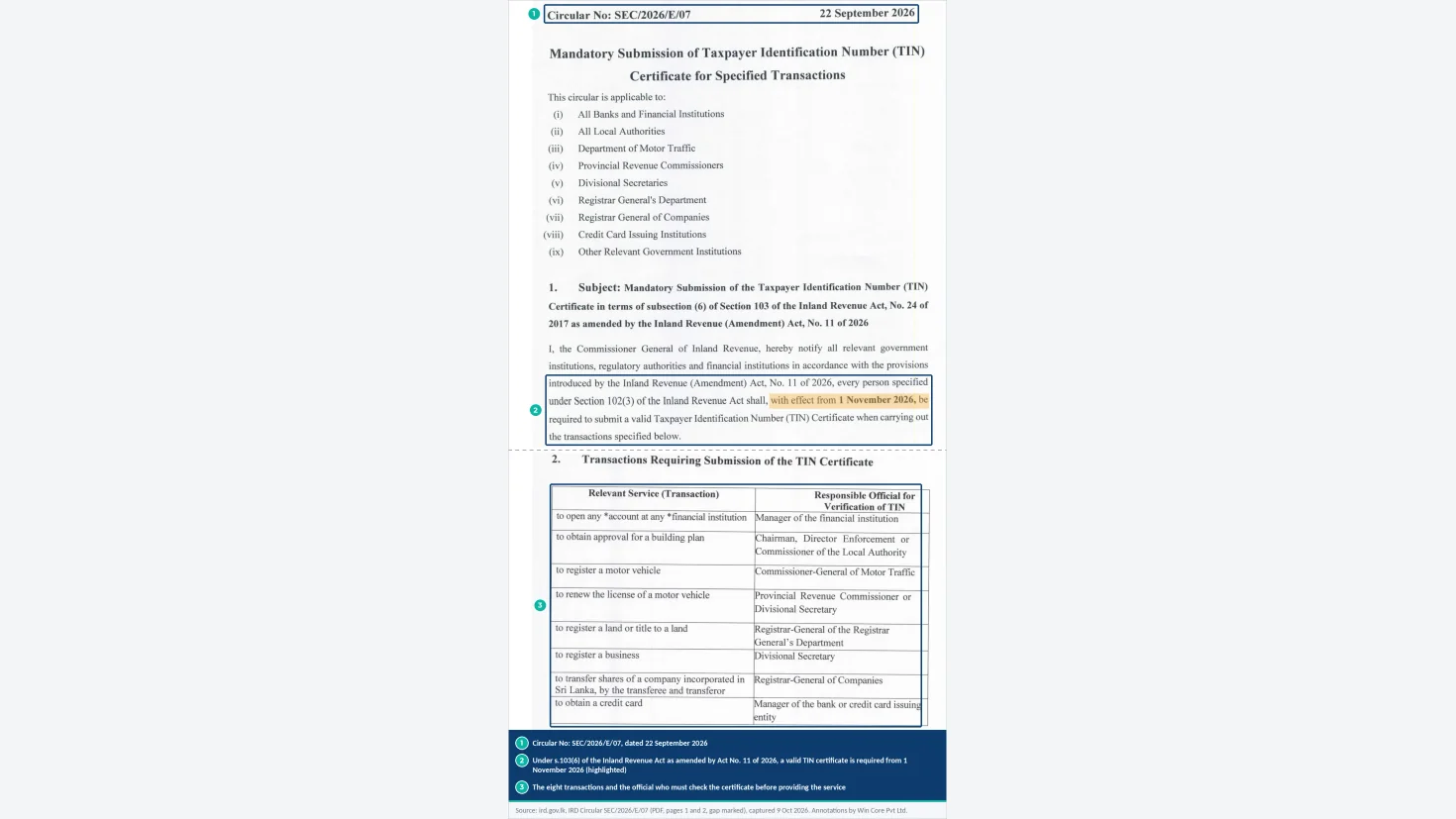
From 1 November 2026 individuals need a TIN certificate for eight transactions. Who needs one, how to get it, and TINs for companies and staff.