
Withholding tax circular 2026: the yearly WHT certificate rules
From 8 June 2026 the IRD allows one certificate for up to a year, on four conditions. The rates, the 30 April statement and each penalty.
On this page
Last verified against the primary sources on 21 October 2026.
The withholding tax circular 2026 in Sri Lanka is IRD Circular SEC/2026/E/04, effective 8 June 2026. It keeps the rates in the Inland Revenue Act: 5 percent on service fees to a resident individual once the month's total exceeds Rs 100,000, 10 percent on interest and on resident rent above Rs 100,000 a month, 14 and 15 percent on the rest [1]. Its one real change is to the certificate. A withholding agent may now give a payee one WHT certificate covering up to a full year of assessment, but only if the payee agrees, and the payee can still demand a monthly one. Since 3 June 2026 the Act also says the certificate is free [2].
This piece covers what the circular changed. For the standing mechanics, see our guides to 5 percent WHT on service fees and the WHT annual statement and certificate of deduction.
Take a hypothetical garment buying office in Kandy that pays a resident freelance translator more than Rs 100,000 in most months. Can it issue one certificate for 2026/27 in April 2027 instead of twelve? We answer it condition by condition below.
The withholding tax circular 2026 replaced the 2022 circular on 8 June 2026
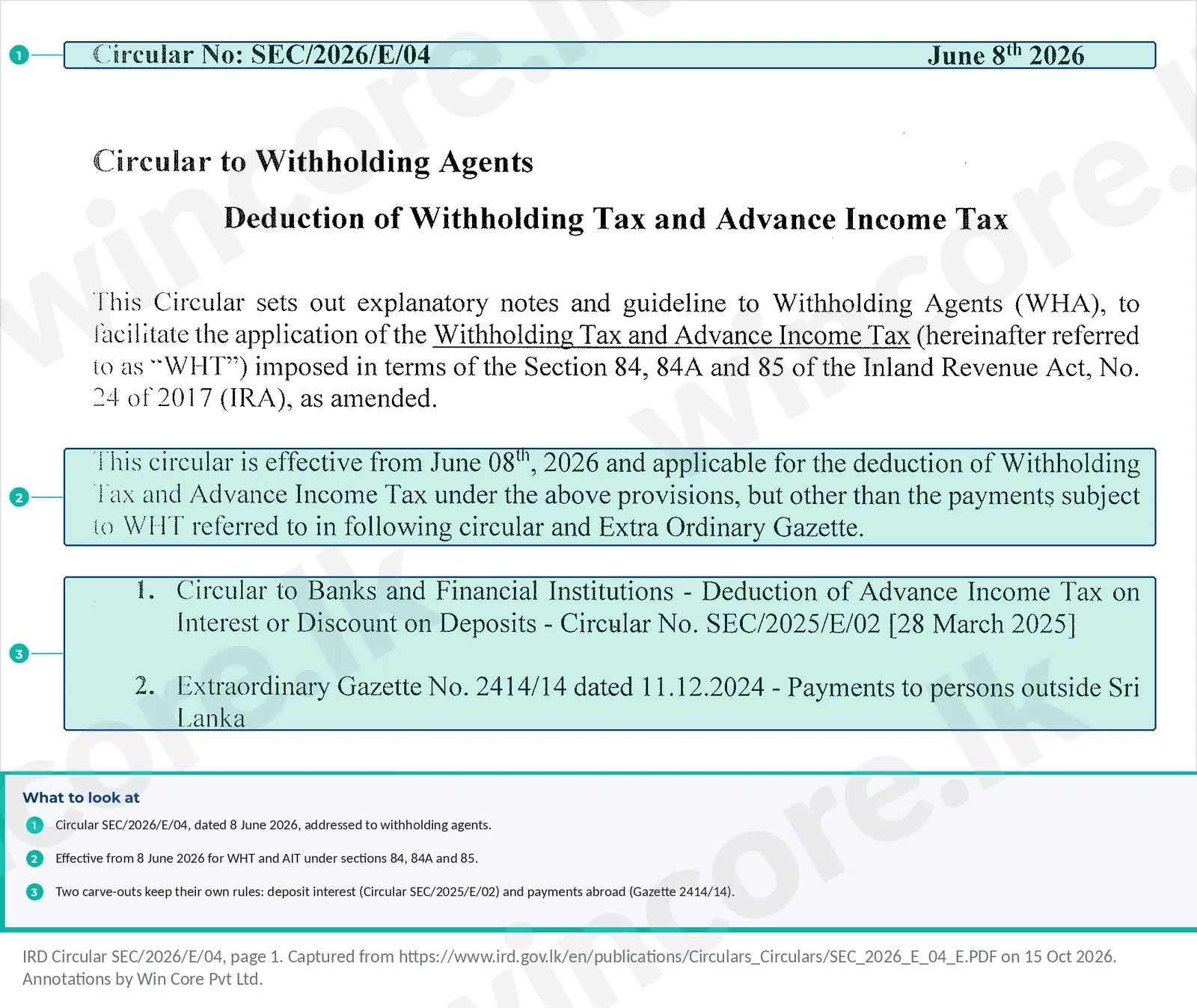
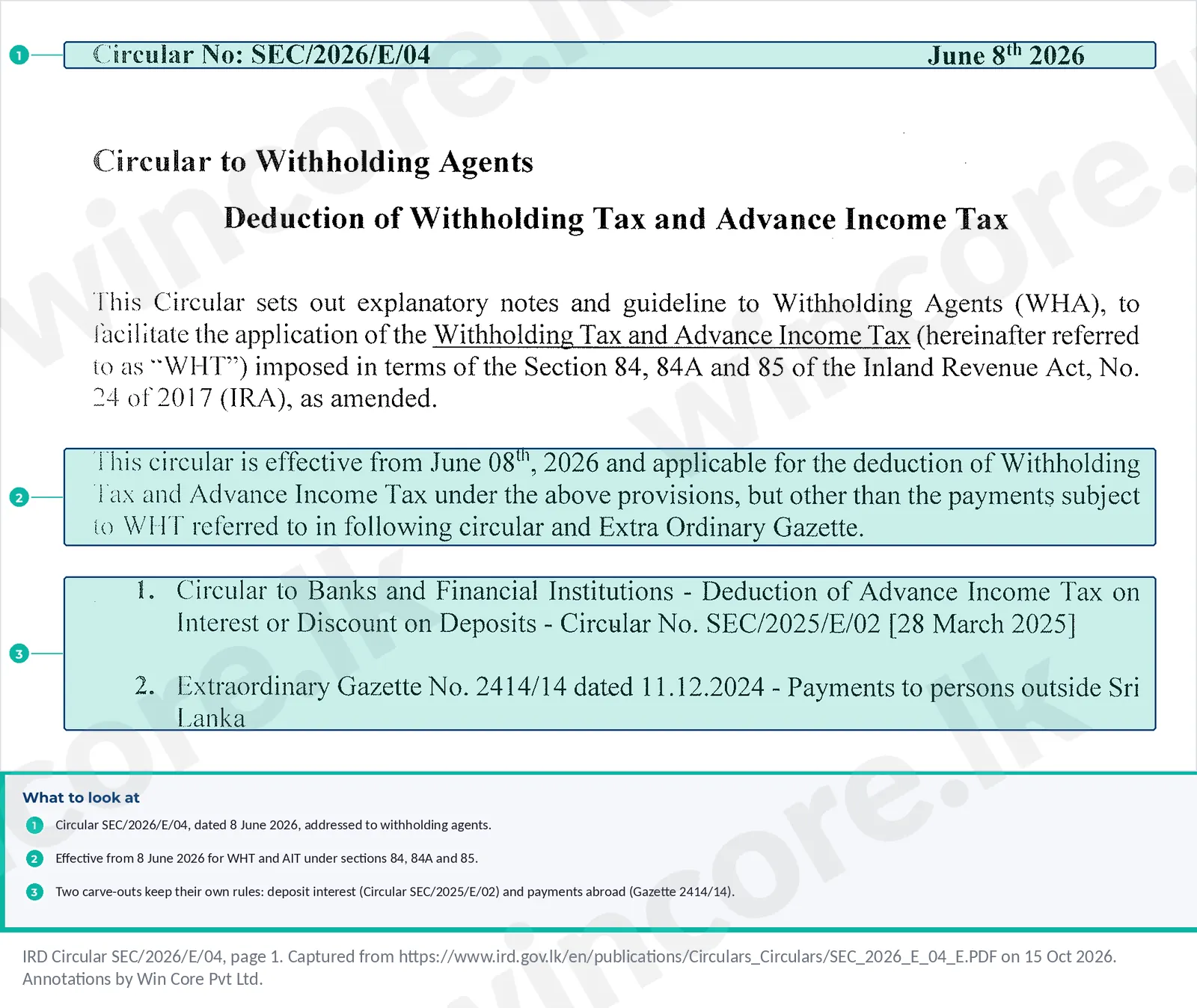
Circular SEC/2026/E/04, dated 8 June 2026, is the IRD's "Circular to Withholding Agents", subtitled "Deduction of Withholding Tax and Advance Income Tax" [1]. It gives "explanatory notes and guideline" on tax "imposed in terms of the Section 84, 84A and 85" of the Inland Revenue Act, No. 24 of 2017, and Circular SEC/2022/E/03 of 23 December 2022 "is terminated with effect from the effective date of this circular" [1].
A circular is guidance, not law. The rules behind it sit in sections 84 to 87 of the Act, as amended by the Inland Revenue (Amendment) Act, No. 11 of 2026, certified on 3 June 2026. Apart from the sections listed in its commencement table, that Act came into operation on the date it became law (s.1(2)) [2]. So the wider list of professions applies from 3 June 2026, while the circular "is effective from June 08th,2026" [1]. On our reading, payments between 3 and 7 June 2026 follow the amended Act; the circular only explains it.
It covers every withholding agent, but not payments by individuals "unless payment made in conducting a business" [1]. Two groups follow other rules: banks deducting AIT on deposit interest (Circular SEC/2025/E/02 of 28 March 2025), and payments to persons outside Sri Lanka (Extraordinary Gazette No. 2414/14 of 11 December 2024) [1].
The rates did not change, but 29 more professions now pay 5 percent
The rate table runs over pages 1 and 2 [1]:
| Payment | Rate |
|---|---|
| Service fee to a resident individual who is not an employee, if the month's aggregate exceeds Rs 100,000 | "5% on full payment" |
| Interest or discount | 10% |
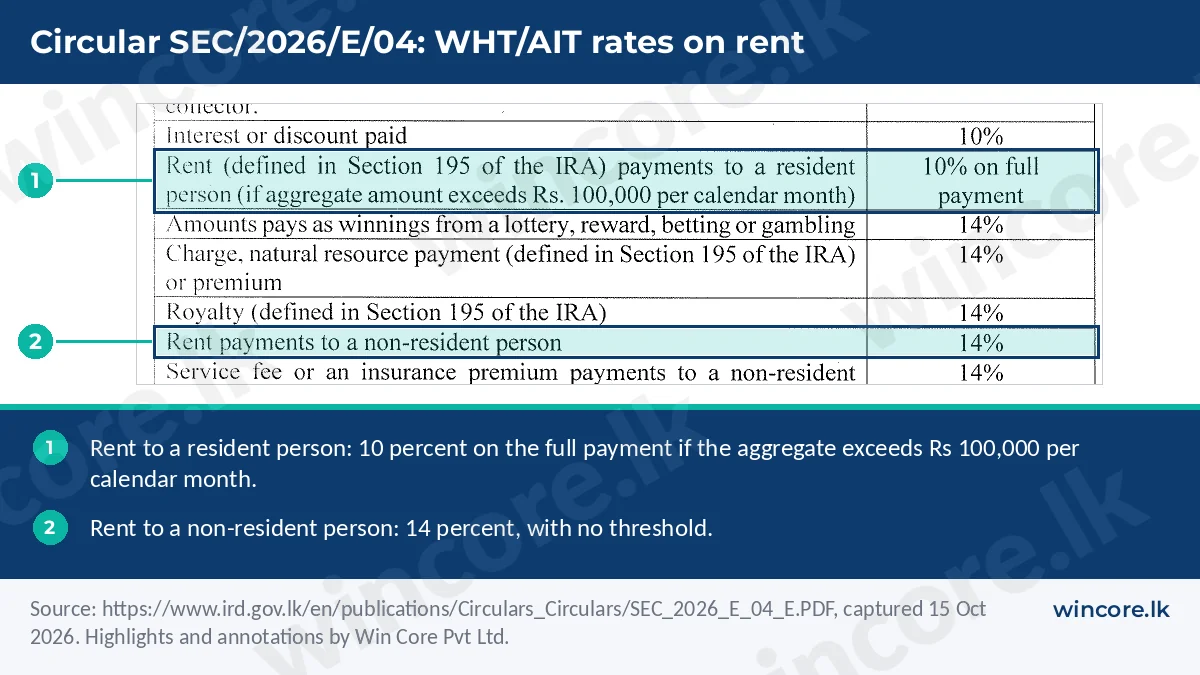
| Rent to a resident, if the month's aggregate exceeds Rs 100,000 | "10% on full payment" |
| Lottery, reward, betting or gambling winnings; charges, natural resource payments, premiums; royalties | 14% |
| Rent, service fees or insurance premiums to a non-resident | 14% |
| Dividend | 15% |
| Non-resident transport or telecom (s.85(2), Gazette No. 2064/51) | 2% |
| Gems sold at a National Gem and Jewellery Authority auction | 2.5% |
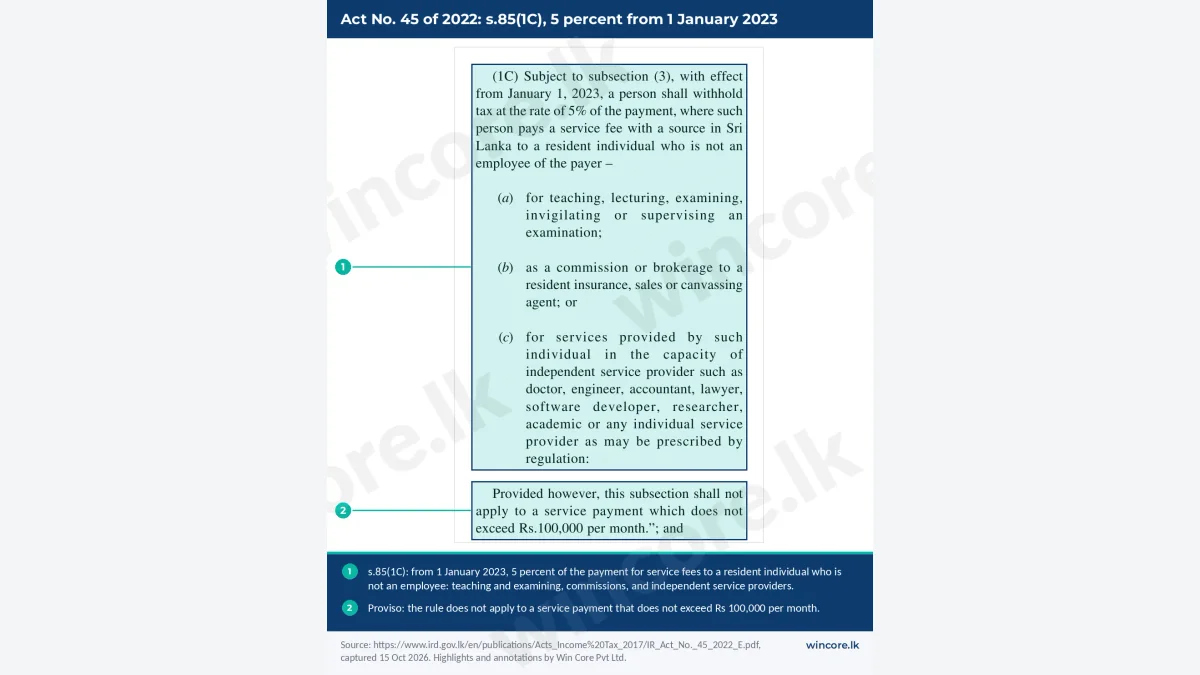
The domestic rates match paragraph 10 of the First Schedule to the Act [3]. The 5 percent rule on service fees has applied since 1 January 2023, when Act No. 45 of 2022 inserted section 85(1C) [4]. What changed in 2026 is the list: section 13 of Act No. 11 added 29 professions, from auditor and photographer to translator, writer and debt collector [2].
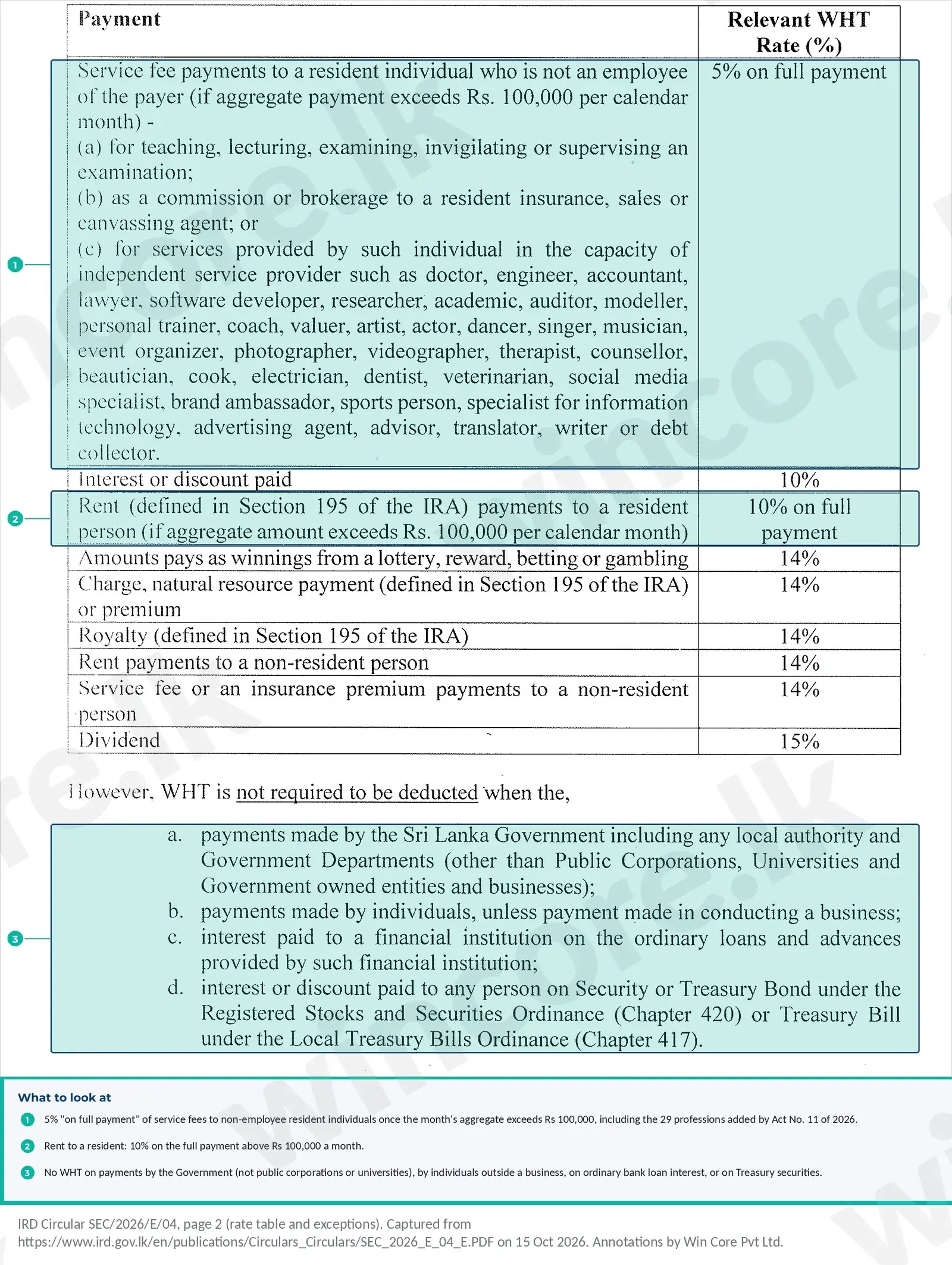
No WHT is due on payments by the Government, local authorities and Government departments "other than Public Corporations, Universities and Government owned entities and businesses", on interest paid to a financial institution on its ordinary loans and advances, or on Treasury bonds and bills [1]. Exempt amounts include lottery winnings up to Rs 500,000. Anyone else claiming an exemption needs a confirmation letter from the Commissioner General, given to the payer "prior to the WHT deduction" [1].
The base is the gross amount "excluding any Value Added Tax payable". If the payer wants to pay an invoice in full, "the invoiced amount should be treated as the net amount" and the tax is computed on "the grossed-up amount" [1]; see our piece on grossing up withholding tax on rent. Pay "within fifteen days after the end of each calendar month", online or at People's Bank under tax type code 43 for interest and 44 for other payments [1]. Our WHT calculator gives the deduction for a single payment.
A yearly WHT certificate needs the payee's agreement and stops at a year of assessment
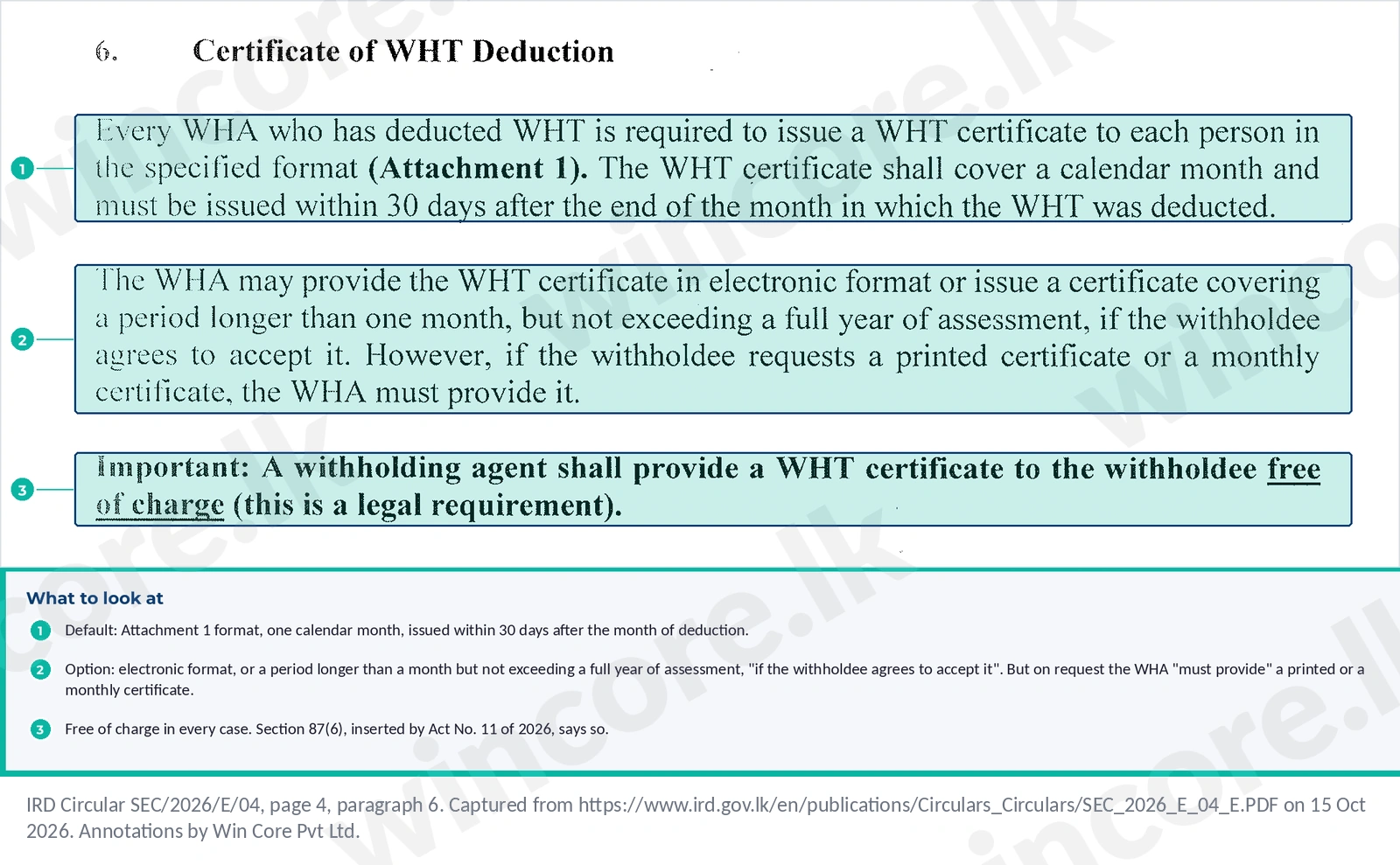
Paragraph 6 of the circular sets a default and an option [1].
The default: the certificate is in the Attachment 1 format, it "shall cover a calendar month and must be issued within 30 days after the end of the month in which the WHT was deducted".
The option: "The WHA may provide the WHT certificate in electronic format or issue a certificate covering a period longer than one month, but not exceeding a full year of assessment, if the withholdee agrees to accept it." That sentence carries four conditions:
- It is the payer's choice to offer. "May", not must.
- The payee must agree. The text says "agrees to accept it". It does not say in writing, and it sets no form.
- The period is capped. Longer than a month, "not exceeding a full year of assessment". A year of assessment runs from 1 April to 31 March [3].
- The payee can take it back. "However, if the withholdee requests a printed certificate or a monthly certificate, the WHA must provide it."
A fifth rule sits over all of them, and it is statute. Section 87(6), added by section 15 of Act No. 11, says a withholding agent shall serve a certificate "free of any charge or payment" [2]. The circular repeats it: free of charge, "this is a legal requirement" [1].
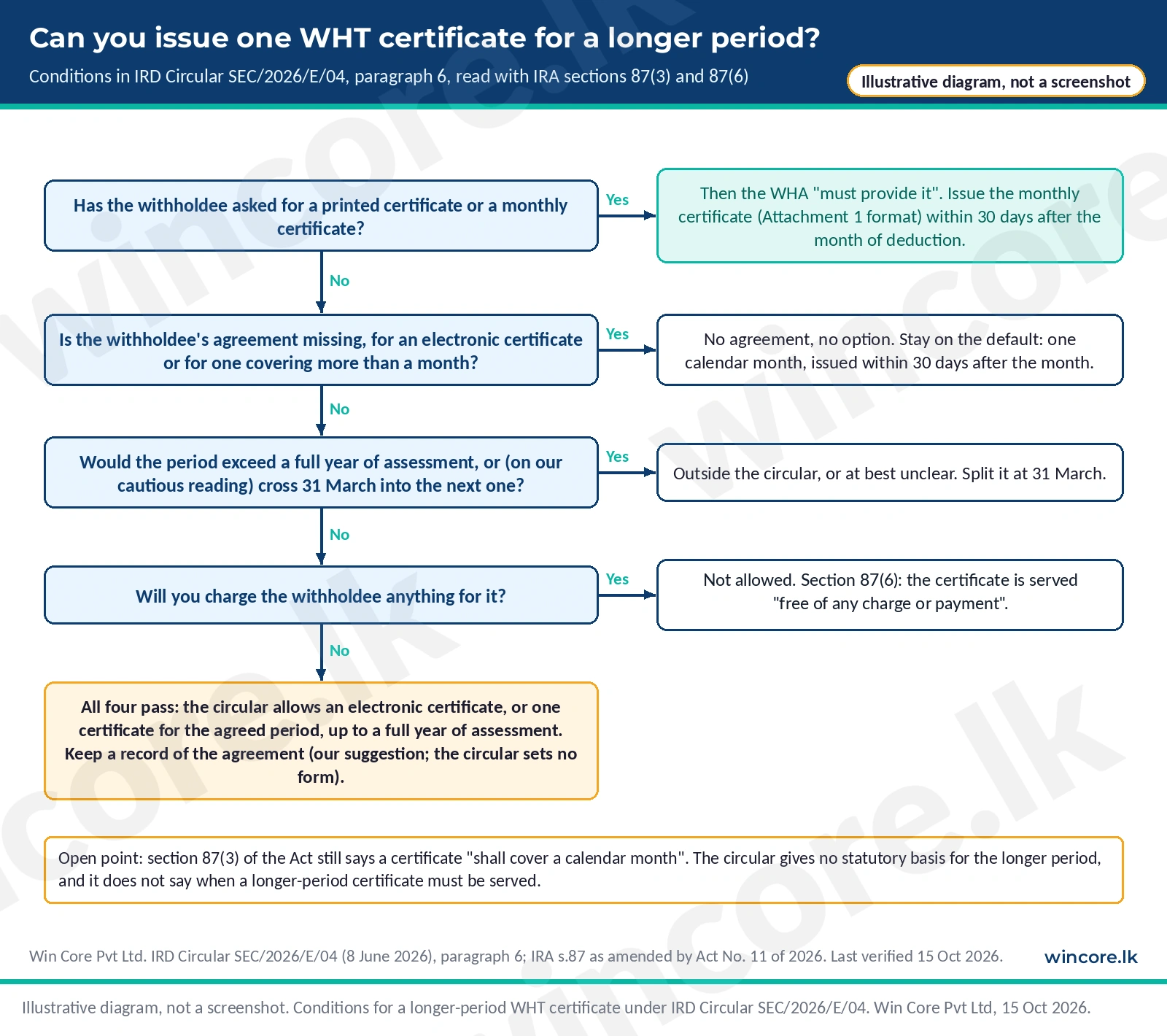
Now the catch. Section 87(3) of the Act still says a certificate "shall cover a calendar month and shall be served within thirty days after the end of the month" [3]. Act No. 11 added subsection (6) and left subsection (3) alone [2]. The circular cites no power for the longer period, although the Attachment 1 form has a line "Payment made for Period: from: to:", so the IRD plainly expects longer periods to be used. Can a payee who agreed later insist on monthly certificates? On our reading, yes: the request right carries no condition.
Why the payee cares: tax withheld from a payment that is not a final withholding payment is credited to the payee for the year of assessment (s.89), and the certificate is the evidence [3]. A payee on one certificate for 2026/27 needs it before filing by 30 November 2027, and may need monthly proof sooner for a loan. If you are the payee, our income tax services cover the return and the credit claim.
Points the circular leaves open
- Legal basis. Section 87(3) says "shall cover a calendar month", and the circular states no statutory basis for a longer period. Only the IRD, or the courts, can settle whether a yearly certificate satisfies section 87. The safe course is records able to produce a monthly certificate on demand.
- When a longer-period certificate is due. The circular does not say. On our reading, within 30 days after the end of the agreed period.
- Electronic format. The words "if the withholdee agrees" follow both options. We read the condition as covering electronic certificates too.
- Straddling two years. "Not exceeding a full year of assessment" might allow any twelve months. We would not cross 31 March.
The annual statement is still due by 30 April, in the IRD's CSV format
The payer must be registered as a withholding agent; one that is not must get a number "not later than 30 days prior to the commencement of deduction of WHT" [1]. It keeps records for every payment in the Attachment 2 format, including copies of tax clearance and exemption confirmations.
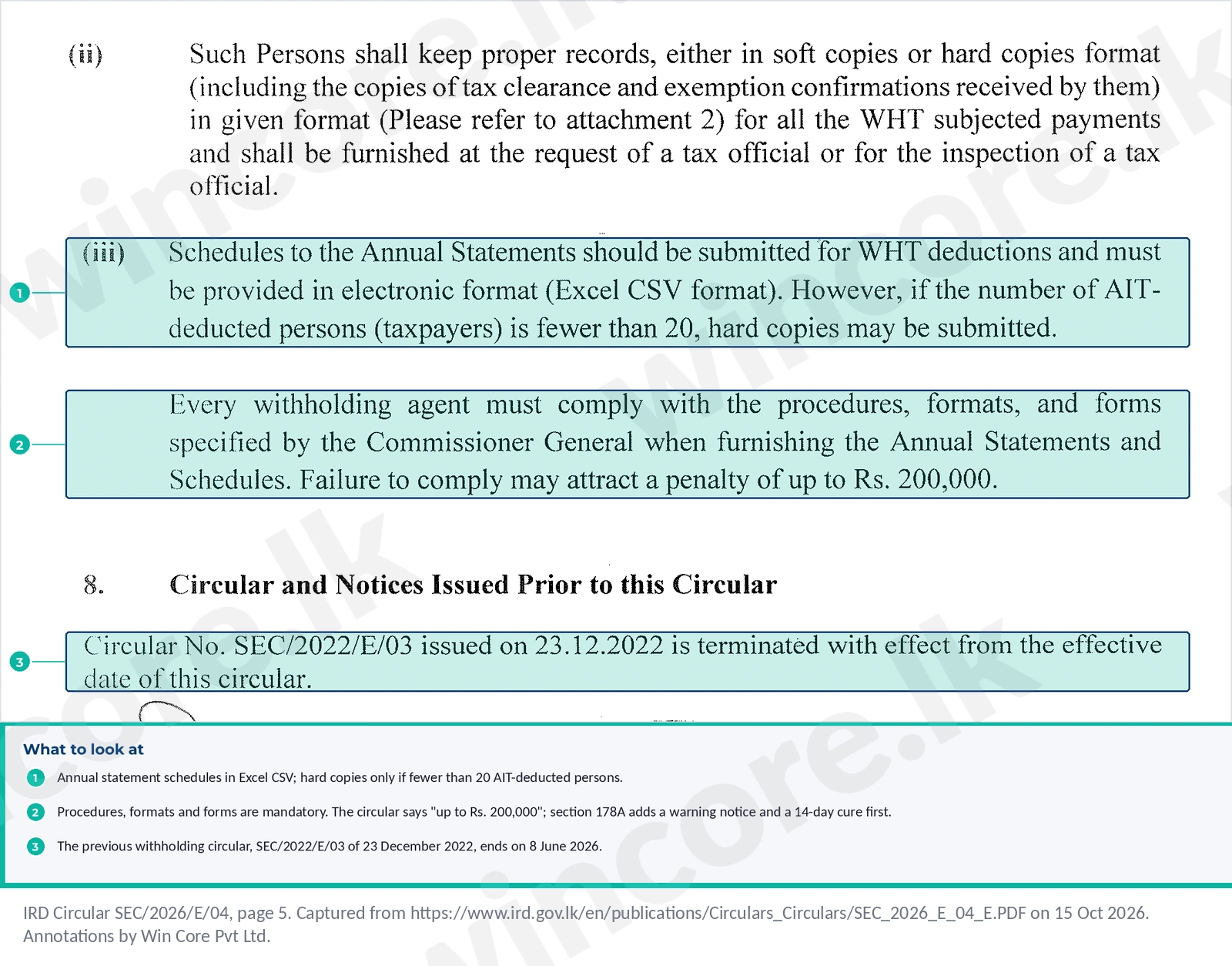
Section 86(2) requires an annual statement within thirty days after the end of each year ending on 31 March, which means by 30 April [3]. The circular adds that schedules "must be provided in electronic format (Excel CSV format)", with hard copies allowed only "if the number of AIT-deducted persons (taxpayers) is fewer than 20", and that failing to follow the specified procedures, formats and forms "may attract a penalty of up to Rs. 200,000" [1]. Our piece on withholding agents' annual statements and certificates walks through the filing itself.
Each withholding default has its own penalty section
| Default | Section | What follows |
|---|---|---|
| Tax not withheld | IRA s.86(3), (4) | Payer pays it anyway; the payee is jointly and severally liable |
| Withheld tax paid late | IRA s.157, s.159(1) | Interest at 1.5 percent a month or part of a month |
| Withheld tax not paid within fourteen days of the due date | IRA s.179(1) | 20 percent of the tax due but not paid |
| Expense claimed before the WHT is paid | IRA s.10(2) | "the deduction shall not be allowed until the tax withheld has been paid" |
| Annual statement filed late | IRA s.178(1), (2), on our reading, because s.195 defines a "tax return" as "a return or annual statement" | Greater of 5 percent of tax owing plus 1 percent a month, or Rs 50,000 plus Rs 10,000 a month; capped at Rs 400,000 a return |
| Annual statement still not filed 30 days after the Commissioner-General's notice | IRA s.185A (Act No. 11, s.31) | Offence if without reasonable cause: fine up to Rs 400,000, up to six months' imprisonment, or both |
| Statement requirements under s.86(9) not followed | IRA s.178A (Act No. 11, s.30) | Up to Rs 200,000 for a year of assessment; warning notice first, no penalty if complied with within 14 days |
| Records not kept | IRA s.182(2), (3) | Rs 1,000 a day; warning notice first, no penalty if complied with |
| Certificate not served, or a fee charged | IRA s.87(1), (6) | Breach of duty; we have not found a penalty section aimed at it |
Section 178A reaches only the requirements specified under section 86(9) [2], where the statement procedures and forms sit. Certificates are in section 87, so the circular's Rs 200,000 line does not reach them.
Worked example: one certificate for a freelance translator
Back to the Kandy buying office. In July 2026 it pays the translator Rs 150,000 and in August Rs 90,000, both for services.
- July: Rs 150,000 exceeds Rs 100,000, so WHT is 5 percent of the full amount, Rs 7,500, payable by 15 August. If the buying office instead pays the whole invoice and bears the tax, it grosses up: Rs 150,000 / 0.95 = Rs 157,894.74, WHT Rs 7,894.74.
- August: Rs 90,000 does not exceed the threshold. No WHT, and nothing to certify.
Can it issue one certificate for July 2026 to March 2027? The translator agreed by email in July; the period ends on 31 March 2027; the certificate is free. If, in December, the translator asks for monthly certificates for a loan file, the buying office must issue them. On the circular's terms the yearly certificate is permitted. On section 87(3), a monthly certificate is the safer record, and issuing both costs little.
Three misreadings to avoid
- "A full year means any 12 months." Risky. The text says "a full year of assessment", and that runs April to March [3].
- "Two Rs 60,000 invoices in a month escape WHT." No. The circular tests the aggregate for the calendar month, here Rs 120,000, so 5 percent applies to the full amount [1].
- "Government bodies never deduct." Public corporations, universities and state-owned businesses are expressly outside the Government exception [1].
What this means for you
If you pay freelancers, landlords or lenders, the circular changes your documents more than your tax. The new freedom is the certificate period, with strings: the payee's agreement, a cap at one year of assessment, a monthly certificate on request, and no fee. A clean ledger helps; see our bookkeeping basics for Sri Lankan small businesses.
- Register as a withholding agent before the first deduction, and add the 29 professions to your payables system.
- Aggregate monthly per payee and apply the rate to the full amount once Rs 100,000 is exceeded; pay by the 15th.
- Set a certificate policy: monthly by default, longer periods only with the payee's recorded agreement, never past 31 March, never for a fee.
- File the annual statement by 30 April in the CSV format. Our tax services team can run the cycle with you.
Checklist: documents needed
- Your withholding agent registration number
- A monthly schedule of payments to each payee, by payment type
- Each payee's name, address and TIN, NIC or passport number
- Any CGIR exemption confirmation letter a payee has given you
- OTPP or People's Bank payment receipts for each month
- The payee's written or email agreement to any longer-period or electronic certificate
- Copies of every certificate issued, in the Attachment 1 format
- The Attachment 2 record and the CSV schedules for the annual statement
Frequently asked questions
Can we issue one WHT certificate for the whole year in Sri Lanka?
Yes, under Circular SEC/2026/E/04, if the payee agrees and the period does not exceed a full year of assessment, 1 April to 31 March [1]. Section 87(3) of the Act still says a certificate covers a calendar month [3], so keep records that can produce monthly certificates, and issue them whenever the payee asks.
Does the payee's agreement to a yearly certificate have to be in writing?
The circular does not say; it only requires that the withholdee "agrees to accept it" [1]. Our suggestion is an email or a signed note on file, because the agreement is the condition that makes a longer period permissible, and a tax officer reviewing your records will want to see it.
Can a withholding agent charge for a WHT certificate?
No. Since 3 June 2026 section 87(6) of the Inland Revenue Act requires the certificate to be served "free of any charge or payment" [2]. The circular repeats that this is a legal requirement [1]. It applies to monthly, longer-period, printed and electronic certificates alike.
When is withholding tax due to the IRD?
Within fifteen days after the end of the calendar month in which it was deducted, under section 86(1) and paragraph 5 of the circular [1] [3]. Pay through the Online Tax Payments Platform or at People's Bank, using code 43 for interest and 44 for other payments.
What happens if we forgot to deduct withholding tax?
You still pay the tax that should have been withheld, and the payee is jointly and severally liable for it (s.86(3) and (4)) [3]. Your expense deduction waits until the tax withheld has been paid (s.10(2)), and interest can follow.
Talk to us. If you would like us to review your withholding process or set a certificate policy before the 2026/27 annual statement, book a consultation at our contact page.
WinCore Pvt Ltd
This article is general information on the law as at 21 October 2026 and is not advice on your specific position.
References
- Inland Revenue Department. Circular to Withholding Agents: Deduction of Withholding Tax and Advance Income Tax, SEC/2026/E/04 (8 June 2026), paras 1 to 8 and Attachments 1 and 2. https://www.ird.gov.lk/en/publications/Circulars_Circulars/SEC_2026_E_04_E.PDF . Primary. Accessed 21 October 2026.
- Parliament of Sri Lanka. Inland Revenue (Amendment) Act, No. 11 of 2026 (certified 3 June 2026), ss.1, 13, 15, 30 and 31. https://www.ird.gov.lk/en/publications/Acts_Income%20Tax_2017/IR_Act_No_11-2026_E.pdf . Primary. Accessed 21 October 2026.
- Inland Revenue Department. Inland Revenue Act, No. 24 of 2017, consolidated with amendments to 2025, ss.10(2), 20(1), 86, 87, 89, 157, 159, 178, 179, 182 and 195; First Schedule para 10. https://www.ird.gov.lk/en/publications/Acts_Income%20Tax_2017/IRA_Cons_Act_-_2025_Changes.pdf . Primary. Accessed 21 October 2026.
- Parliament of Sri Lanka. Inland Revenue (Amendment) Act, No. 45 of 2022, inserting s.85(1C) from 1 January 2023. https://www.ird.gov.lk/en/publications/Acts_Income%20Tax_2017/IR_Act_No._45_2022_E.pdf . Primary. Accessed 15 October 2026.
Put these insights to work
WinCore specialists can review your current workflow, document gaps, and build a practical 90-day action plan.
Book a free consultationContinue reading
Explore more WinCore analysis to keep your finance, tax, and compliance roadmap moving.
When a payer must withhold 5 percent on service fees, the services added in June 2026, payment within 15 days and the certificate rules.

WHT reporting breaks when certificates and annual statements are treated as year-end admin. Build a monthly evidence workflow that files cleanly.
When a tenant must deduct 10 percent AIT from rent, the base excluding VAT, payment within 15 days, certificates and worked examples.