
How to deduct AIT on rent when the monthly amount exceeds Rs 100,000
When a tenant must deduct 10 percent AIT from rent, the base excluding VAT, payment within 15 days, certificates and worked examples.
On this page
Last verified against the primary sources on 15 October 2026. Material added on 21 October 2026 was verified that day.
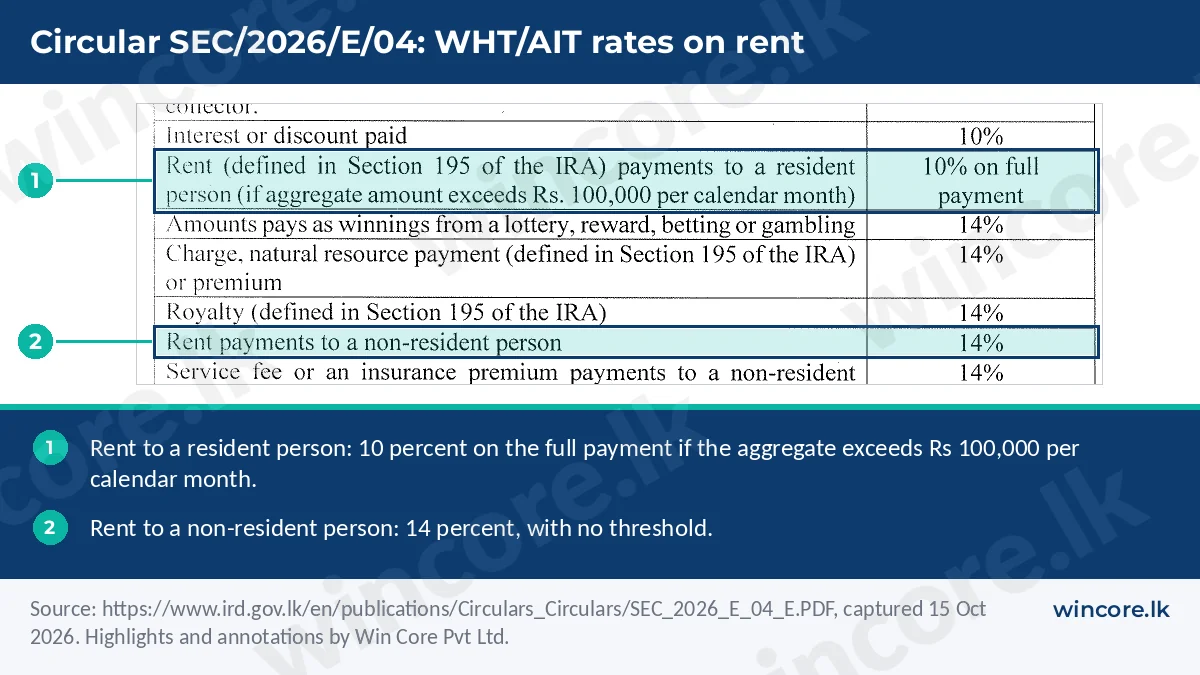
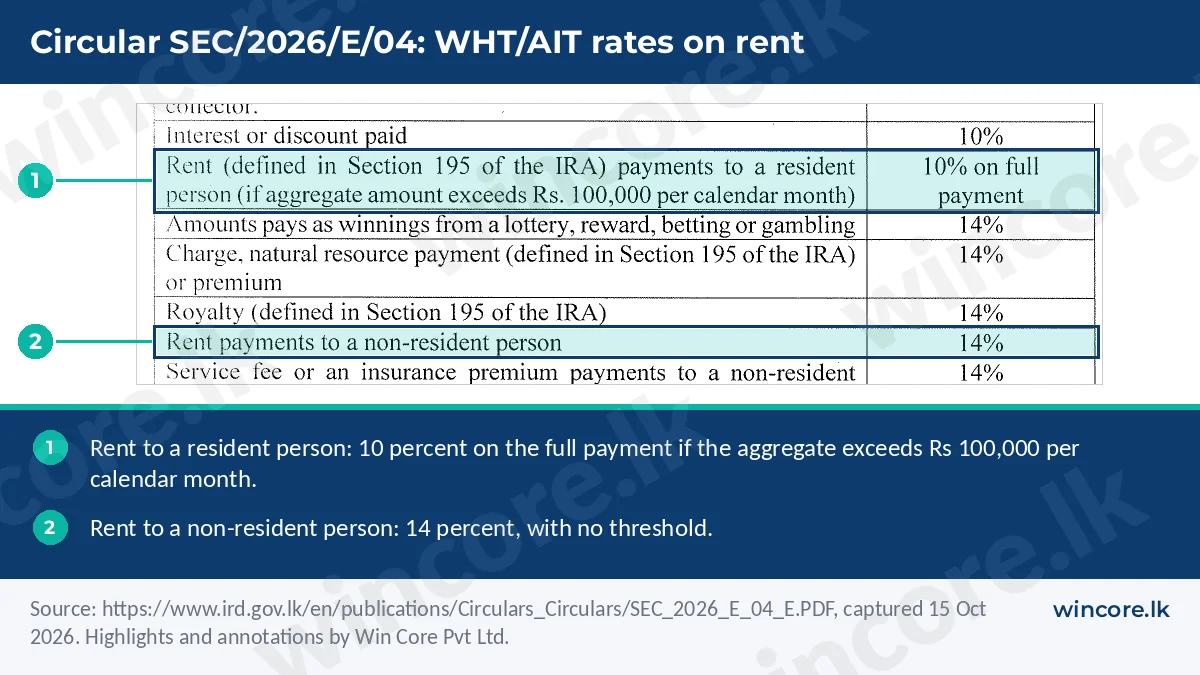
Rent withholding comes down to rate, base and dates. When you pay rent to a resident and the aggregate in a calendar month exceeds Rs 100,000, you deduct Advance Income Tax (AIT) at 10 percent on the full payment. When the landlord is non-resident the rate is 14 percent, with no threshold [1]. The base is the gross rent excluding VAT. The tax reaches the Inland Revenue Department (IRD) within 15 days after the month ends, and the landlord gets a certificate within 30 days [1]. The IRD set out these rules in Circular SEC/2026/E/04 of 8 June 2026, which applies the Inland Revenue Act [1] [2].
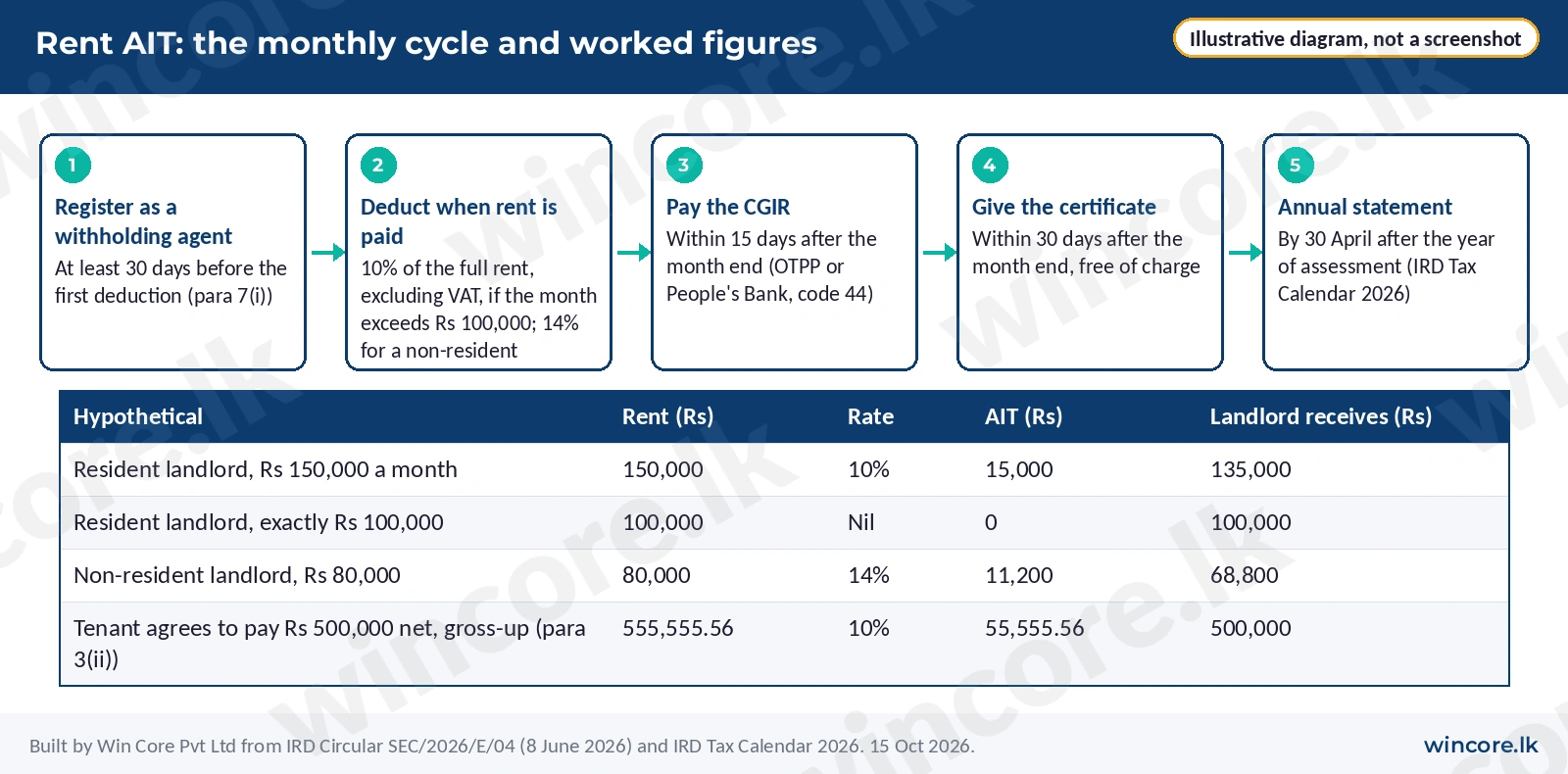
Take a hypothetical furniture showroom in Kurunegala that rents its shop floor. The monthly rent is Rs 150,000, paid to a resident individual landlord. Because the month's total exceeds Rs 100,000, the company deducts Rs 15,000 and pays the landlord Rs 135,000. By 15 of the next month the Rs 15,000 is with the IRD, and within 30 days after the month end the landlord has a certificate. If the same landlord later hands over a valid exemption confirmation letter from the Commissioner General of Inland Revenue (CGIR), the company stops deducting from the next payment.
A second hypothetical shows the non-resident rule. The same showroom pays Rs 80,000 a month for a small storeroom to an individual landlord who has lived abroad for years and is non-resident. There is no Rs 100,000 threshold for non-residents, so it deducts 14 percent, Rs 11,200, from every payment [1].
This guide covers who must deduct, the threshold, residence, the exemption letter, the base and gross-up, payment, certificates and records. It does not cover the landlord's own income tax, including the 25 percent deduction for rental income of resident individuals, or treaty relief; our guide to rental income tax in Sri Lanka covers the landlord's side.
Step 1. Check that you are a withholding agent and register first
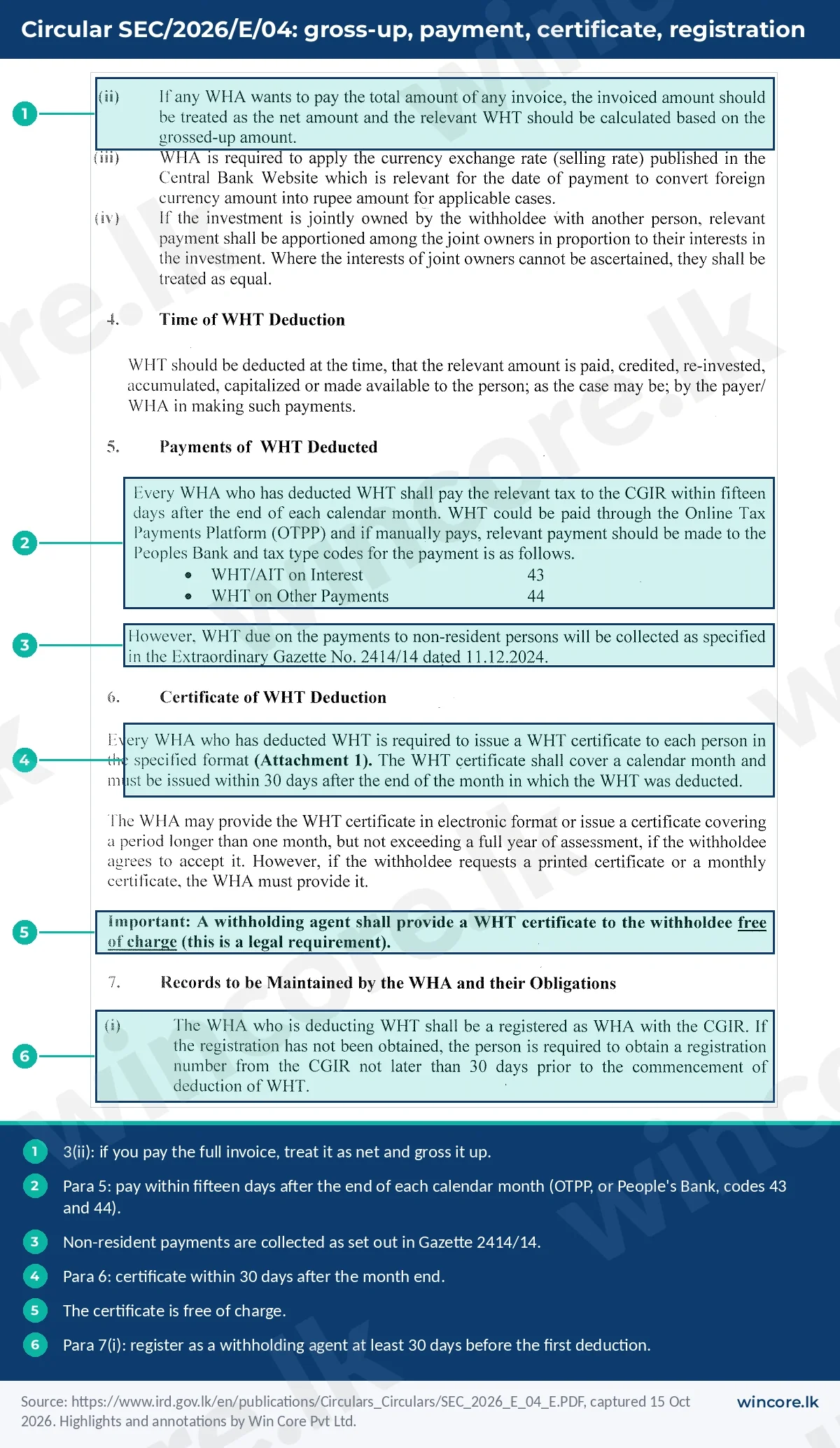
What to do. Since 1 January 2023, s.84A(1A) of the Inland Revenue Act requires "a person" to deduct AIT from rent with a source in Sri Lanka [2] [3]. Rent has that source when it is "rent paid for the use of, right to use or forbearance from using an asset situated in Sri Lanka" (s.73(1)(f)) [2]. The test is where the property is, not where the payer banks or where the payment is made. The duty does not apply to payments made by individuals "unless payment made in conducting a business", or to Government payers other than public corporations, universities and Government-owned businesses [1]. A company, branch, partnership or sole trader paying rent for business premises is a withholding agent. If you are not yet registered as one, register with the CGIR "not later than 30 days prior to the commencement of deduction" [1].
Where. The IRD, through your tax file.
What you need. Your TIN and the date of the first rent payment that will need a deduction.
What goes wrong. Assuming that rent tax is the landlord's problem. Registering after the first deduction instead of 30 days before it. Working from the old rule: from 1 April 2020 until 1 January 2023, s.84A(1) said only that a resident taxpayer "may make a request to the withholding agent to deduct Advance Income Tax" from rent, and the payer deducted only on request [2]. Act No. 45 of 2022 replaced the request with a duty from 1 January 2023 [3]. A business that has paid rent gross since 2021 may still be following a rule that ended in 2022.
How long. Allow at least 30 days before the first payment, because that is the statutory lead time.
Instrument: Inland Revenue Act, No. 24 of 2017, ss.73(1)(f), 84A(1) and 84A(1A), the last inserted by Act No. 45 of 2022 s.16; IRD Circular SEC/2026/E/04, paras 1 and 7(i). Official link: Circular SEC/2026/E/04. Last verified: 21 Oct 2026.
Step 2. Test whether the month's rent exceeds Rs 100,000
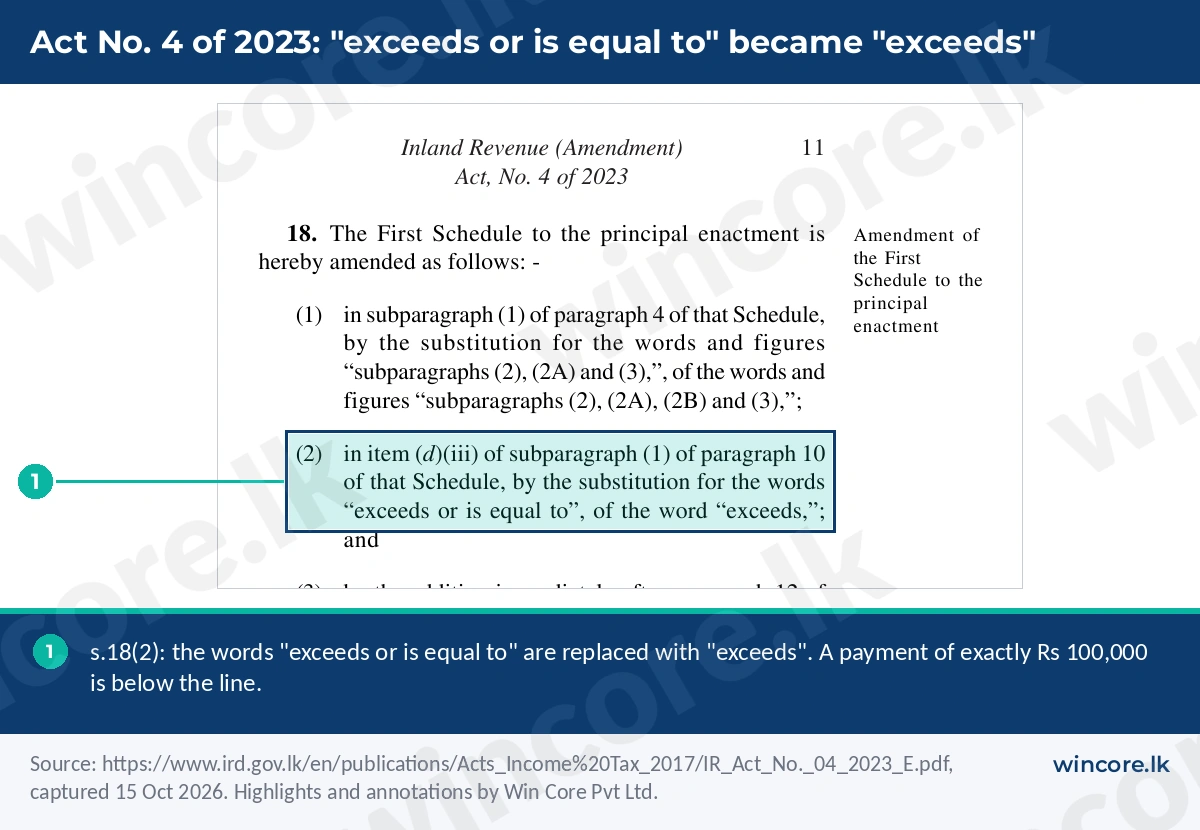
What to do. Add every rent payment to the same resident payee in the calendar month. If the total exceeds Rs 100,000, AIT applies to the entire amount, "10% on full payment" [1]. The test is "exceeds". Act No. 4 of 2023 replaced "exceeds or is equal to" with "exceeds" in the rate schedule [4], so a payment of exactly Rs 100,000 does not trigger the deduction.
Where. Your accounts payable ledger and the lease.
What you need. The rent schedule for the month, including any top-up or arrears paid in the same month.
What goes wrong. Deducting only on the excess over Rs 100,000. Treating exactly Rs 100,000 as taxable. Splitting one rent across two invoices to stay under the line. Forgetting a mid-month payment that takes the total over.
How long. A few minutes once the month's total is known.
Instrument: Inland Revenue Act, First Schedule para 10, as amended by Act No. 4 of 2023 s.18(2); Circular SEC/2026/E/04, para 1. Official link: Act No. 4 of 2023. Last verified: 15 Oct 2026.
Step 3. Confirm the landlord's residence
What to do. Establish whether the landlord is resident. For a resident the rate is 10 percent once the threshold is crossed; for a non-resident it is 14 percent on every payment [1]. A company is resident if it is incorporated in Sri Lanka, or registered or has its principal office here [2]. Ask the landlord to confirm its status in writing and keep the confirmation on the lease file.
Where. The lease, the landlord's written confirmation, and its certificate of incorporation or registration.
What you need. Evidence of residence.
What goes wrong. Applying 10 percent to a non-resident, or a threshold to a non-resident. Missing the Port City point: s.41(6) of the Port City Act deems an offshore company registered under that Act to be "a non-resident company" for the Inland Revenue Act [5], while s.69(4)(b) of the Inland Revenue Act makes a company resident if it is registered in Sri Lanka [2]. Which rate applies to rent paid to a Port City offshore company is an open point. We would ask the IRD before choosing.
How long. Same day if the lease file already holds the information.
Instrument: Inland Revenue Act, s.69(4); Colombo Port City Economic Commission Act, No. 11 of 2021, s.41(6). Official link: Port City Act No. 11 of 2021. Last verified: 15 Oct 2026.
Step 4. Check for a CGIR exemption confirmation letter before payment
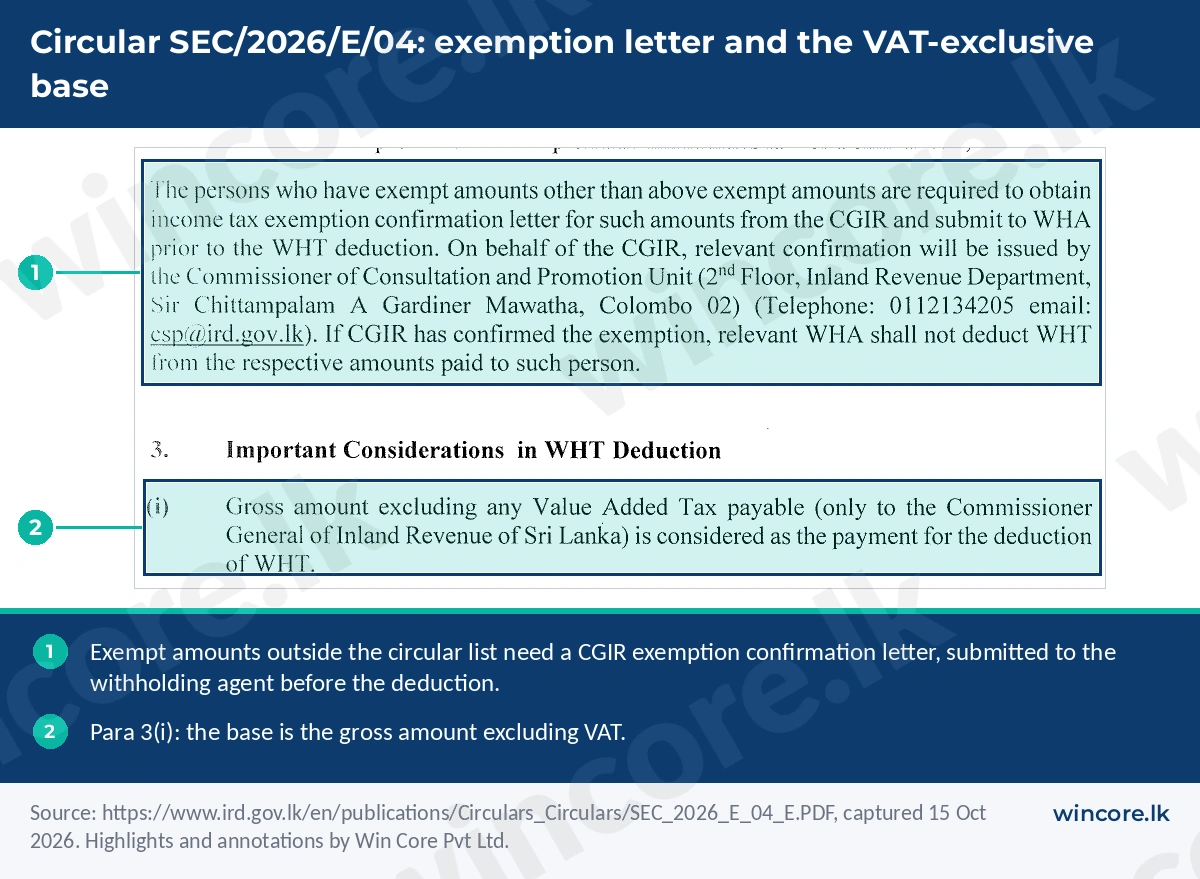
What to do. A landlord with an exempt amount that is not on the circular's own list must obtain an "income tax exemption confirmation letter" from the CGIR and "submit to WHA prior to the WHT deduction" [1]. The Commissioner of the Consultation and Promotion Unit issues it on the CGIR's behalf. If the letter confirms the exemption, you do not deduct. Without it, you deduct.
Where. From the landlord. File it with the lease documents.
What you need. A letter that names the landlord and covers the payment.
What goes wrong. Accepting a verbal assurance. Accepting a letter addressed to another company in the same group. Continuing to rely on a letter after the period it covers has ended. The circular asks you to keep copies of exemption confirmations in your records [1].
How long. Immediate if the letter is on file; otherwise the landlord must obtain it.
Instrument: Circular SEC/2026/E/04, para 2. Official link: Circular SEC/2026/E/04. Last verified: 15 Oct 2026.
Step 5. Deduct on the right base, and gross up if you pay the full invoice
What to do. Deduct at the time the rent is "paid, credited, re-invested, accumulated, capitalized or made available" to the landlord [1]. The base is the "gross amount excluding any Value Added Tax" [1], so a VAT-registered landlord's VAT is left out. Where the rent is fixed in a foreign currency, convert it at the Central Bank selling rate "relevant for the date of payment" [1]. If you have agreed to pay the full invoice without deduction, the circular treats the invoice as the net amount and the tax is calculated on the grossed-up amount [1]. At 10 percent, a Rs 500,000 net payment grosses up to Rs 555,555.56 (500,000 / 0.9), and the tax is Rs 55,555.56. At 14 percent it grosses up to Rs 581,395.35 (500,000 / 0.86), and the tax is Rs 81,395.35. Put simply, a "no deduction" clause costs the tenant 11.11 percent of the invoice on top at the resident rate, and 16.28 percent at the non-resident rate.
Where. Accounts payable.
What you need. The rent before VAT, the residence status, the rate and the lease terms on who bears the tax.
What goes wrong. Deducting on rent including VAT. Converting foreign currency rent at the buying rate, or at the rate on the invoice date. Paying a full invoice and remitting 10 percent of the invoice instead of the grossed-up tax. Netting off a discount the landlord has not actually given.
How long. Part of the normal payment run.
Instrument: Circular SEC/2026/E/04, paras 3(i), 3(ii), 3(iii) and 4. Official link: Circular SEC/2026/E/04. Last verified: 21 Oct 2026.
Where the lease promises a net amount to the landlord, work through the rent withholding gross-up rather than deducting tax from that promised net payment.
Step 6. Pay the tax and issue the certificate
What to do. Pay the tax to the CGIR "within fifteen days after the end of each calendar month" [1]. Payment can go through the Online Tax Payments Platform (OTPP); if paid manually, it goes to People's Bank under the tax type code for "WHT on Other Payments", 44 [1]. Tax on payments to non-residents is collected under the procedure in Gazette Extraordinary No. 2414/14 of 11 December 2024 [1] [6]. Issue the landlord a certificate in the IRD format, covering the calendar month, within 30 days after the month end, free of charge [1]. The annual statement for the year to 31 March is due by 30 April; the 2026 Tax Calendar shows 30 April 2026 for the 2025/2026 statement [7]. Our guide to the WHT annual statement and certificate of deduction sets out the yearly cycle.
No quarterly statement for rent, for now. Section 86(8), added by Act No. 4 of 2023, requires an agent who has deducted AIT under s.84A to file "a quarterly statement as specified by the Commissioner-General" within 30 days after the quarters ending 30 June, 30 September and 31 December [4]. Circular SEC/2025/E/05 of 1 July 2025 specifies only banks and financial institutions deducting AIT on deposit interest, and says "Withholding Agents not specified as above are not required to file" those statements [9]. A business deducting AIT from rent therefore files the annual statement only, until the IRD specifies otherwise.
Where. OTPP or People's Bank for payment; the certificate goes to the landlord, on paper or electronically if the landlord agrees [1].
What you need. The tax amount, the landlord's name, address and identity or TIN number, and the payment reference.
What goes wrong. Paying late. Issuing no certificate, so the landlord cannot claim the credit. Charging for the certificate; the circular says it must be free [1]. Ignoring the procedures, formats and forms the CGIR specifies for statements under new s.86(9): new s.178A allows a penalty of up to Rs 200,000 for a year of assessment [1] [8], but only after a notice of warning, and none is imposed if you comply within fourteen days of its service [8]. Not filing the annual statement at all is a separate default. Under new s.185A the CGIR first serves a notice giving 30 days to comply; failing to comply without reasonable cause is an offence carrying a fine of up to Rs 400,000, imprisonment of up to six months, or both [8].
How long. Part of the monthly payment run.
Instrument: Circular SEC/2026/E/04, paras 5, 6 and 7; Inland Revenue Act s.86(8), inserted by Act No. 4 of 2023, and ss.86(9), 178A and 185A, inserted by Act No. 11 of 2026; Circular SEC/2025/E/05; IRD Tax Calendar 2026. Official link: Tax Calendar 2026. Last verified: 21 Oct 2026.
Step 7. Keep a monthly working you can produce on request
What to do. For each landlord keep a schedule of every rent payment in the month, the running total, the residence status, whether an exemption letter is on file, the rate, the tax and the certificate number. The circular requires proper records, "including the copies of tax clearance and exemption confirmations", to be produced to a tax official on request [1]. Keep it in a form you can export: schedules to the annual statement go in electronically, in Excel CSV format, and hard copies are allowed only where fewer than 20 persons had AIT deducted [1].
Where. Your compliance folder or accounting system.
What you need. Payment records and any exemption letter.
What goes wrong. Relying on the bank statement. It shows the net payment, not why a rate was chosen.
How long. A few minutes at month end.
Instrument: Circular SEC/2026/E/04, paras 7(ii) and 7(iii). Official link: Circular SEC/2026/E/04. Last verified: 21 Oct 2026.
Checklist: documents needed
- Withholding agent registration (obtained 30 days before the first deduction)
- Monthly rent total for each landlord
- Written confirmation of the landlord's residence
- CGIR exemption confirmation letter, if claimed
- Working of tax on the full rent excluding VAT, grossed up if you pay the full invoice
- Payment receipt (OTPP or People's Bank, code 44)
- Certificate issued within 30 days
- Annual statement for the year to 31 March, with schedules in CSV (hard copy only if fewer than 20 payees)
Frequently asked questions
Is the threshold "Rs 100,000 or more"?
No. It is "exceeds". A payment of exactly Rs 100,000 is below the line [4].
Does the 10 percent apply only to the amount above Rs 100,000?
No. Once the month's total exceeds Rs 100,000, the 10 percent is deducted on the full payment [1].
Do I deduct on the VAT as well?
No. The base is the gross amount excluding VAT [1].
What if rent is paid by a private individual?
Payments by individuals are outside the deduction unless made in conducting a business [1].
What if the landlord is a Port City offshore company?
That is an open point between s.41(6) of the Port City Act and s.69(4)(b) of the Inland Revenue Act [2] [5]. Ask the IRD before you choose 10 or 14 percent.
What happens if we never deducted AIT on rent?
You still owe it. Section 86(3) says an agent who fails to withhold "shall however pay the tax that should have been withheld in the same manner and at the same time as tax that is withheld" [2]. The landlord is jointly and severally liable with you under s.86(4), and once you have paid, s.86(6) entitles you to recover an equal amount from the landlord [2]. Register, work out the missed months and regularise them together.
Does the landlord get credit for the tax?
Yes, against its own income tax. That is why the certificate matters [1].
Talk to us. If you are unsure whether a landlord is resident, or whether an exemption letter still holds, our income tax services team can review the lease; book a consultation at our contact page. Our bookkeeping practices guide covers the monthly records, and our secretarial services team keeps lease files in order.
WinCore Pvt Ltd
This guide is general information on the law as at 15 October 2026 and is not advice on your specific situation.
References
- Inland Revenue Department. Circular to Withholding Agents: Deduction of Withholding Tax and Advance Income Tax, Circular No. SEC/2026/E/04 (8 June 2026), paras 1 to 7. https://www.ird.gov.lk/en/publications/Circulars_Circulars/SEC_2026_E_04_E.PDF . Primary. Accessed 15 October 2026 (paras 3(iii), 4 and 7 on 21 October 2026).
- Inland Revenue Department. Inland Revenue Act No. 24 of 2017, consolidated text with amendments to 2025, ss.69(4), 73(1)(f), 84A(1), 84A(1A) and 86(3), (4) and (6). https://www.ird.gov.lk/en/publications/Acts_Income%20Tax_2017/IRA_Cons_Act_-_2025_Changes.pdf . Primary. Accessed 15 October 2026 (ss.73, 84A(1) and 86 on 21 October 2026).
- Parliament of Sri Lanka. Inland Revenue (Amendment) Act, No. 45 of 2022, s.16. https://www.ird.gov.lk/en/publications/Acts_Income%20Tax_2017/IR_Act_No._45_2022_E.pdf . Primary. Accessed 15 October 2026.
- Parliament of Sri Lanka. Inland Revenue (Amendment) Act, No. 4 of 2023, s.7 (new s.86(8)) and s.18(2). https://www.ird.gov.lk/en/publications/Acts_Income%20Tax_2017/IR_Act_No._04_2023_E.pdf . Primary. Accessed 15 October 2026 (s.7 on 21 October 2026).
- Parliament of Sri Lanka. Colombo Port City Economic Commission Act, No. 11 of 2021, s.41(6). https://www.portcitycolombo.gov.lk/resources/documents/acts/11-2021_E.pdf . Primary. Accessed 15 October 2026.
- Commissioner General of Inland Revenue. Regulations under Section 86(7), Gazette Extraordinary No. 2414/14 (11 December 2024), procedure for withholding from payments to non-resident persons. https://documents.gov.lk/api/content-file-proxy?file=/extra-gazette-content/2414-14_E_1784566474.pdf . Primary. Accessed 15 October 2026.
- Inland Revenue Department. Tax Calendar 2026, AIT/WHT payment on the 15th and annual statement on 30 April 2026. https://www.ird.gov.lk/en/publications/Tax%20Calendar_Documents/Tax_Calendar_2026_E.pdf . Primary. Accessed 15 October 2026.
- Parliament of Sri Lanka. Inland Revenue (Amendment) Act, No. 11 of 2026, ss.14 (new s.86(9)), 30 (new s.178A) and 31 (new s.185A). https://www.ird.gov.lk/en/publications/Acts_Income%20Tax_2017/IR_Act_No_11-2026_E.pdf . Primary. Accessed 15 October 2026 (ss.14, 30 and 31 on 21 October 2026).
- Inland Revenue Department. Circular for WHT Agents (Banks and Financial Institutions) to file Quarterly Statement of Advance Income Tax, Circular No. SEC/2025/E/05 (1 July 2025), specification under s.86(8) and termination of Circular SEC/2023/E/05. https://www.ird.gov.lk/en/publications/Circulars_Circulars/SEC_2025_E_05_E.PDF . Primary. Accessed 21 October 2026.
Put these insights to work
WinCore specialists can review your current workflow, document gaps, and build a practical 90-day action plan.
Book a free consultationContinue reading
Explore more WinCore analysis to keep your finance, tax, and compliance roadmap moving.
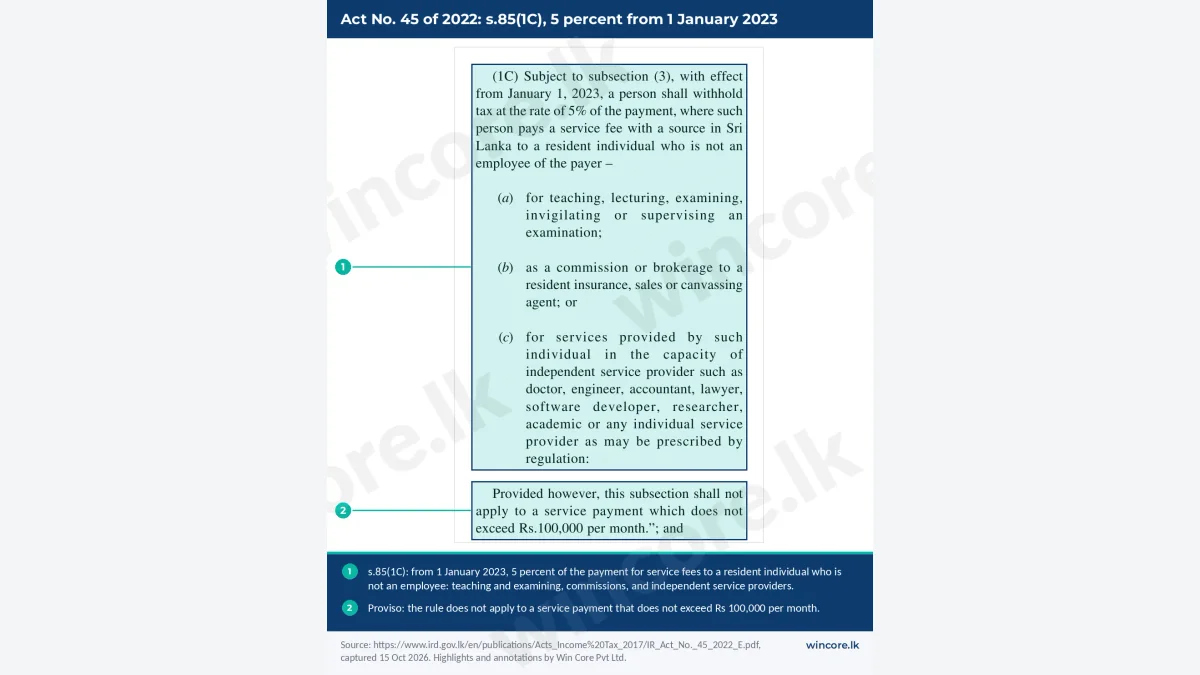
When a payer must withhold 5 percent on service fees, the services added in June 2026, payment within 15 days and the certificate rules.
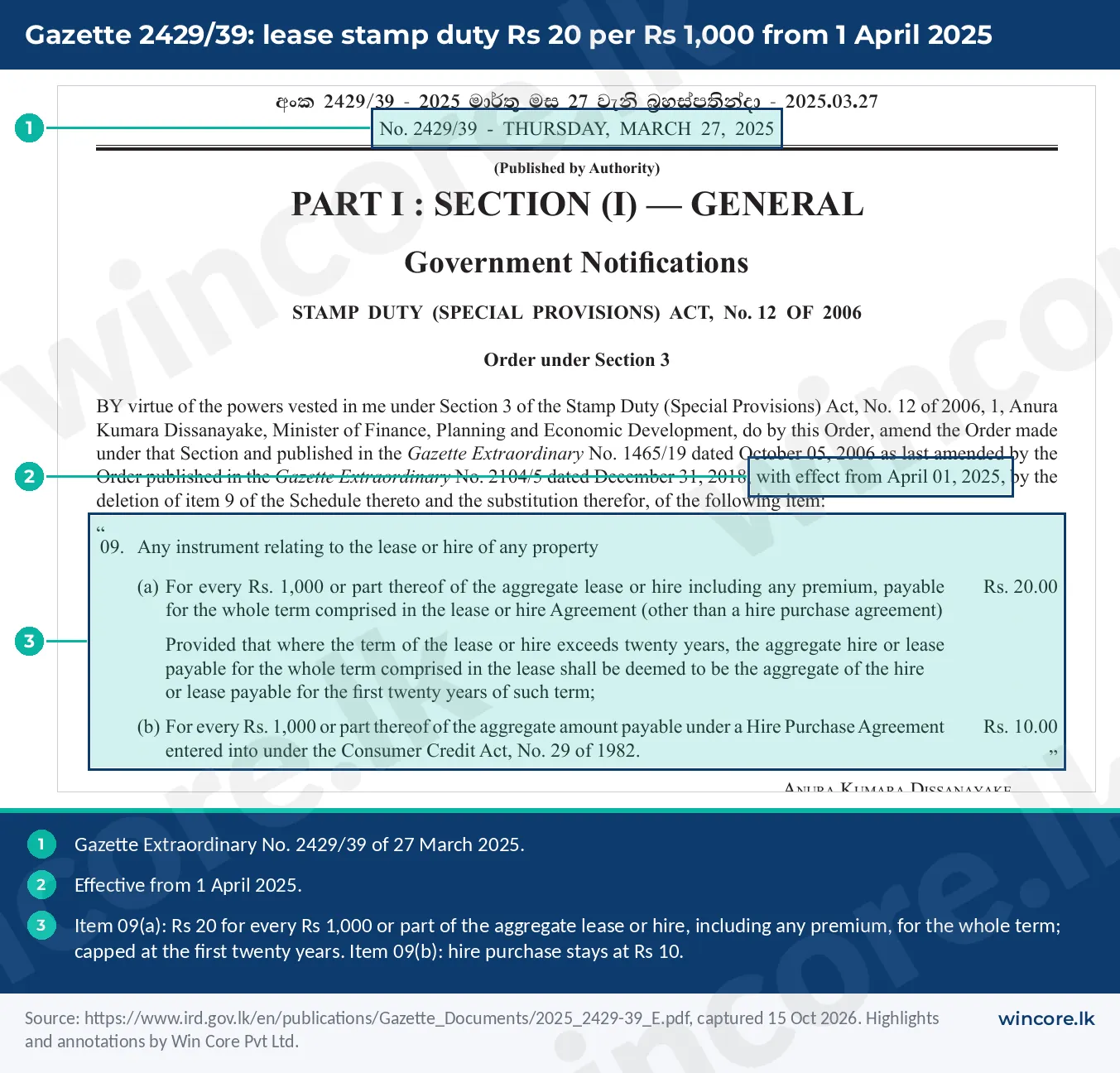
Stamp duty on a lease is Rs 20 per Rs 1,000 of the aggregate rent from April 2025. Who pays, how to pay, the exemptions and worked examples.
From 1 November 2026 individuals need a TIN certificate for eight transactions. Who needs one, how to get it, and TINs for companies and staff.