
Rental income tax in Sri Lanka: withholding, deductions, and annual return guide
Rent above Rs 100,000 a month from a business tenant has 10% AIT deducted. How the credit works, deductible expenses, the 25% relief and the return.

On this page
Last verified against the primary sources on 15 October 2026.
Take a hypothetical Colombo property owner whose only income is rent of Rs 120,000 a month from a company tenant. Because the month's rent exceeds Rs 100,000, the tenant deducts 10 percent and pays Rs 108,000 [1]. The Rs 12,000 goes to the Inland Revenue Department (IRD). After allowable outgoings and the Rs 1,800,000 personal relief [2], the owner's tax for the year is nil, so the Rs 144,000 withheld over the year can be refunded. It stays with the IRD if the owner never files a return.
This guide explains how withholding on rent works from the landlord's side, which expenses reduce taxable rental income, and what you need to do by 30 November to file your return and claim back what the IRD is holding.
The 10 percent withholding on rent
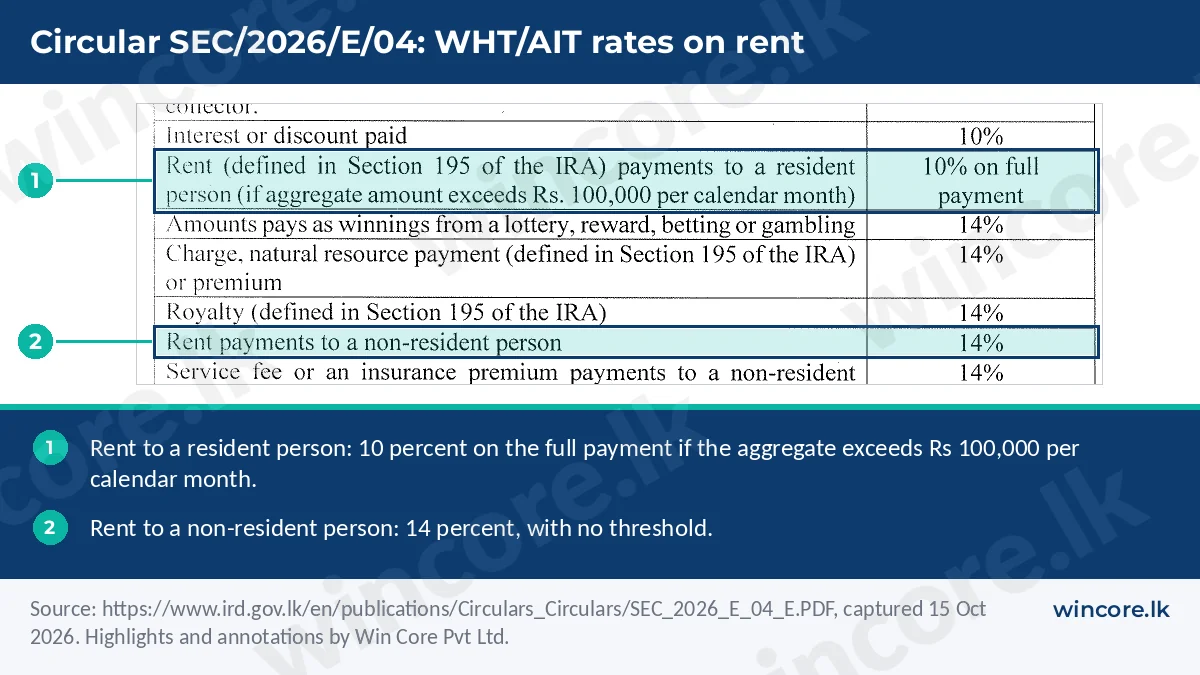
Since 1 January 2023, section 84A(1A) of the Inland Revenue Act requires a person paying rent with a source in Sri Lanka to deduct Advance Income Tax (AIT) [3] [4]. Where the rent paid to a resident landlord in a calendar month exceeds Rs 100,000 in total, the tenant deducts 10 percent of the full rent, excluding VAT. For a non-resident landlord the rate is 14 percent, with no threshold [1].
The duty applies to tenants paying in the course of a business, including companies, partnerships, sole traders, public corporations, universities and Government-owned businesses. Other Government payers, and individuals renting privately, do not deduct [1]. The tenant pays the tax to the IRD within 15 days after the end of the month [1]. The tenant's side of the rule, including registration, the VAT-exclusive base, gross-up and worked examples, is in our guide to AIT on rent.
- A company leasing office space at Rs 150,000 a month: deducts 10 percent, Rs 15,000, and pays it to the IRD by the 15th of the following month
- A company paying Rs 90,000 a month to a resident landlord: no deduction, because the month's rent does not exceed Rs 100,000
- An individual renting a house for private use from an individual: no deduction
The tax withheld is not a final tax. It is a credit against the landlord's income tax, claimed in the annual return [3].
What the landlord receives and needs to document
When your tenant must deduct, you receive the rent minus 10 percent. For each calendar month, the tenant must give you a withholding certificate in the IRD's format within 30 days after the month ends, free of charge [1].
Collect and retain these certificates throughout the year. They are your documentary evidence when claiming the credit in your annual return.
If a tenant fails to withhold, it must still pay the tax that should have been withheld, and the landlord is jointly and severally liable for that tax [3]. A landlord who cannot produce certificates also risks a dispute about whether the credit is legitimate.
Deductible expenses against rental income
Rental income is not taxable on the gross amount. The Inland Revenue Act allows certain expenses to be deducted from gross rental receipts before computing taxable income:
| Expense | Deductible? |
|---|---|
| Property maintenance and repairs | Yes |
| Annual ground rent and outgoings | Yes |
| Building insurance premiums | Yes |
| Depreciation (capital allowances at the statutory rates) | Yes |
| Municipal or pradeshiya sabha property tax | Yes |
| Interest on a loan used to buy the rental property | Yes (section 12) |
| Capital improvements (extensions, renovations) | No (depreciate separately) |
Interest on a loan is deductible to the extent the borrowed money was used to acquire an asset used to earn income (section 12 of the Inland Revenue Act), so interest on a loan taken to buy the rented property counts. The financial-cost cap in section 18 applies to entities, not to individual landlords [3].
The 25 percent rental relief (individuals): instead of claiming actual repair, maintenance and depreciation costs, a resident individual can claim a relief equal to 25 percent of the year's total rental income (Fifth Schedule, paragraph 2(c)) [3]. It is one or the other: the relief is only allowed if no deduction is claimed for actual repair, maintenance or depreciation. Other outgoings, such as insurance and property rates, are unaffected.
Capital improvements are added to the depreciable cost of the property and recovered through capital allowances over time. They are not expensed in the year incurred.
Individual vs company: how rental income is taxed differently
For an individual landlord: Rental income is aggregated with all other income and taxed at the progressive personal income tax rates. From Y/A 2025/2026 the bands are 6, 18, 24, 30 and 36 percent after the personal relief [2]. Tax withheld by the tenant is a credit against the final liability.
If your total income from all sources is below the personal relief of Rs 1,800,000 a year (Rs 1,200,000 before 1 April 2025) [2], you may be entitled to a refund of the tax deducted. But you must file a return to claim it. The refund is not automatic.
For a company receiving rental income: Rental income forms part of the company's assessable income, and tax withheld by the tenant is a credit against corporate income tax. The standard corporate rate is 30 percent, with 15 percent for specified concessionary income [5]. Rental income from property held as an investment asset rather than a trading asset is still subject to the same net-profit computation.
Worked example: individual landlord receiving commercial rent
Hypothetical scenario:
- Monthly rent: Rs 120,000, excluding VAT. Tenant is a private limited company.
- Tax deducted each month: Rs 12,000 (10 percent of the full rent, because the month's total exceeds Rs 100,000)
- Monthly receipt: Rs 108,000
- The landlord has no other income.
Annual income computation:
- Gross annual rental income: Rs 1,440,000
- Maintenance and repairs: Rs 85,000
- Building insurance: Rs 36,000
- Property tax: Rs 24,000
- Depreciation: Rs 72,000
- Total deductions: Rs 217,000
- Net rental income: Rs 1,223,000
Alternatively, the landlord could drop the actual repairs and depreciation (Rs 157,000) and claim the 25 percent rental relief of Rs 360,000 instead, alongside the insurance and property tax. That gives net rental income of Rs 1,020,000, the better choice here. Either way the result below is the same:
- Less: personal relief (Y/A 2025/2026, Rs 1,800,000; only the net rental income can be used)
- Taxable income: Rs 0
- Income tax: Rs 0
- Credit for tax withheld: Rs 144,000 (Rs 12,000 × 12)
- Refund due: Rs 144,000
To receive this refund, the landlord must file an individual income tax return with the certificates and a computation showing how the rental income was derived.
Annual return for landlords: the 30 November deadline and the late filing penalty
Landlords with rental income are required to file an annual income tax return if:
- their total income (all sources including rent) exceeds the filing threshold, or
- tax has been deducted from their rent and they wish to claim a refund, or
- the IRD has issued them with a notice to file
Returns are filed electronically through the IRD's e-Services (RAMIS) [3]. For a landlord receiving rent throughout Y/A 2025/2026 (April 2025 to March 2026), the return is due by 30 November 2026, and any balance of tax for the year was due by 30 September 2026 [6].
Late filing penalty: under section 178(1), the greater of 5 percent of the tax owing plus 1 percent a month, or Rs 50,000 plus Rs 10,000 a month, capped at Rs 400,000 for each return under section 178(2) [3].
Multiple properties and rental income aggregation
If you own two or more rental properties, all rental income is aggregated in the same return. Each property is reported separately with its own income and expense computation, but the net incomes combine for the progressive rate calculation.
This aggregation can push individual landlords into higher tax brackets. A person earning only salary income in the 6 percent band may find that combined rental income from multiple properties moves them into the 18 to 24 percent bands, a material difference in tax liability.
Consider the aggregate tax position before acquiring additional investment properties. The projected post-tax yield is the relevant metric, not the gross rental return.
Withholding certificates: collect them monthly or lose the credit at year-end
If you rely on certificates as tax credits, build a monthly collection routine:
- Issue a rent invoice to the tenant each month.
- Follow up for the certificate, which is due within 30 days after the end of the month of payment [1].
- Retain certificates in a dedicated folder by year of assessment.
- Reconcile total certificates against the total credit claimed in your return before filing.
Missing or delayed certificates are a common reason landlords cannot claim their full credit at year-end. The IRD requires documentary evidence, not just stated amounts.
For related reading, see our guide to AIT on rent and income tax bands for 2026.
Talk to us. If you receive rent and need the return computed or a refund of tax withheld claimed, our tax team can work through it with you; book a consultation at our contact page.
WinCore Pvt Ltd
This guide is general information on the law as at 15 October 2026 and is not advice on your specific situation.
References
- Inland Revenue Department. Circular to Withholding Agents: Deduction of Withholding Tax and Advance Income Tax, Circular No. SEC/2026/E/04 (8 June 2026), rate table and paras 1, 3, 5 and 6. https://www.ird.gov.lk/en/publications/Circulars_Circulars/SEC_2026_E_04_E.PDF . Primary. Accessed 15 October 2026.
- Parliament of Sri Lanka. Inland Revenue (Amendment) Act, No. 2 of 2025, personal relief and individual rates from 1 April 2025. https://www.ird.gov.lk/en/publications/Acts_Income%20Tax_2017/IR_Act_No_02-2025_E.pdf . Primary. Accessed 15 October 2026.
- Inland Revenue Department. Inland Revenue Act, No. 24 of 2017, consolidated text with amendments to 2025, ss.12, 18, 84A(1A), 86(3) and (4), 88, 113(1B), 178 and Fifth Schedule para 2(c). https://www.ird.gov.lk/en/publications/Acts_Income%20Tax_2017/IRA_Cons_Act_-_2025_Changes.pdf . Primary. Accessed 15 October 2026.
- Parliament of Sri Lanka. Inland Revenue (Amendment) Act, No. 45 of 2022, s.16 (inserting s.84A(1A)). https://www.ird.gov.lk/en/publications/Acts_Income%20Tax_2017/IR_Act_No._45_2022_E.pdf . Primary. Accessed 15 October 2026.
- Inland Revenue Department. Tax Chart, Year of Assessment 2025/2026, corporate income tax rates. https://www.ird.gov.lk/en/publications/SitePages/tax_chart_2526.aspx . Primary. Accessed 15 October 2026.
- Inland Revenue Department. Tax Calendar 2026, final payment for Y/A 2025/2026 on 30 September 2026 and return on 30 November 2026. https://www.ird.gov.lk/en/publications/Tax%20Calendar_Documents/Tax_Calendar_2026_E.pdf . Primary. Accessed 15 October 2026.
Put these insights to work
WinCore specialists can review your current workflow, document gaps, and build a practical 90-day action plan.
Book a free consultationContinue reading
Explore more WinCore analysis to keep your finance, tax, and compliance roadmap moving.
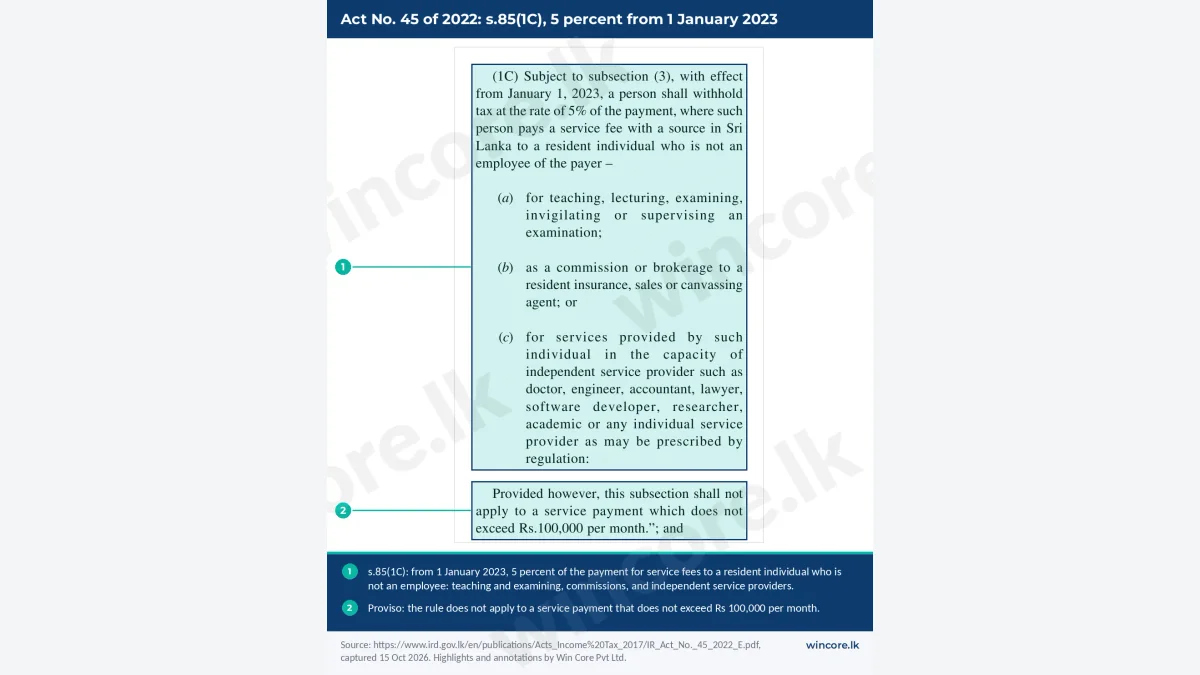
When a payer must withhold 5 percent on service fees, the services added in June 2026, payment within 15 days and the certificate rules.
When a tenant must deduct 10 percent AIT from rent, the base excluding VAT, payment within 15 days, certificates and worked examples.
Sri Lanka corporate income tax guide: rates, taxable income, quarterly instalments, deductions, capital allowances, and key compliance penalties.