
Corporate income tax compliance in Sri Lanka
Sri Lanka corporate income tax guide: rates, taxable income, quarterly instalments, deductions, capital allowances, and key compliance penalties.

On this page
Last verified against the primary sources on 15 October 2026.
File your company's income tax return late and the penalty is the greater of 5 percent of the tax owing plus 1 percent a month, or Rs 50,000 plus Rs 10,000 a month, up to Rs 400,000 a return [1]. Leave a quarterly instalment unpaid for 14 days after its due date and a 10 percent penalty applies, with interest at 1.5 percent a month on top [1]. Sri Lanka's self-assessment system requires companies to calculate, schedule, and file without prompting.
That is what makes corporate income tax (CIT) compliance a recurring finance discipline, not a once-a-year task. The standard rate is 30%. There is no SME rate: the 14 percent rates applied only to periods before 1 October 2022 [1]. Knowing the rate is only the starting point. Getting each instalment right, paying the balance by the final payment date and filing the return by 30 November without a penalty is the actual job.
This guide covers rates, calculations, deadlines, deductions, capital allowances, penalties, and worked examples.
What CIT actually taxes. And what it does not
CIT is a tax on the annual taxable profit of a company. Unlike personal income tax, which applies to individuals, CIT applies to incorporated entities as separate legal persons. The tax is calculated on each company's annual profits after allowable deductions, and is paid through quarterly instalments with a final payment and an annual return.
Key characteristics of Sri Lanka's CIT framework:
- Annual assessment based on company taxable income for the year of assessment
- Three rates: 30% standard, 45% and 15% for specified income
- Quarterly instalments during the year, based on the prior year's tax
- Annual income tax return filed electronically by 30 November
- Administered by the IRD under the Commissioner-General of Inland Revenue
Who pays Corporate Income Tax?
Resident companies
A company is resident in Sri Lanka if it is incorporated here, or if its management and control are exercised from Sri Lanka. Resident companies are taxable on their worldwide income. Income from both Sri Lankan and foreign sources.
- Companies incorporated under the Companies Act No. 7 of 2007
- Foreign subsidiaries where management and control is exercised in Sri Lanka
- Any entity whose central management direction originates in Sri Lanka
Non-resident companies
Non-resident companies with a presence in Sri Lanka, through a branch, permanent establishment, or agency, are taxed only on Sri Lanka-sourced income. Specific withholding tax rates also apply to payments made to non-residents for services, interest, dividends, and royalties.
Entities exempt from CIT
- Approved charitable organisations and trusts recognised by the IRD
- Religious institutions with formal IRD recognition
- Government ministries, departments, and statutory bodies
- Approved co-operative societies under qualifying conditions
- Provident funds and approved employee benefit schemes
For a voluntary organisation, distinguish the NGO and charitable-institution tax rules from the ordinary company profit computation.
The year of assessment for CIT purposes
Sri Lanka's year of assessment runs from 1 April to 31 March. The year ending 31 March 2026 is the Year of Assessment (Y/A) 2025/2026. Its final tax payment was due on 30 September 2026 and its return is due on 30 November 2026 [2].
A company may apply to the Commissioner-General to change its year of assessment (section 20(2)) [1]. See changing your financial year end before you plan around a non-March year.
Corporate income tax rates: current rates
All rates are set in the First Schedule to the Inland Revenue Act No. 24 of 2017 and its amendments [1].
CIT rates
- Standard rate: 30%. Applies to all companies and income not covered by another rate, including banks, finance companies and telecommunications operators
- 45%: betting and gaming, and the manufacture and sale or import and sale of liquor and tobacco products
- 15%: gains and profits from services used outside Sri Lanka and paid for in foreign currency remitted through a bank in Sri Lanka, and foreign-source income remitted through a bank
The 15 percent rate applies to the qualifying gains and profits themselves. There is no test that export income must reach 70 percent of revenue [1]. See our guide to tax on foreign service exports.
There is no SME rate, and no current 14 percent, 17.5 percent or 24 percent rate for IT, tourism, agriculture, BOI manufacturing or listed companies. The 14 percent rates ended on 30 September 2022, and no SME rate applies from 1 April 2023 [1].
BOI companies
Concessionary rates carried over for BOI enterprises and under repealed Acts cannot apply after 31 March 2025 (section 203(6), inserted by section 35 of Act No. 11 of 2026) [3]. Investment incentives now run mainly through enhanced capital allowances; see enhanced capital allowance and our BOI incentives guide.
How taxable income is calculated
Sri Lanka's CIT system uses a four-step framework. Each step requires careful documentation because the IRD can examine every stage.
Step 1: Determine gross income
Gross income includes all amounts received or accrued during the year of assessment:
- Revenue from trading operations. Sales turnover, service fees, commissions, contract income
- Interest income from bank deposits, loans advanced, and debt instruments held
- Rental income from property, equipment, and vehicles
- Dividend income from shareholdings (see the withholding tax section below)
- Capital gains on disposal of investment assets and business assets
- Foreign-sourced income for resident companies
- Any other gain or profit of an income nature, whether recurring or one-off
Step 2: Calculate statutory income
Statutory income is gross income minus expenses directly incurred in producing that income. Each source of income is evaluated separately. Expenses that are capital in nature, personal, or not wholly and exclusively for the purpose of producing income are excluded at this stage.
Step 3: Arrive at assessable income
Assessable income is statutory income minus any qualifying losses carried forward from prior years of assessment. Losses can be carried forward for up to 6 years (section 19(1)(b)) [1], subject to the conditions in the loss carry-forward section below.
Step 4: Determine taxable income
Taxable income is assessable income minus any qualifying deductions, such as approved charitable donations. This final figure is what the CIT rate is applied to.
Worked example: calculating CIT for a standard company
Take a hypothetical private limited company with no special rate:
- Gross income for the year: LKR 15,000,000
- Allowable deductions (staff, rent, capital allowances, professional fees): LKR 9,500,000
- Statutory income: LKR 5,500,000
- Qualifying losses carried forward from prior year: LKR 300,000
- Assessable income: LKR 5,200,000
- Approved charitable donation deduction: LKR 100,000
- Taxable income: LKR 5,100,000
- CIT at 30%: LKR 1,530,000
Allowable deductions
Deductions reduce taxable income and are therefore central to an accurate computation. Only expenditure incurred in producing taxable income qualifies. The burden of proof is on the taxpayer. Every deduction requires supporting documentation.
Operating expenses
- Employee salaries, wages, allowances, and bonuses, including the employer's EPF (12%) and ETF (3%) contributions
- Office rent, utilities (electricity, water, internet), and building maintenance costs
- Professional fees. Audit, legal, accounting, tax advisory, and management consulting
- Insurance premiums for business assets, public liability, and professional indemnity policies
- Marketing, advertising, sales promotional, and public relations expenditure
- Travel and transportation costs directly related to business income-producing activities
- Repairs and maintenance on revenue account. Capital improvements are not deductible as expenses
- Interest on borrowings used to finance income-producing assets or activities
- Bad debts. deductible only when the debt is demonstrably irrecoverable and has been formally written off in the accounts; general provisions for doubtful debts do not qualify
Research and development
Research and development expenditure is deductible in full, whether or not it is capital in nature (section 15) [1]. There is no 300 percent R&D deduction and no 200 percent deduction for training or export promotion. An additional 100 percent R&D deduction in the Sixth Schedule was time-limited. For the general rules, see which expenses a company can deduct.
Non-deductible expenses
These items appear in financial statements but must be added back when computing taxable income:
- Personal expenses of directors and shareholders. Any private element disqualifies the entire expense unless it can be apportioned
- Domestic or private expenditure of any nature
- Fines, penalties, and court-ordered payments including IRD penalties
- Political donations and contributions
- Capital expenditure. Recovered through capital allowances instead
- Life insurance premiums on personal policies held for the benefit of directors
- Entertainment expenses, which are not deductible at all (section 10) [1]
- General provisions for future losses, contingencies, or doubtful debts
For training costs, test when education expenditure is deductible rather than treating every course fee as an allowable business expense.
Capital allowances by asset class
Capital assets are not deducted in full when purchased. Capital allowances under the Fourth Schedule reduce taxable income over the asset's life on a straight-line basis [1].
Capital allowance rates
- Computers and data handling equipment, plant, machinery, equipment, furniture and fittings: 20% a year (written off over 5 years)
- Commercial vehicles, buses, goods vehicles, trucks and motorcycles: 20% a year (over 5 years). Ordinary motor cars get no capital allowance
- Buildings and structures: 5% a year (over 20 years)
- Intangible assets: over their useful life
A new undertaking whose depreciable assets exceed USD 250,000 but not USD 3 million can claim an enhanced capital allowance of 100 percent from 1 April 2026, in addition to the ordinary allowances (Act No. 11 of 2026, s.37) [3]. See enhanced capital allowance in 2026.
Quarterly instalment payments
CIT is not paid in a single lump sum at year-end. Companies pay four quarterly instalments during the year of assessment, then settle the balance by the final payment date.
Payment schedule
- 1st instalment: 15 August
- 2nd instalment: 15 November
- 3rd instalment: 15 February
- 4th instalment: 15 May
Dates are from the IRD Tax Calendar [2]. When a date falls on a weekend or holiday, check the IRD's notices for that year. The Statement of Estimated Tax (SET) no longer has to be filed: Act No. 11 of 2026 discontinued it from Y/A 2026/27 [3].
An instalment unpaid 14 days after its due date attracts a penalty of 10 percent of the unpaid amount (section 179(2)), and interest runs at 1.5 percent a month or part month (sections 157 and 159) [1].
How to calculate quarterly instalments
From Y/A 2026/27 each instalment is (A minus C) divided by B, under section 90(3) as amended by section 16 of Act No. 11 of 2026 [3]. A is the tax payable for the previous year, B is the number of instalments remaining, and C is the instalments already paid plus tax withheld from the company's income during the year. The IRD's Circular SEC/2026/E/06 (Re-Revised) sets out this method and the alternative for a company with no prior-year taxable income or with income expected to fall [4].
- Obtain the prior year's tax from the finalised computation
- Before each due date, deduct the instalments already paid and any WHT withheld so far, and divide by the instalments left
- Where current-year income is expected to be lower, use the alternative method in the circular and document the basis with management sign-off
- Enter all four payment dates in your tax calendar. Use the tax calendar tool to track them alongside VAT, WHT, and payroll-tax deadlines
- Pay through the IRD's authorised payment channels and retain the payment receipt
- At year-end, reconcile total instalments paid against the actual liability in the return; settle any balance by the final payment date
See quarterly instalments after the SET for the full method.
Worked example: quarterly instalment calculation
Take a hypothetical company whose tax for Y/A 2025/2026 was LKR 1,200,000. For Y/A 2026/2027:
- 15 August 2026: (1,200,000 minus 0) divided by 4 = LKR 300,000
- A bank then withholds LKR 60,000 of WHT from the company's interest income
- 15 November 2026: (1,200,000 minus 360,000) divided by 3 = LKR 280,000
- 15 February 2027: (1,200,000 minus 640,000) divided by 2 = LKR 280,000
- 15 May 2027: (1,200,000 minus 920,000) divided by 1 = LKR 280,000
- Instalments plus WHT credit: LKR 1,200,000
If the actual Y/A 2026/2027 liability turns out to be LKR 1,500,000, the balance of LKR 300,000 is payable by the final payment date, with interest if it is paid late.
Annual income tax return filing
Deadline and documentation
The annual return must be filed on or before 30 November after the end of the year of assessment. For Y/A 2025/2026 the deadline is 30 November 2026, and the final payment was due on 30 September 2026 [2]. Returns are filed electronically (section 113) [1].
A complete return file should contain:
- Financial statements for the year
- Tax computation schedule reconciling accounting profit to taxable income. Every line of adjustment must be documented
- Schedules detailing all disallowable items added back and all allowable deductions claimed
- Capital allowance computation showing the opening and closing tax written-down value of each asset class
- Details of all four quarterly instalments paid, supported by receipts
- Withholding tax certificates received from payers during the year
- Prior-year loss carry-forward schedule if losses are being utilised
- Transfer pricing documentation where related-party transactions exist
The corporate tax calculator can help with a first pass before the full computation.
Records retention
Keep financial records, ledgers, supporting documents, returns, computations, assessment notices and IRD correspondence for the period the Inland Revenue Act requires, and keep statutory company records (board minutes, share registers, incorporation documents) permanently.
If an old assessment or credit mentions ESC, use the historical Economic Service Charge guide rather than a current income-tax rate table.
Withholding tax and its interaction with CIT
Withholding tax (WHT) is deducted at source on specific categories of payment, such as dividends, interest, service fees and rent. Where WHT has been deducted on income that is also included in a company's taxable income, the amount deducted is credited against the CIT liability [1].
How the offset works in practice: If a company earns interest income of LKR 500,000 from a fixed deposit and the bank deducts WHT at 10% (LKR 50,000) [5], that LKR 50,000 reduces the CIT payable. The company must obtain a WHT certificate from the payer to support the credit.
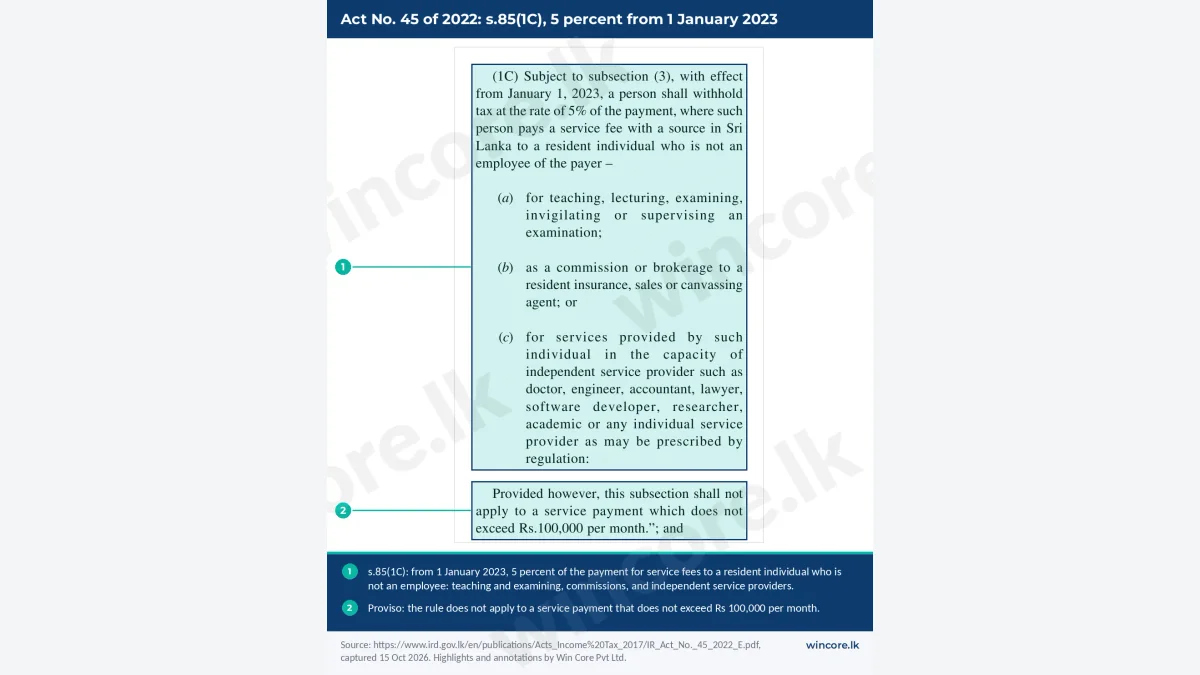
Reconciling WHT activity against CIT assumptions monthly removes the most common mismatch risk in IRD desk audits. See our guide to 5 percent WHT on service fees for the rules a company applies when it is the payer.
Dividends are subject to WHT at 15 percent, and for a resident recipient that WHT is not a final tax (section 88(1A)) [1]. Do not assume dividend income is exempt; check the exemptions in the Act before leaving it out of the computation.
Loss carry-forward rules
Sri Lanka permits companies to carry forward business losses to offset against taxable profits in future years of assessment:
- Losses may be carried forward for a maximum of 6 years from the year of assessment in which the loss arose (section 19(1)(b)) [1]. A loss from Y/A 2020/2021 expires unutilised after Y/A 2026/2027
- The business generating the loss must be continuing, if the nature of the business changes materially, IRD may disallow the carry-forward
- Capital losses are generally not available for carry-forward against income profits; specific rules govern offset of capital losses against capital gains only
- Where there is a material change in ownership of the company, loss utilisation may be restricted or denied entirely to prevent artificial loss trafficking between entities
- Losses from one distinct source of income cannot always be freely offset against an unrelated income source
Finance teams should maintain a loss register tracking: the year each loss arose, original amount, amounts utilised in each subsequent year, and the remaining carry-forward balance. This is a standard IRD audit request.
Transfer pricing rules
Sri Lanka's transfer pricing rules require that transactions between associated persons, including related companies, group entities, and controlling shareholders, are conducted at arm's length prices, as if the parties were independent and unrelated.
Obligations for companies with related-party transactions:
- Related-party arrangements must be documented with contemporaneous supporting analysis
- The burden of proof that prices are arm's length rests with the taxpayer, not the IRD
- Where the IRD determines a transaction was not at arm's length, it will restate taxable income upwards and assess additional tax plus penalties
- Stricter documentation requirements apply to multinational groups and cross-border related-party transactions
- Companies in larger domestic or international groups should maintain a formal transfer pricing study to defend their positions at audit
Finance teams at multinational-group entities should monitor IRD announcements on global minimum tax rules, which are under active review as part of international tax alignment.
Penalties for non-compliance
Penalties are a material risk for companies that miss deadlines, underpay instalments, or file incorrect returns. Chapter XVII of the Inland Revenue Act sets them out [1].
Late filing penalty (section 178)
- The greater of 5% of the tax owing plus 1% for each month or part month the return is late, and LKR 50,000 plus LKR 10,000 for each month or part month
- Capped at LKR 400,000 a return
Late payment
- 20% of tax due but not paid, once it is still unpaid fourteen days after its due date (section 179(1)) [1] [6]
- 10% instead of 20% on an instalment not paid within 14 days of its due date (section 179(2))
- Interest at 1.5% a month or part month on unpaid tax (sections 157 and 159)
Other penalties
- An underpayment caused by an incorrect return made intentionally or negligently: 25% of the underpayment, or 75% where it exceeds LKR 10 million or 25% of the tax liability (section 180)
- Failing to keep records or to give the IRD facilities to inspect them: penalties under section 182 [1]
- Failing to comply with an IRD notice to give information: a separate penalty in Chapter XVII, charged after a warning [1]
- Tax evasion: prosecution under the Inland Revenue Act
For the full penalty map, see RAMIS penalties in Sri Lanka.
Five control failures that turn CIT compliance into a year-end emergency
Companies with stable CIT compliance outcomes treat tax as part of their core finance operating rhythm. Not as an annual emergency triggered by approaching deadlines.
The most common control failures in Sri Lankan SMEs and mid-sized groups are:
- tax computations built in isolated spreadsheets with no version control or review sign-off
- weak linkage between the financial close calendar and the tax computation timeline
- insufficient documentation for expense claims and related-party transactions
- delayed reconciliation of WHT credits, quarterly payments, and assessment balances
- rate assumptions not updated when legislation or circulars change mid-year
Running quarterly instalment reviews as part of management reporting, maintaining a defensible computation trail throughout the year, and cross-reconciling CIT with VAT, WHT, and payroll data are the disciplines that prevent year-end surprises.
Talk to us. If you want a second pair of hands on instalments, the computation or the return, our tax team can work through the current year with you; book a consultation at our contact page.
WinCore Pvt Ltd
This guide is general information on the law as at 15 October 2026 and is not advice on your specific situation.
References
- Inland Revenue Department. Inland Revenue Act, No. 24 of 2017, consolidated, ss.10, 15, 19, 20, 88, 113, 157, 159, Chapter XVII (ss.176 to 185), First, Fourth and Sixth Schedules. https://www.ird.gov.lk/en/publications/Acts_Income%20Tax_2017/IRA_Cons_Act_-_2025_Changes.pdf . Primary. Accessed 15 October 2026.
- Inland Revenue Department. Tax Calendar 2026, instalment dates, final payment and return for Y/A 2025/26. https://www.ird.gov.lk/en/publications/Tax%20Calendar_Documents/Tax_Calendar_2026_E.pdf . Primary. Accessed 15 October 2026.
- Parliament of Sri Lanka. Inland Revenue (Amendment) Act, No. 11 of 2026, certified 3 June 2026, ss.16, 17, 35 and 37. https://www.ird.gov.lk/en/publications/Acts_Income%20Tax_2017/IR_Act_No_11-2026_E.pdf . Primary. Accessed 15 October 2026.
- Inland Revenue Department. Circular SEC/2026/E/06 (Re-Revised), quarterly instalments under section 90(3) (12 August 2026). https://www.ird.gov.lk/en/publications/Circulars_Circulars/SEC_2026_E_06_ReRiv_E.pdf . Primary. Accessed 15 October 2026.
- Inland Revenue Department. Tax Chart, Y/A 2025/26, corporate rates and WHT/AIT rates from 1 April 2025. https://www.ird.gov.lk/en/publications/SitePages/tax_chart_2526.aspx . Primary. Accessed 15 October 2026.
- Inland Revenue Department. Guide to the Return of Income Tax, Y/A 2025/26, Section 09, penalty of 20 percent of tax due but not paid, 10 percent on a late instalment, interest at 1.5 percent a month or part of a month. https://www.ird.gov.lk/en/Downloads/IT_Individuals_Doc/Asmt_IIT_004_2025_2026_E.pdf . Primary. Accessed 15 October 2026.
Put these insights to work
WinCore specialists can review your current workflow, document gaps, and build a practical 90-day action plan.
Book a free consultationContinue reading
Explore more WinCore analysis to keep your finance, tax, and compliance roadmap moving.
The SET filing requirement is gone from Y/A 2026/27. Quarterly instalments now follow a formula based on the previous year's tax. Here is how it works.
From 1 April 2026, Sri Lanka's Enhanced Capital Allowance also applies to new undertakings whose depreciable assets exceed USD 250,000 but not USD 3 million, opening a 100% allowance to mid-market investors.
When a payer must withhold 5 percent on service fees, the services added in June 2026, payment within 15 days and the certificate rules.