
NGO tax in Sri Lanka: section 68 and charitable institutions
How the Inland Revenue Act taxes NGOs and charities: the section 68 charge on receipts, the 30 and 14 percent rates, and the 2026 credit for approved ones.
On this page
Last verified against the primary sources on 22 October 2026.
NGO tax in Sri Lanka has two layers under the Inland Revenue Act, No. 24 of 2017 (IRA). A non-governmental organization pays income tax on its taxable income at 30 percent (First Schedule paragraph 7(1), from 1 April 2023), and section 68(1) adds an "additional tax on three percent of amounts received" by grant, donation, contribution "or in any other manner", charged at 30 percent (paragraph 7(3)(d)). A charitable institution is taxed at 14 percent and the section 68 charge is not addressed to it. The Inland Revenue (Amendment) Act, No. 11 of 2026, certified on 3 June 2026, changed the NGO definition and added a full tax credit for approved charitable institutions from the year of assessment 2025/26.
Many people assume a non-profit pays no income tax. That is not what the Act says. It taxes both "non-governmental organizations" and "charitable institutions", and it taxes NGOs on what they receive as well as on what they earn. This piece sets out each rule from the clause itself.
Registering with the NGO Secretariat and being an "NGO" for tax are separate tests. For registration, see our article on the NGO Act, Act No. 31 of 1980.
The Inland Revenue Act draws two categories, and the line moved in 2026
"Non-governmental organization"
Section 195 defines it as "any organization or association, whether incorporated or unincorporated, formed by a person or a group of persons on a voluntary basis and which is nongovernmental in nature, and established and constituted (a) for the provision or relief and services of a humanitarian nature to the poor and destitute, the sick, orphans, widows, youth, children; or (b) generally for the provision of relief to the needy", "unless such organization or association is determined by the Commissioner-General not to be a non-governmental organization" [1].
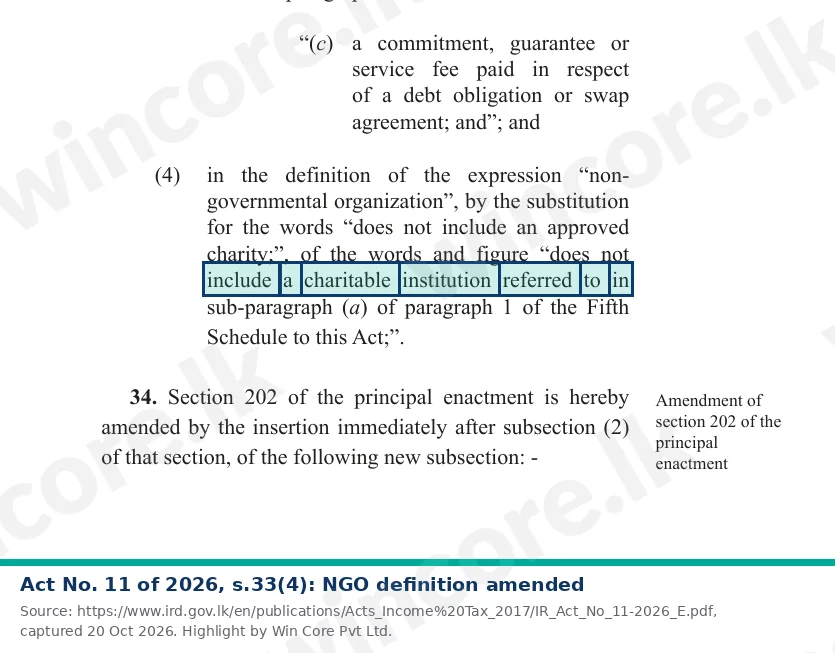
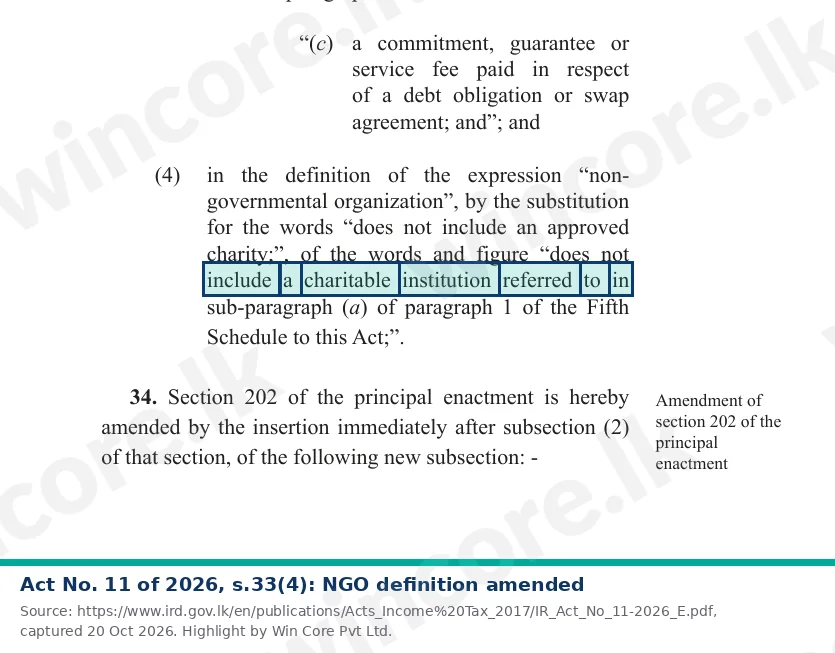
Until 2026 the definition ended "but in all cases does not include an approved charity". Section 33(4) of Act No. 11 of 2026 replaced those words with "does not include a charitable institution referred to in sub-paragraph (a) of paragraph 1 of the Fifth Schedule to this Act" [2].
"Charitable institution"
Section 195 defines a charitable institution as the trustee or trustees of a trust, or a corporation or unincorporated body, "established for a charitable purpose only or engaged solely in carrying out a charitable purpose" [1]. "Charitable purposes" are purposes "for the benefit of the public or any section of the public in or outside Sri Lanka" in five categories: "the relief of poverty"; "the advancement of education or knowledge other than by any institution established for business purposes or by any institution established under the Companies Act"; protection of the environment; the advancement of religion; and "any other purpose beneficial to the community".
The two definitions overlap. A body doing humanitarian relief can meet both. The only express exclusion from the NGO definition is a paragraph 1(a) institution, and the Act does not say which treatment applies to a body that meets both definitions and is not a paragraph 1(a) institution. On our reading that body is at risk of the NGO treatment, including section 68. Which category a particular body falls in is a question to settle with the Inland Revenue Department (IRD) before the first return.
Section 68 taxes NGO receipts, not profit: 30 percent of 3 percent
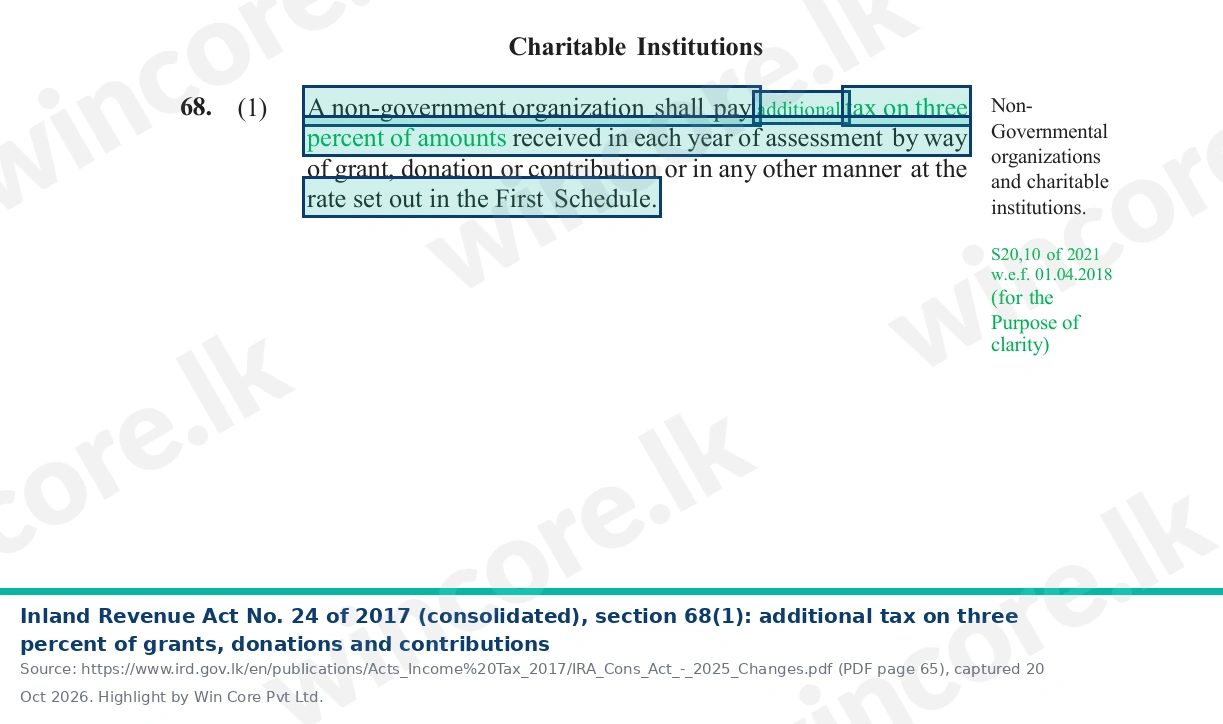
Section 68(1): "A non-government organization shall pay additional tax on three percent of amounts received in each year of assessment by way of grant, donation or contribution or in any other manner at the rate set out in the First Schedule" [1].
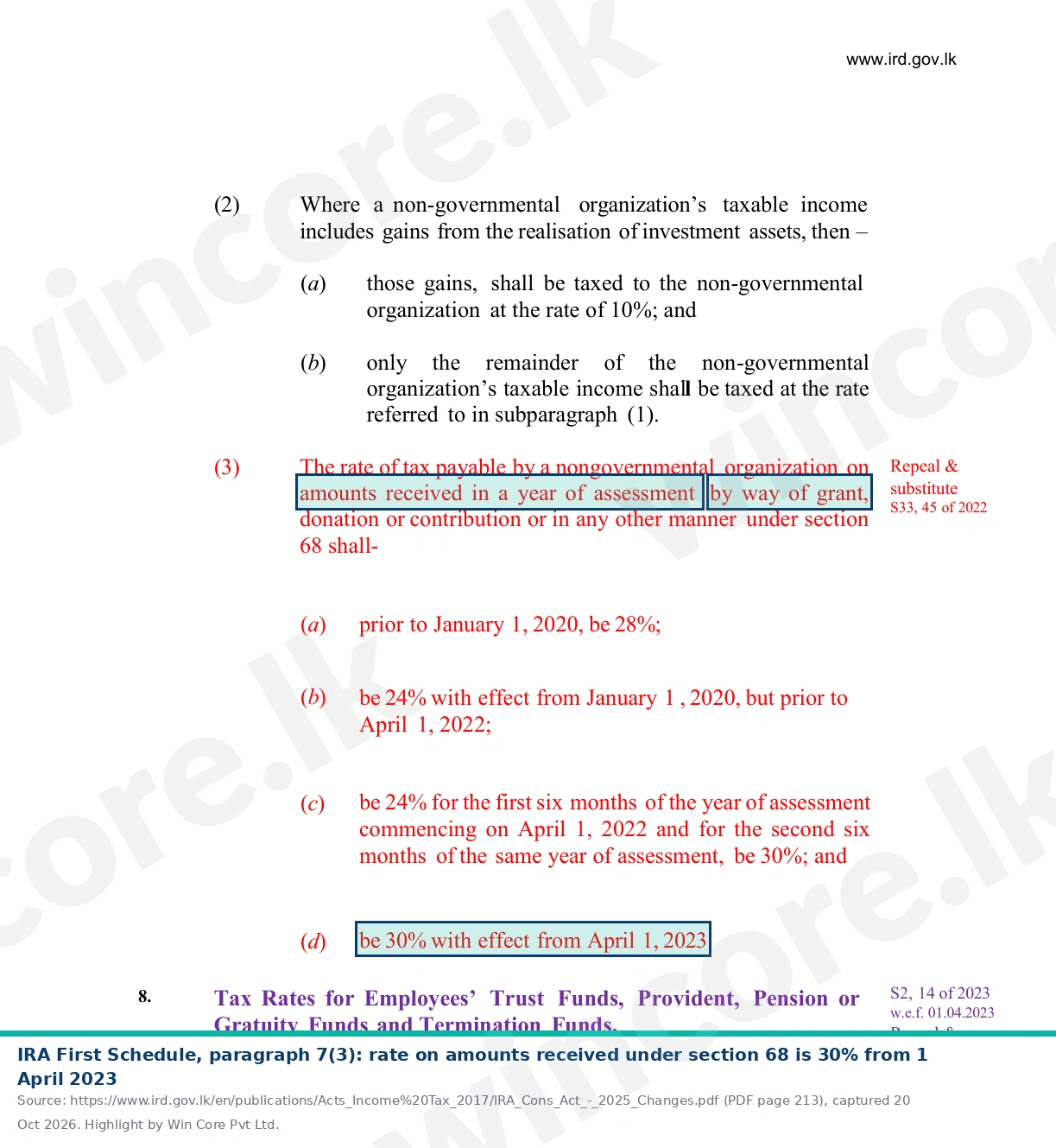
The rate is in First Schedule paragraph 7(3): the rate "on amounts received in a year of assessment by way of grant, donation or contribution or in any other manner under section 68 shall ... (d) be 30% with effect from April 1, 2023" [1]. Earlier rates were 28 percent before 1 January 2020, 24 percent to 31 March 2022, and 24 then 30 percent in the two halves of 2022/23.
The 0.9 percent figure is our arithmetic. Neither clause says "0.9%". Section 68(1) sets the base at three percent of amounts received; paragraph 7(3)(d) sets the rate at 30 percent. Thirty percent of three percent is 0.9 percent of receipts. We use the figure only as that arithmetic, on the rates in force today. The base is everything received "in any other manner", not only grants, and the charge applies even if every rupee is spent on the cause.
Hypothetical example
A district-level NGO runs a school-meals programme funded by local donations of Rs 8,400,000 in the year of assessment 2025/26, with no other receipts.
| Step | Basis | Amount (Rs) |
|---|---|---|
| Receipts | Donations received | 8,400,000 |
| Three percent of receipts | s.68(1) | 252,000 |
| Additional tax at 30 percent | First Schedule para 7(3)(d) | 75,600 |
| As a share of receipts | Our arithmetic | 0.9 percent |
Any income tax on its taxable income is a separate charge. Section 68 does not say whether grants and donations are themselves part of an NGO's taxable income; we keep that open.
Relief is discretionary, not automatic
Section 68(2) lets the Commissioner-General "reduce or remove the tax payable" by an NGO engaged in "rehabilitation and the provision of infrastructure facilities and livelihood support to displaced persons in any area identified by the Government", or in "any other activity approved by the Minister as being of humanitarian in nature, taking into consideration the nature and gravity of any disaster and the magnitude of relief required", "if it appears that such reduction is just and equitable in all the circumstance of the case" [1]. A school-meals programme in ordinary times is unlikely to fit either limb on its own.
NGO income tax is 30 percent, and investment gains moved to 30 percent in June 2026
On top of the section 68 charge, First Schedule paragraph 7(1)(d) taxes an NGO's taxable income at "30 % with effect from April 1, 2023" [1]. Gains from realising investment assets were taxed at 10 percent under paragraph 7(2)(a). Section 36(6) of Act No. 11 of 2026 changed that to "10%, prior to the date on which the provisions referred to in subsection (2) of section 1 come into operation" and "30%, with effect from" that date [2]. Section 1(2) brings those provisions into force "on the date on which the Bill becomes an Act of Parliament", and the Act was certified on 3 June 2026. Section 36 of the Act is not in its Table of special dates.
For how the 30 percent rate sits beside the other company and individual rates, see our guide to income tax bands in Sri Lanka for 2026.
A charitable institution pays 14 percent, and the 2026 credit can cancel it
First Schedule paragraph 6(1): "the taxable income of a charitable institution for a year of assessment shall be taxed at the rate of [14%]" [1]. The square brackets are in the IRD's consolidated text, which does not say what they mark. Paragraph 6(2)(a) taxes a charitable institution's investment-asset gains "at the rate of 10%".
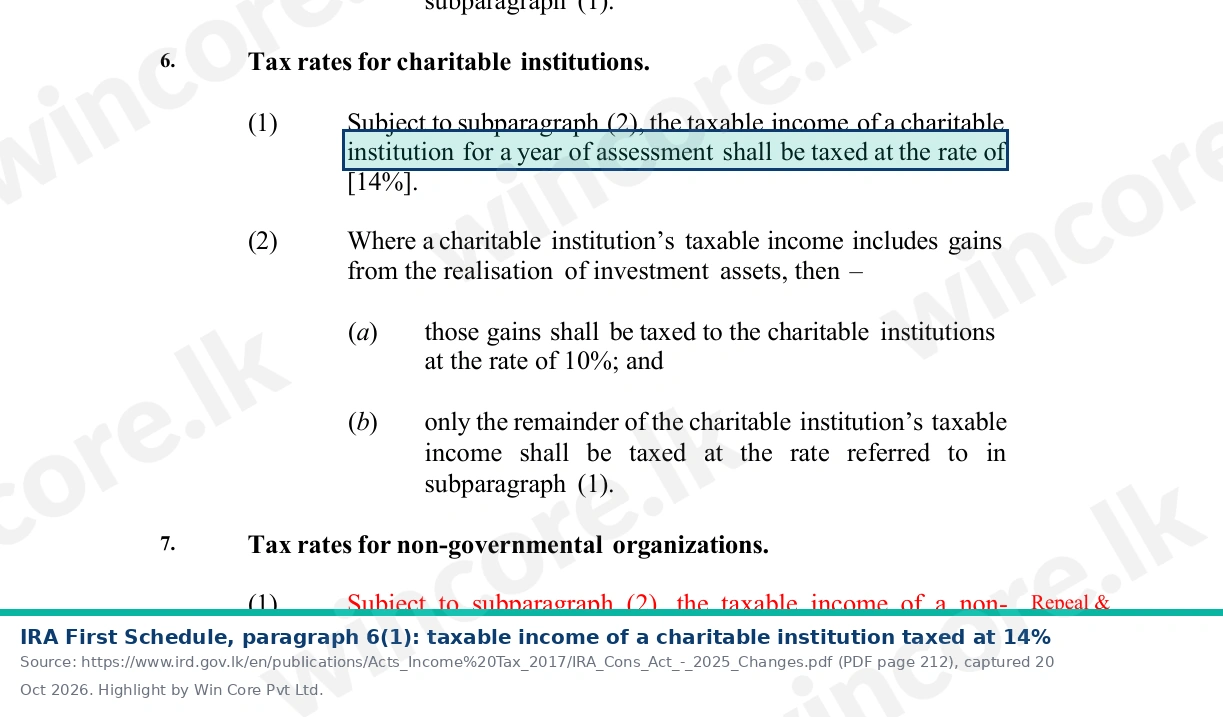
Section 36 of Act No. 11 of 2026 amends paragraphs 1, 2, 3, 4, 5 and 7 of the First Schedule, not paragraph 6 [2]. On our reading the 14 and 10 percent charitable rates are unchanged, while the NGO gains rate in paragraph 7 rose to 30 percent.
The tax credit for approved charitable institutions
Before 2025/26, section 68(3) allowed a discretionary credit: where a charitable institution provides "institutionalized care for the sick or the needy" and bears the cost, the Commissioner-General "may, subject to specified conditions, grant a tax credit", "provided it appears to the Commissioner-General that such reduction or remission is just and equitable" [1].
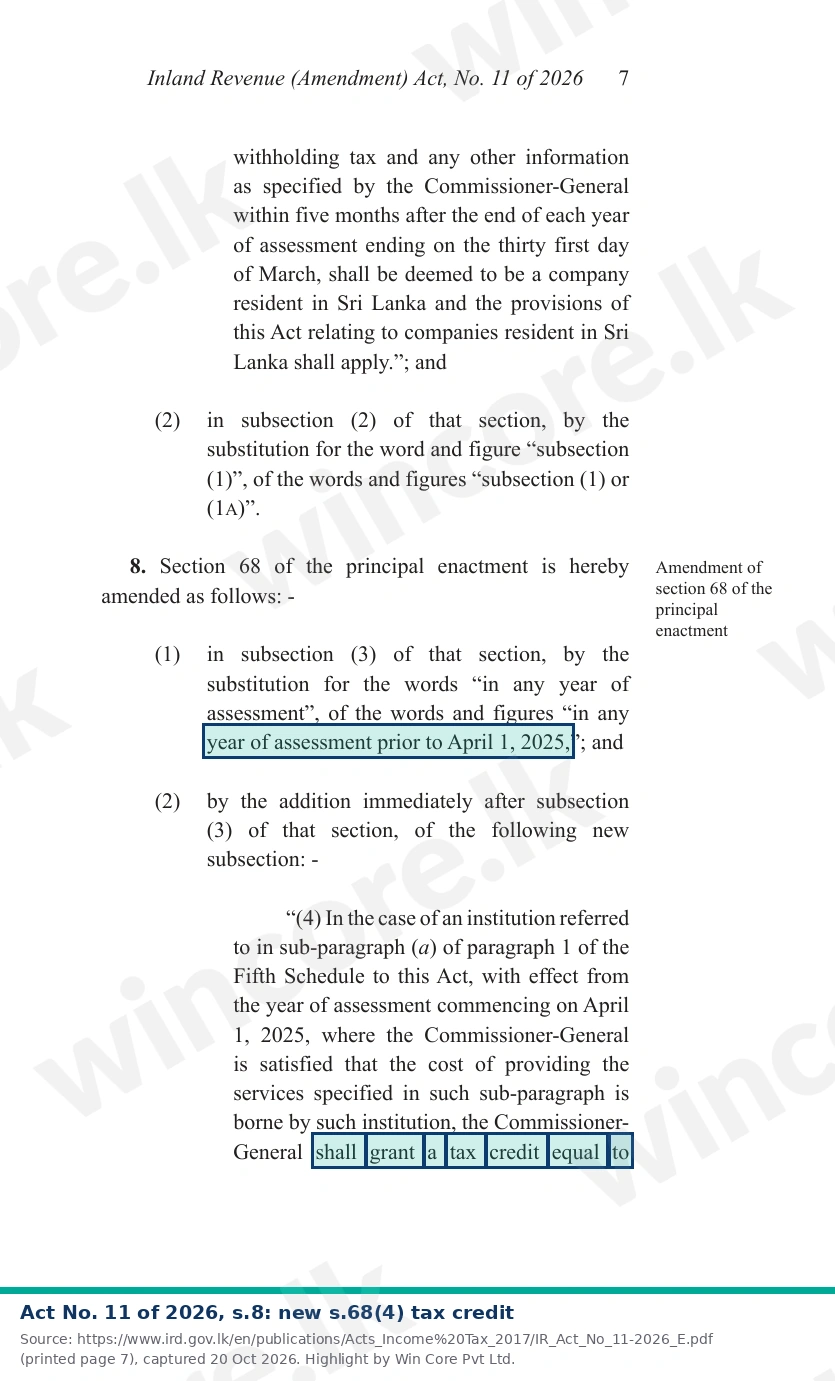
Section 8 of Act No. 11 of 2026 confined section 68(3) to "any year of assessment prior to April 1, 2025" and added section 68(4): for an institution in Fifth Schedule paragraph 1(a), "with effect from the year of assessment commencing on April 1, 2025, where the Commissioner-General is satisfied that the cost of providing the services specified in such sub-paragraph is borne by such institution, the Commissioner-General shall grant a tax credit equal to the tax payable on the institution's taxable income for the year of assessment" [2]. The Act's Table dates section 8 from 1 April 2025.
Fifth Schedule paragraph 1(a)(i), as substituted by section 40 of Act No. 11 of 2026 from 1 April 2025, covers "A. a charitable institution established for the provision of institutionalized care for the sick or the needy; or B. on or after April 1, 2025, an institution incorporated, or registered under any law in force for the registration of social service organizations that provide healthcare facilities in collaboration with healthcare or education services of the Government" [2]. Paragraph 1(a)(ii) still requires the institution to be "declared by the Minister as an approved charitable institution for the purposes of this sub-paragraph" [1].
The IRD's notice SEC/PN/IT/2026/02 of 8 June 2026 adds the administrative route: "Organizations that qualify to be gazetted as approved charitable institutions may apply to the Tax Policy and Legislation Unit of the Inland Revenue Department (IRD) and be included in the list published on the IRD website", and "Donations made by taxpayers to such organizations shall be treated as qualifying payments", subject to the Fifth Schedule [3].
Late returns and late payment follow the general IRA penalties
Section 68 has no penalty of its own. On our reading the general IRA penalties apply to the additional tax and the income tax alike [1]:
| Default | Section | Penalty |
|---|---|---|
| Return filed late | s.178(1), (2) | Greater of 5 percent of tax owing plus 1 percent a month, or Rs 50,000 plus Rs 10,000 a month; capped at Rs 400,000 per return |
| Tax not paid within fourteen days of the due date, or by the due date in a notice of assessment if later | s.179(1) | 20 percent of the tax due but not paid; not while an extension under s.151 runs (s.179(3)) |
| Instalment not paid within fourteen days of its due date | s.179(2) | 10 percent of the tax due but not paid |
| Underpayment from an incorrect statement or material omission due to intentional conduct or negligence | s.180 | 25 percent of the underpayment, or 75 percent where it exceeds Rs 10 million or 25 percent of the tax liability |
Checklist: documents needed
- Constitution or trust deed showing the objects (for the s.195 definitions)
- Register of all grants, donations, contributions and other receipts by year of assessment (the s.68(1) base)
- Financial statements and the tax computation for taxable income (First Schedule para 6 or 7)
- Evidence of rehabilitation or Minister-approved humanitarian activity, if seeking s.68(2) relief
- Ministerial declaration or IRD listing as an approved charitable institution (Fifth Schedule para 1(a))
- Cost records showing the institution bears the cost of its services (s.68(4))
What this means for you
First, decide which tax category you are in: NGO, charitable institution, or approved charitable institution under paragraph 1(a). Do it before your first return, and get the IRD's view if the answer is unclear, because the definitions overlap. If you are an NGO, budget for the section 68 charge on all receipts, which on our arithmetic is 0.9 percent at today's rates, on top of any income tax at 30 percent. Keep a full record of receipts by year of assessment, since that is the section 68 base. If your work is rehabilitation or disaster relief, consider asking the Commissioner-General for relief under section 68(2). If you provide institutional care, or healthcare with Government services, check whether you can be declared an approved charitable institution and claim the section 68(4) credit from 2025/26.
Our tax return filing services team prepares NGO and charity tax computations and returns, and our accounting services team keeps the receipts register and financial statements that the section 68 base depends on. Before registering a new body, see our tax registration checklist.
Open points we have not settled
- Whether grants are also taxable income of an NGO under the IRA's general rules; section 68 does not say.
- Bodies meeting both definitions that are not paragraph 1(a) institutions: which treatment applies is not stated.
- Charitable institution rates (14 and 10 percent): unamended by Act No. 11 of 2026 on our reading; the meaning of the square brackets in the consolidation is not stated.
- Effective date of the definition change in s.33(4) of Act No. 11 of 2026: not in the Act's Table, so on our reading it operates from certification on 3 June 2026.
- Interest on late tax is not covered here.
FAQ
Is NGO tax in Sri Lanka really 0.9 percent of grants?
The additional tax under section 68 is 30 percent charged on 3 percent of receipts, which our arithmetic puts at 0.9 percent of receipts. Neither clause states 0.9 percent. The base is all receipts, not only grants, and income tax at 30 percent on taxable income is a separate charge on top.
Does a charity pay the section 68 tax?
Section 68(1) charges a "non-government organization", so a body that is only a charitable institution is outside it and is taxed at 14 percent. But the definitions overlap: a body that also meets the NGO definition, and is not an approved paragraph 1(a) institution, may face section 68. Settle the category with the IRD.
Is the 2026 tax credit for approved charities automatic?
No. The institution must fall within Fifth Schedule paragraph 1(a) and be declared by the Minister, and the Commissioner-General must be satisfied that it bears the cost of its services. If those conditions are met, section 68(4) says the credit "shall" be granted, equal to the tax on its taxable income, from 2025/26.
Does NGO Secretariat registration make us an NGO for tax?
Not by itself. The tax test is the definition in section 195 of the Inland Revenue Act, based on how the body is formed and what it is constituted to do, and the Commissioner-General can determine that a body is not an NGO. Registration under the 1980 Act is a separate regime with its own rules.
Talk to us. If you run or are setting up an NGO or charity and want its tax category and returns settled, book a consultation at our contact page.
WinCore Pvt Ltd
This article is general information on the law as at 22 October 2026 and is not advice on your specific position.
References
- Inland Revenue Department. Inland Revenue Act, No. 24 of 2017 (consolidated, 2025 changes), ss.68, 178 to 180, 195; First Schedule paras 6 and 7; Fifth Schedule para 1. https://www.ird.gov.lk/en/publications/Acts_Income%20Tax_2017/IRA_Cons_Act_-_2025_Changes.pdf . Primary (consolidation). Accessed 22 October 2026.
- Parliament of Sri Lanka. Inland Revenue (Amendment) Act, No. 11 of 2026 (certified 3 June 2026), ss.1, 8, 33, 36, 40. https://www.ird.gov.lk/en/publications/Acts_Income%20Tax_2017/IR_Act_No_11-2026_E.pdf . Primary. Accessed 22 October 2026.
- Inland Revenue Department. Notice to the Taxpayers SEC/PN/IT/2026/02 (8 June 2026), item 7. https://www.ird.gov.lk/en/Lists/Latest%20News%20%20Notices/Attachments/788/SEC_PN_IT_2026-02.pdf . Administrative. Accessed 22 October 2026.
Put these insights to work
WinCore specialists can review your current workflow, document gaps, and build a practical 90-day action plan.
Book a free consultationContinue reading
Explore more WinCore analysis to keep your finance, tax, and compliance roadmap moving.
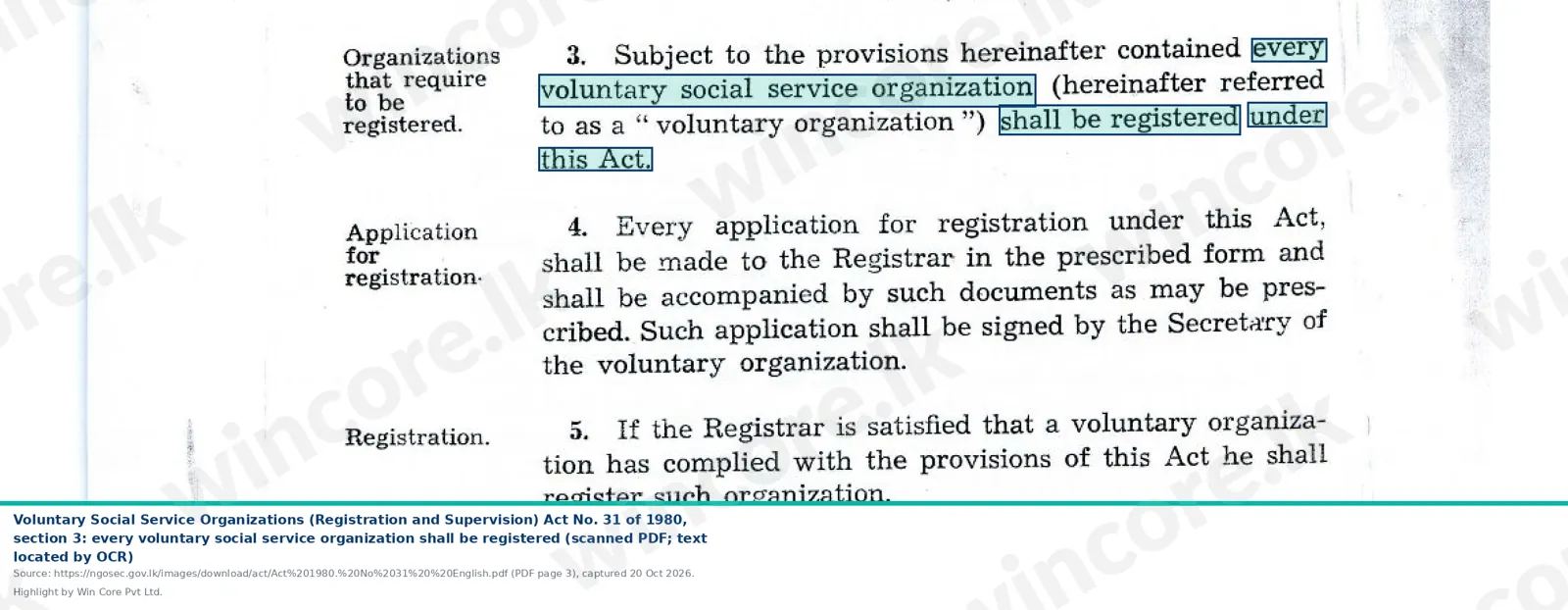
The 1980 Act is still the law. Registration is required, the fine is Rs 250, and the Secretariat's board and clearance rules do most of the work.

Sri Lanka income tax bands for 2026 explained with current rates, worked examples, and practical APIT planning for employees and employers.

Practical tax registration checklist for Sri Lankan businesses covering sequence, ownership, document controls, and setup errors that delay compliance.