
NGO Act Sri Lanka: Act No. 31 of 1980 and the 2026 draft bill
The 1980 Act is still the law. Registration is required, the fine is Rs 250, and the Secretariat's board and clearance rules do most of the work.
On this page
Last verified against the primary sources on 21 October 2026.
Updated 28 October 2026: worked example and open points revised.
The NGO Act in Sri Lanka is still the Voluntary Social Service Organizations (Registration and Supervision) Act, No. 31 of 1980, amended by Act No. 8 of 1998, the only amending Act on the NGO Secretariat's download page. Section 3 requires every voluntary social service organization to register, and the Act's only fine is up to Rs 250 under section 16. A 2026 replacement has been drafted, but on 21 October 2026 it was not on the Government Printer's list of 2026 bills, so it is not law.
For people setting up a foundation, a charity or a guarantee company for social work in Sri Lanka, the first question is: do we have to register with the NGO Secretariat? The law is the Voluntary Social Service Organizations (Registration and Supervision) Act, No. 31 of 1980, amended once in 1998. This article reads the Act from the Secretariat's own copy and separates three things: what the Act says, what the Secretariat requires administratively, and what the draft would change if it became law.
No new NGO law has been passed; the 2026 replacement is still a draft
Not as far as we can verify. On 21 October 2026, the Act in force is still No. 31 of 1980 as amended by Act No. 8 of 1998. Both are posted on the National Secretariat for Non-Governmental Organizations' download page [1] [2].
A draft Non-Governmental Organisations (Registration and Supervision) Act, numbered L.D.-O. 6/2026, would repeal and replace the 1980 Act. The International Center for Not-for-Profit Law's civic freedom monitor reports that, as of July 2026, it "had been approved by the Cabinet but had not been tabled in Parliament" [5]. The Sunday Times reported in July 2026 that the Director General of the NGO Secretariat confirmed that "because the bill is not yet finalised, it has not been enacted into law" [6].
An ICNL column in The Morning on 14 August 2026 still described the Government as "currently considering" the draft Act [7]. All three are secondary sources. The primary check we could make: the Department of Government Printing's 2026 bills list, opened on 21 October 2026, shows 21 bills, the latest dated 21 May 2026, and none is an NGO or voluntary organization bill [8]. A bill published after that list was last updated would not show, so the exact stage of the draft stays an open point. Nothing in this article treats the draft as law.
Section 3 of the NGO Act requires every voluntary organization to register
Registration
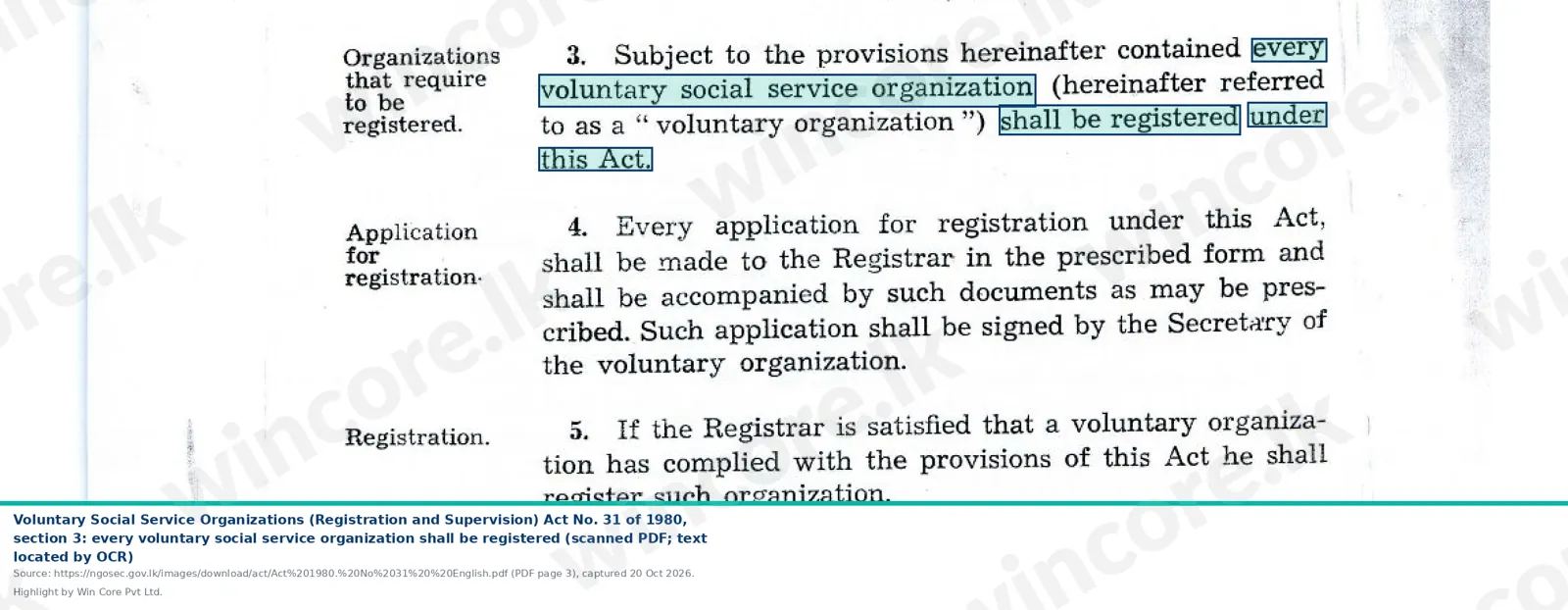
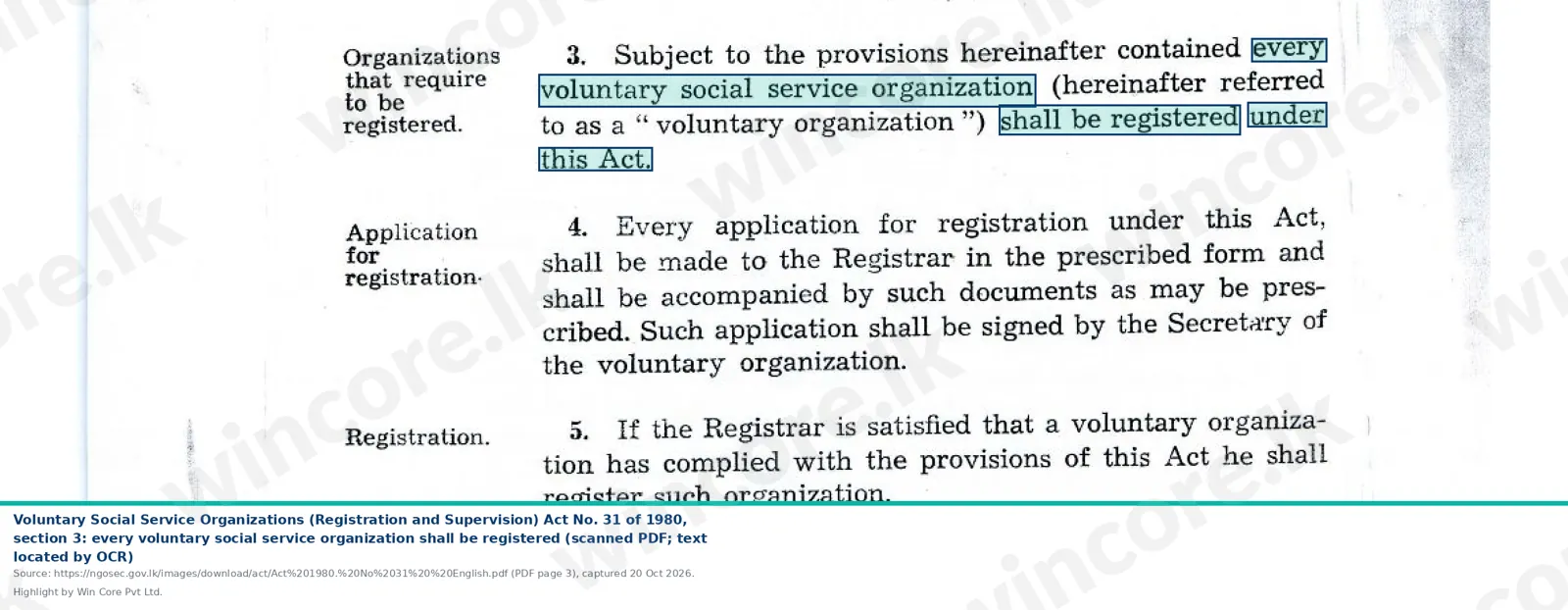
Section 3: "Subject to the provisions hereinafter contained every voluntary social service organization (hereinafter referred to as a 'voluntary organization') shall be registered under this Act" [1].
Then [1]:
- s.4: the application goes "to the Registrar in the prescribed form", with prescribed documents, "signed by the Secretary of the voluntary organization";
- s.5: the Registrar registers it "if the Registrar is satisfied that a voluntary organization has complied with the provisions of this Act";
- s.6: a person aggrieved by a refusal may, "within thirty days of such refusal, appeal to the Secretary to the Ministry" in charge of social services;
- s.7: a certificate of registration "shall be conclusive evidence" of registration unless cancellation is proved;
- s.8: a registered address, with any change notified "within seven days".
Who is covered
The definition is in s.18. A "Voluntary Social Service Organization" means "any organization formed by a group of persons on a voluntary basis" that [1]:
- "(a) is of a non-Governmental nature";
- "(b) is dependent on public contributions, charities, grants payable by the Government or donations local or foreign, in carrying out its functions"; and
- "(c) has as its main objectives, the provision of such reliefs and services as are necessary for the mentally retarded or physically disabled, the poor, the sick, the orphans and the destitutes, and the provision of relief to the needy in times of disaster", and "includes a community hostel".
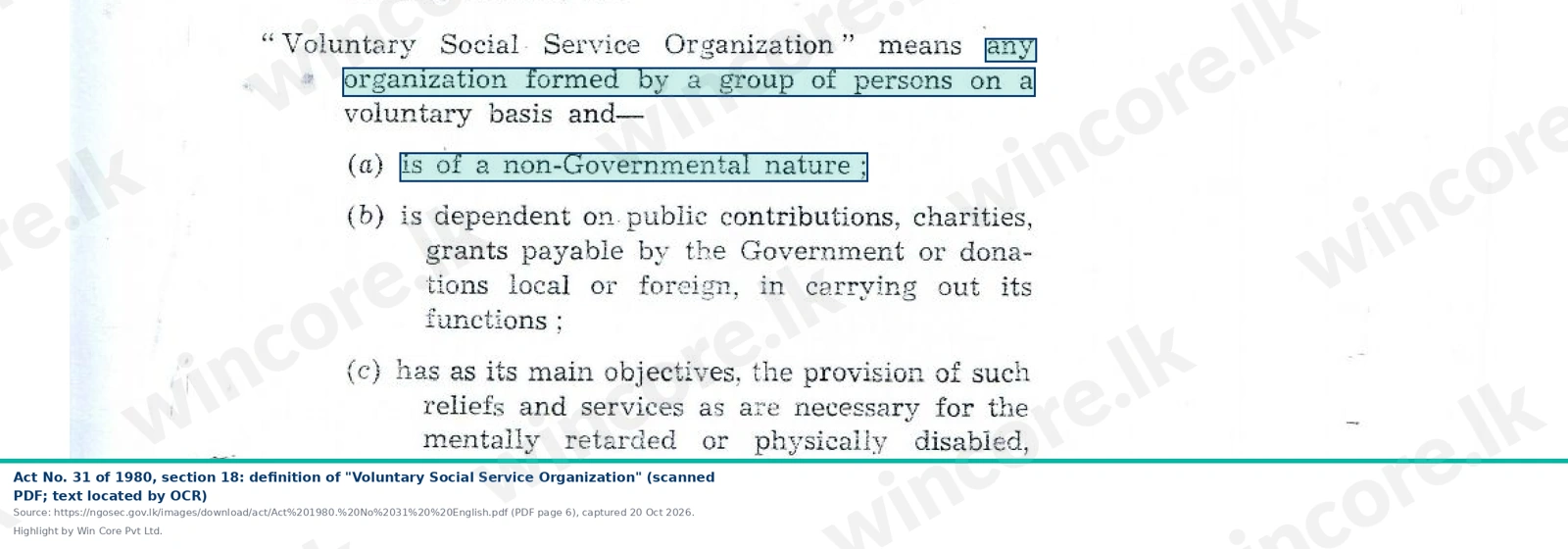
On our reading all three limbs must be met, because the definition joins them with "and". Limb (c) is narrow on its face: relief and services for specified groups and disaster relief. An organization working only on, say, the environment or the arts does not obviously fit it. The Secretariat's practice is broader (see below). Which reading governs a particular organization is a question to put to the Secretariat, and we list it as open.
Supervision
Section 9 gives the Registrar or an authorized officer power [1]:
- (a) "to enter and inspect at all reasonable hours of the day, the premises" of a registered organization, to see "whether satisfactory standards of service are maintained";
- (b) to bring "any allegation of fraud or misappropriation of funds" to the Minister's notice;
- (c) to attend executive committee or general meetings in stated circumstances, without a vote;
- (d) "to audit or cause to be audited in the prescribed manner the accounts of such organization once at least in every year".
Sections 10 to 14 provide for a Board of Inquiry on allegations of fraud or misappropriation. Its report goes to the Minister, who refers it "to the appropriate authority for steps to be taken according to law" (s.14) [1].
The 1998 amendment
Act No. 8 of 1998 inserted s.14A. Where a Board of Inquiry reports evidence of fraud or misappropriation, and the Minister is satisfied that it affects financial management and "that public interest will suffer" if the existing executive committee continues, the Minister "shall, by Order published in the Gazette, appoint an Interim Board of Management". While it sits, the executive committee ceases to exercise its powers [2].
The NGO Act's only fine is Rs 250, under section 16
| Default | Section | Consequence |
|---|---|---|
| Wilfully neglecting or refusing to do an act or furnish information required by the Registrar; disobeying a summons or lawful written order; failing to furnish information lawfully required | Act No. 31 of 1980 s.16(1), (2) | Offence; on summary conviction before a Magistrate, a fine "not exceeding two hundred and fifty rupees" [1] |
| Fraud or misappropriation found by a Board of Inquiry | s.14, s.14A | Referral "to the appropriate authority"; possible Interim Board of Management by Gazette Order [1] [2] |
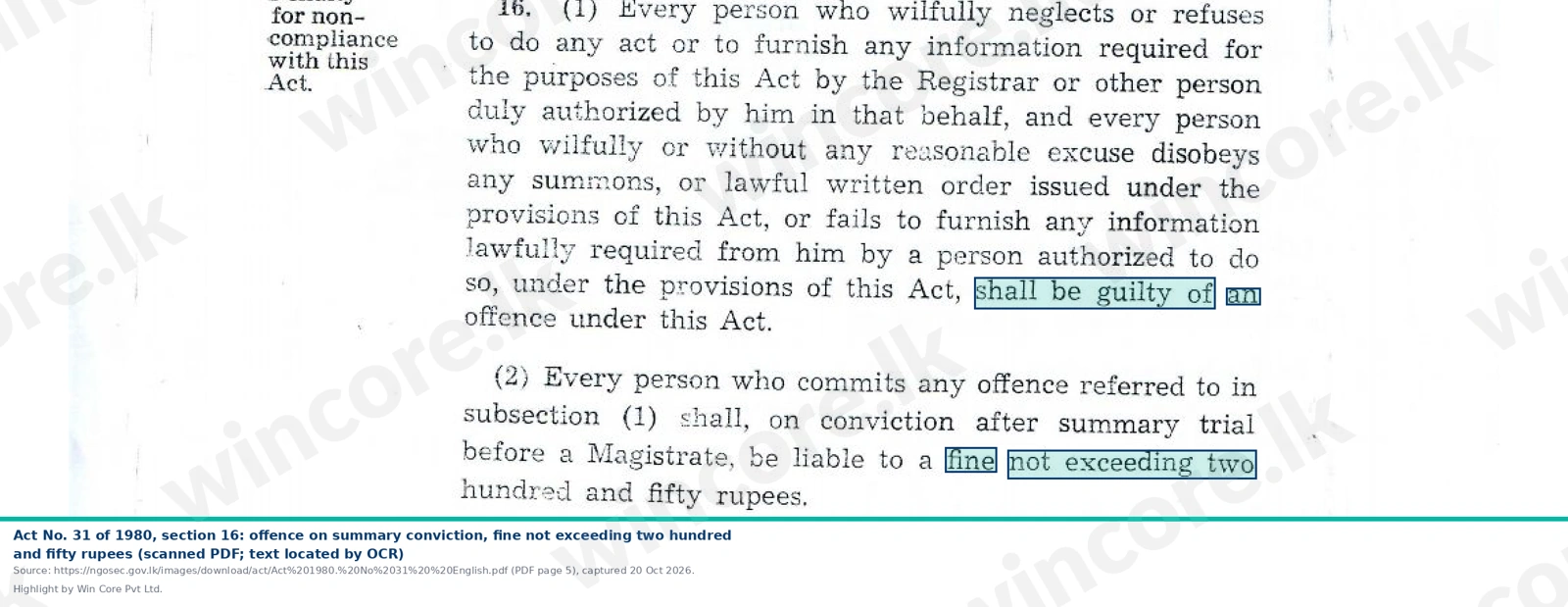
The fine in s.16 has not been raised since 1980 in the texts we read. On our reading, the Act has no separate offence for failing to register at all: section 16 punishes neglecting an act or information "required for the purposes of this Act by the Registrar", disobeying a summons or written order, and failing to furnish information, not the failure to apply under section 3. The practical consequences of not registering, such as banks or donors asking for a certificate, are outside the Act.
The Secretariat adds board, name and clearance rules the Act does not contain
The Secretariat's registration page sets out requirements that are not in the Act's text. They are administrative, but they are what an applicant will face [3]:
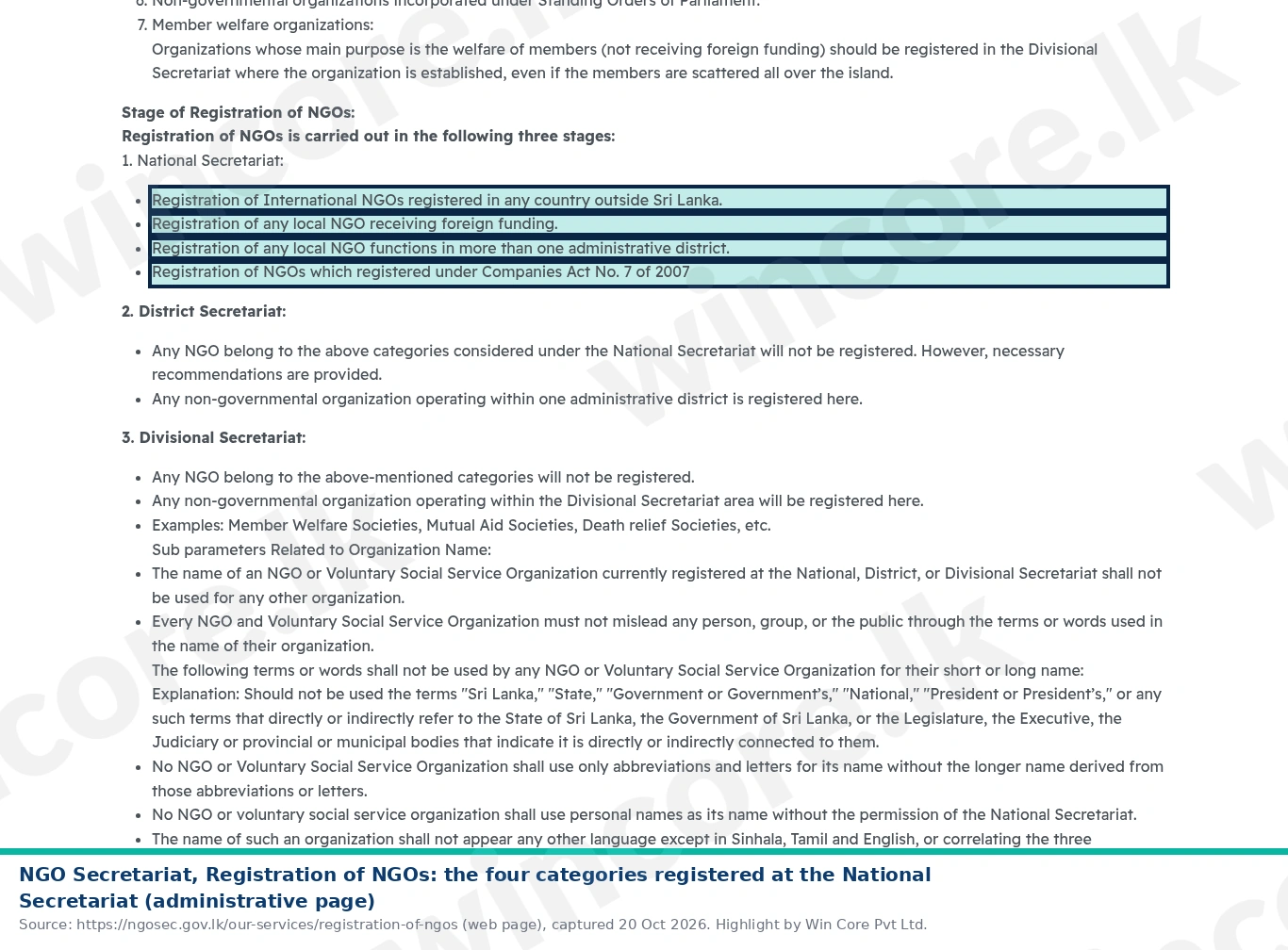
- Three levels. The National Secretariat registers international NGOs, local NGOs receiving foreign funding, local NGOs working in more than one administrative district, and "NGOs which registered under Companies Act No. 7 of 2007". District and Divisional Secretariats register organizations working within one district or division.
- Foreign funds. The page refers to "Presidential Circular No. RAD/99/01 dated 06.02.1999" in connection with money from foreign sources.
- Officers. "Officers/Board of Directors shall not be less than five (05)", the majority of officers of a local NGO "should be local people", an international NGO "must appoint a local person or persons to run the local administration", and "Wages cannot be paid and only an allowance can be paid" to officers. Appointments and removals go through a General Assembly resolution, and the page lists disqualifications, including persons under 18 and persons convicted by a court in Sri Lanka or any other country.
- Family members. The page says officers "cannot have more than two members of the same family", and also that "No two members of the same family should be appointed". These two lines conflict. For both, the page says family "include spouse, children, parents, and siblings". We list the conflict as open.
- Names. Words such as "Sri Lanka", "State", "Government", "National" and "President" must not be used; abbreviations alone are not allowed without the longer name; a personal name needs the National Secretariat's permission; and the name may appear only in Sinhala, Tamil and English. A name already registered at any level cannot be reused. Our company name check covers the Registrar of Companies side for a guarantee company, which is a separate test.
- Clearance. National-level applications are sent "to the Ministry of Defense, the Ministry of Foreign Affairs, and the relevant line ministries for obtaining clearance", and "If there is a problem in clearance reports, the registration request will be rejected".
A guarantee company doing relief work faces two regimes
A guarantee company doing charitable work faces the Companies Act and, on the Secretariat's practice, NGO registration. The company side (incorporation, the company secretary, annual returns) is covered in our guides to registering a company in Sri Lanka and Form 15 annual return filing. Tax is a third, separate regime: section 68 of the Inland Revenue Act imposes an additional tax on NGOs, explained in our piece on how NGOs are taxed in Sri Lanka. For a company limited by guarantee, see guarantee company registration.
By contrast, take a hypothetical society, not a company, formed by a group of residents to run a community hostel for families visiting patients at the district hospital, funded by grants from the Government. Section 18 includes a community hostel, and Government grants fall within limb (b), so the society is inside the definition. It works only in that district and is not registered under the Companies Act, so on the Secretariat's page it registers at District Secretariat level, and the national clearance stage does not apply. It appoints five officers, a majority local, and pays them allowances only. It keeps accounts ready for an audit under s.9(d), which allows the Registrar to audit "once at least in every year". For a society rather than a company, see society registration on eROC.
What this means for you
Check your objects against s.18 first, then the Secretariat's categories. If you receive foreign money or work across districts, expect national-level registration and security clearance. Build a board of at least five, with a local majority and no salaried officers. Keep accounts audit-ready, because the Registrar may audit at least once a year. Watch for the 2026 draft: if it is tabled and passed, registration and funding rules would change, and we will update this piece. Until then, the 1980 Act governs. Our company secretarial services and accounting team handle the guarantee company side, and our audit support helps keep the books ready for the Registrar.
Checklist: documents needed
- Constitution or articles, with objects mapped to s.18 (practice)
- Application in the prescribed form, signed by the Secretary (s.4)
- List of at least five officers or directors, with residence and family relationships (Secretariat page)
- Registered address (s.8)
- Funding sources, especially any foreign funding (Secretariat page)
- Certificate of incorporation, if a guarantee company
- Latest accounts, ready for audit (s.9(d))
FAQ
Has the NGO Act of 1980 been replaced in Sri Lanka?
No. On 21 October 2026 the law is still Act No. 31 of 1980 as amended by Act No. 8 of 1998 [1] [2]. A 2026 replacement bill has been drafted and reported as Cabinet approved, but it was not on the Government Printer's 2026 bills list when we checked, and secondary sources say it had not been tabled as of July 2026.
Does a guarantee company need NGO registration?
On the Secretariat's practice, yes, if it does NGO work. The Act itself does not name companies, but the Secretariat's page lists "NGOs which registered under Companies Act No. 7 of 2007" as a National Secretariat category [3]. Check your objects against section 18 first, because the Act's definition is narrower than the Secretariat's practice.
What is the penalty under the NGO Act?
A fine of up to Rs 250 on summary conviction, under section 16. The offence covers wilfully neglecting or refusing to do an act or give information the Registrar requires, disobeying a summons or written order, and failing to furnish information lawfully required [1]. Fraud found by a Board of Inquiry is referred to "the appropriate authority" under section 14.
Can NGO board members be paid in Sri Lanka?
Not wages, on the Secretariat's rules. Its registration page says "Wages cannot be paid and only an allowance can be paid for Officers/Board of Directors" [3]. The Act itself says nothing on pay. On our reading, staff who are not officers or directors are not caught by that line, but confirm with the Secretariat before relying on it.
Can we appeal if the Registrar refuses registration?
Yes. Section 6 lets a person aggrieved by a refusal appeal to the Secretary to the Ministry in charge of social services "within thirty days of such refusal" [1]. The Act sets no time for the Registrar to decide, and a refusal after a problem in the ministry clearance reports is an administrative step on the Secretariat's page.
Open points
- Status of the 2026 draft (L.D.-O. 6/2026). Not on the Government Printer's 2026 bills list on 21 October 2026 (latest entry 21 May 2026); its stage after Cabinet approval comes from secondary sources only.
- Scope of s.18(c). Narrow on its face; the Secretariat applies the Act more widely.
- Family-member rule. The Secretariat's page is internally inconsistent.
- Regulations. We did not read any regulations prescribing forms or documents under s.4 or s.15.
- Presidential Circular RAD/99/01. Referred to on the page; we did not read the circular.
Last verified
We read the Act No. 31 of 1980 and Act No. 8 of 1998 PDFs from the Secretariat (scanned; read by OCR and checked against page images) and its registration page on 20 October 2026, and re-checked the registration page and the 2026 bills list on 21 October 2026.
The short version
The NGO law is still Act No. 31 of 1980, amended in 1998. It requires registration, gives the Registrar inspection and audit powers, and carries a Rs. 250 fine. The Secretariat's page adds board, name and clearance rules. A 2026 replacement is a draft, not law, as far as we can verify.
Talk to us. If you are setting up a guarantee company for social work and want the company, accounts and tax side set up properly, book a consultation at our contact page. See also our company registration services and income tax services.
WinCore Pvt Ltd
This article is general information on the law as at 21 October 2026 and is not advice for your specific situation.
References
- Parliament of Sri Lanka. Voluntary Social Service Organizations (Registration and Supervision) Act, No. 31 of 1980, ss.3 to 18. https://ngosec.gov.lk/images/download/act/Act%201980.%20No%2031%20%20English.pdf . Primary (scanned; read by OCR). Accessed 20 October 2026.
- Parliament of Sri Lanka. Voluntary Social Service Organizations (Registration and Supervision) (Amendment) Act, No. 8 of 1998, s.2 (new s.14A). https://ngosec.gov.lk/images/download/act/Act%201998.No%208%20%20English.pdf . Primary (scanned; read by OCR). Accessed 20 October 2026.
- National Secretariat for Non-Governmental Organizations. Registration of NGOs. https://ngosec.gov.lk/our-services/registration-of-ngos . Administrative (Primary for the Secretariat's own practice). Accessed 21 October 2026.
- National Secretariat for Non-Governmental Organizations. Download section (Acts and circulars). https://ngosec.gov.lk/download-section . Administrative. Accessed 20 October 2026.
- International Center for Not-for-Profit Law. Civic Freedom Monitor: Sri Lanka. https://www.icnl.org/resources/civic-freedom-monitor/sri-lanka . Secondary. Accessed 20 October 2026.
- The Sunday Times (Sri Lanka). Sweeping NGO bill tightens foreign funding rules (26 July 2026). https://www.sundaytimes.lk/260726/business-times/sweeping-ngo-bill-tightens-foreign-funding-rules-650182.html . Secondary. Accessed 20 October 2026.
- The Morning. Draft NGO Act of 2026 (International Center for Not-for-Profit Law column, 14 August 2026). https://www.themorning.lk/articles/TxdfsSVh55fbDbTuaTAv . Secondary. Accessed 21 October 2026.
- Department of Government Printing. Bills 2026 list. https://documents.gov.lk/view/bill/bl_2026.html . Primary (official list). Accessed 21 October 2026.
Put these insights to work
WinCore specialists can review your current workflow, document gaps, and build a practical 90-day action plan.
Book a free consultationContinue reading
Explore more WinCore analysis to keep your finance, tax, and compliance roadmap moving.
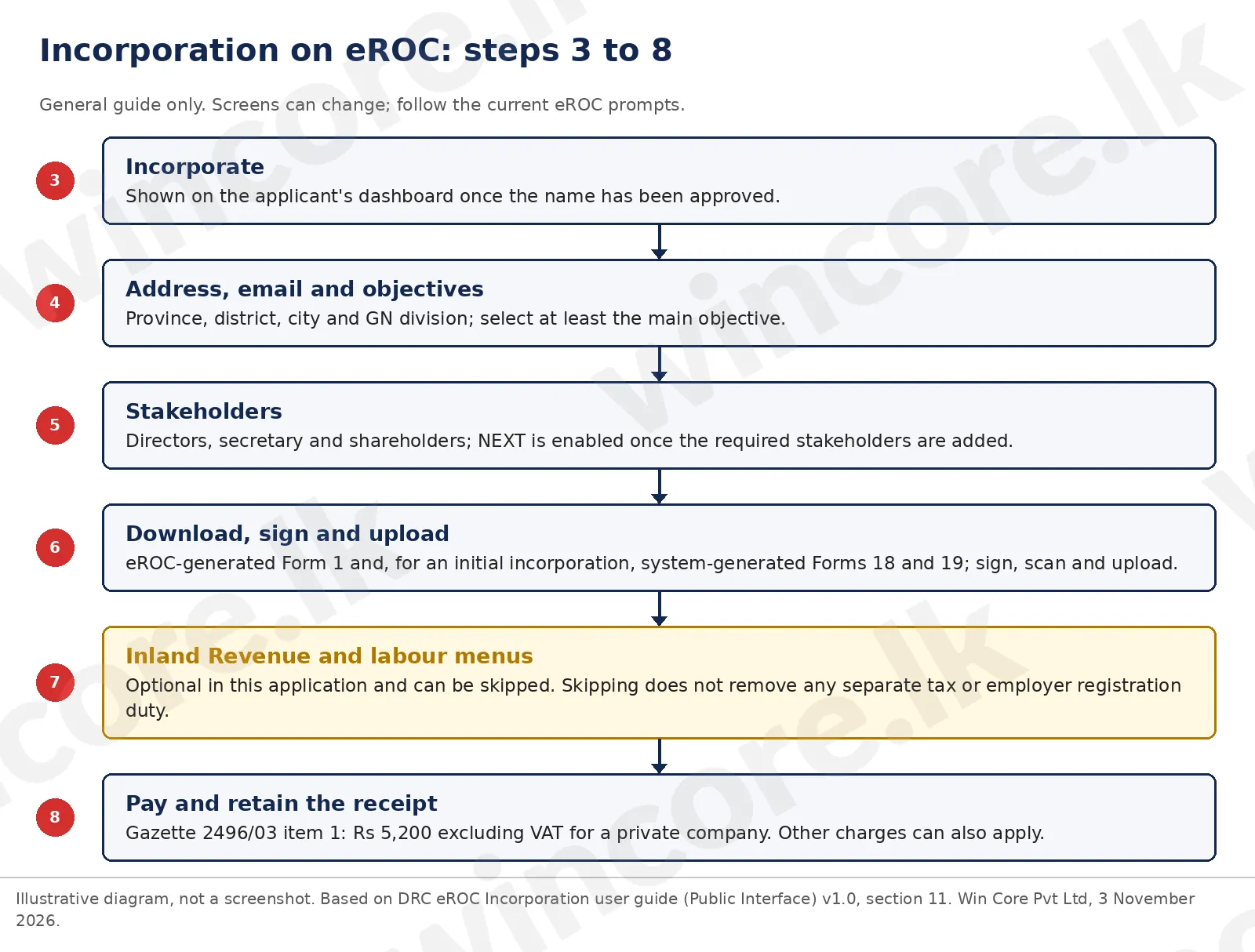
Registering a private limited company in Sri Lanka in 2026: structure, name approval, the eROC filing with BO 1 and BO 5, the TIN and the first year.

Check a company name before registering with Sri Lanka's Registrar of Companies: identical and misleading names, restricted words, suffixes and approval.

A late annual return rarely stands alone. Fix the officers, file beneficial ownership at once, then each overdue return with its AGM, then tax.