
Late annual return Sri Lanka: the order to catch up on filings
A late annual return rarely stands alone. Fix the officers, file beneficial ownership at once, then each overdue return with its AGM, then tax.
On this page
Last verified against the primary sources on 26 October 2026.
A late annual return in Sri Lanka is rarely the only thing missing. A company that has not filed for a few years usually also has old director or secretary details on the Registrar's file, AGMs that were never held or minuted, beneficial ownership details not yet given, and tax returns waiting on accounts. This guide is a map. It sets out how to find what is missing, the order to fix things in and why, the fees and penalties, and what the Registrar can do if a company stays in default. Where a detailed guide exists, the step links to it rather than repeating it. The example is an invented road marking company three years behind.
Step 1: find out what is missing
Start with three sources and compare them.
- The Registrar's file. Inspect the company's file or order certified copies of what is on it: the last annual return, the directors and secretary on record, the registered office and any charges. The fees order lists "For inspection of a file kept by the registrar general of companies" and "For certification of any document or extract thereof filed with the registrar general of companies" at Rs 1,300 each, excluding VAT [2].
- Your own minute book and registers. Look for board minutes, AGM minutes or written resolutions, the share register and the register of directors.
- Your accounts and tax position. Note which years have signed financial statements, and which income tax and other returns are filed.
List every year since the last annual return that was filed. For each year, note whether there was an AGM or resolution, whether financial statements exist, and whether the return was filed. For who must file accounts and how, see filing financial statements with the Registrar.
The order to fix things in, and why
The order matters because each filing relies on the one before it. An annual return signed by a director who is not on the Registrar's record, or showing an office the Registrar does not know, creates a new mismatch.
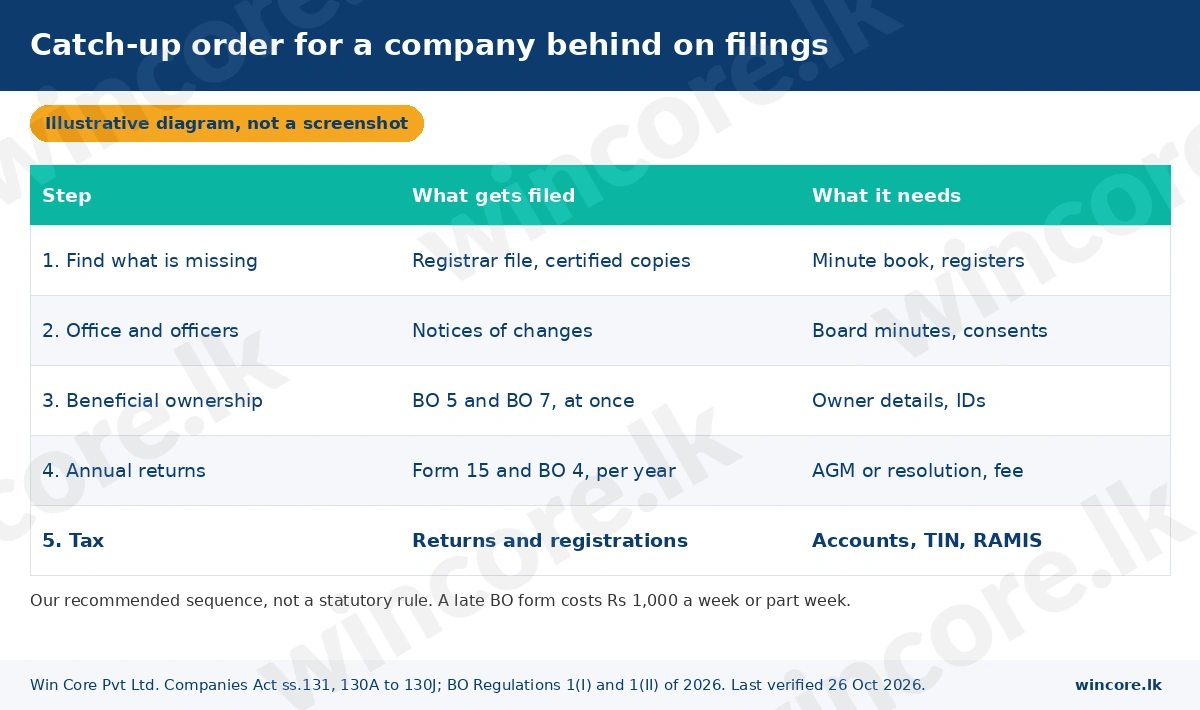
1. Registered office and officers first
Bring the Registrar's record of the registered office, directors and secretary up to date with the notices that should have been filed when each change happened. Confirm who the current directors are by checking board minutes and written consents. Until this is done, nobody can safely sign the later returns.
2. Beneficial ownership, without waiting for the returns
The Companies (Amendment) Act No. 12 of 2025 added sections 130A to 130J on beneficial ownership. Do not wait for the overdue annual returns. Once the share and officer records are right, file Form BO 5 for the authorised person and Form BO 7 for the beneficial owners, because from 22 October 2026 a late form costs Rs 1,000 for each week or part week (see below). After that, each annual return goes in with its Form BO 4, under section 130A(8) and regulation 3 [4] [6]. Our beneficial ownership regulations guide explains who counts and which forms apply.
3. Overdue annual returns, each with its AGM or resolution
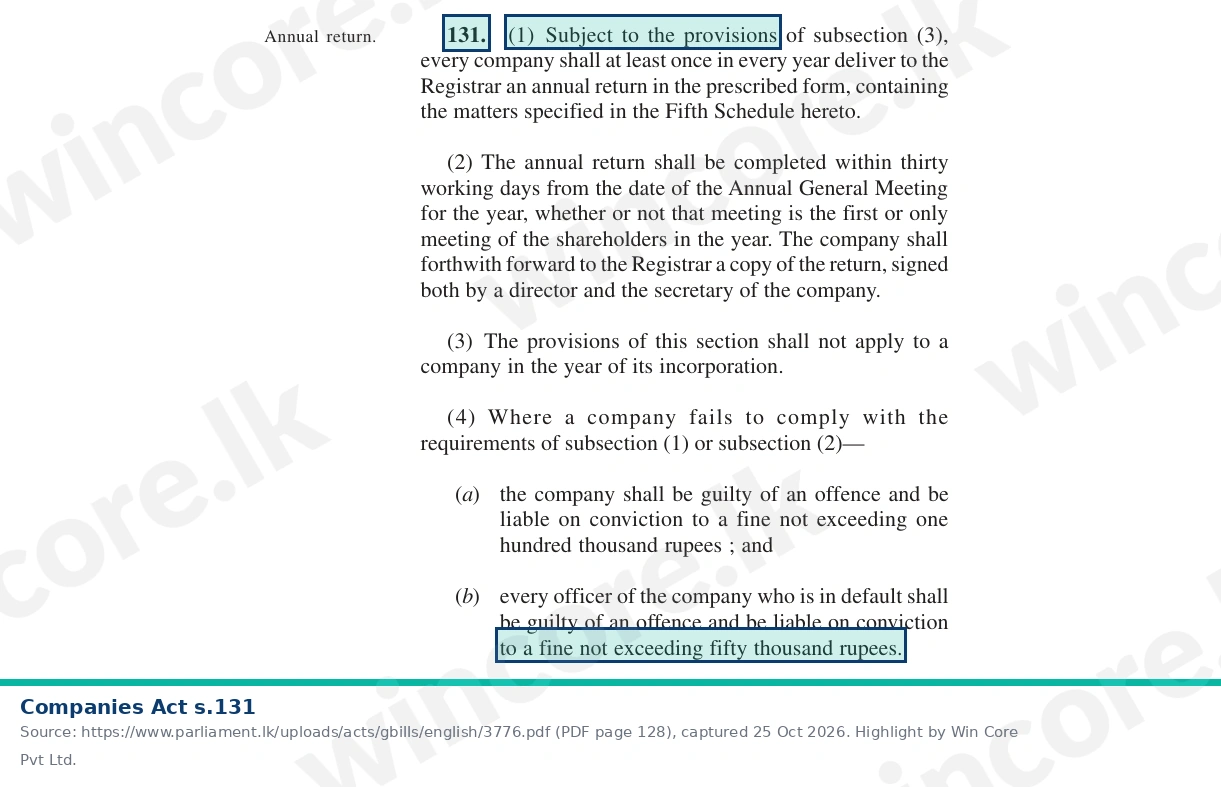
Section 131(1) requires every company to "at least once in every year deliver to the Registrar an annual return in the prescribed form". Section 131(2) says the return "shall be completed within thirty working days from the date of the Annual General Meeting for the year" [1]. Section 131(3) exempts "a company in the year of its incorporation".
So each missing year needs its AGM, or a written resolution in lieu where the articles and the Act allow it, and then its return. File them in date order. Each return should show the officers, shareholders and registered office as they were for that year. Our first AGM guide covers late AGMs, and our Form 15 guide covers the return itself.
4. Tax registrations and returns
Last, align the IRD position with the corrected company record: the TIN details, the authorised officers, and any income tax returns, which need the financial statements. The tax side has its own guides, so it is not repeated here.
What overdue returns cost, and the fines behind them
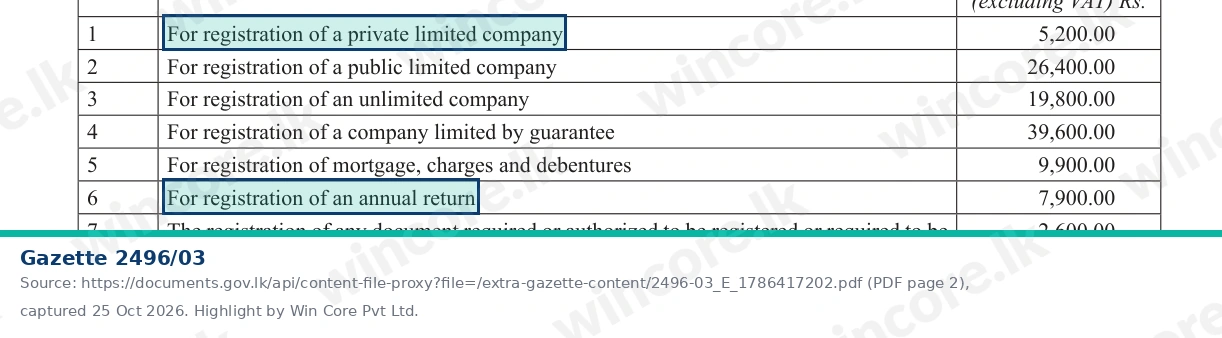
Annual return filing fee. The Companies (Fees) Orders as amended by Gazette Extraordinary No. 2496/03 of 6 July 2026 list item 6, "For registration of an annual return", at Rs 7,900.00, under the heading "Amended Fee (excluding VAT) Rs." [2].
Late fee. The schedule to 2496/03 contains no separate late-filing fee for an annual return [2]. We have not read the 2022 order it amends (Gazette 2303/07) at an official source [3], so whether an item there that 2496/03 left unchanged sets a late charge is an open point. Each overdue year is a separate return with its own fee. Under section 514 the Registrar may accept a composition sum instead of prosecuting, and eROC shows any such sum on the payment screen; our first AGM guide explains it. See our fees order guide.
Fine for not filing. The real exposure is section 131(4). Where a company fails to comply with subsection (1) or (2), "the company shall be guilty of an offence and be liable on conviction to a fine not exceeding one hundred thousand rupees". Every officer in default is liable "to a fine not exceeding fifty thousand rupees" [1].
Beneficial ownership late penalty. The Companies (Beneficial Ownership) Regulations, No. 1(II) of 2026, published in Extraordinary Gazette No. 2511/47 of 21 October 2026, came into operation on 22 October 2026. Regulation 3 replaced regulation 10 of the Regulations No. 1(I) of 2026 (Gazette 2509/67) with these words: "Where any prescribed Beneficial Ownership Form required to be submitted to the Registrar under the Act or these Regulations is not submitted within the period prescribed therefor, a penalty payment of one thousand rupees (Rs. 1,000/-) per week shall be charged and collected by the Registrar. Any part of a week during which the default continues shall be deemed to constitute a full week for the purpose of penalty charge" [5]. So a form ten weeks and two days late counts as eleven weeks: Rs 11,000. From 9 to 21 October 2026 the first version of regulation 10 doubled the charge each week; the new regulations do not say how weeks of delay in that period are charged, so check the eROC payment screen.
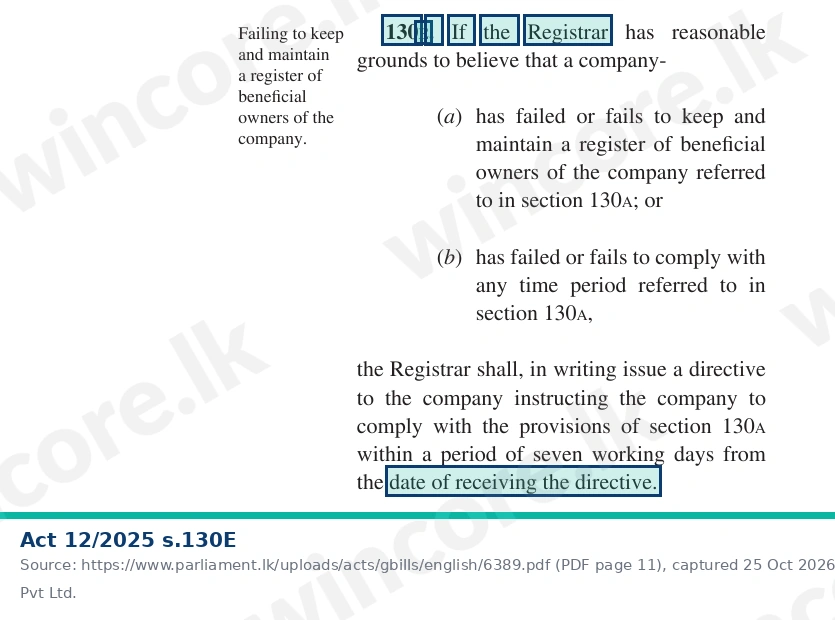
Under the Act itself. A company that already had beneficial owners when the Act came into operation had six months to send their details to the Registrar (section 130H(1)), on Form BO 7 (regulation 6 of the Regulations No. 1(I) of 2026) [6]. Failing to do so is an offence under section 130H(4), punishable by "a fine not exceeding fifty thousand rupees or to imprisonment of either description for a period not exceeding six months, or to both" [4]. Section 130E requires the Registrar, where it has reasonable grounds to believe a company "has failed or fails to keep and maintain a register of beneficial owners" or "has failed or fails to comply with any time period referred to in section 130A", to "issue a directive to the company instructing the company to comply with the provisions of section 130A within a period of seven working days from the date of receiving the directive" [4]. Section 130G(1) makes failure to comply with section 130A(1), (3), (4), (7) or (8), and knowingly giving false details, an offence. The penalty is "a fine not exceeding one million rupees or to imprisonment of either description for a period not exceeding ten years or to both". Under section 130G(2), directors and officers are deemed to have committed the offence unless they prove it was without their knowledge or that they "exercised all due diligence".
What the Registrar can do if the company stays in default
Beyond prosecution under sections 131(4), 130G and 130H(4), the Registrar can remove a company that appears not to be operating. Section 394(1) applies "Where the Registrar has reasonable cause to believe that a company is not carrying on business or is in operation". The Registrar may then send a letter of inquiry. If no answer comes within one month, a second letter follows by registered post, warning that "a notice will be published in the Gazette with a view to striking off the name of the company from the register" [1].
A company years behind on annual returns is the kind that draws those letters. Answer them.
Late annual return Sri Lanka: the step table
| Step | What to do | What it needs | Source |
|---|---|---|---|
| 1. Find what is missing | Inspect the file; order certified copies; compare with minute book | Company number; Rs 1,300 per inspection or certification (ex VAT) | Gazette 2496/03 items 9, 10 |
| 2. Office and officers | File the outstanding change notices | Board minutes, director consents, secretary details | Companies Act |
| 3. Beneficial ownership | Update the BO register; file BO 5 and BO 7 now, then a BO 4 with each Form 15 | Owner details and IDs, share records | ss.130A, 130C and 130H; Gazettes 2509/67 and 2511/47 |
| 4. Annual returns | Hold AGM or pass resolution, then file Form 15, one per year in order | Financial statements, share register, officer details; Rs 7,900 per return (ex VAT) | s.131; Gazette 2496/03 item 6 |
| 5. Tax | Align TIN and authorised officers; file outstanding returns | Audited or signed accounts, tax computations | IRD guides |
| Throughout | Answer any Registrar letter or directive | Reply within the period stated | ss.130E, 394 |
The example: a road marking company three years behind
This is an invented example. A road marking company has two directors and a company secretary, and its financial year ends on 30 June. Its last annual return was filed three years ago. In the year after that, one director resigned and a new one was appointed, but neither change was filed. No AGM has been held or minuted for the three financial years since, and the accounts for those years are prepared but not yet audited. The AGM for the year that ended this 30 June is not yet due.
- Find what is missing. The company inspects its file and orders certified copies of the last annual return, at Rs 1,300 each before VAT. The Registrar's file still shows the director who left.
- Officers. The board minutes the resignation and appointment, collects the new director's consent, and files the change notices.
- Beneficial ownership. As soon as the share register is confirmed, without waiting for the audits, the company files Form BO 5 and Form BO 7. Filed ten weeks and two days late under the new regulation 10, the penalty counts eleven weeks: Rs 11,000. Each later Form 15 goes in with a Form BO 4.
- Annual returns. The auditors complete the three years of accounts. The company holds an AGM for each year, or passes written resolutions where permitted, and files three Form 15 returns in date order. That is Rs 23,700 in return fees (3 x Rs 7,900) before VAT, plus Rs 2,300 before VAT for each Form BO 4 if eROC asks for one with each late return: Rs 30,600 in all, plus any composition sum eROC shows. The directors also note the section 131(4) exposure.
- Tax. The audited accounts support the outstanding income tax returns.
What this means for you
- Compare the Registrar's file with your own records before filing anything.
- Fix the registered office and officers first, then file annual returns year by year, each backed by an AGM or resolution.
- Budget Rs 7,900 per annual return before VAT. The order has no separate late fee, but eROC may show a section 514 composition sum at payment, and the section 131(4) fines are larger.
- Treat beneficial ownership as urgent: file it without waiting for the annual returns, because a late form costs Rs 1,000 for each week or part week, and a Registrar directive gives seven working days.
- Answer any section 394 letter, or the company may be struck off.
Checklist: documents needed
- Certified copies of the last annual return and current Registrar record
- Minute book: board minutes, AGM minutes or written resolutions for each year
- Share register and register of directors
- Consents and details of every director appointed since the last return
- Financial statements for each missing year
- Beneficial owner details and identity documents
- TIN and IRD filing status
FAQ
Is there a late fee for a late annual return in Sri Lanka?
The Companies (Fees) Orders as amended by Gazette 2496/03 list Rs 7,900 (excluding VAT) for registering an annual return and no separate late fee. Each overdue year is filed and paid for separately. The bigger risk is section 131(4): fines on conviction of up to Rs 100,000 for the company and Rs 50,000 for each officer in default, though under section 514 the Registrar may accept a composition sum instead.
In what order should a company catch up its filings?
Start by comparing the Registrar's file with your minute book. Then fix the registered office, directors and secretary, so the later filings match. File the beneficial ownership forms straight away, because a late form costs Rs 1,000 a week. Next, file each overdue annual return in date order with its AGM or resolution, then tax. Each step relies on the record created by the one before.
What happens if we ignore the Registrar's letters?
Under section 394, if the Registrar believes a company is not carrying on business and gets no answer to two letters, a notice may be published in the Gazette with a view to striking the company off. For beneficial ownership, section 130E allows a directive to comply within seven working days.
Do we need an AGM for every missed year?
Section 131(2) ties the annual return to the AGM for the year, so each missed year normally needs its own AGM, or a written resolution in lieu where the articles and the Act allow it. Hold them in date order and minute them before filing each year's return.
The short version
Find the gaps, fix officers first, file beneficial ownership straight away, then each annual return in order with its meeting behind it, then tax. The fee is Rs 7,900 per return before VAT, with no separate late fee in the order, but a section 514 composition sum may be added, and fines and strike-off are the real risks.
Talk to us. Our company secretarial services list "Annual Return Filing", "Annual General Meetings" and "Company Changes", or book a consultation at our contact page.
WinCore Pvt Ltd
This article is general information on the law as at 26 October 2026 and is not advice on your specific position.
Cover image: Image by Freepik.
References
- Parliament of Sri Lanka. Companies Act, No. 07 of 2007, ss.131, 394 and 514. https://www.parliament.lk/uploads/acts/gbills/english/3776.pdf . Primary. Accessed 25 October 2026.
- Companies (Fees) Orders, amended by Gazette Extraordinary No. 2496/03 of 6 July 2026, Schedule items 6, 9 and 10. https://documents.gov.lk/api/content-file-proxy?file=/extra-gazette-content/2496-03_E_1786417202.pdf . Primary. Accessed 25 October 2026.
- Companies (Fees) Orders, Gazette Extraordinary No. 2303/07 of 25 October 2022, the order amended by Gazette 2496/03. Not read at an official source as at 26 October 2026.
- Parliament of Sri Lanka. Companies (Amendment) Act, No. 12 of 2025, s.7 (new ss.130A to 130J). https://www.parliament.lk/uploads/acts/gbills/english/6389.pdf . Primary. Accessed 26 October 2026.
- Minister of Trade, Commerce, Food Security and Cooperative Development. Companies (Beneficial Ownership) Regulations, No. 1(II) of 2026, Extraordinary Gazette No. 2511/47 of 21 October 2026, regs 1 to 3. Registrar's copy linked from https://drc.gov.lk/en/?p=5007 (file https://drive.google.com/file/d/1zQMPo8yAMzOb6PH4rzVxxEcoLN_S6Kc2/view). Primary. Read 26 October 2026.
- Minister of Trade, Commerce, Food Security and Cooperative Development. Companies (Beneficial Ownership) Regulations, No. 1(I) of 2026, Gazette No. 2509/67 of 9 October 2026, regs 3, 4, 6 and 10 and Schedule II. Registrar's copy https://drive.google.com/file/d/1v3jBw9yrmEX3U1g-dvD_q_jtAq5lL5hH/view . Primary. Read 26 October 2026.
Put these insights to work
WinCore specialists can review your current workflow, document gaps, and build a practical 90-day action plan.
Book a free consultationContinue reading
Explore more WinCore analysis to keep your finance, tax, and compliance roadmap moving.
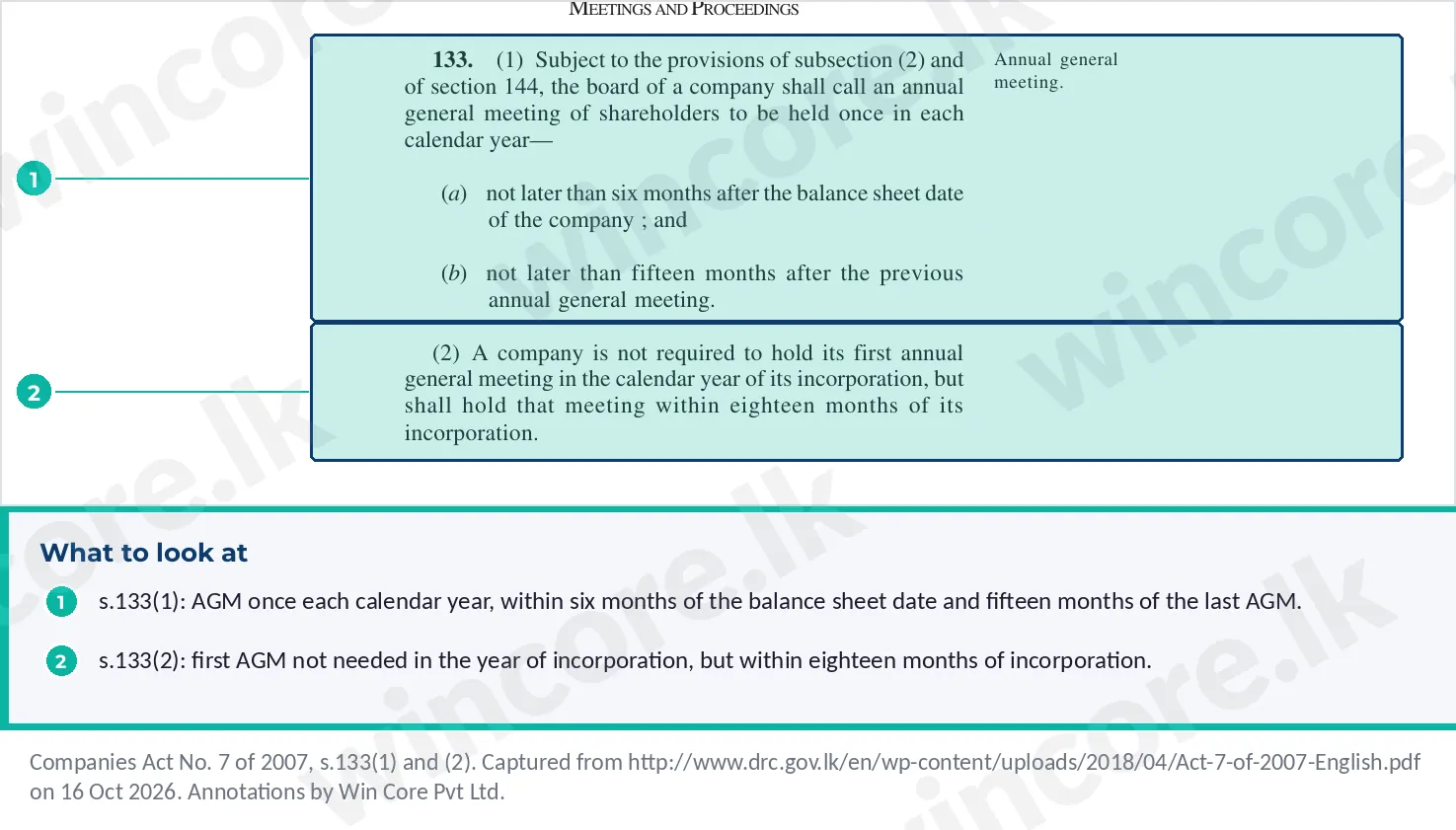
A new company's first AGM, worked from the incorporation date: the eighteen month limit, the six month question, and what a late annual return costs.
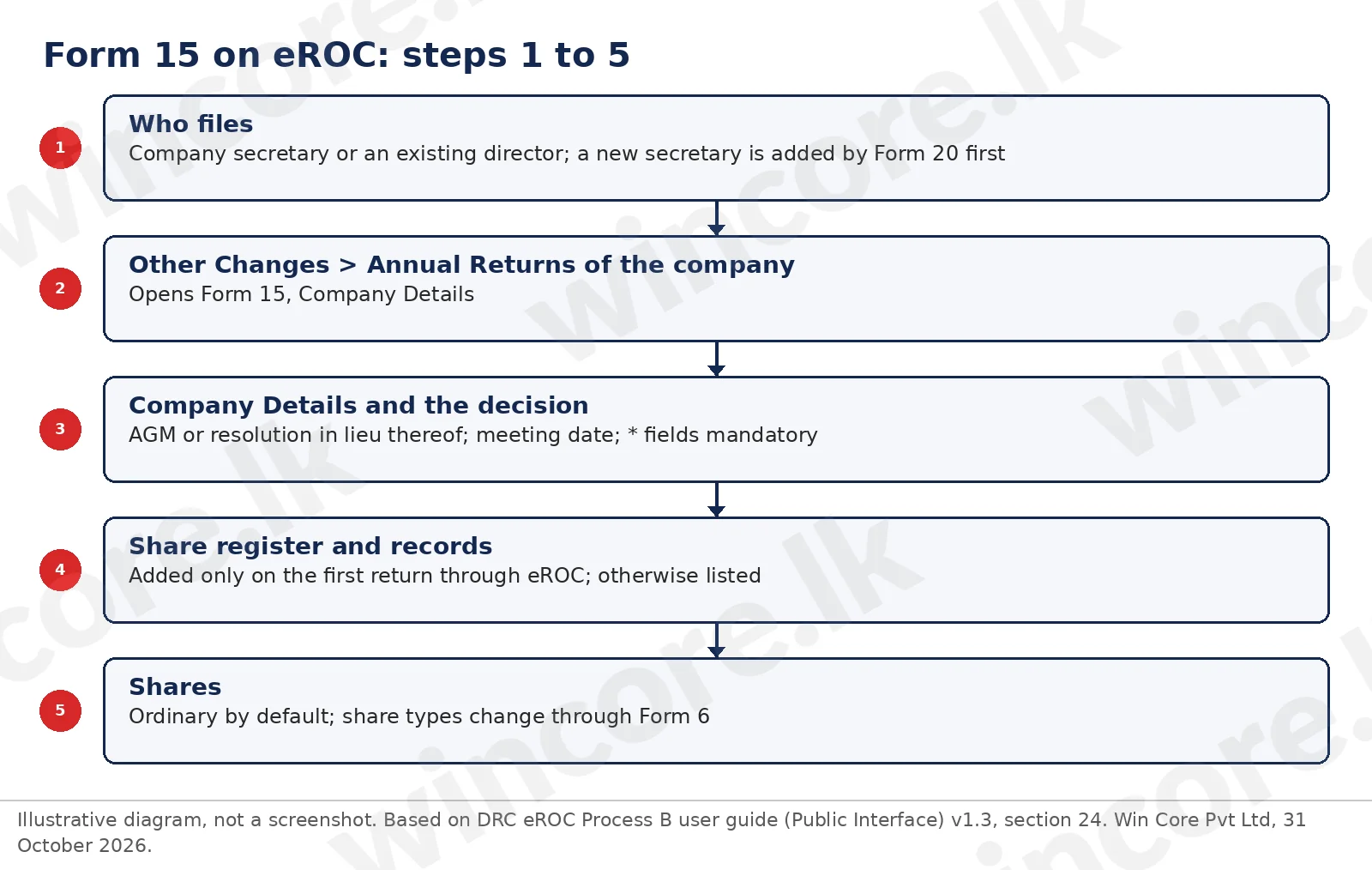
Treat Form 15 as a live governance filing: the 30-working-day clock from the AGM, the BO 4 that goes with it, the fee, and the controls that keep it on time.
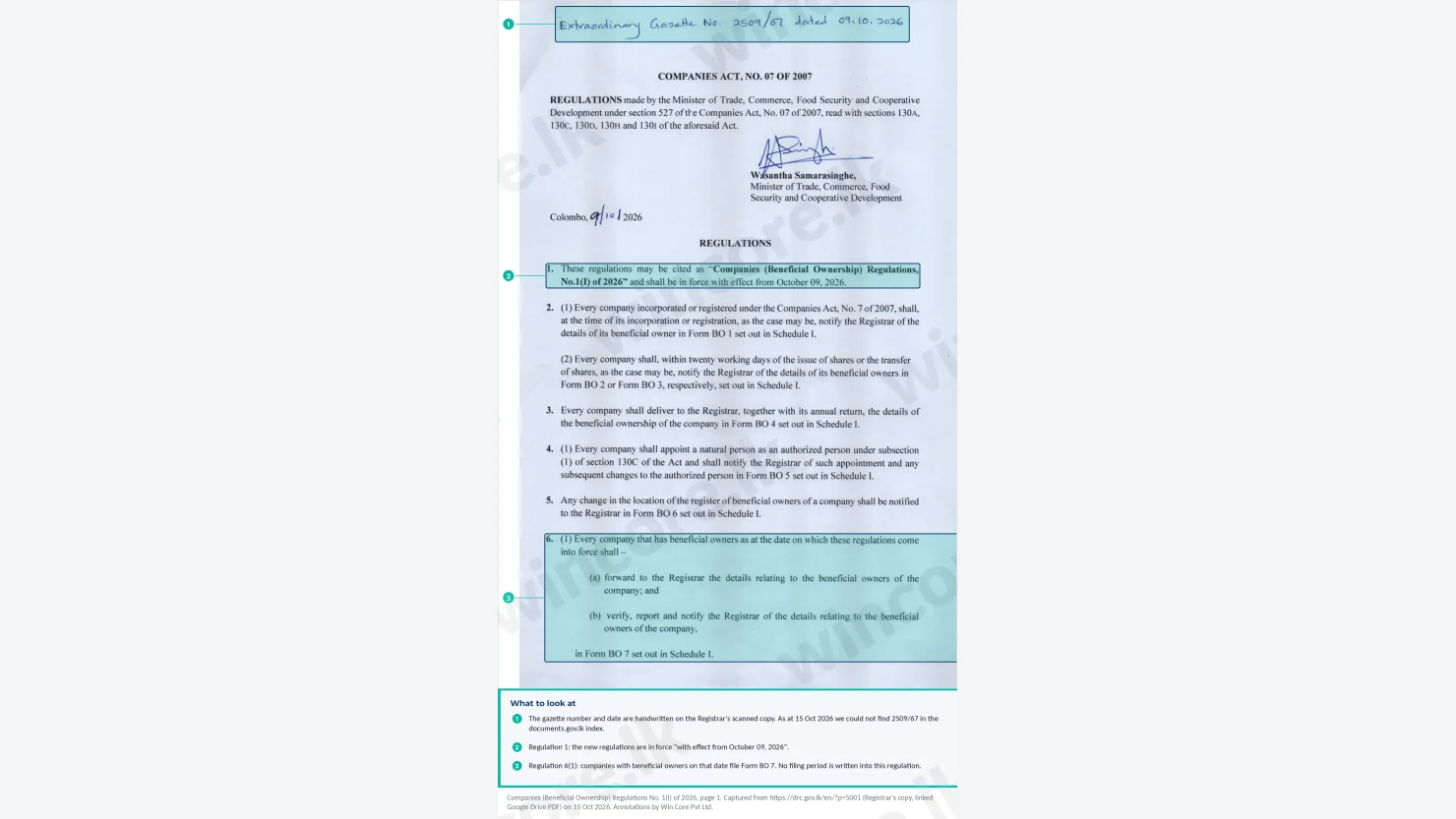
The October 2026 BO regulations replaced the March set, and from 22 October a late form costs Rs 1,000 a week. What a late BO 7 filing now costs.