
How to change your financial year-end for tax compliance in Sri Lanka
Changing a company's year-end in Sri Lanka: the section 20(2) application to the IRD, what does not move, the AGM consequence and the controls to rebuild.

On this page
Last verified against the primary sources on 15 October 2026.
The year of assessment in Sri Lanka runs from 1 April to 31 March [1]. A company or trust that cannot submit accounts for that twelve-month period may apply to the Commissioner-General for accounts based on an alternative period of twelve months to be used to compute its income tax for a given year of assessment. The Commissioner-General may approve on terms and conditions and may revoke the approval if they are not met [1]. An approved change does not alter when the company pays tax by instalments or on assessment [1].
Take a hypothetical Colombo trading company whose bank tests its loan covenants on accounts to 30 June. Without approval, the finance team prepares March accounts for tax and June accounts for the bank, and reconciles the two every year. With approval, the June accounts are used for the tax computation, and one set of year-end working papers serves both. The instalment dates and the return date for the year of assessment stay where they were.
That gap between reporting cycles is where review bottlenecks, bridge schedules and audit queries start. The change is not automatic: it needs a clear business case, the Commissioner-General's approval and a transition plan covering the computation, payments, payroll cut-offs and supporting schedules.
This guide explains when a year-end change makes sense, what the application should cover, what moves and what does not, and which controls need to be rebuilt before the new cycle goes live.
Four business situations that justify a year-end change request to the IRD
For many locally managed businesses, keeping statutory accounts and tax reporting on the 1 April to 31 March cycle is the cleanest option.
The pressure to change usually comes from outside the local filing model. A company may report to an investor group, a regional consolidation pack or a covenant-testing timetable that closes on another date. If management reporting stays on one cycle and tax working papers stay on another, every quarter carries duplicate schedules, extra reconciliations and more room for control failure.
The statutory route is an application under section 20(2), so treat it as an approval process, not a bookkeeping preference [1]. Be ready to explain why the March period does not work for the company, and keep a written record of the commercial rationale behind the request.
Typical cases include:
- the company is part of a group that reports on a fixed close date
- board reporting, audit planning and management packs already operate on a non-March cycle
- the business wants to remove repeated bridge schedules between statutory accounts and group or lender reporting
- financing, investor reporting or lender covenants are tied to another year-end and the split calendar is creating risk
For a newly incorporated company, check the special timing of the first financial year before applying the rules for a later year-end change.
What to include in your IRD year-end change request (and what weak applications leave out)
A weak request states the preferred date but says little about the operating impact. A stronger request explains the current year-end, the proposed year-end, the commercial reason for the change, and how the business will keep income, deductions and filing obligations from dropping into a transition gap.
In practice, the request pack should cover:
- legal entity name, TIN and current accounting period
- proposed twelve-month period and the year of assessment it should first apply to
- the commercial rationale for the change, such as group or lender reporting alignment
- how the short or long transition period will be tracked
- who will own revised filing, payment and review controls
- how the company will keep tax computations, payroll cut-offs and year-end evidence aligned during the switch
Keep the pack consistent with the rest of the tax file. If the business is already reviewing its wider filing model, align the request with the corporate income tax guide, the RAMIS filing guide and the internal reporting calendar approved by management. Read the approval's terms carefully, because the Commissioner-General can attach conditions and revoke the approval if they are broken [1].
What moves and what does not during the transition
Changing the accounting period is not only a filing formality. It changes how the finance team prepares the computation and proves the bridge between the old and new periods. It does not change the payment calendar.
What does not move. A change approved under section 20(2) "shall not result in altering the time at which the trust or company shall pay tax by instalments and on assessment" [1]. Quarterly instalments stay on the year of assessment calendar, and they are now based on the previous year's tax, since the Statement of Estimated Tax was discontinued [2]. The return of income is due not later than eight months after the end of the year of assessment [1], which is 30 November [3]. If the approval letter sets a different arrangement, follow the letter.
What does move. The accounts used in the computation, the cut-off for the tax working papers, and the company law calendar. Under the Companies Act, each AGM must be held no later than six months after the balance sheet date [4], and the annual return on Form 15 follows within thirty working days of the AGM [4]. A company that moves its balance sheet date from 31 March to 30 June moves its latest AGM date from 30 September to 31 December, and its Form 15 with it. Our Form 15 guide covers the filing. To adopt or change the date, see the Form 17 steps on eROC.
For many companies, the practical mistake is continuing to use the old March-based internal timetable for the computation out of habit, or moving the payment dates when the Act says they stay put. Use the tax calendar as the baseline control, and rebuild the internal ownership matrix as soon as the alternative period is approved.
Payroll, close-process and system cut-offs need to move with the year-end
Finance teams often focus on the annual tax return and forget the monthly processes that feed it. If payroll, APIT, EPF, ETF, intercompany accruals and ledger close activities are not cut off cleanly at the new year-end, the company can create mismatches between the trial balance, the tax computation and the supporting schedules.
That is why a year-end change should be handled as a cross-functional control exercise, not a narrow tax memo. If payroll periods, leave accruals, bonus accruals or employee tax files are part of the shift, bring in payroll services so the revised calendar is reflected in monthly processing as well as the annual return file. APIT itself still runs on the year of assessment: the employer's annual statement covers the year to 31 March [1].
If the change is happening at the same time as a wider close-process cleanup, use the year-end close guide to rebuild reconciliations, approvals and supporting schedules before the first new cycle closes.
Losses, capital allowances and deferred tax cannot be rolled forward casually
A year-end change does not suspend the underlying tax rules. If the company has carried-forward losses, those balances still need to be tracked by year of assessment. An unrelieved business loss may be deducted for up to six years of assessment after the year in which it arose [1].
The same discipline applies to capital allowances. Accounting depreciation does not determine the tax deduction. The tax computation still needs to apply the statutory capital allowances to the approved period, including any necessary transitional apportionment.
Map the bridge from accounting profit to taxable income in your computation model, and check the approved transition treatment before relying on a template.
Six things to do before your new year-end goes live
Before filing the request or activating the revised calendar, make sure the operating model can support the change.
- Prepare a short board or management paper explaining the commercial reason for the change and the expected control benefit.
- Build a transition bridge that shows how the old period, the new period and any short or long gap period will be reconciled.
- Update the tax compliance calendar, the AGM and Form 15 dates, the RAMIS workplan and the internal ownership matrix.
- Refresh the capital allowance schedule, loss schedule and deferred tax working papers so they match the new reporting timeline.
- Confirm that payroll, APIT and ledger close evidence will still tie back cleanly to the revised year-end.
- Rebrief auditors, group or lender reporting teams and local reviewers early so the change does not create a second round of adjustments later.
Change the date without rebuilding the controls and you have not fixed the compliance problem. You have moved it to a different month.
Frequently asked questions
Can a Sri Lankan company use a year-end other than 31 March for tax?
It can apply under section 20(2) for accounts based on an alternative twelve-month period to be used to compute its tax. The change is not automatic; it needs the Commissioner-General's approval, which may carry conditions [1].
Does changing the year-end change the corporate tax rate?
No. The year-end affects the accounts used and the control calendar. The applicable rate still depends on the nature of the income and the law in force for the year of assessment.
Do instalment and payment dates move with the new year-end?
No. Section 20(3) says an approved change does not alter the time for paying tax by instalments and on assessment [1].
Does the AGM date change?
Yes. The AGM must be held no later than six months after the balance sheet date, so a new balance sheet date moves the AGM deadline and the Form 15 that follows it [4].
Should every company align its tax year with its group reporting year?
Not necessarily. The change is worth considering when the split calendar is creating repeated reconciliation work, control gaps or audit inefficiency. If the current setup is stable and well controlled, forcing a change may add complexity rather than remove it.
Talk to us. If you are weighing a change of year-end, our tax team can review the case and the transition calendar with you, and our company secretarial team can reset the AGM and Form 15 dates; book a consultation at our contact page.
This guide is general information on the law as at 15 October 2026 and is not advice on your specific situation.
References
- Inland Revenue Department. Inland Revenue Act, No. 24 of 2017, consolidated, ss.19(1), 20(1) to (3), 86(2) and 93(1). https://www.ird.gov.lk/en/publications/Acts_Income%20Tax_2017/IRA_Cons_Act_-_2025_Changes.pdf . Primary. Accessed 15 October 2026.
- Parliament of Sri Lanka. Inland Revenue (Amendment) Act, No. 11 of 2026, certified 3 June 2026, s.16. https://www.ird.gov.lk/en/publications/Acts_Income%20Tax_2017/IR_Act_No_11-2026_E.pdf . Primary. Accessed 15 October 2026.
- Inland Revenue Department. Tax Calendar 2026. https://www.ird.gov.lk/en/publications/Tax%20Calendar_Documents/Tax_Calendar_2026_E.pdf . Primary. Accessed 15 October 2026.
- Parliament of Sri Lanka. Companies Act, No. 7 of 2007, ss.131(2) and 133(1). https://drc.gov.lk/en/wp-content/uploads/2018/04/Act-7-of-2007-English.pdf . Primary. Accessed 15 October 2026.
Put these insights to work
WinCore specialists can review your current workflow, document gaps, and build a practical 90-day action plan.
Book a free consultationContinue reading
Explore more WinCore analysis to keep your finance, tax, and compliance roadmap moving.

Sri Lanka corporate income tax guide: rates, taxable income, quarterly instalments, deductions, capital allowances, and key compliance penalties.

Close your books before the March 31 deadline to reduce audit risk and start with clean numbers. A practical 10-step year-end guide for SMEs.
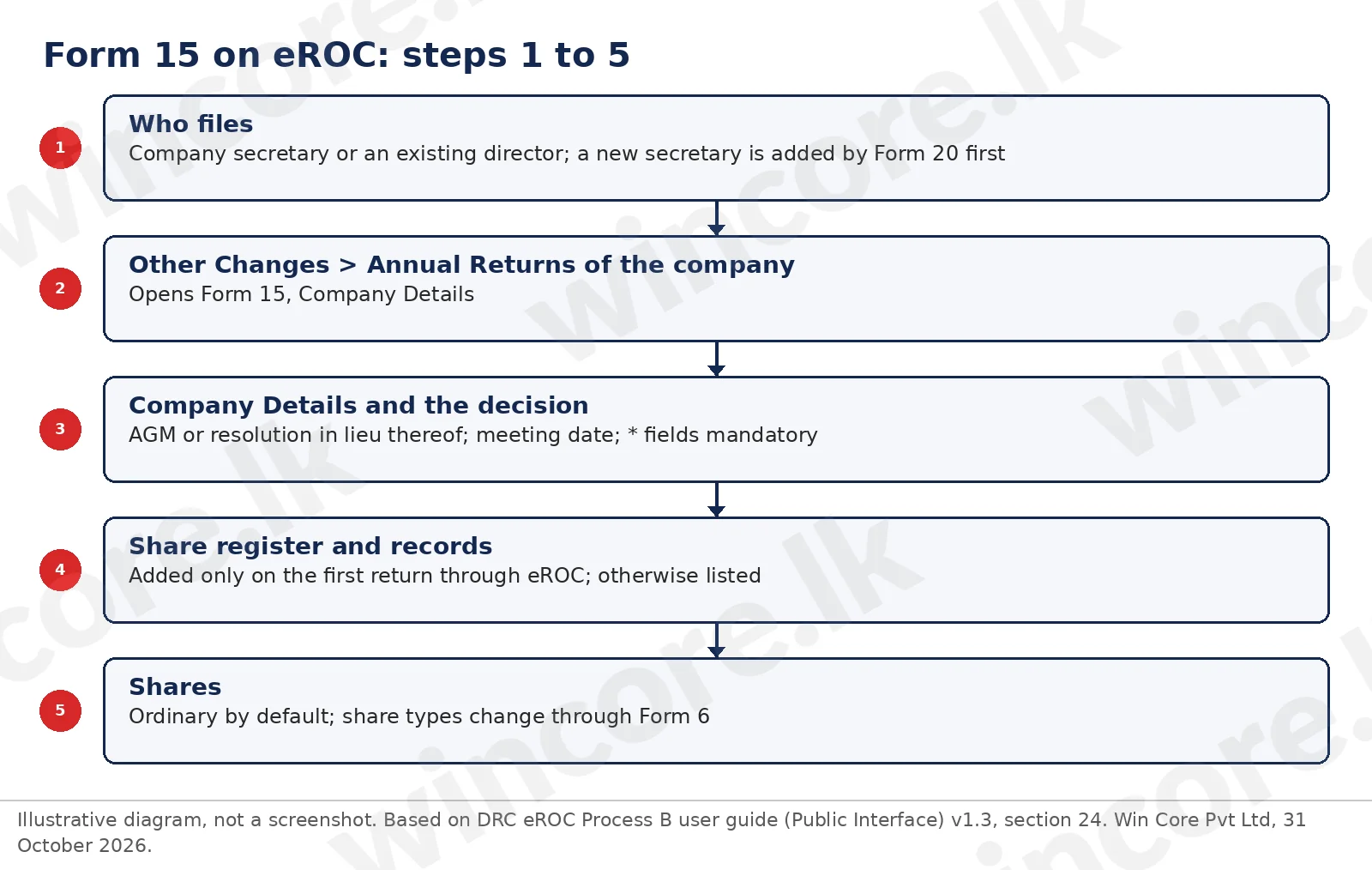
Treat Form 15 as a live governance filing: the 30-working-day clock from the AGM, the BO 4 that goes with it, the fee, and the controls that keep it on time.