
Close fast, reconcile deeply, and protect your audit window
Close your books before the March 31 deadline to reduce audit risk and start with clean numbers. A practical 10-step year-end guide for SMEs.

On this page
Last verified against the primary sources on 15 October 2026.
Miss something at year-end and it does not stay contained. An unreconciled balance becomes an audit query. A missing accrual becomes a misstated tax return. A payroll-to-ledger mismatch becomes a letter from the IRD.
For most Sri Lankan companies, the financial year closes on 31 March, the end of the year of assessment. The income tax return is due not later than eight months after that date [1], which is 30 November, and the final payment of the year's tax is due on 30 September [2]. Eight months is not generous, especially if the underlying books need reconstruction before the accounts can be prepared. This guide gives you the ten-step sequence that determines whether your close is clean or chaotic.
For filing deadlines, use the tax calendar. For tax projections before close, use the income tax calculator.
What makes year-end close different from every other month
Month-end closes are about operational accuracy. Keeping management information current. Year-end close carries three additional obligations that a routine month-end does not:
Statutory accuracy. The financial statements produced at year-end are the basis for your auditor's opinion, your tax return, and your Directors' Report. Errors that slip through during the year get corrected at year-end. If they are not caught, they create audit queries, IRD scrutiny, or misstated accounts.
Tax planning window. In the weeks between 31 March and the date your tax return is filed, you have a window to structure qualifying payments, assess deductible expenditure, and confirm relief entitlements. Once the accounts are signed off, this window closes.
Control evidence. Year-end close produces the documentation that demonstrates your internal controls worked during the year. Reconciliations, approval records, confirmation letters. Auditors rely on this documentation. Without it, the scope of audit procedures expands.
When allocating the close tasks, distinguish transaction bookkeeping from accounting judgments so each item has the right reviewer.
The 10-step close process
Step 1: Freeze transaction entry for the prior period
Before any closing procedure begins, freeze the prior-year period in your accounting system. No new transactions should be posted to periods prior to 1 April without a formal adjustment request. This prevents the close from being a moving target.
Inform all budget holders, department heads, and anyone with posting access that the prior-year period is closed for routine transactions. Define the process for exceptional late entries (supplier invoices with a March date that arrive in April, for example).
Step 2: Reconcile all bank accounts
Every bank account must be reconciled to the bank statement as at 31 March. The reconciliation should:
- Match the closing bank balance on the statement to the general ledger balance
- List all uncleared items (cheques not yet presented, deposits in transit)
- Identify and clear items that have been outstanding for more than 60 days
- Be signed off by a reviewer who did not prepare the reconciliation
Outstanding cheques that have not been presented after six months generally warrant a reversal and reissuance process. Outstanding deposits in transit for more than 30 days should be investigated immediately.
Step 3: Reconcile all receivable ledgers
Debtor reconciliation is consistently one of the highest-risk areas in an SME year-end close.
Steps:
- Age the debtors ledger: produce a list of all outstanding invoices categorised by age (0 to 30 days, 31 to 60, 61 to 90, over 90)
- Confirm balances with customers for all material balances (send statement confirmations where your auditor requires)
- Review all balances over 90 days for collectability
- Raise a provision for doubtful debts based on your assessment of collectability
- Remove from the ledger any balances that are confirmed as uncollectable (bad debt write-off, subject to approval)
A common error is to show a gross debtor balance without an appropriate provision. This overstates assets on the balance sheet and understates the true bad debt expense. For the tax side of a write-off, see bad debt relief for income tax and VAT.
Step 4: Reconcile all payable ledgers
Supplier statement reconciliation confirms that your payable ledger reflects all outstanding liabilities at the period-end.
Steps:
- Obtain supplier statements for all material creditor balances
- Reconcile each supplier statement to the payable ledger
- Identify and investigate all differences (invoices in transit, duplicate entries, credit notes not applied)
- Record an accrual for any services received before 31 March where the supplier invoice has not yet been received (goods received not invoiced, or GRNI, accruals)
The GRNI accrual is often missed by SMEs. If your business had services delivered or goods received before 31 March for which an invoice was not received until April, those costs belong in the year ending 31 March.
Step 5: Complete fixed asset review
The fixed asset register should be reconciled to the general ledger and physically verified.
Depreciation:
- Confirm that depreciation has been charged for all months of the year, including prorated depreciation for additions and disposals
- Confirm the depreciation method and useful life applied for each asset category matches the company's accounting policy
Disposals:
- Identify any assets disposed of during the year
- Remove the cost and accumulated depreciation from the register
- Record any profit or loss on disposal
Capital vs. revenue: Review all maintenance and repair expenditure charged to the income statement to confirm no capital items have been expensed. Review additions to ensure no revenue items have been capitalised.
Revaluation: If your company revalues property, plant, or equipment, confirm whether a valuation is required for the current year-end.
Step 6: Review and record all accruals and prepayments
Accruals and prepayments ensure that expenses and income are recognised in the correct period.
Accruals to check:
- Audit fee accrual (confirm the estimate with your auditor)
- Legal and professional fee accruals
- Bonus and commission accruals (confirm final amounts against approved lists)
- Rent accrual (if payment is in arrears relative to period)
- Interest accrual on loans
- Utilities (if billing is monthly but the March bill has not been received)
Prepayments to release:
- Annual insurance premiums. Prorate the period covered beyond 31 March into next year
- Software licences covering the next annual period
- Advance payments to suppliers for services not yet received
Step 7: Reconcile payroll and statutory contributions
The payroll close is often treated as separate from the financial close, but the two must agree before accounts are finalised.
Reconciliation points:
- Total salary expense per payroll records matches the salary expense in the general ledger
- EPF payable account balance matches the amount outstanding from the last month's remittance (March EPF is due by 30 April) [3]
- ETF payable similarly reconciled; ETF is due by the same date [4]
- APIT payable balance reconciled to the last remittance and any outstanding balances
Review the EPF/ETF employer contribution expense charged during the year to confirm it has been fully accrued for all months, including March (payable in April). The March contribution is a year-end liability even though it falls due for payment after the year-end.
Use the EPF calculator to verify the calculation is correct for each employee grade.
Step 8: Review intercompany and related-party balances
If your company has transactions with related parties (group companies, directors, major shareholders), these require specific treatment.
Intercompany balances: Confirm that all intercompany balances are eliminated (where consolidated accounts are prepared) or disclosed (in standalone accounts). Confirm that intercompany sales are at arm's length or that transfer pricing is documented.
Director loan accounts: Directors' drawings, loans, and advances must be reviewed. Loans to directors may require disclosure in the Directors' Report. Repayment terms must be confirmed.
Related-party disclosures: Under SLFRS [5], you are required to disclose material related-party transactions in the notes to the accounts. Prepare a schedule of all transactions with related parties during the year.
Step 9: Review tax provisions and confirm filing position
Before the accounts are finalised, prepare (or review) the tax computation.
Corporate income tax:
- Calculate taxable income: start from accounting profit and adjust for non-deductible items (penalties, private expenses, entertaining above threshold), deductible items not in the P&L (capital allowances), and approved exemptions
- Apply the correct tax rate: 30 percent standard, 15 percent on specified concessionary income, 45 percent on liquor, tobacco, betting and similar activities. There is no separate SME rate [1]
- Calculate the tax payable after credit for the quarterly instalments the company paid and any WHT or AIT deducted from its own income. APIT is not a company credit: it is tax deducted from employees' pay. The Statement of Estimated Tax has been discontinued, and instalments are now based on the previous year's tax [6]
Confirm unutilised tax losses: If your company has brought-forward tax losses available for offset, confirm the amount and apply them against the current year's taxable income. An unrelieved business loss can be deducted for up to six years of assessment after the year in which it arose [1].
Deferred tax: If your company applies LKAS 12 (Deferred Tax), review the deferred tax asset/liability calculation for the year-end.
SSCL payable: Confirm Social Security Contribution Levy is calculated on all liable turnover and paid for each month, with the quarterly returns filed [7].
Step 10: Prepare the financial statements and supporting schedules
Once steps 1 to 9 are complete, you can produce the draft financial statements.
Components for a full set of accounts under LKAS/SLFRS:
- Statement of Financial Position (Balance Sheet)
- Statement of Profit or Loss and OCI (other income and expense outside profit or loss)
- Statement of Changes in Equity
- Statement of Cash Flows
- Notes to the Financial Statements
Key notes to prepare:
- Summary of significant accounting policies
- Fixed assets note (cost, depreciation, net book value movements)
- Debtors note (including ageing and provision for bad debts)
- Creditors note
- Loans and borrowings
- Related-party transactions
- Contingent liabilities (pending litigation, guarantees)
- Events after the reporting date (material events between 31 March and the accounts signing date)
Timeline for March year-end companies
- 31 March: Year-end transaction entry freezes.
- 15 April: Bank and payroll reconciliations complete.
- 30 April: Balance sheet reconciliations, accruals, and adjustments complete; EPF/ETF for March remitted.
- 15 May: Draft accounts sent to directors for review.
- 31 May: Draft accounts sent to auditors.
- 30 September: Final payment of income tax for the year [2].
- 30 November: Income tax return due, eight months after the 31 March year end [1] [2].
The dates in steps 2 to 5 are a working plan, not legal deadlines. Plan the AGM as well: it must be held no later than six months after the balance sheet date, so by 30 September for a 31 March year end, with Form 15 due within thirty working days after it [8]. Our Form 15 guide covers the filing.
Common year-end close errors to avoid
- Not reconciling before adjusting. Making accruals before reconciliation is complete creates double-counting.
- Processing April transactions into March. Strict period controls prevent this; lax controls can generate an audit qualification.
- Carryover of prior-year provision balances. Provisions that were created last year and not utilised must be reviewed. Are they still required? If not, they must be released.
- Missing the bank cut-off. Cheques sent before 31 March but not presented until April need to be in the March payables. Receipts banked on 31 March but posted on 1 April need to be reviewed for proper cut-off.
- Forgetting SSCL. SSCL is often managed separately from income tax. Confirm the SSCL liability as at 31 March is fully captured.
Talk to us. If your year-end close is already behind, or you want to avoid the reconstruction work next time, our accounting team can work through the reconciliations, accruals and audit preparation with you; book a consultation at our contact page.
This guide is general information on the law as at 15 October 2026 and is not advice on your specific situation.
References
- Inland Revenue Department. Inland Revenue Act, No. 24 of 2017, consolidated, ss.19(1), 20(1), 93(1) and the First Schedule. https://www.ird.gov.lk/en/publications/Acts_Income%20Tax_2017/IRA_Cons_Act_-_2025_Changes.pdf . Primary. Accessed 15 October 2026.
- Inland Revenue Department. Tax Calendar 2026. https://www.ird.gov.lk/en/publications/Tax%20Calendar_Documents/Tax_Calendar_2026_E.pdf . Primary. Accessed 15 October 2026.
- Central Bank of Sri Lanka. Employees' Provident Fund Act, No. 15 of 1958 (reprint), s.10. https://www.cbsl.gov.lk/sites/default/files/cbslweb_documents/laws/acts/en/epf_act.pdf . Primary. Accessed 15 October 2026.
- Employees' Trust Fund Board. Employees' Trust Fund Act, No. 46 of 1980, s.16. https://etfb.lk/wp-content/uploads/2021/03/ETF-Act.pdf . Primary. Accessed 15 October 2026.
- CA Sri Lanka. Sri Lanka Accounting Standards (SLFRS and LKAS). https://www.casrilanka.com . Secondary. Accessed 15 October 2026.
- Parliament of Sri Lanka. Inland Revenue (Amendment) Act, No. 11 of 2026, certified 3 June 2026, s.16. https://www.ird.gov.lk/en/publications/Acts_Income%20Tax_2017/IR_Act_No_11-2026_E.pdf . Primary. Accessed 15 October 2026.
- Inland Revenue Department. Social Security Contribution Levy Act, No. 25 of 2022, consolidated up to 2026, ss.8(1) and 17(1). https://www.ird.gov.lk/si/publications/Acts_SSCL/SSCL_Cons_Act_-_2026_Changes.pdf . Primary. Accessed 15 October 2026.
- Parliament of Sri Lanka. Companies Act, No. 7 of 2007, ss.131(2) and 133(1). https://drc.gov.lk/en/wp-content/uploads/2018/04/Act-7-of-2007-English.pdf . Primary. Accessed 15 October 2026.
Put these insights to work
WinCore specialists can review your current workflow, document gaps, and build a practical 90-day action plan.
Book a free consultationContinue reading
Explore more WinCore analysis to keep your finance, tax, and compliance roadmap moving.
Bookkeeping guide for Sri Lankan small businesses: legal requirements, chart of accounts, source documents, 5-year retention rule, and monthly routines.
Cash flow management for Sri Lankan SMEs: the cash conversion cycle, 13-week rolling forecasts, receivables and payables, factoring, and planning tax payments.
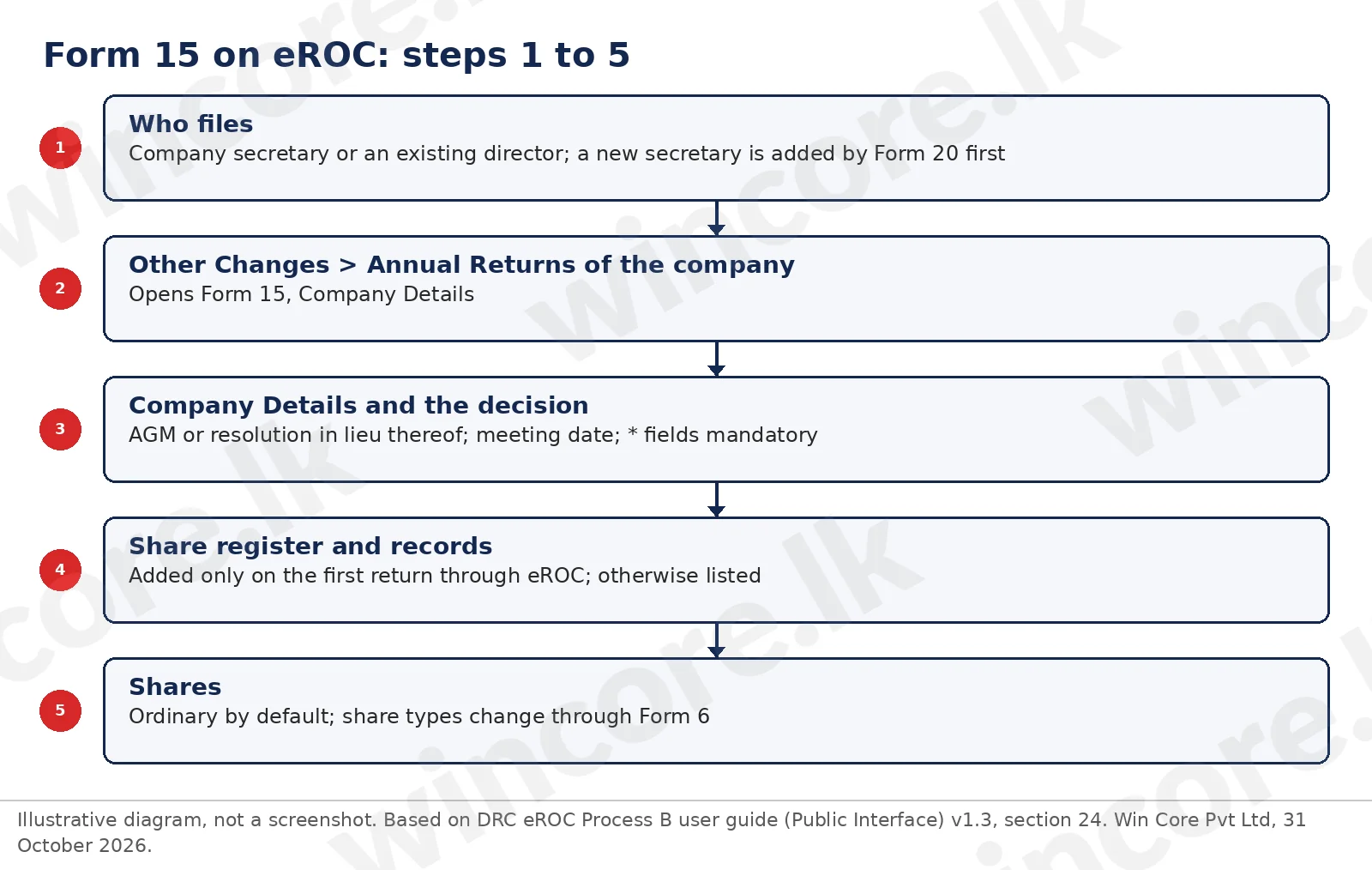
Treat Form 15 as a live governance filing: the 30-working-day clock from the AGM, the BO 4 that goes with it, the fee, and the controls that keep it on time.