
Economic Service Charge in Sri Lanka: archive guide and cleanup steps
The Economic Service Charge was abolished from 1 January 2020. This guide shows where legacy ESC records still matter and how to remove outdated live tasks.

On this page
Last verified against the primary sources on 15 October 2026.
This is a historical explainer. The Economic Service Charge (ESC) was abolished with effect from 1 January 2020 [1]. That does not close your ESC history. Unresolved assessments for earlier years, legacy audit queries and ESC balances in old financial statements stay open until they are documented and closed.
The goal here is to help you close historical exposure cleanly and keep current-year compliance focused on the taxes that apply now, which are listed at the end.
ESC is abolished: what that does and does not resolve
The Inland Revenue Department (IRD) lists the "Abolition of Economic Service Charge with effect from January 1, 2020" among its 2020 policy changes [1]. ESC should be treated as a legacy topic unless a specific historical assessment, objection or reconciliation remains open for your business.
In practice: do not keep ESC as an active task in your live tax calendar unless you have a clearly documented historical case.
When ESC still matters
You may still need ESC documentation when:
- historical assessments remain unresolved
- an audit query on an earlier year asks for ESC evidence
- legacy financial statements include ESC balances
- advisers need data for an earlier period for a reconciliation
If none of these apply, ESC routines in active workflows only add noise.
Build the ESC archive file first. Then remove it from your workflow
Create one consolidated archive file with:
- historical ESC return copies
- payment evidence and remittance references
- correspondence with the IRD and advisers
- assessment, objection or settlement letters
- reconciliation notes explaining the closure status
A complete file lets you answer a historical query quickly if one arrives.
Remove ESC from live operating controls safely
After the archive is ready, update your live controls:
- remove ESC from monthly compliance checklists
- remove ESC reminders from internal calendar tools
- update finance SOPs to label ESC as historical
- brief payroll and accounts teams so the task is not switched back on by mistake
Use the tax calendar tool to keep only active obligations in view.
If historical ESC exposure is still open, treat it as a project
If your business still has unsettled historical ESC positions, treat closure as a small project with an owner, a timeline and evidence controls, rather than an undefined backlog item.
The taxes that apply now
Instead of spending time on a tax that has ended, check the current obligations on their own terms:
Nation Building Tax ended a month before ESC, with effect from 1 December 2019 [1]; see the NBT historical guide.
Talk to us. If an ESC assessment or archive is still open, or you want your current obligations mapped, our tax team can help; reach us through our contact page.
This guide is general information on the law as at 15 October 2026 and is not advice on your specific situation.
References
- Inland Revenue Department. Policy Changes, web page, 2020 entry for Economic Service Charge and 2019 entry for Nation Building Tax ("Last updated: 28-02-2023"). https://www.ird.gov.lk/en/about%20ird/sitepages/policy%20changes.aspx . Primary. Accessed 15 October 2026.
Put these insights to work
WinCore specialists can review your current workflow, document gaps, and build a practical 90-day action plan.
Book a free consultationContinue reading
Explore more WinCore analysis to keep your finance, tax, and compliance roadmap moving.
Nation Building Tax was abolished from 1 December 2019. Use this guide to organise legacy records and remove outdated NBT tasks from active tax operations.
Sri Lanka corporate income tax guide: rates, taxable income, quarterly instalments, deductions, capital allowances, and key compliance penalties.
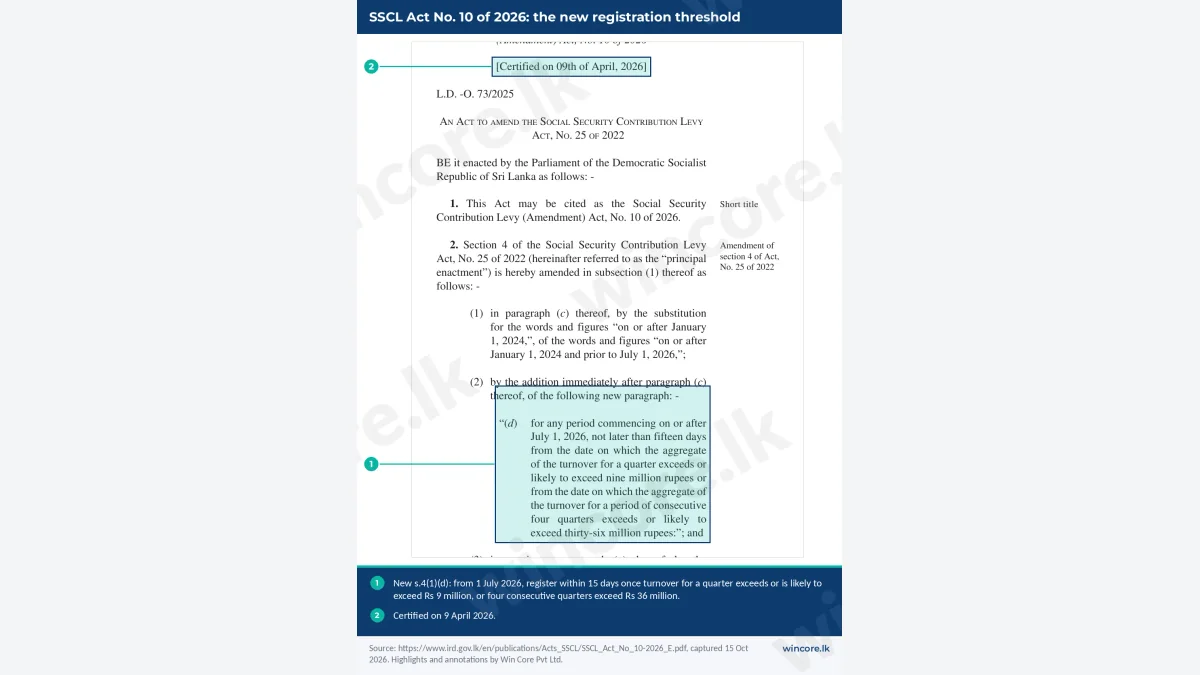
SSCL registration now starts at Rs 9 million a quarter or Rs 36 million a year from 1 July 2026. How to test, register and pay monthly.