
Nation Building Tax in Sri Lanka: archive guide and control steps
Nation Building Tax was abolished from 1 December 2019. Use this guide to organise legacy records and remove outdated NBT tasks from active tax operations.

On this page
Last verified against the primary sources on 15 October 2026.
This is a historical explainer. Nation Building Tax (NBT) was abolished with effect from 1 December 2019 [1]. Finance teams that never consolidated their NBT history can still find the gap at a bad time, such as during due diligence or a query about an old year.
This guide explains how to manage NBT as a closed record set and keep legacy tasks out of current compliance. For the taxes that apply now, go to the current guides listed at the end.
NBT is abolished: what that does and does not resolve
The Inland Revenue Department (IRD) lists the "Abolition of Nation Building Tax with effect from December 1, 2019" among its 2019 policy changes [1]. Periods before that date are history, but the records for them still exist, and any assessment, objection or reconciliation that is still open for those periods has not gone away because the tax ended.
The practical point is simple: NBT should not sit in your active monthly tax checklist unless a specific legacy case is still open.
When businesses still need NBT documentation
Historical NBT records are still relevant when:
- an audit of an earlier year asks for transaction support
- assessments, objections or reconciliations for NBT periods remain open
- old ERP balances still carry NBT postings
- an acquisition or due diligence review asks for the historical tax trail
Without a consolidated file, teams lose time reconstructing old data under deadline pressure.
Create one consolidated NBT archive file, before any query arrives
Keep one central archive package with:
- historical NBT returns and schedules
- proof of payments and bank references
- correspondence with the IRD or external advisers
- working papers that bridge the accounting and tax positions
- closure notes on resolved and unresolved items
Label each document by period so a reviewer can trace it to the right year.
Four checks before you formally close NBT in your records
Before you close legacy NBT internally, confirm that:
- historical ledger balances match the archived returns
- any earlier adjustments are documented and approved
- each unresolved item has an owner, a target date and a next step
- board or management reporting shows the closure status
This reduces surprises when an old year is reviewed.
Once the archive is complete, remove NBT from every live workflow
Once the legacy file is complete, clean up your operating routine:
- remove NBT from recurring tax checklists
- update SOPs to mark NBT as historical
- align finance, tax and payroll teams on active obligations only
- use the tax calendar tool for current deadlines
The taxes that apply now
Check each current tax on its own terms rather than mapping old NBT routines onto it. Start with the VAT registration thresholds and the SSCL registration test, both checked against the primary sources on 15 October 2026. For the wider picture, see the guides on VAT compliance, WHT registration and corporate income tax. The Economic Service Charge was abolished a month later, with effect from 1 January 2020 [1]; see the ESC historical guide.
Talk to us. If an old NBT period is still open, or you want your current obligations mapped, our tax team can help; reach us through our contact page.
This guide is general information on the law as at 15 October 2026 and is not advice on your specific situation.
References
- Inland Revenue Department. Policy Changes, web page, 2019 entry for Nation Building Tax and 2020 entry for Economic Service Charge ("Last updated: 28-02-2023"). https://www.ird.gov.lk/en/about%20ird/sitepages/policy%20changes.aspx . Primary. Accessed 15 October 2026.
Put these insights to work
WinCore specialists can review your current workflow, document gaps, and build a practical 90-day action plan.
Book a free consultationContinue reading
Explore more WinCore analysis to keep your finance, tax, and compliance roadmap moving.
The Economic Service Charge was abolished from 1 January 2020. This guide shows where legacy ESC records still matter and how to remove outdated live tasks.
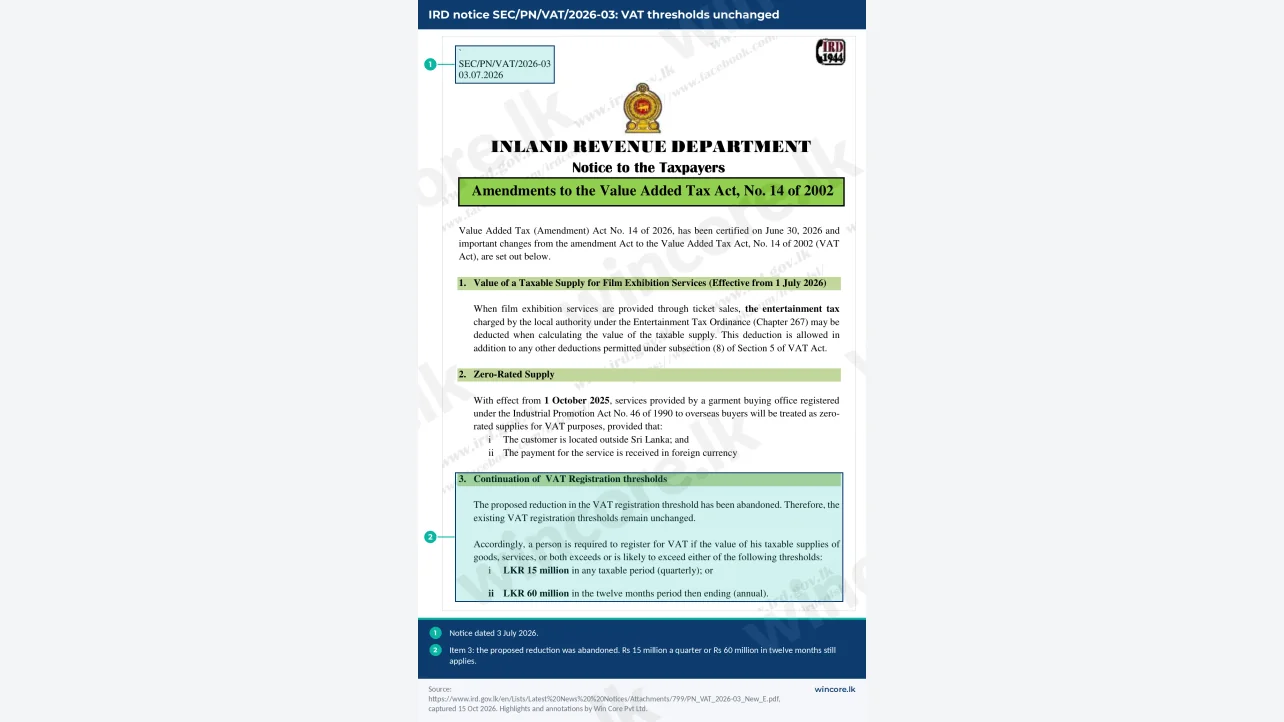
The VAT registration tests are Rs 15 million a quarter or Rs 60 million over 12 months. How the tests run, the 15 day rule and who must register.
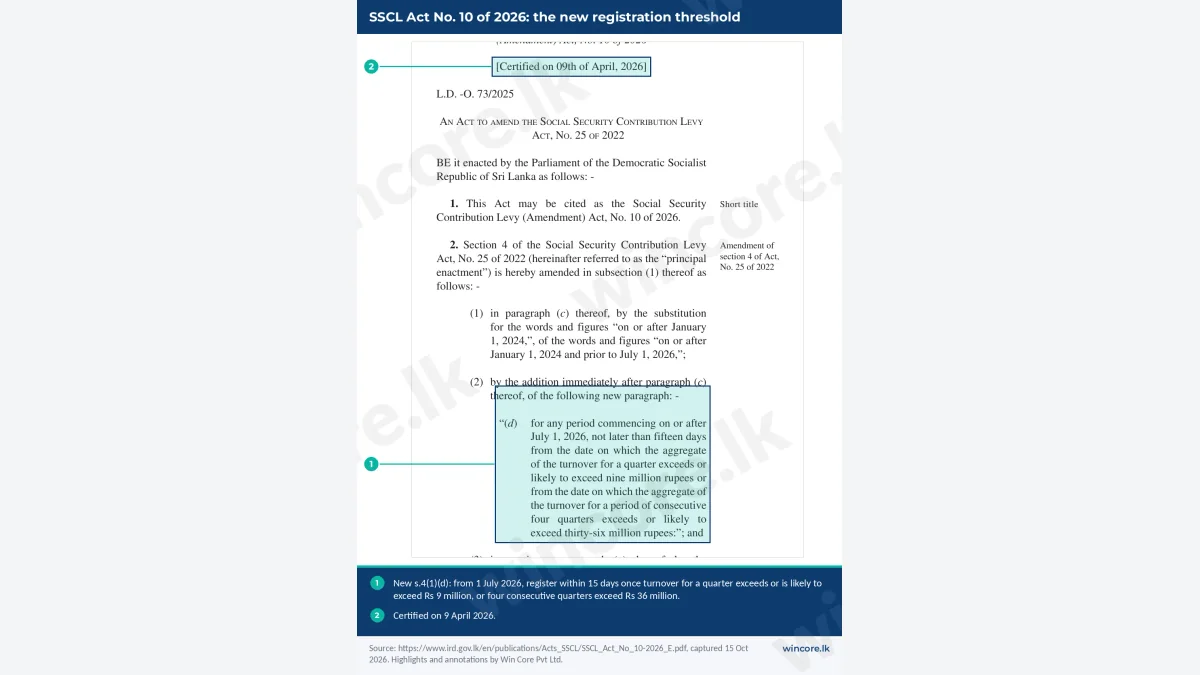
SSCL registration now starts at Rs 9 million a quarter or Rs 36 million a year from 1 July 2026. How to test, register and pay monthly.