
WHT registration in Sri Lanka: complete operating guide
WHT registration works best when withholding-agent onboarding, payment mapping, deduction, and remittance controls are designed as one process.

On this page
Last verified against the primary sources on 15 October 2026.
Miss the WHT registration step and every payment you released without withholding becomes your liability. A withholding agent that fails to withhold "shall however pay the tax that should have been withheld", and the payee is jointly and severally liable for the same tax [1]. Tax paid after the due date carries interest at 1.5 percent a month or part month [1], and, if the tax is still unpaid fourteen days after the due date, a penalty of 20 percent of the tax due but not paid under section 179(1), the rate the Inland Revenue Department (IRD) gives in its return guide [1] [2].
This is the part most businesses get wrong: they treat WHT registration as a one-off admin task and forget to build the operating process around it.
This guide covers the operating side of WHT registration in Sri Lanka: when to register, what records to prepare, how to map rates and payment categories before go-live, and how to stop registration from becoming a recurring monthly error source.
Quick answer: WHT registration is not a one-form task. Get your TIN and IRD e-Services access working first, map every payment category that attracts withholding (interest at 10 percent, dividends at 15 percent, rent and listed service fees above Rs 100,000 a month, payments to non-residents at 14 percent), and register as a withholding agent not later than 30 days before the first deduction [3]. Then lock in a monthly cycle: deduct before the payment is released, pay the IRD within 15 days after the end of the month [1], and give each payee a certificate within 30 days after the end of the month [1].
WHT and AIT rates you will use from day one (October 2026)
| Payment type | Payee | Rate | Notes |
|---|---|---|---|
| Interest or discount | Resident | 10% | From 1 April 2025, up from 5 percent; bank deposit interest has its own circular |
| Dividends | Resident | 15% | For a resident individual, a final withholding payment on dividends paid from 1 January 2023 (s.88(1A)(aa), Act No. 45 of 2022): listed in the return, not added to income, no credit |
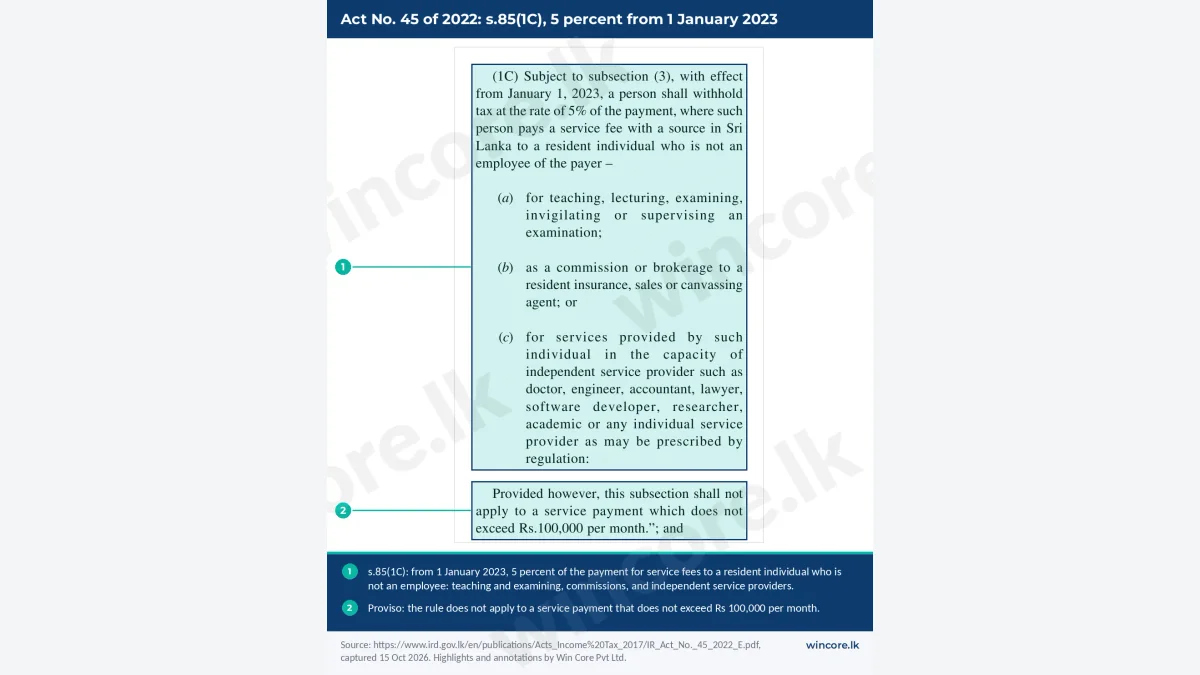
| Listed service fees | Resident individual who is not an employee | 5% | On the full payment where the month's total to that person exceeds Rs 100,000 |
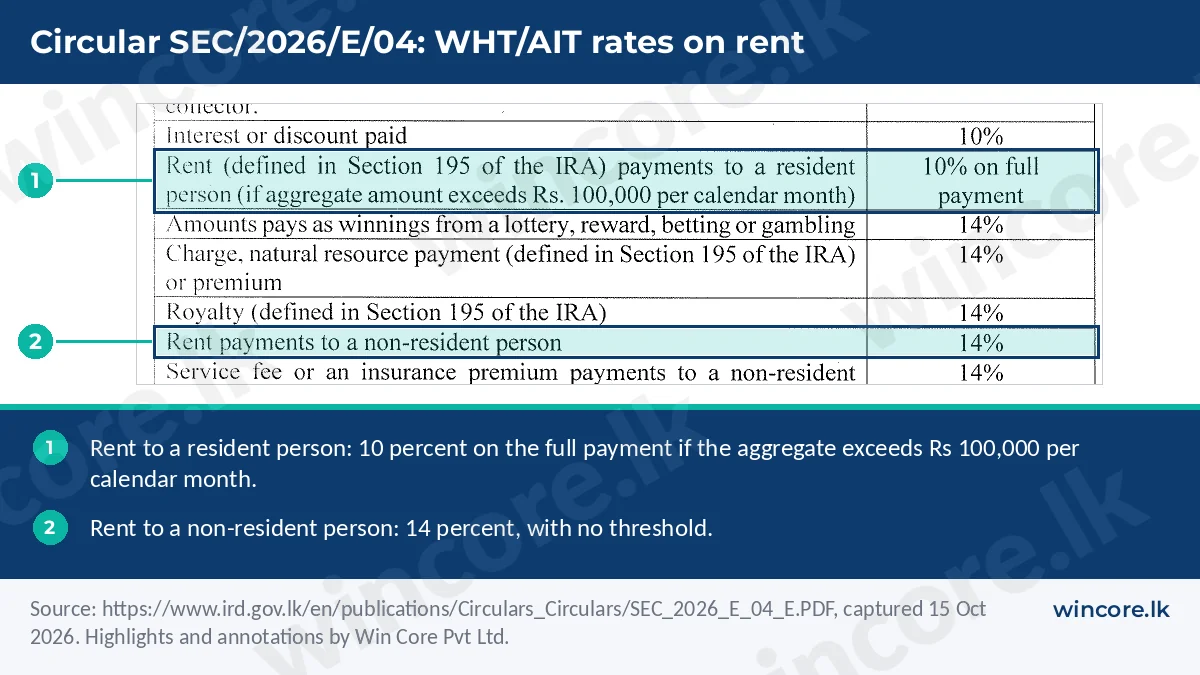
| Rent | Resident | 10% | On the full rent excluding VAT where the month's total exceeds Rs 100,000 |
| Rent, royalties, service fees, insurance premiums | Non-resident | 14% | No monthly threshold; check any double tax agreement first |
| Lottery, reward, betting or gambling winnings | Any | 14% | Not relevant to most business payers |
Sources for the table: the IRD's circular to withholding agents [3], the 10 percent interest rate in Act No. 2 of 2025 [4], the service fee rule in section 85(1C) [5], and section 88(1A) on final withholding payments [1]. There is no 2 percent rate on contract or subcontract payments, and the 5 percent service fee rate does not apply to fees paid to firms or companies [3] [5].
The two rules that catch most payers have their own guides: 5 percent WHT on service fees to resident individuals and AIT on rent above Rs 100,000 a month.
For a landlord, distinguish the deduction at source from reporting rental income and claiming the tax credit.
How to pay WHT to the IRD: deadline and steps
Pay the tax withheld to the Commissioner-General "within fifteen days after the end of each calendar month" [1]. The circular allows payment through the Online Tax Payments Platform (OTPP) or manually at People's Bank under tax type code 44, "WHT on Other Payments" [3].
- Work out the month's deductions payee by payee
- Pay through OTPP, or at People's Bank under code 44
- Keep the payment reference against each payee's working
Late payment carries interest at 1.5 percent a month or part month from the due date [1] and, if the tax is still unpaid fourteen days after the due date, a penalty of 20 percent of the tax due but not paid under section 179(1) [1] [2]. A late income tax instalment carries 10 percent under section 179(2) instead [1]. Interest for years of assessment up to 2024/2025 is written off if the tax and any applicable penalties are paid by 2 December 2026 [6] [7]. The Rs 400,000 cap you may have read about belongs to section 178, the penalty for filing a tax return late, and applies per return; it is not the penalty for paying withholding tax late [1].
Certificates and the annual WHT statement: what to issue, to whom, and by when
Give each payee a withholding certificate covering the calendar month within 30 days after the month ends [1], free of any charge [7]. A certificate covering a longer period, up to a full year of assessment, or an electronic one, is allowed only if the payee agrees to accept it [3]. Payees use the certificates to claim credit for the tax in their own income tax returns [1].
By 30 April, file the annual statement for the year to 31 March with the IRD, listing payments, payees with their TINs, and tax withheld [1] [8]. The circular asks for the statement schedules in CSV format, with paper allowed where there are fewer than 20 payees [3]. Failing to follow the procedures, formats and forms the Commissioner-General specifies for the statement can attract a penalty of up to Rs 200,000 for a year of assessment under section 178A, inserted by Act No. 11 of 2026, if a warning notice is not complied with within 14 days [7] [3]. Not filing the statement at all is an offence under new s.185A, with a fine of up to Rs 400,000, imprisonment of up to six months, or both [7].
1) Start with payment mapping, not with the portal
WHT registration only works when the finance team knows which payments need tax withheld.
Before you file the registration request, build a payment map covering:
- interest and discount
- dividends
- rent
- listed service fees to resident individuals, including insurance and sales commissions to individual agents
- service fees, royalties, rent and insurance premiums paid to non-residents
- lottery, reward, betting or gambling winnings, if your business pays them
The recurring failure is simple: a business registers for WHT, but accounts payable still books vendor payments without a classification rule. Registration without payment mapping creates more risk, not less.
2) Confirm whether your business should register now
WHT registration is not optional once certain payment types appear in your books. The moment your business pays more than Rs 100,000 in a month in rent to one landlord, distributes dividends, or sends service fees to a non-resident supplier, the IRD expects you to be withholding, paying by the 15th, and keeping payee records. You must register as a withholding agent with the Commissioner-General not later than 30 days before you start deducting [3].
The duty does not apply to Government payers other than public corporations, universities and Government-owned businesses, or to individuals paying outside a business [3]. A company, partnership or sole trader paying in the course of business is in scope.
Common triggers include:
- interest or dividend payments
- rent to one landlord above Rs 100,000 in a calendar month
- listed service fees to one resident individual above Rs 100,000 in a calendar month
- sales models built on commissions to individual insurance or sales agents
- service fees, royalties or rent paid to non-residents
- vendor models where one individual receives several service-fee payments in the same month, because the test is the month's total
If your payment mix is changing fast, run the mapping review before the next heavy payment month. Do not wait until year-end or until a supplier asks for a tax certificate.
For the broader onboarding sequence, use the tax registration checklist.
3) Set your rate map before registration goes live: not after
The rate logic should be agreed and documented before you submit the registration request. Not assembled in a rush when the first payment is due.
Use the rate table above as the starting map, and record against each category the provision or circular paragraph you relied on. For payments to non-residents, check whether a double tax agreement gives a lower rate, and keep the treaty support on the payee file before you apply it.
Do not hard-code a rate from budget speeches or commentary. Apply the rate in the Act and the IRD's current circular until they change.
If your team cannot explain why a rate applies before the first payment to the IRD, you are not ready to register.
4) Prepare the registration pack before you request registration
The minimum working pack should include:
- active business TIN
- PIN-enabled access to IRD e-Services
- entity contact details and registered email
- request letter or internal approval note showing why WHT registration is needed
- payee and payment matrix with likely categories
- accountable owner for monthly payment to the IRD
- archive location for certificates and annual statements
A TIN does not by itself make you a registered withholding agent. Keep TIN registration and withholding agent registration as separate lines in your internal checklist, and diarise the withholding registration at least 30 days before the first deduction [3].
5) Submit the registration through the right channel
In practice, businesses either use IRD e-Services with their current TIN and PIN, or apply to the IRD with the prescribed registration form and supporting documents. For walk-in or manual support, keep the current form pack and contact point together in one file. The IRD forms page publishes the annual WHT/AIT statement pack and related declarations.
Do not submit generic letters with no payment profile explanation. The strongest registration requests are specific about:
- the entity making payments
- the categories expected to be paid
- the date from which the first deduction will be made
- who will manage ongoing compliance
6) Lock in the monthly WHT cycle before the first payment leaves your account
Deduction, payment to the IRD by the 15th and certificates within 30 days need to be built into your payment approval workflow before money moves. Not added as a cleanup task after the fact.
Use this operating sequence:
- classify the payment before it is approved for release
- confirm resident or non-resident status
- confirm whether a treaty claim or IRD exemption confirmation letter exists
- add up the month's payments to the same payee where a Rs 100,000 test applies
- apply the current rate and document the basis
- deduct tax at the point of payment
- pay through OTPP or People's Bank by the 15th and archive proof
- issue the certificate within 30 days and update the annual statement tracker for that payee
This is where most businesses break down. They do not fail because the rate table is missing. They fail because deduction happens after payment approval instead of before it.
7) Keep payee-level records from month one
Annual statement preparation becomes chaotic only when monthly records are weak.
For each payee, retain:
- legal name and TIN/NIC or foreign tax identifier
- payment category used
- gross payment amount, excluding VAT
- tax rate applied
- tax withheld
- payment date
- payment reference
- certificate number or certificate issue date
- treaty or exemption support where relevant
The circular requires proper records, including copies of tax clearance and exemption confirmations, to be produced to a tax official on request [3]. Do not wait until year-end to assemble this data. The IRD annual statement pack is much easier to prepare if the payee file is updated every month.
8) Build annual statement readiness into every monthly cycle. Not at year-end
Deducting and paying is only half the obligation. Every payee is entitled to a certificate within 30 days after the month ends [1], and the annual statement goes to the IRD by 30 April [8]. A statement filed late or in the wrong format is a separate failure from late payment, whether or not the tax itself was paid on time [7].
The IRD forms and returns page publishes the annual WHT/AIT statement pack for the relevant year of assessment. Use that live pack, not a prior-year spreadsheet or a copied PDF from another adviser folder.
Treat the annual statement as the output of monthly discipline:
- every payment reference should already be logged
- every payee should already be classified
- every certificate should already be traceable
- every treaty claim should already be attached to the payee file
If those conditions are not met, the registration process was incomplete even if registration itself went through.
9) Common WHT registration failures
These are the recurring faults that create downstream risk:
- registering before mapping actual payment categories
- relying on old rate sheets, such as 5 percent on interest or 14 percent on dividends
- deducting only on the excess over Rs 100,000 instead of the full payment
- treating vendor master data as optional
- paying first and deciding withholding later
- not keeping resident and non-resident evidence with the payee file
- missing the connection between monthly payments and annual statement preparation
- assuming a bank or ERP configuration is the same thing as legal registration
The fix is a process that runs before payment approval. Not a better spreadsheet built after penalties land.
10) How this guide fits the tax cluster
Use this post with the adjacent guides:
- 5 percent WHT on service fees to resident individuals
- AIT on rent above Rs 100,000 a month
- WHT certificates and the annual statement
- TIN certificate requirement from 1 November 2026
- Tax registration checklist for businesses in Sri Lanka
That sequence gives you the legal identity setup, the payment-classification rules, and the operating checklist in one workflow.
Talk to us. If you need to register as a withholding agent or want your payment map checked before the first deduction, our tax team can work through it with you; book a consultation at our contact page.
WinCore Pvt Ltd
This guide is general information on the law as at 15 October 2026 and is not advice on your specific situation.
References
- Inland Revenue Department. Inland Revenue Act, No. 24 of 2017, consolidated text with amendments to 2025, ss.86(1), (3) and (4), 87(3), 88(1A), 157, 159(1), 178 and 179. https://www.ird.gov.lk/en/publications/Acts_Income%20Tax_2017/IRA_Cons_Act_-_2025_Changes.pdf . Primary. Accessed 15 October 2026.
- Inland Revenue Department. Guide to the Return of Income Tax, Y/A 2025/26, Section 09, penalty of 20 percent of tax due but not paid, 10 percent on a late instalment, interest at 1.5 percent a month or part of a month. https://www.ird.gov.lk/en/Downloads/IT_Individuals_Doc/Asmt_IIT_004_2025_2026_E.pdf . Primary. Accessed 15 October 2026.
- Inland Revenue Department. Circular to Withholding Agents: Deduction of Withholding Tax and Advance Income Tax, Circular No. SEC/2026/E/04 (8 June 2026), rate table and paras 1 to 7. https://www.ird.gov.lk/en/publications/Circulars_Circulars/SEC_2026_E_04_E.PDF . Primary. Accessed 15 October 2026.
- Parliament of Sri Lanka. Inland Revenue (Amendment) Act, No. 2 of 2025, withholding on interest from 1 April 2025. https://www.ird.gov.lk/en/publications/Acts_Income%20Tax_2017/IR_Act_No_02-2025_E.pdf . Primary. Accessed 15 October 2026.
- Parliament of Sri Lanka. Inland Revenue (Amendment) Act, No. 45 of 2022, inserting s.85(1C). https://www.ird.gov.lk/en/publications/Acts_Income%20Tax_2017/IR_Act_No._45_2022_E.pdf . Primary. Accessed 15 October 2026.
- Inland Revenue Department. Notice to the Taxpayers SEC/PN/IT/2026/02, Amendments to the Inland Revenue Act (8 June 2026), item 22. https://www.ird.gov.lk/en/Lists/Latest%20News%20%20Notices/Attachments/794/SEC_PN_IT_2026-02_E.pdf . Primary. Accessed 15 October 2026.
- Parliament of Sri Lanka. Inland Revenue (Amendment) Act, No. 11 of 2026, s.15 (new s.87(6)), s.42 (interest write-off) and new ss.178A and 185A. https://www.ird.gov.lk/en/publications/Acts_Income%20Tax_2017/IR_Act_No_11-2026_E.pdf . Primary. Accessed 15 October 2026.
- Inland Revenue Department. Tax Calendar 2026, AIT/WHT annual statement due 30 April 2026. https://www.ird.gov.lk/en/publications/Tax%20Calendar_Documents/Tax_Calendar_2026_E.pdf . Primary. Accessed 15 October 2026.
Put these insights to work
WinCore specialists can review your current workflow, document gaps, and build a practical 90-day action plan.
Book a free consultationContinue reading
Explore more WinCore analysis to keep your finance, tax, and compliance roadmap moving.
When a payer must withhold 5 percent on service fees, the services added in June 2026, payment within 15 days and the certificate rules.
When a tenant must deduct 10 percent AIT from rent, the base excluding VAT, payment within 15 days, certificates and worked examples.
WHT reporting breaks when certificates and annual statements are treated as year-end admin. Build a monthly evidence workflow that files cleanly.