
WHT annual statement and certificate of deduction in Sri Lanka
WHT reporting breaks when certificates and annual statements are treated as year-end admin. Build a monthly evidence workflow that files cleanly.

On this page
Last verified against the primary sources on 15 October 2026.
A payee calls to say their WHT credit is not showing in RAMIS. You check your records and find the certificate was never formally issued. The deduction happened, the payment went to the IRD, but there is no certificate number and no payee register entry for that payment. Now the IRD has the money and the payee cannot claim the credit. That is a compliance failure that starts in month three of the year and surfaces at annual statement time.
If you want reliable WHT filing outcomes, treat certificate issuance and annual statement preparation as one continuous monthly process. Not a year-end reconciliation project.
The deadlines that drive the workflow
- Payment to the IRD: within fifteen days after the end of each calendar month [1].
- Certificate to the payee: covering the calendar month, within 30 days after the month ends [1], free of any charge [2]. A certificate covering a longer period, up to a full year of assessment, or an electronic certificate, is allowed only if the payee agrees to accept it [3].
- Annual statement to the IRD: for the year to 31 March, by 30 April [4]. The circular asks for the schedules in CSV format, with paper allowed where there are fewer than 20 payees [3].
- Penalties for the annual statement: up to Rs 200,000 for a year of assessment under section 178A, inserted by Act No. 11 of 2026, for not following the procedures, formats and forms the Commissioner-General specifies, where a warning notice is not complied with within 14 days; not filing at all is an offence under new s.185A, with a fine of up to Rs 400,000, imprisonment of up to six months, or both [2] [3].
Three outputs that must stay linked: monthly record, certificate, and annual statement
You need three linked outputs:
- monthly deduction and payment record
- deduction certificate issued to each payee
- annual statement consolidating yearly payee-level data
If those outputs are produced by different teams without one shared dataset, filing errors are almost guaranteed.
For rate and category mechanics, use 5 percent WHT on service fees to resident individuals and AIT on rent above Rs 100,000 a month.
Build your WHT register from month one. Not in the week before the annual statement is due
Do not wait for year-end to organise payee data.
Maintain one live WHT register containing:
- payee legal identity and tax ID details
- payment category classification
- gross payment, excluding VAT, and WHT deducted
- payment reference and date
- certificate number and issue date
This register should be updated every month before close sign-off. The circular also requires proper records, including copies of tax clearance and exemption confirmations, to be produced to a tax official on request [3].
What every deduction certificate should capture
Issue the certificate in the IRD's format [3]. In practice it should capture:
- payer identity details
- payee identity details
- period and payment reference
- gross amount subject to withholding
- rate applied
- amount deducted
- date of deduction and payment reference
Late or incomplete certificates create downstream issues for payees claiming credits and can trigger avoidable disputes. Charging the payee for a certificate is not allowed [2].
For taxpayer onboarding and setup sequencing, pair this guide with WHT registration in Sri Lanka.
Run this five-step WHT workflow every month-end, before the next period opens
- finalise payment classification and deduction computation
- post deductions and pay the IRD by the 15th
- issue certificates within 30 days after the month ends
- reconcile ledger, bank payment references, and WHT register
- lock the period data pack before the next month begins
This workflow keeps annual statement work incremental instead of crisis-driven.
Track all payment and filing dates in the tax calendar.
Four checks that must pass before you submit the annual statement
Before filing, confirm:
- yearly totals in the statement equal monthly payment totals
- every statement line has certificate support
- payee IDs and names match master data exactly
- treaty or special-rate cases have complete support records
Any unresolved variance should be corrected before filing, not explained after assessment queries begin.
Five common filing defects, and what causes them
- payee identity mismatch between certificates and annual statement
- omitted payments that were deducted manually outside the normal workflow
- wrong payment-type coding from the AP process
- certificate issued but not logged in the annual statement source file
- annual statement prepared from spreadsheets that bypass the monthly register
The solution is process integration, not additional year-end spreadsheets.
Related: Withholding tax circular 2026: the yearly WHT certificate rules.
Frequently asked questions
Can we prepare the annual statement directly from bank records?
Bank records are necessary but not sufficient. You need linked payment classification, certificate, and payee tax-identity detail.
Is issuing certificates optional if we already paid the WHT to the IRD?
No. The certificate is due within 30 days after the month ends [1], and it is the payee's evidence for claiming credit for the tax.
Can we issue one certificate for the whole year?
Only if the payee agrees to accept a certificate covering a longer period; otherwise issue one for each calendar month [3].
What is the best way to reduce annual statement errors?
Use one controlled monthly WHT register and reconcile it before each period close.
Should annual statement ownership sit only with tax?
No. Tax should own policy, but AP, payroll or treasury, and finance control teams must feed the same validated dataset.
Talk to us. If your WHT register has gaps or your certificate log is incomplete, our tax team can review the process with you before the next annual statement; book a consultation at our contact page.
WinCore Pvt Ltd
This guide is general information on the law as at 15 October 2026 and is not advice on your specific situation.
References
- Inland Revenue Department. Inland Revenue Act, No. 24 of 2017, consolidated text with amendments to 2025, ss.86(1) and 87(3). https://www.ird.gov.lk/en/publications/Acts_Income%20Tax_2017/IRA_Cons_Act_-_2025_Changes.pdf . Primary. Accessed 15 October 2026.
- Parliament of Sri Lanka. Inland Revenue (Amendment) Act, No. 11 of 2026, s.15 (new s.87(6)), new ss.86(9), 178A and 185A. https://www.ird.gov.lk/en/publications/Acts_Income%20Tax_2017/IR_Act_No_11-2026_E.pdf . Primary. Accessed 15 October 2026.
- Inland Revenue Department. Circular to Withholding Agents: Deduction of Withholding Tax and Advance Income Tax, Circular No. SEC/2026/E/04 (8 June 2026), paras 6 and 7. https://www.ird.gov.lk/en/publications/Circulars_Circulars/SEC_2026_E_04_E.PDF . Primary. Accessed 15 October 2026.
- Inland Revenue Department. Tax Calendar 2026, AIT/WHT annual statement due 30 April 2026. https://www.ird.gov.lk/en/publications/Tax%20Calendar_Documents/Tax_Calendar_2026_E.pdf . Primary. Accessed 15 October 2026.
Put these insights to work
WinCore specialists can review your current workflow, document gaps, and build a practical 90-day action plan.
Book a free consultationContinue reading
Explore more WinCore analysis to keep your finance, tax, and compliance roadmap moving.
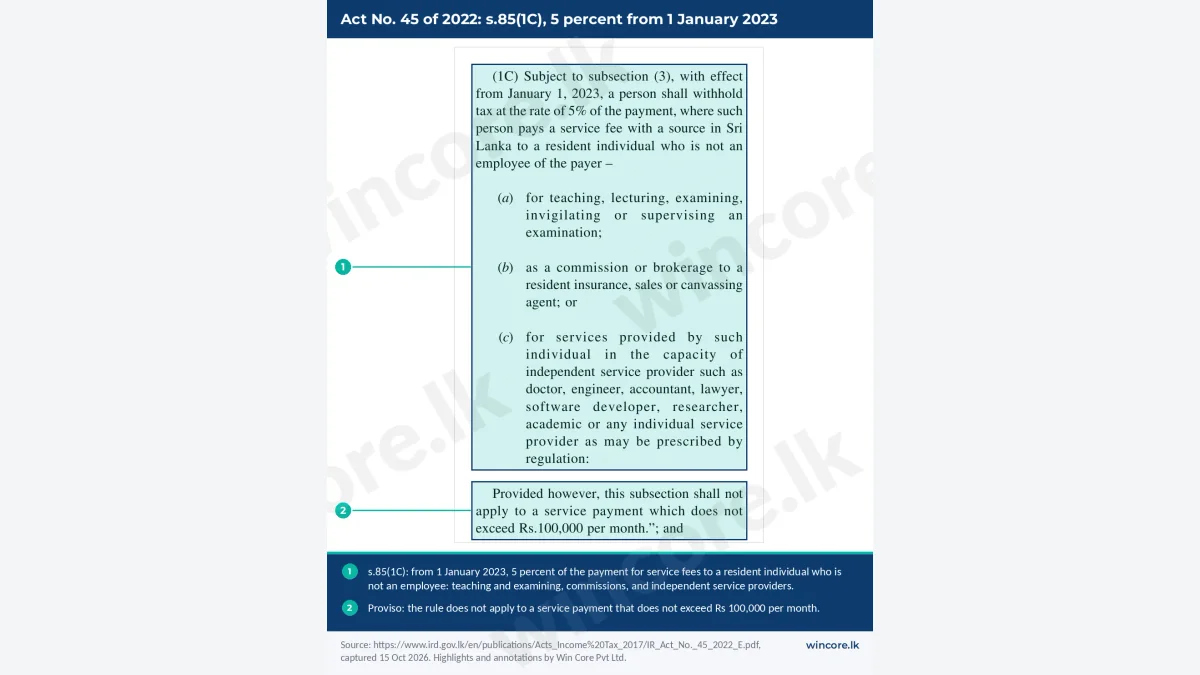
When a payer must withhold 5 percent on service fees, the services added in June 2026, payment within 15 days and the certificate rules.
WHT registration works best when withholding-agent onboarding, payment mapping, deduction, and remittance controls are designed as one process.

A practical RAMIS filing checklist for Sri Lankan businesses covering account access, return preparation, submission order, and deadline control.