
VAT registration and compliance in Sri Lanka
VAT guide for Sri Lanka covering who must register, zero rating and exemptions, tax invoices, filing and payment dates, input tax credits, penalties, and deregistration.

On this page
Last verified against the primary sources on 15 October 2026.
Take a hypothetical lift maintenance company whose quarters usually sit well below the line, until one busy quarter of repair work reaches Rs 15.4 million. It does not register, on the view that one busy quarter does not count. It does: the threshold is Rs 15 million in a quarter [1]. The Commissioner-General can register the business from a date he determines and assess the tax it should have paid [2]. On top of that come the penalties the VAT Act provides for failing to register and for paying late [2], and the work of correcting months of invoices to customers who already paid without VAT.
This guide covers who must register, rates, zero rating and exemptions, invoice rules, filing and payment, input tax credits, penalties and deregistration.
What changed in 2026
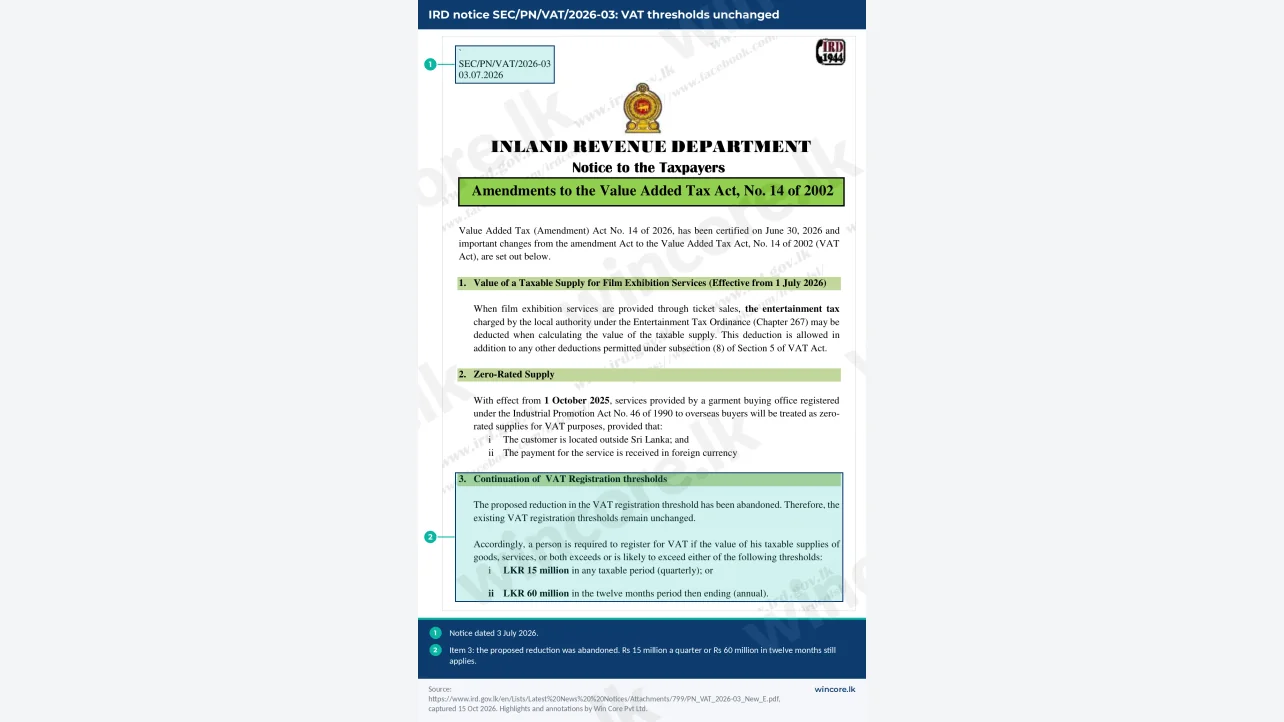
- The registration threshold did not change. The proposed reduction was abandoned, so the threshold stays at Rs 15 million in a quarter or Rs 60 million in the twelve months then ending [1].
- Non-resident digital platforms supplying services to customers in Sri Lanka come into VAT from 1 July 2026 [1].
- Financial services are charged VAT at 20.5 percent for taxable periods from 1 July 2026 [1].
- The tax invoice format in Gazette 2481/22 applies from 1 October 2026 [3].
- Secured POS machines will be required within three months of a date the Commissioner-General has yet to prescribe [1].
- SVAT ended on 1 October 2025 [4].
The standard rate remains 18 percent [2]. The separate SSCL registration threshold did fall, to Rs 9 million a quarter from 1 July 2026: see our SSCL registration guide.
What is VAT and how does it work?
Value Added Tax is an indirect tax levied on the supply of goods and services at each stage of production and distribution. Unlike income tax, which is paid on profits, VAT is collected at each stage of the supply chain and ultimately borne by the final consumer.
How VAT flows through a business
- Output VAT: VAT you charge on your sales to customers
- Input VAT: VAT you pay on your purchases from suppliers
- Net VAT payable: output VAT minus input VAT, the amount paid to the Inland Revenue Department (IRD)
- If input VAT exceeds output VAT in a period, the excess is set off against output VAT in the following periods [2]. Fast cash refunds are limited to registrants eligible for the Risk-Based Refund Scheme (see below)
Registered businesses act as VAT collectors for the government while being entitled to recover the VAT they paid on their own inputs.
Current VAT rates in Sri Lanka
Standard rate: 18%
The 18 percent standard rate applies to all taxable supplies of goods and services unless the supply is specifically zero-rated or exempt [2]. Financial services have their own rate of 20.5 percent from 1 July 2026 [1].
Zero-rated supplies: 0%
Zero-rated means no VAT is charged on the supply, but the supplier can still claim input VAT on related purchases. Zero rating under section 7 covers [2]:
- exported goods
- the services listed in section 7, such as international transport
- any other service supplied to a person outside Sri Lanka and consumed outside Sri Lanka
In each case the supply is zero-rated only where payment is received in foreign currency through a licensed bank in Sri Lanka within six months of the end of the taxable period [2] [4]. Since 1 October 2025, services of a registered garment buying office to customers outside Sri Lanka, paid in foreign currency, are also zero-rated [1].
Essential food items, agricultural produce and educational materials are not zero-rated. Where they carry no VAT, it is because they are exempt under the First Schedule [2], and the input VAT behind them is not recoverable.
Exempt supplies
Exempt means no VAT is charged on the supply, but the supplier cannot claim input VAT on related costs. Exempt categories in the First Schedule include [2]:
- education services provided by schools and universities
- residential rental income
- land and building sales (with specified exceptions)
- postal services provided by the national postal authority
- healthcare services provided by medical institutions or professionally qualified persons, other than hospital room charges, which are taxable from 1 January 2024 [5]
- from 1 July 2026, supplies to a Port City Business of Strategic Importance [1]; see our BSI guide
Financial services are not exempt as a class: they are charged VAT on financial services at 20.5 percent from 1 July 2026 [1]. The VAT (Amendment) Act No. 14 of 2026 also extends the healthcare exemption to healthcare, including telemedicine, that a non-resident supplies through an electronic platform [6].
If your business makes both taxable and exempt supplies, input VAT must be apportioned, and only the portion relating to taxable activities is recoverable [2]. Our VAT exemptions guide covers classification controls.
Who must register for VAT?
You must register if your taxable supplies have exceeded, or are likely to exceed, Rs 15 million in a quarter or Rs 60 million in the twelve months then ending, and you must apply within 15 days of becoming liable [2]. A person who imports or exports goods for commercial purposes must register whatever its turnover [2], and from 1 July 2026 non-resident platforms have their own test under section 25L [6]. Our verified guides on the VAT registration thresholds and VAT and SSCL thresholds in 2026 set out each test, the wholesale and retail rule, and worked cases.
Finance teams should track taxable supplies every month, not only at quarter-end, so the 15 days do not start before anyone notices.
If your sales model includes imports, exports or complex supply classifications, speak to tax advisory support before your first high-volume cycle closes.
Voluntary registration
Businesses below the threshold may choose to register voluntarily. This is worth considering when:
- you want to recover input VAT on significant business purchases
- your clients are VAT-registered and need tax invoices from you
- you expect to exceed the threshold within the next 12 months
- you are investing in capital assets with significant VAT content
Step-by-step VAT registration process
- Determine your liability. Calculate your taxable turnover for the most recent quarter and the twelve months then ending, and check whether you import or export goods commercially.
- Obtain your TIN. A TIN is required before VAT registration; a company must register for one within 30 days of incorporation [7]. See our TIN guide.
- Gather the documents listed below.
- Complete the VAT registration application through IRD e-Services or at an IRD office.
- Submit it within 15 days of becoming liable [2].
- Receive your certificate. The effective date of registration is stated on it.
- Update your invoicing from the effective date (see the invoice rules below).
Documents usually requested
For companies: certificate of incorporation, Articles of Association, a board resolution naming the authorised signatory, the TIN, NICs of the directors, proof of the registered business address, and bank account details. For sole proprietors and partnerships: business registration certificate, NIC of the proprietor or each partner, the TIN, proof of business premises, the partnership agreement if any, and bank account details.
Tax invoice rules
A registered person must issue a tax invoice within 28 days of the supply when a registered purchaser asks for one [2]. Only one tax invoice may be issued for each supply. A customer who is not registered receives an ordinary invoice showing the total including tax, which is not a tax invoice [2].
From 1 October 2026 every tax invoice must follow the format in Gazette 2481/22 as amended by Gazette 2500/106: the title TAX INVOICE, the supplier's and purchaser's nine-digit TINs, names and addresses, a serial number in the pattern YYMMM_QQQQ_XXXXX of up to 40 characters with no spaces, dates as MM/DD/YYYY, values excluding VAT, VAT and total in rupees to two decimals, and only VAT-applicable items [8] [3]. Our tax invoice guide lists every field and the controls.
Keep the duplicate of every tax invoice for five years after the end of the taxable period in which it was issued [2]. Gaps in numbering attract scrutiny in an IRD review. Credit notes and debit notes should also be numbered in sequence and reference the original invoice.
VAT return filing: frequency and deadlines
Filing frequency
Your filing frequency follows the taxable period set by the VAT Act, not your turnover [2]:
- Monthly returns: for taxable periods from 1 October 2025, a one-month taxable period applies to eligible exporters and projects [9]
- Quarterly returns: every other registered person has a three-month taxable period (quarters starting 1 January, 1 April, 1 July and 1 October)
- Check the filing frequency shown for your VAT account in e-Services and follow it
Filing and payment deadlines
Payment and filing are two separate deadlines [2] [10]:
- VAT payment: on or before the 20th of the following month, for every month
- VAT return: on or before the last day of the month after the taxable period ends, filed electronically (mandatory for taxable periods from 1 July 2025)
Monthly filers: August 2026 VAT was payable by 20 September 2026 and the August return due by 30 September 2026.
Quarterly filers: VAT is still paid monthly: tax for the first month of the quarter by the 20th of the second month, tax for the second month by the 20th of the third month, and the balance for the quarter by the 20th of the month after the quarter ends. Returns: January to March by 30 April, April to June by 31 July, July to September by 31 October, October to December by 31 January.
Diarise both dates. Treating the return deadline as the payment deadline is a common failure, because by then the payment is already late.
Step-by-step VAT return filing process
- Close your sales register and purchase register for the taxable period
- Reconcile output VAT on all taxable sales and input VAT on business purchases
- Remove disallowed input claims: claims without valid tax invoices, personal expenses, and costs related only to exempt supplies
- Calculate net VAT payable: output VAT minus allowable input VAT
- Log in to IRD e-Services
- Select the VAT return and the correct return period
- Enter sales and purchase information, including totals, VAT amounts and supply classifications
- Upload supporting schedules where required
- Review the calculated net payable or refundable amount
- Submit the return
- Pay online if VAT is payable
- Download and keep the filed return and the payment receipt
If input VAT exceeds output VAT, the excess input tax is carried forward and set off against output VAT of the following periods [2]. Refunds follow the refund scheme the IRD describes in its FAQs: a refund within 45 days of the return due date is available to registrants eligible for the Risk-Based Refund Scheme [9]. Our VAT refunds guide covers eligibility and the evidence file.
You must file a nil return for any period in which you had no transactions. Not filing because there was no activity exposes you to the same penalties for late returns [2].
Input VAT credit rules
What qualifies for input VAT recovery
- VAT on goods purchased for business use
- VAT on services consumed in business operations
- VAT on business-related expenses including travel, professional fees and supplies
- VAT on capital assets acquired for taxable business activities
- VAT paid at import, supported by the customs declaration
Every claim requires a valid tax invoice from a VAT-registered supplier [2]. A receipt, or an ordinary invoice issued to an unregistered customer, does not support an input claim.
What is blocked from input VAT recovery
- Personal expenses or purchases with no business connection
- Entertainment expenses not clearly connected to a business purpose
- VAT on purchases related only to exempt supplies
- Purchases without a valid tax invoice from a registered supplier
- Costs outside the scope of your registered business activities
Time limit for claiming input VAT
VAT on a local purchase must be claimed in a VAT return for a period ending within 12 months of the tax invoice date, and VAT on imports within 24 months of the customs declaration date [10]. Claims made after those windows are disallowed. Build a system to flag invoices approaching the deadline.
Record-keeping requirements
Proper records are your first line of defence in any IRD review. Keep at least:
Sales records
- Copies of all tax invoices issued, in sequence
- Credit notes issued, with reference to original invoice numbers
- Sales day book or electronic sales register
- Customer payment receipts
Purchase records
- Originals of all tax invoices received from suppliers
- Debit notes received from suppliers
- Purchase day book or electronic purchase register
- Supplier payment records
VAT return records
- All filed VAT returns for every period
- Payment receipts and online payment confirmations
- Correspondence with the IRD about your VAT account
- Reconciliation schedules used to prepare each return
General business records
- Bank statements for all business accounts
- Cash book
- General ledger with VAT account detail
- Asset registers for capital items on which input VAT was claimed
Retention period: the VAT Act requires records to be kept, and the duplicate of every tax invoice must be kept for five years after the end of the taxable period in which it was issued [2]. Keeping the rest of your VAT records for the same period, in paper or digital form that you can produce on request, is sensible practice. Longer retention is advisable for property transactions and capital assets.
VAT on imports
VAT on imported goods is charged at the point of entry into Sri Lanka, at 18 percent on the value of the import as section 6 of the VAT Act defines it, and must be paid before the goods are cleared [2].
The import VAT can then be claimed as input VAT if:
- the goods are imported for taxable business purposes
- you hold the customs declaration and the commercial invoice
- you have the bill of lading or airway bill
- you have the payment receipts for the import VAT settled at Customs
Keep all import documentation. The IRD may request it during any audit of your input claims.
VAT on exports
Exports are zero-rated, so you do not charge VAT to foreign buyers and you keep the right to claim input VAT on costs related to the export activity, but only where payment is received in foreign currency through a licensed bank in Sri Lanka within six months of the end of the taxable period [2] [4]. An exporter must also be registered whatever its turnover [2].
Documentation to support zero rating on exports:
- Customs export declaration
- Commercial invoice showing the foreign buyer's details
- Bank credit advice showing the foreign currency received through a licensed bank in Sri Lanka, and its date
- Shipping documents: bill of lading or airway bill
If the payment arrives late, in rupees, or outside the banking system, or the documents are incomplete, the IRD can treat the supply as taxable at 18 percent and raise an assessment with default penalties.
VAT penalty schedule: late filing, late payment, failure to register, incorrect returns
VAT penalties come from the VAT Act No. 14 of 2002 itself, not from the Inland Revenue Act, so the income tax and APIT penalty rules do not apply to VAT [2].
Late filing penalties
- Penalties for late returns. The VAT Act provides penalties where a return is not furnished on time [2]. If a failure under the VAT Act is prosecuted, the maximum fine for an offence under section 67 is Rs 1,000,000 for offences committed on or after 1 October 2025 [1]
- Lost input tax. Input tax on a local purchase can only be claimed within 12 months of the tax invoice date (24 months from the customs declaration for imports), so a long-overdue return can forfeit credits [10]
Every missed return is a separate exposure.
Late payment penalties
The VAT Act provides penalties for VAT paid late [2]. Pay by the 20th even when the return is not yet due.
Failure to register
- Back-payment of all VAT from the date registration should have been triggered. The Commissioner-General can register you compulsorily from a date he determines (section 14(1)) and assess the tax you ought to have paid (section 28) [2]
- Penalties. The VAT Act provides penalties for failing to register and for paying the assessed tax late [2]
Incorrect or understated returns
- Additional assessment of the shortfall (section 31) [2]
- Penalties. The VAT Act also provides penalties for incorrect returns and for fraud [2]
Failure to issue valid tax invoices
- Issuing more than one tax invoice for a supply is unlawful [2], and from 1 July 2026 failing to furnish valid tax invoices is an offence under section 67, with a fine of up to Rs 1,000,000 for offences on or after 1 October 2025 [1]
- The IRD may assess tax on estimated supplies where invoicing controls have broken down
Failure to maintain required records
- The VAT Act requires records to be kept and provides penalties for failing to keep them [2]
- The IRD can assess on best-judgment estimates where records are absent or unverifiable
The Simplified VAT (SVAT) scheme has been abolished
The SVAT scheme, which let exporters and approved projects settle VAT on local purchases with credit vouchers instead of cash, was abolished with effect from 1 October 2025 by the VAT (Amendment) Act No. 4 of 2025 [4]. All SVAT registrations were cancelled, suppliers now charge VAT and issue standard tax invoices, and eligible exporters, approved projects and suppliers to specified projects recover input VAT through the Risk-Based Refund Scheme [9]. Our VAT refunds and SVAT guide covers the scheme. If you still use SVAT assumptions in pricing or cash-flow models, update them: input VAT on local purchases is now a cash outflow until it is recovered.
VAT deregistration
When to apply for deregistration
A registered person may apply to cancel its registration at any time after twelve months from the date of registration, if it has ceased the taxable activity or its supplies do not exceed the values in section 10 [2]. In practice that covers:
- the business has ceased operations entirely
- taxable turnover has fallen below the Rs 15 million quarterly threshold (Rs 60 million annually)
- the business structure has changed through merger, acquisition or conversion
Registration can also be cancelled by the IRD, for example where the business closes permanently or registration was obtained by fraud.
Deregistration process
- Submit a deregistration application to the IRD
- File a final VAT return covering all supplies up to the deregistration date
- Pay all outstanding VAT, including any default penalties
- Account for VAT on the value of any remaining trading stock held at the deregistration date, which is treated as a deemed supply at market value
- Issue credit notes for any cancelled or reversed supplies
- Return the original VAT registration certificate to the IRD [2]
- Obtain written confirmation of deregistration and keep it permanently
Do not assume deregistration is complete until you hold written confirmation from the IRD. Filing obligations continue until the effective deregistration date is formally confirmed.
The six VAT mistakes that create IRD assessments, and how to close each gap
Not monitoring turnover in real time. By the time the quarter closes, the obligation may already have been triggered. Track taxable supplies monthly and flag when the quarter's running total approaches Rs 12 million, to allow time to prepare a registration application before you cross the line.
Invoices not in the Gazette format. Missing fields or the wrong serial pattern mean your customer cannot rely on the invoice for input VAT. Check your template against Gazette 2481/22 now, and again whenever the IRD amends it.
Claiming input VAT without valid supplier invoices. A payment summary or receipt is not sufficient. You must hold the supplier's tax invoice. Ask for compliant invoices before releasing payment.
Mixing exempt and taxable supplies without apportionment. If your business makes both, input VAT must be allocated. Claiming 100 percent recovery when some costs relate to exempt supplies will be reversed on audit.
Missing filing deadlines, including nil periods. A nil return takes minutes to file. Every missed return, nil or not, exposes you to a penalty. Set calendar reminders for every due date.
Poor record sequencing. Gaps in invoice numbering, missing purchase invoices and unreconciled ledger balances are common triggers for extended IRD reviews. Reconcile your VAT return figures to the general ledger before each submission.
Frequently asked questions
What is the current VAT registration threshold?
Rs 15 million in any quarter or Rs 60 million in the twelve months then ending [1]. Importers and exporters of goods for commercial purposes must register regardless of turnover [2].
Has the VAT threshold changed recently?
No. A proposed cut to Rs 9 million a quarter was abandoned, and the IRD confirmed the existing thresholds in notice SEC/PN/VAT/2026-03 of 3 July 2026 [1]. The Rs 9 million figure belongs to SSCL from 1 July 2026; see VAT and SSCL thresholds in 2026.
Can I claim VAT on purchases made before registration?
Do not count on it. Input VAT is claimed in returns for periods from the date your registration takes effect. Whether any credit is available for VAT paid before that date, for example on stock or capital goods held when you register, depends on conditions in the VAT Act, so confirm it with the IRD or your adviser before you price on that basis.
What if my input VAT exceeds output VAT in a period?
The surplus is carried forward and set off against future output VAT [2]. Refunds follow the refund scheme described in the IRD FAQs: registrants eligible for the Risk-Based Refund Scheme can expect a refund within 45 days of the return due date, or of complying with a Notice 2 if one is issued [9].
Must I file if I had no transactions in a period?
Yes. A nil return must be submitted for every period regardless of activity.
What is the penalty for a late VAT return?
The VAT Act provides penalties where a return is not furnished on time [2]. If a failure is prosecuted, the maximum fine for an offence under section 67 is Rs 1,000,000 for offences committed on or after 1 October 2025 [1].
What happens if VAT is paid late?
The VAT Act provides penalties for late payment [2]. Pay by the 20th of the following month, even when the return is due later.
Can VAT invoices be handwritten or must I use accounting software?
A handwritten tax invoice must still carry every element of the Gazette format, including the serial number pattern [8]. Once the Commissioner-General prescribes the date and specifications, registered persons will have three months to move transactions and invoices onto secured POS machines [1].
How long must VAT records be kept?
The duplicate of every tax invoice must be kept for five years after the end of the taxable period in which it was issued [2]. Keeping your other VAT records for the same period is sensible practice; longer retention is recommended for property transactions and capital assets.
Related reading
- TIN certificate and company TIN registration
- Corporate income tax in Sri Lanka
- 5 percent WHT on service fees
VAT return data must reconcile with corporate tax accounts, payroll tax obligations and cash management planning. Consistent filing data across all obligations from the start avoids corrections later.
Talk to us. If you are near the threshold, already above it, or moving your invoices to the Gazette format, our tax team can work through registration and filing with you; reach us through our contact page.
This guide is general information on the law as at 15 October 2026 and is not advice on your specific situation.
References
- Inland Revenue Department. Notice to the Taxpayers: Amendments to the Value Added Tax Act, No. 14 of 2002, SEC/PN/VAT/2026-03 (3 July 2026), items 2, 3, 4, 7, 9, 11 and 15. https://www.ird.gov.lk/en/Lists/Latest%20News%20%20Notices/Attachments/799/PN_VAT_2026-03_New_E.pdf . Primary. Accessed 15 October 2026.
- Inland Revenue Department. Value Added Tax Act, No. 14 of 2002, consolidated version up to 2025, ss.2, 6, 7, 8, 10, 14, 16, 20, 21, 22, 26, 28, 31, 64, the penalty provisions and First Schedule. https://www.ird.gov.lk/en/publications/Value%20Added%20Tax_Acts/VAT_Act_No_14%5BE%5D_2002_%28Consolidation_2025%29.pdf . Primary. Accessed 15 October 2026.
- Commissioner-General of Inland Revenue. Gazette Extraordinary No. 2500/106 (6 August 2026), moving the tax invoice format's effective date to 1 October 2026. https://www.ird.gov.lk/en/publications/Gazette_Documents/2026_2500_106_E.pdf . Primary. Accessed 15 October 2026.
- Inland Revenue Department. Notice to Taxpayers: Amendments to the Value Added Tax Act, PN/VAT/2025-01 (Revised) (17 April 2025), on the VAT (Amendment) Act No. 4 of 2025. https://www.ird.gov.lk/en/Lists/Latest%20News%20%20Notices/Attachments/677/PN_VAT_2025-01_11042025_E.pdf . Primary. Accessed 15 October 2026.
- Parliament of Sri Lanka. Value Added Tax (Amendment) Act, No. 32 of 2023, certified 13 December 2023, s.4(2), First Schedule Part III para (b) item (ix), from 1 January 2024. https://www.ird.gov.lk/en/publications/Value%20Added%20Tax_Acts/VAT_Act_No._32_2023_E.pdf . Primary. Accessed 15 October 2026.
- Parliament of Sri Lanka. Value Added Tax (Amendment) Act, No. 14 of 2026, certified 30 June 2026, new s.25L and s.17(2) (First Schedule Part III para (e)). https://www.ird.gov.lk/en/publications/Value%20Added%20Tax_Acts/VAT_Act_No_14-2026_E.PDF . Primary. Accessed 15 October 2026.
- Parliament of Sri Lanka. Inland Revenue (Amendment) Act, No. 11 of 2026, certified 3 June 2026, s.23 (new s.102(1A)). https://www.ird.gov.lk/en/publications/Acts_Income%20Tax_2017/IR_Act_No_11-2026_E.pdf . Primary. Accessed 15 October 2026.
- Commissioner-General of Inland Revenue. Gazette Extraordinary No. 2481/22 (27 March 2026), format of the tax invoice under section 20 of the VAT Act. https://www.ird.gov.lk/en/publications/Gazette_Documents/2026_2481-22_E.pdf . Primary. Accessed 15 October 2026.
- Inland Revenue Department. Frequently Asked Questions: VAT and SVAT changes (last updated 1 August 2025). https://www.ird.gov.lk/en/Lists/Latest%20News%20%20Notices/Attachments/702/VAT31072025_SVAT_Repeal_FAQs_QG.pdf . Primary. Accessed 15 October 2026.
- Inland Revenue Department. VAT payment and return reminder for August 2026 (15 September 2026). https://www.ird.gov.lk/en/Lists/Latest%20News%20%20Notices/Attachments/808/VAT_15092026_E.pdf . Primary. Accessed 15 October 2026.
Put these insights to work
WinCore specialists can review your current workflow, document gaps, and build a practical 90-day action plan.
Book a free consultationContinue reading
Explore more WinCore analysis to keep your finance, tax, and compliance roadmap moving.
The VAT registration tests are Rs 15 million a quarter or Rs 60 million over 12 months. How the tests run, the 15 day rule and who must register.
From 1 October 2026 every VAT tax invoice must follow the format in Gazette 2481/22 as amended. The fields, the serial number, the 28-day rule and the controls.
VAT credit positions need disciplined evidence and timing. Understand the refund workflow, carry-forward decisions, and the risk-based refund scheme that replaced SVAT.