
VAT exemptions in Sri Lanka: what qualifies and how to document it
VAT exemption errors create hidden tax leakage. Learn the exempt and zero-rated difference, the July 2026 changes, and the records needed to defend treatment.

On this page
Last verified against the primary sources on 15 October 2026.
You submit the VAT return. The numbers reconcile. But three revenue lines have been classified as exempt for 18 months, and none of them should be.
That is how much VAT exposure starts: not a rate error, but a classification error that nobody flagged because the return kept passing. Teams treat "exempt" and "zero-rated" as interchangeable until the difference appears as blocked input tax, invoices needing reissue, or a refund position that collapses at the worst moment.
If exemption treatment is decided by the person drafting the invoice rather than owned by tax and finance, you already have a classification risk problem.
What changed on 1 July 2026
Three changes from the VAT (Amendment) Act No. 14 of 2026 affect classification:
- Financial services are not exempt as a class. For taxable periods starting on or after 1 July 2026, VAT on the supply of financial services is charged at 20.5 percent [1]. A register that still codes lending or other financial services as "exempt" is out of date.
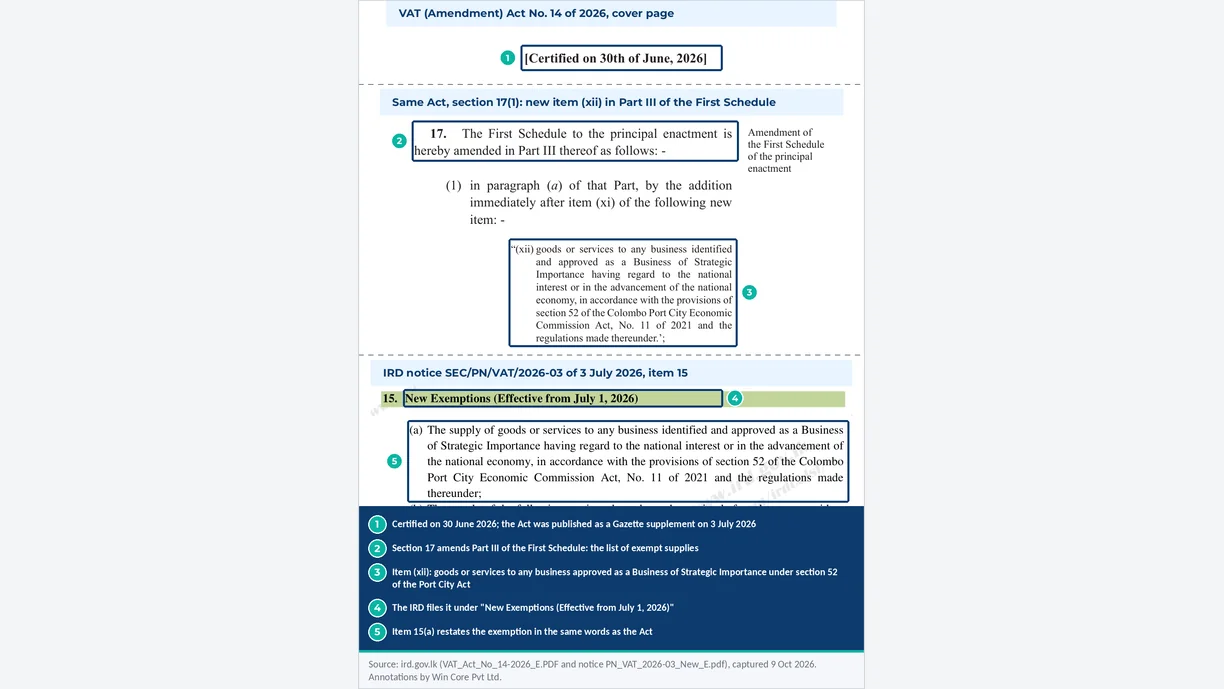
- Supplies to a Port City Business of Strategic Importance (BSI) approved under section 52 of the Colombo Port City Economic Commission Act are exempt from 1 July 2026 [1] [2]. Our guide to supplies to a BSI covers the conditions, invoices and input tax.
- Some services supplied by non-residents through electronic platforms are exempt from the new digital services VAT, including online education and remote healthcare services such as telemedicine [1] [2].
Always confirm the current First Schedule in the VAT Act before relying on a classification [3].
One wrong classification affects your return, your customer's claim, and your margin
Exemption decisions affect more than one return box. They drive:
- whether you charge VAT to the customer
- whether related input VAT is claimable
- whether your gross margin model remains accurate
- whether your pricing stays competitive after tax
If your team classifies a supply as exempt when it is actually taxable, you can create backdated output VAT exposure. If your team classifies something as taxable when it is exempt, your pricing and customer contracts can become commercially misaligned.
Use the tax calendar to lock monthly VAT review points before returns are submitted.
Exempt is not the same as zero-rated
This is the most important distinction for operational control.
| Treatment | VAT charged on sale | Input VAT on related costs |
|---|---|---|
| Taxable at standard rate | Yes | Usually claimable (subject to normal rules) |
| Zero-rated | No (0%) | Usually claimable |
| Exempt | No | Not claimable for costs tied only to exempt activity |
Practical effect:
- zero-rated businesses can still recover related input VAT
- exempt businesses usually absorb related input VAT as a cost
Input tax is VAT paid on purchases used for your taxable activity, and where a purchase is used partly for taxable activity and partly for something else, only the share referable to the taxable activity counts [3]. That is why exemption-heavy sectors need stronger margin controls and better cost allocation.
Zero rating has its own conditions. Exports of goods and services supplied to a person outside Sri Lanka are zero-rated only where payment is received in foreign currency through a licensed bank in Sri Lanka within six months of the end of the taxable period [3]. Food items and educational materials that carry no VAT do so because they are exempt under the First Schedule, not because they are zero-rated [3].
For baseline registration and filing workflow, pair this guide with VAT registration and compliance in Sri Lanka.
Do not assume an export business is outside registration; distinguish exemptions from the registration rules for exporters.
Start your classification review here: the highest-risk supply categories
In practice most review discussions cluster around:
- financial services, which are now taxed at 20.5 percent rather than exempt as a class [1]
- healthcare services provided by medical institutions or professionally qualified persons, which remain exempt, except hospital room charges, which have carried VAT since 1 January 2024 [4]
- selected education-related supplies
- selected residential property and land transactions
- selected public or statutory services
- supplies to customers that may hold BSI approval
Do not run operations from an old "standard list" copied from earlier years. Keep an internal classification register that ties each revenue line to:
- legal basis for treatment
- effective-date note
- document owner
- review date
If your business model has changed in the last 12 months, revalidate every exemption code before the next high-volume filing month.
Assign one owner for the exemption register and one independent reviewer for period-end sign-off. Shared ownership without sign-off discipline is where most classification drift starts.
Documentation that defends an exemption: what auditors look for, what most files are missing
A defensible file should include:
- signed contracts or engagement letters
- invoice sample showing treatment and wording
- working note describing why the supply is exempt
- legal source reference (Act, schedule item or IRD notice)
- approval trail for who signed off the treatment
For mixed supply models, keep transaction-level notes instead of broad assumptions. "All services under this client are exempt" is rarely audit-safe.
If your supporting records are weak, use the tax registration checklist and align it to a monthly records pack.
Mixed-supply businesses must apportion input VAT correctly
Many businesses make both taxable and exempt supplies in the same period. In that model, full input recovery is not available, because tax on shared purchases is apportioned [3].
You need a documented method to allocate shared costs, then apply that method consistently period to period. Typical shared-cost categories include:
- office rent and utilities
- shared software platforms
- finance and admin support services
- common marketing and management overhead
When apportionment changes materially, document the reason immediately. Leaving this to year-end creates high adjustment risk.
Month-end control checklist before filing
Run this checklist before each VAT filing cut-off:
- confirm all new service lines are mapped to taxable, zero-rated, or exempt treatment
- verify any exemption assumptions changed by contract amendments
- review input claims for exempt-only costs and remove disallowed amounts
- recheck unusual transactions before return submission
- retain one period-end evidence pack with legal references and approvals
Use RAMIS filing workflow guidance to keep VAT, WHT and income tax records aligned.
Frequently asked questions
Can we claim input VAT on costs used only for exempt supplies?
No. Input tax is limited to tax on purchases used for your taxable activity, and shared costs are apportioned [3].
Are financial services still VAT exempt?
Not as a class. For taxable periods starting on or after 1 July 2026, VAT on financial services is 20.5 percent [1].
If a supply is zero-rated, do we still need VAT records?
Yes. Zero-rated does not mean undocumented. You need the invoice and the foreign currency receipt through a licensed bank to support the treatment and any input claim [3].
Should exemption treatment be decided by the billing team alone?
No. Billing can apply the treatment, but tax and finance should own the legal classification policy and approval matrix.
How often should exemption mapping be reviewed?
At minimum, on each filing cycle and again when a new product, contract model or customer segment is introduced.
Talk to us. If you want your exemption register checked against the July 2026 changes, our tax team can review it with you; reach us through our contact page.
This guide is general information on the law as at 15 October 2026 and is not advice on your specific situation.
References
- Inland Revenue Department. Notice to the Taxpayers: Amendments to the Value Added Tax Act, No. 14 of 2002, SEC/PN/VAT/2026-03 (3 July 2026), items 7 and 15. https://www.ird.gov.lk/en/Lists/Latest%20News%20%20Notices/Attachments/799/PN_VAT_2026-03_New_E.pdf . Primary. Accessed 15 October 2026.
- Parliament of Sri Lanka. Value Added Tax (Amendment) Act, No. 14 of 2026, certified 30 June 2026, s.17(1) and (2). https://www.ird.gov.lk/en/publications/Value%20Added%20Tax_Acts/VAT_Act_No_14-2026_E.PDF . Primary. Accessed 15 October 2026.
- Inland Revenue Department. Value Added Tax Act, No. 14 of 2002, consolidated version up to 2025, ss.7, 8, 22(3), 83 and First Schedule. https://www.ird.gov.lk/en/publications/Value%20Added%20Tax_Acts/VAT_Act_No_14%5BE%5D_2002_%28Consolidation_2025%29.pdf . Primary. Accessed 15 October 2026.
- Parliament of Sri Lanka. Value Added Tax (Amendment) Act, No. 32 of 2023, certified 13 December 2023, s.4(2), First Schedule Part III para (b) item (ix), from 1 January 2024. https://www.ird.gov.lk/en/publications/Value%20Added%20Tax_Acts/VAT_Act_No._32_2023_E.pdf . Primary. Accessed 15 October 2026.
Put these insights to work
WinCore specialists can review your current workflow, document gaps, and build a practical 90-day action plan.
Book a free consultationContinue reading
Explore more WinCore analysis to keep your finance, tax, and compliance roadmap moving.
VAT guide for Sri Lanka covering who must register, zero rating and exemptions, tax invoices, filing and payment dates, input tax credits, penalties, and deregistration.
From 1 July 2026 supplies to a Port City Business of Strategic Importance are VAT exempt. The legal basis, invoicing and the input VAT effect.
Practical tax registration checklist for Sri Lankan businesses covering sequence, ownership, document controls, and setup errors that delay compliance.