
Supplies to a BSI are VAT exempt from 1 July 2026
From 1 July 2026 supplies to a Port City Business of Strategic Importance are VAT exempt. The legal basis, invoicing and the input VAT effect.
On this page
Last verified against the primary sources on 9 October 2026.
Most tax reliefs are proved with your own paperwork. You show your own registration, your own export documents, your own approval letter. A few are proved with someone else's, and those are harder, because the evidence sits in your customer's file, not yours. The VAT exemption for supplies to a Business of Strategic Importance (BSI) in the Colombo Port City is the second kind.
Think of it as a passport check. The exemption belongs to the supply, but it only applies if the customer holds a particular passport: a Government Order designating it as a BSI. The supplier is the officer at the desk. If you let an invoice through without VAT, you need to have seen the passport. If you charge VAT to a customer who holds one, the invoice is wrong in the other direction.
From 1 July 2026, the supply of goods or services to a BSI is exempt from VAT [1] [2]. For example, take a hypothetical Colombo office cleaning company that sent a Port City customer a July invoice with 18 percent VAT, as it had every month for two years. If that customer holds a BSI Order, that invoice is now wrong, and the contractor will be asked for a credit note. So if your customer has a Port City address, can you simply stop charging VAT? No. An address is not a passport, and the change also costs most suppliers some input VAT. This article sets out where the exemption comes from, who qualifies, how invoices either side of 1 July are treated, and what happens to your input tax.
Where the exemption comes from
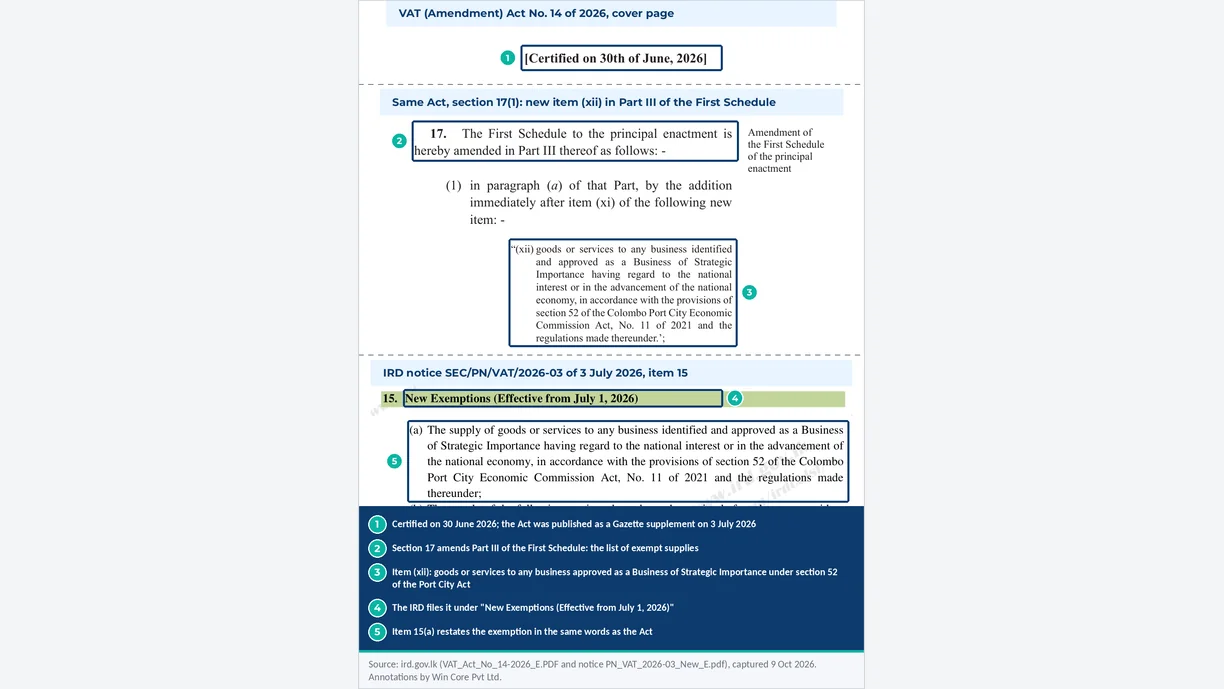
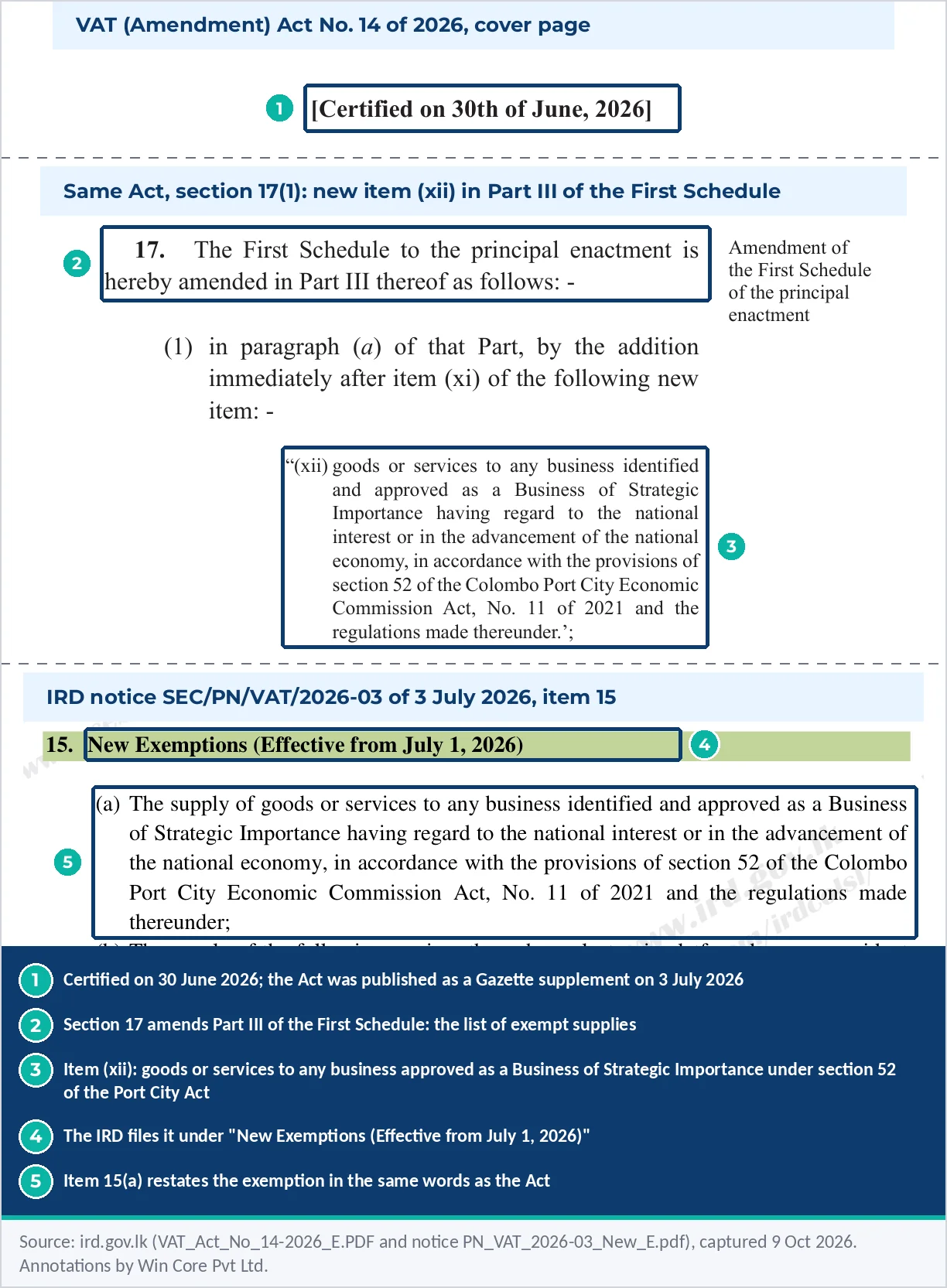
The exemption is in an Act of Parliament, not a gazette. Section 17(1) of the Value Added Tax (Amendment) Act No. 14 of 2026 adds a new item (xii) to paragraph (a) of Part III of the First Schedule to the VAT Act [1]. Paragraph (a) lists "the supply or import of" goods and services that are exempt, and the new item reads: "goods or services to any business identified and approved as a Business of Strategic Importance having regard to the national interest or in the advancement of the national economy, in accordance with the provisions of section 52 of the Colombo Port City Economic Commission Act, No. 11 of 2021 and the regulations made thereunder" [1]. Under section 8 of the VAT Act, a supply listed in the First Schedule is not a taxable supply [3].
The date needs a word of care. The Act was certified on 30 June 2026 and published as a Gazette supplement on 3 July 2026 [1]. Its text gives item (xii) no commencement date of its own. The IRD's notice of 3 July 2026 lists it under "New Exemptions (Effective from July 1, 2026)" [2], which is the date suppliers are working to. KPMG's July 2026 summaries reproduce the IRD's wording and date [10] [11]. The idea was first announced in the 2025 Budget [12], so it has been expected for some time, but it was not law until the 2026 Act.
Instrument: Value Added Tax (Amendment) Act No. 14 of 2026, s.17(1), inserting item (xii) in para (a), Part III, First Schedule, VAT Act No. 14 of 2002; IRD notice SEC/PN/VAT/2026-03, item 15(a). Official link: VAT (Amendment) Act No. 14 of 2026. Last verified: 9 Oct 2026.
Before relying on the supplier exemption, trace the BSI designation and relief Gazette chain for the customer concerned.
Who holds the passport
Not every Port City business. A BSI is a business that has gone through a specific process under sections 52 and 53 of the Port City Act. The Commission recommends it; the Cabinet approves the designation and the exemptions; and within two weeks of Cabinet approval an Order is published in the Gazette specifying, among other things, the rationale, the exemptions and their dates, and the name of the applicant [4]. That Order is the passport.
Since September 2025, regulations under section 52 divide BSIs into Primary BSIs, which meet investment and employment thresholds, and Secondary BSIs, which are other authorised persons identified as BSIs [6]. The regulations themselves do not mention VAT. Item (xii) refers to any business approved as a BSI under section 52 "and the regulations made thereunder" [1], so on its words it covers both tiers.
The Commission's laws and regulations page does not publish a register of BSIs [9]. In practice, the customer will have to show you its Order.
Instrument: Colombo Port City Economic Commission Act No. 11 of 2021, ss.52 and 53, as amended by Act No. 1 of 2026; Colombo Port City Economic Commission Regulations No. 1 of 2025, Gazette Extraordinary 2454/62 of 20 September 2025. Official link: Port City Act No. 11 of 2021. Last verified: 9 Oct 2026.
Invoices before and after 1 July
The date on the invoice does not decide which side of the line a supply falls. The time of supply does, and the VAT Act fixes it by rule. For services, the supply takes place at the earliest of: the service being performed, a payment being received, a payment falling due, or an invoice being issued [3]. If an invoice is issued within ten days of performance, the invoice date replaces the performance date [3]. Goods follow the same pattern, with delivery in place of performance [3]. For agreements with periodic payments, such as a monthly retainer, the supply takes place when each payment is due or received, whichever is earlier [3].
That gives a few simple outcomes. The June maintenance retainer fee is taxable. The July fee paid in advance on 25 June is also taxable, because the payment was received in June. The July fee due on 1 July and paid on 3 July is exempt. The harder cases are work finished in the last days of June and invoiced in early July. On our reading of section 4 those are exempt if nothing was due or paid in June, but they are close enough to the line that we would confirm each one before dropping the VAT.
The 2026 Act contains no transitional rule for item (xii) [1]. Two practical points follow. First, an exempt supply should not carry a tax invoice: section 20 provides for tax invoices on taxable supplies by registered persons [3]. Issue an ordinary invoice and state that the supply is exempt under item (xii). Second, if you charged VAT to a BSI on a supply made after 1 July, that tax was overcharged. Section 25 provides for a credit note to correct it [3], and your customer will expect one, because VAT that should not have been charged is not input tax it can claim.
Instrument: VAT Act No. 14 of 2002, ss.4, 20 and 25 (consolidated to 2025). Official link: VAT Act consolidation 2025. Last verified: 9 Oct 2026.
What happens to your input VAT
This is where suppliers pay for their customers' relief. Input tax is the VAT you pay on purchases used for your taxable activity [3]. Once some of your sales are exempt, the purchases behind those sales no longer support taxable supplies. Section 22(3) says that where purchases are used partly for taxable activity and partly for other purposes, the tax is apportioned, and "only so much of the tax ... as is referable to his taxable activity" counts as input tax [3].
Take a supplier with Rs 10 million of monthly sales, Rs 3 million of them to a BSI, and Rs 900,000 of VAT on shared costs such as rent, software and transport. In June it claims all Rs 900,000. In July, if it apportions by turnover, it claims Rs 630,000 and the other Rs 270,000 becomes a cost of doing business. VAT it pays on purchases used only for the BSI contract cannot be claimed at all. Figure 2 sets out the month.
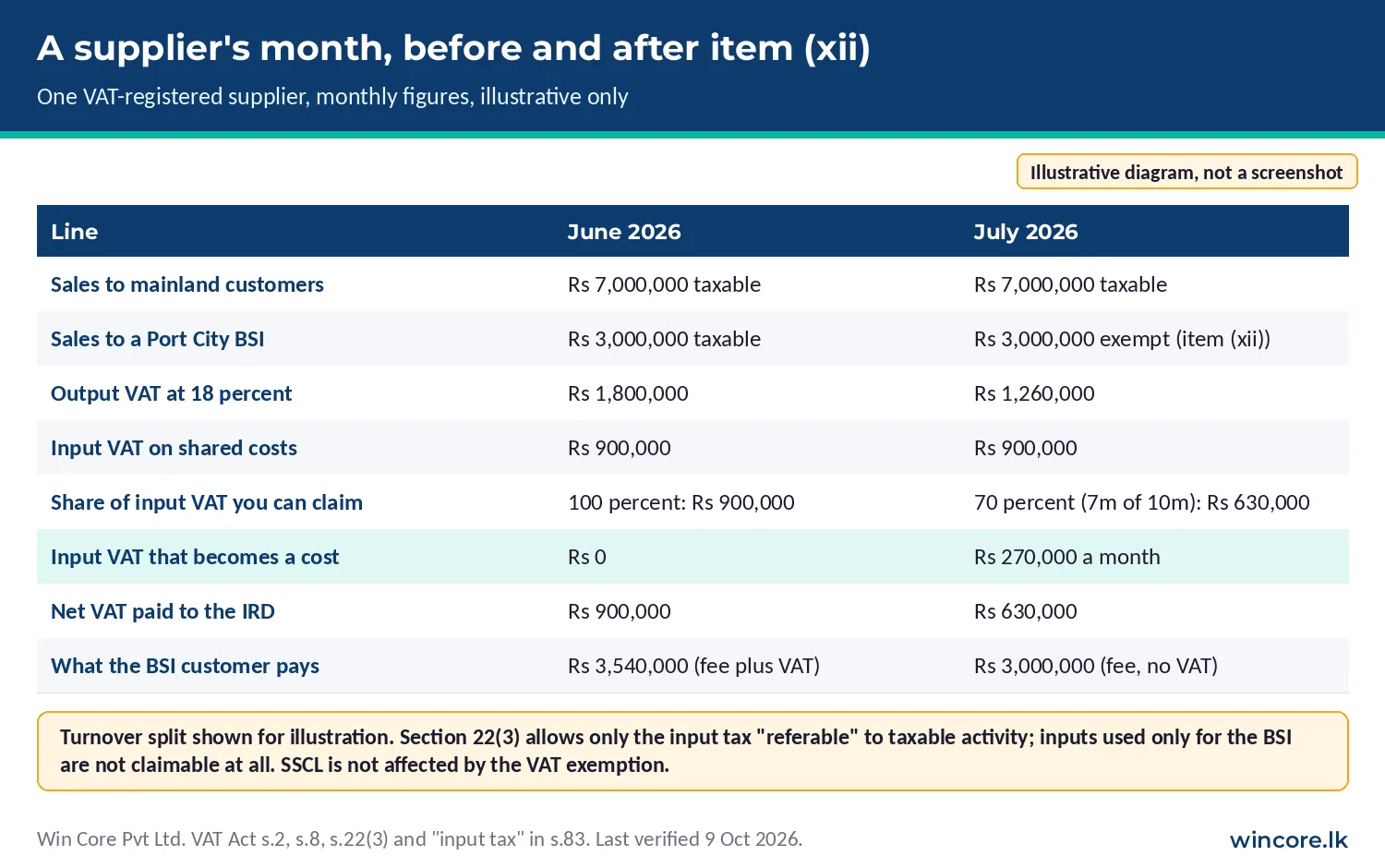
Turnover is the simplest way to apportion, but the Act does not prescribe one method, so agree yours with your adviser and use it consistently. Two further effects are easy to miss. Exempt supplies are not taxable supplies [3], so they do not count towards the VAT registration threshold. A supplier whose main customers are BSIs may find its taxable turnover falling below the threshold, which section 16 links to cancellation of registration [3]. The thresholds themselves have not changed [2]; our article on VAT and SSCL thresholds in 2026 sets them out, including the registration test.
Instrument: VAT Act No. 14 of 2002, ss.8, 16, 22(3) and the definition of "input tax" in s.83 (consolidated to 2025). Official link: VAT Act consolidation 2025. Last verified: 9 Oct 2026.
Keep the BSI concession distinct from other VAT exemptions and their supporting evidence.
What does not change: SSCL
The Social Security Contribution Levy is a separate tax with its own exemption schedule, and we found no BSI or Port City exemption in it [7]. A VAT exempt supply to a BSI can still carry SSCL.
Instrument: Social Security Contribution Levy Act No. 25 of 2022, consolidated text to 9 April 2026, First and Second Schedules. Official link: SSCL Act consolidated. Last verified: 9 Oct 2026.
The passport can be withdrawn
The 2026 amendment to the Port City Act added ex-post monitoring. The Commission evaluates BSIs against their approved key performance indicators; a BSI that fails to take corrective action can have "any or all exemptions or incentives granted under this Act" restricted, suspended or revoked, after a show cause notice giving one month to respond [5] [8]. Item (xii) is an exemption under the VAT Act, not under the Port City Act, but it depends on the customer being a business "approved as a Business of Strategic Importance" [1]. If the designation goes, we would expect the VAT exemption to go with it. Neither Act says how that would be announced to suppliers.
Instrument: Colombo Port City Economic Commission (Amendment) Act No. 1 of 2026, s.14, inserting ss.52A to 52E. Official link: Port City (Amendment) Act No. 1 of 2026. Last verified: 9 Oct 2026.
What this means for you
If you supply a Port City business:
- Ask each Port City customer whether it is a BSI, and for a copy of its gazette Order. Keep it on the customer file with a short written confirmation from the customer that the designation is current.
- From 1 July 2026, invoice BSI customers without VAT, on an ordinary invoice that cites item (xii). Check any June advance payments and late June work against the time of supply rules.
- Issue credit notes for any VAT charged to a BSI on supplies made after 1 July.
- Re-run your input VAT apportionment from the July return, and price the lost input credit into your BSI contracts.
- Keep charging SSCL where it applies.
- Re-check your VAT registration position if BSI sales are a large share of your turnover.
If you are a BSI:
- Send your Order to your suppliers now, and to new suppliers at onboarding. Without it, a careful supplier will keep charging VAT.
- Review invoices issued since 1 July and ask for credit notes where VAT was charged.
- Expect some suppliers to raise prices to recover the input VAT they can no longer claim.
- Keep your KPIs on track. The exemption depends on the designation.
Points the law does not yet settle
We would not present these as settled. Port City operations only? Exemptions granted under section 52 of the Port City Act relate to a BSI's operations "in and from the Area of Authority" [4]; item (xii) refers to section 52 but does not repeat that limit [1]. Whether a supply to a BSI's activity outside Port City is covered is unclear. Imports by a BSI. Paragraph (a) covers "the supply or import of" listed items, and item (xii) speaks of goods or services "to" a BSI [1]; whether a BSI's own imports are covered is not addressed in the IRD notice [2]. Evidence. Neither the Act nor the notice says what a supplier must hold. The Order and a customer confirmation are our recommendation, not a legal requirement. Date. The IRD's 1 July 2026 date is not written into the Act's text.
Frequently asked questions
Is this exemption in a gazette?
No. It is in section 17(1) of the VAT (Amendment) Act No. 14 of 2026 [1]. The gazette that matters is your customer's BSI Order under section 53(3) of the Port City Act [4].
Does every company in the Port City get VAT free supplies?
No. Only businesses designated as BSIs under section 52 [1] [4].
Can I still claim input VAT on costs linked to a BSI contract?
Not on costs used only for that contract. Shared costs are apportioned under section 22(3) [3].
Is SSCL also exempt?
We found no BSI exemption in the SSCL Act [7].
Talk to us. If you supply Port City businesses, or you hold a BSI Order and want your suppliers' invoices right from July, our tax services team can review the position. Book a consultation at our contact page. Return dates are on our tax calendar.
Check the passport first. Then drop the VAT.
WinCore Pvt Ltd
This article is general information on the law as at 9 October 2026 and is not advice on your specific position.
References
- Parliament of Sri Lanka. Value Added Tax (Amendment) Act, No. 14 of 2026, certified 30 June 2026, published as a Supplement to Part II of the Gazette of 3 July 2026, s.17(1). https://www.ird.gov.lk/en/publications/Value%20Added%20Tax_Acts/VAT_Act_No_14-2026_E.PDF (also at https://documents.gov.lk/api/content-file-proxy?file=%2Fact-content%2F14-2026_E_1784552930.pdf). Primary. Accessed 9 October 2026.
- Inland Revenue Department. Notice to the Taxpayers: Amendments to the Value Added Tax Act, No. 14 of 2002, SEC/PN/VAT/2026-03 (3 July 2026), items 3 and 15. https://www.ird.gov.lk/en/Lists/Latest%20News%20%20Notices/Attachments/799/PN_VAT_2026-03_New_E.pdf . Primary. Accessed 9 October 2026.
- Inland Revenue Department. Value Added Tax Act, No. 14 of 2002, consolidated version up to 2025, ss.2, 4, 8, 16, 20, 22, 25 and 83. https://www.ird.gov.lk/en/publications/Value%20Added%20Tax_Acts/VAT_Act_No_14%5BE%5D_2002_%28Consolidation_2025%29.pdf . Primary. Accessed 9 October 2026.
- Parliament of Sri Lanka. Colombo Port City Economic Commission Act, No. 11 of 2021, ss.52 and 53. https://www.portcitycolombo.gov.lk/resources/documents/acts/11-2021_E.pdf . Primary. Accessed 9 October 2026.
- Parliament of Sri Lanka. Colombo Port City Economic Commission (Amendment) Act, No. 1 of 2026, ss.13 to 15 (new ss.52A to 52E). https://www.portcitycolombo.gov.lk/resources/documents/acts/01-2026_E.pdf . Primary. Accessed 9 October 2026.
- Colombo Port City Economic Commission. Colombo Port City Economic Commission Regulations No. 1 of 2025, Gazette Extraordinary No. 2454/62 (20 September 2025), paras 3 to 6. https://www.portcitycolombo.gov.lk/resources/documents/extragazettes/2454-62_E.pdf . Primary. Accessed 9 October 2026.
- Inland Revenue Department. Social Security Contribution Levy Act, No. 25 of 2022, consolidated text including 2026 changes. https://www.ird.gov.lk/si/publications/Acts_SSCL/SSCL_Cons_Act_-_2026_Changes.pdf . Primary. Accessed 9 October 2026.
- Parliament of Sri Lanka. Speaker endorses the certificate on the Colombo Port City Economic Commission (Amendment) Bill, Parliament news (21 January 2026). https://www.parliament.lk/en/home/parliament-news/view/5035 . Primary. Accessed 9 October 2026.
- Colombo Port City Economic Commission. Laws and regulations, web page. https://www.portcitycolombo.gov.lk/laws-and-regulations . Primary. Accessed 9 October 2026.
- KPMG Sri Lanka. Tax Flash News: Notice on Amendments to the VAT Act (July 2026). https://assets.kpmg.com/content/dam/kpmgsites/lk/pdf/kpmg-tax-news/2026/july/Notice_on_Amendments_to_the_VAT_Act.pdf . Secondary (corroboration). Accessed 9 October 2026.
- KPMG US. Sri Lanka: Value added tax amendment act No. 14 of 2026 introduces VAT on nonresident digital service providers, TaxNewsFlash (July 2026). https://kpmg.com/us/en/taxnewsflash/news/2026/07/tnf-sri-lanka-value-added-tax-amendment-act-no-14-of-2026-introduces-vat-on-nonresident-digital-service-providers.html . Secondary (corroboration). Accessed 9 October 2026.
- Daily FT. Key tax moves in Budget 2025. https://www.ft.lk/front-page/Key-tax-moves-in-Budget-2025/44-773163 . Secondary (Budget proposal only). Accessed 9 October 2026.
Put these insights to work
WinCore specialists can review your current workflow, document gaps, and build a practical 90-day action plan.
Book a free consultationContinue reading
Explore more WinCore analysis to keep your finance, tax, and compliance roadmap moving.
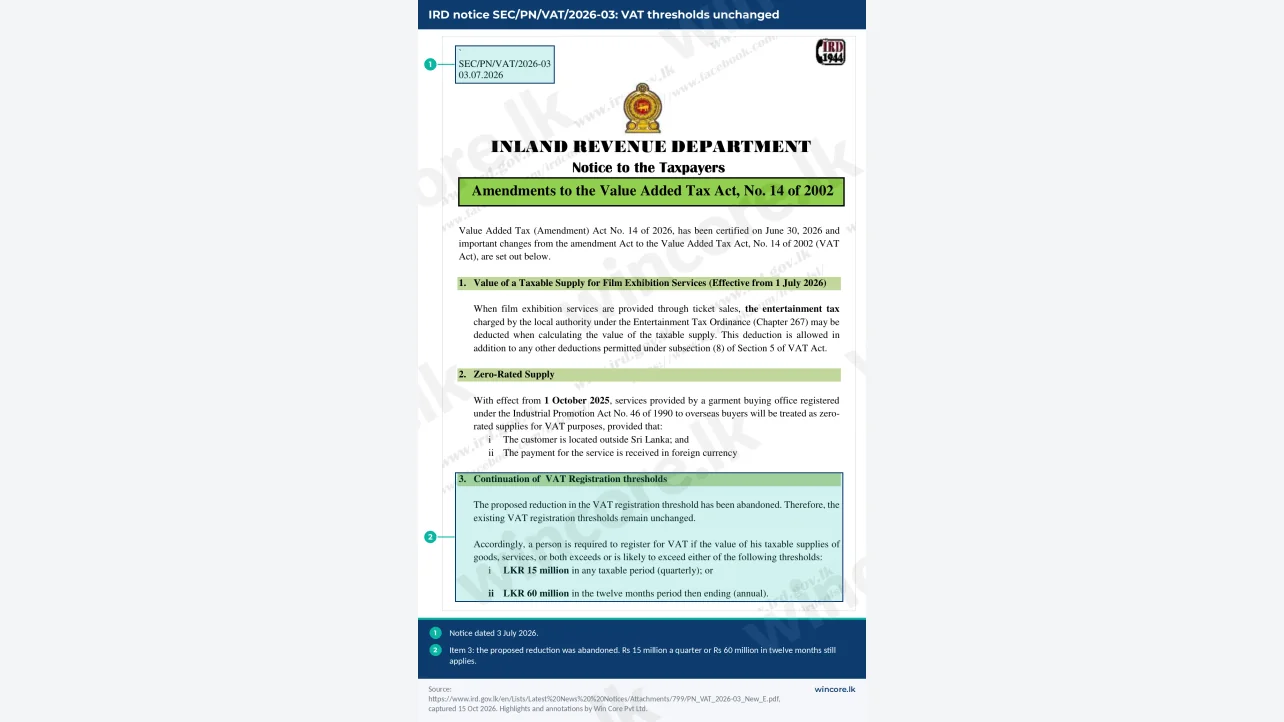
The VAT registration tests are Rs 15 million a quarter or Rs 60 million over 12 months. How the tests run, the 15 day rule and who must register.
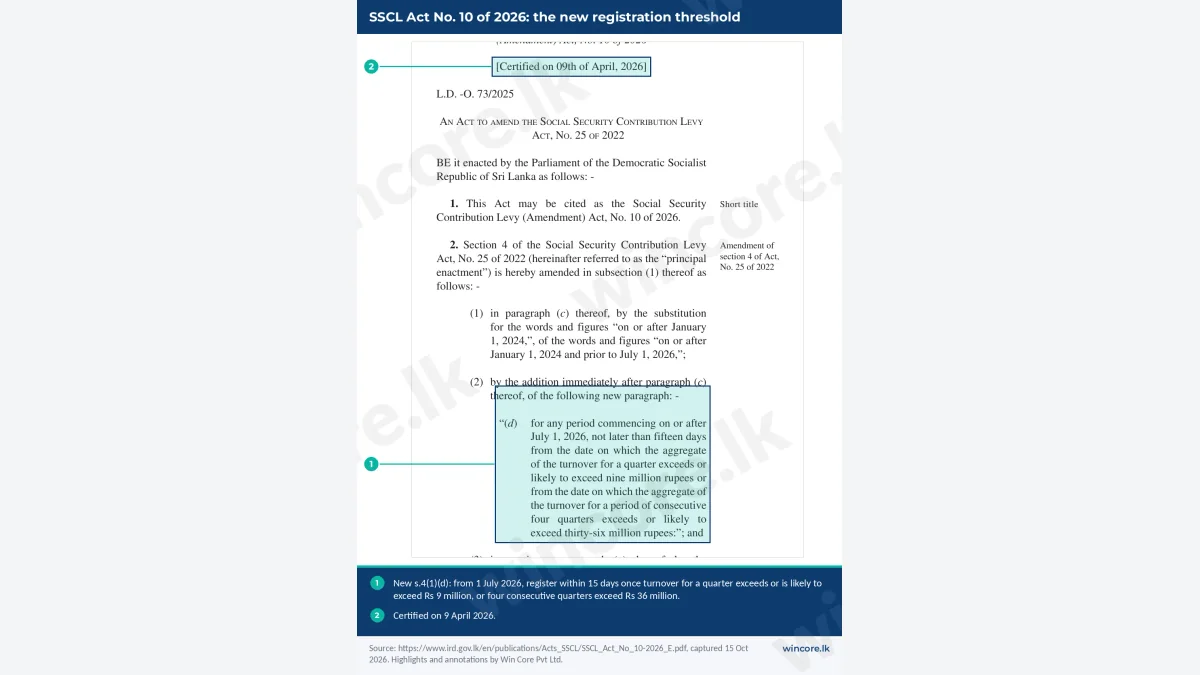
SSCL registration now starts at Rs 9 million a quarter or Rs 36 million a year from 1 July 2026. How to test, register and pay monthly.
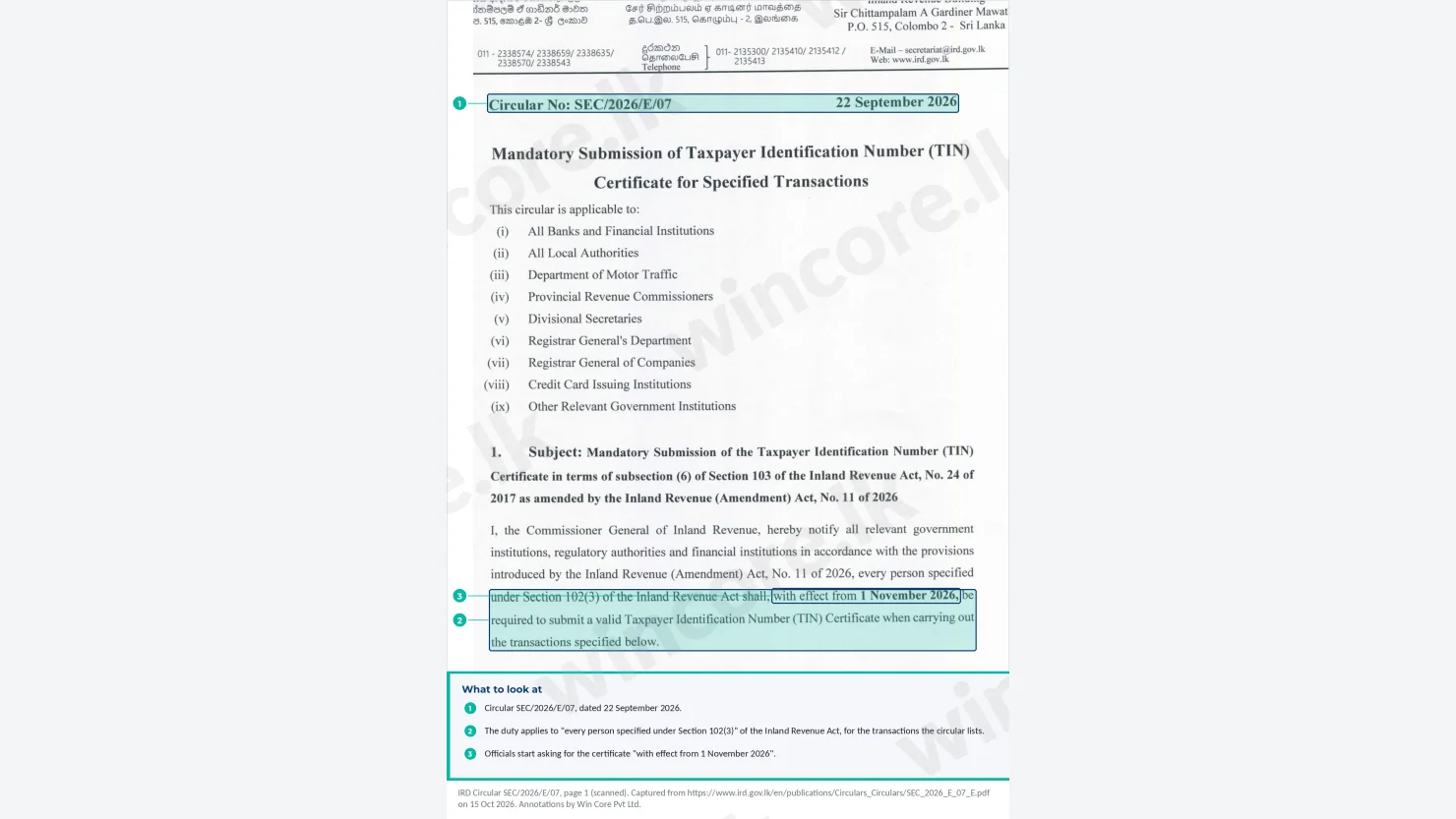
What the IRD circular says, clause by clause: eight transactions, five exemptions, the 1 April and 1 November dates, and why a company still needs a TIN.