
VAT registration for exporters in Sri Lanka needs a sale document
Exporting goods makes VAT registration compulsory, whatever your turnover. What the Act requires, what the IRD's own guide asks for, and the fifteen days.
On this page
Last verified against the primary sources on 22 October 2026.
VAT registration for exporters in Sri Lanka does not depend on turnover. Since the VAT (Amendment) Act No. 4 of 2025 became law on 11 April 2025, section 10(1)(ix) of the VAT Act requires any person who "imports or exports goods for commercial purposes" to register, and section 10(2) gives fifteen days from liability to apply. The Act lists no documents. The IRD's 2026 registration guide does: for exporters it asks for a "Performa invoice", a proforma invoice to a buyer, with the usual business and address papers [1] [2] [4].
The first layer is law. The second is administration, and it can change without Parliament. This piece keeps them apart.
Take a hypothetical coir products maker in Kurunegala that sells only in Sri Lanka, turns over about Rs 25 million a year and has never registered for VAT, because it is well below the Rs 60 million line. A buyer in Rotterdam now wants a first container of coir doormats. Must the maker register, by when, and what will the IRD ask for?
VAT registration for exporters is required at any turnover under section 10(1)(ix)
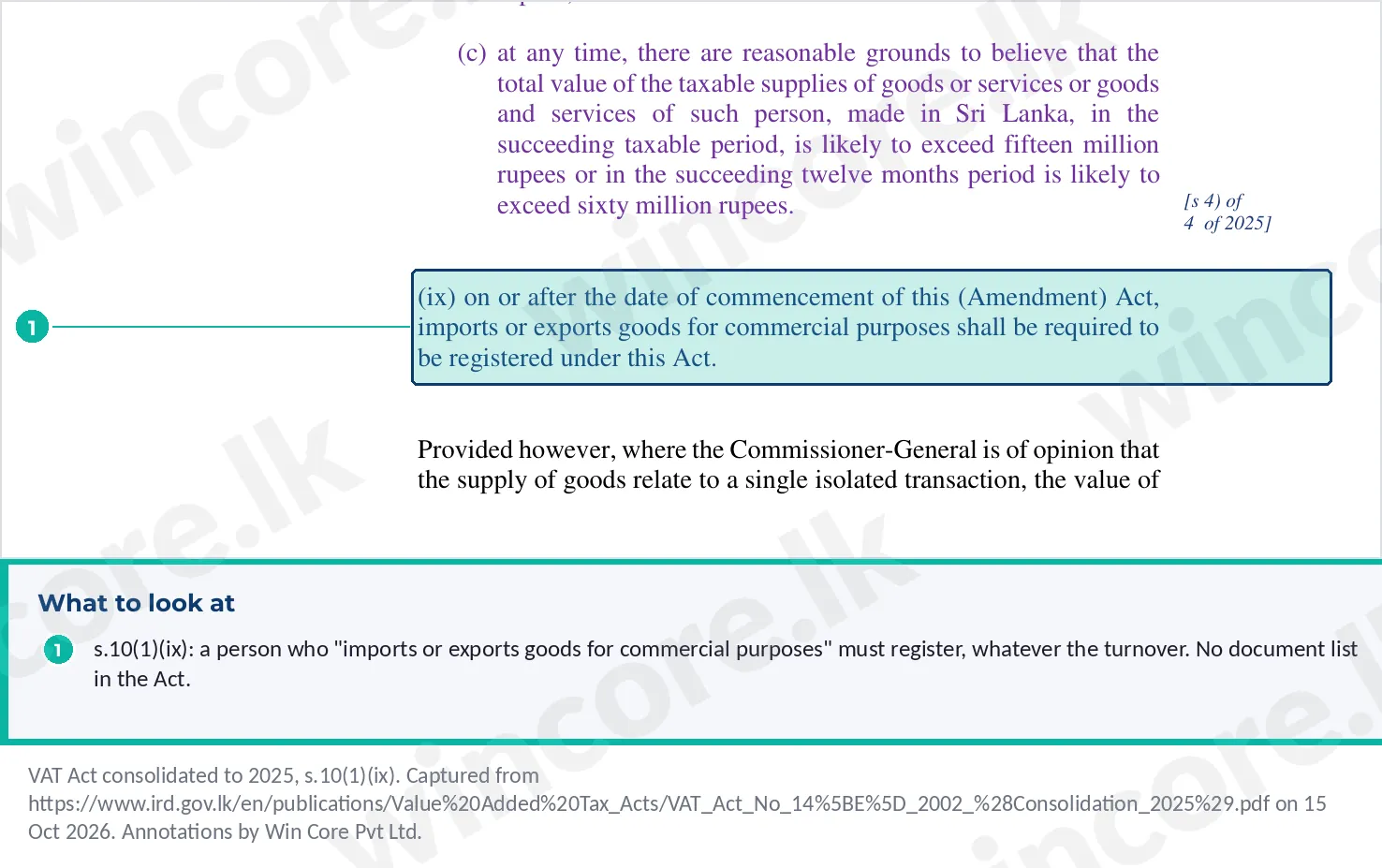
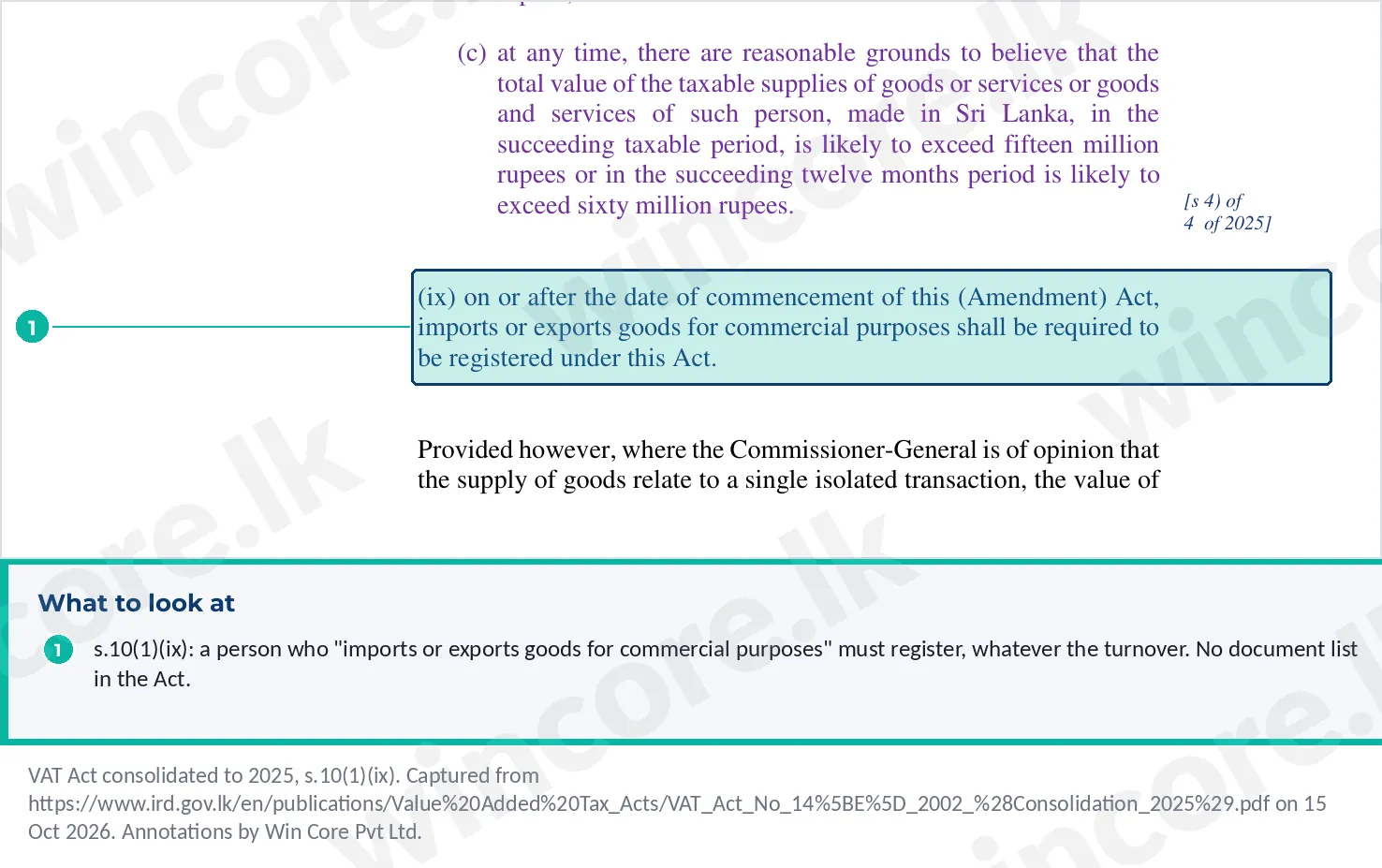
The rule. A person who "on or after the date of commencement of this (Amendment) Act, imports or exports goods for commercial purposes shall be required to be registered under this Act" (s.10(1)(ix)) [1]. The paragraph was inserted by section 4 of Act No. 4 of 2025 [2].
When it took effect. Section 1(2) of Act No. 4 of 2025 says its provisions, other than one backdated item in section 3, "shall come into operation on the date on which the Bill becomes an Act of Parliament". The Act was certified on 11 April 2025, so paragraph (ix) runs from that day [2]. The IRD's VAT page states the same rule in its own words: "All persons importing or exporting goods for commercial purposes will be required to register under the VAT Act, regardless of turnover thresholds or exemptions" [5].
Three features matter:
- No turnover test. Paragraph (viii) carries the Rs 15 million a quarter and Rs 60 million a year tests; paragraph (ix) carries none. Our maker is well below both and still has to register once it exports. How the turnover tests run is in our guide to VAT registration thresholds.
- Goods, not services. The paragraph says "goods". A business that exports services is tested under the other paragraphs; the income tax and VAT position of service exports is in our article on foreign service export tax.
- "For commercial purposes." The Act does not define the phrase. A gift or a personal shipment is outside the words. The proviso after paragraph (ix) lets the Commissioner-General exclude "a single isolated transaction" when "calculating the total value of taxable supplies"; on our reading that limb works on the value tests and does not touch paragraph (ix), which has no value test, so a one-off commercial export is still caught [1].
The Act sets the fifteen days, not the documents
Every person required to be registered "shall make an application for registration in the specified form to the Commissioner-General not later than fifteen days from the date on which is so liable to be registered" (s.10(2)) [1]. The Act says "in the specified form" and nothing about attachments.
If no application is made, section 14(1)(c) lets the Commissioner-General register the person anyway, "after affording such person an opportunity of being heard", "with effect from such date as may be determined by him" [1]. That date can sit well before the IRD noticed.
| Question | VAT Act | IRD guide (2026) |
|---|---|---|
| Must an exporter of goods register? | Yes, s.10(1)(ix) | Lists "Import & Export" as its own category |
| By when? | Fifteen days from liability, s.10(2) | Not stated |
| On what form? | "the specified form" | e-Services, with the listed documents |
| Which sale document? | Not stated | "Performa invoice for exporters" |
| Penalty for not applying | s.67(a) offence | Not stated |
The document list is the IRD's, and it can change. It cannot extend the s.10(2) clock: if collecting papers takes longer than fifteen days, that is a practical risk, not a legal extension.
The IRD asks exporters for a proforma invoice
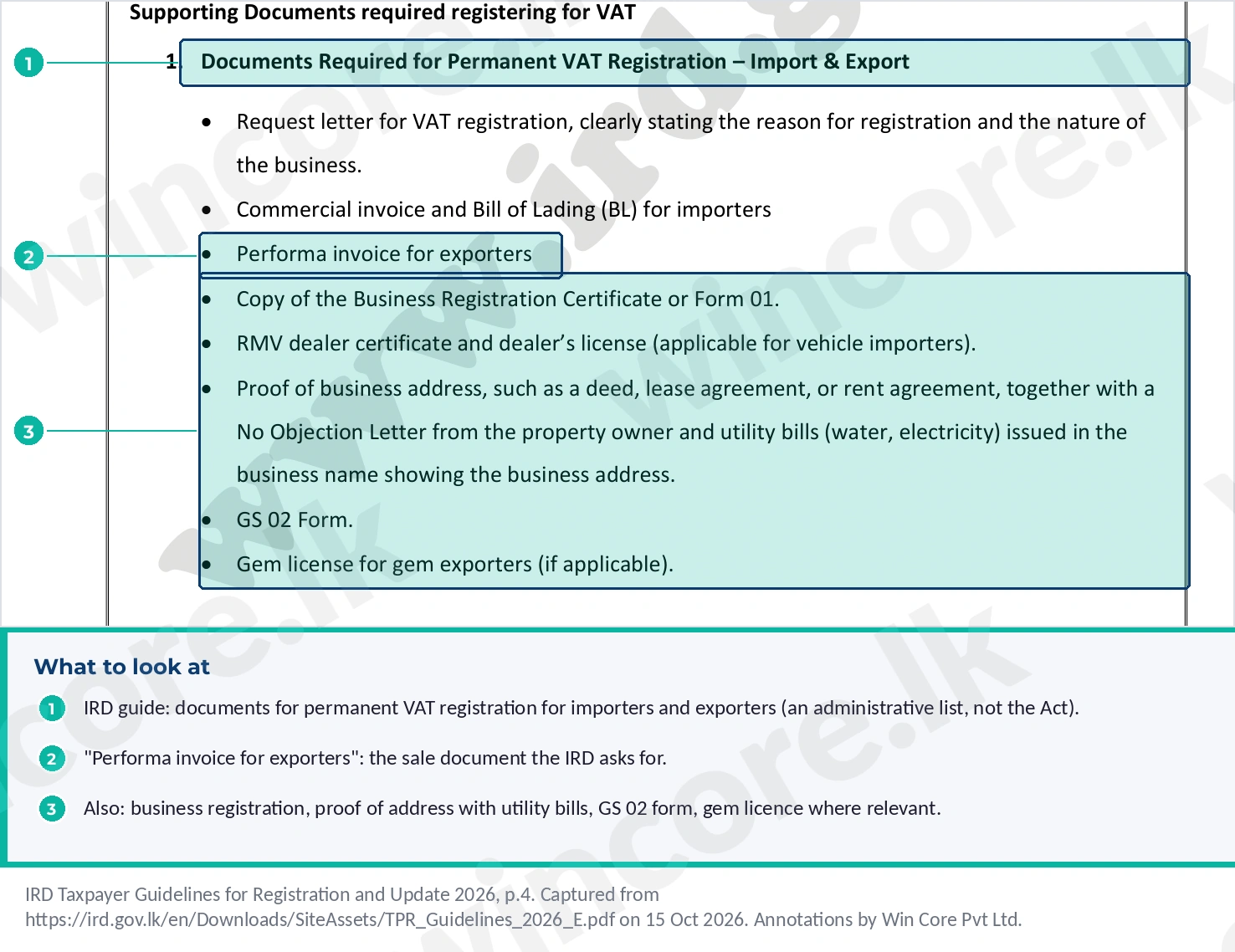
The IRD guide is administrative. Under "Documents Required for Permanent VAT Registration - Import & Export" it lists [4]:
| Document | Who |
|---|---|
| Request letter "clearly stating the reason for registration and the nature of the business" | All |
| "Commercial invoice and Bill of Lading (BL)" | Importers |
| "Performa invoice" (proforma invoice) | Exporters |
| Business Registration Certificate or Form 01 | All |
| RMV dealer certificate and dealer's licence | Vehicle importers |
| Proof of business address, a no objection letter from the owner and utility bills in the business name | All |
| GS 02 Form | All |
| Gem licence | Gem exporters, if applicable |
So the sale document for an exporter is a proforma invoice: the exporter's own priced offer to a named buyer, before the goods move. The guide also says registration details "should be updated prior to applying for any/all tax type(s) including Permanent VAT" [4]. The guide spells it "Performa"; nothing turns on the spelling.
Two IRD documents, two different lists
The IRD's VAT web page carries an older and shorter list, which includes "Documents to prove that exports were made continuously by such exporters" [5]. That reads as evidence of a history of exports, which a first-time exporter cannot give; the 2026 guide's proforma invoice is a forward-looking document. On our reading the 2026 guide is the current list, but take both to the application if you can.
Activation and Temporary VAT
Where a VAT tax type already exists but is inactive, the guide asks instead for "document proof confirming taxable supplies", listing "Sales invoices / Purchase orders/ Sales agreements / Bank statements / Rent agreement/ Airway bill / Bill of lading / Commercial invoice with bank endorsement", and certificates from bodies such as the Tea Board [4]. It also describes Temporary VAT, "required to undertake import, export and re-export activities via Sri Lanka Customs, for those who have not obtained a permanent Value Added Tax registration" [4]. The guide does not say how Temporary VAT sits with the duty in section 10(1)(ix) for a regular exporter; we treat that as open.
Exports are zero rated, so registering is not a tax on the export
Registration does not mean charging 18 percent to the foreign buyer. Under section 7(1)(a), a supply of goods "shall be zero rated where the supplier of such goods has exported such goods for which payment is received in foreign currency through a bank in Sri Lanka licenced under the Banking Act" "within a period of six months from the end of the taxable period" of export [1]. Miss the bank route or the six months and the zero rate is lost on that export.
Registration does change the maker's local sales. Once registered, its taxable sales inside Sri Lanka carry VAT, and it can claim input tax on its purchases under section 22 [1]. Our VAT calculator shows the effect on a local price. Act No. 14 of 2026 also rewrote "eligible exporter" as a registered person whose zero-rated supplies in the preceding calendar year were "greater than fifty percent" of all its supplies, a definition that matters for refunds [3].
Failing to apply is an offence under section 67
| Default | Consequence | Section |
|---|---|---|
| Failing to apply for registration under s.10 | Offence. Periods before 1 October 2025: fine up to Rs 25,000 or up to six months, or both. Periods on or after 1 October 2025: fine "not exceeding one million rupees" or up to six months, or both | s.67(a), as amended by Act No. 14 of 2026, s.13 [1] [3] |
| No application made | Commissioner-General may register you after a hearing, from a date he determines | s.14(1)(c) [1] |
We do not borrow the separate evasion penalty in section 66 for a late application. Whether the Rs 1 million band can apply to conduct before 30 June 2026, when Act No. 14 became law, is discussed in our article on the VAT Amendment Act No. 14 of 2026.
Common misreadings
- "Exporters only register above Rs 60 million." Section 10(1)(ix) has no turnover test.
- "The Act says we need a proforma invoice." The Act is silent on documents; the IRD guide asks for it.
- "Registering means charging VAT to the foreign buyer." Exports of goods are zero rated under s.7(1)(a), if the foreign currency payment comes through a licensed bank in time.
- "Without a buyer we cannot be liable." Liability turns on exporting goods for commercial purposes, not on having a document ready.
Worked example: the coir products maker
The maker agrees price and terms with the Rotterdam buyer on 5 November 2026, for shipment in December. On our reading it is now about to export goods commercially, and the cautious course is to treat 5 November as the date of liability. It issues a proforma invoice dated 5 November 2026 on its letterhead, addressed to the buyer, with the goods, quantity, price, currency and delivery terms. It updates its TIN details, gathers its business registration, address proof, utility bills and GS 02 form, and applies for permanent VAT through e-Services by 20 November 2026, fifteen days later. When the container ships and the dollars arrive through its bank within six months of the quarter's end, the export is zero rated. Its local sales carry VAT from the date its registration takes effect.
What this means for you
If you export goods commercially, you must register for VAT whatever your turnover, and apply within fifteen days of becoming liable. Prepare the proforma invoice early, because the IRD expects one. Route export receipts through a licensed bank in foreign currency so the zero rate holds. Our tax services team handles VAT registration and returns for exporters.
Checklist: documents needed
- Request letter stating the reason for registration and the nature of the business
- Proforma invoice to your buyer, dated, priced and addressed
- Business Registration Certificate or Form 01
- Proof of business address, no objection letter and utility bills in the business name
- GS 02 Form, and any sector licence such as a gem licence
- Updated TIN registration details on e-Services
Open points
- "For commercial purposes" is not defined in the Act.
- When an exporter becomes "liable to be registered" under s.10(1)(ix): the first firm order, the first shipment, or earlier. We read it as when commercial exporting begins or is imminent.
- How Temporary VAT for exports sits with s.10(1)(ix) for a regular exporter: no IRD statement found in the 2026 guide or on the IRD VAT page (checked 22 October 2026).
- Whether the IRD accepts a sales agreement or purchase order in place of a proforma invoice for permanent registration: the 2026 guide names the proforma invoice for this category and lists the other documents only for activation.
- Which of the two IRD document lists an officer will apply.
FAQ
Must a small exporter register for VAT in Sri Lanka?
Yes, if it exports goods for commercial purposes. Section 10(1)(ix) of the VAT Act, inserted from 11 April 2025, has no turnover test, so a business well below Rs 15 million a quarter or Rs 60 million a year must still register once it exports. It applies within fifteen days of becoming liable under section 10(2) [1] [2].
What sale document does the IRD want from an exporter?
A proforma invoice. The IRD's 2026 registration guide lists a "Performa invoice for exporters" among the documents for permanent VAT on the import and export basis, alongside a request letter, business registration, address proof with utility bills and the GS 02 form. Importers give a commercial invoice and bill of lading instead [4].
Is the proforma invoice a requirement of the VAT Act?
No. The Act only requires an application "in the specified form" within fifteen days. The document list comes from the IRD's administrative guide, which can change without an amendment to the Act. The fifteen days in section 10(2) do not stretch while you collect the documents, so prepare them early [1] [4].
Does an exporter charge VAT to its foreign buyer?
Usually not. Exported goods are zero rated under section 7(1)(a) where payment is received in foreign currency through a licensed bank in Sri Lanka within six months from the end of the taxable period of export. Registration still brings the exporter's local sales into VAT and lets it claim input tax [1].
What happens if an exporter does not register?
Failing to apply is an offence under section 67(a). For periods from 1 October 2025 the fine is up to Rs 1 million, or up to six months' imprisonment, or both. Separately, the Commissioner-General may register you under section 14(1)(c), after a hearing, from a date he decides [1] [3].
This article is general information on the law as at 22 October 2026, not advice for your specific situation.
Talk to us. If you are starting to export and need your VAT registration and returns in order, contact us at our contact page.
WinCore Pvt Ltd
References
- Inland Revenue Department. Value Added Tax Act, No. 14 of 2002 (Consolidation 2025), ss.7(1)(a), 10(1)(viii) and (ix) with provisos, 10(2), 14(1)(c), 22 and 67(a). https://www.ird.gov.lk/en/publications/Value%20Added%20Tax_Acts/VAT_Act_No_14%5BE%5D_2002_%28Consolidation_2025%29.pdf . Primary. Accessed 22 October 2026.
- Parliament of Sri Lanka. Value Added Tax (Amendment) Act, No. 4 of 2025 (certified 11 April 2025), ss.1 and 4. https://www.ird.gov.lk/en/publications/Value%20Added%20Tax_Acts/VAT_Act_No_04-2025_E.pdf . Primary. Accessed 22 October 2026.
- Parliament of Sri Lanka. Value Added Tax (Amendment) Act, No. 14 of 2026 (certified 30 June 2026), ss.13 (amending s.67) and 16 ("eligible exporter"). https://www.ird.gov.lk/en/publications/Value%20Added%20Tax_Acts/VAT_Act_No_14-2026_E.PDF . Primary. Accessed 21 October 2026.
- Inland Revenue Department. Taxpayer Guidelines for Registration and Update (2026), Registration of Tax Types, Registration for Temporary VAT, Updating Tax Type Details. https://ird.gov.lk/en/Downloads/SiteAssets/TPR_Guidelines_2026_E.pdf . Primary (administrative). Accessed 22 October 2026.
- Inland Revenue Department. Value Added Tax web page, chargeability, importers and exporters, documents required for registration. https://www.ird.gov.lk/en/type%20of%20taxes/sitepages/value%20added%20tax%20(vat).aspx . Primary (administrative). Accessed 22 October 2026.
Put these insights to work
WinCore specialists can review your current workflow, document gaps, and build a practical 90-day action plan.
Book a free consultationContinue reading
Explore more WinCore analysis to keep your finance, tax, and compliance roadmap moving.
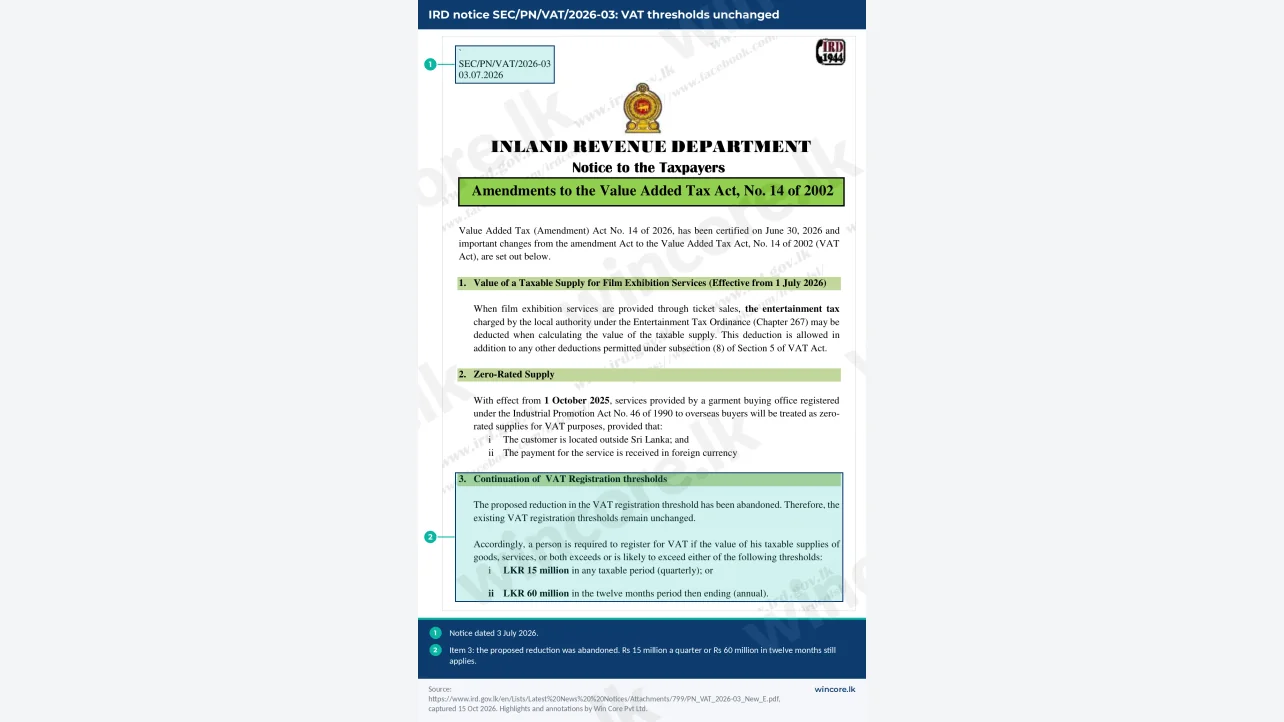
The VAT registration tests are Rs 15 million a quarter or Rs 60 million over 12 months. How the tests run, the 15 day rule and who must register.

Since 1 April 2025, profits from services used outside Sri Lanka and paid in foreign currency through a bank are taxed at 15%. The conditions and the records to keep.
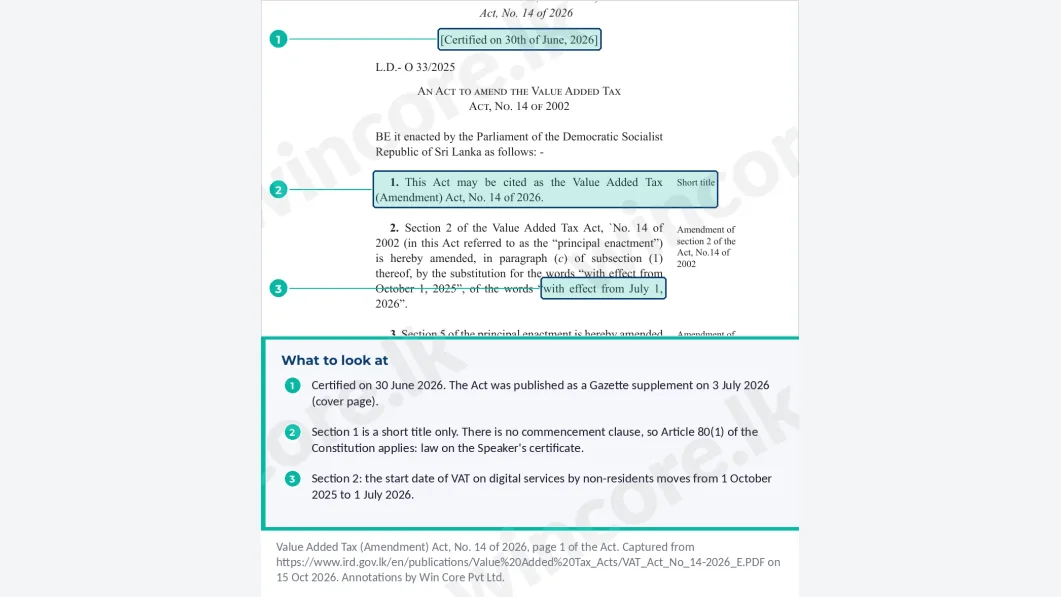
Digital services VAT, a 20.5 percent rate for financial services and Rs 1 million fines: each change in the 2026 VAT Act, with its own start date.