
VAT Amendment Act No. 14 of 2026: what changed and from when
Digital services VAT, a 20.5 percent rate for financial services and Rs 1 million fines: each change in the 2026 VAT Act, with its own start date.
On this page
Last verified against the primary sources on 21 October 2026.
The VAT Amendment Act No. 14 of 2026 was certified on 30 June 2026 and has no commencement clause, so it became law that day. Its own dates do the rest: VAT on digital services supplied by non-residents starts on 1 July 2026, financial services move from 18 to 20.5 percent for periods from 1 July 2026, and the maximum fine for VAT offences rises from Rs 25,000 to Rs 1 million for any period from 1 October 2025. The IRD notice of 3 July 2026 gives 1 July 2026 for most of the undated changes, one day after the statutory date [1] [3].
A penalty, a refund or a registration deadline is measured against the statutory date. The IRD notice is useful, and we quote it below, but it is a reading of the Act, not the Act.
Take a hypothetical VAT registered tyre distributor in Ratnapura that pays an overseas provider for a fleet-tracking subscription. Will the provider now add VAT, and what should the distributor do if it does?
VAT Amendment Act No. 14 of 2026 became law on 30 June 2026
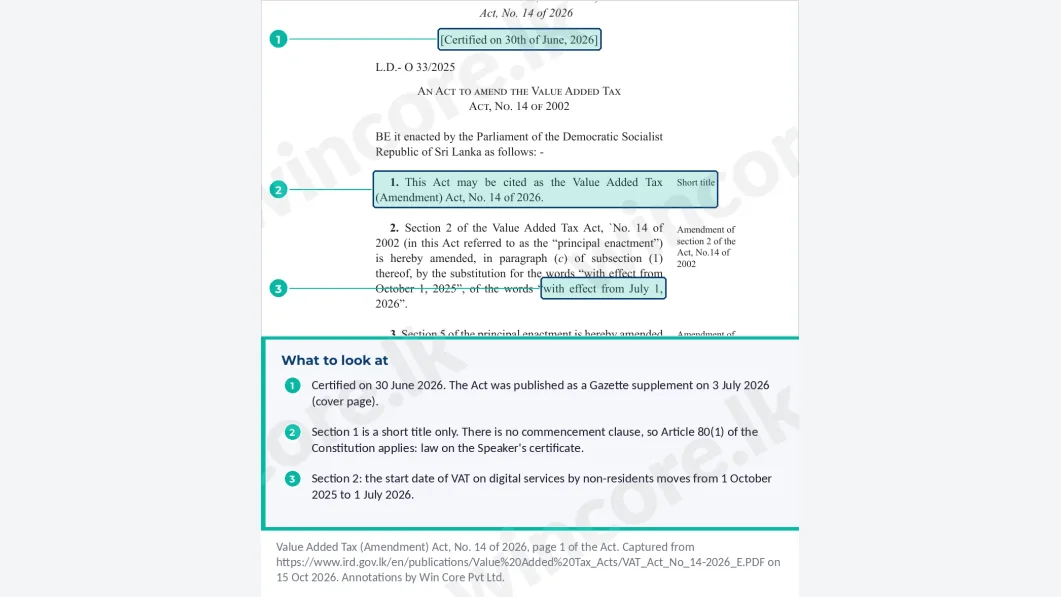
The Value Added Tax (Amendment) Act, No. 14 of 2026 amends the Value Added Tax Act, No. 14 of 2002. It was certified on 30 June 2026 and published as a Gazette supplement on 3 July 2026 [1]. The IRD lists it on its Acts page with the same certification date [8].
Section 1 is a short title only, with no commencement clause. Under Article 80(1) of the Constitution, "a Bill passed by Parliament shall become law when the certificate of the Speaker is endorsed thereon" [6]. So the Act became law on 30 June 2026, and a provision without its own date speaks from then.
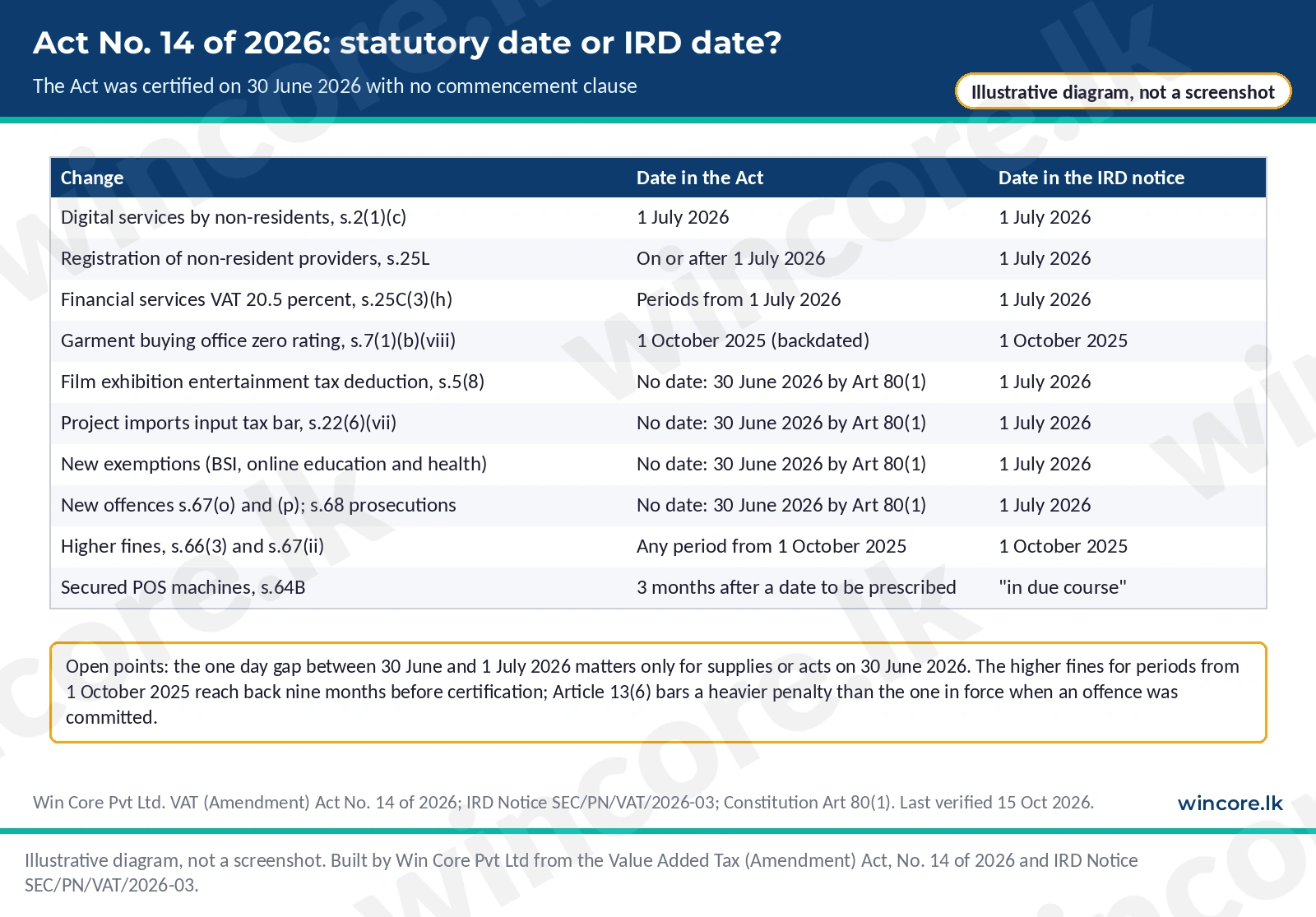
Three clocks: the dates in the Act against the IRD dates
Dates written into the Act. VAT on digital services moves to "with effect from July 1, 2026" (section 2). Registration of non-resident providers applies "on or after July 1, 2026" (new section 25L). Financial services VAT is 20.5 percent for periods "commencing on or after July 1, 2026" (section 7). Garment buying office services are zero rated "with effect from October 1, 2025" (section 4). The higher fines apply "for any period on or after October 1, 2025" (sections 12 and 13) [1].
No date in the Act. The entertainment tax deduction for film exhibitions, the input tax bar on project imports, the new offences, the new prosecution section and the new exemptions carry no date. On our reading they operate from 30 June 2026.
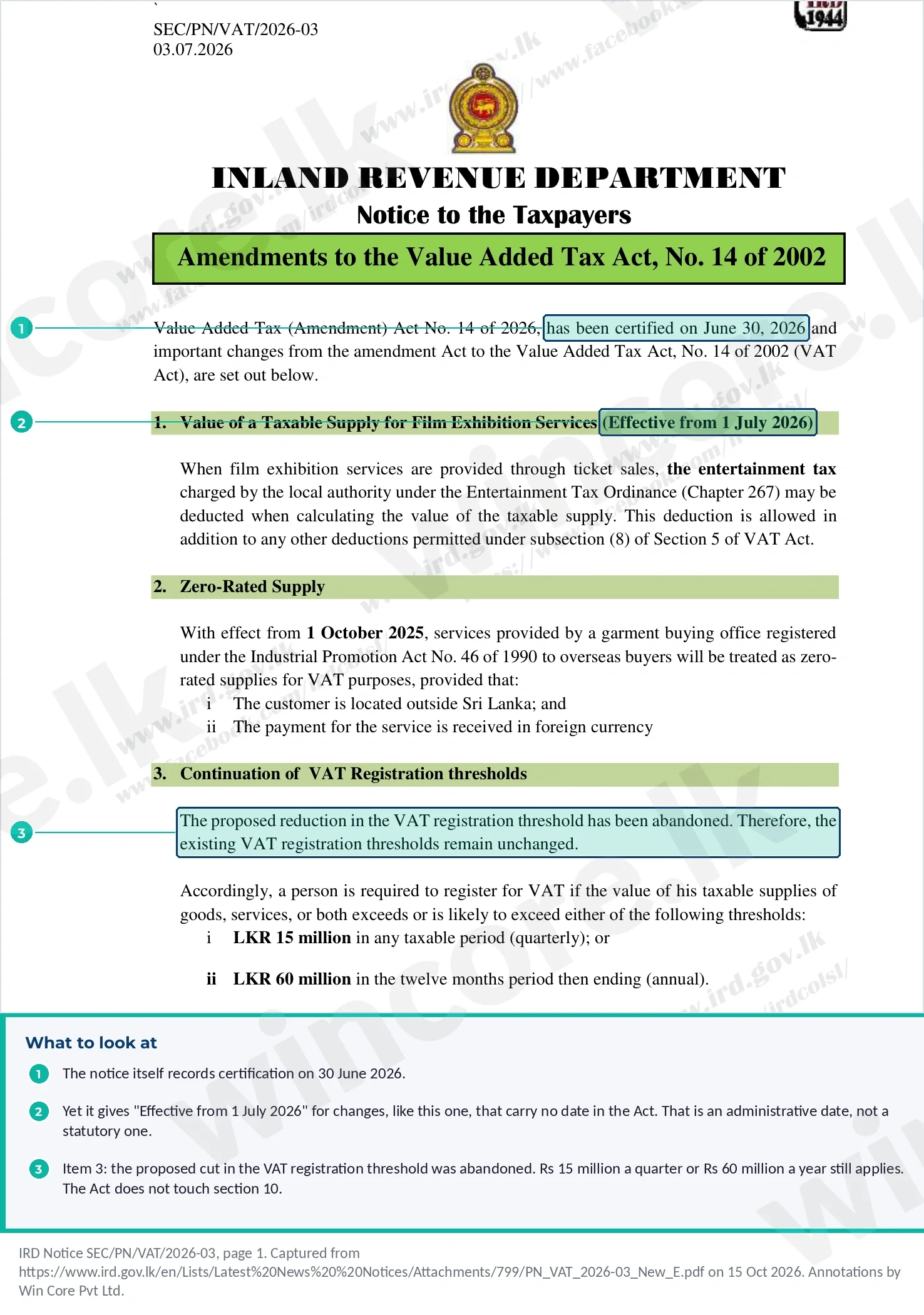
The IRD's dates. Notice SEC/PN/VAT/2026-03 of 3 July 2026 gives "Effective from 1 July 2026" for most of those undated items, including the new exemptions, the project imports rule and the criminal proceedings section [3]. The gap is one day. It matters only for a supply or act on 30 June 2026, which can still decide a prosecution or a refund dispute. We keep it as an open point.
The Act matters most to non-resident online providers, the local businesses that buy from them, suppliers of financial services, and anyone facing a VAT prosecution. Our tax services team handles VAT registration, returns and input tax reviews for local businesses.
Digital services and a 20.5 percent rate lead the changes
Digital services by non-residents
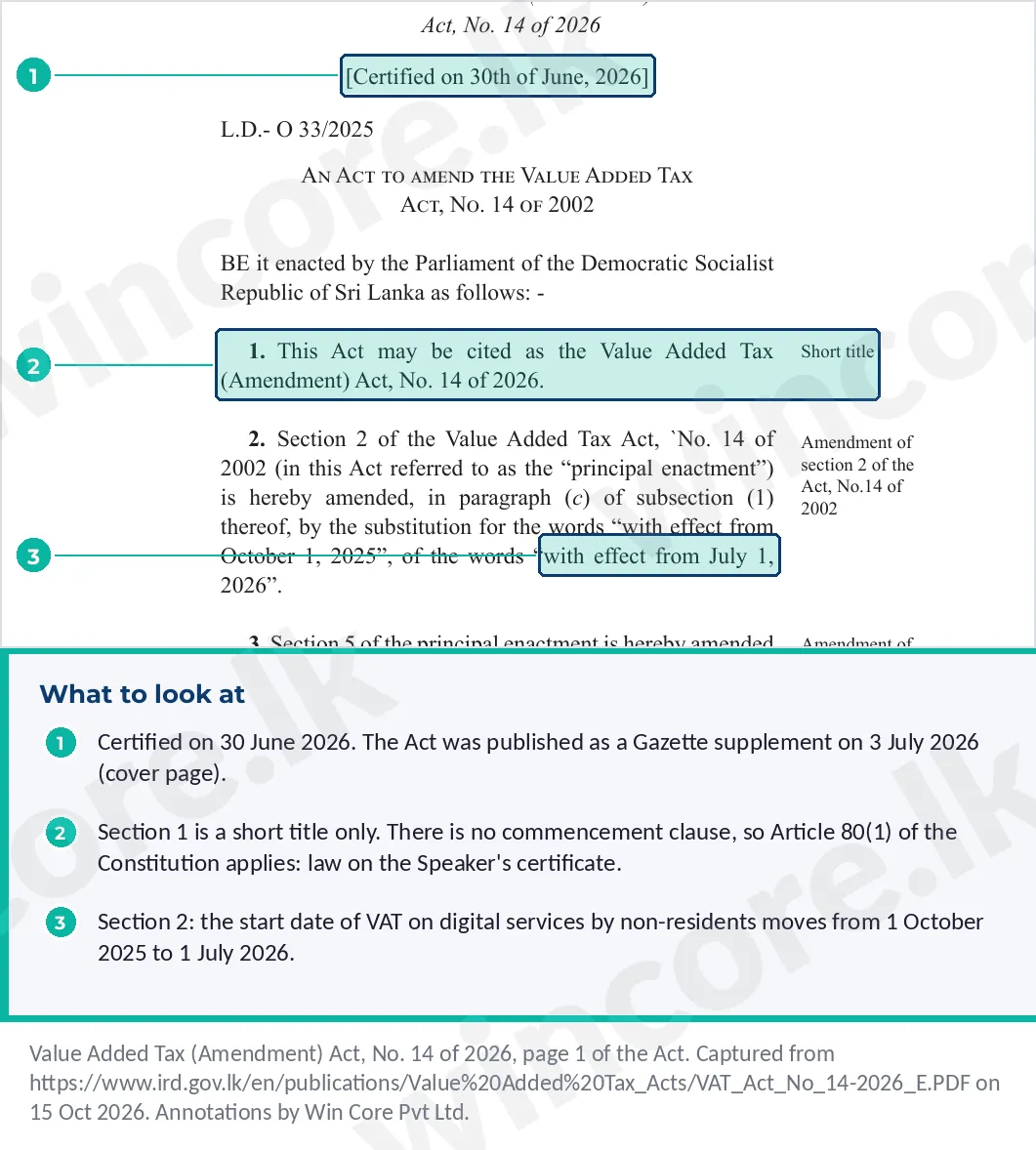
Section 2(1)(c) of the VAT Act charges tax "on the supply of services by a non-resident person through an electronic platform to a person in Sri Lanka" [2]. Act No. 4 of 2025 set the start at 1 October 2025; the IRD postponed it, most recently in Notice SEC/PN/VAT/2026-02 of 31 March 2026, "until July 1, 2026, subject to formal amendment to the VAT Act" [4]. Section 2 of Act No. 14 of 2026 is that formal amendment [1].
The new Chapter IIIC fills in the mechanics:
- Registration. Under section 25L(1), a non-resident must register if, on or after 1 July 2026, its supplies "within the twelve months period then ending" exceed Rs 60 million, or if for a quarter from 1 July 2026 they exceed "or is likely to exceed" Rs 15 million. The application is due "not later than three months" from liability or from the date the form is specified, "whichever comes later" [1].
- Who is "in Sri Lanka". Section 25L(5) deems the recipient to be here where "two or more" of four indicators point here: billing or business address, a local bank, a locally issued payment instrument, or a local IP address [1].
- Business buyers. Under section 25N(1), the tax "shall not be charged on or collected" where the recipient is a VAT registered person. If it was charged anyway, the provider must refund it, and if it cannot, the buyer may claim it as input tax "to the extent allowable under section 22"; the worked example below walks through it [1].
- Exempt online services. Online educational and healthcare services by non-residents, and services to an organisation or to diplomatic missions to the extent specified, are added to the exemption schedule [1].
The buyer's side, including what a local business should do with a foreign invoice, is covered in our guide to VAT on digital services bought from abroad.
Financial services at 20.5 percent
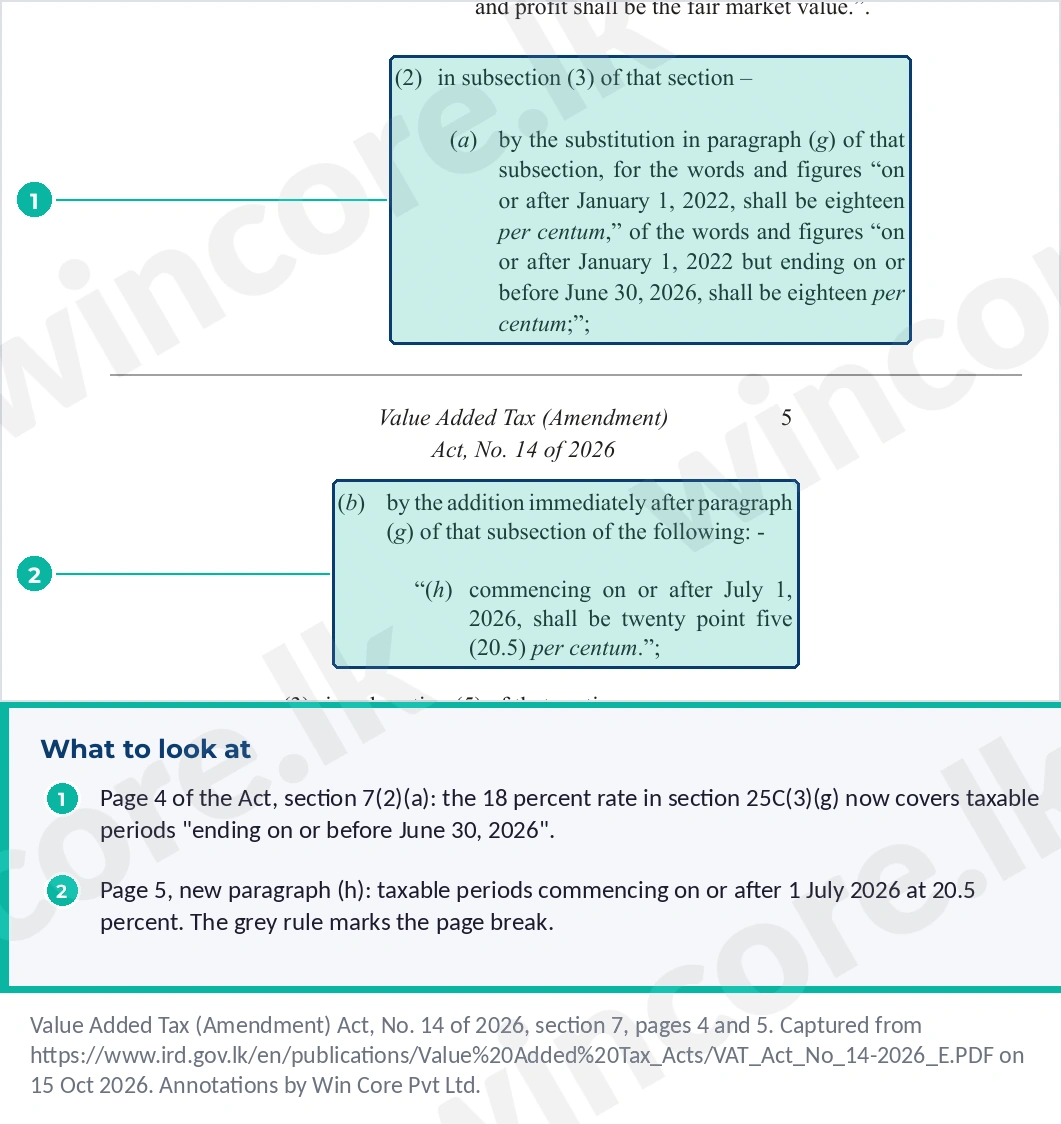
Section 7 closes the 18 percent rate in section 25C(3)(g) for taxable periods "ending on or before June 30, 2026" and adds paragraph (h): "commencing on or after July 1, 2026, shall be twenty point five (20.5) per centum" [1]. The IRD notice links this to the Social Security Contribution Levy [3]. Item 25 of Part II of the First Schedule to the SSCL Act now exempts financial services "liable to Value Added Tax under Chapter IIIA ... at the rate of twenty and one half per centum" [7]. In effect the levy on financial services has been folded into a higher VAT rate. That last sentence is our characterisation, not the Act's. How the SSCL side changed is set out in our piece on the SSCL Amendment Acts No. 24 of 2025 and No. 10 of 2026.
Other changes, briefly
- Garment buying offices. Services to overseas buyers by an office registered under the Industrial Promotion Act are zero rated "so far as such services are provided to a person outside Sri Lanka for payment in foreign currency, with effect from October 1, 2025" [1]. This one reaches back in the taxpayer's favour.
- Film exhibitions. Entertainment tax charged by a local authority is deducted from the value of the supply [1].
- Project imports. New section 22(6)(vii) denies input tax where tax on project plant, machinery, equipment or vehicles was deferred and they are "not been re-exported within one month of the completion of the project" [1].
- Business of Strategic Importance. Supplies of goods or services to a business approved under section 52 of the Colombo Port City Economic Commission Act are exempt; the IRD gives 1 July 2026 [1] [3]. Invoicing and the input tax effect are in our guide to supplies to a BSI.
- Point of sale machines. New section 64B requires secured POS machines "within three months from the date so prescribed" [1]. The IRD says the specifications will be prescribed "in due course" [3]. Nothing is prescribed yet.
- Public register. The Commissioner General will publish each registered person's name, address, registration number and status, partly "for the purpose of section 25N" [1]. On our reading, that is how a foreign provider is meant to check whether a buyer is registered.
- Housekeeping. Return schedules may be furnished "from the commencement date of the relevant taxable period", a tsunami relief write-off (section 48C), an indemnity for officers making refunds under the Risk Based Refund Scheme (section 58(5)), and a reworded "eligible exporter" definition [1].
The VAT registration threshold did not change
Many expected this Act to cut the VAT registration threshold. It does not touch section 10. The IRD notice says "The proposed reduction in the VAT registration threshold has been abandoned", and the thresholds stay at Rs 15 million a quarter or Rs 60 million for the twelve months then ending [3]. How the tests run is in our guide to VAT registration thresholds.
The same two figures now appear in section 25L for non-residents [1]. A local business and a foreign platform therefore cross the line at the same turnover, which is the closest the Act comes to a level field. Two differences remain: the non-resident has three months to apply under section 25L(2), where a local business has fifteen days under section 10(2), and the twelve month test in section 25L(1)(a) has no "likely to exceed" limb [1] [2].
Fines rise to Rs 1 million, and each default has its own section
| Default | Section | Maximum |
|---|---|---|
| Evasion, or a fraudulent refund claim, for any period before 1 October 2025 | 66(2) | Twice the tax, plus up to Rs 25,000 or six months, or both |
| The same, for any period on or after 1 October 2025 | 66(3) | Twice the tax evaded (the paragraph also covers a refund obtained by fraud), plus up to Rs 1 million or six months, or both |
| Section 67 offences, any period before 1 October 2025 | 67(i) | Up to Rs 25,000 or six months, or both |
| Section 67 offences, any period on or after 1 October 2025, including new (o) fraudulent refunds and (p) failing to furnish valid tax invoices or customs declarations "as required under section 21" | 67(ii) | Up to Rs 1 million or six months, or both |
| Non-resident fails to file the simplified statement of supplies to registered buyers | 25N(4) | Up to Rs 50,000; under 25N(5) it may be reduced or annulled if the failure was "due to circumstances beyond his control" and the provider has since complied |
Sources: [1] [2]. Before this Act, section 66 and section 67 capped the fine at "twenty five thousand rupees" [2]. New section 68 caps the total term at five years for offences from "a single act, omission or course of conduct" and sets time limits for proceedings of up to twelve years, three in some cases [1].
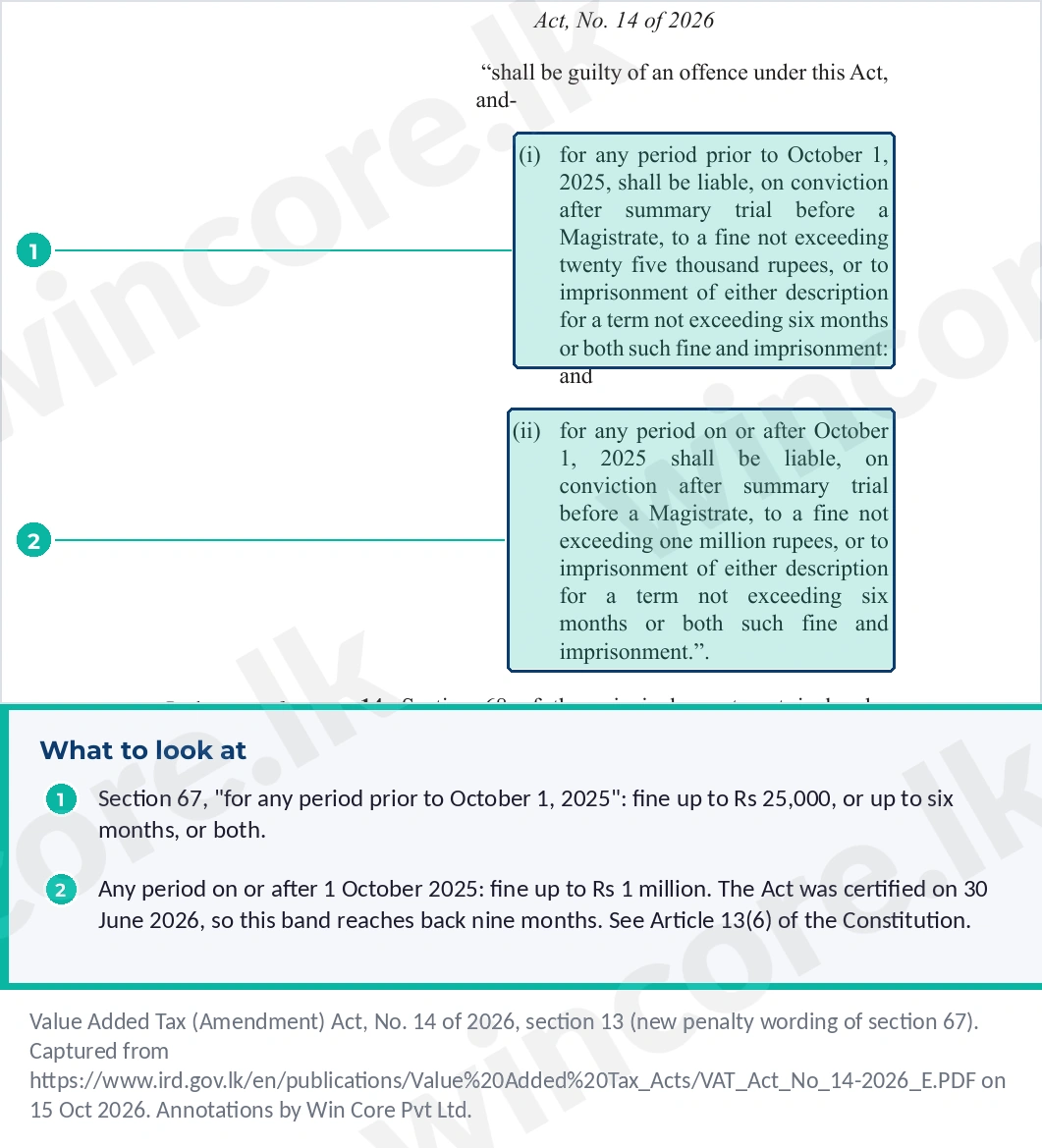
Open point: the backdated fine. The Rs 1 million band applies "for any period on or after October 1, 2025", but the Act became law on 30 June 2026 [1]. Article 13(6) of the Constitution says "no penalty shall be imposed for any offence more severe than the penalty in force at the time such offence was committed" [6]. Article 80(3) bars any court from questioning a certified Act [6], so the argument is about reading section 67, not its validity. On our reading, a court would be slow to apply the higher cap to conduct before 30 June 2026. The IRD notice states the bands without comment [3].
Open point: failing to register under section 25L. Section 67(a) punishes a failure "to apply for registration as required under section 10 or section 25A" [2]. The Act did not add section 25L to that list. Whether a non-resident that never registers commits a section 67 offence is not settled at source. The tax itself can still be assessed under section 28(d) [2].
A registered buyer should not be charged VAT: a worked example
Back to the hypothetical tyre distributor. Its overseas fleet-tracking provider registers under section 25L in late 2026 and starts adding VAT at 18 percent to every invoice. The distributor is VAT registered, so section 25N(1) says the tax should not have been charged at all. It asks for a refund. If the provider has already paid the tax over and cannot refund it, the distributor keeps the invoice, which shows VAT separately, and claims the amount as input tax under section 22, subject to the usual limits [1]. Our VAT calculator separates the tax from a VAT inclusive amount if the invoice shows only a total.
Does the distributor owe anything for the months between October 2025 and June 2026? On the statute as amended, no. Section 2 replaced the October 2025 start with 1 July 2026, so on our reading no charge on non-resident digital services arose for that window [1]. The Act does not say the old words never applied, so a textual argument for a charge in that window exists; given the IRD's postponement notices [4] we regard it as remote, but it is not settled at source. The procedure Order in Gazette 2443/30 still recites "with effect from October 01, 2025" [5]; the Act now overrides it.
What this means for you
- If you buy online services from abroad and are VAT registered, give your providers your registration number. Section 25N means they should not charge you VAT.
- If a provider charges you anyway, ask for a refund before you claim it as input tax.
- Suppliers of financial services: compute periods from 1 July 2026 at 20.5 percent, and check that SSCL is no longer paid on the financial services item 25 covers.
- Do not concede the Rs 1 million cap for conduct before 30 June 2026 without advice.
- Watch for the POS specification. The three month clock starts only when it is prescribed.
Checklist: documents needed
- Your VAT registration certificate and number, to give overseas providers
- Invoices from non-resident digital providers since 1 July 2026, with any VAT shown separately
- Refund requests to providers that charged VAT, and their replies
- For financial services, return workings for periods from 1 July 2026 at 20.5 percent
- A note of any supply or act dated 30 June 2026, for the one day gap
FAQ
When did the VAT Amendment Act No. 14 of 2026 come into force?
It became law on 30 June 2026, the day the Speaker certified it, because the Act has no commencement clause and Article 80(1) of the Constitution applies. Several sections carry their own dates: 1 July 2026 for digital services and the 20.5 percent rate, and 1 October 2025 for garment buying offices and the higher fines. The IRD uses 1 July 2026 for most undated changes [1] [3].
Do foreign digital service providers have to register for VAT in Sri Lanka?
Yes, once their digital services to persons in Sri Lanka exceed Rs 60 million in the twelve months then ending, or exceed or are likely to exceed Rs 15 million in a quarter commencing on or after 1 July 2026. Under section 25L(2) they apply electronically within three months, not the fifteen days that applies to a local business [1].
Should a foreign provider charge VAT to a VAT registered business in Sri Lanka?
No. Section 25N(1) says the tax shall not be charged on or collected where the recipient is a registered person. If it is charged, the provider must refund it. If the provider has already paid it over to the IRD, the buyer may deduct it as input tax under section 22, using the provider's invoice that shows VAT separately [1].
What is the VAT rate on financial services from 1 July 2026?
It is 20.5 percent for taxable periods commencing on or after 1 July 2026, up from 18 percent, under new section 25C(3)(h). Financial services taxed at that rate are exempt from SSCL under item 25 of Part II of the First Schedule to the SSCL Act, so on our reading the levy has been folded into the higher VAT rate [1] [7].
Did Act No. 14 of 2026 lower the VAT registration threshold?
No. The Act does not touch section 10, and the IRD notice says the proposed reduction "has been abandoned". A business still registers when taxable supplies exceed Rs 15 million in a quarter or Rs 60 million in the twelve months then ending, or are likely to. The threshold that fell in 2026 was the SSCL threshold, under a different Act [3].
Talk to us. If you would like us to review your VAT position under Act No. 14 of 2026, including foreign service invoices and financial services returns, book a consultation at our contact page.
WinCore Pvt Ltd
References
- Parliament of Sri Lanka. Value Added Tax (Amendment) Act, No. 14 of 2026, ss.1 to 18. https://www.ird.gov.lk/en/publications/Value%20Added%20Tax_Acts/VAT_Act_No_14-2026_E.PDF . Primary. Accessed 21 October 2026.
- Inland Revenue Department. Value Added Tax Act, No. 14 of 2002, consolidated up to 2025, ss.2(1), 28, 66, 67 and 68. https://www.ird.gov.lk/en/publications/Value%20Added%20Tax_Acts/VAT_Act_No_14%5BE%5D_2002_%28Consolidation_2025%29.pdf . Primary. Accessed 15 October 2026.
- Inland Revenue Department. Notice to the Taxpayers: Amendments to the Value Added Tax Act, No. 14 of 2002, SEC/PN/VAT/2026-03 (3 July 2026), items 1 to 15. https://www.ird.gov.lk/en/Lists/Latest%20News%20%20Notices/Attachments/799/PN_VAT_2026-03_New_E.pdf . Primary. Accessed 21 October 2026.
- Inland Revenue Department. Notice to the Taxpayers: Postponement of effective date of imposition of VAT on the supply of digital services, SEC/PN/VAT/2026-02 (31 March 2026). https://www.ird.gov.lk/en/Lists/Latest%20News%20%20Notices/Attachments/772/PN_VAT_2026_-_2_E.pdf . Primary. Accessed 21 October 2026.
- Commissioner General of Inland Revenue. Order under section 26(1B): procedure for VAT on services supplied by a non-resident through an electronic platform, Gazette Extraordinary No. 2443/30 (1 July 2025), paras 1.1 and 1.2. https://documents.gov.lk/api/content-file-proxy?file=/extra-gazette-content/2443-30_E_1784567172.pdf . Primary. Accessed 15 October 2026.
- Parliament of Sri Lanka. The Constitution of the Democratic Socialist Republic of Sri Lanka (Revised Edition 2023), Articles 13(6), 80(1) and 80(3). https://www.parliament.lk/files/pdf/constitution.pdf . Primary. Accessed 15 October 2026.
- Inland Revenue Department. Social Security Contribution Levy Act, No. 25 of 2022, consolidated up to 2026, First Schedule Part II item 25. https://www.ird.gov.lk/si/publications/Acts_SSCL/SSCL_Cons_Act_-_2026_Changes.pdf . Primary. Accessed 15 October 2026.
- Inland Revenue Department. Acts page, Value Added Tax entries. https://www.ird.gov.lk/en/publications/sitepages/Acts.aspx?menuid=1601 . Primary. Accessed 15 October 2026.
Put these insights to work
WinCore specialists can review your current workflow, document gaps, and build a practical 90-day action plan.
Book a free consultationContinue reading
Explore more WinCore analysis to keep your finance, tax, and compliance roadmap moving.
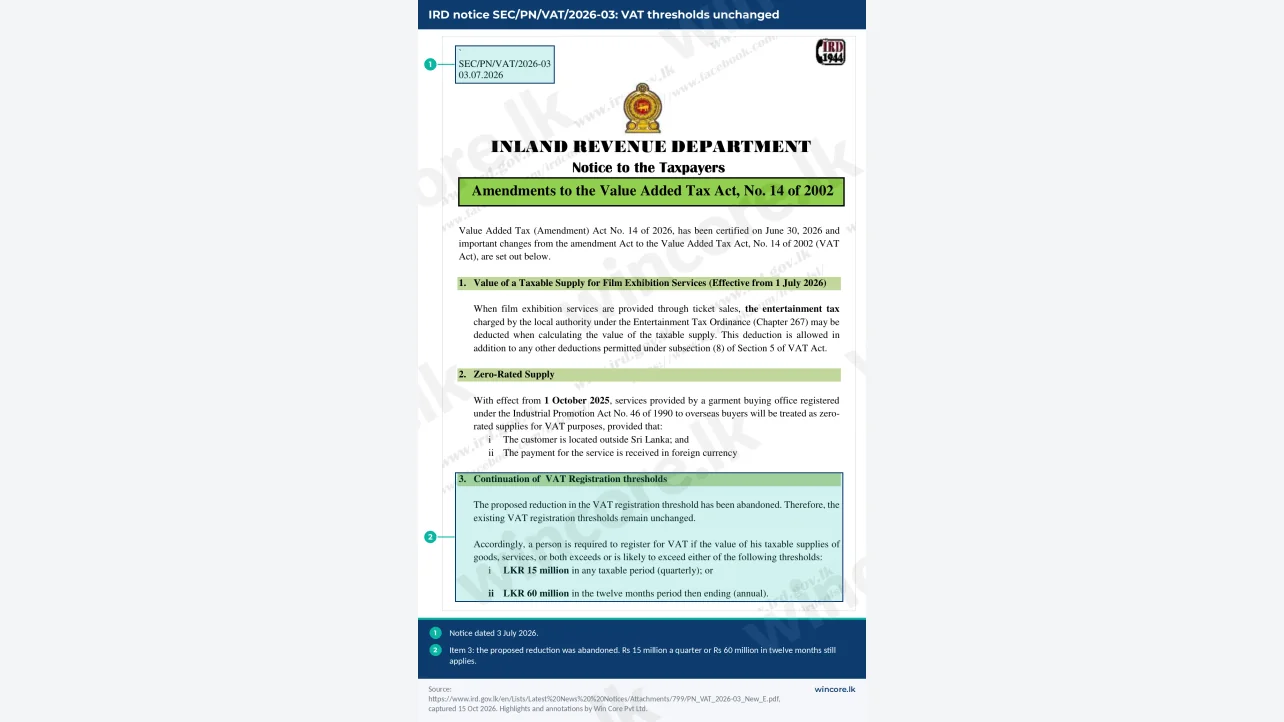
The VAT registration tests are Rs 15 million a quarter or Rs 60 million over 12 months. How the tests run, the 15 day rule and who must register.
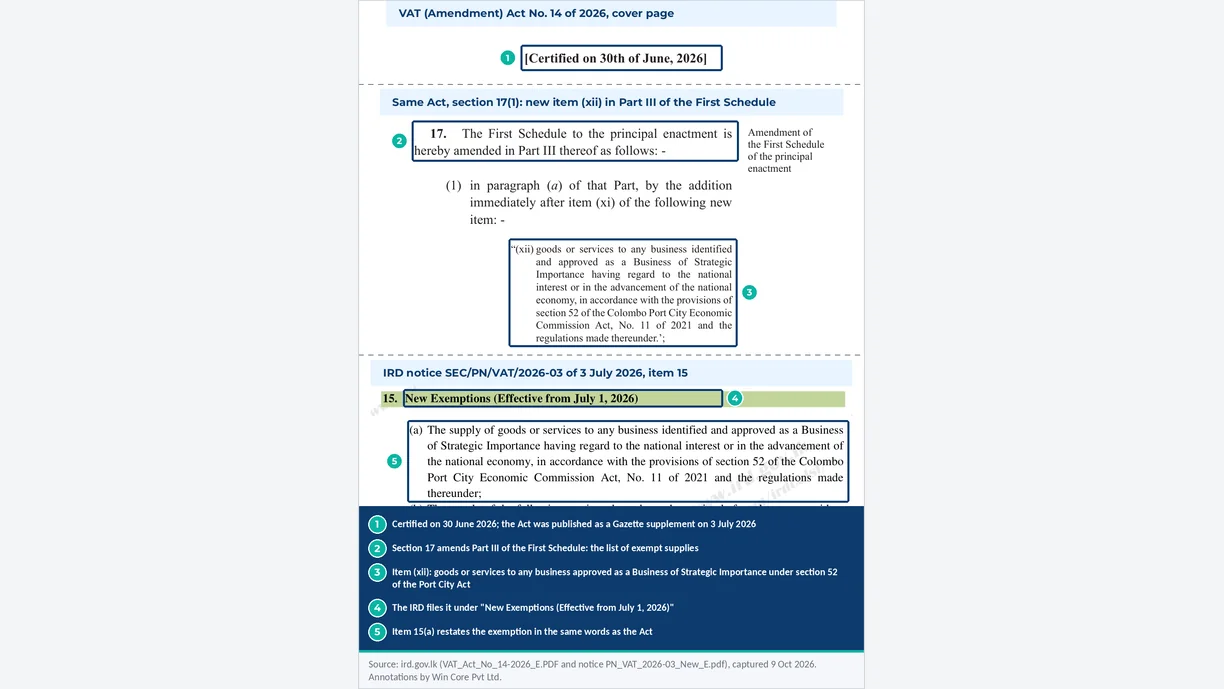
From 1 July 2026 supplies to a Port City Business of Strategic Importance are VAT exempt. The legal basis, invoicing and the input VAT effect.
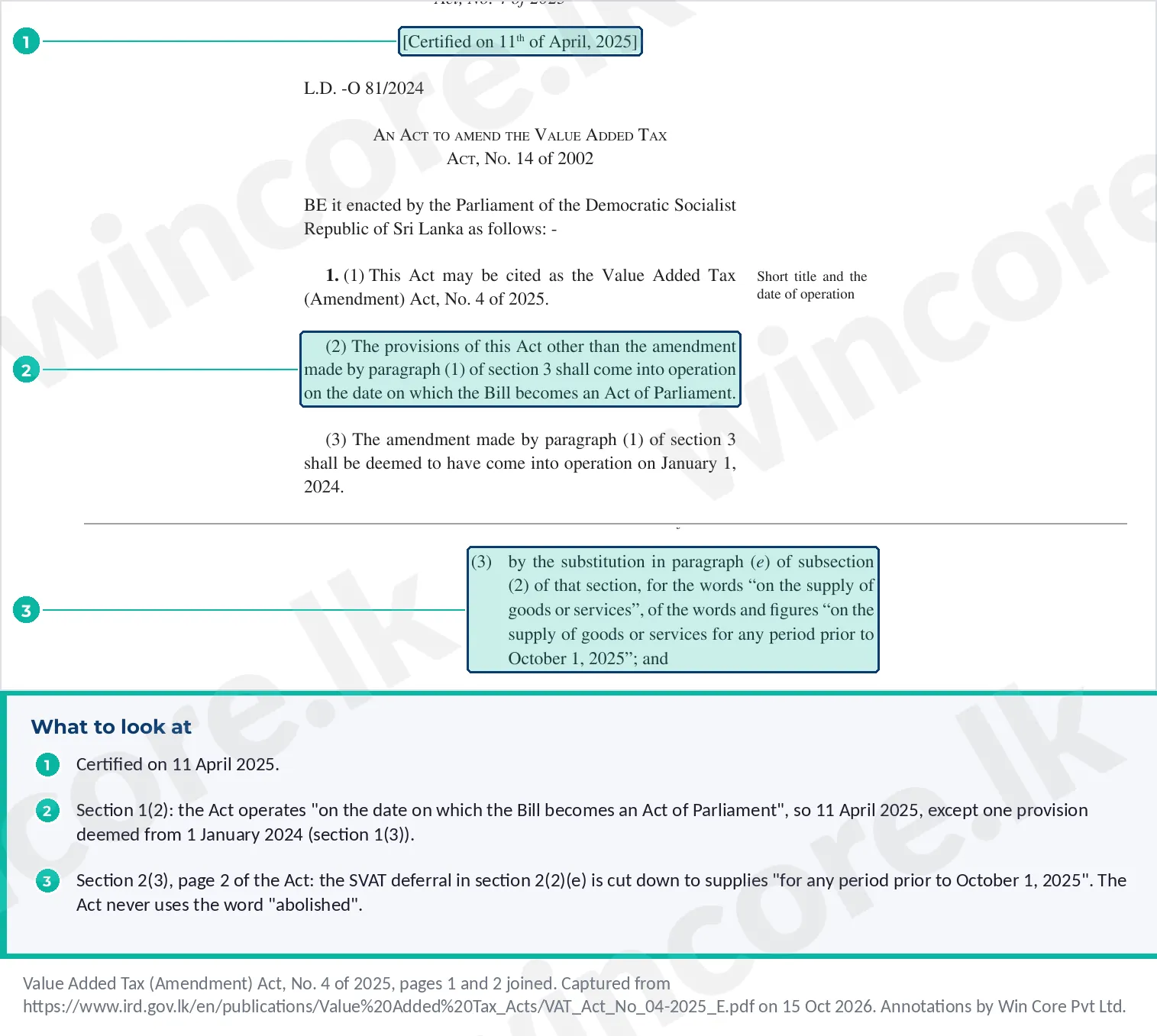
SVAT stopped for supplies from 1 October 2025. How the 2025 Act did it, when exporters now get refunds, and which wind-up dates count.