
VAT Amendment Act No. 4 of 2025: how SVAT ended and RBRS began
SVAT stopped for supplies from 1 October 2025. How the 2025 Act did it, when exporters now get refunds, and which wind-up dates count.
On this page
Last verified against the primary sources on 21 October 2026.
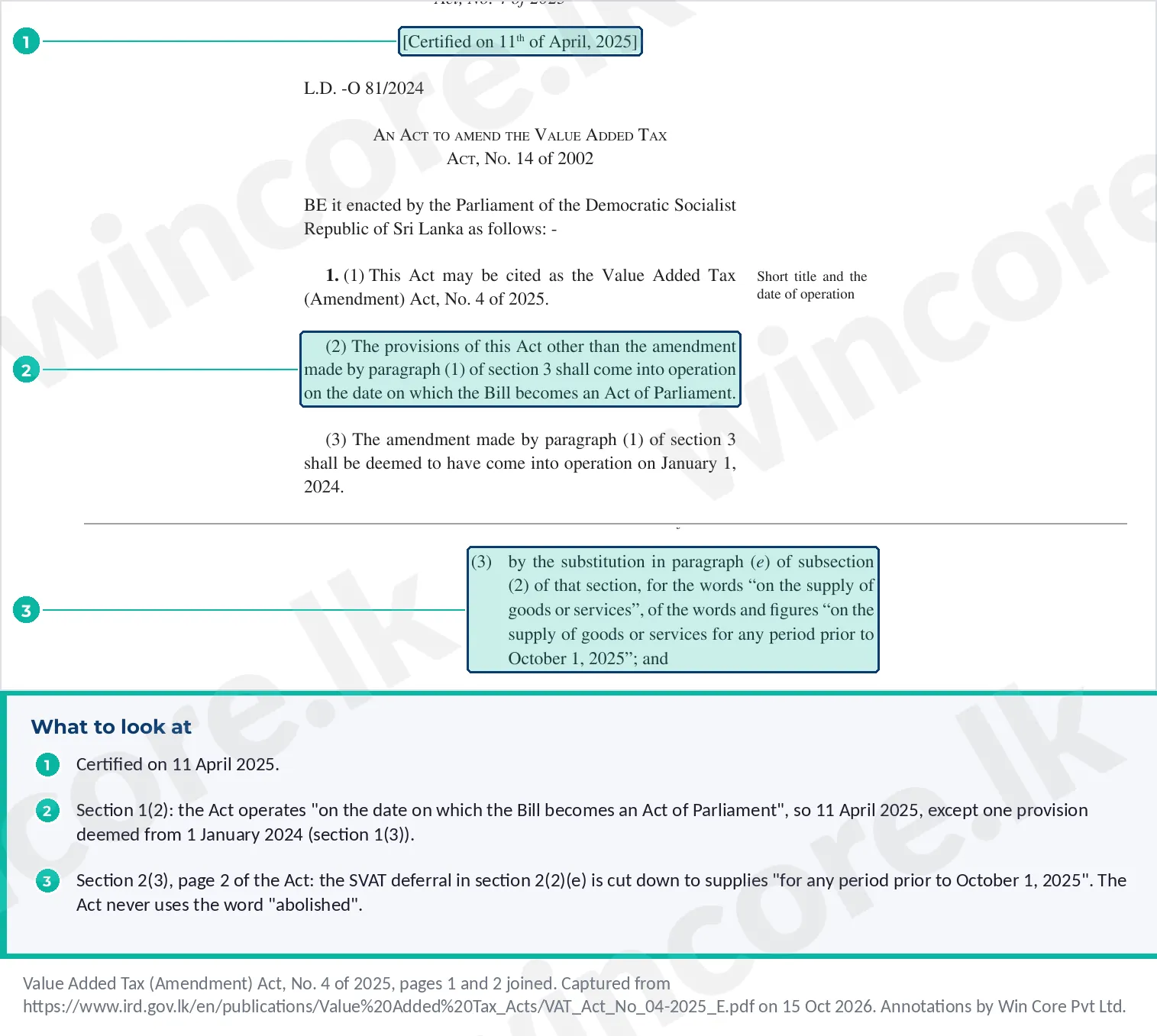
The VAT Amendment Act No. 4 of 2025, certified on 11 April 2025, ended the Simplified VAT scheme (SVAT) for supplies in any period from 1 October 2025. In its place, eligible exporters and project suppliers get excess input tax refunded within 45 days of the last day of the month after each period, subject to the Risk Based Refund Scheme (RBRS). The same Act made every commercial importer and exporter register for VAT, whatever its turnover [1].
A tax scheme can end without anyone repealing it. Parliament left every SVAT section in place and added a cut-off date to each one. Read the Act for the word "abolished" and you will not find it; the effect is the same.
The method matters for anyone tidying up old SVAT periods. The old provisions still govern supplies before 1 October 2025, and a new set of rules governs everything after.
SVAT ran on IOUs. A registered supplier issued a suspended tax invoice, the buyer handed over a credit voucher instead of cash, and the tax was settled on paper. The Risk Based Refund Scheme (RBRS) that replaced it runs on cash and a waiting period. The exporter pays the VAT, and the State promises to pay it back within a fixed number of days.
Take a hypothetical apparel exporter that used to buy all its fabric under SVAT. From 1 October 2025 it pays VAT in cash to every local supplier. It wants to know when it gets that money back, and whether it missed any of the SVAT wind-up deadlines.
VAT Amendment Act No. 4 of 2025 operated from 11 April 2025
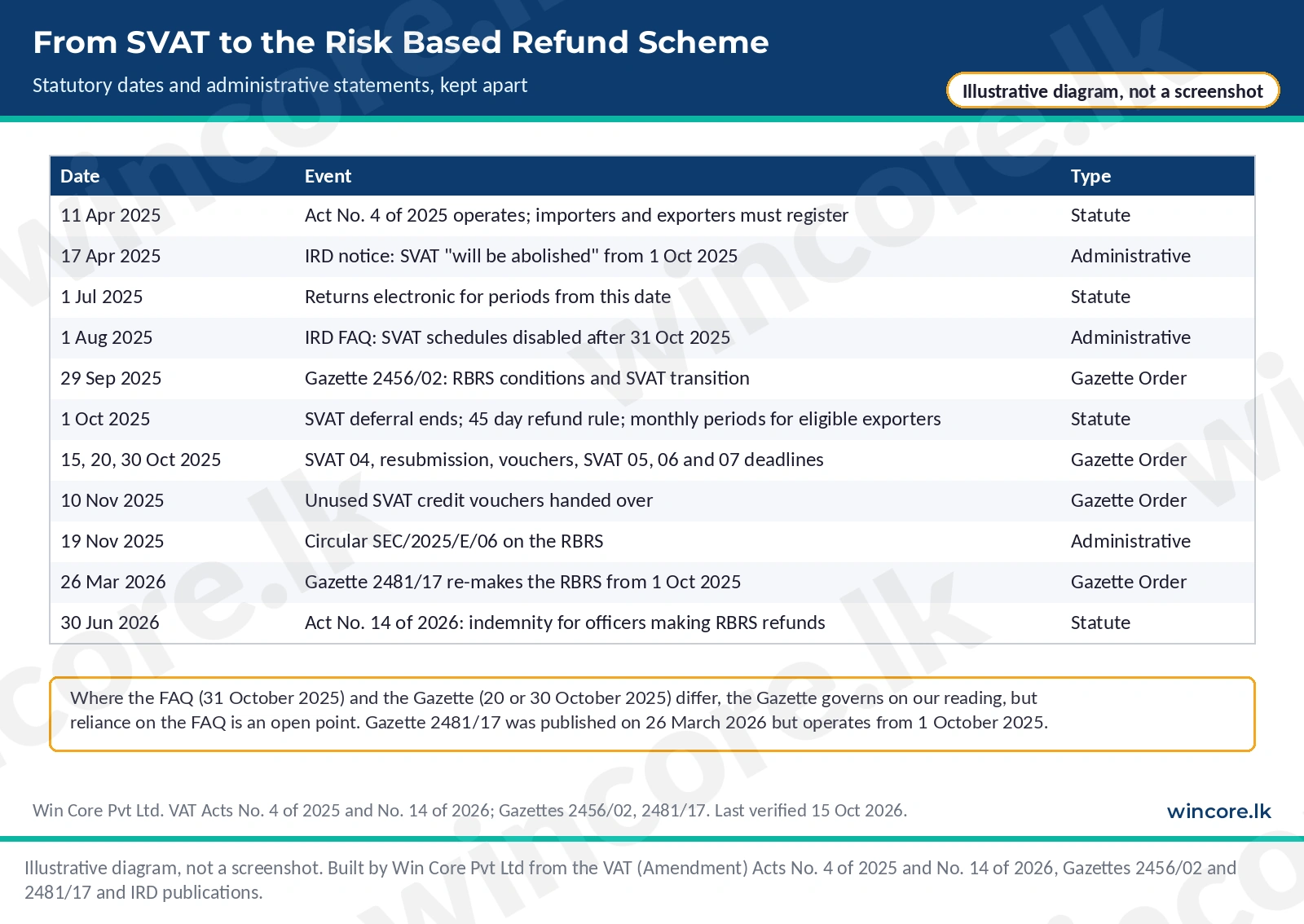
Act No. 4 of 2025 amends the Value Added Tax Act, No. 14 of 2002. It was certified on 11 April 2025 and published as a Gazette supplement on 17 April 2025 [1]. Unlike its 2026 successor, it has a commencement clause. Section 1(2) says the Act operates "on the date on which the Bill becomes an Act of Parliament", except one amendment that section 1(3) deems to have operated from 1 January 2024 [1]. Under Article 80(1) of the Constitution, a Bill becomes law "when the certificate of the Speaker is endorsed thereon" [9]. So the operative date is 11 April 2025.
When reviewing the replacement for SVAT, check exporter registration and refund records as a separate compliance task.
SVAT was ended by a date limit, not a repeal
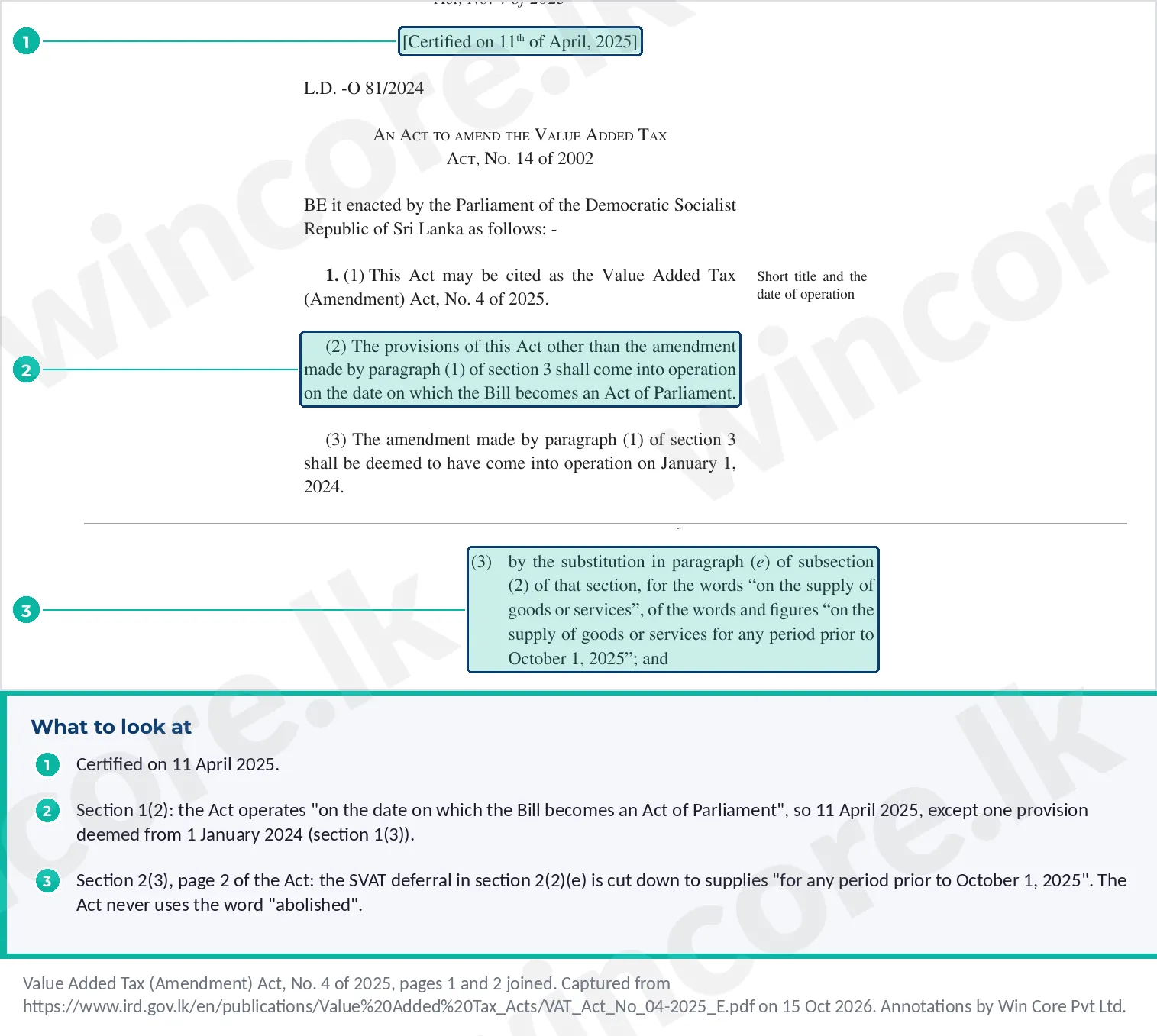
The statutory home of SVAT was section 2(2)(e), under which "the Commissioner-General shall defer the payment of tax due" on supplies by a person "registered in the Simplified Value Added Tax Scheme" to exporters and certain project suppliers [2]. Section 2(3) of the 2025 Act inserted a time limit: the deferral now applies only "on the supply of goods or services for any period prior to October 1, 2025" [1].
The Act did the same to the related refund rule for SVAT suppliers in section 22(5)(e), now limited to "April 1, 2011 but prior to October 1, 2025", and to the monthly taxable period for Registered Identified Purchasers [1] [2]. The administrative guidelines that ran the scheme, in Gazette 1986/9 of 27 September 2016, were "rescinded from the taxable period commencing from October 01, 2025" by the Commissioner General's Order [4].
The word "abolished" is the IRD's. Its notice of 17 April 2025 says "The Simplified VAT Scheme will be abolished with effect from October 1, 2025, and replaced by a Risk-Based Refund Scheme" [5]. That is an accurate summary of the effect. It is not the statutory text. The practical side, including carry forward and refund evidence, is in our guide to VAT refunds and SVAT.
Refunds now run on a 45 day clock
New paragraph (f) of the second proviso to section 22(5) adds two classes to the list of persons entitled to a refund of excess input tax: an "eligible exporter", or a registered person whose supplies to a Strategic Development Project or specified project were more than 50 percent of its total supplies [1]. An eligible exporter is a registered person whose zero rated supplies in "the preceding calendar year" were "greater than fifty percent" of its total supplies [1].
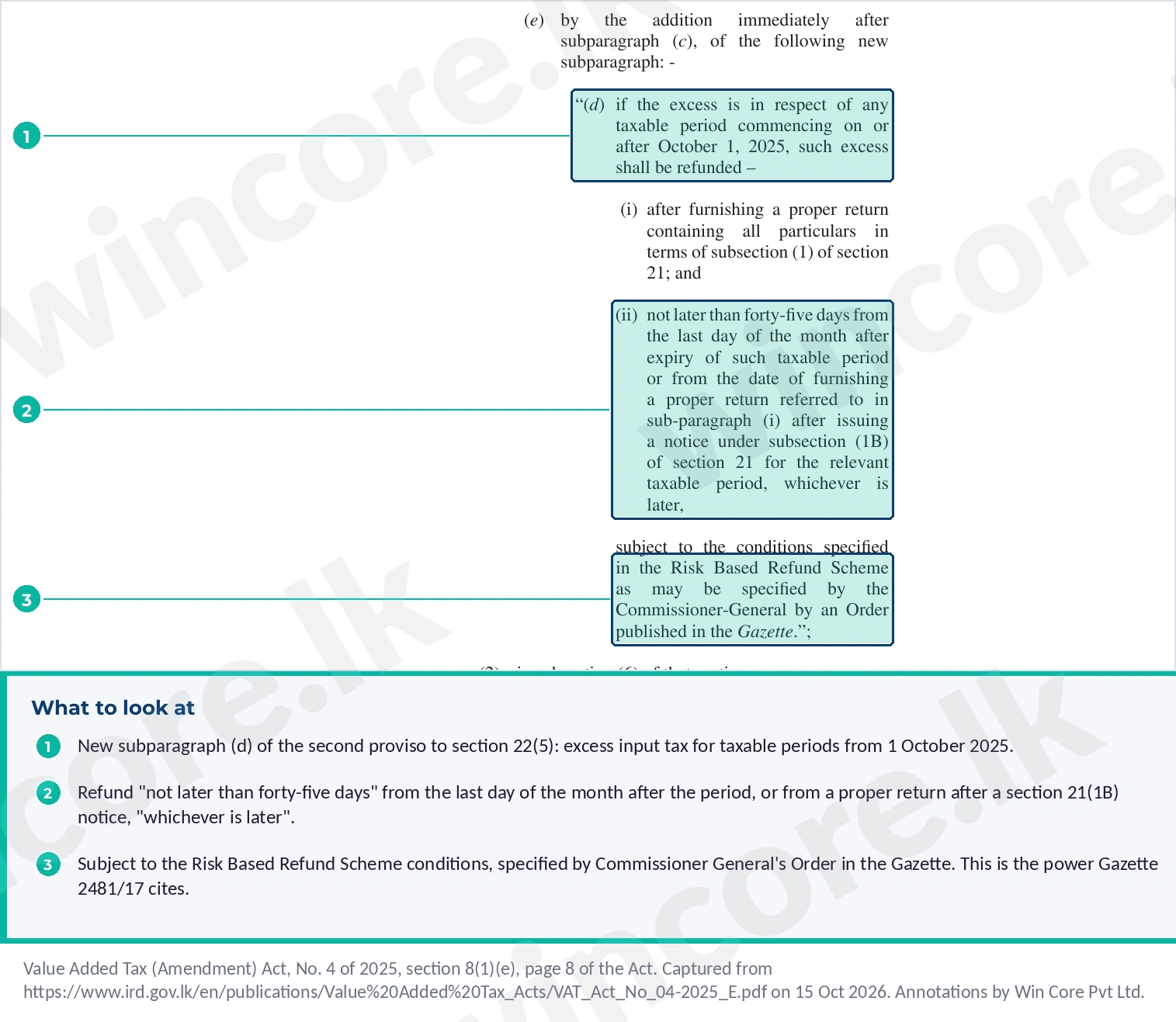
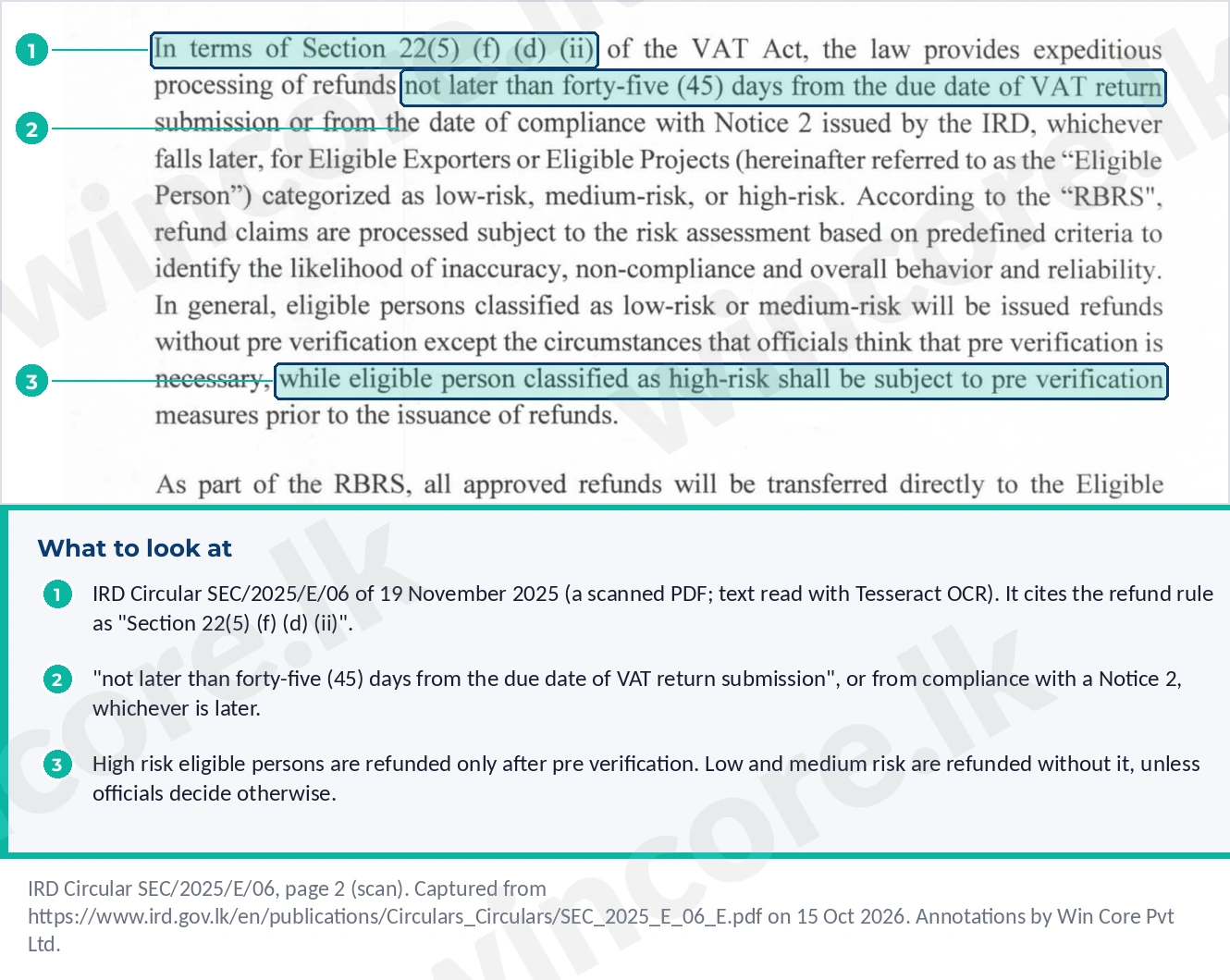
New subparagraph (d) then sets the timing for any refundable excess. For any taxable period from 1 October 2025, the excess is refunded "after furnishing a proper return" and "not later than forty-five days from the last day of the month after expiry of such taxable period", or from the date of a proper return made after a section 21(1B) notice, "whichever is later" [1]. All of it is "subject to the conditions specified in the Risk Based Refund Scheme" set by Gazette Order [1].
Eligible exporters also move to monthly returns. For periods from 1 October 2025, the taxable period is "a period of one month" for an eligible exporter and certain project suppliers [1].
Gazette 2481/17 re-made the refund conditions from 1 October 2025
The Commissioner General first set the RBRS conditions in Gazette 2456/02 of 29 September 2025, citing "paragraph (f) of sub-section (5) of section 22" [3]. That paragraph lists who is eligible. The power to set RBRS conditions sits in subparagraph (d).
On 26 March 2026, Gazette 2481/17 replaced it. It cites "subparagraph (d) of the second proviso to sub-section (5) of section 22", and says: "These Regulations operate effective from October 01, 2025 and rescind the Regulations published in the Gazette Extraordinary No. 2456/02 dated September 29, 2025, effective from the same date" [4]. It was signed on 24 March 2026.
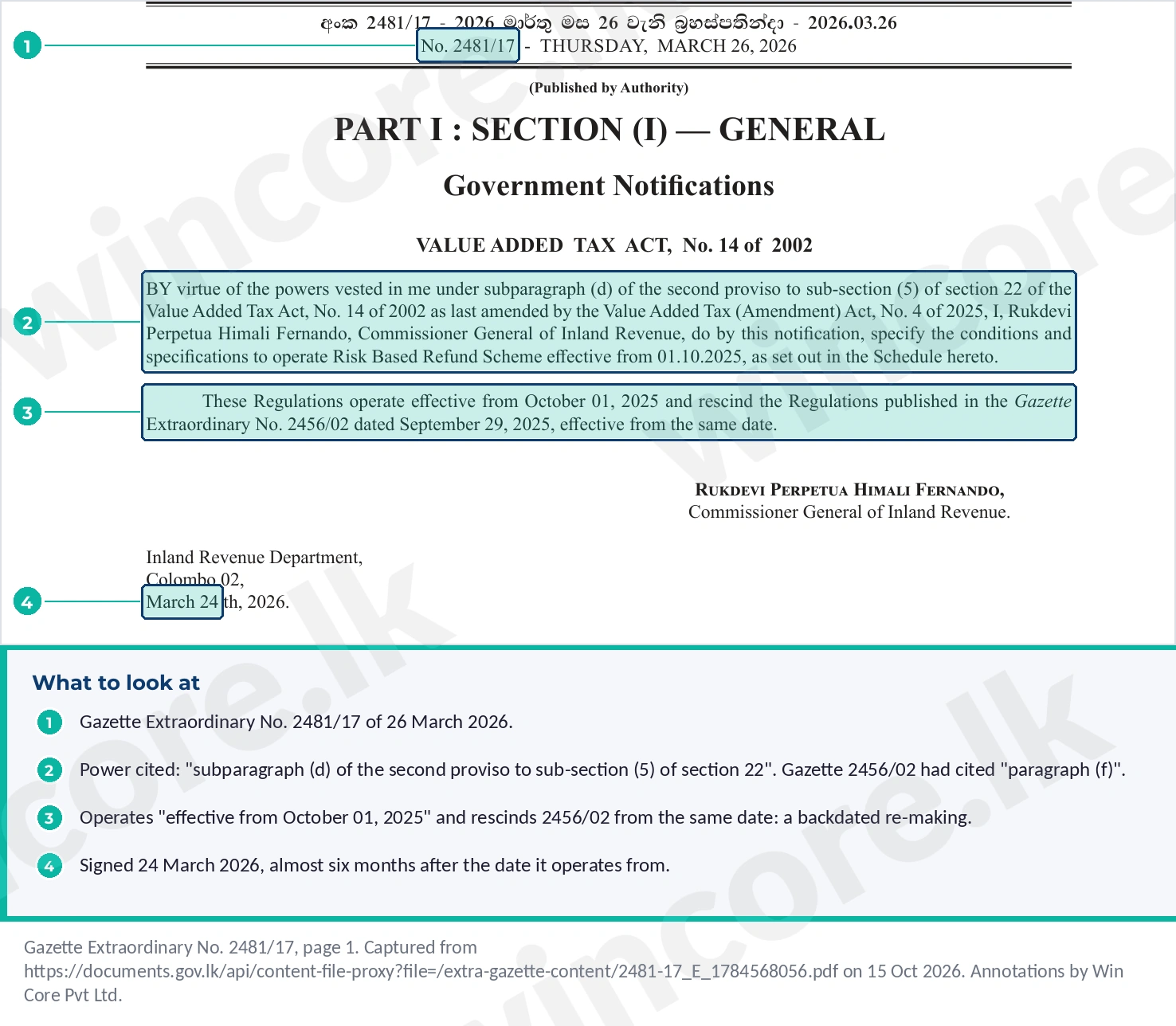
Open point. The 2481/17 Order does not say why it was re-made. A corrected power citation is the obvious reading, and it is ours, not the Gazette's. Whether an Order can operate from a date almost six months before it was made, absent express power in the Act, is not settled at source. In practice the conditions are the same in substance, so the issue matters only if someone challenges a refund decision made between October 2025 and March 2026.
Under the Order, the Commissioner General identifies eligible exporters "based on the VAT return data of the calendar year 2024" for the period 1 October 2025 to 31 March 2026, then annually from 1 April. Risk ratings draw on up to five years of history and are reviewed "at six-month intervals" [4]. The IRD's circular adds that high risk persons "shall be subject to pre verification" before a refund issues [7].
The FAQ and the Gazette gave different SVAT deadlines
The SVAT wind-up deadlines were published twice, and the two versions differ. The IRD's FAQ, last updated on 1 August 2025, told suppliers to resubmit rejected SVAT 04 forms and upload SVAT 05 and 07 schedules "by 31 Oct 2025" [6]. Both Gazette 2456/02 and its replacement say the resubmission was due "on or before October 20, 2025" and SVAT 05 and 07 "on or before October 30, 2025" [3] [4].
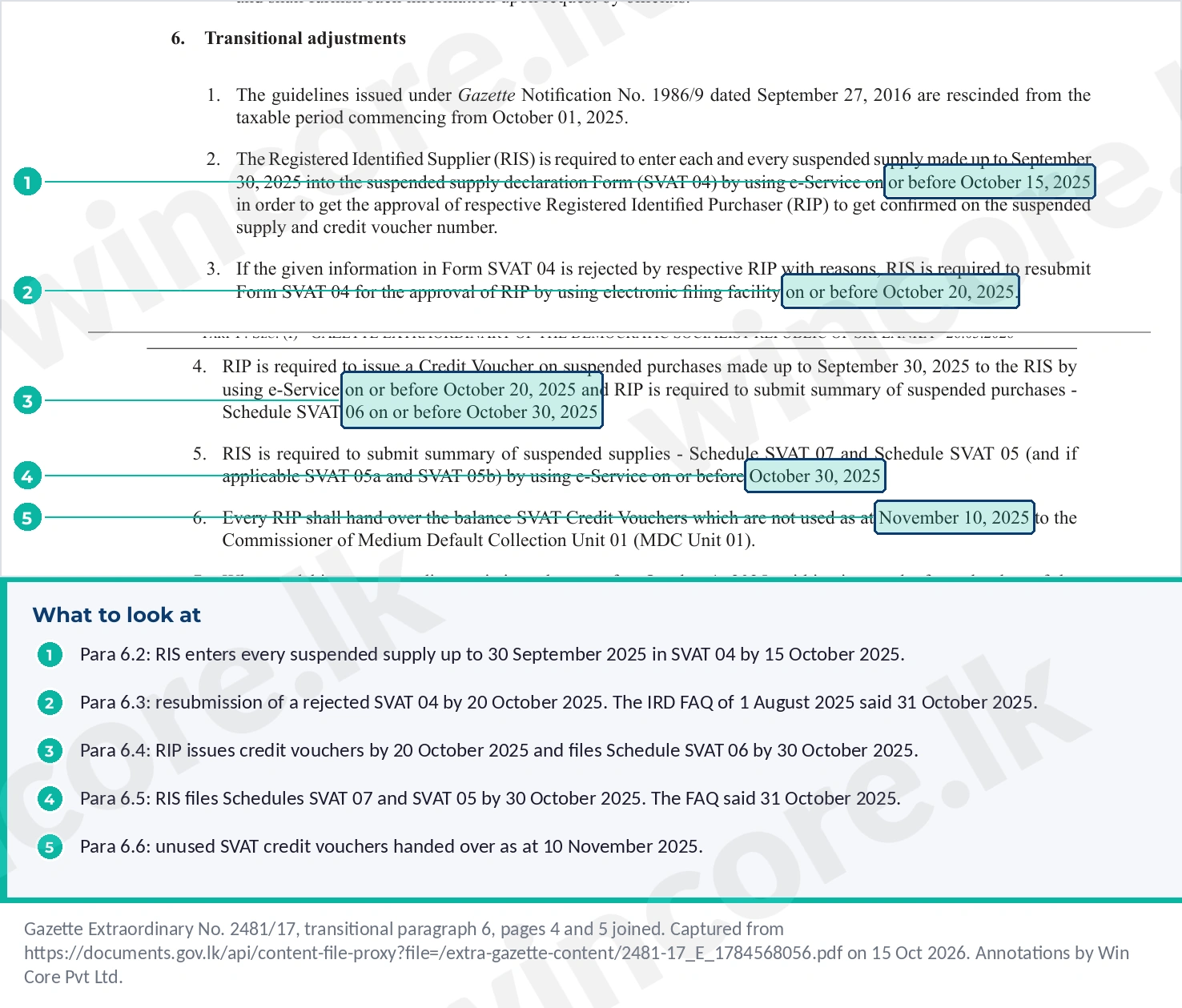
On our reading the Gazette governs, because it is the Commissioner General's Order and the FAQ is guidance. The order of events matters, though: the FAQ was last updated on 1 August 2025, before either Gazette was made [6]. Which date binds a taxpayer who followed it is an open point. The full list from paragraph 6: SVAT 04 by 15 October 2025; resubmission and buyers' credit vouchers by 20 October; SVAT 05, 06 and 07 by 30 October; unused vouchers handed over as at 10 November 2025 [4]. For the exporter in our example, a filing on 31 October was late on the Gazette's dates and on time on the FAQ's.
Importers and exporters must register, whatever their turnover
Former SVAT suppliers and buyers are the obvious group. The Act reaches further:
- Importers and exporters must register. New section 10(1)(ix): every person who "on or after the date of commencement of this (Amendment) Act, imports or exports goods for commercial purposes shall be required to be registered" [1]. There is no turnover test in that paragraph. The IRD reads it as applying "regardless of turnover thresholds or exemptions" [5]. The Act does not define "commercial purposes", and we keep its scope open. Our tax services team handles VAT registration and RBRS refund claims; the turnover tests and the 15 days are in our guide to VAT registration thresholds.
- Electronic returns. For periods from 1 July 2025, returns are filed "by electronic means", with a proviso that the Commissioner General "may permit" a written return "on special circumstances" [1].
- Invoice format. New section 20(2A) lets the Commissioner General specify the tax invoice format by Order [1]. That Order is now Gazette 2481/22 as amended by 2500/106, in force from 1 October 2026; see our guide to VAT tax invoice requirements.
- Staff meals and transport. Free or subsidised meals, and transport "using a motor coach" between home and work, are valued at zero from 1 January 2024, and the employer may still claim input tax on outsourced meals and transport [1].
- Tax shown but not paid. New section 48B lets the Commissioner General "immediately collect" tax shown on an invoice but not paid over, "irrespective of whether such person is registered or not" [1].
- Exemptions. Chemical naphtha supplied to the Ceylon Electricity Board for generation, and "liquid milk and yoghurt, produced out of locally produced fresh milk", became exempt; the exemption for imported aircraft engines and parts ended for imports after commencement [1]. The IRD adds that the milk must contain "at least 50%" local fresh milk [5]. That figure is not in the Act, and we treat it as an open point.
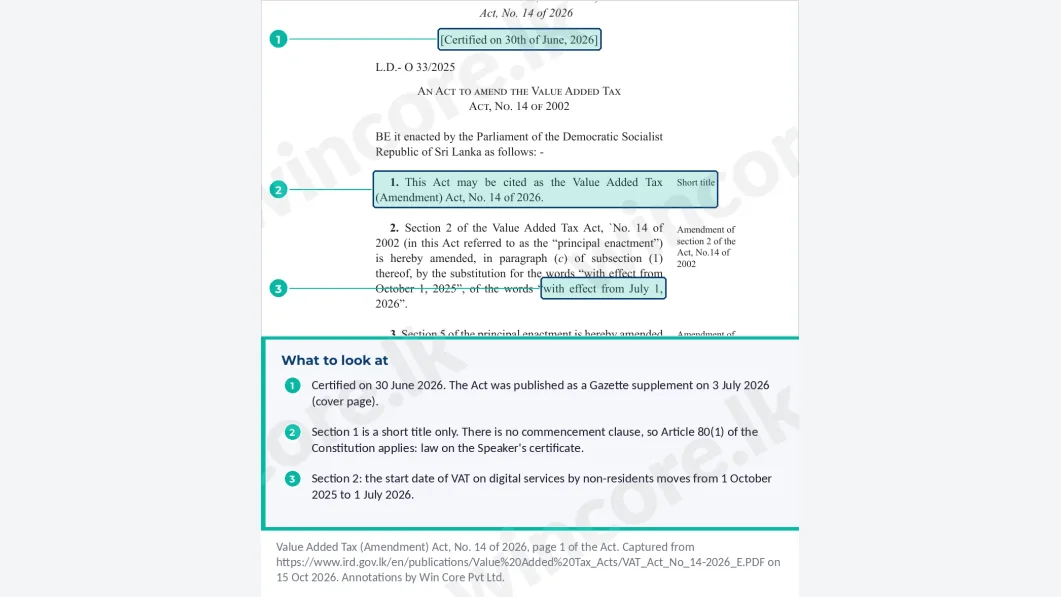
- Digital services. The Act charged VAT on non-resident digital services from 1 October 2025. That date was later moved to 1 July 2026 by Act No. 14 of 2026 [8]; see our piece on the VAT Amendment Act No. 14 of 2026.
Penalties: which section for which default
Act No. 4 of 2025 created no new offence. The defaults it makes possible fall under existing sections:
- Failing to register as an importer or exporter. Section 67(a): "fails to apply for registration as required under section 10" [2]. Until Act No. 14 of 2026, the fine was "not exceeding twenty five thousand rupees" or up to six months. That Act raised it to "one million rupees" for "any period on or after October 1, 2025", a change with its own retroactivity problem [8].
- Failing to file a return. Section 67(f), same fines [2] [8].
- Collecting VAT and keeping it. Section 48B collection, and section 66 if there is evasion: twice the tax, plus a fine [1] [2].
An exporter now waits up to three and a half months: a worked example
Is an exporter worse off without SVAT? In cash flow terms, usually yes, and the Act tells you by how much.
Our hypothetical apparel exporter is an eligible exporter, so its taxable period is one month. For October 2025, its return is due "not later than the last day of the month after the expiry of each taxable period": 30 November 2025 [1]. The refund is due "not later than forty-five days" from that date: 14 January 2026, if the return is proper and no section 21(1B) notice issues [1]. VAT paid to a fabric supplier on 1 October 2025 could therefore be out of the business for up to three and a half months. Under SVAT it was never paid in cash at all. On a fabric invoice of Rs 1,180,000 including VAT at 18 percent, Rs 180,000 is tied up; our VAT calculator splits any VAT inclusive amount.
If the exporter is rated high risk, pre verification comes first [4] [7]. The 45 day limit is in the Act, but it is expressly "subject to the conditions specified in the Risk Based Refund Scheme" [1]. How far those conditions can extend the statutory limit is an open point.
What this means for you
- If you were on SVAT, check your SVAT 04 to 07 filings against the Gazette dates, not the FAQ.
- If you export, confirm with the IRD that you are on the eligible exporter list for the current year from 1 April.
- Budget for VAT cash tied up for up to three and a half months a cycle.
- If you import or export for business, register, whatever your turnover.
- Keep bank and contact details current in RAMIS, a condition of the RBRS [4].
Checklist: documents needed
- Your SVAT 04, 05, 06 and 07 submissions with their filing dates, against Gazette 2481/17 paragraph 6
- Records of unused SVAT credit vouchers handed over as at 10 November 2025
- Each monthly return from October 2025 and its due date, with the 45 day refund date worked out
- Any section 21(1B) notice and the date you complied with it
- Your RAMIS bank account and contact details, checked
- For importers and exporters, the VAT registration certificate
FAQ
When did SVAT end in Sri Lanka?
SVAT ended for supplies in any period from 1 October 2025. The VAT Amendment Act No. 4 of 2025 limited the SVAT deferral in section 2(2)(e) to supplies "for any period prior to October 1, 2025", and the IRD described the change as abolition. Supplies before that date are still governed by the old SVAT rules, and the wind-up filings ran to 10 November 2025 [1] [5].
How long does a VAT refund take under the Risk Based Refund Scheme?
Up to 45 days from the last day of the month after the taxable period, or from a proper return made after a section 21(1B) notice, whichever is later. The limit is in the Act but is "subject to the conditions specified in the Risk Based Refund Scheme", and high risk persons are verified before any refund issues [1] [7].
What were the final SVAT deadlines?
Under Gazette 2481/17, SVAT 04 by 15 October 2025, resubmissions and credit vouchers by 20 October, SVAT 05, 06 and 07 by 30 October, and unused vouchers handed over as at 10 November 2025. The IRD FAQ of 1 August 2025 gave 31 October for resubmissions and SVAT 05 and 07, and which date binds is open [4] [6].
Do importers and exporters have to register for VAT regardless of turnover?
Yes. New section 10(1)(ix) requires every person who, on or after 11 April 2025, "imports or exports goods for commercial purposes" to register, and it carries no turnover test. The IRD reads it as applying "regardless of turnover thresholds or exemptions". The Act does not define "commercial purposes", so its edges remain open [1] [5].
Who is an eligible exporter for VAT refunds?
A registered person whose zero rated supplies in the preceding calendar year were more than half of its total supplies. Eligible exporters file monthly from 1 October 2025. For October 2025 to March 2026 the IRD identified them from 2024 return data, and it reviews the list each year from 1 April [1] [4].
This article is general information on the law as at 21 October 2026 and is not advice on your specific transaction.
Talk to us. If you would like us to review your SVAT wind-up filings or your RBRS refund position, book a consultation at our contact page.
WinCore Pvt Ltd
References
- Parliament of Sri Lanka. Value Added Tax (Amendment) Act, No. 4 of 2025, ss.1 to 8, 11, 13 and 14. https://www.ird.gov.lk/en/publications/Value%20Added%20Tax_Acts/VAT_Act_No_04-2025_E.pdf . Primary. Accessed 21 October 2026.
- Inland Revenue Department. Value Added Tax Act, No. 14 of 2002, consolidated up to 2025, ss.2(2)(e), 22(5), 26(1), 66 and 67. https://www.ird.gov.lk/en/publications/Value%20Added%20Tax_Acts/VAT_Act_No_14%5BE%5D_2002_%28Consolidation_2025%29.pdf . Primary. Accessed 15 October 2026.
- Commissioner General of Inland Revenue. Conditions and specifications to operate the Risk Based Refund Scheme, Gazette Extraordinary No. 2456/02 (29 September 2025), preamble and para 6. https://documents.gov.lk/api/content-file-proxy?file=/extra-gazette-content/2456-02_E_1784567486.pdf . Primary. Accessed 15 October 2026.
- Commissioner General of Inland Revenue. Conditions and specifications to operate the Risk Based Refund Scheme, Gazette Extraordinary No. 2481/17 (26 March 2026), preamble and paras 2 to 6. https://documents.gov.lk/api/content-file-proxy?file=/extra-gazette-content/2481-17_E_1784568056.pdf . Primary. Accessed 21 October 2026.
- Inland Revenue Department. Notice to the Taxpayers: Amendments to the Value Added Tax Act, PN/VAT/2025-01 (Revised) (17 April 2025), items 2, 4, 8 and 9. https://www.ird.gov.lk/en/Lists/Latest%20News%20%20Notices/Attachments/677/PN_VAT_2025-01_11042025_E.pdf . Primary. Accessed 15 October 2026.
- Inland Revenue Department. Frequently Asked Questions: VAT and SVAT changes (last updated 1 August 2025), "Abolition of SVAT". https://www.ird.gov.lk/en/Lists/Latest%20News%20%20Notices/Attachments/702/VAT31072025_SVAT_Repeal_FAQs_QG.pdf . Primary. Accessed 21 October 2026.
- Inland Revenue Department. Circular SEC/2025/E/06: Risk Based Refund Scheme (19 November 2025), page 2 (scanned; read by OCR). https://www.ird.gov.lk/en/publications/Circulars_Circulars/SEC_2025_E_06_E.pdf . Primary. Accessed 15 October 2026.
- Parliament of Sri Lanka. Value Added Tax (Amendment) Act, No. 14 of 2026, ss.2, 10 and 13. https://www.ird.gov.lk/en/publications/Value%20Added%20Tax_Acts/VAT_Act_No_14-2026_E.PDF . Primary. Accessed 15 October 2026.
- Parliament of Sri Lanka. The Constitution of the Democratic Socialist Republic of Sri Lanka (Revised Edition 2023), Article 80(1). https://www.parliament.lk/files/pdf/constitution.pdf . Primary. Accessed 15 October 2026.
Put these insights to work
WinCore specialists can review your current workflow, document gaps, and build a practical 90-day action plan.
Book a free consultationContinue reading
Explore more WinCore analysis to keep your finance, tax, and compliance roadmap moving.

VAT credit positions need disciplined evidence and timing. Understand the refund workflow, carry-forward decisions, and the risk-based refund scheme that replaced SVAT.
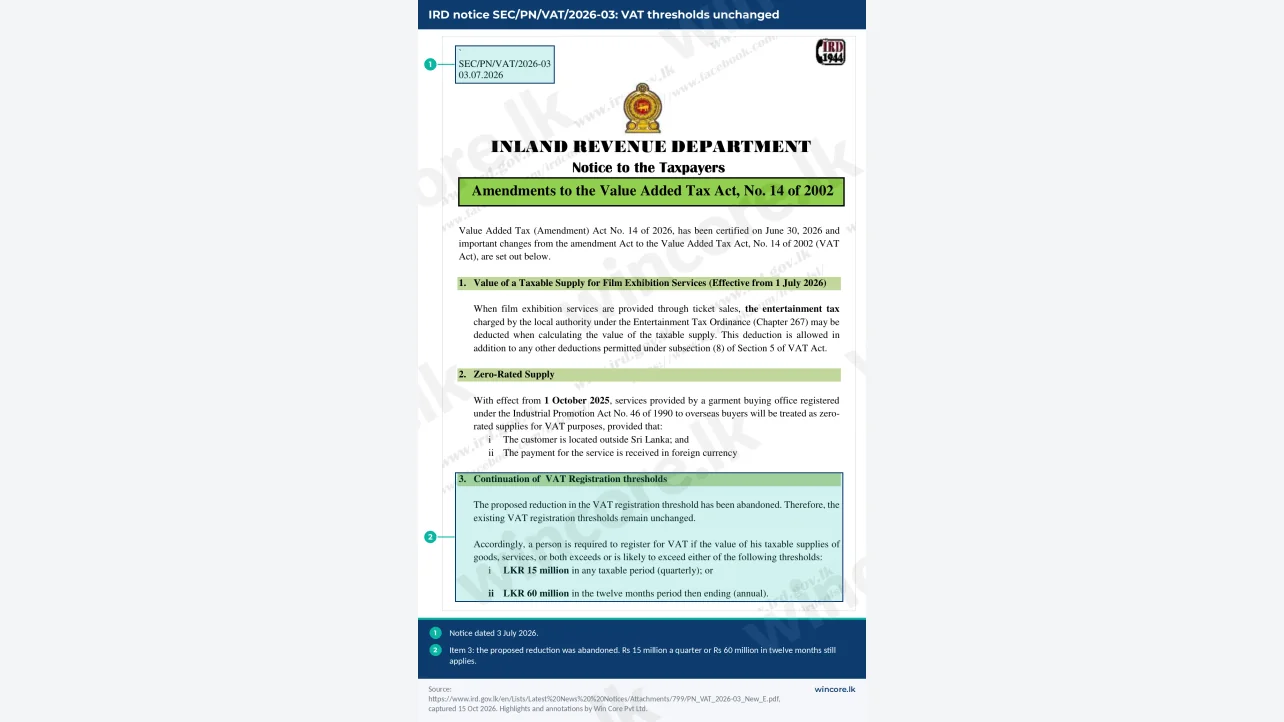
The VAT registration tests are Rs 15 million a quarter or Rs 60 million over 12 months. How the tests run, the 15 day rule and who must register.
Digital services VAT, a 20.5 percent rate for financial services and Rs 1 million fines: each change in the 2026 VAT Act, with its own start date.