
VAT on digital services from abroad in Sri Lanka: who pays
A foreign platform now adds Sri Lankan VAT to some subscriptions. Who registers, who pays, when a registered buyer pays nothing, and what is still open.
On this page
Last verified against the primary sources on 21 October 2026.
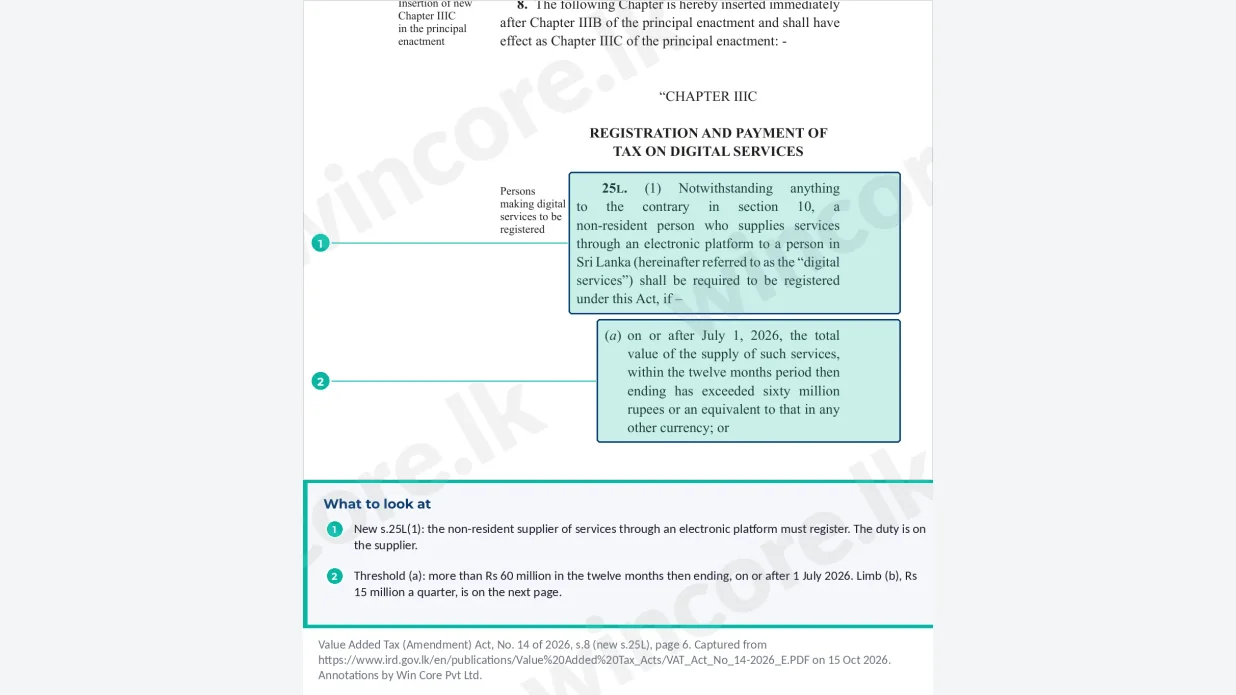
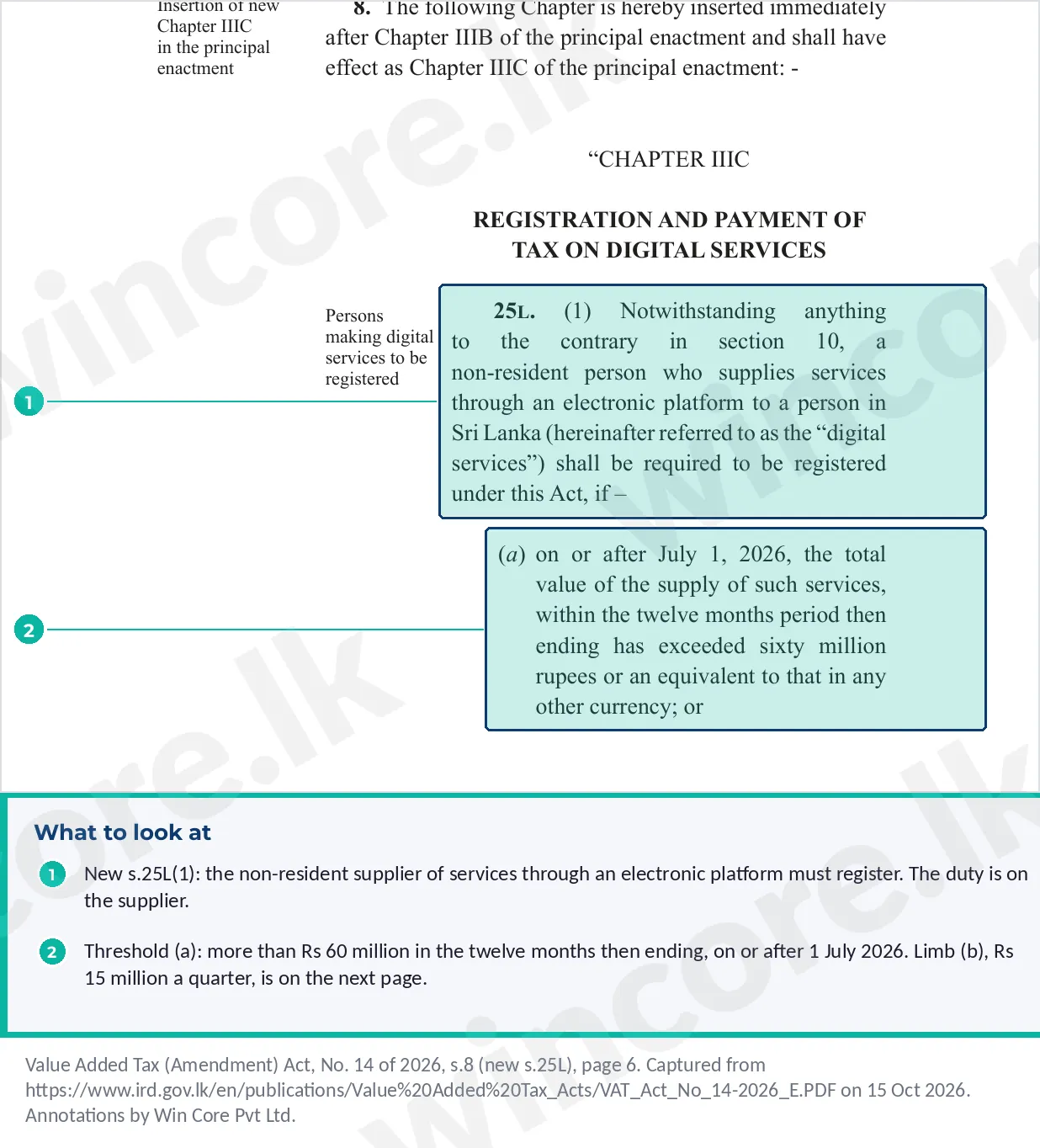
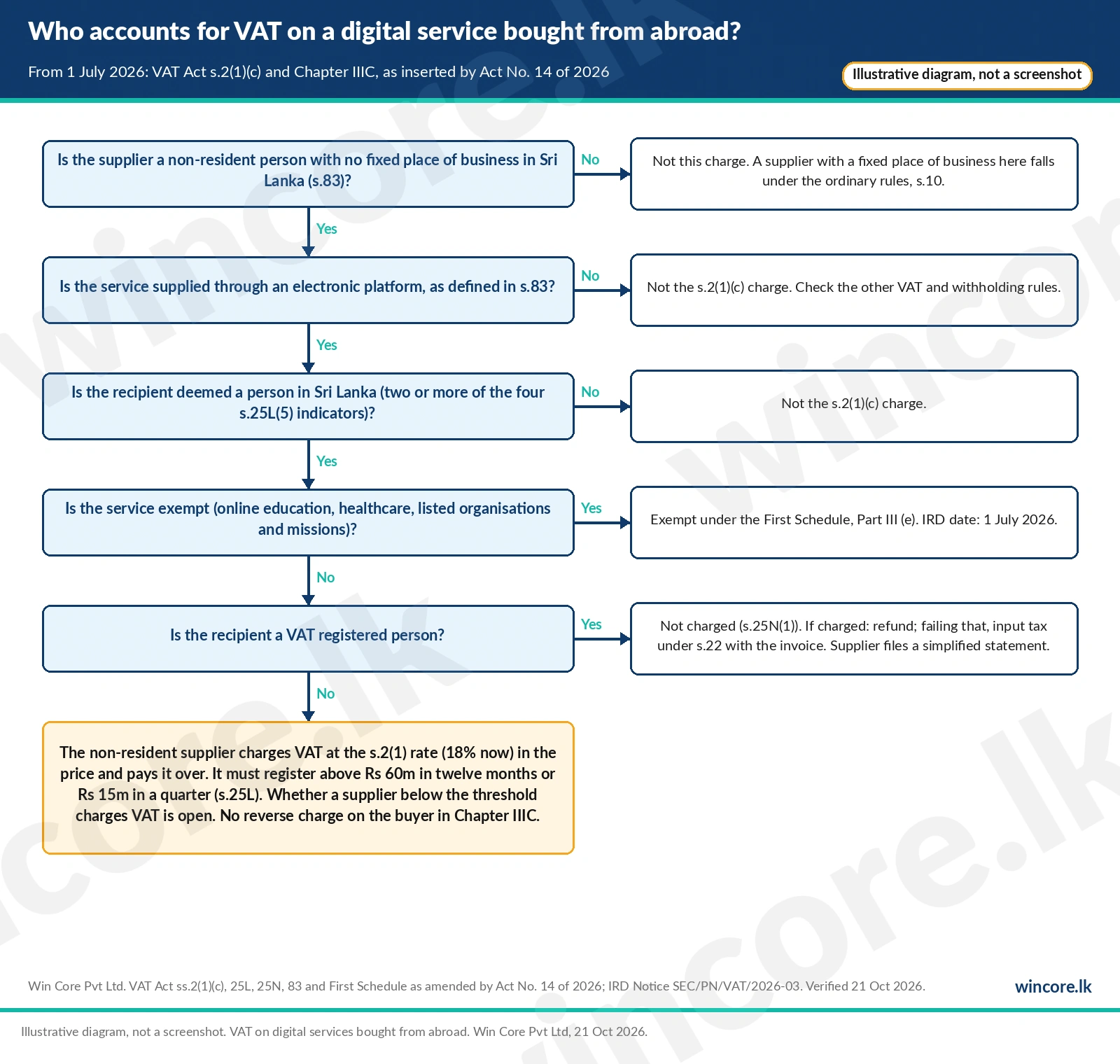
VAT on digital services from abroad applies in Sri Lanka from 1 July 2026. A non-resident that supplies services to persons in Sri Lanka through an electronic platform must register once those supplies exceed Rs 60 million in the twelve months then ending, or exceed or are likely to exceed Rs 15 million in a quarter, and it then charges VAT at the general rate of 18 percent and pays it over. A buyer that is VAT registered should not be charged at all (section 25N), and nothing in the new Chapter IIIC asks the buyer to account for the tax itself [1] [2].
Take a hypothetical driving school in Kandy that is not VAT registered and pays a monthly subscription to an overseas lesson-scheduling platform. From 1 July 2026 that subscription can carry Sri Lankan VAT. This piece is the buyer's guide: who is liable, when, at what rate, what a registered buyer should do, and which parts the law has not settled. Our article on the VAT Amendment Act No. 14 of 2026 covers the whole Act; this one stays on digital services.
The VAT on digital services from abroad started on 1 July 2026
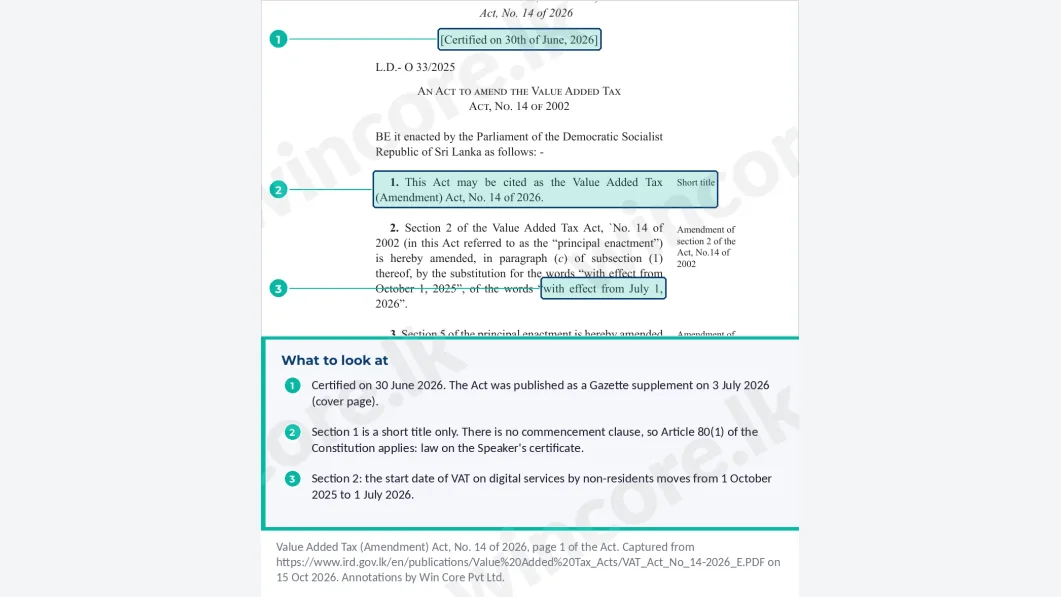
Section 2(1)(c) of the VAT Act charges tax "on the supply of services by a non-resident person through an electronic platform to a person in Sri Lanka" [2]. Act No. 4 of 2025 set the start at 1 October 2025. Section 2 of the VAT (Amendment) Act No. 14 of 2026, certified on 30 June 2026, replaced "with effect from October 1, 2025" with "with effect from July 1, 2026" [1].
Keep the two kinds of date apart:
- Statutory: 1 July 2026, in section 2(1)(c) as amended, and "on or after July 1, 2026" in the new section 25L [1].
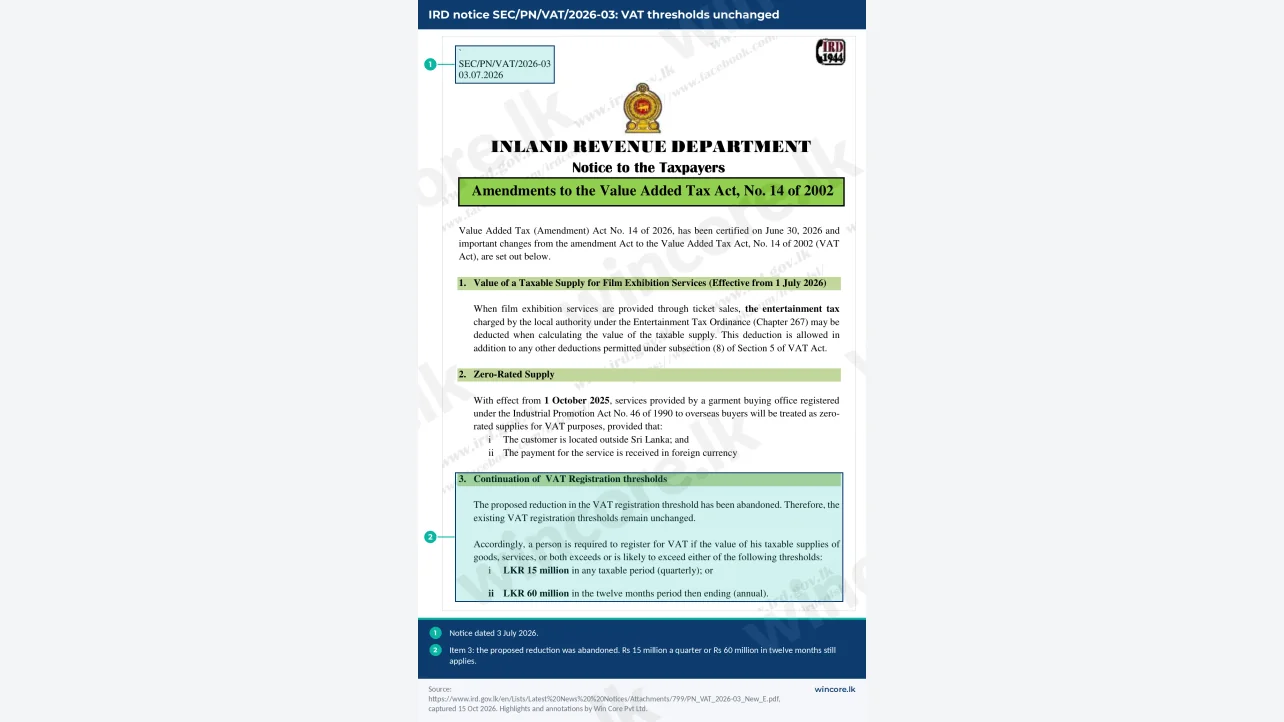
- Administrative: IRD Notice SEC/PN/VAT/2026-02 of 31 March 2026 had postponed the start "until July 1, 2026, subject to formal amendment to the VAT Act" [4]. Notice SEC/PN/VAT/2026-03 of 3 July 2026 confirmed: "With effect from 1 July 2026, VAT will apply to services supplied by non-resident persons through electronic platforms to customers in Sri Lanka" [3].
Did anything arise between October 2025 and June 2026? On the statute as amended, no, on our reading: section 2 replaced the October 2025 date. The Act does not say the old words never applied, so a textual argument for a charge in that window exists. Given the IRD's postponement notices we regard it as remote, but it is not settled at source, which is the same position our Act No. 14 article takes [1] [4].
The foreign supplier registers, charges and pays, not the buyer
Chapter IIIC, inserted by section 8 of Act No. 14, puts every duty on the non-resident supplier [1].
- Registration (s.25L(1)). A non-resident that supplies services through an electronic platform to a person in Sri Lanka "shall be required to be registered" if "(a) on or after July 1, 2026, the total value of the supply of such services, within the twelve months period then ending has exceeded sixty million rupees", or "(b) for any quarter commencing on or after July 1, 2026", the quarter's supplies exceed "or is likely to exceed fifteen million rupees" [1]. Limb (a) has no "likely" test.
- When to apply (s.25L(2)). Electronically, "not later than three months, from the date on which such person is required to be registered or from the date on which the Commissioner-General has specified such form, whichever comes later" [1]. A local business has fifteen days under section 10(2), as our guide to VAT registration thresholds explains.
- Payment (s.25P). In accordance with section 26, by electronic remittance, "in Sri Lankan rupees or in such foreign currency as may be permitted", "either directly by the non-resident digital service provider or through a representative appointed for that purpose" [1].
- Returns (s.25Q). A return "for each taxable period as specified in section 21 by an electronic means", accounts kept "on an invoice basis", and currency conversion differences "shall be disregarded" [1].
Penalties, mapped to each default
| Default | Section | Consequence |
|---|---|---|
| Simplified statement of supplies to registered buyers not filed | VAT Act s.25N(4) | Penalty up to Rs 50,000; may be reduced or annulled under s.25N(5) if the failure was "due to circumstances beyond his control" and the provider has since complied [1] |
| Tax paid late | VAT Act s.27 | Late payment penalty; the Order points to s.27 (para 8.1) [5] |
| Tax not paid | VAT Act s.28(1)(d) | The Assessor assesses "any person who is chargeable with tax on the supply of services by a non-resident person" through an electronic platform [2] |
| Non-resident never registers | Open | Section 67(a) names sections 10 and 25A, not 25L, as our Act No. 14 article notes [2] |
Who counts as "non-resident" and "in Sri Lanka"
The amended section 83 defines a "non-resident person" as one who undertakes transactions involving the supply of services "but who has no fixed place of business in Sri Lanka". It does not include a person registered under section 10 that trades here without a fixed place of business through an agent under section 55. A "fixed place" is one "at the disposal of a person" from which it "regularly supplies services" using human and technical resources there. An "electronic platform" is "any online system, website, mobile application, or other digital interface operating through the internet that enables one or more service providers to supply services to service recipients" [1].
A recipient is "deemed to be a person in Sri Lanka" where "two or more" of these point here, on information the supplier has: billing, residential or business address; payment through a Sri Lankan bank or financial institution; a payment instrument issued in Sri Lanka; or the device's IP address (s.25L(5)) [1]. One indicator is not enough.
A VAT registered buyer should not be charged at all
Section 25N(1): "Notwithstanding the provisions of section 2 and this Chapter", the tax "shall not be charged on or collected for the supply of services made by a non-resident person through an electronic platform, where the recipient of such services is a registered person under this Act" [1]. Two provisos follow. A registered provider that charged it anyway "shall refund the tax so charged or collected". If it cannot, because the tax has been remitted, the buyer may treat it as input tax "to the extent allowable under section 22", and the provider's invoice showing VAT separately "shall be treated as a valid tax invoice" [1].
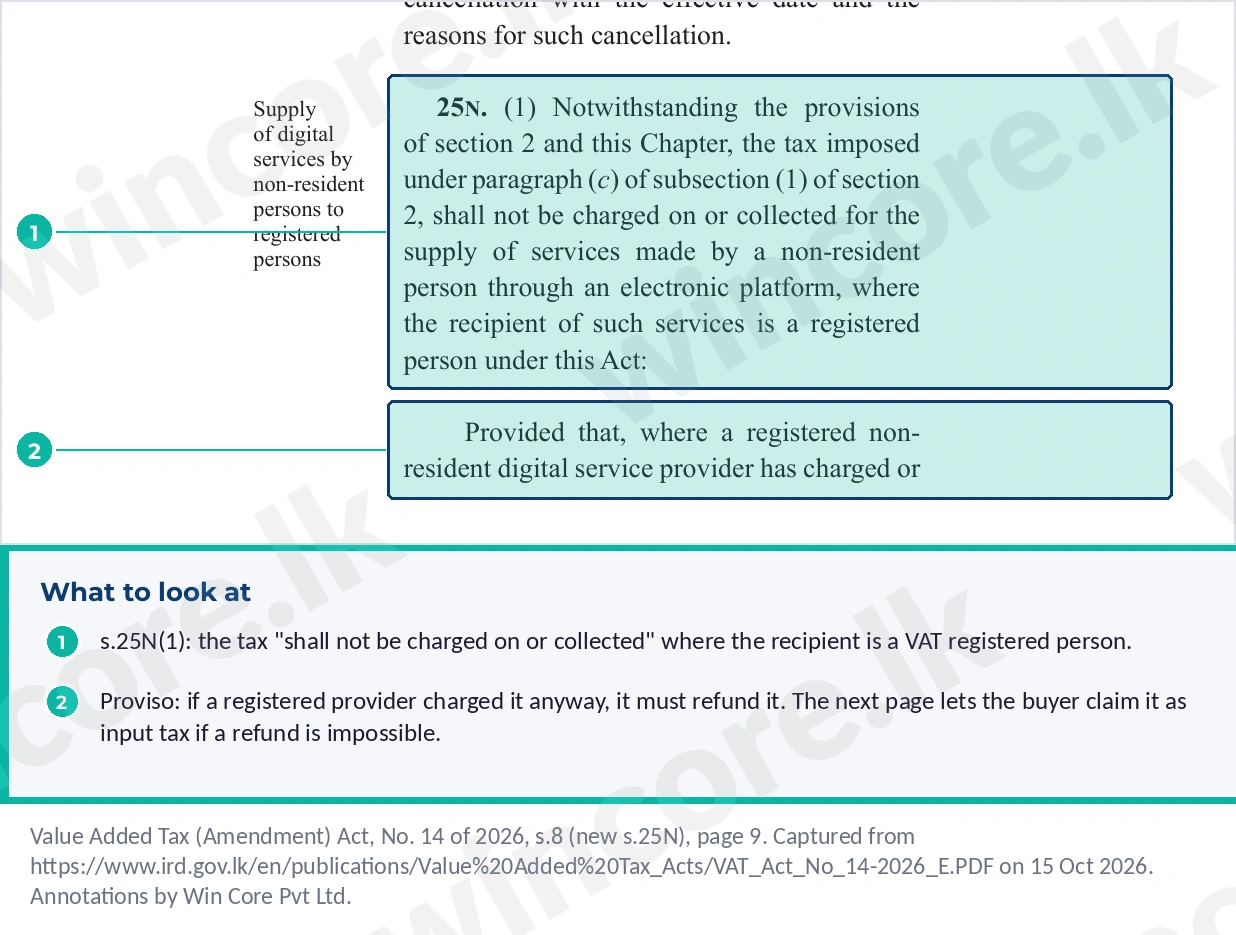
Is there a reverse charge, so that the registered buyer accounts for the VAT itself? Not in Chapter IIIC. Section 25N says the tax is not charged; it does not move the liability to the buyer. In return the supplier must file "a simplified statement containing particulars of supplies made to registered persons": date, the buyer's TIN, name, value, invoice number and description (s.25N(2), (3)) [1]. The Commissioner-General must now publish each registered person's name, address, registration number and status, partly "for the purpose of section 25N" (s.73(1A)) [1]. On our reading, that public register is how a provider is meant to check a buyer's status.
An unregistered buyer pays the VAT inside the price
For a consumer, or a business below the VAT threshold like our driving school, a registered foreign provider charges VAT and the buyer pays it as part of the price. The buyer has no return to file and no input tax to claim, so the cost is real: on a subscription priced before tax, the bill rises by 18 percent. If the driving school later registers for VAT, it should give its registration number to each provider, because section 25N turns on whether the recipient is a registered person and the provider can only act on what it is told and what the public register shows.
A worked example
Suppose the driving school's plan is priced at the rupee equivalent of Rs 20,000 a month before tax, and the provider has registered under section 25L. The driving school is not VAT registered, so the invoice shows Rs 20,000 plus VAT of Rs 3,600, a total of Rs 23,600. Over twelve months the VAT is Rs 43,200, a cost the driving school cannot recover. A VAT registered bus operator on the same plan should see Rs 20,000 and no VAT. If its provider adds Rs 3,600 by mistake, the operator asks for a refund first, and only if the provider cannot refund because the tax has been remitted does it claim the Rs 3,600 as input tax, using an invoice that shows the VAT separately. Our VAT calculator separates the tax from a VAT inclusive total.
The rate is 18 percent, unless the service is exempt
The rate is the general rate in section 2(1): "for any taxable period commencing on or after January 1, 2024 at the rate of eighteen per centum" [2]. The Commissioner-General's Order in Gazette 2443/30 says the same: "The currently applicable VAT rate is 18%" [5].
Before applying it, check the First Schedule. Section 17 of Act No. 14 adds paragraph (e) to Part III, exempting these services supplied "through an electronic platform by a non-resident person" [1]:
- "educational services including online courses, seminars, training, digital education platforms, virtual classrooms, learning management systems and courses in marketplaces";
- "healthcare services including online consultations, digital prescriptions, AI-assisted diagnostic, digital health tracking and telemedicine";
- services to an organisation or to diplomatic missions to the extent a written law or a Government agreement provides.
The Act gives the exemption no date of its own; the IRD gives "Effective from July 1, 2026" [3].
The 2025 procedure Order was written for an October 2025 start
Gazette 2443/30 of 1 July 2025 is an Order under section 26(1B). It lists services treated as taxable, "but not limited to", including cloud computing, software as a service, digital marketing and advertising, streaming, gaming and booking apps [5]. It says the tax must be remitted "no later than the twentieth day of the month following the end of the taxable period", and that returns are quarterly, due by the last day of the month after each quarter [5]. Two cautions. The Order still recites "with effect from October 01, 2025", and its threshold wording ("within the last three months") is not the Act's "quarter commencing" test [5] [1]. We searched ird.gov.lk and documents.gov.lk on 21 October 2026 and found no replacement Order for the 1 July 2026 date. Treat the Order's procedure as the IRD's current practice, not as settled law.
VAT does not settle withholding tax on the same payment
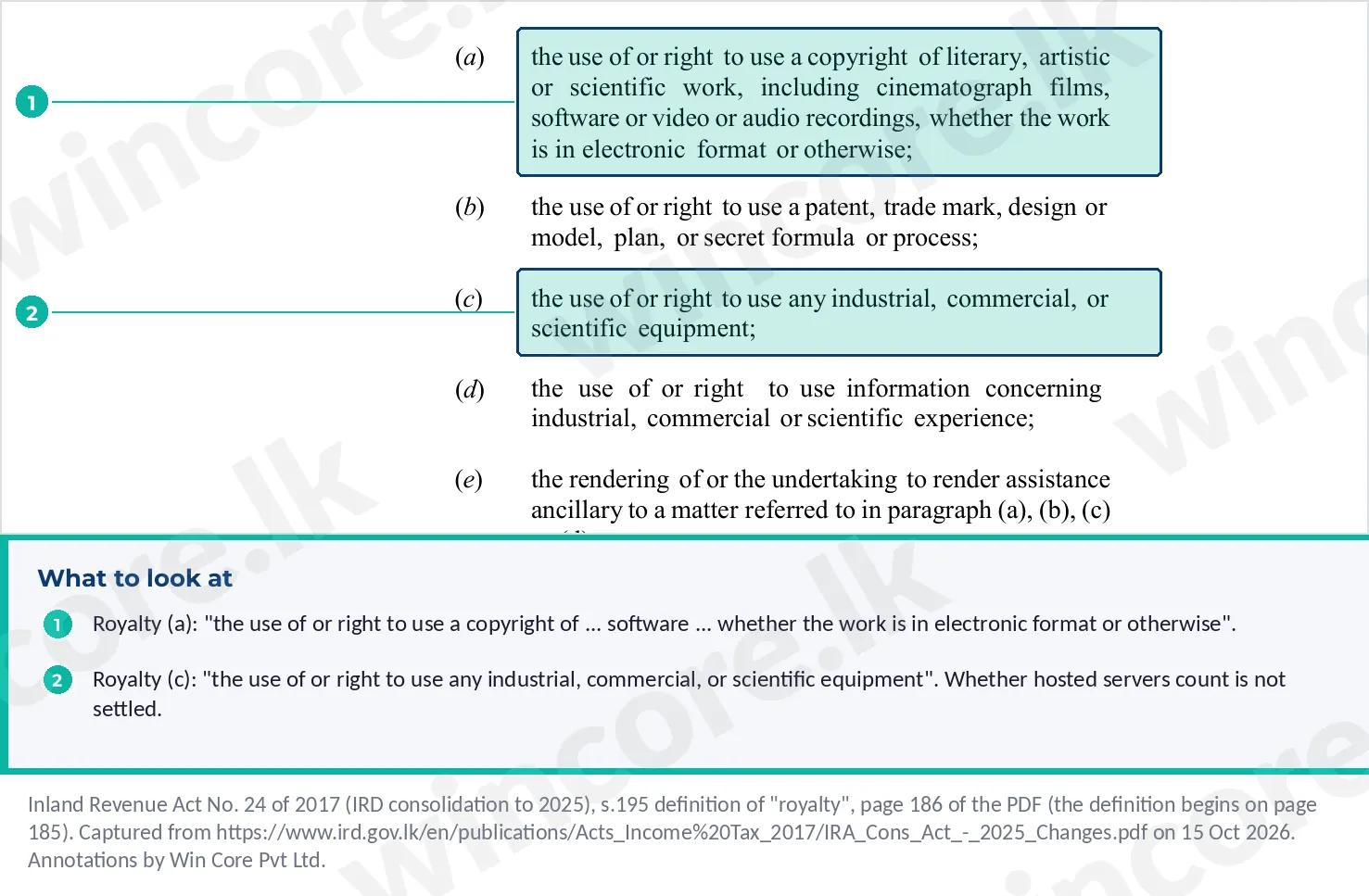
VAT is one question; withholding tax is another. A payment abroad for software or a hosted subscription may also have to be tested under the Inland Revenue Act, where on our reading it can be a royalty subject to 14 percent withholding. That is set out in our article on withholding tax on SaaS subscriptions. Paying the VAT correctly says nothing about withholding, and the reverse. Our income tax services cover both sides of a foreign invoice.
What this means for you
- If you are VAT registered, give each foreign provider your VAT registration number. Under section 25N they should not charge you.
- If a provider charges you anyway, ask for a refund first. Claim input tax only if it cannot refund, and only with an invoice showing VAT separately.
- If you are not registered, expect 18 percent on subscriptions from registered foreign providers, unless the service is online education or healthcare.
- Do not self-account. Chapter IIIC gives the buyer no reverse charge.
- Check withholding tax separately on any software or subscription paid abroad.
Checklist: documents needed
- Your VAT registration certificate and number, to give each foreign provider
- Foreign digital service invoices from 1 July 2026, with any VAT shown separately
- Refund requests sent to providers that charged VAT, and their replies
- A list of subscriptions that are online education or healthcare, for the exemption
- Your withholding tax workings for the same foreign payments
Open points
- Whether supplies before 1 July 2026 count in the "twelve months period then ending" for limb (a). The Act says "on or after July 1, 2026" without saying which supplies are counted. Notice SEC/PN/VAT/2026-03 says "during any consecutive 12-month period" [3].
- Whether a non-resident below the threshold must charge VAT. Section 2(1)(c) charges the tax; section 25L requires registration only above the threshold [1] [2].
- Who "any person who is chargeable with tax" in section 28(1)(d) is. Chapter IIIC places the duties on the supplier, so on our reading it is the supplier, but the paragraph does not say so [2].
- Whether failure to register under section 25L is an offence under section 67 [2].
- The status of the 2025 Order after the date change. The IRD says the Commissioner-General "will issue further guidelines" [3].
FAQ
Who pays VAT on a foreign subscription in Sri Lanka, me or the platform?
The foreign platform charges, collects and pays it once it is registered under section 25L. You bear it inside the price only if you are not VAT registered. If you are registered, section 25N says it should not be charged to you at all, and Chapter IIIC does not ask you to account for it yourself [1].
Do I have to register for VAT because I buy foreign software?
No. Registration under section 25L is a duty of the non-resident supplier, not of the Sri Lankan buyer. Your own VAT registration still depends on your own taxable supplies under section 10, so buying foreign services neither triggers it nor removes it. A registered buyer simply gives its number to the provider [1] [2].
What VAT rate applies to digital services from abroad?
The rate is 18 percent, the general rate in section 2(1) for periods from 1 January 2024. Before applying it, check the First Schedule: online educational and healthcare services supplied by a non-resident through a platform, and some services to organisations and diplomatic missions, are exempt, from 1 July 2026 on the IRD's date [1] [2] [3].
What should a VAT registered business do if a foreign platform charges VAT?
Ask the provider for a refund first, because section 25N requires a registered provider to refund tax it should not have charged. Only if it cannot refund, because the tax has already been remitted, may you claim it as input tax under section 22, using the provider's invoice that shows the VAT separately [1].
Did VAT on foreign digital services apply from October 2025?
On the Act as amended, no, on our reading. Section 2 of Act No. 14 of 2026 replaced the 1 October 2025 start with 1 July 2026, and the IRD had postponed the date by notice. The Act does not say the old words never applied, so a remote textual argument remains [1] [4].
This article is general information on the law as at 21 October 2026 and is not advice on your specific transaction.
Talk to us. If you need to sort your foreign subscriptions for VAT and withholding tax, or you are a foreign provider deciding whether to register, contact us at our contact page.
WinCore Pvt Ltd
References
- Parliament of Sri Lanka. Value Added Tax (Amendment) Act, No. 14 of 2026 (certified 30 June 2026), ss.2, 8 (new ss.25L to 25Q), 15 (new s.73(1A)), 16 (s.83 definitions), 17 (First Schedule Part III). https://www.ird.gov.lk/en/publications/Value%20Added%20Tax_Acts/VAT_Act_No_14-2026_E.PDF . Primary. Accessed 21 October 2026.
- Inland Revenue Department. Value Added Tax Act, No. 14 of 2002 (Consolidation 2025), ss.2(1), 10, 27, 28(1)(d), 67. https://www.ird.gov.lk/en/publications/Value%20Added%20Tax_Acts/VAT_Act_No_14%5BE%5D_2002_%28Consolidation_2025%29.pdf . Primary. Accessed 21 October 2026.
- Inland Revenue Department. Notice to the Taxpayers: Amendments to the Value Added Tax Act, No. 14 of 2002, SEC/PN/VAT/2026-03 (3 July 2026), items 4, 13, 14 and 15. https://www.ird.gov.lk/en/Lists/Latest%20News%20%20Notices/Attachments/799/PN_VAT_2026-03_New_E.pdf . Primary (administrative). Accessed 21 October 2026.
- Inland Revenue Department. Notice SEC/PN/VAT/2026-02 (31 March 2026), postponement of VAT on digital services. https://www.ird.gov.lk/en/Lists/Latest%20News%20%20Notices/Attachments/772/PN_VAT_2026_-_2_E.pdf . Primary (administrative). Accessed 15 October 2026.
- Commissioner General of Inland Revenue. Order under section 26(1B): procedure for VAT on services supplied by a non-resident through an electronic platform, Gazette Extraordinary No. 2443/30 (1 July 2025), paras 1.2, 1.3, 2.3, 2.4, 6.2, 7.8, 8.1. https://documents.gov.lk/api/content-file-proxy?file=/extra-gazette-content/2443-30_E_1784567172.pdf . Primary. Accessed 21 October 2026.
Put these insights to work
WinCore specialists can review your current workflow, document gaps, and build a practical 90-day action plan.
Book a free consultationContinue reading
Explore more WinCore analysis to keep your finance, tax, and compliance roadmap moving.
Digital services VAT, a 20.5 percent rate for financial services and Rs 1 million fines: each change in the 2026 VAT Act, with its own start date.
A licence to use hosted software looks like a royalty under section 195. What that means for the 14 percent, the bank's TCC and grossing up.
The VAT registration tests are Rs 15 million a quarter or Rs 60 million over 12 months. How the tests run, the 15 day rule and who must register.