
Withholding tax on SaaS subscriptions in Sri Lanka: is it a royalty?
A licence to use hosted software looks like a royalty under section 195. What that means for the 14 percent, the bank's TCC and grossing up.
On this page
WinCore Pvt Ltd. Tax. Last verified 21 October 2026
Withholding tax on a SaaS subscription paid abroad from Sri Lanka is, on our reading, 14 percent Advance Income Tax (AIT) where the subscription is a licence to use software. The Inland Revenue Act No. 24 of 2017 defines a royalty in section 195 to include the right to use software "whether the work is in electronic format or otherwise"; a royalty paid by a resident has a Sri Lankan source under section 73(1)(c)(i); and since 1 January 2023 section 84A(1A) requires AIT on royalties at the First Schedule rate, which is 14 percent [1] [2]. The Act has no rule written for hosted software, so this is our best reading, not settled law. The bank will also want a tax clearance certificate before the money leaves [3].
A software subscription is a key to a room someone else owns. The tax question is what you are paying for: the right to use what is in the room, or the service of having the room run for you. The first looks like a royalty and the second like a service fee, and the Act sources and withholds the two differently. Take a hypothetical Sri Lankan company paying a foreign provider for 40 user seats of a hosted accounting tool. We use it throughout.
Withholding tax on a SaaS subscription turns on royalty or service fee
Route 1: royalty
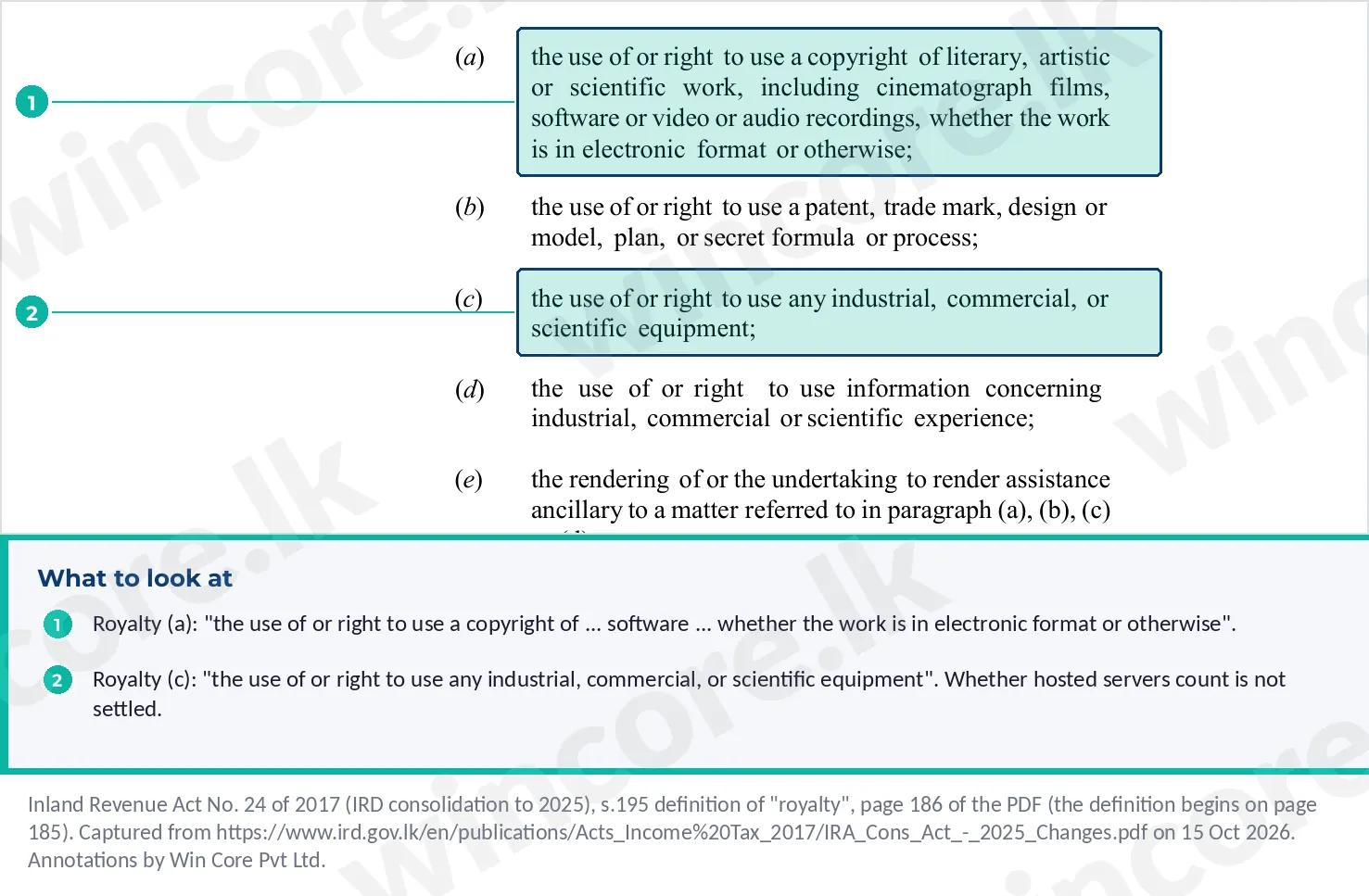
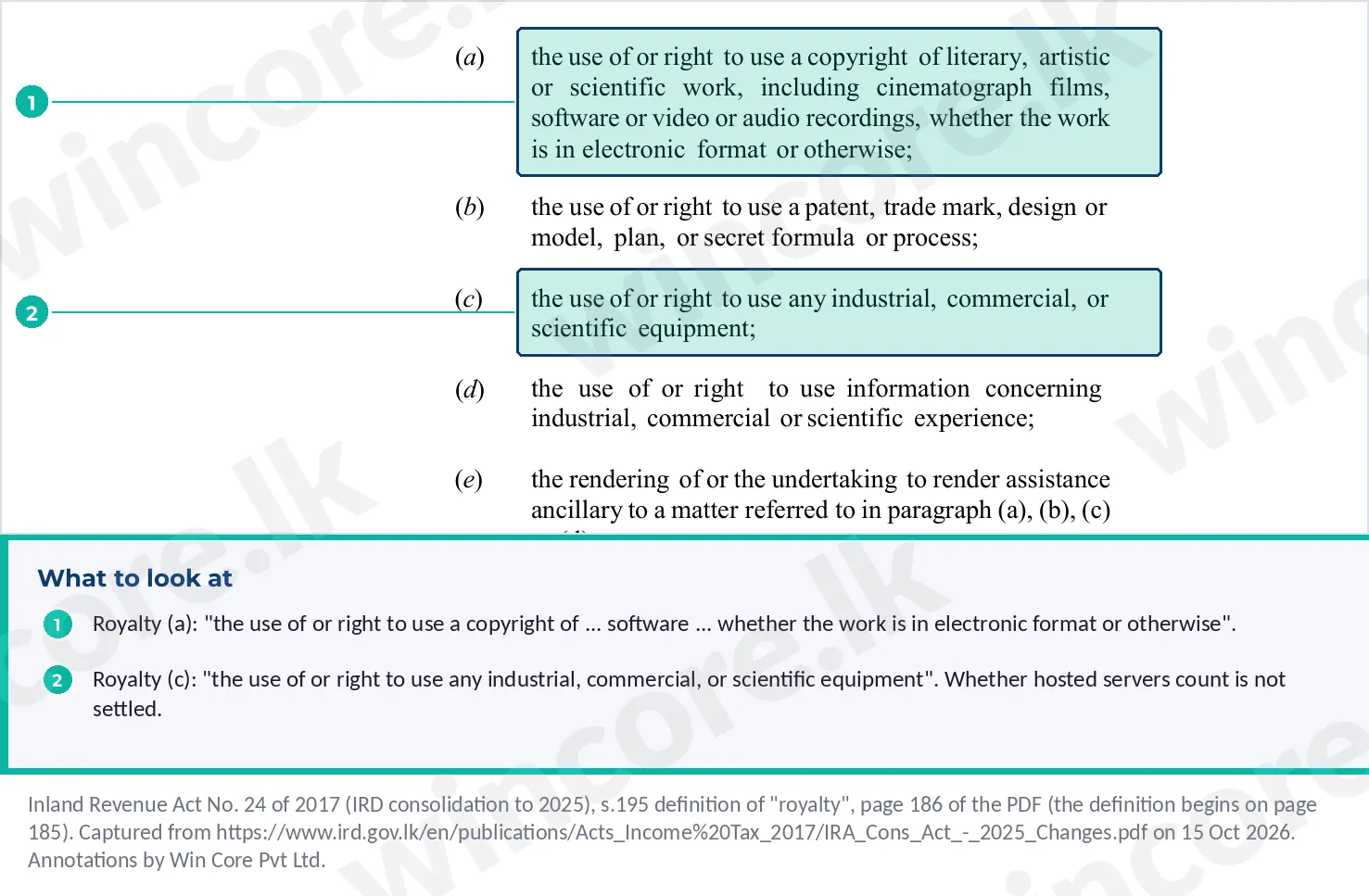
Section 195 defines a "royalty" as a payment "derived as consideration for", among other things, "(a) the use of or right to use a copyright of literary, artistic or scientific work, including cinematograph films, software or video or audio recordings, whether the work is in electronic format or otherwise" and "(c) the use of or right to use any industrial, commercial, or scientific equipment" [1].
A royalty has a source in Sri Lanka if "paid by a resident person, other than as an expenditure of a business carried on by the resident person through a permanent establishment outside Sri Lanka" (s.73(1)(c)(i)) [1]. Section 84A(1A), inserted by the Inland Revenue (Amendment) Act No. 45 of 2022 with effect from 1 January 2023, says "a person shall deduct Advance Income Tax from the payment of dividend, interest, discount, charge, natural resource payment, rent, royalty or premium which has a source in Sri Lanka, at the rate provided in paragraph 10 of the First Schedule" [2]. Paragraph 10(1)(d) sets the rates "for payments to which section 84A(1A) applies", and for "all other payments except dividend" the rate is 14 percent [2]. The IRD's withholding circular SEC/2026/E/04 lists royalty at 14 percent to match [4].
Instrument: Inland Revenue Act No. 24 of 2017, ss.73(1)(c), 84A(1A), 195 and First Schedule para 10(1)(d)(iv), as amended by Act No. 45 of 2022, ss.16 and 33. Official link: Act No. 45 of 2022. Last verified: 21 Oct 2026.
Route 2: service fee
A "service fee" is "a payment to the extent to which, based on market values, it is reasonably attributable to services rendered by a business of a person, but excludes interest, rent or a royalty" [1]. Note the exclusion: if the payment is a royalty, it cannot be a service fee.
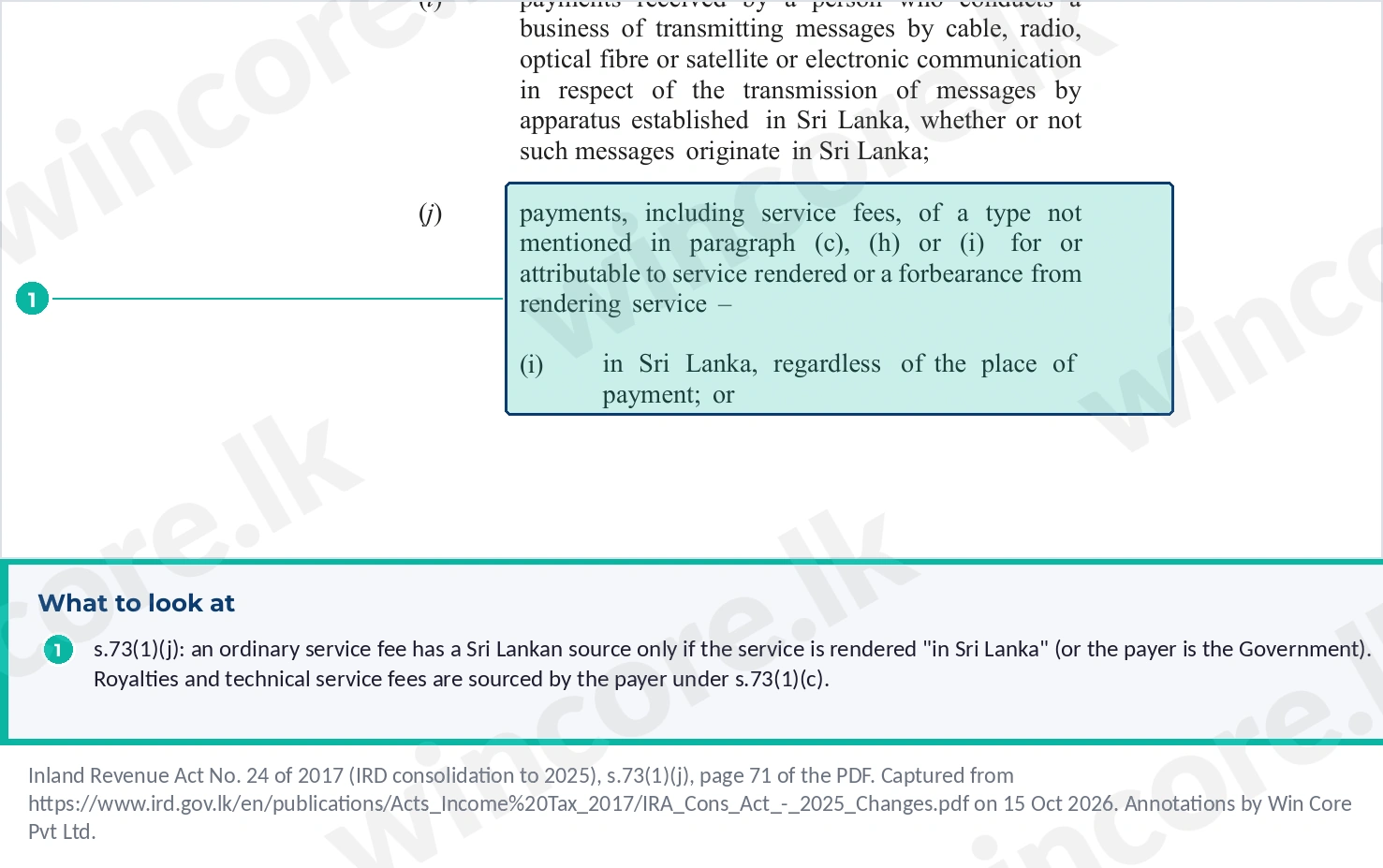
Section 85(1B), also from 1 January 2023, requires withholding "at the rate of 14% of the payment, where such person pays a service fee or an insurance premium with a source in Sri Lanka to a non-resident person" [2]. The source rule then decides everything. Section 73(1)(c) sources a "technical service fee, or similar payment" by the payer's residence, like a royalty, and a technical service fee is "a service fee for managerial, technical, or consultancy services" [1]. Any other service fee falls under section 73(1)(j): it has a Sri Lankan source if "for or attributable to service rendered ... in Sri Lanka, regardless of the place of payment", or where the Government pays [1].
If a payment was made without the required deduction, review the withholding shortfall and penalty exposure before correcting the return.
Our reading: a standard SaaS licence is a royalty at 14 percent
So which is the 40-seat accounting tool? We see three positions, in order of strength.
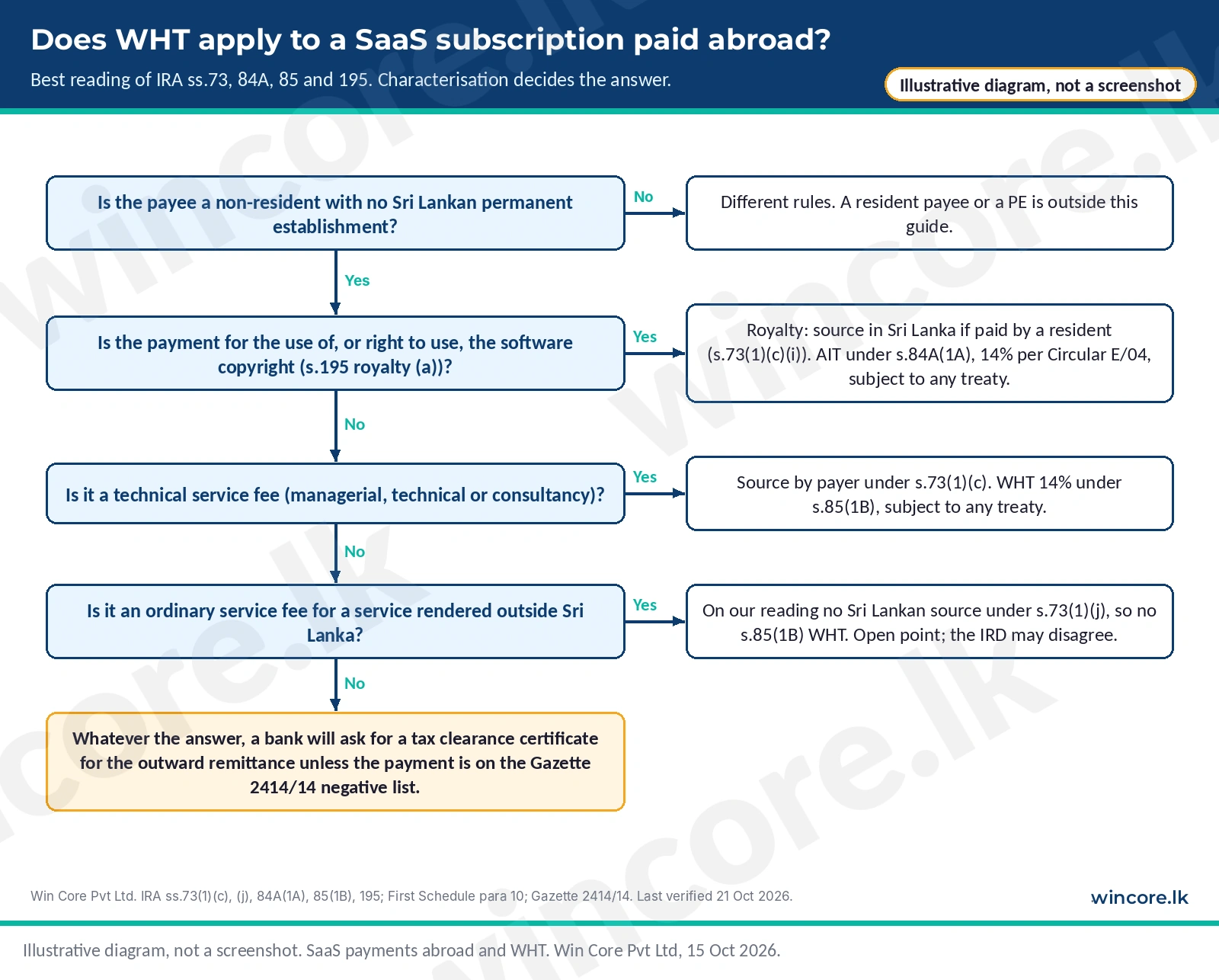
- Royalty, under limb (a). The customer pays for the right to use software, and the definition expressly includes software in electronic format [1]. Most SaaS terms are written as a licence. On this reading the payment has a Sri Lankan source because the payer is resident, and AIT is 14 percent under section 84A(1A) [2].
- Technical service fee or "similar payment". If the subscription is mainly support, configuration or managed IT, it may be a technical service fee, sourced by the payer and withheld at 14 percent under section 85(1B) [1] [2].
- Ordinary service fee rendered abroad. If the customer receives a service performed on foreign servers and no right to use copyright, the fee is a service fee under section 73(1)(j). Rendered outside Sri Lanka, on our reading it has no Sri Lankan source and section 85(1B) does not apply [1].
The rate is 14 percent on routes 1 and 2, so the practical question for most payers is between those two and route 3. Our view is that route 1 is the safer reading for a standard SaaS licence. Route 3 is arguable but not settled, and we would not rely on it without the contract terms and, ideally, the IRD's own view. Calling the payment a "subscription" does not change the answer: the definition turns on what the payment is "consideration for" [1].
If a branch of a foreign company pays
A royalty or technical service fee also has a Sri Lankan source where it is "paid by a non-resident person as an expenditure of a business carried on by the non-resident person through a Sri Lankan permanent establishment" (s.73(1)(c)(ii)) [1]. So a Sri Lankan branch that pays the provider directly is in the same position as a resident payer.
The bank will ask for a tax clearance certificate under Gazette 2414/14
Withholding is not only a return question. Gazette Extraordinary No. 2414/14, regulations made by the Commissioner General under section 86(7) and in force "from January 01, 2025", requires withholding agents and banks making outward remittances to follow a set procedure [3]. Withholding tax, which "includes Advance Income Tax", on payments to a non-resident is collected by the Commissioner General, who issues a tax clearance certificate (TCC) for the remittance, and "a TCC shall be obtained from the CGIR for all other payments not mentioned in the Negative List" [3].
Software subscriptions are not on that list as a class. The list does include "periodical subscriptions for journal, magazines and other publications" (item 3(viii)) and payments by Sri Lankan Airlines Limited for "software licenses" (item 3(xviii)) [3]. On our reading neither covers an ordinary company's SaaS fee.
Three more rules in item 5 of the same Schedule matter for every remittance [3]:
- the rate "will be decided based on the provisions of the IRA as amended, but subject to the provisions of the respective Double Tax Avoidance Agreement", and the payee's tax residency certificate has to be submitted to claim treaty benefits;
- if you want to remit the full invoice, "the invoiced amount should be treated as the net amount and the relevant withholding tax should be calculated based on the grossed-up amount";
- foreign currency is converted at the CBSL selling rate published on the date of remittance.
On our 40-seat example, an invoice of USD 1,000 remitted in full is grossed up to 1,000 divided by 0.86, or USD 1,162.79, and the AIT is USD 162.79, converted at that day's CBSL selling rate. Our withholding tax calculator and currency converter help with the working.
Instrument: Regulations under section 86(7), Gazette Extraordinary No. 2414/14 of 11 December 2024, items 2, 3, 5. Official link: Gazette 2414/14. Last verified: 21 Oct 2026.
Check exemptions and treaties before applying 14 percent
Section 85(3) excludes "payments made by individuals, unless made in conducting a business" and "payments that are exempt amounts" from service fee withholding, and section 84(3), applied to AIT through section 84A, excludes exempt amounts [1]. Then check whether Sri Lanka has a double tax agreement with the provider's country, and what its royalty article says, before applying 14 percent; the Gazette expressly makes the rate subject to the treaty [3]. We have not reviewed treaties for this article.
Getting it wrong costs the payer, not the provider
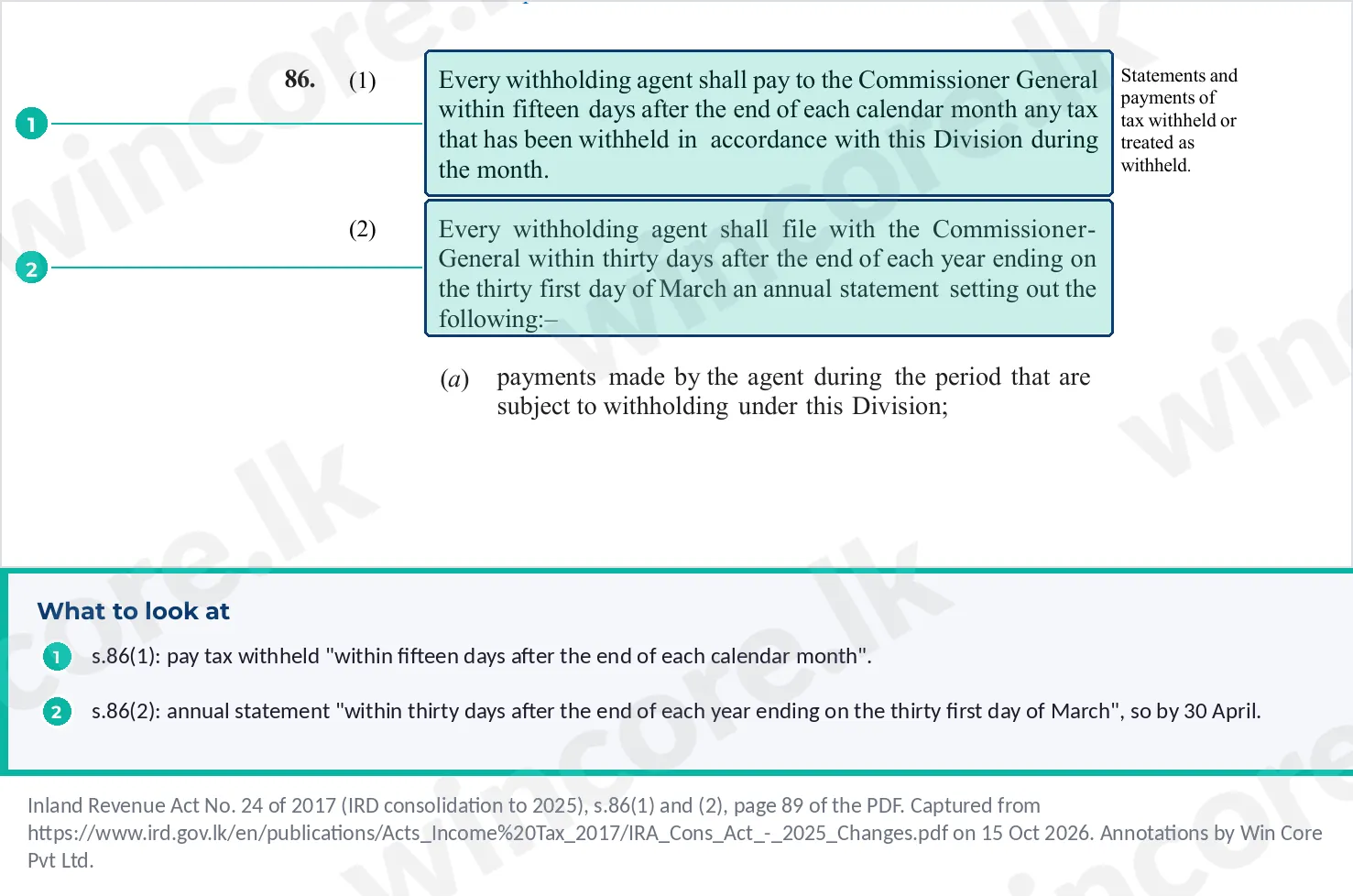
The cost of under-withholding falls on the Sri Lankan payer. Under section 86(3) and (4) a withholding agent that fails to withhold must still pay the tax that should have been withheld, and payer and payee are jointly and severally liable [1]. Late payment carries interest under section 159 and, once fourteen days past the due date, the penalty of 20 percent of the tax due but not paid under section 179(1) [1]. There is a deduction point too: under section 10(2) the expense is deductible, but "the deduction shall not be allowed until the tax withheld has been paid to the Commissioner General" [1]. Our guide to the WHT annual statement and certificate of deduction covers the year-end filing, and our WHT registration guide covers becoming a withholding agent. For a monthly subscription, that is a reason to settle the characterisation once, in writing, rather than month by month.
VAT is a separate question with a separate answer. From 1 July 2026 a foreign provider registered under the new VAT rules for electronic platforms charges Sri Lankan VAT to buyers who are not VAT-registered, and charges none to a registered buyer; our article on VAT on digital services bought from abroad explains it. Paying VAT correctly says nothing about withholding tax, and the reverse. Withholding on fees to resident individuals is a different regime again, set out in our article on 5 percent WHT on service fees.
What this means for you
- Read the contract. A licence grant points to royalty; a pure service performed abroad points the other way.
- Default to 14 percent AIT on a standard SaaS licence paid by a resident, unless a treaty reduces it.
- Plan the TCC before the payment date. The bank will ask, and the Commissioner's unit needs the invoice and agreement.
- Gross up if you pay the full invoice, at the CBSL selling rate on the remittance date.
- Keep the paper. The certificate, the TCC and the contract support the deduction under section 10(2).
Our tax return filing services team can review a contract, the treaty position and the TCC application.
Open points. The Act does not address hosted software, and the IRD's view in practice may differ from ours. Whether "similar payment" in section 73(1)(c) catches SaaS fees that are not technical service fees is unclear. Whether access to hosted servers is "use of ... commercial ... equipment" under limb (c) is untested. Treaties were not reviewed.
Checklist: documents needed
- The SaaS contract or terms of service, showing whether a licence is granted
- Invoices for the period, with currency and amount
- The provider's country of residence and, for treaty relief, its tax residency certificate
- Your TIN and withholding agent registration
- TCC application in the IRD's specified format, with invoices and agreement
- Grossed-up working at the CBSL selling rate on the remittance date
- AIT payment receipt and certificate of deduction
- Annual WHT/AIT statement entry for the payment
Frequently asked questions
Is a SaaS subscription a royalty in Sri Lanka?
On our reading, usually yes, where the subscription grants a licence to use software. Section 195 defines a royalty to include the right to use a copyright in software "whether the work is in electronic format or otherwise" [1]. A pure service performed abroad with no right to use software may not be a royalty, but the Act has no rule written for hosted software.
What is the withholding tax rate on a royalty paid to a non-resident?
It is 14 percent. Since 1 January 2023 section 84A(1A) requires Advance Income Tax on royalties with a Sri Lankan source at the First Schedule rate, and paragraph 10(1)(d) sets 14 percent for "all other payments except dividend" [2]. A double tax agreement with the provider's country can reduce the rate, with the payee's tax residency certificate [3].
Do we need a tax clearance certificate to pay a software subscription abroad?
Yes, unless the payment is on the Negative List in Gazette 2414/14. Software subscriptions are not on it as a class; the list covers periodical subscriptions for journals and magazines and, separately, software licences paid by Sri Lankan Airlines [3]. Banks must ask for a valid TCC before making any other outward remittance.
Can we pay the full invoice and absorb the withholding tax?
Yes, but the tax is then grossed up. Gazette 2414/14 says that where you remit the full invoice, "the invoiced amount should be treated as the net amount" and the withholding tax is calculated on the grossed-up amount [3]. At 14 percent, a USD 1,000 invoice paid in full carries AIT of USD 162.79, which is your cost.
Is VAT on a foreign SaaS subscription the same as withholding tax?
No. They are separate taxes with separate rules. From 1 July 2026 a registered foreign platform charges VAT to Sri Lankan buyers who are not VAT-registered [5]. Withholding tax depends on how the Inland Revenue Act characterises the payment, so paying the VAT correctly does not settle the withholding question, and the reverse.
Talk to us. If you pay foreign software providers and want a clear withholding position for each contract, book a consultation at our contact page.
WinCore Pvt Ltd
This article is general information on the law as at 21 October 2026 and is not advice on your specific transaction.
References
- Inland Revenue Department. Inland Revenue Act, No. 24 of 2017, consolidated to 2025, ss.10(2), 73(1)(c), (j), 73(2), 84(3), 85(3), 86(3), (4), 159, 179(1), 195 ("royalty", "service fee"). https://www.ird.gov.lk/en/publications/Acts_Income%20Tax_2017/IRA_Cons_Act_-_2025_Changes.pdf . Primary. Accessed 15 October 2026 (ss.73(1)(j) and 195 from the captures in Figures 1 and 2; s.10(2) re-read 21 October 2026).
- Parliament of Sri Lanka. Inland Revenue (Amendment) Act, No. 45 of 2022, ss.16 (s.84A(1A)), 17 (s.85(1B)) and 33 (First Schedule para 10(1)(d)). https://documents.gov.lk/view/acts/2022/12/45-2022_E.pdf . Primary. Accessed 21 October 2026.
- Commissioner General of Inland Revenue. Regulations under section 86(7): procedure for withholding from payments to non-residents, Gazette Extraordinary No. 2414/14 (11 December 2024), items 2, 3, 5 and 6. https://documents.gov.lk/api/content-file-proxy?file=/extra-gazette-content/2414-14_E_1784566474.pdf . Primary. Accessed 21 October 2026.
- Inland Revenue Department. Circular SEC/2026/E/04, Deduction of Withholding Tax and Advance Income Tax (8 June 2026), rate table. https://www.ird.gov.lk/en/publications/Circulars_Circulars/SEC_2026_E_04_E.PDF . Primary (administrative). Accessed 15 October 2026 (scanned PDF; not machine-readable on 21 October 2026).
- Parliament of Sri Lanka. Value Added Tax (Amendment) Act, No. 14 of 2026, s.8 (ss.25L and 25N). https://www.ird.gov.lk/en/publications/Value%20Added%20Tax_Acts/VAT_Act_No_14-2026_E.PDF . Primary. Accessed 15 October 2026 (as verified for sibling piece RT9-16).
Put these insights to work
WinCore specialists can review your current workflow, document gaps, and build a practical 90-day action plan.
Book a free consultationContinue reading
Explore more WinCore analysis to keep your finance, tax, and compliance roadmap moving.

WHT reporting breaks when certificates and annual statements are treated as year-end admin. Build a monthly evidence workflow that files cleanly.
WHT registration works best when withholding-agent onboarding, payment mapping, deduction, and remittance controls are designed as one process.
Interest, 20 percent, s.178, s.178A or a prosecution: which section a withholding agent's slip falls under, with a worked late-statement example.