
Withholding tax penalties in Sri Lanka: each default, each section
Interest, 20 percent, s.178, s.178A or a prosecution: which section a withholding agent's slip falls under, with a worked late-statement example.
On this page
Last verified against the primary sources on 22 October 2026.
Withholding tax penalties in Sri Lanka depend on which duty a withholding agent missed. Tax withheld must be paid within 15 days after the month ends; if it is late, interest runs from the due date at 1.5 percent a month or part month, and a penalty of 20 percent of the tax due but not paid applies under s.179(1) once fourteen days have passed after the due date [3] [4]. The annual statement is due by 30 April; filing it late falls, on our reading, under s.178, capped at Rs 400,000 [3]. Since Act No. 11 of 2026 (certified 3 June 2026), a statement in the wrong format can cost up to Rs 200,000 under s.178A, and ignoring a 30-day notice to file is an offence under s.185A [2].
Each default has its own section, and they do not overlap neatly. Some attach to the tax, some to the filings, and one is a criminal prosecution. This piece maps each one. For the monthly workflow that keeps the statement clean, see our guide to the WHT annual statement and certificate of deduction; for the June 2026 circular itself, see our piece on Circular SEC/2026/E/04 and the yearly WHT certificate.
Late payment of withheld tax costs interest and a 20 percent penalty
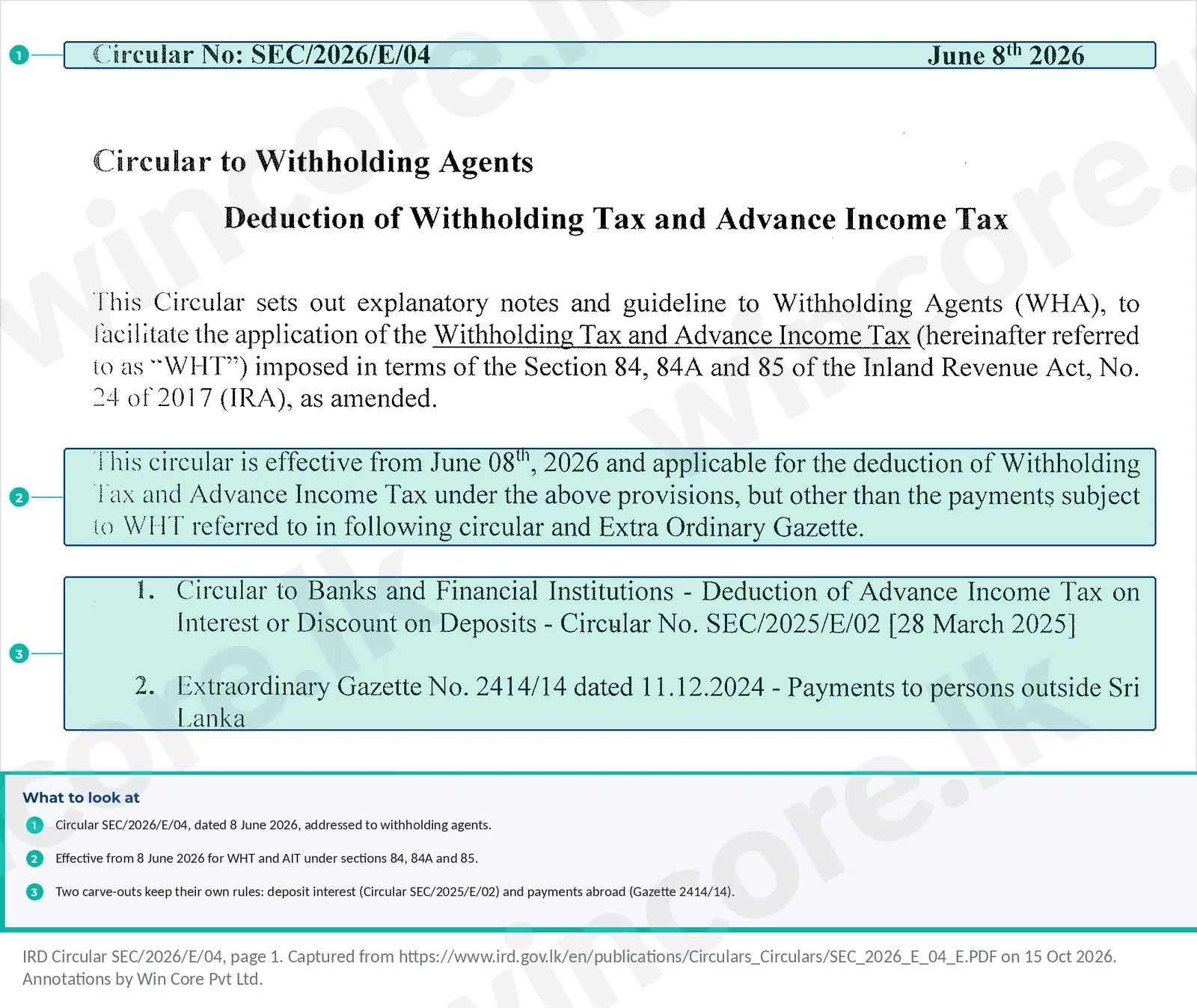
Section 86(1) requires every withholding agent to pay the tax withheld "within fifteen days after the end of each calendar month" [3]. Tax withheld in September is due by 15 October. The circular repeats the rule and points agents to the Online Tax Payments Platform, or People's Bank under tax type code 44 for "WHT on Other Payments" [1].
Two charges follow a late payment. Interest under s.157 runs from the due date at "one and one-half per cent per month or part month" (s.159(1)) [3]. And s.179(1) imposes a penalty of 20 percent of the tax due but not paid, as the IRD's own return guide states [4]. Under s.179(1) that penalty applies only if the tax is still unpaid fourteen days after the due date, or by the due date in a notice of assessment if later [3]; s.179(2) sets a separate 10 percent penalty for income tax instalments.
Not withholding at all is a different default. Under s.86(3) the agent "shall however pay the tax that should have been withheld in the same manner and at the same time as tax that is withheld", and under s.86(4) the withholdee is "jointly and severally liable" with the agent [3]. An agent that pays the tax itself may recover an equal amount from the withholdee (s.86(6)) [3]. And the payer's own expense deduction "shall not be allowed until the tax withheld has been paid to the Commissioner General" (s.10(2)) [3].
A late annual statement falls under section 178, on our reading
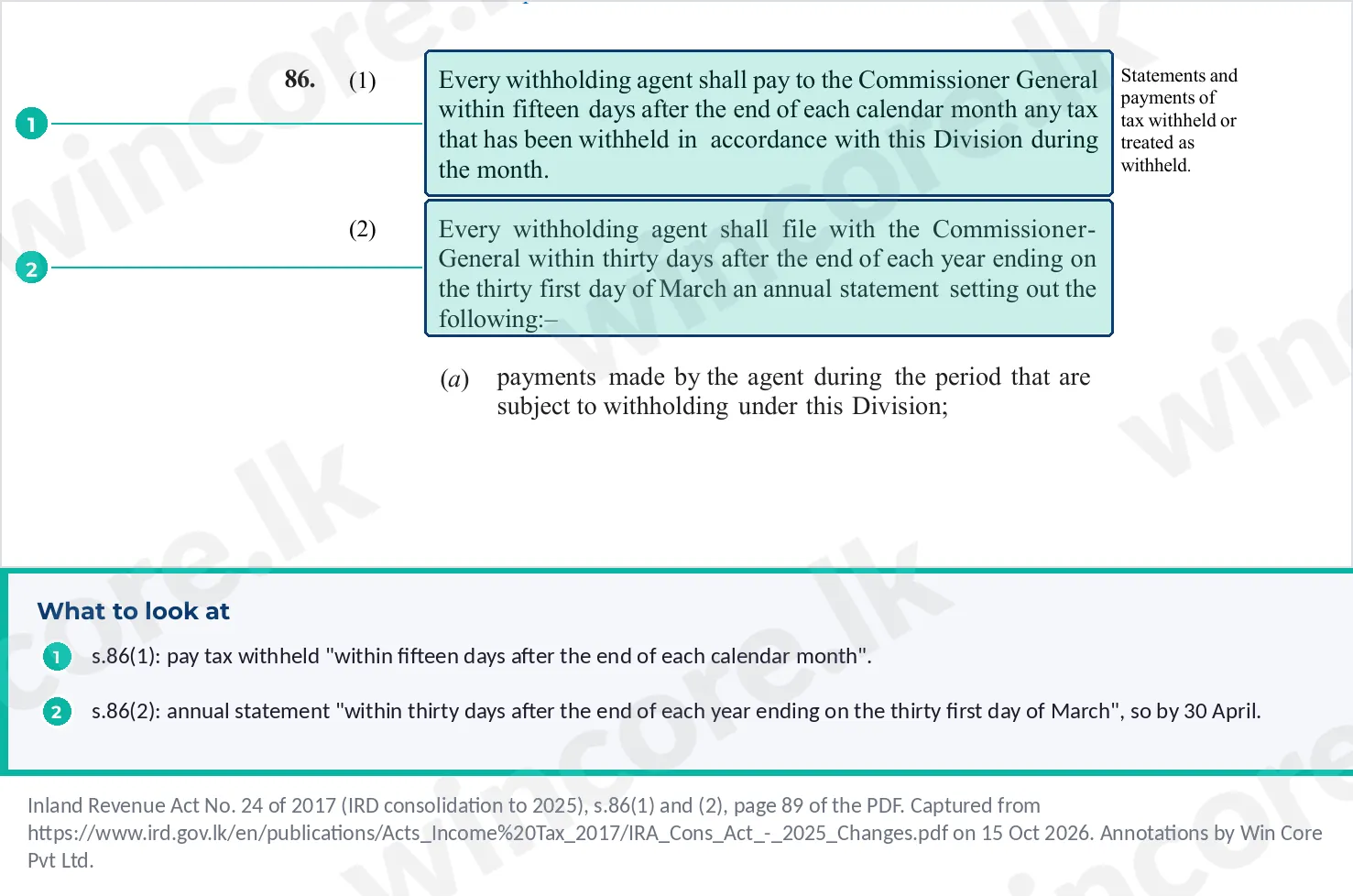
Section 86(2) requires a statement "within thirty days after the end of each year ending on the thirty first day of March", so by 30 April. It sets out the payments subject to withholding, "the name, address and tax identification number of the withholdee", the tax withheld from each payment, and "any other information that the Commissioner General may specify" [3]. The statement for 2026/27 is due by 30 April 2027.
Section 178(1) applies to "a person who fails to file a tax return on or before the date by which filing is required". Section 195 defines "tax return" as "a return or annual statement, including an information return" [3]. So we read s.178 as reaching the s.86(2) statement. The penalty is "the greater of" 5 percent of the tax owing plus 1 percent a month, and Rs 50,000 plus Rs 10,000 for each month or part of a month the failure continues, "limited to four hundred thousand rupees" by s.178(2) [3]. Where all the tax was paid on time, the tax owing may be nil, and the Rs 50,000 limb sets the figure. The Act does not say this in terms for the annual statement, so treat it as our reading; our guide to RAMIS penalties applies the same formula to income tax returns.
The Rs 200,000 penalty is about format, not lateness
Act No. 11 of 2026 added s.86(9): "The Commissioner-General may specify the procedures, formats and forms for filing statements required under subsections (2) and (8). Every withholding agent shall comply with the requirements relating to such procedures, formats and forms" [2]. The circular then specifies that schedules "must be provided in electronic format (Excel CSV format)", with hard copies allowed "if the number of AIT-deducted persons (taxpayers) is fewer than 20" [1].
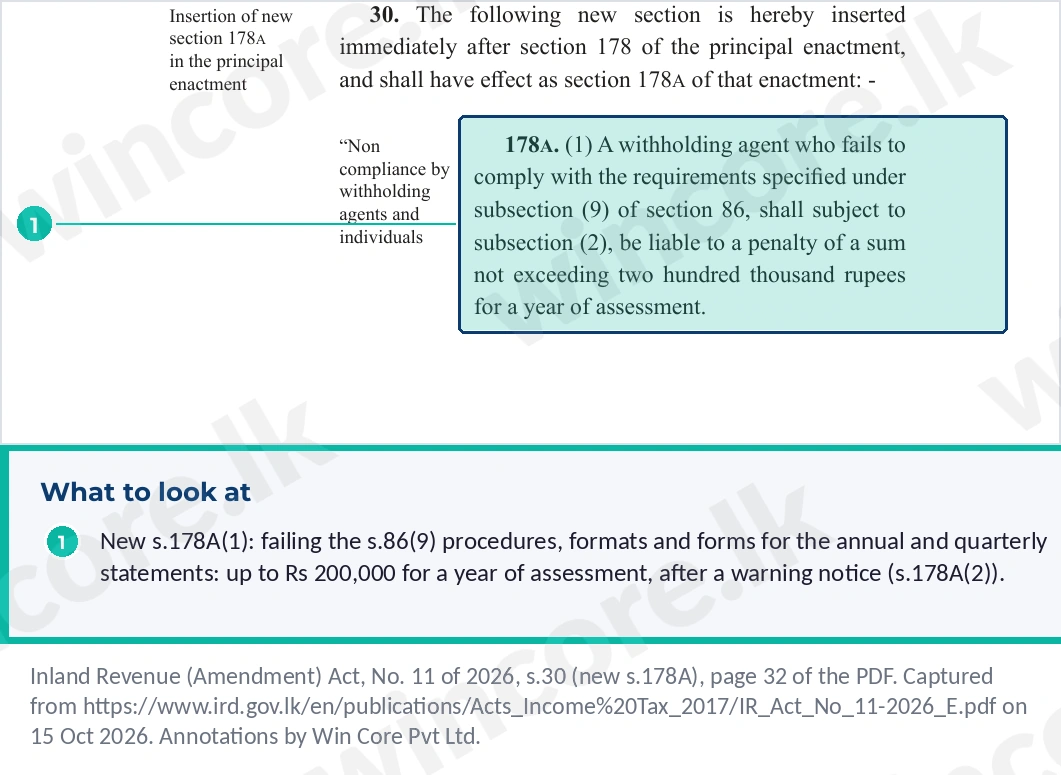
New s.178A(1) makes an agent "who fails to comply with the requirements specified under subsection (9) of section 86" liable to "a penalty of a sum not exceeding two hundred thousand rupees for a year of assessment" [2]. Before assessing it, the Commissioner-General "shall issue a notice of warning", and no penalty is imposed where the agent complies "within fourteen days from the date of service of the notice" [2]. Section 86(9) covers only the s.86(2) and (8) statements. It says nothing about certificates, monthly payments or records, so s.178A does not reach them.
Ignoring a 30-day notice to file is a prosecution under section 185A
New s.185A(1)(a) applies where a person fails to "file with the Commissioner-General an annual statement as required by section 86" [2]. The Commissioner-General must first serve a written notice that legal proceedings will be instituted unless the person complies "within thirty days of serving the notice". Only a failure "without reasonable cause" to comply with that notice is an offence, and the penalty follows "on conviction after summary trial before a Magistrate": "a fine not exceeding four hundred thousand rupees or to imprisonment of either description for a term not exceeding six months or to both" [2]. The quarterly AIT statement is not named in s.185A(1).
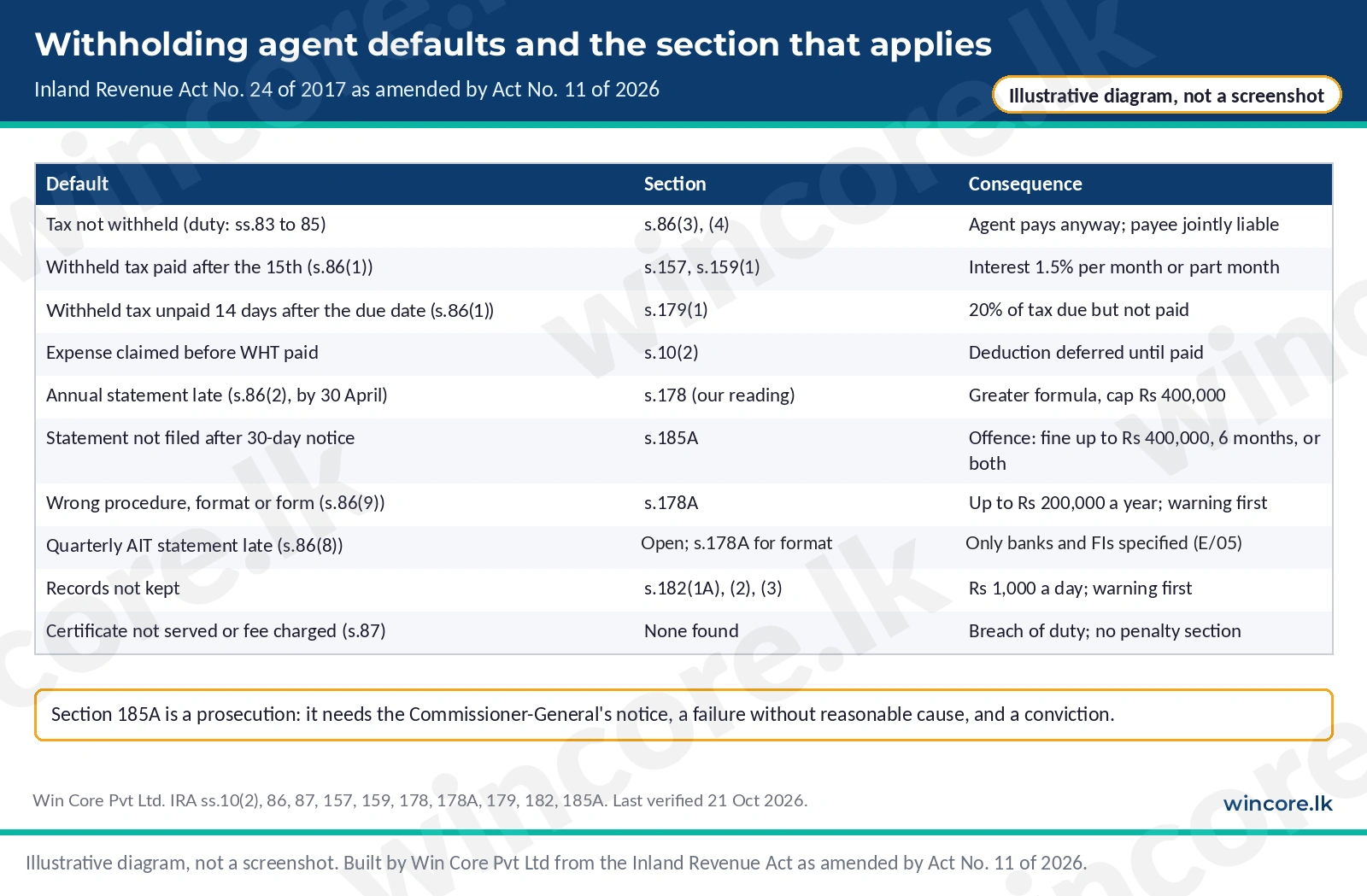
Withholding tax penalties in Sri Lanka, mapped default by default
| Default | Duty section | Penalty section | Consequence |
|---|---|---|---|
| Tax not withheld | ss.83 to 85 | s.86(3), (4) | Agent pays the tax anyway; withholdee jointly and severally liable [3] |
| Withheld tax paid after the 15th | s.86(1) | s.157, s.159(1) | Interest at 1.5 percent per month or part month [3] |
| Withheld tax unpaid fourteen days after the due date | s.86(1) | s.179(1) | 20 percent of the tax due but not paid [4] |
| Expense claimed before WHT paid | s.10(2) | s.10(2) | Deduction not allowed until the tax is paid [3] |
| Annual statement late | s.86(2) | s.178 (our reading) | Greater of the two formulas; cap Rs 400,000 [3] |
| Annual statement still not filed after a 30-day notice | s.86(2) | s.185A | Offence: fine up to Rs 400,000, up to six months, or both [2] |
| Wrong procedure, format or form | s.86(9) | s.178A | Up to Rs 200,000 for a year of assessment; warning first [2] |
| Quarterly AIT statement late, where one is required | s.86(8) | Open | Not named in s.185A; whether s.178 applies is open |
| Records not kept | s.182 | s.182 | Rs 1,000 a day; warning notice first [3] |
| Certificate not served, or a fee charged | s.87(1), (6) | None found | Breach of duty; we have not found a penalty section aimed at it |
Quarterly AIT statements: most agents do not file one yet. Section 86(8) requires an agent that has deducted AIT under s.84A to file "a quarterly statement as specified by the Commissioner-General", within thirty days after the quarters ending 30 June, 30 September and 31 December [3]. Circular SEC/2025/E/05 specifies only banks and financial institutions deducting AIT on deposit interest, and says "Withholding Agents not specified as above are not required to file the above said Quarterly Statements" [5]. A business deducting AIT on rent therefore files the annual statement only, until the IRD specifies otherwise, as our guide to AIT on rent explains.
Certificates. Section 87(3) sets a monthly certificate served within thirty days after the month ends, and new s.87(6) requires it "free of any charge or payment" [2] [3]. The circular allows an electronic certificate, or one "covering a period longer than one month, but not exceeding a full year of assessment, if the withholdee agrees to accept it", and the agent must still provide a printed or monthly one if the withholdee asks [1]. A yearly certificate given on those terms is not a default. The payee needs it: s.93 requires a return to have the s.87 certificates attached [3].
A worked example: late but correct, or on time but in the wrong format
Take a hypothetical logistics company with 25 payees subject to WHT. It withholds Rs 300,000 in total during 2026/27 and pays every month by the 15th. It files the annual statement on 20 June 2027, in the correct CSV format.
On our reading, s.178 applies. The tax owing is nil, so the 5 percent limb gives nothing. The second limb gives Rs 50,000 plus Rs 10,000 for each month or part month the failure continues after 30 April. From 1 May to 20 June is one full month and one part month, so Rs 70,000. No s.178A penalty arises, because the format was right. No s.185A offence arises unless a 30-day notice was served and ignored. No interest or s.179(1) penalty arises, because the tax was paid on time.
Had the company filed on 30 April but as a PDF, the exposure flips: no s.178 penalty, a possible s.178A penalty of up to Rs 200,000, and 14 days after a warning notice to put it right. Had it also paid September's Rs 25,000 of WHT on 10 November instead of 15 October, s.179(1) adds Rs 5,000 and interest runs for one part month, Rs 375 [3] [4]. The WHT calculator and penalty calculator run your own figures.
What this means for you
- Pay by the 15th. Interest runs from the due date, and the 20 percent penalty under s.179(1) follows once 14 days have passed.
- Diary 30 April for the annual statement, and watch for any IRD specification that brings your business into the quarterly AIT statement.
- File in the specified format. Format defaults have their own penalty under s.178A, even when the statement is on time.
- Set a certificate policy. Monthly by default; a yearly certificate only where the payee agreed, never covering more than one year of assessment, always free.
- Answer warning notices fast. Both s.178A and s.182 give a window to comply before a penalty, and s.185A gives 30 days before prosecution.
- Keep the records the circular lists in Attachment 2 [1].
Our income tax services team can review a draft statement against the circular format before you file.
Checklist: documents needed
- The monthly WHT register for the year: payee name, address, TIN, payment, rate and tax withheld
- Payment receipts (OTPP or People's Bank) for each month's tax
- Copies of certificates issued, and any payee agreement to a longer-period certificate
- The annual statement schedules in CSV format
- Tax clearance and exemption confirmation letters received from payees
- Any warning notice or 30-day notice from the IRD, with the date served
Open points we are keeping open
- Quarterly AIT statement filed late. Whether a quarterly statement is a "tax return" for s.178 is open; the definition names "a return or annual statement".
- Quarter ending 31 March. Section 86(8) lists three quarter ends. Our reading that the annual statement covers the fourth is not stated in the Act.
- Hard-copy allowance. The circular's fewer-than-20 rule is worded for AIT-deducted persons; whether it covers WHT schedules is open, so we would file CSV.
- Certificate default. Section 87(3) still says monthly; the circular's longer-period option is administrative.
- Certificate penalty. We have not found a section that penalises failing to serve a certificate.
FAQ
What is the penalty for paying withholding tax late in Sri Lanka?
Two charges apply. Interest runs from the due date at 1.5 percent per month or part month under ss.157 and 159(1), and s.179(1) adds a penalty of 20 percent of the tax due but not paid [3] [4]. Withheld tax is due within 15 days after the end of the month in which it was withheld, and the s.179(1) penalty applies if it is still unpaid fourteen days after that date.
What happens if the WHT annual statement is filed after 30 April?
On our reading, s.178 applies, because s.195 defines a tax return to include an annual statement. The penalty is the greater of 5 percent of tax owing plus 1 percent a month, or Rs 50,000 plus Rs 10,000 a month, capped at Rs 400,000 [3]. Ignoring a later 30-day notice can lead to prosecution under s.185A [2].
Is the Rs 200,000 penalty for late filing?
No. Section 178A covers failing to follow the procedures, formats and forms the Commissioner-General specifies under s.86(9), such as the CSV schedules [1] [2]. The IRD must issue a warning notice first, and no penalty is imposed if the agent complies within 14 days of its service. Late filing is a separate question under s.178.
Do all withholding agents file quarterly AIT statements?
No. Circular SEC/2025/E/05 specifies only banks and financial institutions deducting AIT on deposit interest, and says agents not specified are not required to file the quarterly statements [5]. Other agents, including tenants deducting AIT on rent, file the annual statement by 30 April unless the IRD specifies them later.
Is there a penalty for not issuing a WHT certificate?
We have not found a section aimed at it. Serving the certificate is still a duty under s.87, and it must be free under new s.87(6) [2] [3]. The payee needs it to claim credit, because s.93 requires the certificates to be attached to the return, so a missing certificate usually comes back as a payee dispute.
Talk to us. If you want a second look at your withholding calendar or your annual statement format before 30 April, our contact page.
WinCore Pvt Ltd
This article is general information on the law as at 22 October 2026 and is not advice on your specific position. Open points are stated as open.
References
- Inland Revenue Department. Circular to Withholding Agents: Deduction of Withholding Tax and Advance Income Tax, SEC/2026/E/04 (8 June 2026), paras 5, 6 and 7 and Attachment 2. https://www.ird.gov.lk/en/publications/Circulars_Circulars/SEC_2026_E_04_E.PDF . Primary. Accessed 22 October 2026.
- Parliament of Sri Lanka. Inland Revenue (Amendment) Act, No. 11 of 2026 (certified 3 June 2026), ss.14, 15, 30 and 31. https://www.ird.gov.lk/en/publications/Acts_Income%20Tax_2017/IR_Act_No_11-2026_E.pdf . Primary. Accessed 22 October 2026.
- Inland Revenue Department. Inland Revenue Act, No. 24 of 2017, consolidated with amendments to 2025, ss.10(2), 86, 87, 89, 93, 157, 159, 178, 179, 182 and 195. https://www.ird.gov.lk/en/publications/Acts_Income%20Tax_2017/IRA_Cons_Act_-_2025_Changes.pdf . Primary. Accessed 15 October 2026 (s.10(2) on 22 October 2026).
- Inland Revenue Department. Guide to the Return of Income Tax, Y/A 2025/26, Section 09 (penalty of 20 percent of the tax due but not paid; 10 percent on an instalment; interest at 1.5 percent a month or part month). https://www.ird.gov.lk/en/Downloads/IT_Individuals_Doc/Asmt_IIT_004_2025_2026_E.pdf . Primary. Accessed 22 October 2026.
- Inland Revenue Department. Circular for WHT Agents (Banks and Financial Institutions) to file Quarterly Statement of Advance Income Tax, SEC/2025/E/05 (July 2025). https://www.ird.gov.lk/en/publications/Circulars_Circulars/SEC_2025_E_05_E.PDF . Primary. Accessed 22 October 2026.
Put these insights to work
WinCore specialists can review your current workflow, document gaps, and build a practical 90-day action plan.
Book a free consultationContinue reading
Explore more WinCore analysis to keep your finance, tax, and compliance roadmap moving.

WHT reporting breaks when certificates and annual statements are treated as year-end admin. Build a monthly evidence workflow that files cleanly.
From 8 June 2026 the IRD allows one certificate for up to a year, on four conditions. The rates, the 30 April statement and each penalty.

RAMIS penalty guide for Sri Lanka with the legal rules for late filing, late payment, interest and incorrect returns, plus practical prevention controls.