
Gross up withholding tax on rent when the lease says no deduction
A no deduction clause does not switch off AIT on rent. It moves the cost to the tenant. The arithmetic, the provisos and the open points.
On this page
Last verified against the primary sources on 21 October 2026.
When a lease says rent is payable "without any deduction or withholding", you still deduct, and you gross up withholding tax on rent: treat the invoice as the net amount, so at the 10 percent rate the tax is 11.11 percent of the invoice and the tenant pays it on top. That is the rule in IRD Circular SEC/2026/E/04, effective 8 June 2026 [1]. The duty to deduct Advance Income Tax (AIT) from business rent to a resident landlord has applied since 1 January 2023 wherever the month's rent exceeds Rs 100,000 [2] [4].
Our guide to deducting AIT on rent covers the rates, registration and dates. This piece goes deeper on one question: when the lease forbids deduction, who bears the tax, and how much is it?
Instruments: Inland Revenue Act, No. 24 of 2017, ss.9, 10, 11, 84(3), 84A(1A), 86, 87, 89 and First Schedule para 10(1)(d) [2]; Circular SEC/2026/E/04, paras 2 and 3 [1]; Gazette Extraordinary No. 2414/14, Schedule item 5 [3].
The lease cannot switch off the duty to deduct
Section 84A(1A) says that "with effect from January 1, 2023, a person shall deduct Advance Income Tax from the payment of dividend, interest, discount, charge, natural resource payment, rent, royalty or premium which has a source in Sri Lanka, at the rate provided in paragraph 10 of the First Schedule" [2]. The duty is the payer's. The lease is a contract between the payer and the landlord. It cannot remove a duty the Act places on one of them.
Section 9(2) points the same way: "an agreement that affects or purports to affect the application of this Act shall not be entered into, except as provided for in this Act" [2]. It sits in the section on exemptions, so we do not lean on it alone. And there is a proviso. Section 9(3) says subsection (2) does not apply to "an agreement that is in force on date of commencement of this Act" or to projects approved under the Strategic Development Projects Act [2]. A lease signed before the 2017 Act commenced is an edge case worth checking. Even then, it would not remove the withholding duty that section 84A(1A) added in 2023. On our reading, the lease decides who carries the cost, not whether the tax is withheld.
What if the tenant ignores the duty and pays the full invoice? Section 86(3) answers: an agent who fails to withhold "shall however pay the tax that should have been withheld in the same manner and at the same time as tax that is withheld" [2]. Section 86(4) makes the landlord "jointly and severally liable" [2]. So ignoring the duty does not leave the tax with the landlord. It leaves it with both, with the tenant first in line.
How to gross up withholding tax on rent under the circular
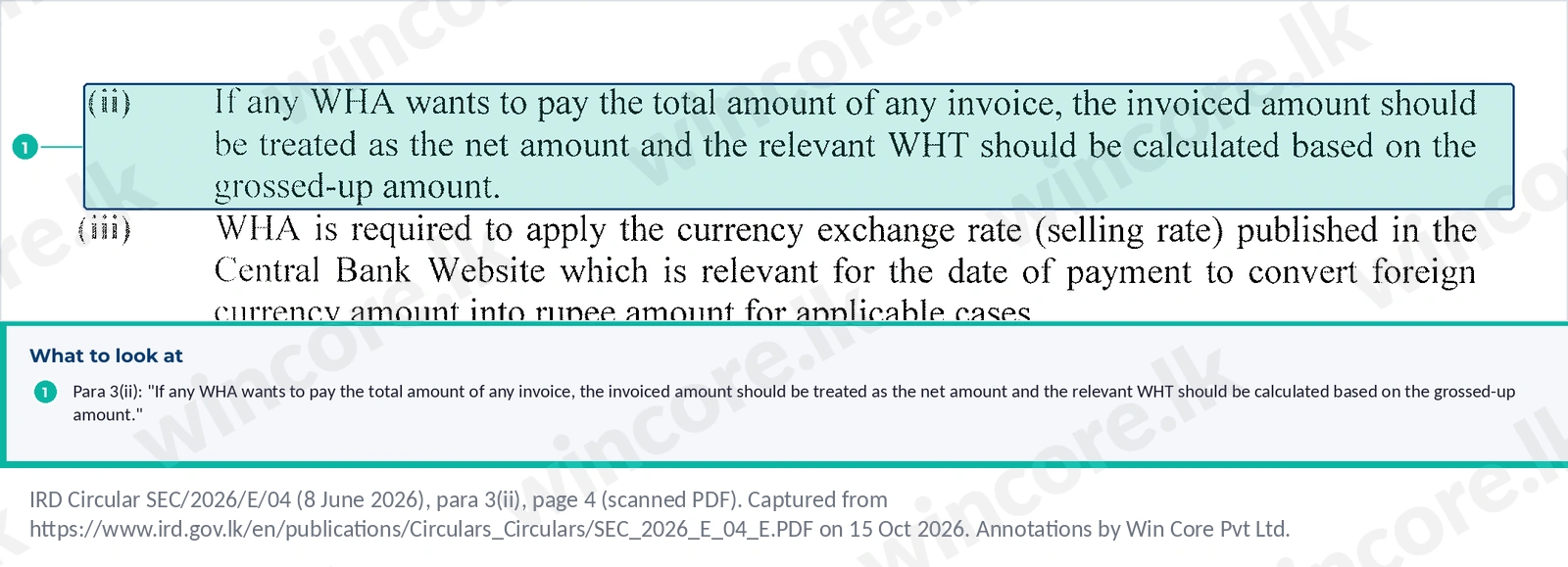
Paragraph 3(ii) of the circular says: "If any WHA wants to pay the total amount of any invoice, the invoiced amount should be treated as the net amount and the relevant WHT should be calculated based on the grossed-up amount" [1].
In plain arithmetic, the grossed-up amount is the invoice divided by one minus the rate. The tax is the difference. The landlord gets the full invoice. The tenant pays the invoice plus the tax.
Three points about the wording:
- "If any WHA wants to." The circular frames gross-up as the agent's choice. A lease that forbids deduction is what makes the agent want to.
- "Treated as the net amount." The invoice is what the landlord is left with after tax, so the tax is calculated on a bigger figure.
- It is a circular, not the Act. It states how the IRD will compute the tax when the full invoice is paid. It does not change the rate or the base set by the Act.
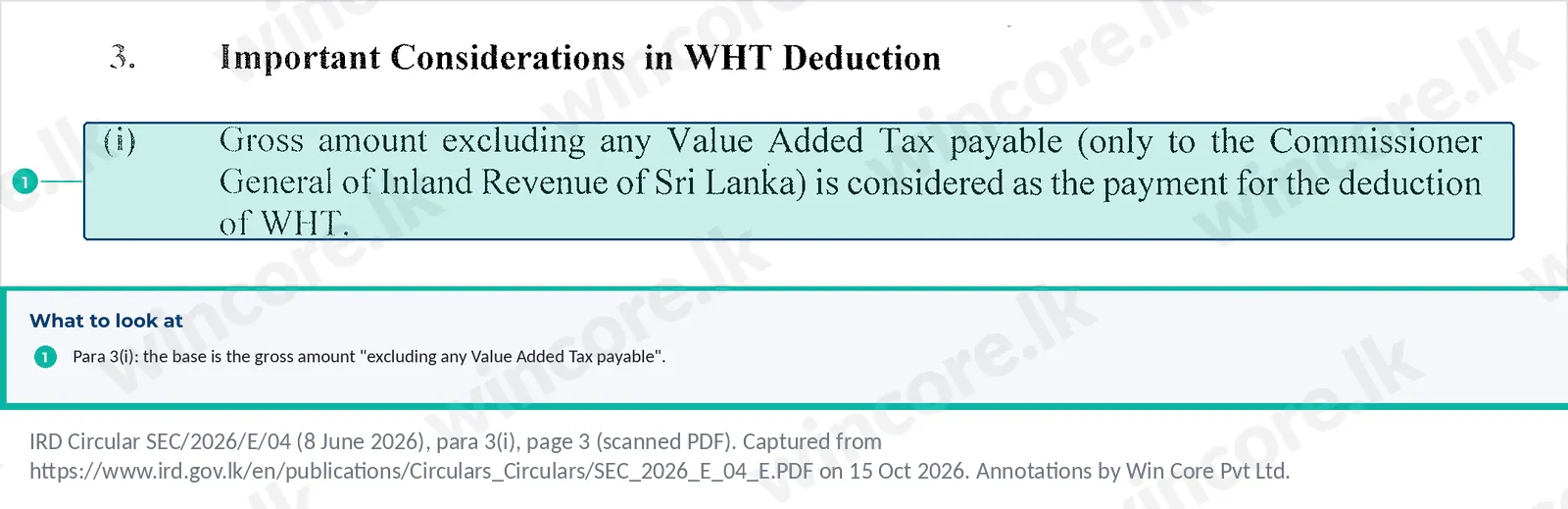
The base is set first. Paragraph 3(i): "Gross amount excluding any Value Added Tax payable (only to the Commissioner General of Inland Revenue of Sri Lanka) is considered as the payment for the deduction of WHT" [1]. So the gross-up applies to the rent net of VAT. VAT is paid in full on top and is not grossed up.
The rate you gross up depends on who the landlord is
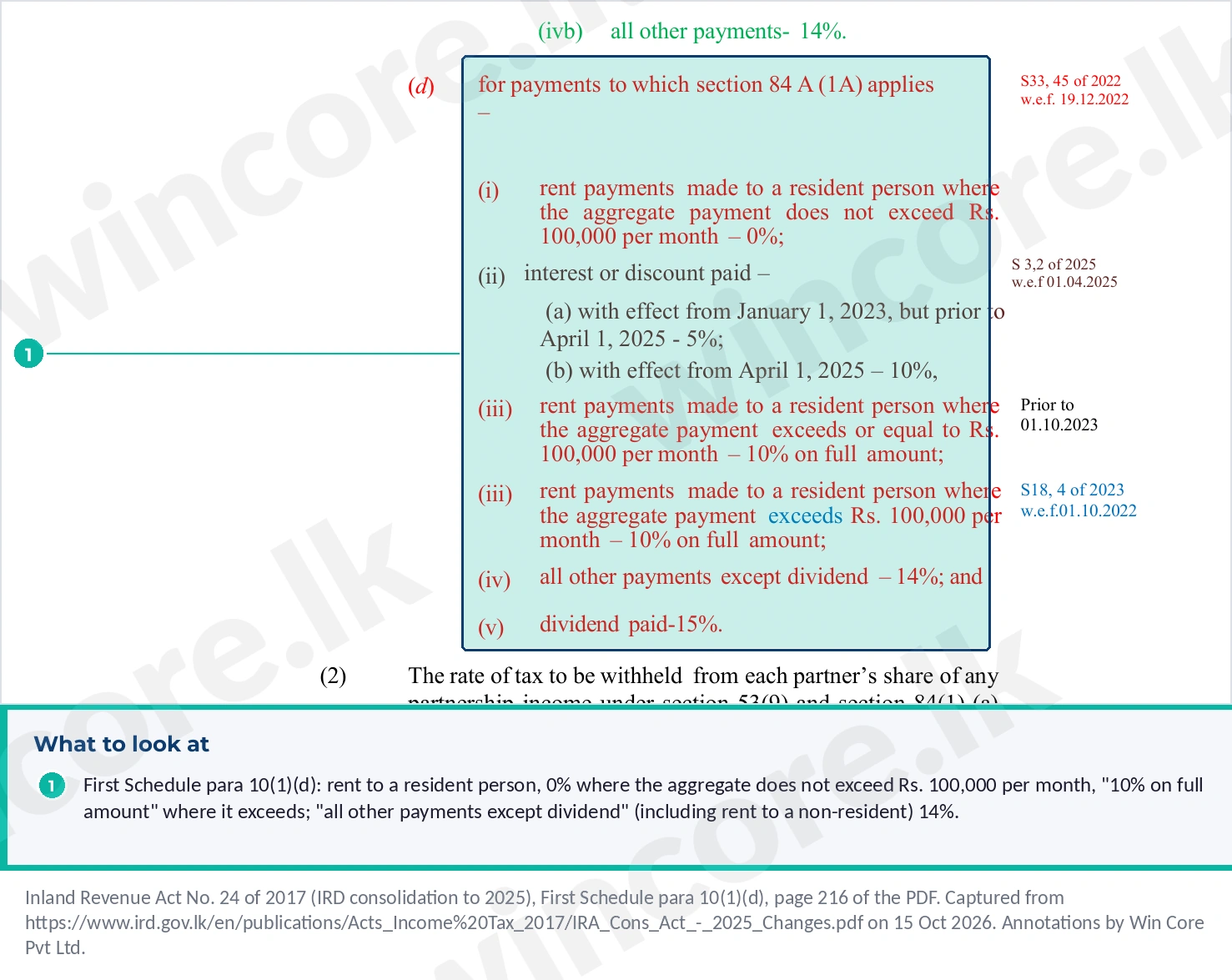
First Schedule para 10(1)(d) sets the rates "for payments to which section 84 A (1A) applies" [2]:
- Rent to a resident person where "the aggregate payment does not exceed Rs. 100,000 per month": 0%.
- Rent to a resident person where "the aggregate payment exceeds Rs. 100,000 per month": "10% on full amount".
- "all other payments except dividend": 14%. That includes rent to a non-resident.
At 10 percent, the tax is 11.11 percent of the invoice. At 14 percent, it is 16.28 percent.
A worked example: Rs 33,333 a month on top
Take a company renting an office at Rs 300,000 a month, excluding VAT, from a resident landlord. The lease says no deduction.
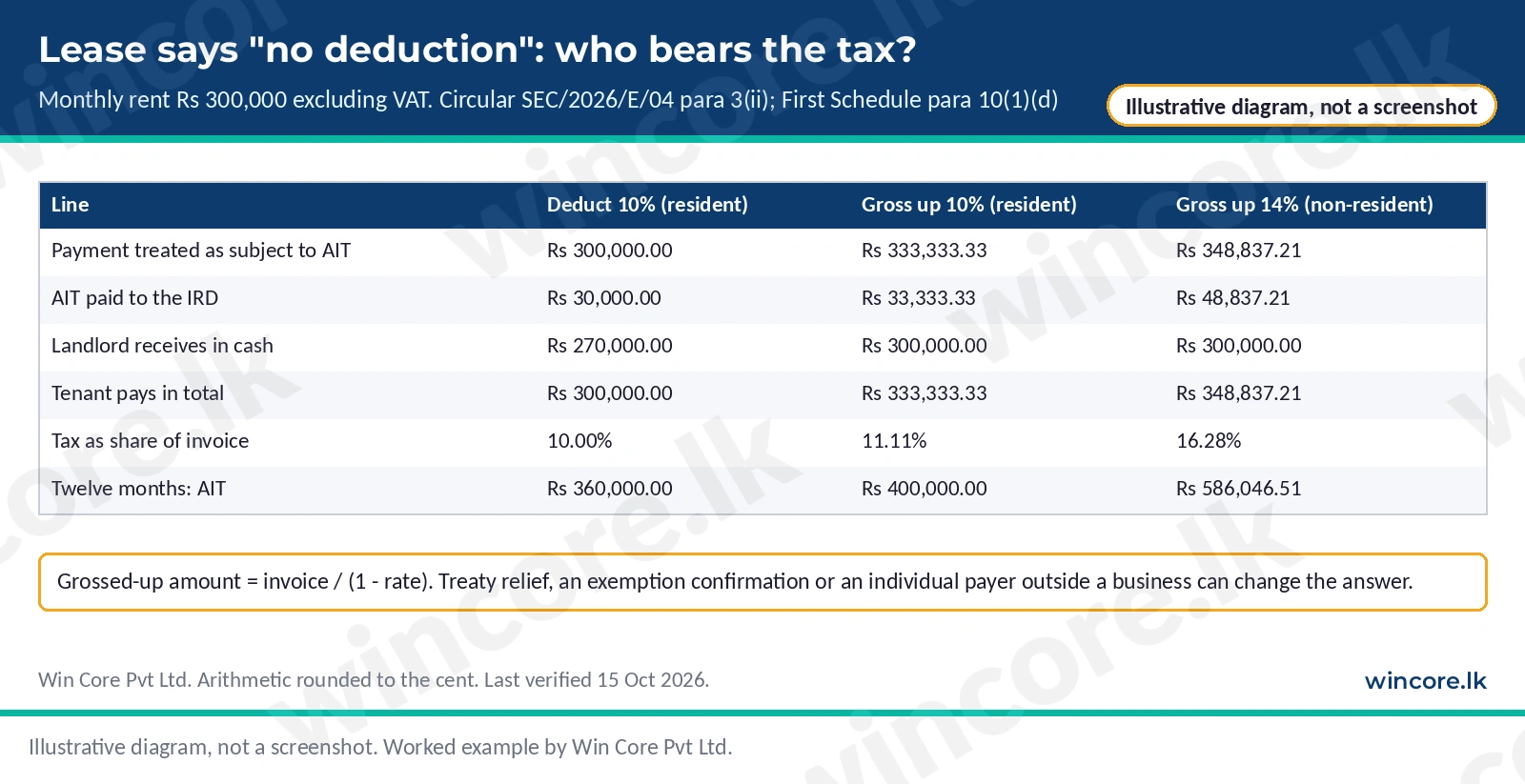
| Line | Deduct 10% | Gross up 10% | Gross up 14% (non-resident) |
|---|---|---|---|
| Payment treated as subject to AIT | Rs 300,000.00 | Rs 333,333.33 | Rs 348,837.21 |
| AIT paid to the IRD | Rs 30,000.00 | Rs 33,333.33 | Rs 48,837.21 |
| Landlord receives in cash | Rs 270,000.00 | Rs 300,000.00 | Rs 300,000.00 |
| Tenant's total cost | Rs 300,000.00 | Rs 333,333.33 | Rs 348,837.21 |
| AIT over twelve months | Rs 360,000.00 | Rs 400,000.00 | Rs 586,046.51 |
The gross-up at 10 percent costs the tenant Rs 33,333.33 a month more than the lease rent, or Rs 400,000 a year. The certificate under section 87(2) sets out "the amount of payments made to the withholdee during the period and tax withheld" [2], so on our reading it should show Rs 333,333.33 and Rs 33,333.33, not Rs 300,000.
Five provisos change the answer
The Rs 100,000 threshold. The 0% band applies where the aggregate payment does not exceed Rs 100,000 a month. Gross-up makes the "payment" bigger than the invoice. Take an invoice of Rs 95,000. At 0%, the payment is Rs 95,000, under the threshold, so no tax. At 10%, the grossed-up payment is Rs 105,555.56, over the threshold, so 10% applies. Both answers are internally consistent. Neither the Act nor the circular says which governs for invoices between Rs 90,000 and Rs 100,000. We treat this as open. Our reading favours 0%, because the tax only arises once the payment exceeds the threshold, and an untaxed invoice has nothing to gross up. The IRD may take the other view.
The landlord is a non-resident. The rate is 14%. Payments to non-residents are collected as specified in Gazette 2414/14 [1]. Its item 5(ii) has the same rule: "the invoiced amount should be treated as the net amount and the relevant withholding tax should be calculated based on the grossed-up amount" [3]. Item 5(i) makes the rate "subject to the provisions of the respective Double Tax Avoidance Agreement", with a tax residency certificate [3]. A treaty rate lower than 14 percent shrinks the gross-up. We have not reviewed individual treaties.
The landlord has an exemption confirmation. Our guide to what to hold when a landlord says it is tax exempt sets out the steps. The circular says that "If CGIR has confirmed the exemption, relevant WHA shall not deduct WHT from the respective amounts paid to such person" [1]. No deduction means nothing to gross up.
The tenant is an individual. Section 84(3) excludes "payments made by individuals, unless made in conducting a business" [2]. A person renting a home for personal use is outside the duty, so the lease clause causes no conflict.
The tenant already paid the full invoice without withholding. Section 86(3) makes the tenant pay the tax. Since the full invoice was paid, the circular's gross-up method points to tax on the grossed-up figure. Section 86(6) lets an agent who paid "recover an equal amount from the withholdee" [2]. Whether a "no deduction" clause bars that recovery as a matter of contract is open. Late payment can also attract interest under section 159 and the late payment penalty under section 179 [2].
The landlord and the tenant each have a tax side to check
The landlord. On our reading, the landlord's rent income is the grossed-up amount, and it gets credit for the AIT. Section 89 treats the withholdee of a payment "that is not a final withholding payment" as "having paid any tax" withheld [2]. The certificate is the evidence.
The tenant. Rent is deductible under section 11(1) as an expense "incurred during the year ... in the production of income" [2]. Section 10(2) delays the deduction "until the tax withheld has been paid to the Commissioner General" [2]. One question is open. Section 10(1)(b)(ii) bars a deduction for "Tax payable under this Act" [2]. Our reading is that the grossed-up rent is all rent, and the AIT is the landlord's tax paid out of it, so the whole Rs 333,333.33 is deductible. The IRD could argue that the extra Rs 33,333.33 is tax borne by the tenant. We have not seen a ruling either way.
Why leases say this
The clause is older than the current AIT rule. From 1 April 2020 to 31 December 2022, AIT on rent applied only if the landlord asked for it; the duty to deduct came back with Act No. 45 of 2022 from 1 January 2023 [4]. Many leases signed then assumed rent would go out gross and said so. The clause is not a trap. It is a fossil from a rule that changed.
What this means for you
- Read the tax clause before the first rent payment.
- Decide: deduct or gross up. If the lease forbids deduction, budget for the grossed-up cost.
- Gross up the rent net of VAT, not the VAT-inclusive total.
- Check the landlord's status: resident, non-resident, or exempt with a CGIR letter.
- Issue the certificate on the grossed-up amount, within 30 days after the month end. Our guide to WHT annual statements and certificates covers the yearly filing.
- At renewal, agree in writing who bears AIT. That is practice, not law, and it saves arguments.
The same gross-up rule applies to service fees; see 5 percent WHT on service fees. Our WHT tax calculator gives the deduction at each rate, and our income tax services team can review a lease clause and set up the computation. Signing a new lease? Check lease stamp duty at the same time.
Checklist: documents needed
- The lease, with its tax or "no deduction" clause marked
- The rent invoice, with VAT shown separately
- The landlord's residence confirmation and TIN
- Any CGIR exemption confirmation letter the landlord holds
- Your withholding agent registration
- The gross-up working: invoice net of VAT, divided by one minus the rate
- The payment receipt and the certificate issued on the grossed-up amount
Frequently asked questions
Does "no deduction" in a lease mean we do not withhold tax on rent?
No, you still withhold. Section 84A(1A) puts the duty to deduct AIT on the payer, and a contract between tenant and landlord cannot remove a duty the Act imposes. What the clause decides is who carries the cost: if the landlord must receive the full invoice, the tenant pays the tax on top by grossing up [1] [2].
How do you calculate gross up withholding tax on rent in Sri Lanka?
Divide the invoice, net of VAT, by one minus the rate, and the difference is the tax. At 10 percent a Rs 300,000 invoice grosses up to Rs 333,333.33, so the tax is Rs 33,333.33, or 11.11 percent of the invoice. At 14 percent the tax is 16.28 percent of the invoice. VAT is paid in full and is not grossed up [1].
We already paid the full rent without deducting. What now?
You still owe the tax that should have been withheld. Section 86(3) makes the withholding agent pay it as if it had been withheld, and on the circular's method it is computed on the grossed-up amount. Section 86(6) lets you recover an equal amount from the landlord, but whether a no deduction clause blocks that recovery is an open contract point [2].
Is the grossed-up part of the rent deductible for the tenant?
On our reading, yes, as rent, once the AIT has been paid to the IRD, because section 10(2) delays the deduction until then. The risk is section 10(1)(b)(ii), which bars a deduction for tax payable under the Act; the IRD could treat the extra amount as tax borne by the tenant. We have not seen a ruling either way [2].
Does gross-up apply to a non-resident landlord?
Yes, at 14 percent unless a double tax treaty gives a lower rate. Gazette 2414/14 item 5(ii) repeats the same gross-up rule for payments to persons outside Sri Lanka, and item 5(i) makes the rate subject to the treaty, with the landlord's tax residency certificate. A lower treaty rate shrinks the gross-up. We have not reviewed individual treaties [3].
Four points the law has not settled
- Threshold and gross-up. Invoices between Rs 90,000 and Rs 100,000 a month.
- Recovery against a "no deduction" clause under s.86(6).
- Deductibility of the gross-up portion given s.10(1)(b)(ii).
- Pre-2018 leases and s.9(3).
We should own a limit. Gross-up arithmetic is exact. The law around it is less so, and our readings on the threshold and deductibility could lose.
Talk to us. If your lease says "no deduction" and you need the real cost worked out, book a consultation at our contact page.
WinCore Pvt Ltd
References
- Inland Revenue Department. Circular to Withholding Agents: Deduction of Withholding Tax and Advance Income Tax, SEC/2026/E/04 (8 June 2026), paras 2 and 3 (scanned PDF, read by OCR). https://www.ird.gov.lk/en/publications/Circulars_Circulars/SEC_2026_E_04_E.PDF . Primary. Accessed 21 October 2026.
- Inland Revenue Department. Inland Revenue Act, No. 24 of 2017, consolidated with amendments to 2025, ss.9(2), (3), 10(1)(b), 10(2), 11(1), 69(4), 84(3), 84A(1A), 86(3), (4), (6), 87(2), 89, 159, 179 and First Schedule para 10(1)(d). https://www.ird.gov.lk/en/publications/Acts_Income%20Tax_2017/IRA_Cons_Act_-_2025_Changes.pdf . Primary. Accessed 15 October 2026.
- Commissioner General of Inland Revenue. Regulations under Section 86(7), Gazette Extraordinary No. 2414/14 (11 December 2024), Schedule item 5. https://documents.gov.lk/api/content-file-proxy?file=/extra-gazette-content/2414-14_E_1784566474.pdf . Primary. Accessed 21 October 2026.
- Parliament of Sri Lanka. Inland Revenue (Amendment) Act No. 45 of 2022, s.16 (new s.84A(1A), from 1 January 2023); and Inland Revenue (Amendment) Act No. 4 of 2023, s.18(2) ("exceeds" from 1 October 2022). https://www.ird.gov.lk/en/publications/Acts_Income%20Tax_2017/IR_Act_No._45_2022_E.pdf and https://www.ird.gov.lk/en/publications/Acts_Income%20Tax_2017/IR_Act_No._04_2023_E.pdf . Primary. Accessed 21 October 2026.
Put these insights to work
WinCore specialists can review your current workflow, document gaps, and build a practical 90-day action plan.
Book a free consultationContinue reading
Explore more WinCore analysis to keep your finance, tax, and compliance roadmap moving.
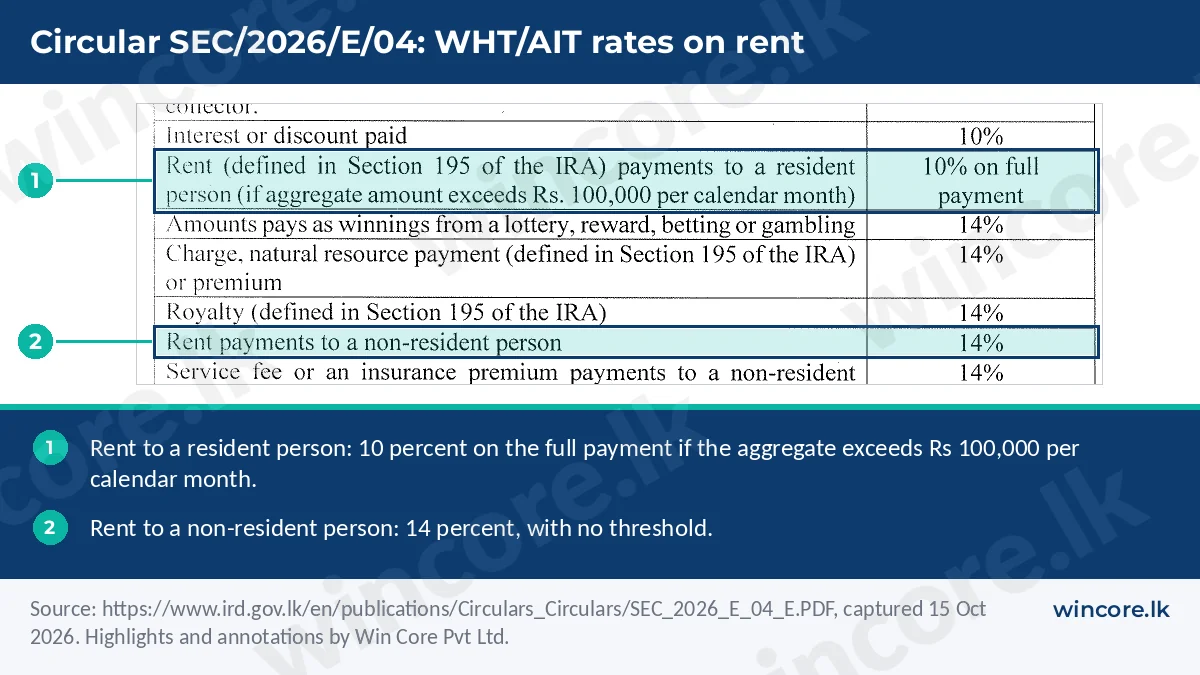
When a tenant must deduct 10 percent AIT from rent, the base excluding VAT, payment within 15 days, certificates and worked examples.
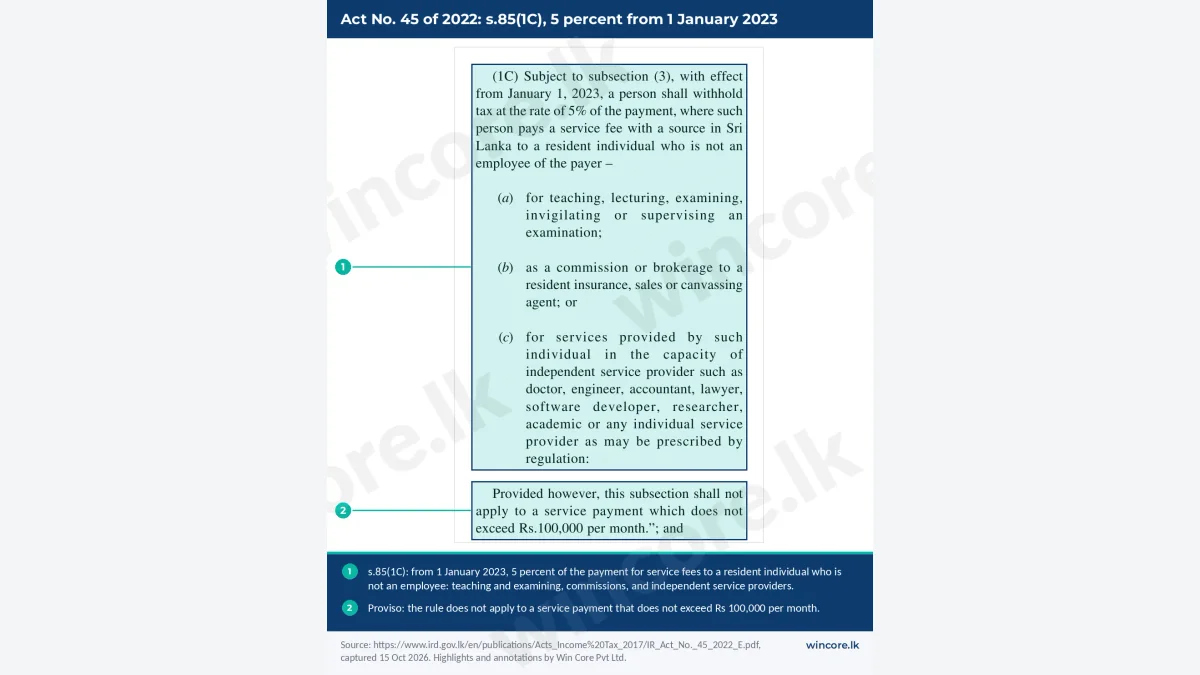
When a payer must withhold 5 percent on service fees, the services added in June 2026, payment within 15 days and the certificate rules.

WHT reporting breaks when certificates and annual statements are treated as year-end admin. Build a monthly evidence workflow that files cleanly.