
Consultant or employee: the misclassification risk in Sri Lanka
When a consultant is legally an employee in Sri Lanka: the tests under EPF, ETF, gratuity and tax law, and what misclassification costs.
On this page
By WinCore Pvt Ltd. Last verified: 9 October 2026.
Sri Lankan employment law does not ask what you called someone. It asks what they actually do for you. Four labour statutes and the Inland Revenue Act each have their own definition, but they all look past the name on the contract to the working relationship underneath. The simplest way to hold this in your head is to think of a jar with a label on it. You choose the label: "consultant", "advisor", "retainer". The Labour Department and the courts open the jar and look inside.
Here is a small example. A hypothetical building contractor pays a quantity surveying "consultant" Rs 250,000 a month. She works 8 to 5 from the contractor's site office, reports to the projects director, uses a company laptop and has no other clients. The invoice says "consultancy fee" and the company deducts 5% withholding tax. On the inside of the jar, every one of those facts looks like employment.
If the label turns out to be wrong, the cost of fixing it is not the contributions alone. It is the surcharge on top.
What each Act looks at
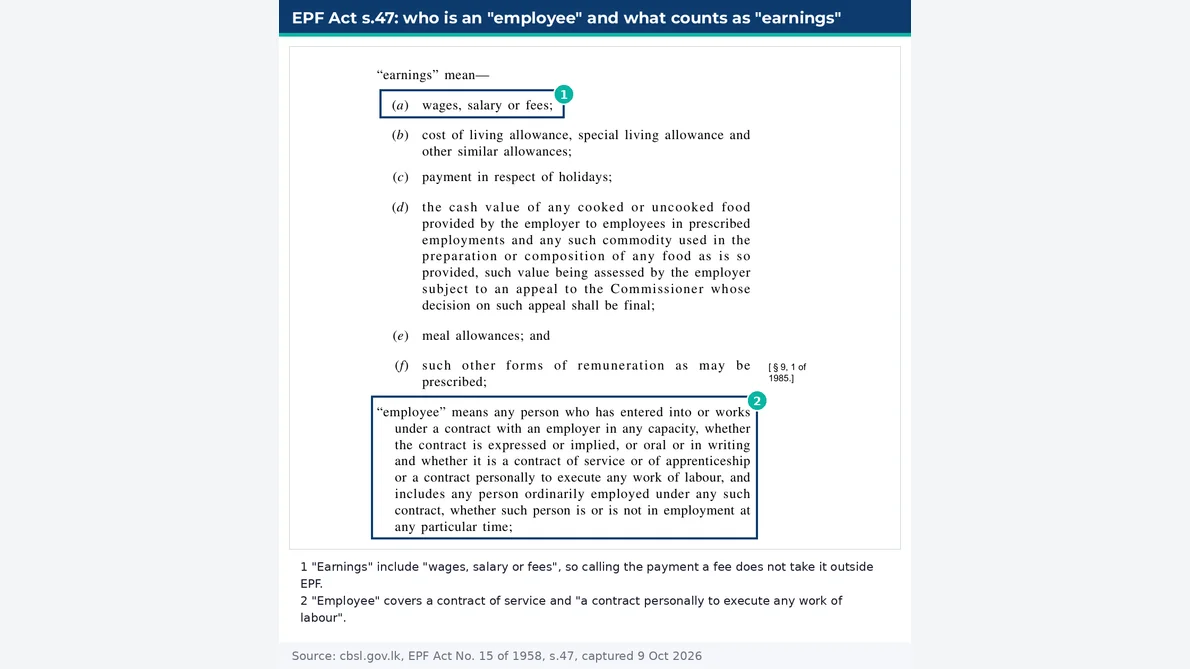
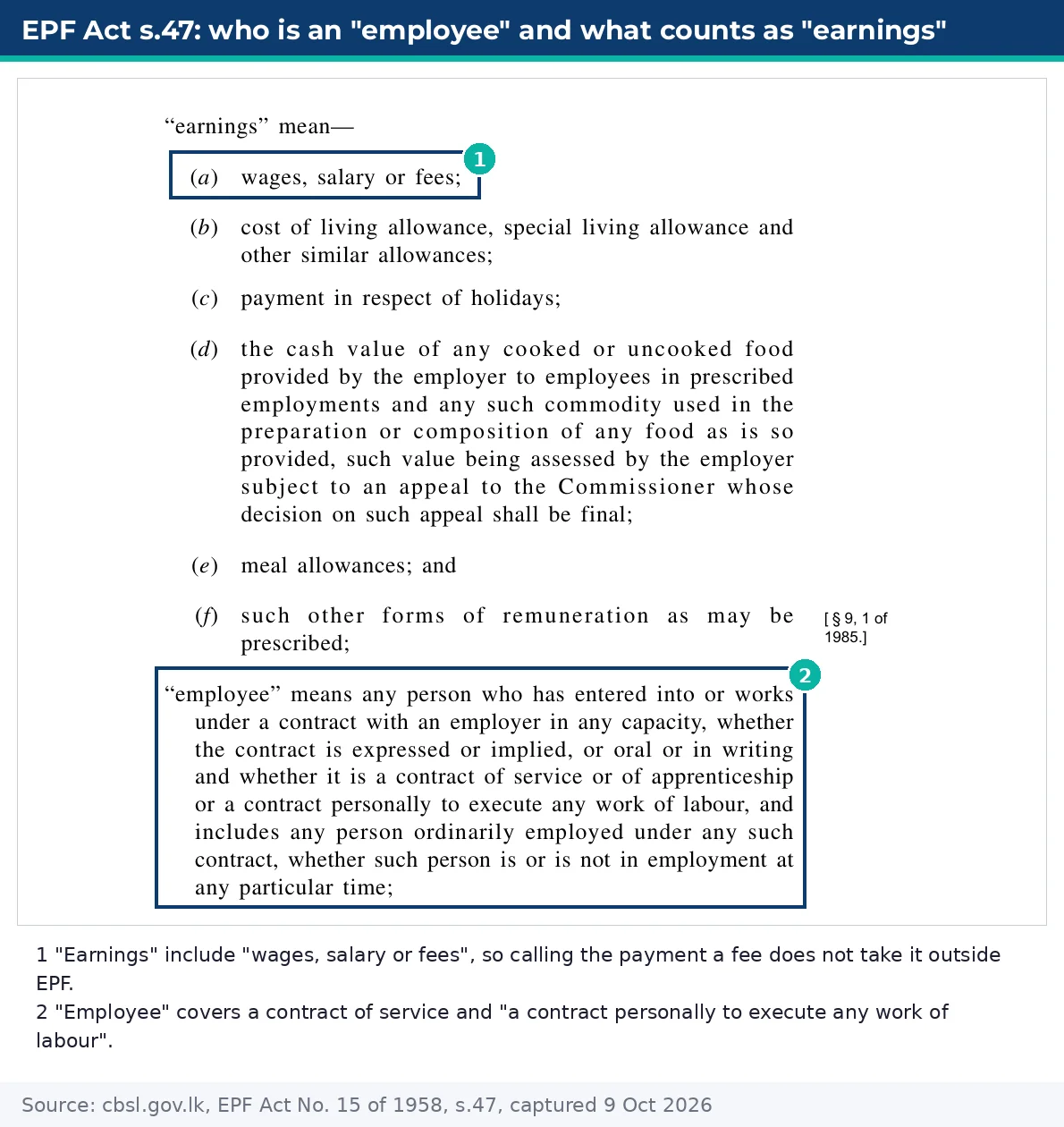
EPF. The Employees' Provident Fund Act defines "employee" as any person who works under a contract with an employer "in any capacity", whether "a contract of service or of apprenticeship or a contract personally to execute any work of labour" [1]. "Earnings" expressly include "wages, salary or fees" [1]. Calling the payment a fee does not change the label inside the jar. The employer pays 12% and the employee 8% of total earnings by the last day of the following month [1].
ETF. The Employees' Trust Fund Act uses the same wide "employee" wording in s.44 and charges the employer 3% of total earnings (s.16(1)) [2].
Gratuity. The Payment of Gratuity Act defines "workman" in s.20 with the same "contract personally to execute any work or labour" language [3]. An employer that employed 15 or more workmen on any day in the previous 12 months must pay a gratuity to a workman with at least five completed years, within 30 days of termination (s.5(1)). For a monthly-rated workman that is half a month's wage or salary for each completed year (s.6(2)) [3]. Consultants who are really workmen count towards the 15. A delivery business that thinks it has 11 staff and 5 contract drivers may in fact be over the threshold for everyone.
Shop and Office Employees Act. This Act regulates hours, overtime, holidays, leave and remuneration for persons "employed in or about the business of" a shop or office, and Part III defines "employee" in exactly those words (s.20) [4]. It turns on what the person does in your business, not on the type of contract.
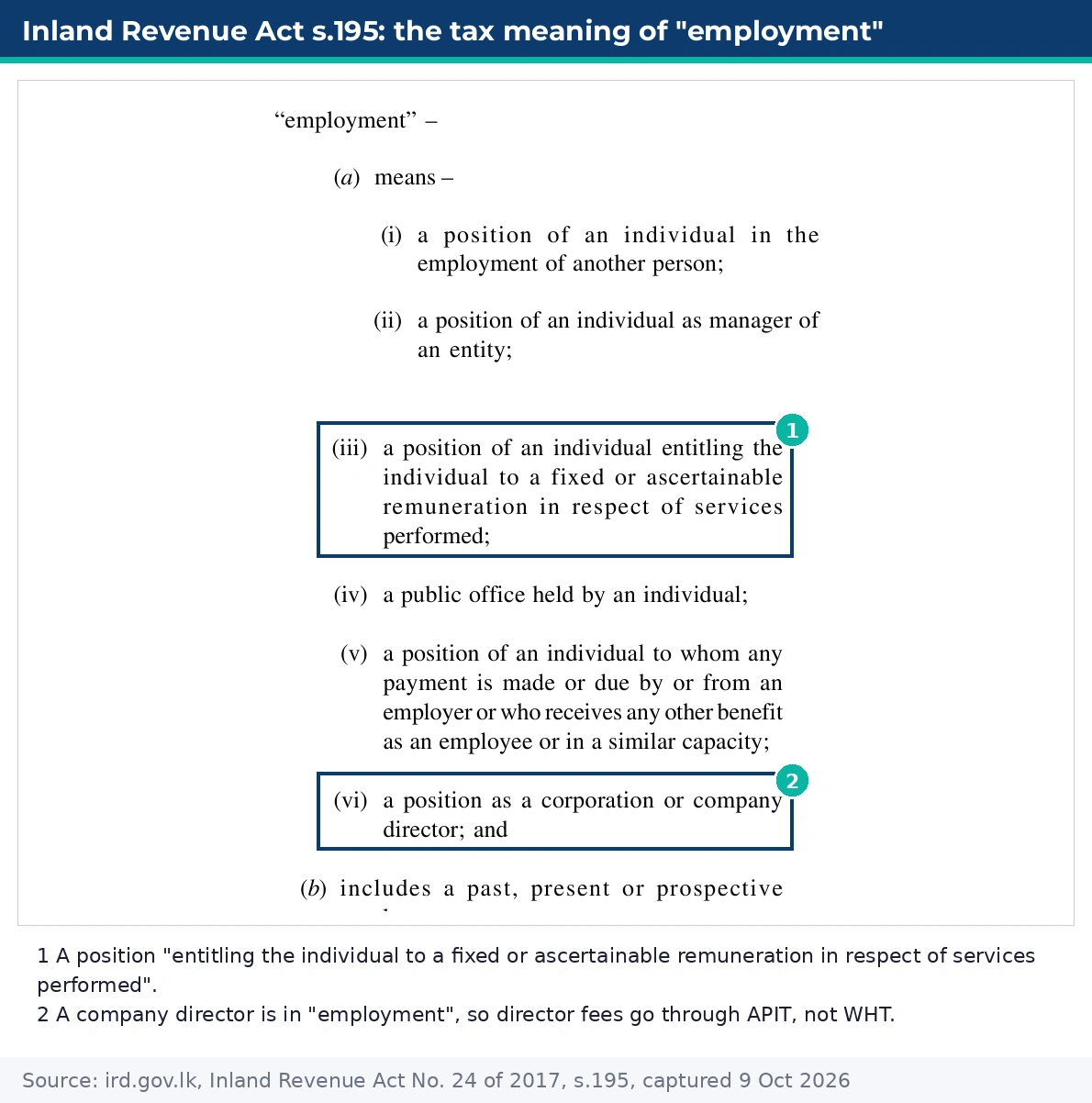
Inland Revenue Act. For tax, s.195 says "employment" includes "a position of an individual entitling the individual to a fixed or ascertainable remuneration in respect of services performed" and "a position as a corporation or company director" [5]. Two points follow. Director fees are employment income, so they go through APIT, not WHT. A flat monthly retainer for services also sits uncomfortably close to the first limb. We have not found an IRD ruling on retainers. Treat this as a risk point, not a settled answer.
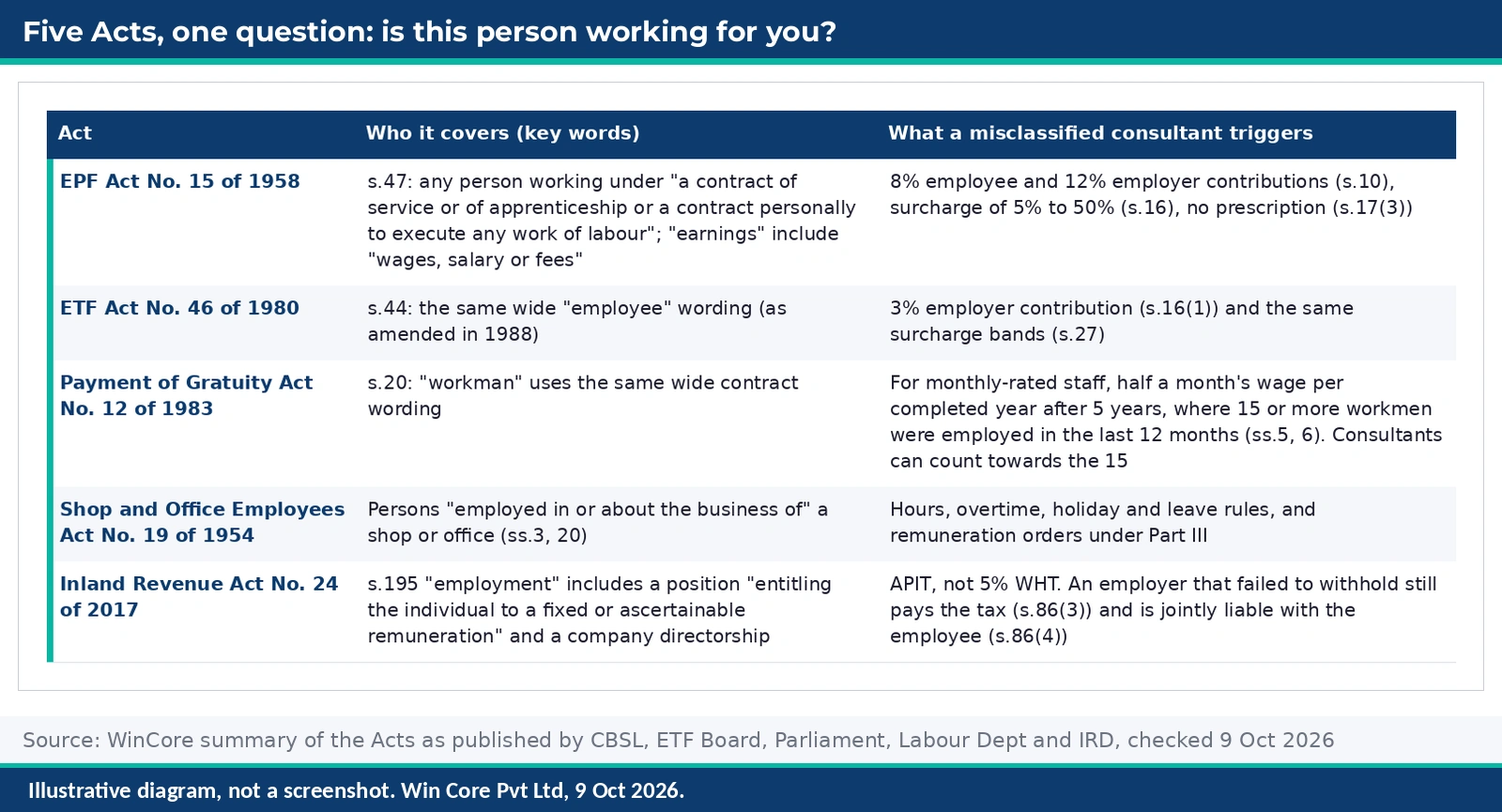
Instruments: EPF Act No. 15 of 1958, ss.10, 47 [1]; ETF Act No. 46 of 1980, ss.16, 44 [2]; Payment of Gratuity Act No. 12 of 1983, ss.5, 6, 20 [3]; Shop and Office Employees Act No. 19 of 1954, ss.3, 20 [4]; Inland Revenue Act No. 24 of 2017, s.195 [5]. Last verified: 9 October 2026.
How the courts open the jar
Is there one test that settles it? No. The courts use three tests together and weigh the whole picture.
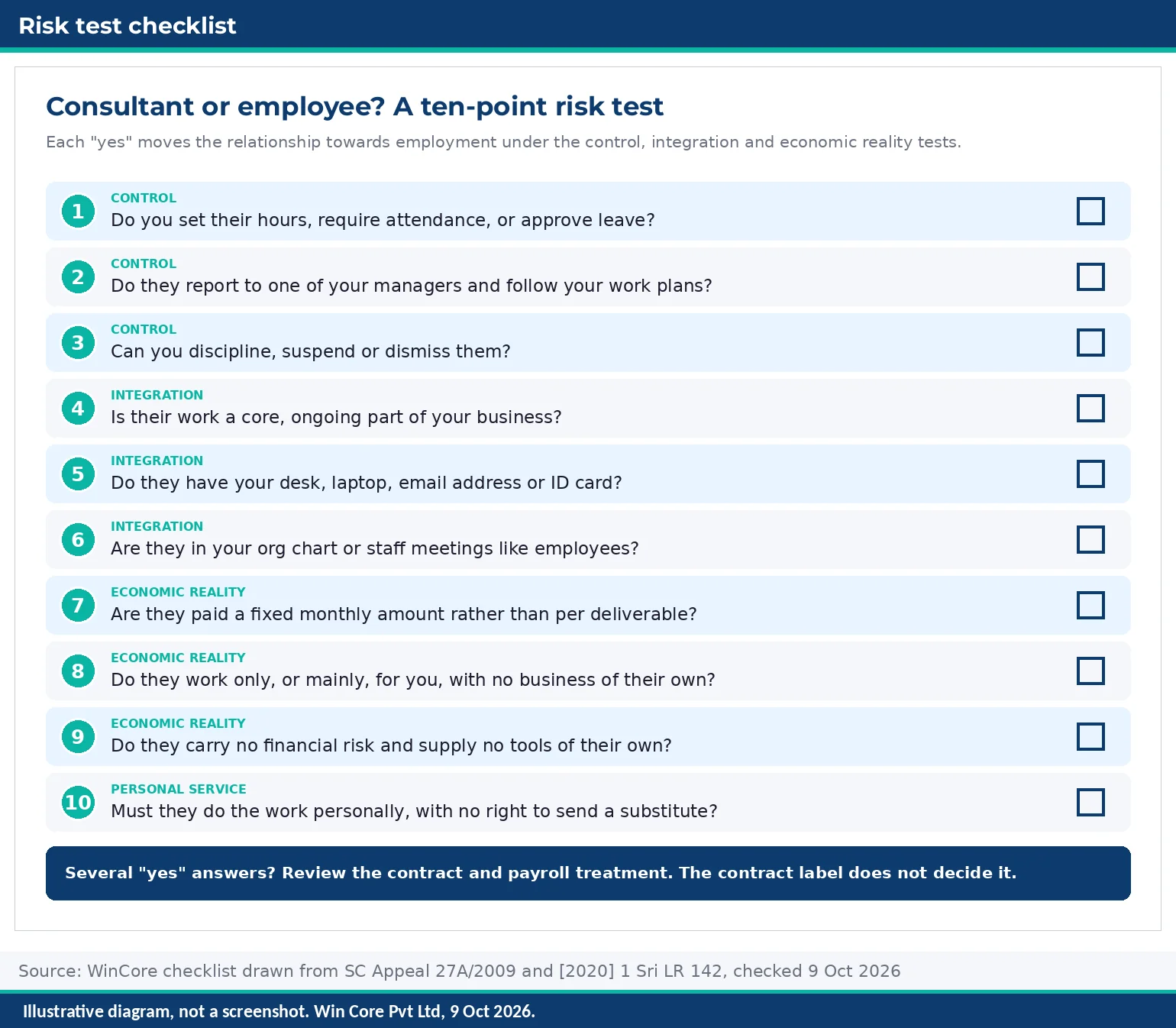
The control test comes from MacKenna J in Ready Mixed Concrete [1968] 2 QB 497 and asks whether the worker is subject to the other party's control "in sufficient degree". The integration test, adopted by Sharvananda J in Y.G. de Silva v Associated Newspapers, asks whether the work is an integral part of the business and whether the person is "part and parcel of the organisation". The economic reality test, approved in Free Lanka Trading Co. Ltd v de Mel 79 (II) NLR 158, asks whether they are employees as a matter of economic reality. All three are set out in the Court of Appeal's decision in Koluundzija v Commissioner General of Labour [6].
Three decisions show the tests at work.
- Sri Lanka Insurance Corporation Ltd v Commissioner of Labour, SC Appeal 27A/2009 (14 December 2016) [7]. Motor claims assessors were paid "fees per report" and the insurer argued they were independent professionals on a contract for service. The Supreme Court looked at the instructions: report by 9.30 a.m., sign the attendance register, face disciplinary action over late reports. It held them to be covered by the EPF Act. Professional skill "would not and cannot override the 'control test' and the 'integration test'", and the appeal was dismissed with costs.
- Koluundzija v Commissioner General of Labour [2020] 1 Sri LR 142 (CA) [6]. An international NGO engaged a person as a "consultant" from 2005 to 2011 under contracts in which she accepted that she was not an employee. She reported to the operations manager, submitted monthly work plans, had a permanent desk and computer, received insurance cover and could not delegate without written approval. The court upheld the order to pay EPF arrears plus surcharge. On tax, it held that deducting withholding tax rather than PAYE "is not decisive", because that is only "the consequential application of the label that the parties agree to attach to their relationship".
- Consolidated Marine Engineers Ltd v Assistant Commissioner of Labour [2020] 3 Sri LR 248 (CA) [8]. This case went the other way. Security guards were paid through a team leader and kept their own attendance book. They were not on the company's pay register, and there was no evidence of any right to suspend or dismiss them. The court found that none of the three tests was met and quashed an EPF demand under the "no evidence" rule. The jar really did contain an independent supplier.
That last case is worth a short detour. In Koluundzija the court quotes an English judge's line that "the Roman soldier would not have been a self-employed labour-only sub-contractor because of any verbal exchange between him and the centurion when he enlisted" [6]. It is a memorable image because it is plainly true: no form of words turns a soldier into a contractor. Bring that back to your own payroll and the lesson is practical. The case the employer won was won on evidence (separate pay, separate attendance records, a real intermediary), not on the wording of the contract.
The Labour Department applies the same tests at its EPF inquiries, and these judgments are reviews of its decisions. Expect the inquiry to ask for attendance records, emails setting work, organisation charts and payment patterns.
Instruments: SC Appeal 27A/2009 [7]; [2020] 1 Sri LR 142 [6]; [2020] 3 Sri LR 248 [8]. Last verified: 9 October 2026.
5% WHT on service fees versus APIT
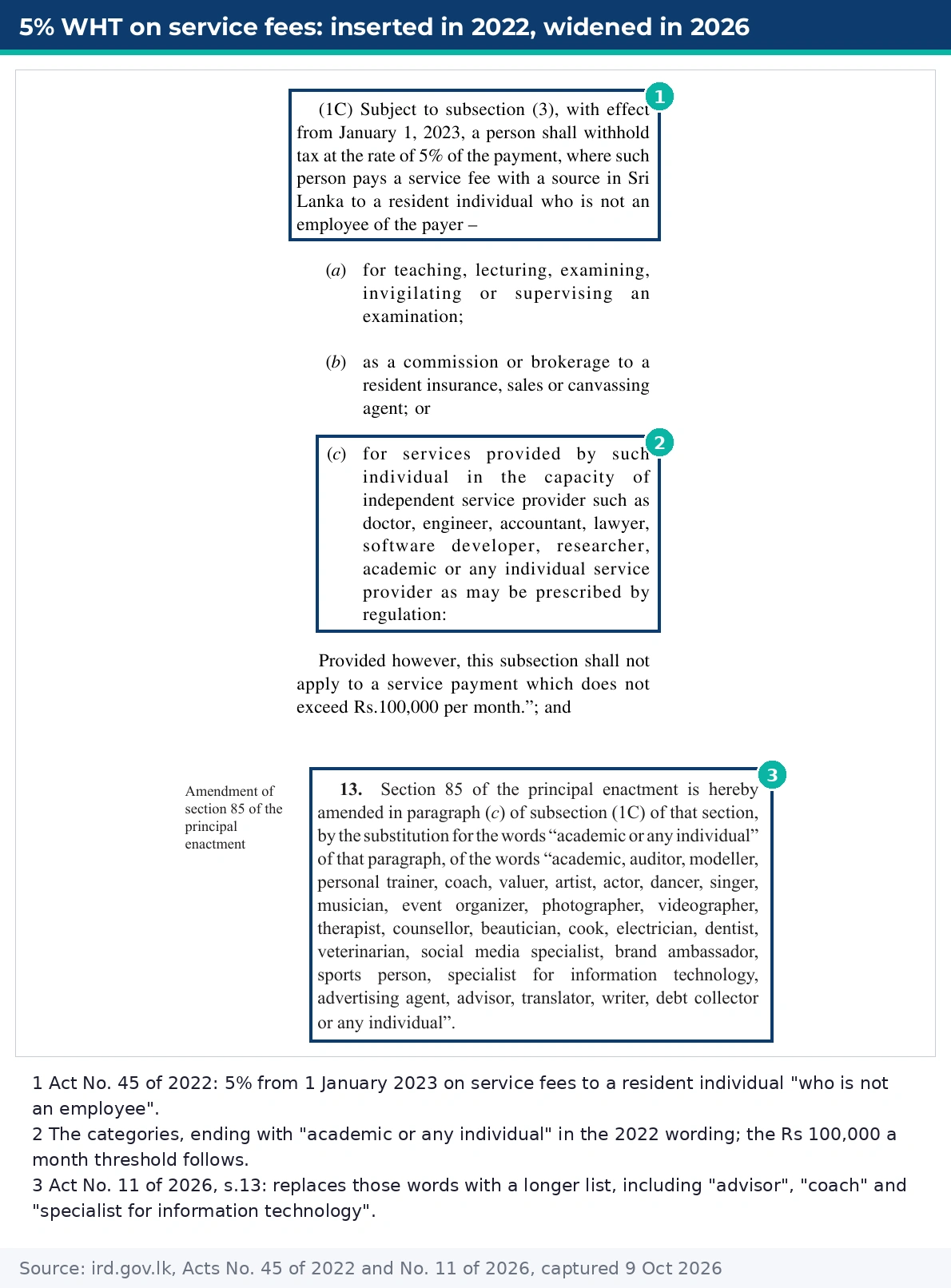
First, a correction to something often repeated. The 5% withholding tax on service fees paid to resident individuals is not new in 2026. It was inserted as s.85(1C) of the Inland Revenue Act by Amendment Act No. 45 of 2022, "with effect from January 1, 2023", for a service fee paid to "a resident individual who is not an employee of the payer", where the payment exceeds Rs 100,000 a month [9]. Inland Revenue (Amendment) Act No. 11 of 2026 (certified 3 June 2026) replaced the short list in paragraph (c) with a much longer one. It now includes "auditor", "coach", "therapist", "social media specialist", "specialist for information technology", "advisor", "translator" and "writer" [10]. The IRD's WHT circular SEC/2026/E/04 shows the rate as "5% on full payment" [11].
Notice the four words in the original text: "who is not an employee". WHT at 5% applies only when the person is genuinely outside employment. If the label is wrong, the right deduction was APIT all along. An employer that fails to withhold the tax it should have withheld must still pay it (s.86(3)), and the employer and employee are jointly liable for it (s.86(4)) [5].
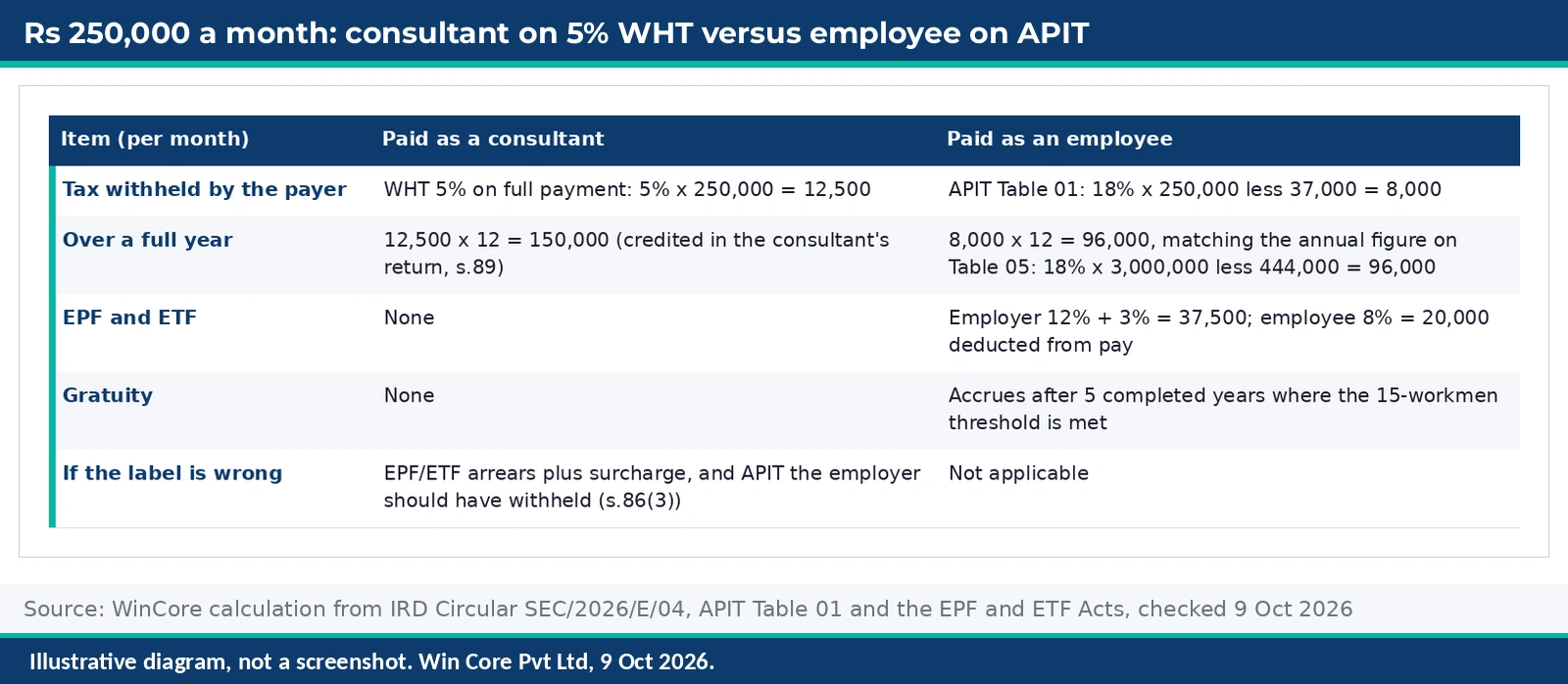
On Rs 250,000 a month the two regimes look like this:
- As a consultant: WHT of 5% × 250,000 = Rs 12,500 a month, or Rs 150,000 a year. This is not a final tax. The consultant claims it as a credit in their own return (s.89) [5].
- As an employee: APIT under Table 01 is 18% × 250,000 less 37,000 = Rs 8,000 a month, or Rs 96,000 a year [12]. That matches the annual figure on Table 05: 18% × 3,000,000 less 444,000 = Rs 96,000. The employer also pays 12% EPF and 3% ETF (Rs 37,500 a month), and the employee's 8% EPF (Rs 20,000) comes out of pay [1][2].
The tax difference is modest. The real gap is the Rs 37,500 a month in employer contributions that the consultancy label leaves out, and that gap is exactly what an inquiry recovers.
Instruments: Inland Revenue Act No. 24 of 2017, ss.86, 89, 195 [5]; Amendment Act No. 45 of 2022, s.17 [9]; Amendment Act No. 11 of 2026, s.13 [10]; Circular SEC/2026/E/04 [11]; APIT Tables Y/A 2025/26 [12]. Last verified: 9 October 2026.
What back-dated surcharges look like
EPF and ETF surcharges do not work like interest. They step up in bands by how long each month's contribution has been in arrears: 5% up to ten days, 15% up to one month, 20% up to three months, 30% up to six months, 40% up to twelve months and 50% beyond twelve months (EPF s.16, ETF s.27) [1][2]. The ETF Board publishes the same bands and adds a 1% a month surcharge for late half-yearly returns [13]. EPF dues are not subject to the Prescription Ordinance (s.17(3)), so the old months do not drop away with time [1].
Take the Rs 250,000 consultant above for the 12 months July 2024 to June 2025, settled on 15 March 2026. Each month's EPF (20% = Rs 50,000) and ETF (3% = Rs 7,500) falls due by the last day of the following month.
- July 2024 to January 2025 (due 31 August 2024 to 28 February 2025): more than 12 months in arrears, so 50%. That is 7 × 57,500 × 50% = Rs 201,250.
- February to June 2025 (due 31 March to 31 July 2025): more than six months but not more than twelve, so 40%. That is 5 × 57,500 × 40% = Rs 115,000.
- Total: contributions of Rs 690,000 plus surcharge of Rs 316,250, which comes to Rs 1,006,250 for one person and one year.
The surcharge adds 46% to the bill (316,250 ÷ 690,000). The employer generally cannot pass its own share or the surcharge to the worker: s.20 of the EPF Act makes any such deduction or contract term void [1]. If the employee's 8% was never deducted at the time, assume for budgeting that the employer will bear it, and take advice before trying to recover it.
Surcharge worked example. Illustrative diagram, not a screenshot. Source: WinCore Pvt Ltd calculation from EPF Act s.16 and ETF Act s.27, checked 9 Oct 2026.
Instruments: EPF Act ss.10, 16, 17(3), 20 [1]; ETF Act ss.16, 27 [2]; ETF Board, Payment of contributions [13]. Last verified: 9 October 2026.
What this means for you
- List every "consultant" who is paid monthly. Run the risk test on each one. Treat anyone with a fixed monthly fee, set hours or a company email address as a priority.
- Fix contracts so they match reality, and change reality where it is wrong. A contract helps only when it matches the facts. Real independence means deliverables, the right to send a substitute, other clients and their own tools.
- Put directors' fees through APIT, whatever the board minute calls them.
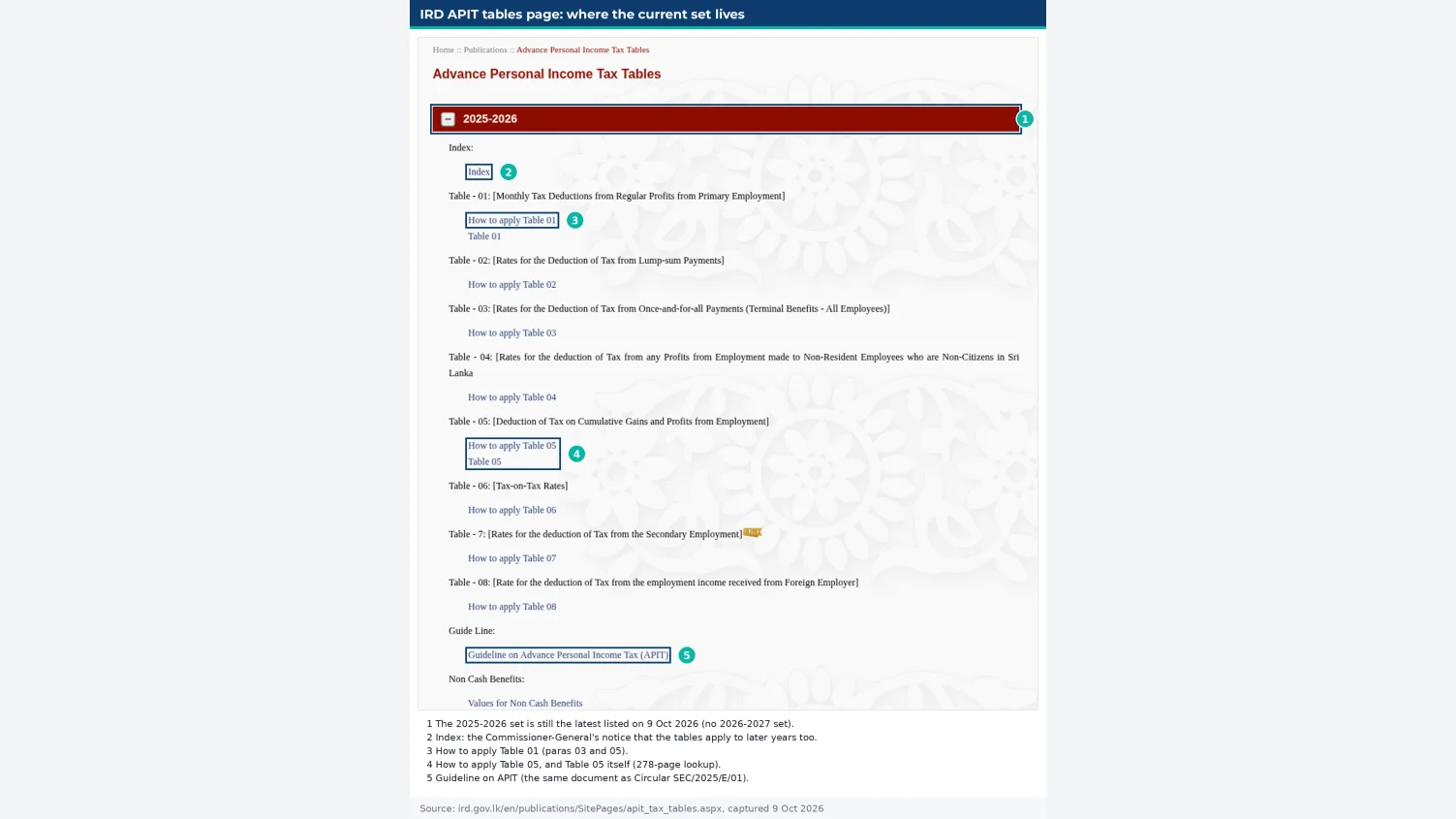
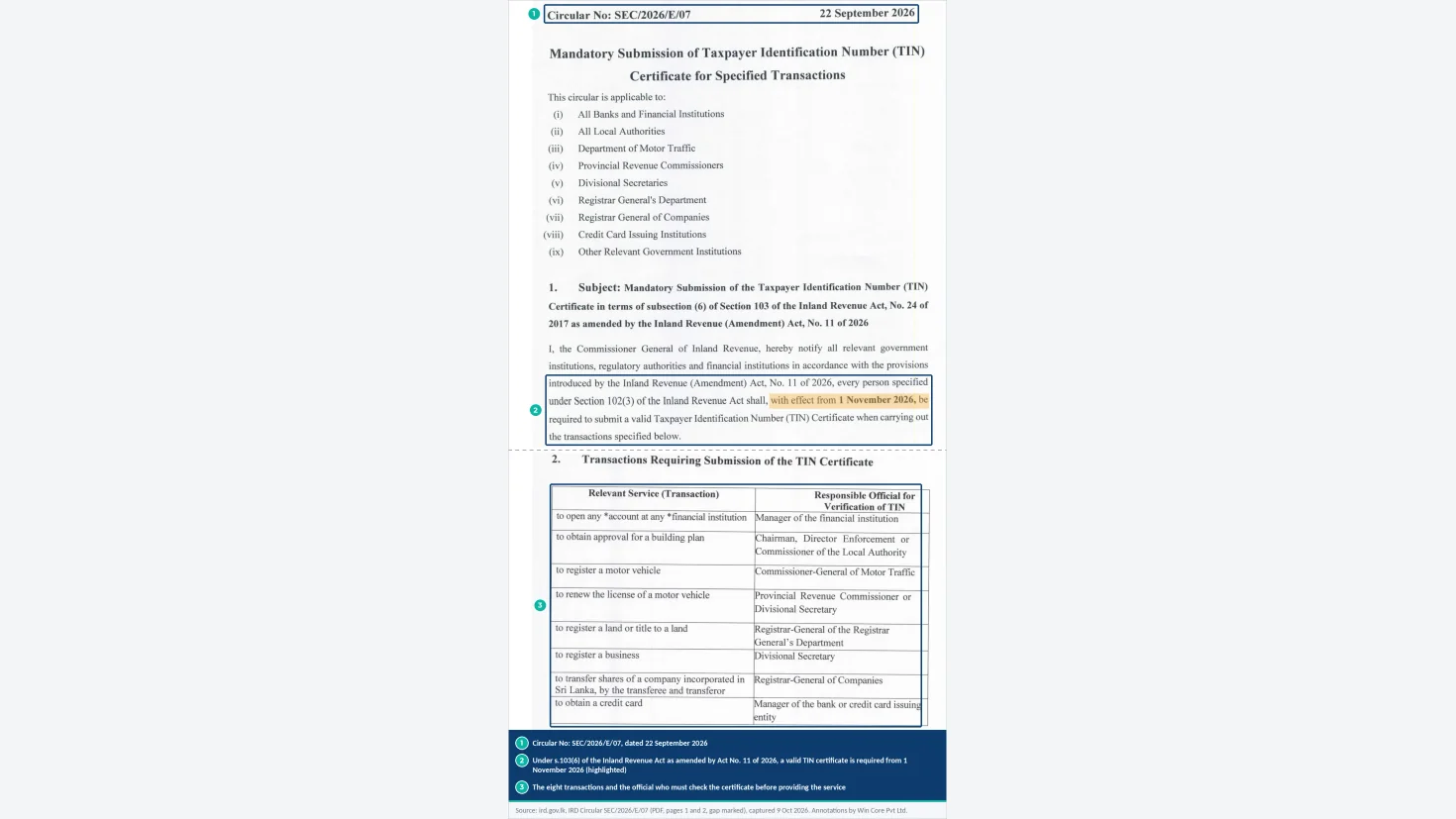
- If the relationship is employment, move the person onto payroll from the next month, and work out the arrears and surcharge so you can decide how to approach the Labour Department. Our EPF and ETF contributions guide covers the monthly mechanics. If a person joins payroll part-way through the year, APIT is calculated on Table 05, not Table 01; our guide to APIT for mid-year joiners and leavers works through it, and every new employee will need a TIN for the APIT statement, as our TIN certificate guide explains. Our payroll, HR and tax teams can take on the clean-up.
FAQ
Does a written consultancy agreement protect us?
Not on its own. The courts treat the label as "not determinative" and look at control, integration and economic reality [6][8].
We deduct 5% WHT. Does that prove the person is a consultant?
No. In Koluundzija the court called the WHT treatment "not decisive" [6]. Section 85(1C) applies only to a person "who is not an employee" [9].
Did Act No. 11 of 2026 introduce the 5% WHT?
No. The 5% has applied since 1 January 2023 under Act No. 45 of 2022. Act No. 11 of 2026 widened the list of service providers, for example to advisors, coaches and IT specialists [9][10].
How far back can EPF arrears go?
The Prescription Ordinance does not apply to EPF or ETF contributions or surcharges [1][2]. In Koluundzija the arrears ran from 2005 to 2011 [6].
Are company directors employees for tax?
Yes. Section 195 includes "a position as a corporation or company director" in employment, so director fees go through APIT [5].
The label is yours to write; the contents decide the bill.
If you are not sure which side of the line your consultants fall on, book a consultation at our contact page and we will go through it with you.
WinCore Pvt Ltd
References
- Employees' Provident Fund Act No. 15 of 1958 (reprint), Central Bank of Sri Lanka. https://www.cbsl.gov.lk/sites/default/files/cbslweb_documents/laws/acts/en/epf_act.pdf. Accessed 9 Oct 2026.
- Employees' Trust Fund Act No. 46 of 1980, Employees' Trust Fund Board. https://etfb.lk/wp-content/uploads/2021/03/ETF-Act.pdf. Accessed 9 Oct 2026.
- Payment of Gratuity Act No. 12 of 1983, Parliament of Sri Lanka. https://www.parliament.lk/uploads/acts/gbills/english/3120.pdf. Accessed 9 Oct 2026.
- Shop and Office Employees (Regulation of Employment and Remuneration) Act No. 19 of 1954, Department of Labour, Labour Code. https://labourdept.gov.lk/downloads/labour_code/20.pdf. Accessed 9 Oct 2026.
- Inland Revenue Act No. 24 of 2017, Inland Revenue Department. https://www.ird.gov.lk/en/publications/Acts_Income%20Tax_2017/IR_Act_No_24_2017_E.pdf. Accessed 9 Oct 2026.
- Koluundzija v Commissioner General of Labour and Others [2020] 1 Sri LR 142 (CA), Sri Lanka Law Reports via LankaLaw. https://lankalaw.net/wp-content/uploads/2020/v1-sri-lr-142.pdf. Accessed 9 Oct 2026.
- Sri Lanka Insurance Corporation Ltd v Commissioner of Labour and Others, SC Appeal 27A/2009, Supreme Court of Sri Lanka. https://supremecourt.lk/wp-content/uploads/judgements/sc_appeal_27a_2009.pdf. Accessed 9 Oct 2026.
- Consolidated Marine Engineers Ltd v Assistant Commissioner of Labour (Colombo South) and Others [2020] 3 Sri LR 248 (CA), Sri Lanka Law Reports via LankaLaw. https://lankalaw.net/wp-content/uploads/2020/v3-sri-lr-248.pdf. Accessed 9 Oct 2026.
- Inland Revenue (Amendment) Act No. 45 of 2022, s.17, Inland Revenue Department. https://www.ird.gov.lk/en/publications/Acts_Income%20Tax_2017/IR_Act_No._45_2022_E.pdf. Accessed 9 Oct 2026.
- Inland Revenue (Amendment) Act No. 11 of 2026, s.13, Inland Revenue Department. https://www.ird.gov.lk/en/publications/Acts_Income%20Tax_2017/IR_Act_No_11-2026_E.pdf. Accessed 9 Oct 2026.
- Circular SEC/2026/E/04, Withholding Tax, Inland Revenue Department. https://www.ird.gov.lk/en/publications/Circulars_Circulars/SEC_2026_E_04_E.PDF. Accessed 9 Oct 2026.
- APIT Tax Table No. 01 and No. 05, Y/A 2025/26, Inland Revenue Department. https://www.ird.gov.lk/en/publications/SitePages/apit_tax_tables.aspx?menuid=1502. Accessed 9 Oct 2026.
- Payment of contributions, Employees' Trust Fund Board. https://etfb.lk/payment-of-contributions/. Accessed 9 Oct 2026.
Put these insights to work
WinCore specialists can review your current workflow, document gaps, and build a practical 90-day action plan.
Book a free consultationContinue reading
Explore more WinCore analysis to keep your finance, tax, and compliance roadmap moving.
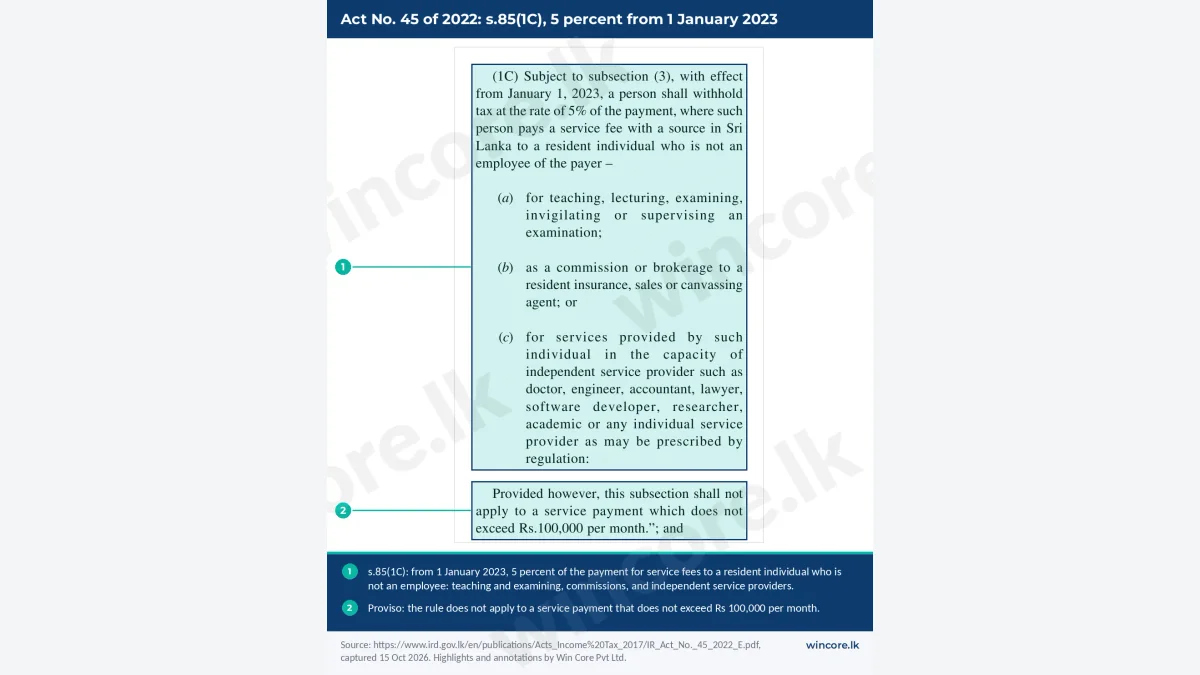
When a payer must withhold 5 percent on service fees, the services added in June 2026, payment within 15 days and the certificate rules.
Staff who join or leave mid-year need APIT Table 05, not Table 01. Why it matters, with worked examples and the T-10 annual return steps.
From 1 November 2026 individuals need a TIN certificate for eight transactions. Who needs one, how to get it, and TINs for companies and staff.