
APIT for staff who join or leave mid-year: Table 05, not Table 01
Staff who join or leave mid-year need APIT Table 05, not Table 01. Why it matters, with worked examples and the T-10 annual return steps.
On this page
By WinCore Pvt Ltd. Last verified: 9 October 2026.
Advance Personal Income Tax (APIT) is built around one annual allowance. Every resident employee gets Rs 1,800,000 of employment income tax free in a year of assessment that runs from 1 April to 31 March. Tax Table 01 spreads it as Rs 150,000 a month, which suits someone on the payroll for all twelve months and nobody else.
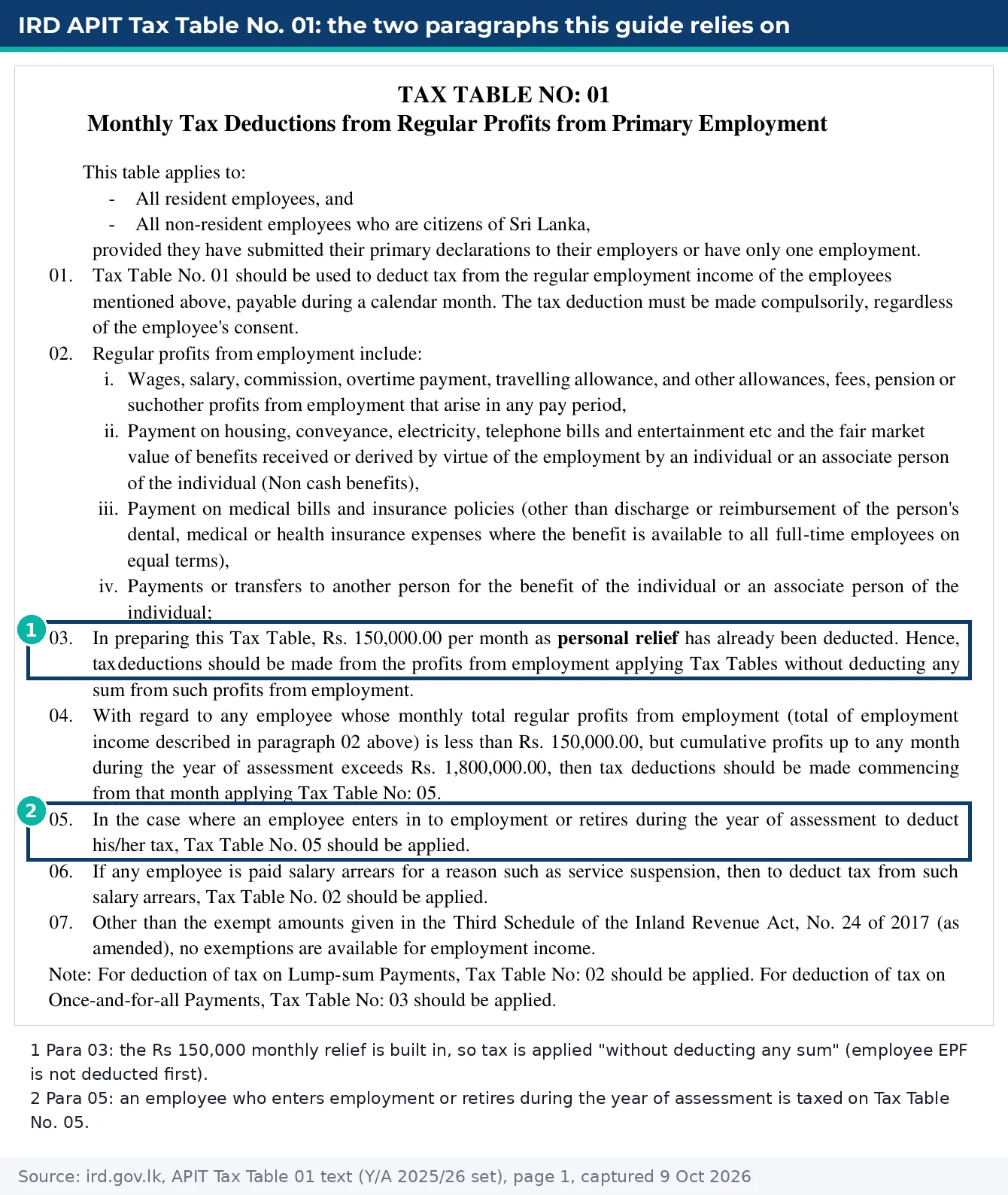
Take a hire who arrives on 1 October. Table 01 gives them Rs 150,000 of relief a month, so by March they have used Rs 900,000 of a Rs 1,800,000 allowance, and Rs 900,000 has been taxed that should not have been. The Inland Revenue Department (IRD) answers this with Table 05, which works on cumulative pay for the year. Its Table 01 instructions say so in one line: where an employee "enters in to employment or retires during the year of assessment", Table 05 "should be applied".
A common error is payroll software that keeps running Table 01 for a mid-year hire. Suppose a design studio hires an account manager on 1 November on Rs 200,000 a month. Software left on Table 01 takes Rs 3,000 a month (6% × 200,000 less 9,000), although the account manager's total pay for the year, five full months, comes to Rs 1,000,000. That is below the Rs 1.8 million allowance, so on Table 05 the right deduction for the whole year is nil, assuming no earlier job that year. The software is not broken; it is set to the wrong table.
Below: the rule, seven steps, and two worked examples from the official table.
The rule in one paragraph
Table 01 is the monthly table for regular pay from primary employment (or a single job). Its paragraph 03 says the monthly relief is built in, so tax is deducted "without deducting any sum": the employee's 8% EPF is not taken off first. Paragraph 05 sends joiners and retirees to Table 05. The Table 05 text repeats this (para 02) and adds (para 03) that a person who leaves one primary employment and takes another "must provide a tax deduction certificate (T-10)" to the new employer, who then deducts "based on the cumulative employment income for the year of assessment (including the employment income from the T-10 of the first employer)". Under Table 05, no tax is due until cumulative pay passes Rs 1,800,000. After that, tax on the cumulative figure is 6% less Rs 108,000 up to Rs 2,800,000, rising in bands to 36% less Rs 1,128,000 above Rs 4,300,000.
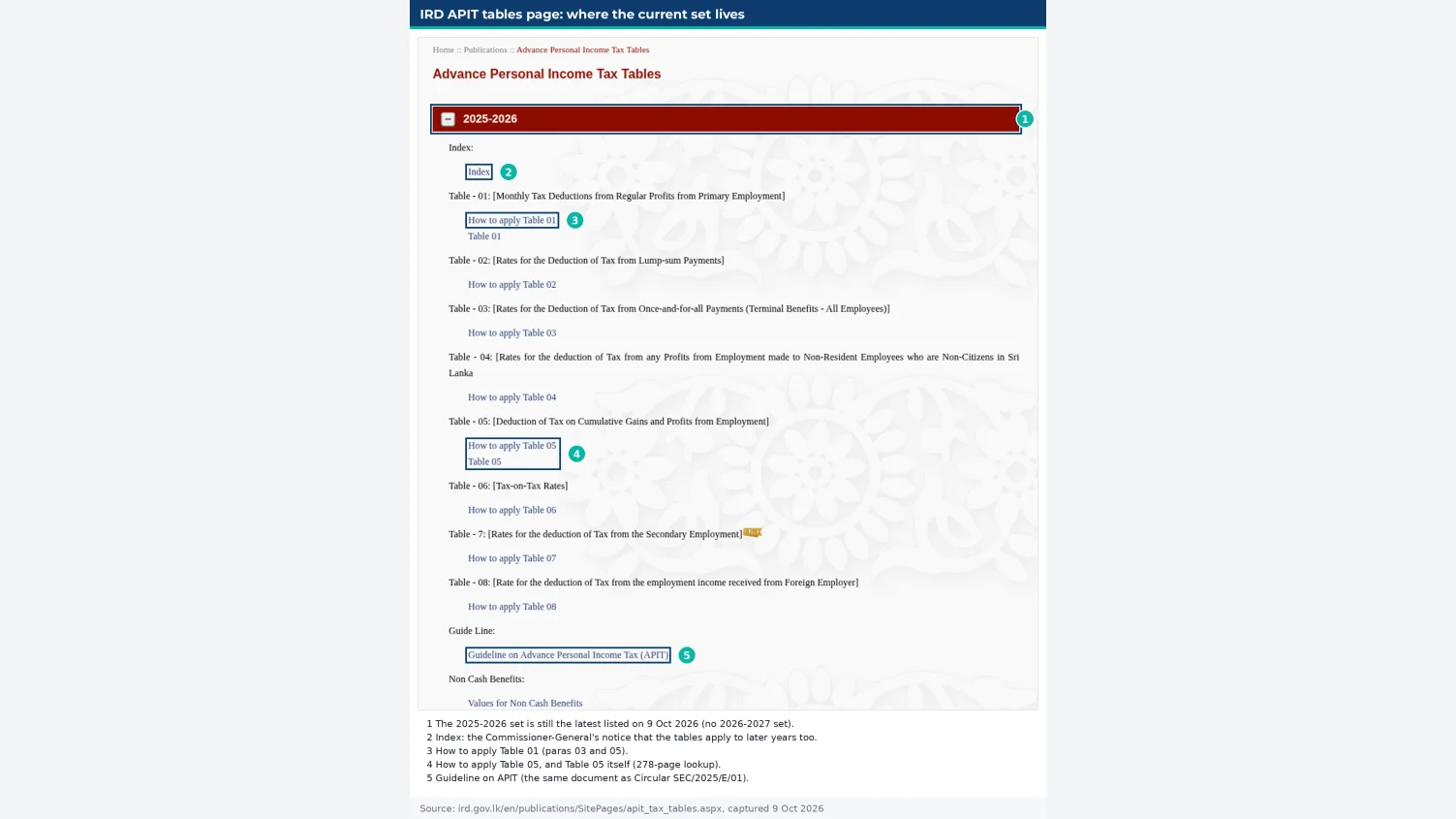
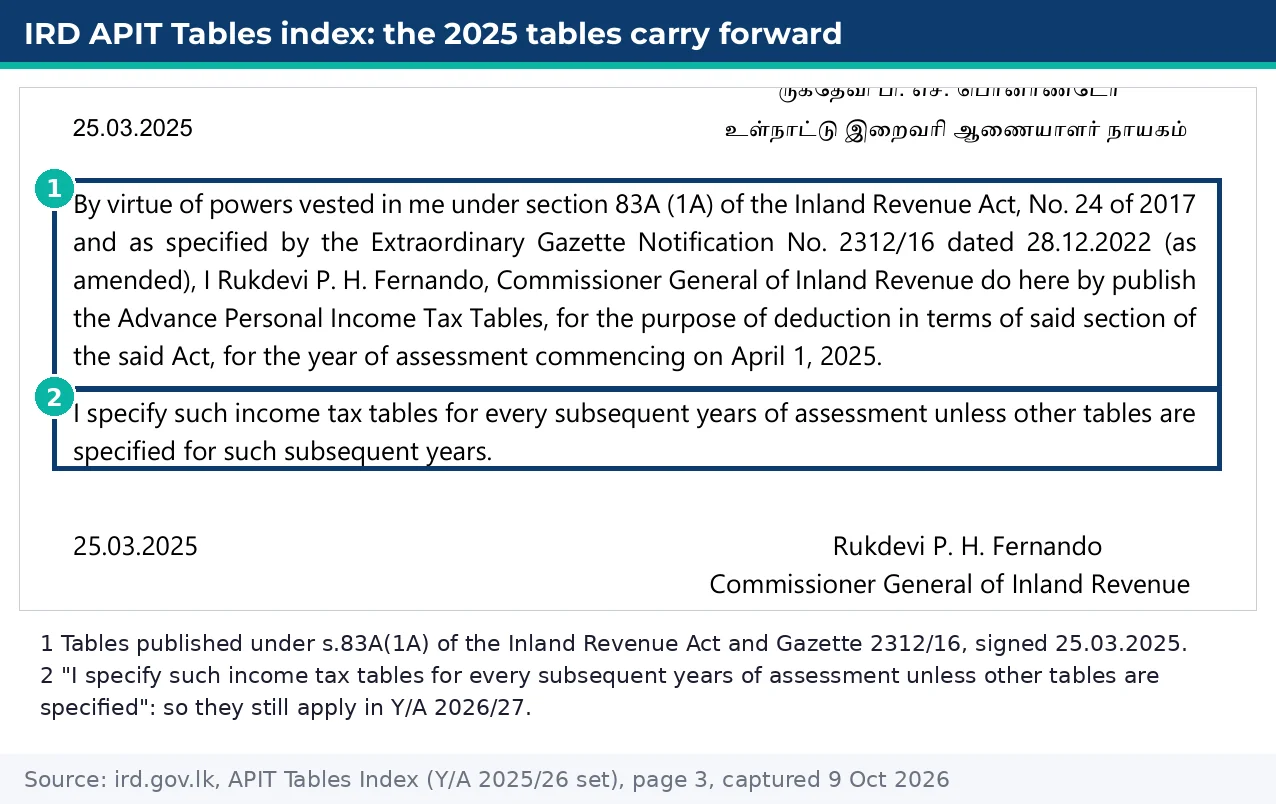
The tables are headed Y/A 2025/26, but the Commissioner-General's notice at the front of the set says they apply "for every subsequent years of assessment unless other tables are specified". On 9 October 2026 the IRD page still lists no newer set, so these are the tables for Y/A 2026/27.
Instrument: IRD APIT Tables Y/A 2025/26, Table 01 text paras 03, 05; Table 05 text paras 02, 03, 05; Index notice. Last verified: 9 October 2026.
Documents and information you need
Checklist: have these before you run the first payroll
- For a joiner: the T-10 (Certificate of Income Tax Deductions) from every earlier employer in the same year of assessment, showing the period of service, gross pay and tax deducted
- The joiner's start date, or the retiree's known last working day
- The Primary Employment Declaration, where the employee has more than one job (Circular SEC/2025/E/01, para 8)
- The employee's TIN or NIC number for the T-10 and the annual statement
- The current Table 05 text and lookup PDF from the IRD APIT page
- Payroll records of cumulative gross pay and APIT deducted to date, month by month
- For a retiree: a separate calculation of gratuity and any other terminal benefits under Table 03
Step 1: Decide whether the employee is a Table 05 case
What to do. Flag every employee whose service with you will not cover the full year from 1 April to 31 March. In Table 01 paragraph 05 the triggers are an employee who "enters in to employment" or "retires" during the year. Table 05 paragraph 01 adds a third: someone on less than Rs 150,000 a month whose cumulative pay passes Rs 1,800,000 because some months paid more. Circular SEC/2025/E/01, para 7(e), mentions only that third case, so read the tables too.
Where. The "How to apply Table 01" and "How to apply Table 05" PDFs on the IRD APIT page.
What you need. The start date or the known retirement date.
What goes wrong. The text says "retires", not "resigns", and a resigning employee has usually been on Table 01 for months before you know (see Step 5). Also, Table 05 covers primary employment or a single job; a second job goes on Table 07 (circular para 7(g)).
How long it takes. A few minutes per employee at onboarding, as an estimate.
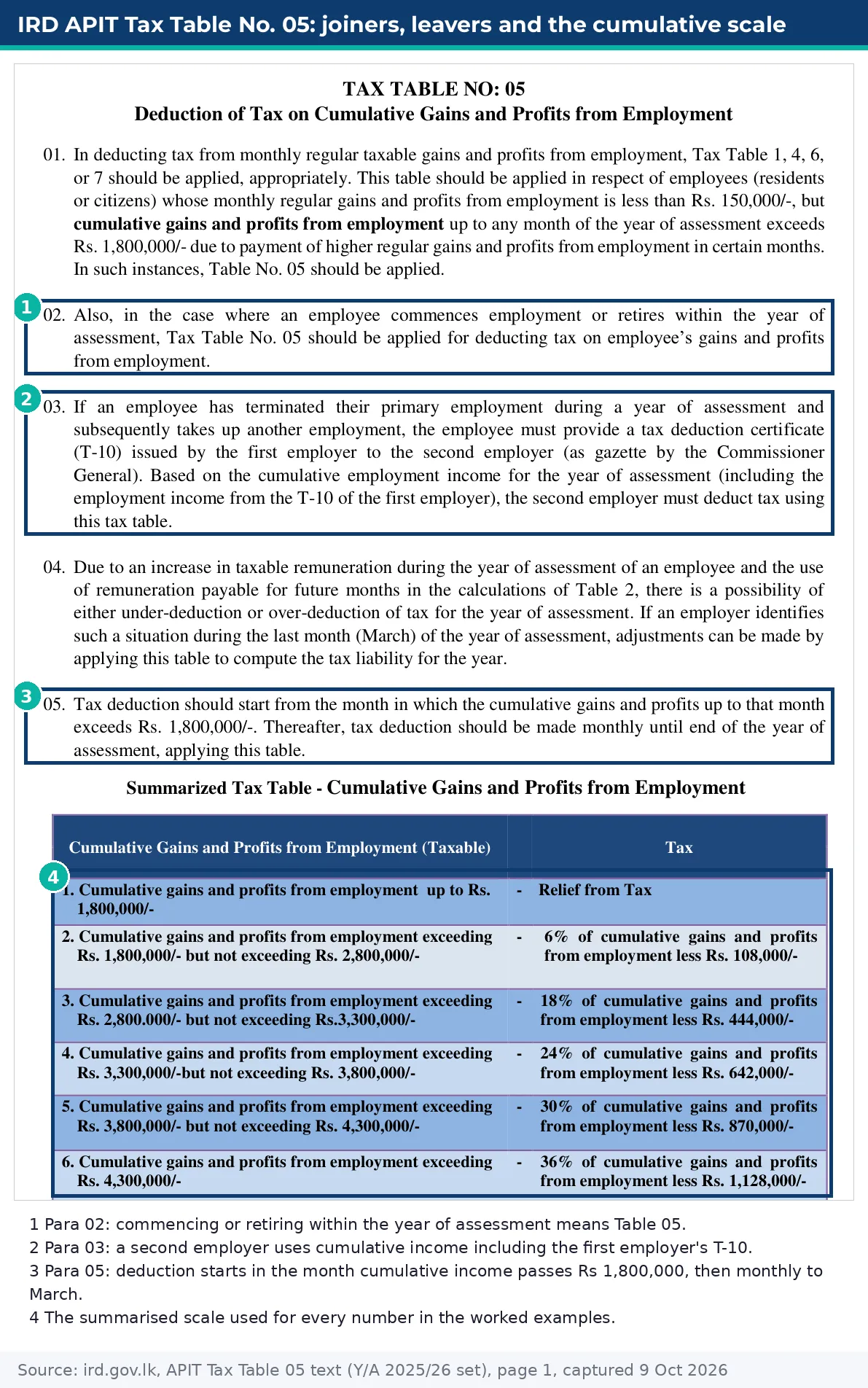
Instrument: Table 05 text paras 01 to 03; Circular SEC/2025/E/01 para 7. Last verified: 9 October 2026.
Step 2: Get the previous employer's T-10
What to do. Ask every joiner for the T-10 from each earlier employer in the same year of assessment: period of service, gross remuneration and tax deducted.
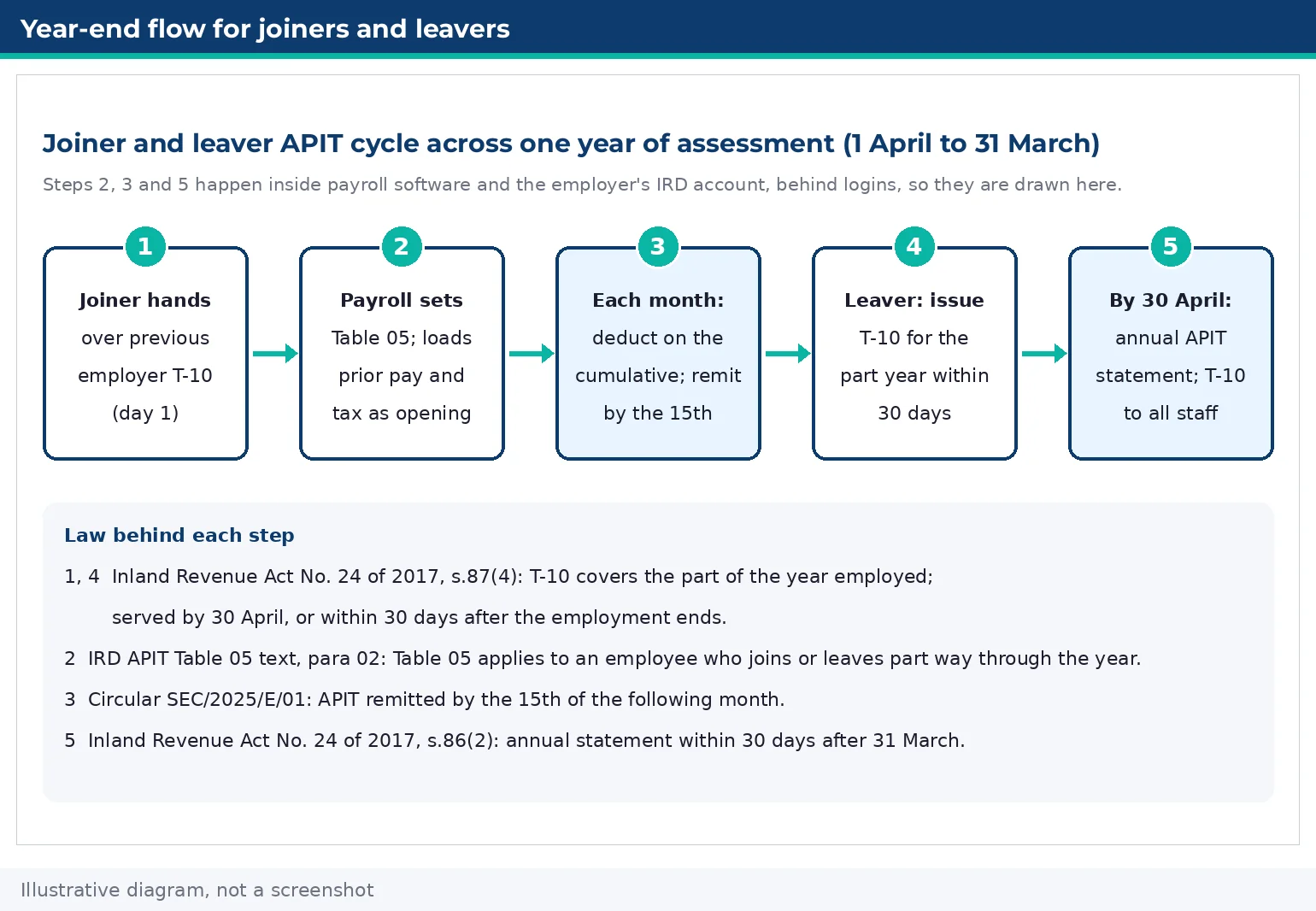
Where. From the previous employer, who must serve it within 30 days of the employment ending, covering "the part of the year during which the employee is employed" (s.87(4)). Since Act No. 11 of 2026 it must be given "free of any charge or payment" (new s.87(6)).
What you need. The signed T-10.
What goes wrong. If no T-10 arrives and you run Table 05 on your own pay alone, you give the employee a second full Rs 1.8 million allowance. In Example 1 below that would cut the year's deduction from Rs 60,000 to Rs 26,400, leaving Rs 33,600 for the employee to settle with the IRD later. Do not guess; record when you asked for it.
How long it takes. Up to 30 days, so it may arrive after your first payroll. Recompute when it does.
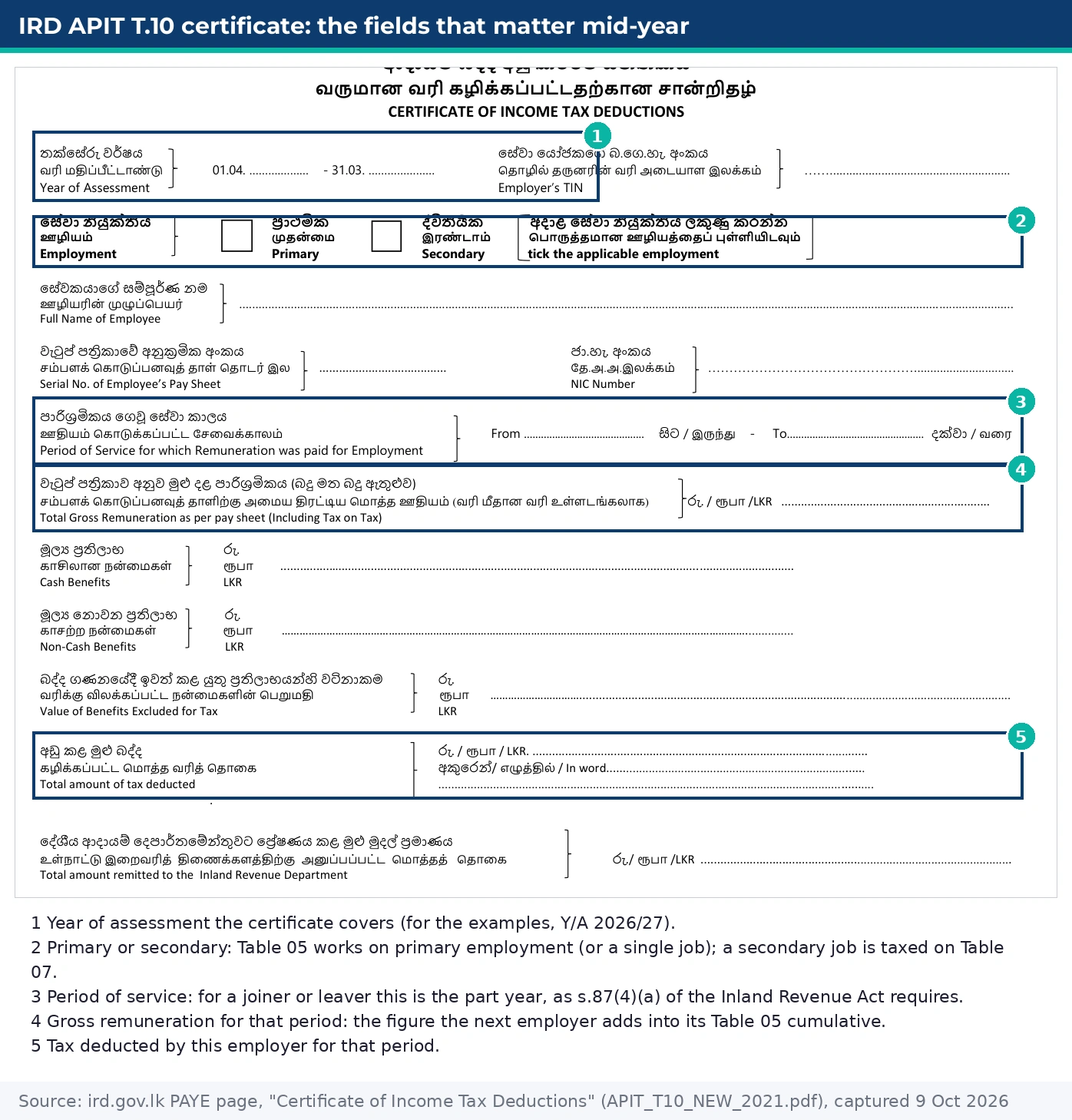
Instrument: Inland Revenue Act No. 24 of 2017 s.87(4); s.87(6) inserted by Act No. 11 of 2026 s.15. Last verified: 9 October 2026.
Step 3: Set up payroll for cumulative deduction
What to do. Move the employee from the monthly table to the cumulative method. Enter the T-10 gross pay as opening "income to date" and the T-10 tax as opening "tax deducted to date". Check that APIT is calculated on gross employment income with nothing taken off first, not even the employee's 8% EPF.
Where. Your payroll system's tax setup screen (behind your login, so not shown).
What you need. The T-10 figures and the employee's start date.
What goes wrong. The common software mistakes:
- The table never changes. Packages often default new employees to Table 01.
- EPF comes off first. Some packages carry over an old "taxable pay = gross less EPF" setting, which goes against the "without deducting any sum" instruction.
- The opening figures are wrong. Some packages accept opening figures but apply them only from the next pay run, or treat the T-10 tax as a refund.
- A pro-rated Table 01. Scaling monthly relief for a part month is not Table 05; the relief is the full Rs 1.8 million for the year.
- Bonuses go into the cumulative. Lump sums such as bonuses belong on Table 02. Its instructions say that where regular pay stays within Rs 1.8 million and a lump sum takes the total over, Table 02 is used "(Not Table 5)".
How long it takes. Under half an hour per employee (estimate), plus a hand check of the first two months.
Instrument: Table 01 text para 03; Table 02 text. Last verified: 9 October 2026.
Step 4: Calculate each month on the cumulative
What to do. Each month, do four things:
- Add this month's regular pay to cumulative pay for the year, including the T-10 figures.
- Look up the tax on that cumulative figure in Table 05.
- Subtract the tax already deducted this year, including the T-10 tax.
- Deduct the difference.
Table 05 paragraph 05 says deduction starts in the month cumulative pay passes Rs 1,800,000 and then continues every month to March.
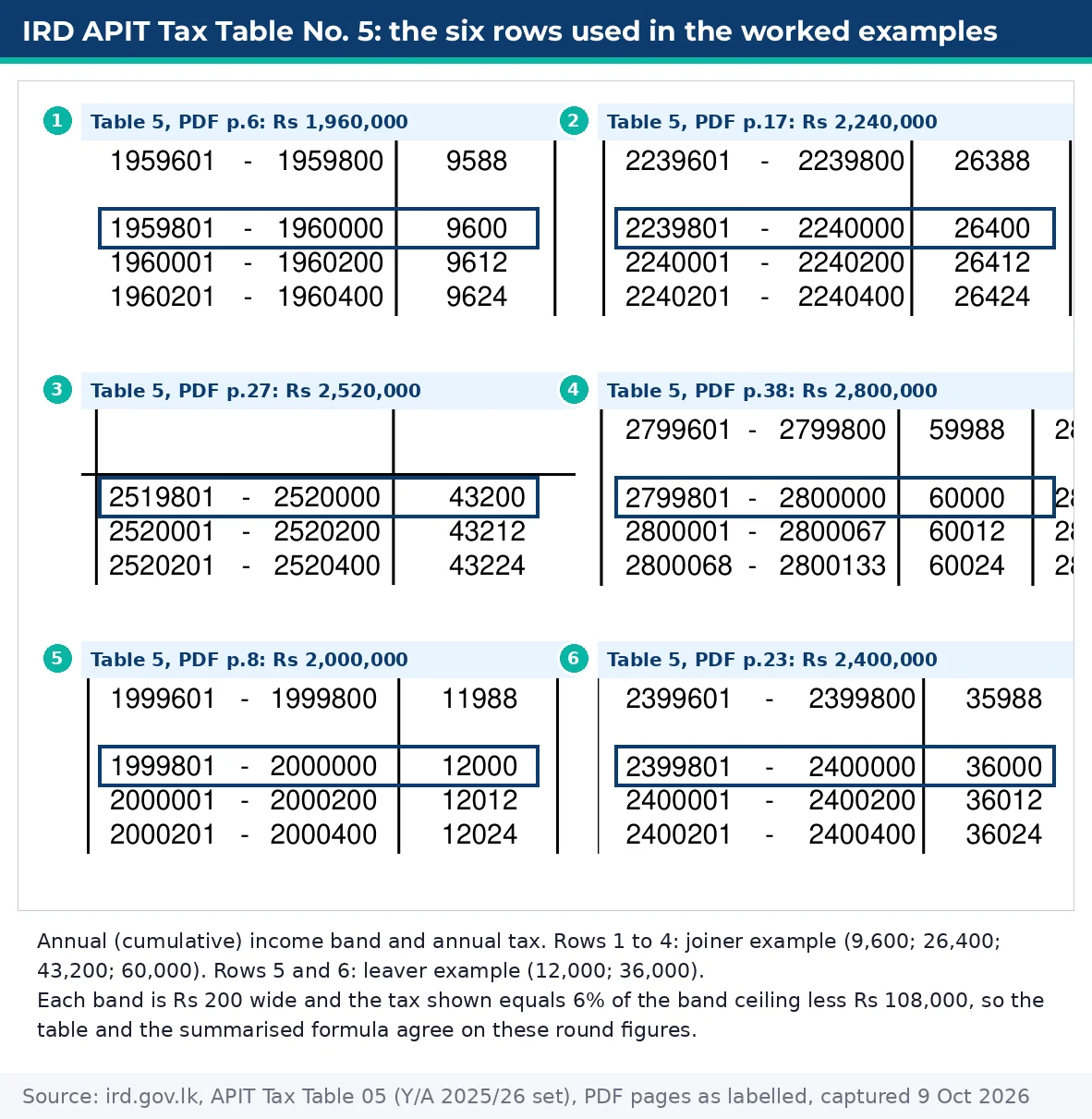
Where. The Table 05 lookup PDF, 278 pages in Rs 200 steps, or the summary formula on page 1 of the Table 05 text. The two give the same answer at the band limits used below.
What you need. The cumulative figures from Step 3.
Worked example 1: a joiner
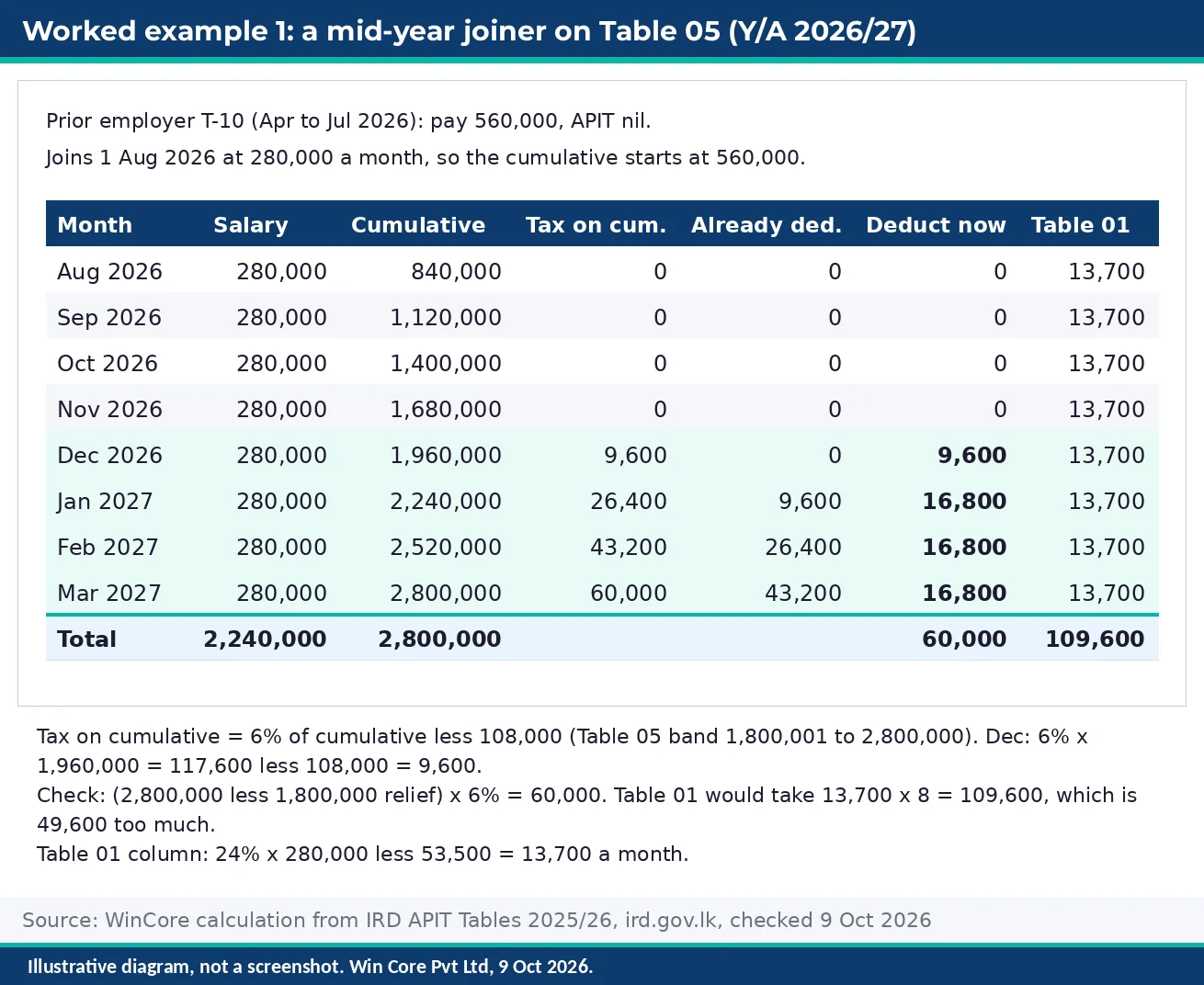
An engineer earned Rs 140,000 a month with a first employer from April to July 2026. That employer's T-10 shows pay of Rs 560,000 and APIT of nil, which is correct because Rs 560,000 is below Rs 1.8 million. The engineer joins you on 1 August 2026 at Rs 280,000 a month.
| Month | Cumulative pay (Rs) | Table 05 tax on cumulative (Rs) | Already deducted (Rs) | Deduct this month (Rs) |
|---|---|---|---|---|
| Aug 2026 | 560,000 + 280,000 = 840,000 | 0 | 0 | 0 |
| Sep 2026 | 1,120,000 | 0 | 0 | 0 |
| Oct 2026 | 1,400,000 | 0 | 0 | 0 |
| Nov 2026 | 1,680,000 | 0 | 0 | 0 |
| Dec 2026 | 1,960,000 | 6% × 1,960,000 = 117,600 less 108,000 = 9,600 | 0 | 9,600 |
| Jan 2027 | 2,240,000 | 134,400 less 108,000 = 26,400 | 9,600 | 16,800 |
| Feb 2027 | 2,520,000 | 151,200 less 108,000 = 43,200 | 26,400 | 16,800 |
| Mar 2027 | 2,800,000 | 168,000 less 108,000 = 60,000 | 43,200 | 16,800 |
| Total | 60,000 |
Check against the annual liability. (2,800,000 less 1,800,000) × 6% = Rs 60,000. The deductions match the year's tax exactly.
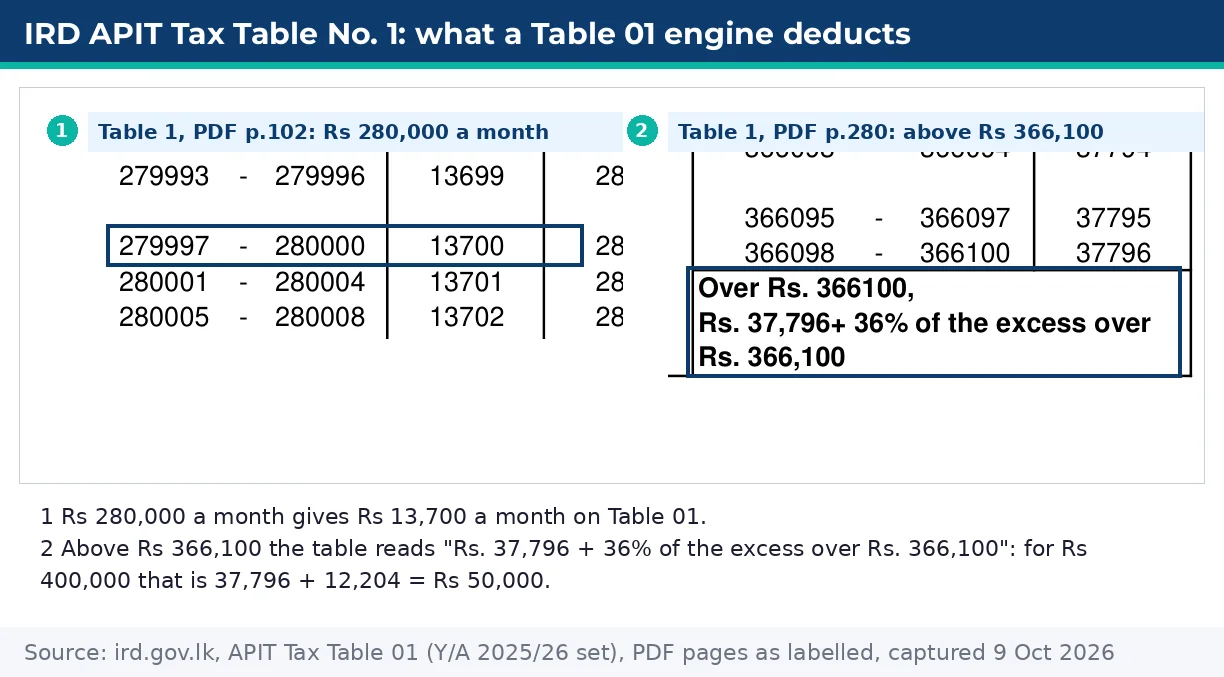
What Table 01 would have done. Rs 280,000 falls in the 24% band, so the deduction is 24% × 280,000 less 53,500 = Rs 13,700 a month. Over eight months that is Rs 109,600, which is Rs 49,600 too much.
What goes wrong. Some software drops back to Table 01 in month two, once the employee is no longer "new". Check the flag stays on until 31 March.
How long it takes. Once set up, it runs with normal payroll.
Instrument: Table 05 text paras 03, 05 and the Table 05 lookup. Last verified: 9 October 2026.
Step 5: Handle a leaver, and issue their T-10
What to do. For an employee whose retirement date is known, run Table 05 from April. For any leaver, issue the T-10 for the part of the year within 30 days of the last day (s.87(4)(b)).
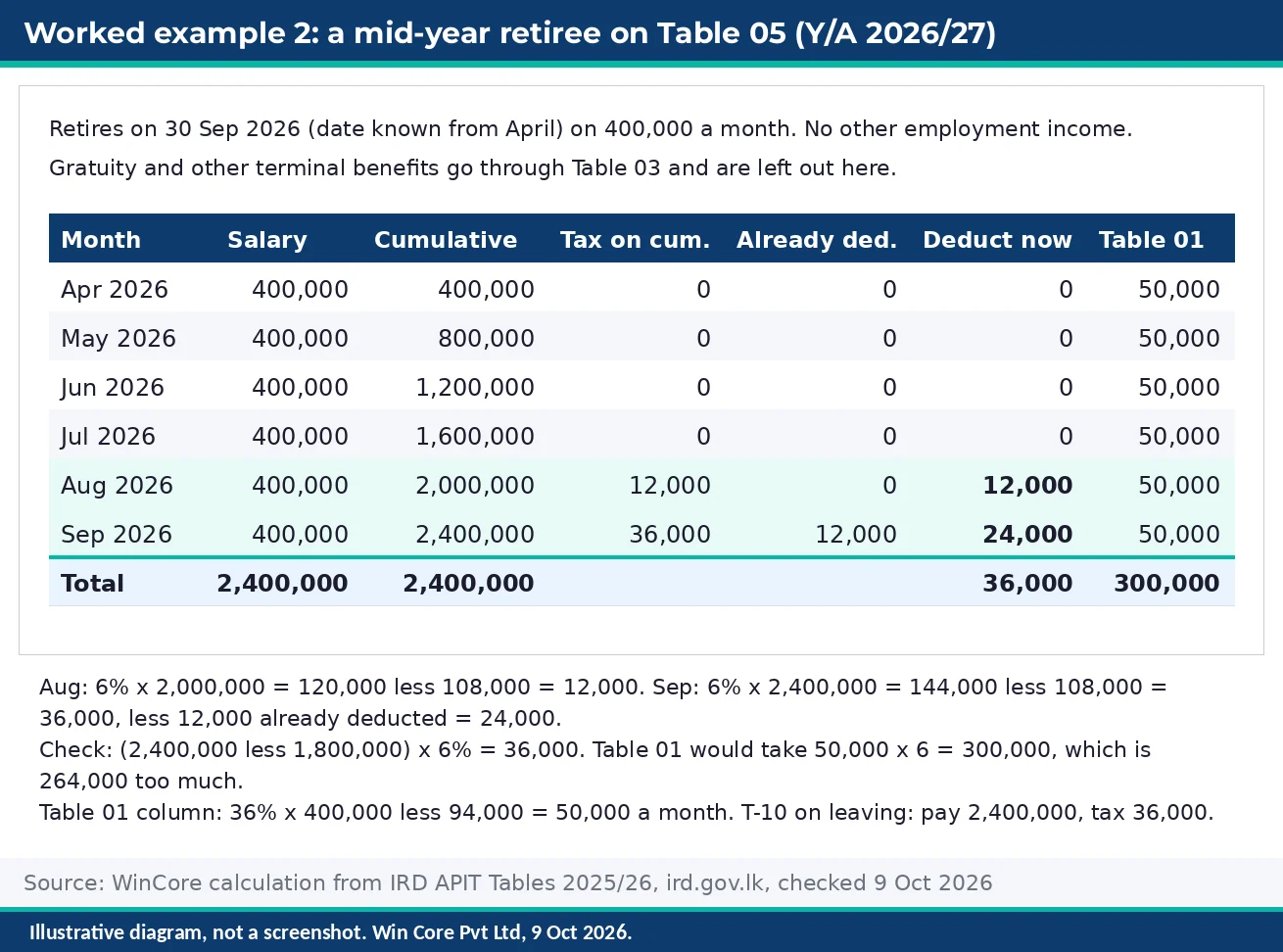
Worked example 2: a known mid-year retirement
An employee on Rs 400,000 a month retires on 30 September 2026, a date known in April. They have no other employment income this year. Gratuity and other terminal benefits go through Table 03 and are not part of this calculation.
| Month | Cumulative pay (Rs) | Table 05 tax on cumulative (Rs) | Already deducted (Rs) | Deduct this month (Rs) |
|---|---|---|---|---|
| Apr to Jul 2026 | 400,000 rising to 1,600,000 | 0 | 0 | 0 each month |
| Aug 2026 | 2,000,000 | 6% × 2,000,000 = 120,000 less 108,000 = 12,000 | 0 | 12,000 |
| Sep 2026 | 2,400,000 | 144,000 less 108,000 = 36,000 | 12,000 | 24,000 |
| Total | 36,000 |
Check. (2,400,000 less 1,800,000) × 6% = Rs 36,000. The T-10 you issue shows gross pay of Rs 2,400,000 and tax of Rs 36,000. A new employer starts from those figures.
What Table 01 would have done. Rs 400,000 is in the 36% band: 36% × 400,000 less 94,000 = Rs 50,000 a month, or Rs 300,000 for six months. That is Rs 264,000 more than the year's liability.
What goes wrong. The awkward case is the unplanned leaver. Suppose the same employee resigned, and you learnt this in August after running Table 01 from April to July. You have deducted 4 × 50,000 = Rs 200,000. Table 05 tax on cumulative pay of Rs 2,400,000 at the end of September is Rs 36,000, so you deduct nothing in August or September, and Rs 164,000 has still been over-deducted. The tables do not say whether to refund it through payroll, and we found no IRD guidance. The cautious route is to leave it on the T-10 for the employee to claim in a return. For years from 1 April 2024, s.150(4) (inserted by Act No. 2 of 2025) generally allows a refund application within 30 months of the end of the year of assessment where a return is required. The guideline circular also invites employers to email practical questions the tables do not cover to tpl@ird.gov.lk "where they will receive written instructions". Get that written instruction before refunding through payroll.
How long it takes. The T-10 takes minutes. The 30-day deadline is the part that slips.
Instrument: Inland Revenue Act No. 24 of 2017 s.87(4)(b); s.150(4) inserted by Act No. 2 of 2025. Last verified: 9 October 2026.
Step 6: Remit by the 15th and keep the trail
What to do. Pay the APIT deducted each month to the Commissioner-General "on or before the 15th day of the month immediately succeeding that month", as the circular puts it. The Act says "within fifteen days after the end of each calendar month" (s.86(1)). Keep a cumulative schedule per Table 05 employee, with the columns used in the examples.
Where. The circular describes payment at Bank of Ceylon branches on IRD remittance forms; online payment happens behind your IRD login.
What you need. The month's APIT total and the employer TIN.
What goes wrong. An agent who fails to withhold must still pay the tax "in the same manner and at the same time" (s.86(3)). The employer can recover it from the employee (s.86(6)), which is hard a year later.
How long it takes. It is part of the normal monthly close.
Instrument: Inland Revenue Act No. 24 of 2017 s.86(1), (3), (6); Circular SEC/2025/E/01 para 10. Last verified: 9 October 2026.
Step 7: Close the year: March check, annual statement and T-10s
What to do. In March, recompute the full year for every Table 05 employee. Table 05 paragraph 04 allows adjustments in March where an under-deduction or over-deduction is found. By 30 April, file the employer's annual statement, which the Act requires "within thirty days after the end of each year ending on the thirty first day of March" (s.86(2)), and serve a T-10 on every employee still employed.
Where. The IRD PAYE page has the statement schedules and T-10 format. Act No. 11 of 2026 lets the Commissioner-General specify the statement's formats (new s.86(9)), with a penalty of up to Rs 200,000 a year of assessment if a warning is not complied with within 14 days (new s.178A). Not filing at all can be prosecuted (new s.185A).
What you need. The cumulative schedules from Step 6 and copies of the joiners' earlier T-10s.
What goes wrong. Your T-10 for a joiner shows only the pay you made and the tax you withheld (s.87(2)). In Example 1 that is Rs 2,240,000 and Rs 60,000. Keep the first employer's T-10 on file to show how you reached Rs 60,000. On the employee's side, the IRD notice on Act No. 11 of 2026 says an individual whose only income is employment income "fully subject to APIT" need not file a return (effective 01.04.2025).
How long it takes. For a small payroll, the March check takes about an hour (estimate).
Instrument: Act No. 24 of 2017 s.86(2), s.87(2); ss.86(9), 178A, 185A inserted by Act No. 11 of 2026; Notice SEC/PN/IT/2026/02 item 12. Last verified: 9 October 2026.
What this means for your payroll
Table 05 does not change what an employee owes for the year, only when you deduct it. Get it wrong and a joiner is over-deducted for months, or a retiree is left with a refund claim they did not need. Two related pieces are worth reading alongside this one: every employee on the annual statement now needs a TIN, as our TIN certificate guide explains, and a "consultant" who should have been on payroll brings APIT arrears with them, as covered in consultant or employee: the misclassification risk. Our salary calculator shows the Table 01 figure for comparison, and our payroll service runs this for employers who prefer not to.
FAQ
Does Table 05 apply to every new joiner?
The IRD text applies it where an employee "enters in to employment" during the year. That covers any joiner after 1 April in primary employment or a single job. A secondary employment goes on Table 07.
What if the new joiner had no job earlier in the year?
Then cumulative pay starts at nil. For example, someone joining on 1 June at Rs 240,000 a month reaches Rs 1,920,000 in January: tax 6% × 1,920,000 less 108,000 = Rs 7,200. In February they reach Rs 2,160,000: tax Rs 21,600, so Rs 14,400 is deducted, and the same again in March at Rs 2,400,000 (tax Rs 36,000). The total is Rs 36,000, against Rs 62,000 under Table 01 (6,200 × 10).
Is EPF deducted before APIT?
No. Table 01 paragraph 03 says tax is deducted "without deducting any sum" from employment income. Table 05 bands are likewise applied to cumulative gross employment income.
Can we refund over-deducted APIT through payroll?
The tables do not say. Ask the IRD in writing at tpl@ird.gov.lk, as Circular SEC/2025/E/01 invites. Until you have an answer, leave the over-deduction on the T-10 for the employee to claim.
Are there 2026/27 APIT tables?
Not on 9 October 2026. The index notice says the 2025/26 tables apply in later years unless other tables are specified.
Sources
IRD APIT Tables page and the Y/A 2025/26 Table 01, 02 and 05 texts, lookups and Index; IRD Circular SEC/2025/E/01; Inland Revenue Act No. 24 of 2017 and Amendment Acts No. 45 of 2022, No. 2 of 2025 and No. 11 of 2026; IRD Notice SEC/PN/IT/2026/02; IRD PAYE page and T-10 format. Links are given in each section. All sources accessed 9 October 2026.
The allowance belongs to the year, not the month, so deduct by the year.
If you would like us to check how your payroll treats joiners and leavers this year, you can book a consultation at our contact page.
WinCore Pvt Ltd
Put these insights to work
WinCore specialists can review your current workflow, document gaps, and build a practical 90-day action plan.
Book a free consultationContinue reading
Explore more WinCore analysis to keep your finance, tax, and compliance roadmap moving.
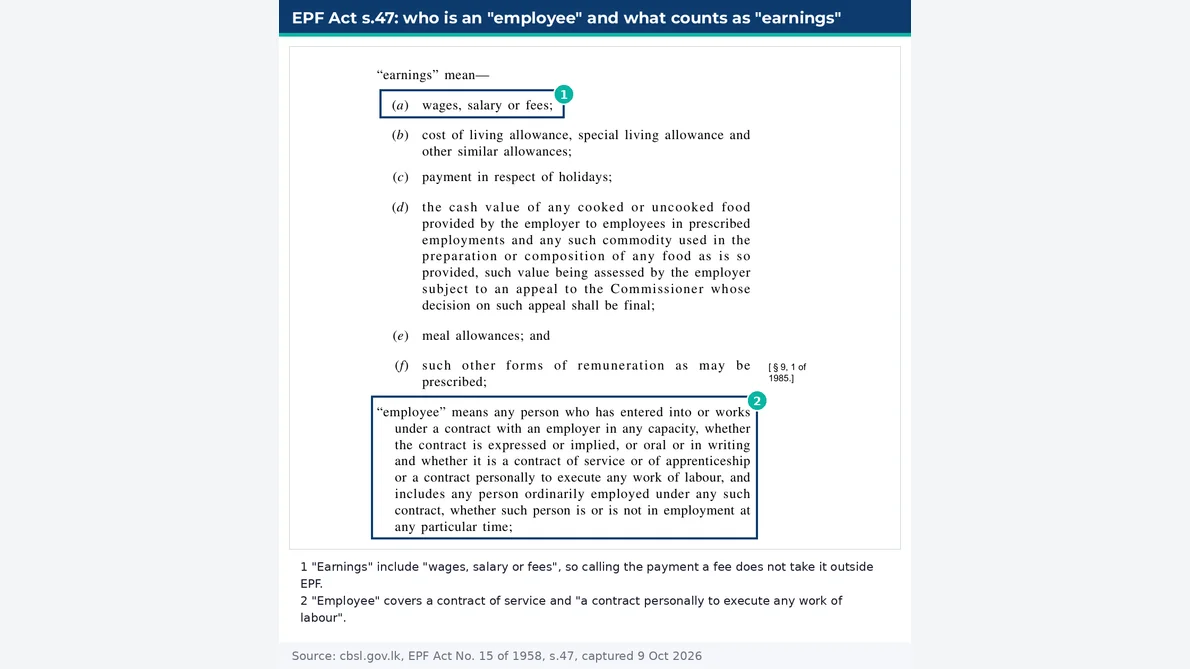
When a consultant is legally an employee in Sri Lanka: the tests under EPF, ETF, gratuity and tax law, and what misclassification costs.
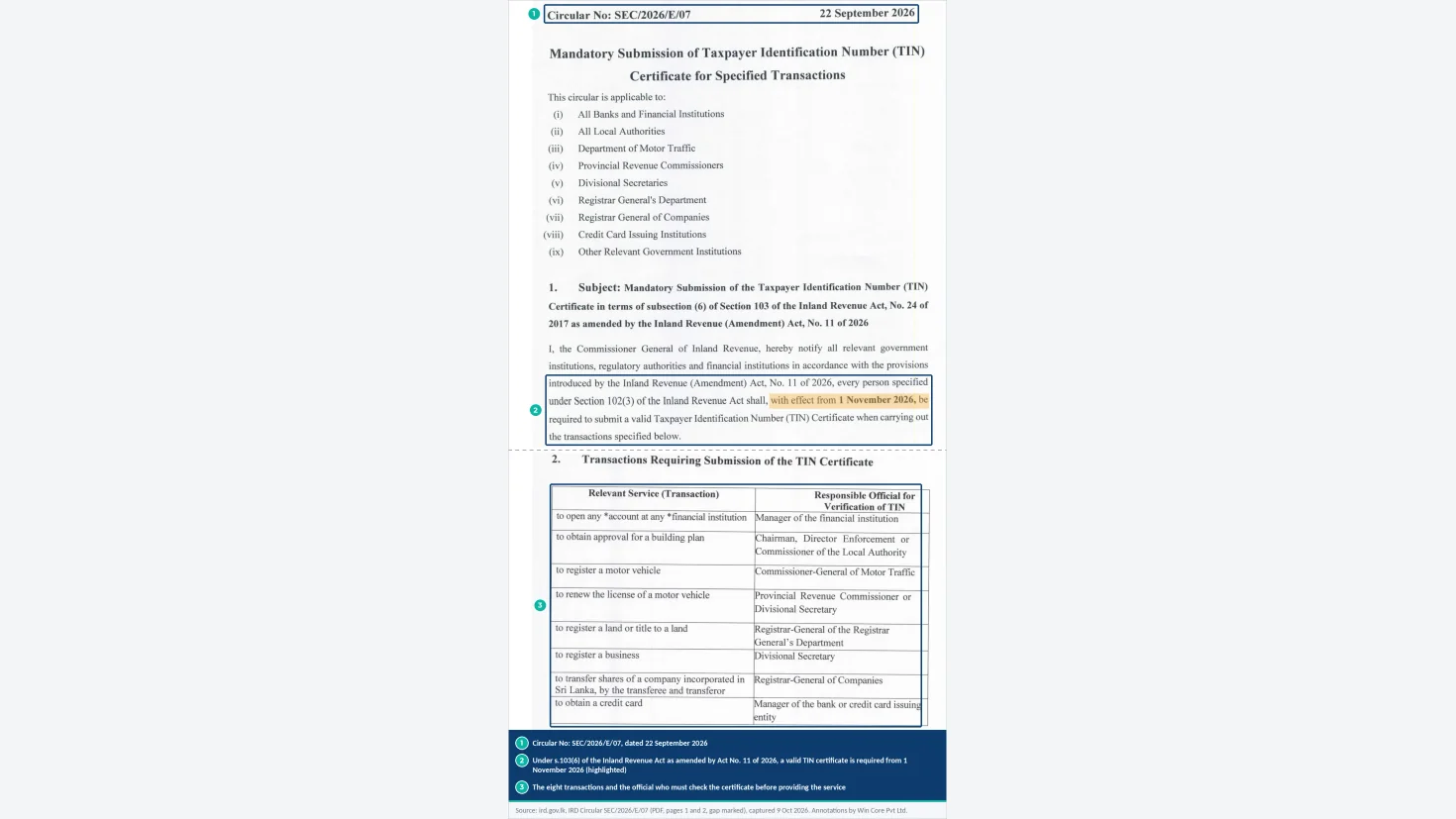
From 1 November 2026 individuals need a TIN certificate for eight transactions. Who needs one, how to get it, and TINs for companies and staff.
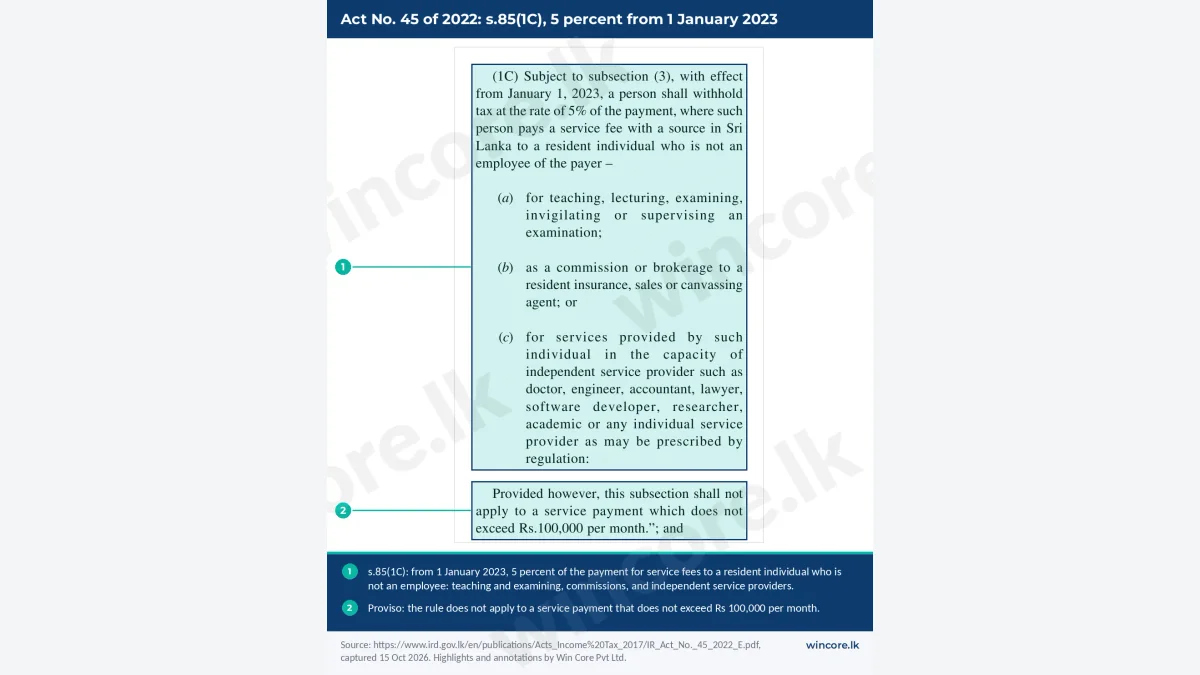
When a payer must withhold 5 percent on service fees, the services added in June 2026, payment within 15 days and the certificate rules.