
Budget 2027 Sri Lanka tax: proposals for companies and employers
A Budget speech proposes and does not change the law. What the 12 November 2026 proposals could mean for companies and employers, and when they apply.
On this page
Last verified against the primary sources on 26 October 2026.
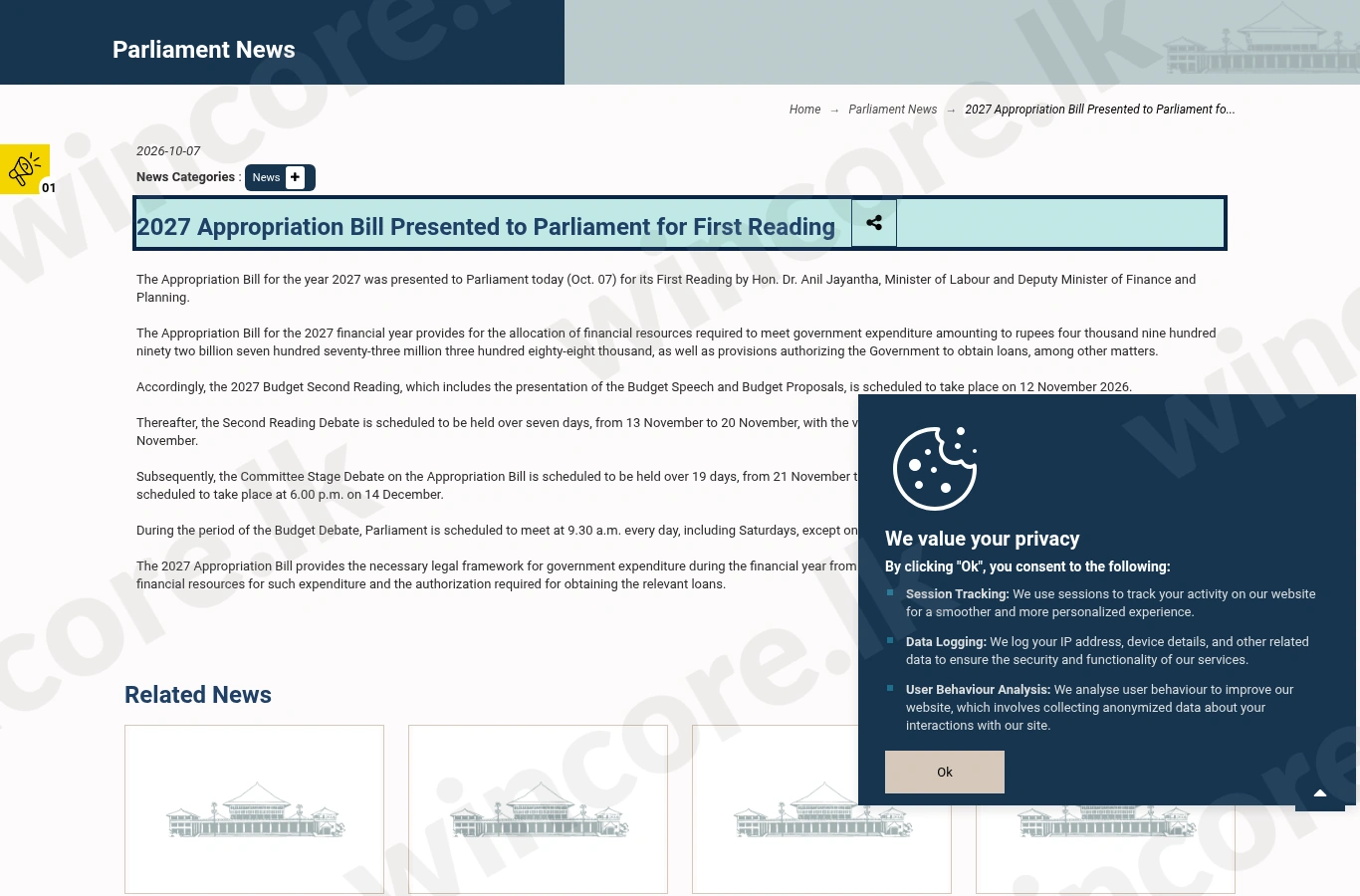
A Budget speech proposes; it does not change the law. The budget 2027 Sri Lanka tax proposals are due on 12 November 2026, when the Appropriation Bill for 2027 has its second reading, and a tax rate, threshold or exemption changes only when an amending Act is certified or, where an Act allows it, an order or notice is gazetted. Parliament's own notice says the second reading "includes the presentation of the Budget Speech and Budget Proposals" and "is scheduled to take place on 12 November 2026" [1]. This page sets out what is proposed for companies and employers, what each proposal needs before it becomes law, and what to do in the meantime. Everything below is a proposal until an Act or gazette says otherwise.
What a Budget speech is, and what it is not
The Budget speech is made on the second reading of the Appropriation Bill. That Bill, Parliament says, "provides the necessary legal framework for government expenditure during the financial year from 1 January to 31 December 2027" [1]. It authorises spending and borrowing. It does not, by itself, change a tax rate.
Tax proposals in the speech are statements of intent. A rate, threshold or exemption changes only when the law that sets it is amended. Until then, the current Acts apply, and a return or payment due before the change must follow them. If the amending Act later back-dates a change, as Act No. 11 of 2026 did for some sections, recheck any return or payment already made for the affected period.
Parliament's scheduled timetable, as published on 7 October 2026 and read again on 26 October 2026 [1]. It will be rechecked after the speech:
| Stage | Date |
|---|---|
| First reading of the Appropriation Bill | 7 October 2026 |
| Second reading: Budget speech and proposals | 12 November 2026 |
| Second reading debate | 13 to 20 November 2026, vote at 6.00 p.m. on 20 November |
| Committee stage debate | 21 November to 14 December 2026 |
| Third reading vote | 6.00 p.m. on 14 December 2026 |
On 24 October 2026 Parliament's Bills page listed the Appropriation Bill as "Pending for 2nd reading" [2].
How a tax proposal becomes law
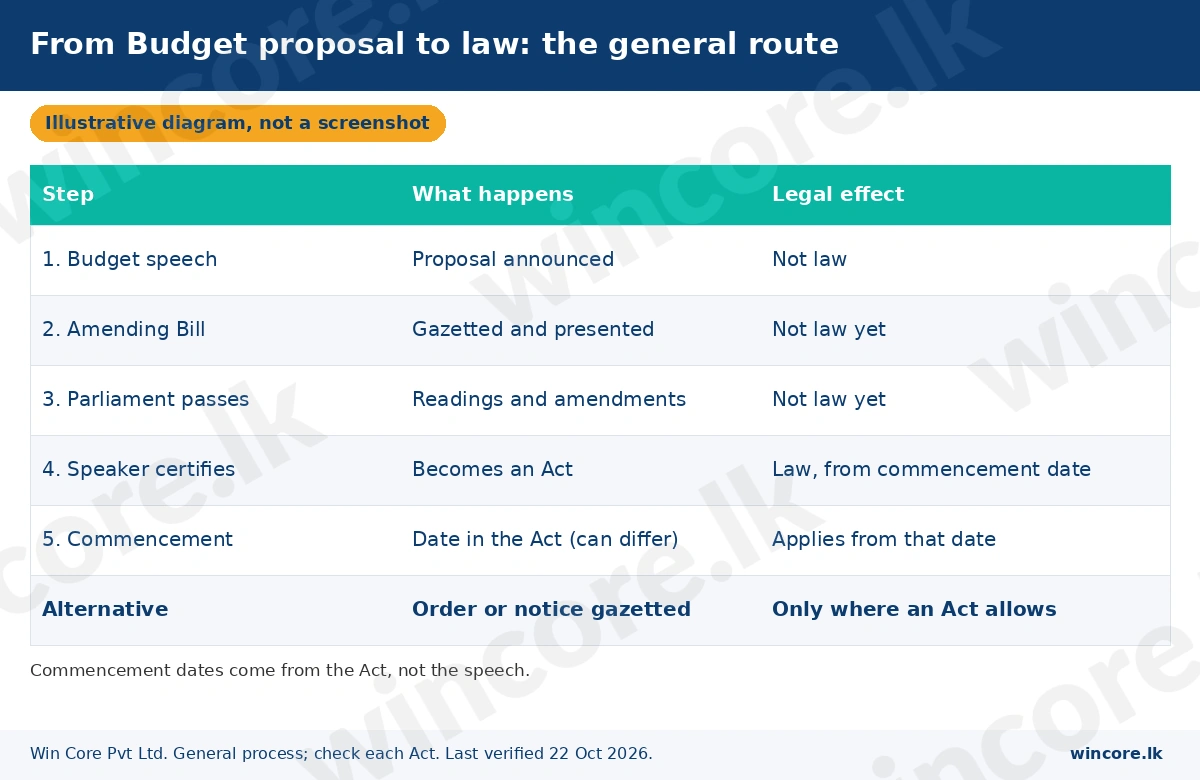
A Budget tax proposal usually needs its own amending Act, separate from the Appropriation Bill. The steps:
- A Bill is drafted and published. Usually, an amending Bill for the relevant Act (for example the Inland Revenue Act or the VAT Act) is gazetted and presented to Parliament.
- Parliament passes it. The Bill goes through its readings, with any amendments.
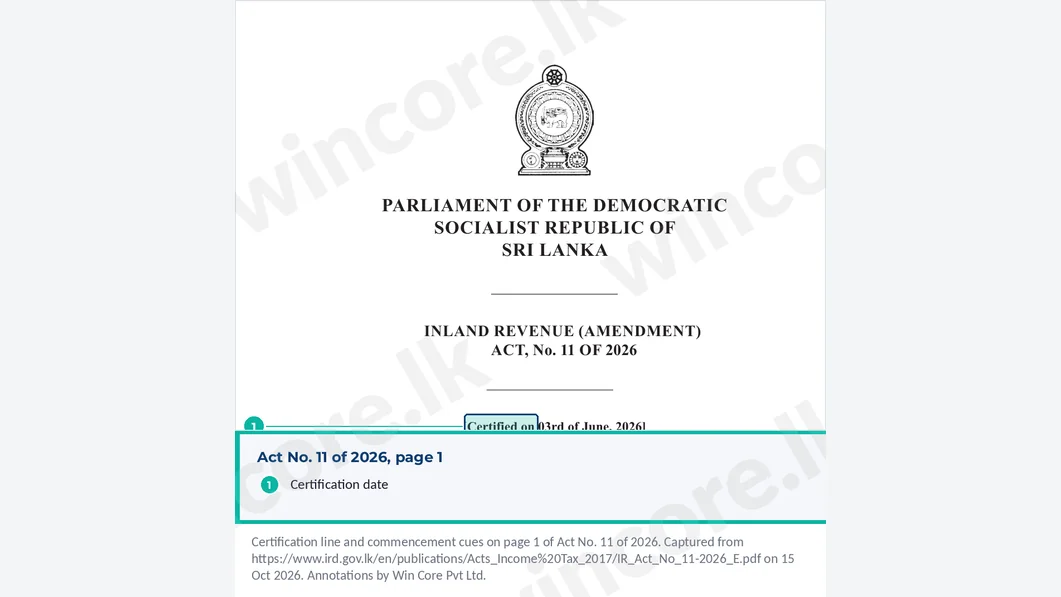
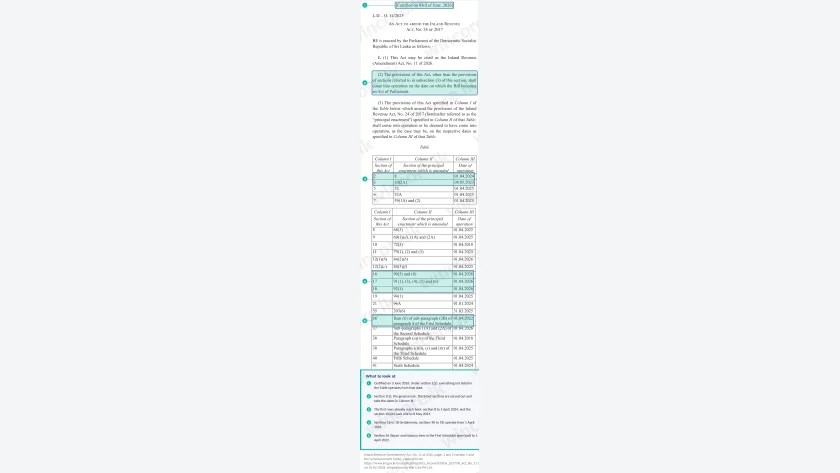
- The Speaker certifies it. It becomes an Act. Recent Acts show what that date means: Inland Revenue (Amendment) Act No. 11 of 2026, certified on 3 June 2026, says its main provisions "shall come into operation on the date on which the Bill becomes an Act of Parliament" [3].
- The effective date is in the Act. Not every provision starts on certification. Act No. 11 of 2026 s.1(3) has a table giving the provisions it lists their own dates, on which they "shall come into operation or be deemed to have come into operation"; every one of those dates is earlier than certification, from 01.04.2018 to 01.04.2026 [3]. Read the commencement section, not the speech.
- Some changes come by gazette. Where an Act lets the Minister or the Commissioner-General change a rate or list by order or notice, the change takes effect from the gazette or notice, on the terms the Act allows.
For the changes already in force this year, see our 2026 tax law changes round-up and our article on Act No. 11 of 2026.
Budget 2027 Sri Lanka tax: what to watch on 12 November, tax by tax
Each kind of proposal will be added to this table after the speech, marked Proposal until an amending Bill is published, Bill while it is before Parliament, and Act only once it is certified with its commencement date. Proposals are labelled as proposals until enacted. Until then the law in force applies, and the articles below explain it.
| Tax | Current law | What we will check in the speech |
|---|---|---|
| Company income tax | Our article on Inland Revenue (Amendment) Act No. 11 of 2026 | Rates, concessionary rates, allowances and deductions |
| Individual income tax and APIT | Our income tax bands article | Relief, bands or rates, and whether new APIT tables would be needed |
| VAT and SSCL | Our VAT Amendment Act No. 14 of 2026 article | Rates, registration, exemptions |
| Withholding tax, stamp duty and other levies | Our 2026 tax law changes round-up | Rates and the payments covered |
| Filing and administration | The IRD tax calendar for 2026 | Filing dates, penalties, interest, RAMIS and e-invoicing |
What to do now
If you are an employer:
- Keep running payroll on the current APIT tables until new tables are issued and take effect.
- Do not change employment contracts or benefit terms on the strength of a proposal.
If you are a company:
- Keep filing and paying on current law; returns and instalments due before any change follow the law in force.
- Note each proposal's status and check it again when the amending Bill is published and when it is certified.
What this means for you
- A Budget speech proposes; an amending Act or a gazette makes law.
- The date in the speech is a proposed start. The date that counts is in the Act's commencement section.
Checklist: documents needed
- The Budget speech text (official version)
- The list of proposals relevant to your company or payroll
- Current Acts and rates for each tax affected
- Any amending Bill once gazetted
- Certified Act and commencement section once passed
FAQ
Is a Budget proposal law?
No. A Budget speech sets out proposals. A tax rate, threshold or exemption changes only when an amending Act is certified or, where an Act allows it, when an order or notice is gazetted. Until then the current law applies, including to returns and payments due before any change takes effect.
When is the Budget 2027 speech?
Parliament scheduled the second reading of the 2027 Appropriation Bill, which includes the Budget speech and proposals, for 12 November 2026. The second reading debate runs from 13 to 20 November, the committee stage from 21 November to 14 December, and the third reading vote is at 6.00 p.m. on 14 December 2026.
Does a proposal take effect on the date announced?
Not necessarily. The date in the speech is a proposed start. The legal start is in the amending Act's commencement section, which can differ and can even apply some provisions from an earlier date. Check the certified Act before changing payroll, invoices or tax payments.
What should an employer do straight after the speech?
Keep using the current APIT tables, note any payroll proposals and their proposed start dates, and wait for the amending Act and any new tables. Plan for the change, but do not apply it until the law and the IRD's tables say it applies.
The short version
12 November brings proposals, not law. Track each one from proposal to Bill to Act, and act on the commencement date in the Act.
Talk to us. If you want help working out what the proposals mean for your company or payroll, see our income tax advisory services or book a consultation at our contact page.
WinCore Pvt Ltd
This article is general information on the law as at 26 October 2026 and is not advice on your specific position.
References
- Parliament of Sri Lanka. 2027 Appropriation Bill Presented to Parliament for First Reading (news, 7 October 2026). https://www.parliament.lk/en/home/parliament-news/view/5450 . Primary. Accessed 24 October 2026.
- Parliament of Sri Lanka. Bills: Appropriation (presented 2026-10-07; current stage "Pending for 2nd reading"). https://www.parliament.lk/en/business-of-parliament/bill-details/G6443 . Primary. Accessed 24 October 2026.
- Parliament of Sri Lanka. Inland Revenue (Amendment) Act, No. 11 of 2026 (certified 3 June 2026), s.1(2) and (3). https://www.ird.gov.lk/en/publications/Acts_Income%20Tax_2017/IR_Act_No_11-2026_E.pdf . Primary. Accessed 24 October 2026.
Put these insights to work
WinCore specialists can review your current workflow, document gaps, and build a practical 90-day action plan.
Book a free consultationContinue reading
Explore more WinCore analysis to keep your finance, tax, and compliance roadmap moving.
One dated register of the Acts, Gazettes and IRD circulars behind our Regulation Desk pieces, with the day each one actually started to bite.
Certified 3 June 2026, Act No. 11 carries nine start dates. Here is each change, the date it bites, the penalty attached and the 2 December write-off.

Sri Lanka income tax bands for 2026 explained with current rates, worked examples, and practical APIT planning for employees and employers.