
Inland Revenue Amendment Act No. 2 of 2025: rates, relief, refunds
In force from 1 April 2025, Act No. 2 cut tax on most salaries, ended two foreign income exemptions and set a 30-month refund limit reaching 2024/25.
On this page
Last verified against the primary sources on 21 October 2026.
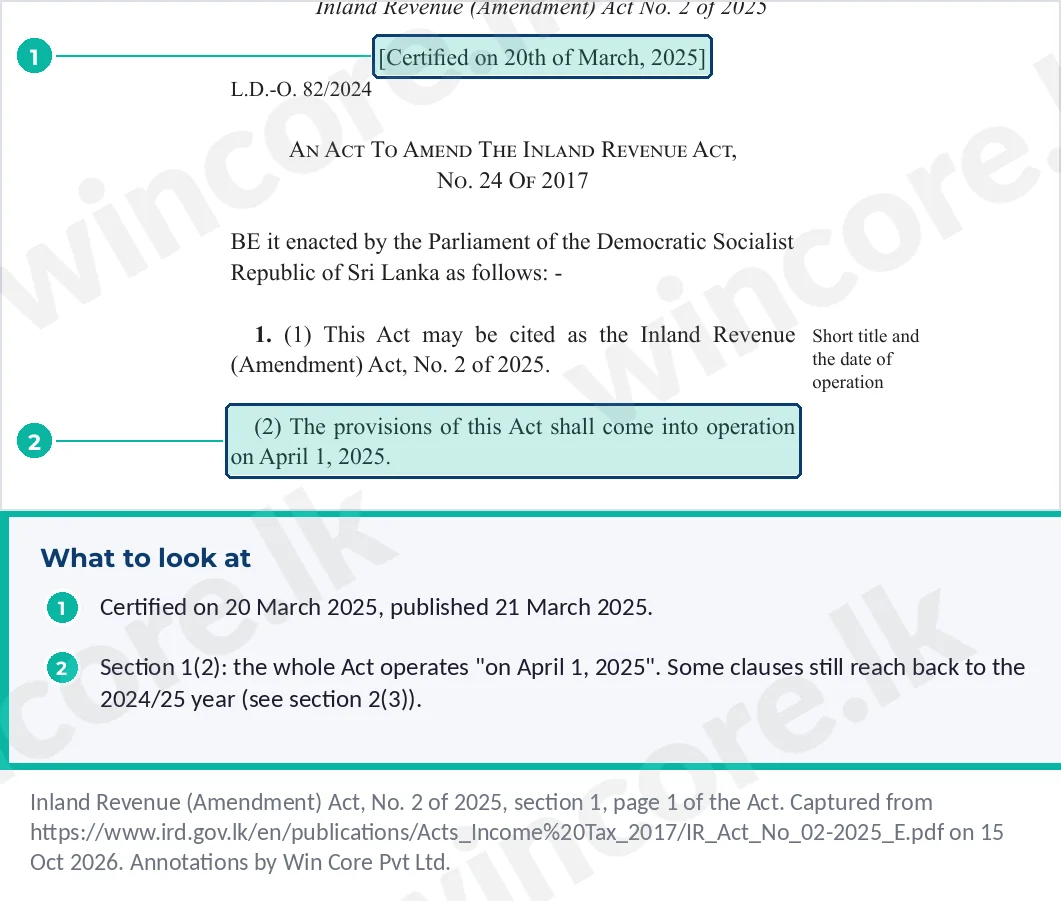
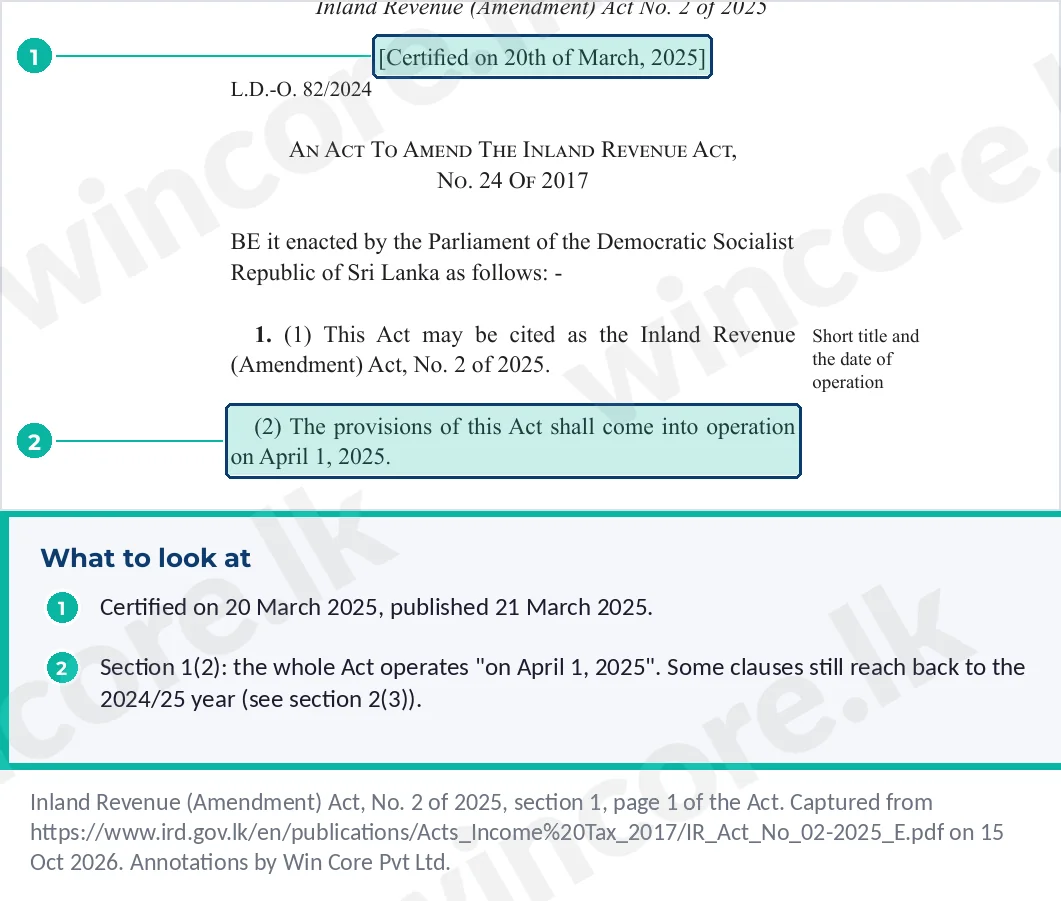
The Inland Revenue Amendment Act No. 2 of 2025 was certified on 20 March 2025 and came into operation on 1 April 2025. It raised personal relief to Rs 1,800,000, replaced the individual bands with 6, 18, 24, 30 and 36 percent, ended the exemption for foreign currency service and foreign-source income in favour of a 15 percent rate (a maximum for individuals), raised betting, gaming, liquor and tobacco to 45 percent and WHT on interest to 10 percent, and limited refund claims for years from 2024/25 to 30 months after the year ends [1].
Take a hypothetical salaried engineer on Rs 300,000 a month who also invoices a foreign client in dollars. Her tax for 2025/26 falls sharply, her dollar fees lose their exemption but are capped at 15 percent, and any refund for 2024/25 now has a deadline she may not know about.
Inland Revenue Amendment Act No. 2 of 2025 took effect on 1 April 2025
Act No. 2 of 2025 amends the Inland Revenue Act, No. 24 of 2017. It was certified on 20 March 2025 and published on 21 March 2025 [1]. Unlike Acts with no commencement clause, which become law on the Speaker's certificate under Article 80(1) of the Constitution [7], this one says in section 1(2): "The provisions of this Act shall come into operation on April 1, 2025" [1].
Lower tax on every salary above Rs 100,000 a month from 2025/26
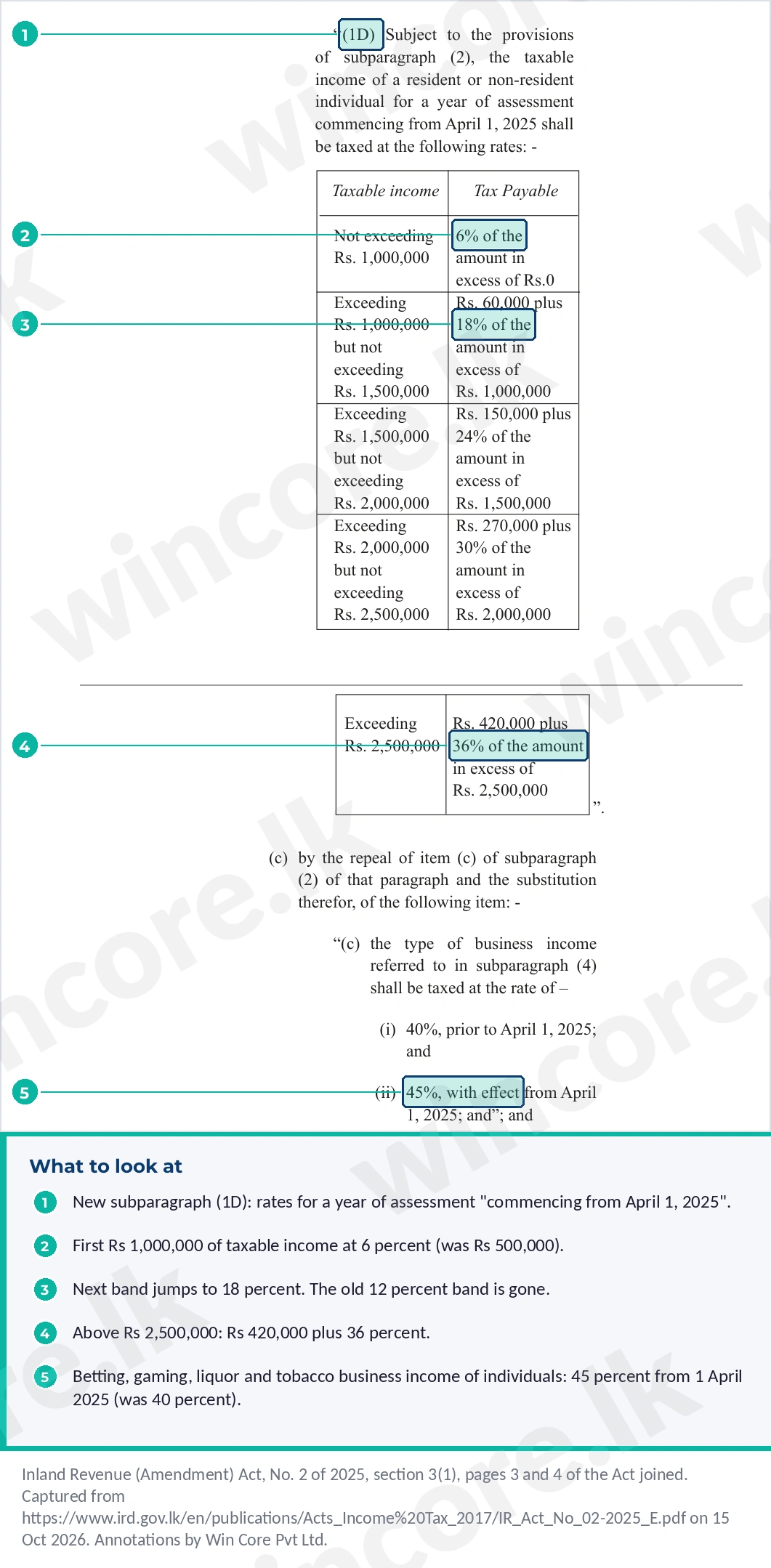
The individual rates. New subparagraph (1D) of paragraph 1 of the First Schedule taxes the taxable income of a resident or non-resident individual "for a year of assessment commencing from April 1, 2025" at 6 percent on the first Rs 1,000,000, 18 percent on the next Rs 500,000, then 24 and 30 percent on Rs 500,000 bands, and above Rs 2,500,000 at "Rs. 420,000 plus 36% of the amount in excess" [1]. The old (1C) table now applies only from 1 April 2023 "but prior to April 1, 2025" [1].
Two things changed at once. The 6 percent band doubled from Rs 500,000 to Rs 1,000,000, and the 12 percent band disappeared. So the step from 6 to 18 percent is now a single jump. Nobody pays more because of it. On our arithmetic, tax under (1D) is never higher than under (1C), and is lower on any taxable income above Rs 500,000: Rs 1,000,000 of taxable income bore Rs 90,000 before and bears Rs 60,000 now [1] [2].
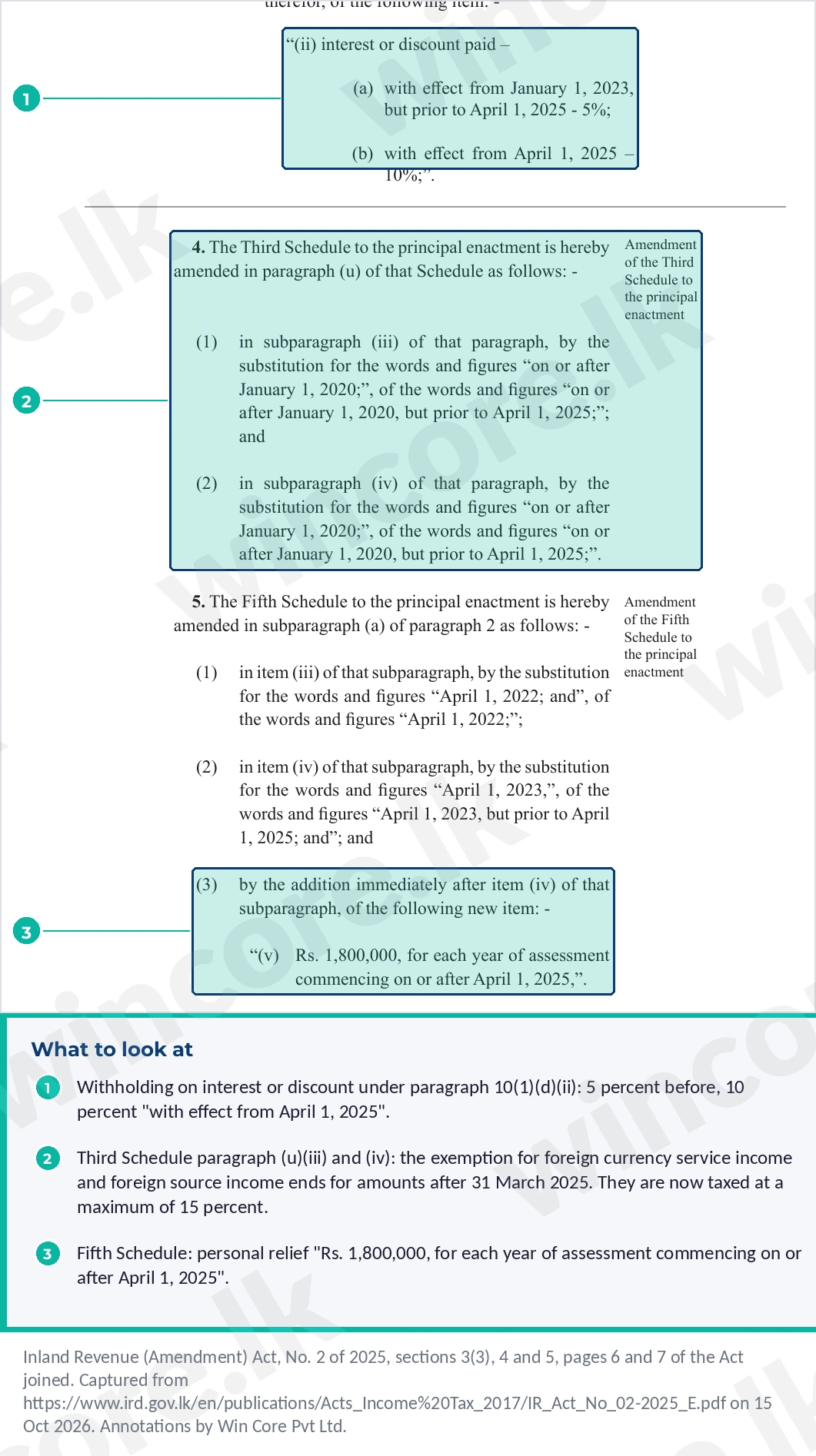
Personal relief of Rs 1.8 million. Section 5 adds item (v) to paragraph 2(a) of the Fifth Schedule: "Rs. 1,800,000, for each year of assessment commencing on or after April 1, 2025" [1]. The Rs 1,200,000 figure now runs only to 31 March 2025. The IRD's employer guideline restates this as Rs 150,000 a month, and says the relief is not available to non-resident non-citizens [3].
Put the two changes together and the effect on salaried staff is large. Below Rs 100,000 a month (Rs 1,200,000 a year) no tax was due in either year.
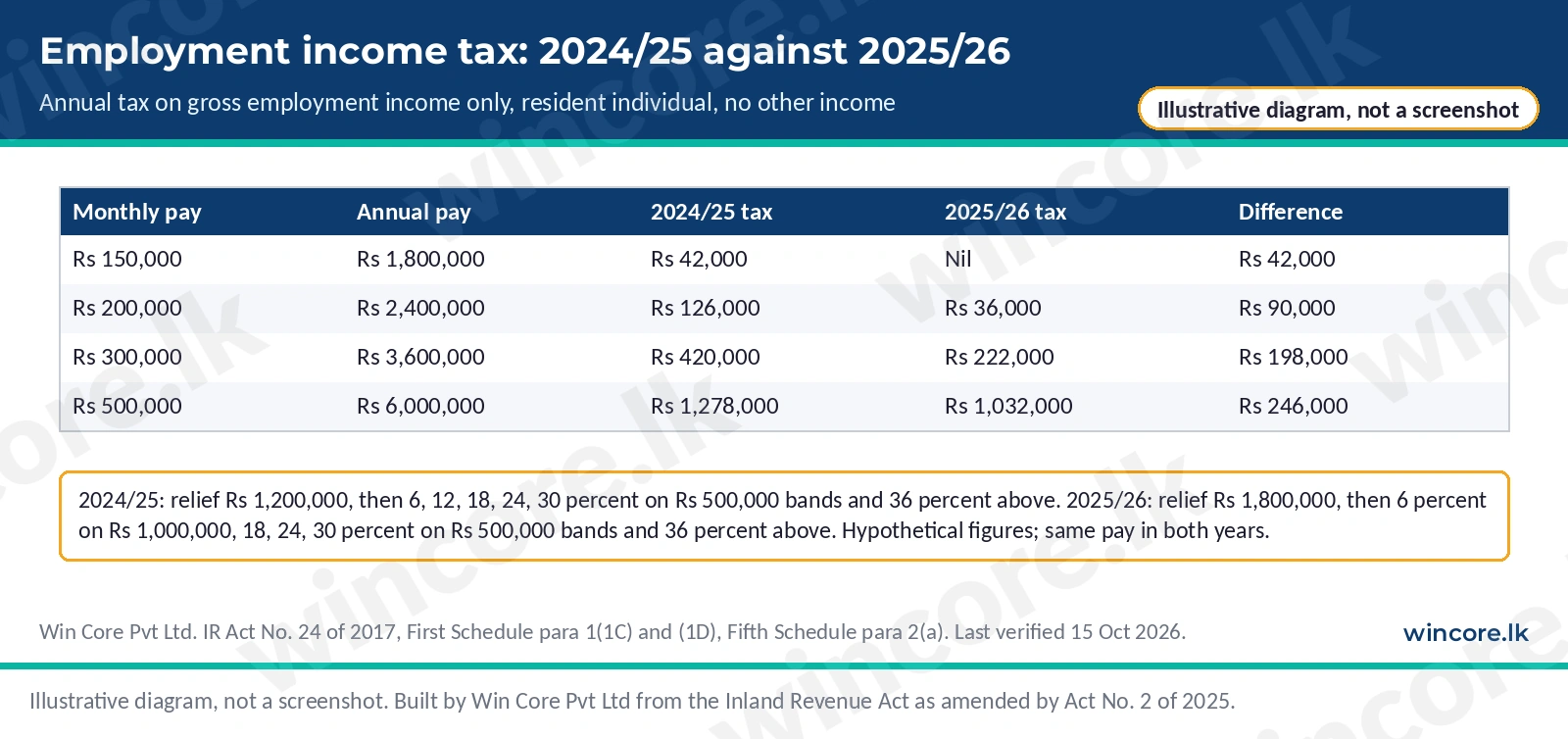
The monthly APIT tables follow the same arithmetic. Table 01 taxes Rs 300,000 a month at "24% of monthly regular profits from employment less Rs. 53,500", which is Rs 18,500 a month, or Rs 222,000 a year, the figure in Figure 3 [4]. Our salary calculator and APIT lookup apply the same tables, and our guide to income tax bands for 2026 works more examples. Act No. 11 of 2026 left the bands and relief unchanged for 2026/27; see our explainer on Act No. 11 of 2026.
Foreign currency income is no longer exempt, but is capped at 15 percent
Section 4 closes two exemptions in paragraph (u) of the Third Schedule. Service income from services "to be utilized outside Sri Lanka", paid in foreign currency and remitted through a bank, and foreign source income earned in foreign currency and remitted, were exempt "on or after January 1, 2020". Both are now exempt only "but prior to April 1, 2025" [1].
In their place, new paragraph 1(6) taxes the same gains and profits of an individual "at the maximum rate of 15% with effect from April 1, 2025" [1], and new paragraph 4(2C) taxes them in a company at 15 percent [1]. Our guide to foreign service export tax sets out the conditions and records, and the foreign service export tax calculator models the rate.
Does "maximum rate of 15%" mean a flat 15 percent? On our reading, no. For an individual it is a ceiling over the (1D) bands, so a person whose total taxable income stays in the 6 percent band pays 6 percent on this income too. The Act does not say how the ceiling applies when the income straddles bands, and we have found no IRD guidance that does. That is an open point. For an individual paid from abroad, see our guide to freelancer tax on foreign income.
Betting, gaming, liquor and tobacco move to 45 percent, and interest WHT to 10 percent
The 45 percent rate. Item (c) of paragraph 1(2) now taxes the business income in paragraph 1(4) at "40%, prior to April 1, 2025" and "45%, with effect from April 1, 2025" [1]. Paragraph 4(2C) sets 45 percent for companies on "gains and profits from conducting betting and gaming" and on "the manufacture and sale or import and sale of any liquor or tobacco product other than the export of such product" [1].
Withholding on interest. Paragraph 10(1)(d)(ii) of the First Schedule, the rate for interest or discount under section 84A(1A), now reads: "(a) with effect from January 1, 2023, but prior to April 1, 2025 - 5%; (b) with effect from April 1, 2025 - 10%" [1] [2].
The 30-month refund window reaches back to 2024/25
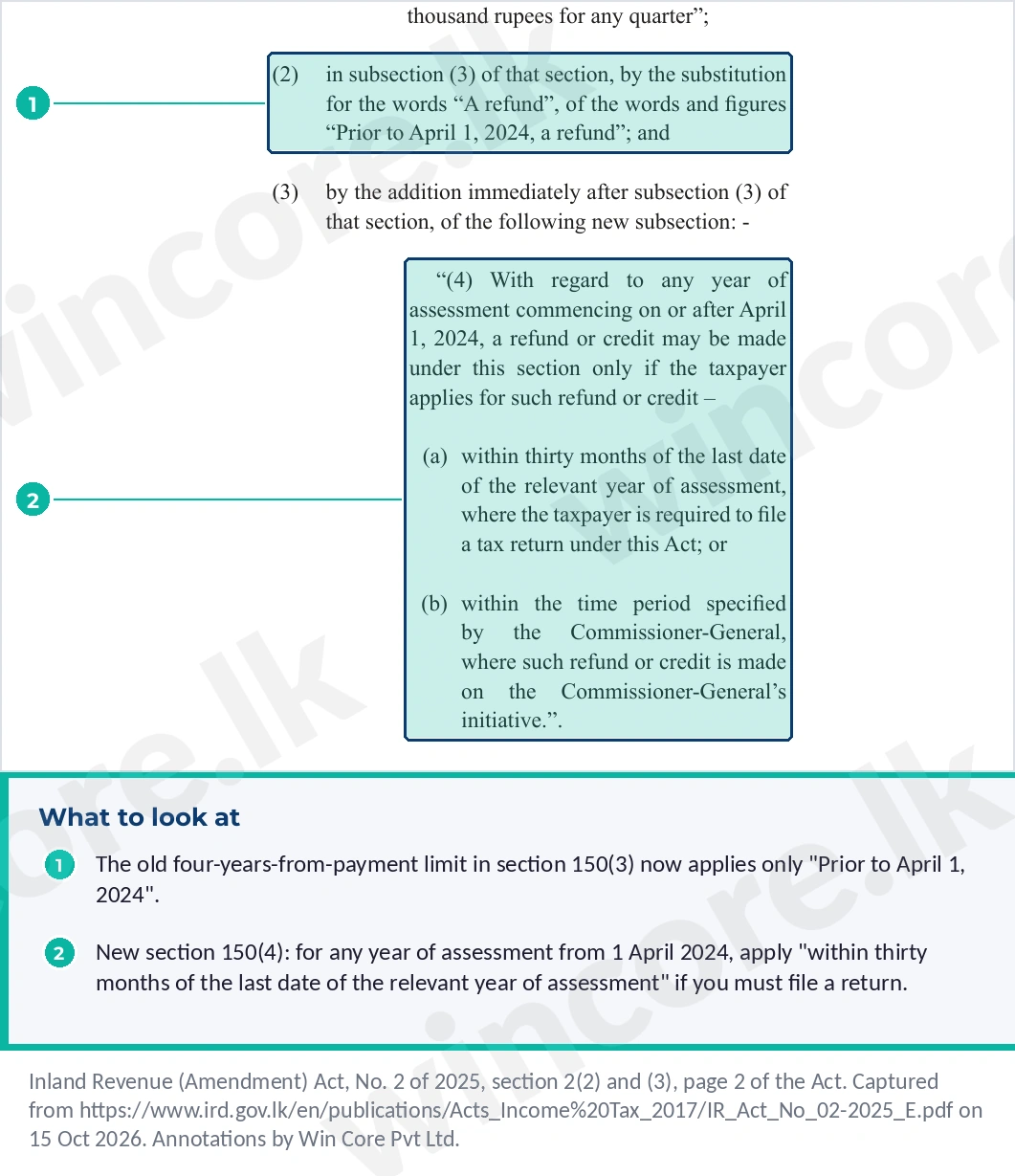
Section 150(3) used to let a taxpayer apply for a refund "within four years of the date of payment" [8]. Section 2(2) of the 2025 Act puts "Prior to April 1, 2024," in front of it. New section 150(4) says that for "any year of assessment commencing on or after April 1, 2024", a refund or credit may be made "only if the taxpayer applies for such refund or credit (a) within thirty months of the last date of the relevant year of assessment, where the taxpayer is required to file a tax return under this Act" [1].
Paragraph (b) covers refunds the Commissioner-General makes on his own initiative, within the time he specifies [1]. On our reading, an employee with only employment income, who is not required to file, is outside paragraph (a), and paragraph (b) reaches that employee only where the refund is made on the Commissioner-General's initiative. The Act does not say what limit applies to such an employee's own claim.
This is the change that reaches back. The Act operates from 1 April 2025, but it applies the 30 month rule to 2024/25, a year that ended on 31 March 2025. For 2024/25 the deadline is 30 September 2027. For 2025/26 it is 30 September 2028.
The same section raises the fast-track refund ceiling in section 150(2A)(a). A resident individual's claim "not exceeding one hundred and eighty thousand rupees for a year of assessment commencing on or after April 1, 2025" must be paid within three months, before any audit. The proviso to that paragraph, which the IRD consolidation applies to senior citizens who are not instalment payers, now reads Rs 180,000 for a year "or forty five thousand rupees for any quarter" from 1 April 2025 [1] [2].
The same substitution lowers the ceiling for earlier years. The words replaced were "not exceeding one hundred thousand rupees"; for a year of assessment "prior to April 1, 2025" the ceiling now reads sixty thousand rupees, and the proviso reads sixty thousand rupees a year or fifteen thousand a quarter [1]. On the text, a claim between Rs 60,000 and Rs 100,000 for 2024/25 no longer qualifies for the three month fast track.
A wording point. The amended section 150(3) now begins "Prior to April 1, 2024, a refund or credit may be made ... within four years of the date of payment" [2]. Prior to what, exactly? Read literally, the date qualifies when the refund is made, not the year it relates to, which would make the subsection spent. Read with (4), it plainly means years of assessment before 2024/25. On our reading the second is right, because it is the only one that gives (3) any work to do.
The Act creates no new penalty; the existing sections apply
The Act creates no new offence or penalty. The defaults that follow from it are governed by the existing sections [2]:
| Default | Section | Consequence |
|---|---|---|
| Employer under-deducts APIT under the new tables | s.86(3), (4) | Employer must pay the tax not withheld; the employee is jointly and severally liable |
| APIT or WHT on interest withheld but paid late | s.86(1), s.179(1) | Due within fifteen days after the month; penalty of 20 percent of the tax due but not paid if it is still unpaid fourteen days after that date, plus interest at 1.5 percent a month or part month from the due date (ss.157, 159); no later Act has changed s.179 |
| Refund claim made after 30 months | s.150(4) | No refund or credit may be made |
Sources: [1] [2] [9]. Our penalty calculator applies the late payment rules to your own figures.
What this means for you
- Employers: check that payroll runs the 2025/26 tables on gross pay with nothing deducted first [4]. Our payroll services run APIT monthly; see also our APIT deduction guide.
- Freelancers and firms earning in foreign currency: the income has been taxable since 1 April 2025, at no more than 15 percent. Keep the bank remittance evidence. Our income tax services prepare and file the return.
- Anyone owed a refund for 2024/25: apply by 30 September 2027, and for 2025/26 by 30 September 2028. Our income tax return filing guide covers claiming the refund in RAMIS.
- Banks and finance companies: withholding on interest is 10 percent for payments from 1 April 2025. The IRD's tax chart for 2025/26 lists the rates side by side.
Checklist: documents needed
- Payroll records showing APIT run on the 2025/26 tables from April 2025
- Invoices, contracts and bank inward remittance advices for foreign currency service or foreign-source income
- WHT certificates for interest received from April 2025
- Your 2024/25 and 2025/26 returns, with the refund amount and the date each year ended
- Any refund application already lodged, with its date
Common misreadings
- "Foreign income is taxed at 15 percent flat." For an individual it is a maximum over the bands; for a company it is a flat 15 percent [1].
- "The four-year refund rule still applies to 2024/25." It does not; section 150(4) covers that year [1].
- "The 12 percent band still exists." Not from 2025/26 [1].
Open points we are keeping open
- How the 15 percent maximum interacts with the (1D) bands when foreign income straddles them.
- Whether the lower Rs 60,000 fast-track ceiling for years before 2025/26 applies to claims already lodged before 1 April 2025.
- What time limit applies to a refund claimed by an employee who is not required to file, since s.150(4)(a) covers only those required to file.
- Whether the 30 month rule for 2024/25, a year that closed before the Act operated, will be applied strictly. On the text it is.
- The IRD consolidation is labelled as incorporating amendments "up to 31st March 2025", and later Acts, including Act No. 11 of 2026, have amended other parts since [2]. Check the current text before relying on any provision not covered here.
FAQ
When did the Inland Revenue Amendment Act No. 2 of 2025 take effect?
It took effect on 1 April 2025, under section 1(2), after certification on 20 March 2025 [1]. The new rates and relief therefore apply from the 2025/26 year of assessment, while the 30-month refund limit also covers 2024/25, the year that ended on 31 March 2025.
What is the tax-free amount for employees from 2025/26?
Personal relief is Rs 1,800,000 a year, which the IRD's employer guideline restates as Rs 150,000 a month [1] [3]. Salary up to that amount bears no APIT. The relief is for residents and non-resident citizens; the IRD says it is not available to non-resident non-citizen employees.
Is income from foreign clients still tax exempt in Sri Lanka?
No, not for amounts after 31 March 2025. The Third Schedule exemption now ends "prior to April 1, 2025" [1]. Qualifying foreign currency service income remitted through a bank is now taxed at a maximum of 15 percent for individuals and at 15 percent for companies.
How long do I have to claim an income tax refund?
For years of assessment from 2024/25, a taxpayer required to file a return must apply within 30 months of the end of the year: by 30 September 2027 for 2024/25 and 30 September 2028 for 2025/26 [1]. Refunds the Commissioner-General makes on his own initiative follow the time he specifies.
Do the APIT tables reflect the new rates?
Yes. The 2025/26 APIT tables apply from 1 April 2025 and, in the Commissioner-General's words, continue "for every subsequent years of assessment unless other tables are specified" [6]. Table 01 at Rs 300,000 a month gives Rs 18,500 of APIT, matching the annual tax under the new bands [4].
Last verified: we re-read Act No. 2 of 2025 at source on 21 October 2026; the consolidation, the APIT circular and tables and the Constitution were checked on 15 October 2026.
This article is general information on the law as at 21 October 2026 and is not advice on your specific transaction.
Talk to us. If you would like us to check your 2025/26 tax, your foreign currency income or an outstanding refund, book a consultation at our contact page.
WinCore Pvt Ltd
References
- Parliament of Sri Lanka. Inland Revenue (Amendment) Act, No. 2 of 2025, ss.1 to 5. https://www.ird.gov.lk/en/publications/Acts_Income%20Tax_2017/IR_Act_No_02-2025_E.pdf . Primary. Accessed 21 October 2026.
- Inland Revenue Department. Consolidated Text of the Inland Revenue Act No. 24 of 2017 (incorporating amendments up to 31 March 2025), ss.86, 150 and 179 and First, Third and Fifth Schedules. https://www.ird.gov.lk/en/publications/Acts_Income%20Tax_2017/IRA_Cons_Act_-_2025_Changes.pdf . Primary. Accessed 15 October 2026.
- Inland Revenue Department. Guideline for Employers on Deducting APIT from Employment Income, Circular SEC/2025/E/01 (25 March 2025), para 5 (scanned; read by OCR). https://www.ird.gov.lk/en/publications/Circulars_Circulars/SEC_2025_E_01_E.pdf . Primary. Accessed 15 October 2026.
- Inland Revenue Department. APIT Tax Table No. 01, Y/A 2025/2026 (text), paras 03 and summarised table. https://www.ird.gov.lk/en/publications/APIT_Tax_Tables/2025-2026/Table%20-%201/02.%20APIT_2526_Table_01_Text.pdf . Primary. Accessed 15 October 2026.
- Inland Revenue Department. APIT Tax Table No. 05, Y/A 2025/2026 (text). https://www.ird.gov.lk/en/publications/APIT_Tax_Tables/2025-2026/Table%20-%205/06.%20APIT_2526_Table_05_Text.pdf . Primary. Accessed 15 October 2026.
- Commissioner General of Inland Revenue. APIT Tables, Index and publication notice (25 March 2025). https://www.ird.gov.lk/en/publications/APIT_Tax_Tables/2025-2026/Index/01.%20APIT_2526_Index.pdf . Primary. Accessed 15 October 2026.
- Parliament of Sri Lanka. The Constitution of the Democratic Socialist Republic of Sri Lanka (Revised Edition 2023), Article 80(1). https://www.parliament.lk/files/pdf/constitution.pdf . Primary. Accessed 15 October 2026.
- Parliament of Sri Lanka. Inland Revenue Act, No. 24 of 2017, s.150(3). https://www.ird.gov.lk/en/publications/Acts_Income%20Tax_2017/IR_Act_No_24_2017_E.pdf . Primary. Accessed 15 October 2026.
- Inland Revenue Department. Guide to the Return of Income Tax, Y/A 2025/26, Section 09 (penalty of 20 percent of the tax due but not paid; interest at 1.5 percent a month or part month). https://www.ird.gov.lk/en/Downloads/IT_Individuals_Doc/Asmt_IIT_004_2025_2026_E.pdf . Primary. Accessed 21 October 2026.
Put these insights to work
WinCore specialists can review your current workflow, document gaps, and build a practical 90-day action plan.
Book a free consultationContinue reading
Explore more WinCore analysis to keep your finance, tax, and compliance roadmap moving.

Sri Lanka income tax bands for 2026 explained with current rates, worked examples, and practical APIT planning for employees and employers.

Since 1 April 2025, profits from services used outside Sri Lanka and paid in foreign currency through a bank are taxed at 15%. The conditions and the records to keep.
Step-by-step guide to filing income tax returns in Sri Lanka: deadlines, RAMIS process, relief, bands, WHT credits, and common penalty traps.