
APIT deduction guide for Sri Lankan payroll teams
APIT deduction for Sri Lankan employers: the five bands, which IRD table applies to bonuses, joiners, second jobs and terminal pay, T-10s and annual statement.

On this page
Last verified against the primary sources on 15 October 2026.
APIT (Advance Personal Income Tax) is the income tax an employer withholds from employment income each month under section 83A of the Inland Revenue Act No. 24 of 2017 and pays to the Inland Revenue Department (IRD) "within fifteen days after the end of each calendar month", in practice by the 15th of the following month (s.86(1)) [1]. It is an advance payment, credited against the employee's income tax for the year. APIT took over from the old PAYE (Pay As You Earn) scheme, and deduction of APIT has been mandatory for employers since 1 January 2023 [2].
An employer that fails to deduct must still pay the tax as if it had been withheld (s.86(3)), and it may recover that tax from the employee (s.86(6)) [1]. Paying late adds a penalty of 20 percent of the tax due but not paid under section 179(1) if the tax is still unpaid fourteen days after the due date [1] [3], plus interest at 1.5 percent a month or part of a month under section 159(1) [1].
This guide covers the threshold and bands, what goes into monthly pay, which IRD tax table applies to which payment, worked examples, T-10 certificates and the annual statement. For registration, see the APIT registration guide; for year-end filing, the APIT return filing guide.
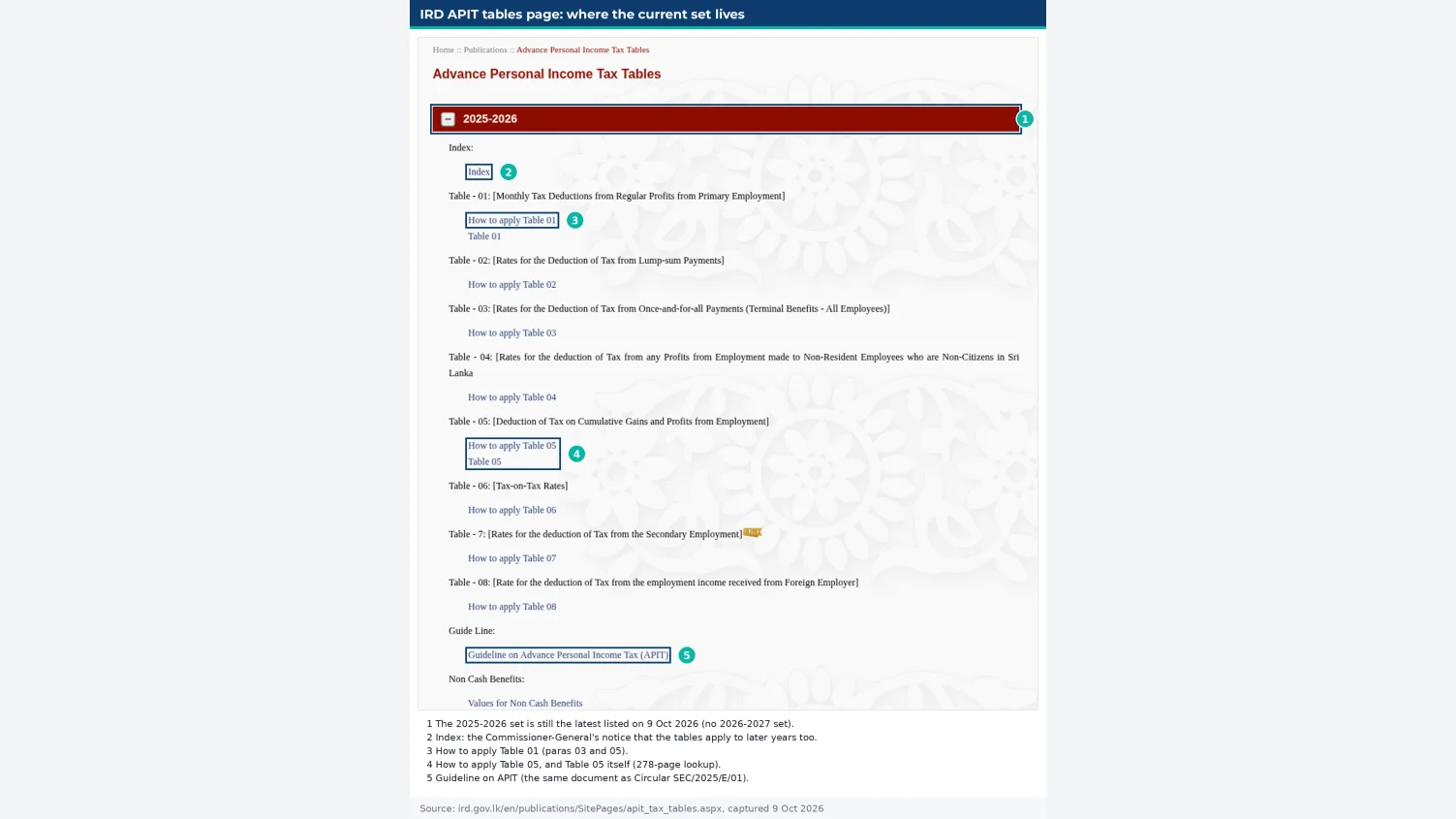
The IRD's tax tables are headed Y/A 2025/26, but the Commissioner-General's notice at the front of the set says they apply "for every subsequent years of assessment unless other tables are specified" [4]. Until the IRD issues new tables, they are the tables for Y/A 2026/27.
Two errors to watch for: using the bands from before April 2025, and taking the employee's 8 percent EPF off pay before applying the table. Table 01 says tax is deducted "without deducting any sum" from employment income [5].
APIT threshold: Rs 150,000 a month
The tax-free amount is Rs 150,000 a month, or Rs 1,800,000 a year, and it is built into Table 01 [5]. The threshold is not a cliff: only the pay above Rs 150,000 is taxed.
The current tables apply from 1 April 2025, under the Inland Revenue Act as amended by Act No. 2 of 2025 [6]. Earlier tables used Rs 100,000 a month (Rs 1,200,000 a year) and a 12 percent band. Do not use them for current payroll.
APIT tax bands
Monthly bands (Table 01)
- Up to Rs 150,000: nil
- Rs 150,001 to 233,333: 6%. Maximum tax in this band Rs 5,000
- Rs 233,334 to 275,000: 18%. Maximum tax in this band Rs 7,500
- Rs 275,001 to 316,667: 24%. Maximum tax in this band Rs 10,000
- Rs 316,668 to 358,333: 30%. Maximum tax in this band Rs 12,500
- Above Rs 358,333: 36%
Table 01 expresses the same thing as pay times rate less a constant: 6% less Rs 9,000 up to Rs 233,333; 18% less Rs 37,000 up to Rs 275,000; 24% less Rs 53,500 up to Rs 316,667; 30% less Rs 72,500 up to Rs 358,333; and 36% less Rs 94,000 above [5].
Annual bands
- Up to Rs 1,800,000: nil
- Rs 1,800,001 to 2,800,000: 6%
- Rs 2,800,001 to 3,300,000: 18%
- Rs 3,300,001 to 3,800,000: 24%
- Rs 3,800,001 to 4,300,000: 30%
- Above Rs 4,300,000: 36%
The cumulative Table 05 applies these annual bands as 6% less Rs 108,000 up to Rs 2,800,000, rising to 36% less Rs 1,128,000 above Rs 4,300,000 [7].
Which table applies to which payment
| Payment or employee | IRD table |
|---|---|
| Regular monthly pay, primary employment or a single job | Table 01 |
| Bonus, incentive, leave encashment, salary arrears | Table 02 |
| Gratuity, compensation for loss of employment, commuted pension, ETF payout | Table 03 |
| Joiner or retiree during the year, or monthly pay under Rs 150,000 with the year passing Rs 1,800,000 | Table 05 |
| Employee with more than one job, or without a primary employment declaration | Table 07 |
The circular that introduced the tables sets out the full list, including Table 04 for non-resident non-citizens, Table 06 where the employer bears the tax and Table 08 for foreign employers [6].
What counts as monthly employment income
Table 01 applies to regular employment income payable in a calendar month: wages, salary, commission, overtime, travelling and other allowances, fees and pension; housing, conveyance, electricity, telephone and entertainment costs the employer pays; the fair market value of non-cash benefits; and medical bills and insurance premiums, except dental, medical or health insurance reimbursed on equal terms to all full-time employees [5]. Only the exemptions in the Third Schedule of the Act apply [5].
Include in monthly pay (Table 01):
- Basic salary
- Cost of living allowance and recurring fixed allowances
- Transport, housing, mobile phone and food allowances
- Overtime (this differs from some EPF treatments)
- Sales commissions
- Directors' fees and meeting fees
- Benefits in kind, at their value
Keep out of the Table 01 figure:
- Reimbursements of actual business expenses supported by receipts
- The employer's own EPF (12 percent) and ETF (3 percent) contributions
- Bonuses and other lump sums, which go through Table 02 [8]
- Gratuity and other terminal benefits, which go through Table 03
The employee's own 8 percent EPF is a deduction from net pay and does not reduce the income on which APIT is calculated [5]. See the EPF and ETF guide for the contribution side.
How to calculate monthly APIT on Table 01
- Total the month's regular pay. Basic salary, allowances, overtime, commission and the value of non-cash benefits. Leave bonuses and terminal payments out.
- Check against Rs 150,000. At Rs 150,000 or less, APIT on regular pay is nil.
- Take the slice above Rs 150,000.
- Apply the band rates to the parts of the slice in each band, or use the rate-less-constant form above.
- Add the bands. Remit the month's total for all employees by the 15th of the following month [1].
The salary calculator is useful for checking a figure before finalising payroll.
Worked example 1. Rs 180,000 a month
- Monthly pay: Rs 180,000
- Above Rs 150,000, so APIT applies
- Slice: Rs 180,000 less Rs 150,000 = Rs 30,000, all in the 6% band (Rs 150,001 to 233,333)
- APIT: Rs 30,000 × 6% = Rs 1,800 (check: 6% × 180,000 less 9,000 = 1,800)
Net pay: Rs 180,000 less EPF (8%) Rs 14,400 less APIT Rs 1,800 = Rs 163,800.
Worked example 2. Rs 300,000 a month
- Monthly pay: Rs 300,000
- Slice above Rs 150,000: Rs 150,000
- First Rs 83,333 at 6% = Rs 5,000
- Next Rs 41,667 at 18% = Rs 7,500
- Next Rs 25,000 at 24% = Rs 6,000
- APIT: Rs 18,500 (check: 24% × 300,000 less 53,500 = 18,500)
Net pay: Rs 300,000 less EPF Rs 24,000 less APIT Rs 18,500 = Rs 257,500.
Worked example 3. A bonus month (Table 02)
A bonus is not added to the month's salary on Table 01. Table 02 annualises it (the EGAR method): add the regular pay already paid this year including this month (A), the regular pay still to be paid to March (B) and the lump sums for the year (C), tax that total on the annual bands, and take off the Table 01 tax on A and B and any tax already taken on earlier lump sums [8].
Take an employee on Rs 170,000 a month who receives a Rs 600,000 incentive in April. This is one of the IRD's own Table 02 examples [8].
- A (April pay): Rs 170,000. B (May to March): Rs 1,870,000. C (incentive): Rs 600,000. Total: Rs 2,640,000
- Tax on Rs 2,640,000: 6% × 2,640,000 less 108,000 = Rs 50,400
- Less Table 01 tax on A and B: Rs 1,200 × 12 = Rs 14,400
- APIT on the incentive: Rs 36,000, plus April's regular APIT of Rs 1,200
Had the incentive been added to April's pay on Table 01, the month's tax would have been 36% × 770,000 less 94,000 = Rs 183,200, about Rs 146,000 too much. Our guide to lump-sum and bonus tax under Table 02 works through further cases.
Overtime, commission and other variable pay
Overtime is regular employment income and goes into the Table 01 figure for the month it is paid [5].
Commission is also regular pay on Table 01, worked out month by month:
- Base Rs 100,000 + commission Rs 30,000 = Rs 130,000: nil
- Base Rs 100,000 + commission Rs 80,000 = Rs 180,000: Rs 1,800
- Base Rs 100,000 + commission Rs 150,000 = Rs 250,000: Rs 8,000 (18% × 250,000 less 37,000)
One exception: where monthly pay is usually under Rs 150,000 but cumulative pay for the year passes Rs 1,800,000 because some months paid more, Table 05 applies from the month the cumulative figure crosses Rs 1,800,000 [7].
Bonuses, incentives, leave encashment and salary arrears go through Table 02, as in example 3 [8].
Benefits in kind
Non-cash benefits go into monthly pay at their fair market value [5]. Common examples are a company vehicle, housing, meals, club memberships and subsidised loans.
Example: cash salary Rs 150,000, a company vehicle valued at Rs 20,000 a month and housing valued at Rs 30,000.
- Total monthly pay: Rs 200,000
- Slice above Rs 150,000: Rs 50,000
- APIT: Rs 50,000 × 6% = Rs 3,000
On cash salary alone, APIT would have been nil.
Second jobs: Table 07
A second employer does not start again from Rs 150,000. Where an employee has more than one employment, or has not given a primary employment declaration, the employer applies Table 07: one rate from Table 7.1 on the whole payment, chosen by the employee's declared income from the primary employment, from nil where combined monthly income is under Rs 150,000 up to 36 percent [9]. If the employee has not disclosed primary employment income, the secondary employer applies the highest rate, 36 percent [9]. Collect the declaration at onboarding.
Joiners and leavers during the year
An employee who joins or retires during the year is taxed on the cumulative Table 05, not Table 01, and a joiner who had an earlier job in the same year must give you that employer's T-10 so the earlier pay goes into the cumulative figure [7]. Our verified guide to APIT for mid-year joiners and leavers works through both cases step by step.
Final pay on termination
- Pay for days worked: regular pay, on Table 01, or on Table 05 for a retiree
- Leave encashment: a lump sum on Table 02 [8]
- Gratuity, compensation for loss of employment, commuted pension: once-and-for-all payments on Table 03. Where they total more than Rs 5,000,000, 12 percent of the excess is retained for payments under schemes the Commissioner-General has approved and 36 percent for unapproved schemes, unless the year's taxable pay plus these payments is within Rs 1,800,000 [10]
Give every leaver a T-10 for the part of the year within 30 days after employment ends (s.87(4)(b)) [1]. Do not wait for the year end.
The T-10 certificate
The T-10 is the certificate of income tax deductions the employer gives each employee. It shows the period of service, gross employment income and APIT deducted, and the employee relies on it to claim credit for the tax [1]. It is not the employer's annual statement.
- Employees still employed at the year end: serve the T-10 by 30 April, with the annual statement [1]
- Leavers: within 30 days after the employment ends [1]
- No charge: since Act No. 11 of 2026, the certificate must be given free of any charge or payment (new s.87(6)) [11]
Record on it the employer's name, address and TIN, the employee's name, NIC and TIN, the period, gross income and tax deducted. Keep proof of delivery.
Paying APIT each month
Only the payment is monthly. There is no monthly APIT return: the employee-level schedules are filed once a year with the annual statement [1] [12].
- January pay: APIT due by 15 February
- February pay: by 15 March
- March pay: by 15 April
- December pay: by 15 January
Pay online through IRD e-Services, or at a bank branch on the IRD's remittance forms as the APIT circular describes [6]. Keep every receipt and payment reference with the month's payroll file.
Monthly checks before you remit
- Apply this month's master changes: joiners, leavers and salary revisions
- Confirm each employee's table (01, 05 or 07) and the pay components
- Run any bonus or lump sum through Table 02 separately
- Review unusual APIT figures by grade or department
- Approve and release payroll before the 15th
The annual statement and its schedules
By 30 April, file the employer's annual statement for the year to 31 March: section 86(2) requires it "within thirty days after the end of each year ending on the thirty first day of March" [1]. E-filing of the APIT annual statement is mandatory for all employers [12].
The statement has three schedules [12]:
- Schedule 01: employees whose APIT was deducted on remuneration other than once-and-for-all payments. This includes bonuses. Each employee's TIN is mandatory
- Schedule 02: once-and-for-all payments (terminal benefits) only, such as gratuity and compensation for loss of employment. Leave encashment is not a terminal benefit for this purpose; it goes through Table 02 and Schedule 01
- Schedule 03: employees whose pay stayed below the threshold, with their TIN where they already have one
Include every employee. Under new s.178A, a withholding agent that does not follow the procedures, formats and forms the Commissioner-General specifies for the statement (new s.86(9)), and does not comply within 14 days of a warning notice, is liable to a penalty of up to Rs 200,000 a year of assessment [11]. Not filing the statement at all is an offence under new s.185A, with a fine of up to Rs 400,000, imprisonment of up to six months, or both [11]. See the APIT return filing guide for the filing steps.
Penalties for employers
Failure to deduct APIT
The employer must pay the tax that should have been withheld, in the same manner and at the same time as if it had been withheld (s.86(3)), and may recover it from the employee (s.86(6)) [1]. Recovery is easier in the next payroll than a year later.
Late payment
APIT still unpaid fourteen days after the due date attracts a penalty of 20 percent of the tax due but not paid under section 179(1) [1] [3], plus interest at 1.5 percent a month or part of a month under section 159(1) from the due date until it is paid [1]. A late income tax instalment carries 10 percent under section 179(2) instead [1].
Annual statement
Up to Rs 200,000 a year of assessment under new s.178A for not following the specified procedures, formats and forms, where a warning is not complied with within 14 days [11]. Not filing at all is an offence under new s.185A [11].
Employees below the threshold
No APIT is deducted on regular pay of Rs 150,000 or less a month, but the employee still goes into Schedule 03 of the annual statement [12]. Watch two things. If one month's regular pay crosses Rs 150,000, Table 01 gives tax for that month. And if cumulative pay for the year passes Rs 1,800,000, Table 05 takes over from that month [7].
APIT and the employee's annual tax
APIT is credited against the employee's income tax for the year. If it exceeds the tax, the employee can claim a refund; if it falls short, for example because of other income, the employee pays the balance. Since 1 April 2025 an individual whose only income is employment income fully subject to APIT does not need to file a return [13].
Common mistakes
- Adding a bonus to the month's salary on Table 01. Bonuses go through Table 02 [8].
- Running Table 01 for a mid-year joiner. Use Table 05 with the previous employer's T-10.
- Restarting from Rs 150,000 for a second job. Use Table 07.
- Deducting the employee's EPF before tax. Table 01 says "without deducting any sum".
- Adding the employer's EPF and ETF to the APIT base. They are not the employee's pay.
- Using the pre-April 2025 bands or the old Rs 100,000 threshold.
- Putting gratuity through Table 01 or Table 02. It is Table 03.
- Missing the 15th. Interest at 1.5 percent a month runs from the due date, so even one day late costs a full month; the 20 percent late payment penalty follows if the tax is still unpaid fourteen days after the due date [1] [3].
- Leaving Schedule 03 out of the annual statement.
Frequently asked questions
Did the APIT bands change for 2025/2026?
Yes. From 1 April 2025 the relief is Rs 150,000 a month and the bands are 6, 18, 24, 30 and 36 percent [6] [5]. The same tables apply for 2026/27 unless the IRD issues new ones [4].
What is the APIT threshold?
Rs 150,000 a month, Rs 1,800,000 a year [5].
Is overtime included?
Yes. Overtime is regular employment income on Table 01 [5].
What if an employee works for two employers?
The primary employer uses Table 01. The secondary employer uses Table 07, at a rate set by the declared primary income, or 36 percent without a declaration [9].
When must APIT be paid to the IRD?
Within fifteen days after the end of the month, so by the 15th of the following month [1].
Can over-deducted APIT be refunded through payroll?
Table 05 allows an adjustment in March where the year's tax was under or over deducted [7]. Beyond that, the tables do not say whether an employer may refund through payroll. The APIT circular invites employers to email practical questions to tpl@ird.gov.lk for written instructions [6]. Until you have one, leave the over-deduction on the T-10 for the employee to claim.
Must we file if every employee is below the threshold?
File the annual statement with those employees in Schedule 03 [12].
Are directors subject to APIT?
Yes. Directors' fees and salary are employment income, taxed on the same tables as other employees [5].
What happens if we fail to deduct APIT at all?
You must pay the tax yourself and may recover it from the employee (s.86(3) and (6)); late payment adds interest at 1.5 percent a month from the due date and, if the tax is still unpaid fourteen days after the due date, a penalty of 20 percent of the unpaid tax under section 179(1) [1] [3].
Talk to us. If you want a second pair of eyes on which table each employee and payment should use, our payroll team can go through it with you; book a consultation at our contact page.
This guide is general information on the law as at 15 October 2026 and is not advice on your specific situation.
References
- Inland Revenue Department. Inland Revenue Act, No. 24 of 2017, consolidated, ss.83A, 86(1) to (3) and (6), 87(4), 159(1) and 179. https://www.ird.gov.lk/en/publications/Acts_Income%20Tax_2017/IRA_Cons_Act_-_2025_Changes.pdf . Primary. Accessed 15 October 2026.
- Inland Revenue Department. Public notice PN/IT/2022-03 (15 December 2022), para 1, deduction of WHT, AIT and APIT mandatory from 1 January 2023. https://www.ird.gov.lk/en/Lists/Latest%20News%20%20Notices/Attachments/479/PN_IT_2022-03_15122022_E.pdf . Primary. Accessed 15 October 2026.
- Inland Revenue Department. Guide to the Return of Income Tax, Y/A 2025/26, Section 09, penalty of 20 percent of tax due but not paid, 10 percent on a late instalment, interest at 1.5 percent a month or part of a month. https://www.ird.gov.lk/en/Downloads/IT_Individuals_Doc/Asmt_IIT_004_2025_2026_E.pdf . Primary. Accessed 15 October 2026.
- Inland Revenue Department. APIT Tax Tables Y/A 2025/26, Index and Commissioner-General's notice. https://www.ird.gov.lk/en/publications/APIT_Tax_Tables/2025-2026/Index/01.%20APIT_2526_Index.pdf . Primary. Accessed 15 October 2026.
- Inland Revenue Department. APIT Tax Table 01, Y/A 2025/26, instructions, paras 01 to 03, 05 to 07. https://www.ird.gov.lk/en/publications/APIT_Tax_Tables/2025-2026/Table%20-%201/02.%20APIT_2526_Table_01_Text.pdf . Primary. Accessed 15 October 2026.
- Inland Revenue Department. Circular SEC/2025/E/01, Guideline for employers on deducting APIT (25 March 2025), list of Tables 01 to 08, payment and tpl@ird.gov.lk paras. https://www.ird.gov.lk/en/publications/Circulars_Circulars/SEC_2025_E_01_E.pdf . Primary. Accessed 15 October 2026.
- Inland Revenue Department. APIT Tax Table 05, Y/A 2025/26, instructions, paras 01 to 05 and summary bands. https://www.ird.gov.lk/en/publications/APIT_Tax_Tables/2025-2026/Table%20-%205/06.%20APIT_2526_Table_05_Text.pdf . Primary. Accessed 15 October 2026.
- Inland Revenue Department. APIT Tax Table 02, Y/A 2025/26, instructions and worked examples. https://www.ird.gov.lk/en/publications/APIT_Tax_Tables/2025-2026/Table%20-%202/03.%20APIT_2526_Table_02_Text.pdf . Primary. Accessed 15 October 2026.
- Inland Revenue Department. APIT Tax Table 07, Y/A 2025/26, instructions and Table 7.1. https://www.ird.gov.lk/en/publications/APIT_Tax_Tables/2025-2026/Table%20-%207/08.%20APIT_2526_Table_07_Text.pdf . Primary. Accessed 15 October 2026.
- Inland Revenue Department. APIT Tax Table 03, Y/A 2025/26, once-and-for-all payments. https://www.ird.gov.lk/en/publications/APIT_Tax_Tables/2025-2026/Table%20-%203/04.%20APIT_2526_Table_03_Text.pdf . Primary. Accessed 15 October 2026.
- Parliament of Sri Lanka. Inland Revenue (Amendment) Act, No. 11 of 2026, s.15 (new s.87(6)), new ss.86(9), 178A and 185A. https://www.ird.gov.lk/en/publications/Acts_Income%20Tax_2017/IR_Act_No_11-2026_E.pdf . Primary. Accessed 15 October 2026.
- Inland Revenue Department. Instructions to complete the APIT Annual Statement, Y/A 2025/2026, e-filing and Schedules 01 to 03. https://www.ird.gov.lk/en/Downloads/Other_PAYE_Doc/Asmt_APIT_Guide_2025_2026_E.pdf . Primary. Accessed 15 October 2026.
- Inland Revenue Department. Public notice SEC/PN/IT/2026/02 on Act No. 11 of 2026, item 12. https://www.ird.gov.lk/en/Lists/Latest%20News%20%20Notices/Attachments/794/SEC_PN_IT_2026-02_E.pdf . Primary. Accessed 15 October 2026.
Put these insights to work
WinCore specialists can review your current workflow, document gaps, and build a practical 90-day action plan.
Book a free consultationContinue reading
Explore more WinCore analysis to keep your finance, tax, and compliance roadmap moving.
Staff who join or leave mid-year need APIT Table 05, not Table 01. Why it matters, with worked examples and the T-10 annual return steps.

Bonuses and other lump sums are taxed on APIT Table 02, not added to the month's salary. How the method works, what goes on Table 03 instead, and worked examples.
How Sri Lankan employers file the APIT annual statement by 30 April: monthly payments by the 15th, Schedules 01, 02 and 03, employee TINs and T-10 certificates.