
APIT annual statement and T-10 filing guide in Sri Lanka
How Sri Lankan employers file the APIT annual statement by 30 April: monthly payments by the 15th, Schedules 01, 02 and 03, employee TINs and T-10 certificates.

On this page
Last verified against the primary sources on 15 October 2026.
A year-end APIT filing built on a copied template from three years ago tends to fail in the same places: terminal benefits and bonuses mixed in Schedule 02, staff below the threshold left out of Schedule 03, and employees with no TIN in Schedule 01. This guide maps what goes into each schedule of the Annual Statement of Employer for APIT (form Asmt_APIT_001), when it is due, how it differs from the T-10 certificate each employee receives, and how the monthly payment trail supports it.
Before filing for the first time, register the APIT tax type; see the APIT registration guide. For the monthly calculation, see the APIT deduction guide.
1) Two cycles: monthly payment, annual statement
- Monthly: pay the APIT deducted to the IRD "within fifteen days after the end of each calendar month" (s.86(1)), in practice by the 15th of the following month [1]. There is no monthly APIT return.
- Annual: file the employer's annual statement "within thirty days after the end of each year ending on the thirty first day of March" (s.86(2)), so by 30 April [1]. For Y/A 2025/26 it was due on 30 April 2026, and for Y/A 2026/27 it is due on 30 April 2027.
E-filing of the APIT annual statement is mandatory for all employers [2]. The schedules are where the employee-level detail goes, once a year.
2) What the annual statement contains
The IRD's instructions for Y/A 2025/2026 set out three schedules [2]:
- Schedule 01: "List of Employees whose APIT have been deducted (Remuneration other than Once-and-for-all Payments (Terminal Benefits)". Regular pay and bonuses go here, for primary or secondary employment. Each employee's TIN is mandatory.
- Schedule 02: "List of Employees whose Once-and-for-all Payments (Terminal Benefits) have been paid". Terminal benefits only, such as gratuity and compensation for loss of employment.
- Schedule 03: "List of Employees whose APIT have not been deducted due to being less than the threshold". Enter the TIN where the employee already has one.
A record in Schedule 01 without a TIN is rejected by RAMIS, and the employee does not get credit for the APIT deducted [3]. Our TIN certificate guide explains how to get TINs for staff who do not have one.
3) Build the statement from monthly records
Every line of the annual statement traces back to a monthly payroll pack. For each payroll month, keep:
- the final approved payroll register
- each employee's gross remuneration, the table used and the APIT calculation
- the payment reference
- reviewer sign-off
- where the supporting files are kept
Record each payment reference against its month on the day you pay. At year end you will match those references back to the months they cover. For what the March payroll must correct, see the APIT year end adjustment.
4) What feeds each schedule
Schedule 01
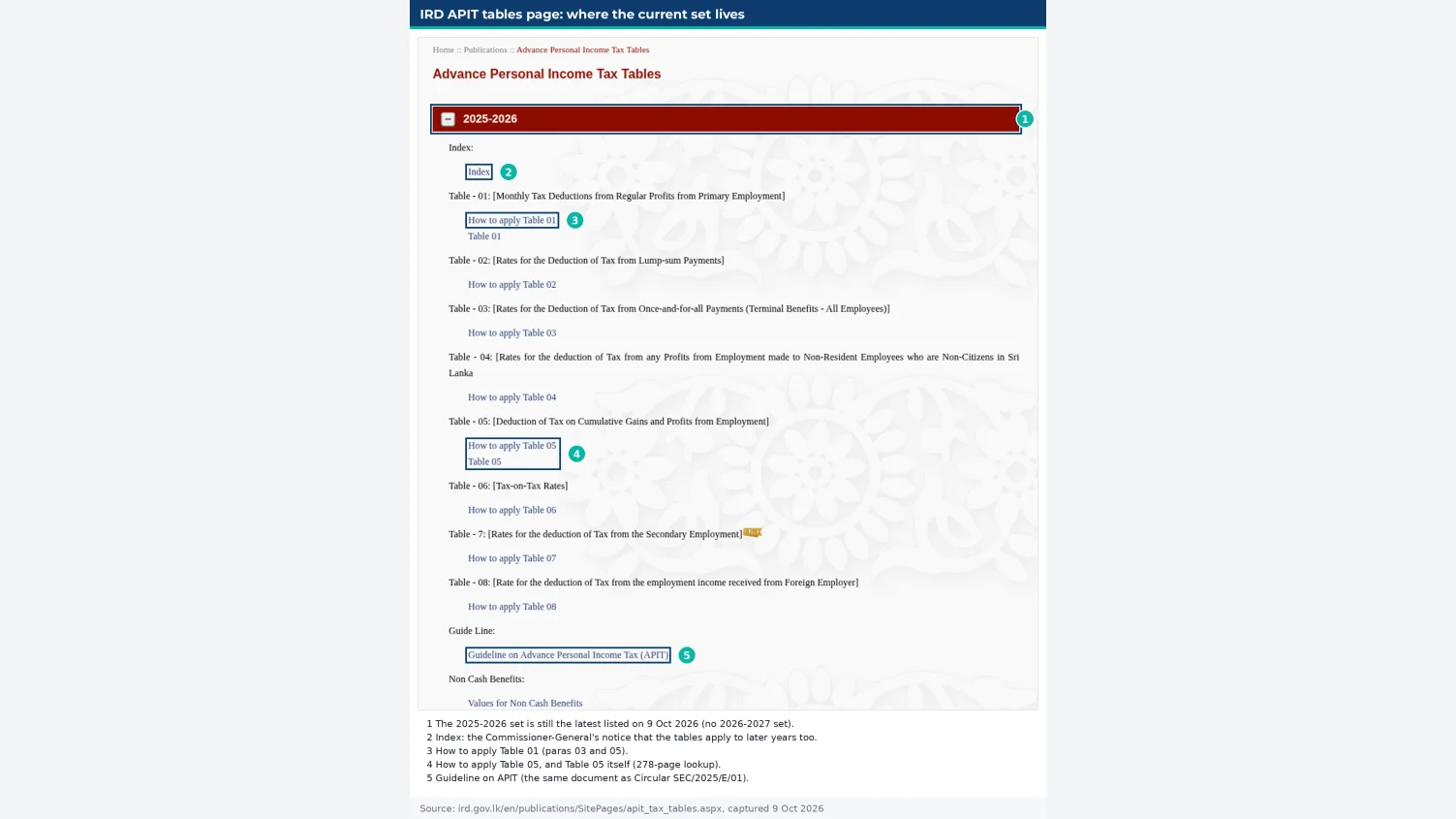
Employees whose remuneration other than terminal benefits attracted APIT during the year. Your payroll register should already show each one's identity details and TIN, gross remuneration, APIT deducted and any adjustment. Bonuses, incentives and leave encashment are taxed on Table 02 [4] and are not terminal benefits, so they belong here.
Schedule 02
Terminal benefits only: retiring gratuity, compensation for loss of office or employment, commuted pension and similar once-and-for-all payments, taxed on Table 03 [5]. Keep the final-settlement working, the Table 03 calculation and any IRD direction together.
Schedule 03
Employees whose APIT was not deducted because their pay stayed below the monthly or yearly threshold [2]. Do not leave them out because their monthly APIT was nil.
5) Joiners and leavers
Joiners. A person who joins during the year is taxed on the cumulative Table 05, using the T-10 from any earlier employer in the same year as the opening figures [6]. Collect the NIC, TIN and that T-10 before the first payroll. Our verified guide to APIT for mid-year joiners and leavers works through the steps.
Leavers. Keep regular pay separate from terminal benefits in the working papers, so each lands in the right schedule. Give the leaver a T-10 for the part of the year within 30 days after the employment ends (s.87(4)(b)) [1].
6) The T-10 is not the annual statement
The T-10 is the certificate of income tax deductions the employer gives each employee, showing the period of service, gross employment income and tax deducted (s.87) [1]. The annual statement is the employer's own return to the IRD under s.86(2). Older guides use the two names interchangeably; they are different documents.
- Employees still employed at year end: serve the T-10 by 30 April, alongside the annual statement [1]
- Leavers: within 30 days after the employment ends [1]
- Free of any charge or payment, under new s.87(6) inserted by Act No. 11 of 2026 [7]
A joiner's T-10 from you shows only the pay you made and the tax you withheld; keep the previous employer's T-10 on file to show how you reached your figures.
7) Paying APIT each month
Pay through IRD e-Services, or at a bank branch on the IRD's remittance forms as the APIT circular describes [8]. Keep the receipt or stamped form and its reference with the month's payroll pack.
Paying late adds a penalty of 20 percent of the tax due but not paid under section 179(1) if the tax is still unpaid fourteen days after the due date [1] [9], plus interest at 1.5 percent a month or part of a month under section 159(1) [1]. A late income tax instalment carries 10 percent under section 179(2) instead [1].
When reconciling older payroll records, distinguish the PAYE terminology from current APIT obligations.
8) Penalty for the annual statement
Act No. 11 of 2026 lets the Commissioner-General specify the statement's formats (new s.86(9)) and adds new s.178A: if an agent does not follow those procedures, formats and forms and does not comply with a warning within 14 days, a penalty of up to Rs 200,000 a year of assessment applies [7]. Not filing at all is an offence under new s.185A, with a fine of up to Rs 400,000, imprisonment of up to six months, or both [7].
9) Common filing failures to remove from your SOP
- Putting bonuses or leave encashment in Schedule 02, which is for terminal benefits only
- Treating Schedule 03 as a reconciliation sheet rather than the list of below-threshold employees
- Employees in Schedule 01 with no TIN
- Calling the annual statement the "T10 return"
- Filing from a copied prior-year template instead of the current year's form and instructions
- Payment proofs with no link back to the employee-level payroll
10) Records to keep
- Monthly payroll registers and APIT workings
- Payment proofs and references
- The annual statement as filed, and its acknowledgement
- T-10s issued and evidence of delivery
- Working papers for terminal payments and corrections
- Employee identity, TIN and employment records
11) A complete year-end file for a 25-employee company
- 12 monthly payroll packs with APIT calculations and payment references
- one terminal-benefit working file for leavers
- the list of below-threshold employees for Schedule 03
- the TIN list for every Schedule 01 employee
- the T-10s issued, with delivery evidence
- the filed annual statement and acknowledgement
Talk to us. If you want the year-end statement and T-10s checked before 30 April, our payroll team can go through them with you; book a consultation at our contact page. Our tax calendar lists the dates.
This guide is general information on the law as at 15 October 2026 and is not advice on your specific situation.
Before filing the annual statement, complete a payroll year-end reconciliation and evidence check.
References
- Inland Revenue Department. Inland Revenue Act, No. 24 of 2017, consolidated, ss.86(1) and (2), 87, 159(1) and 179. https://www.ird.gov.lk/en/publications/Acts_Income%20Tax_2017/IRA_Cons_Act_-_2025_Changes.pdf . Primary. Accessed 15 October 2026.
- Inland Revenue Department. Instructions to complete the APIT Annual Statement, Y/A 2025/2026, e-filing and Schedules 01 to 03. https://www.ird.gov.lk/en/Downloads/Other_PAYE_Doc/Asmt_APIT_Guide_2025_2026_E.pdf . Primary. Accessed 15 October 2026.
- Inland Revenue Department. Notice SEC/PN/APIT/2026-01 (24 February 2026). https://www.ird.gov.lk/en/Lists/Latest%20News%20%20Notices/Attachments/764/SEC_PN_APIT_2026-01_E.pdf . Primary. Accessed 15 October 2026.
- Inland Revenue Department. APIT Tax Table 02, Y/A 2025/26, instructions. https://www.ird.gov.lk/en/publications/APIT_Tax_Tables/2025-2026/Table%20-%202/03.%20APIT_2526_Table_02_Text.pdf . Primary. Accessed 15 October 2026.
- Inland Revenue Department. APIT Tax Table 03, Y/A 2025/26, once-and-for-all payments. https://www.ird.gov.lk/en/publications/APIT_Tax_Tables/2025-2026/Table%20-%203/04.%20APIT_2526_Table_03_Text.pdf . Primary. Accessed 15 October 2026.
- Inland Revenue Department. APIT Tax Table 05, Y/A 2025/26, instructions, paras 02 and 03. https://www.ird.gov.lk/en/publications/APIT_Tax_Tables/2025-2026/Table%20-%205/06.%20APIT_2526_Table_05_Text.pdf . Primary. Accessed 15 October 2026.
- Parliament of Sri Lanka. Inland Revenue (Amendment) Act, No. 11 of 2026, s.15 (new s.87(6)), new ss.86(9), 178A and 185A. https://www.ird.gov.lk/en/publications/Acts_Income%20Tax_2017/IR_Act_No_11-2026_E.pdf . Primary. Accessed 15 October 2026.
- Inland Revenue Department. Circular SEC/2025/E/01, Guideline for employers on deducting APIT (25 March 2025), para 10. https://www.ird.gov.lk/en/publications/Circulars_Circulars/SEC_2025_E_01_E.pdf . Primary. Accessed 15 October 2026.
- Inland Revenue Department. Guide to the Return of Income Tax, Y/A 2025/26, Section 09, penalty of 20 percent of tax due but not paid, 10 percent on a late instalment, interest at 1.5 percent a month or part of a month. https://www.ird.gov.lk/en/Downloads/IT_Individuals_Doc/Asmt_IIT_004_2025_2026_E.pdf . Primary. Accessed 15 October 2026.
Put these insights to work
WinCore specialists can review your current workflow, document gaps, and build a practical 90-day action plan.
Book a free consultationContinue reading
Explore more WinCore analysis to keep your finance, tax, and compliance roadmap moving.
APIT deduction for Sri Lankan employers: the five bands, which IRD table applies to bonuses, joiners, second jobs and terminal pay, T-10s and annual statement.
Staff who join or leave mid-year need APIT Table 05, not Table 01. Why it matters, with worked examples and the T-10 annual return steps.
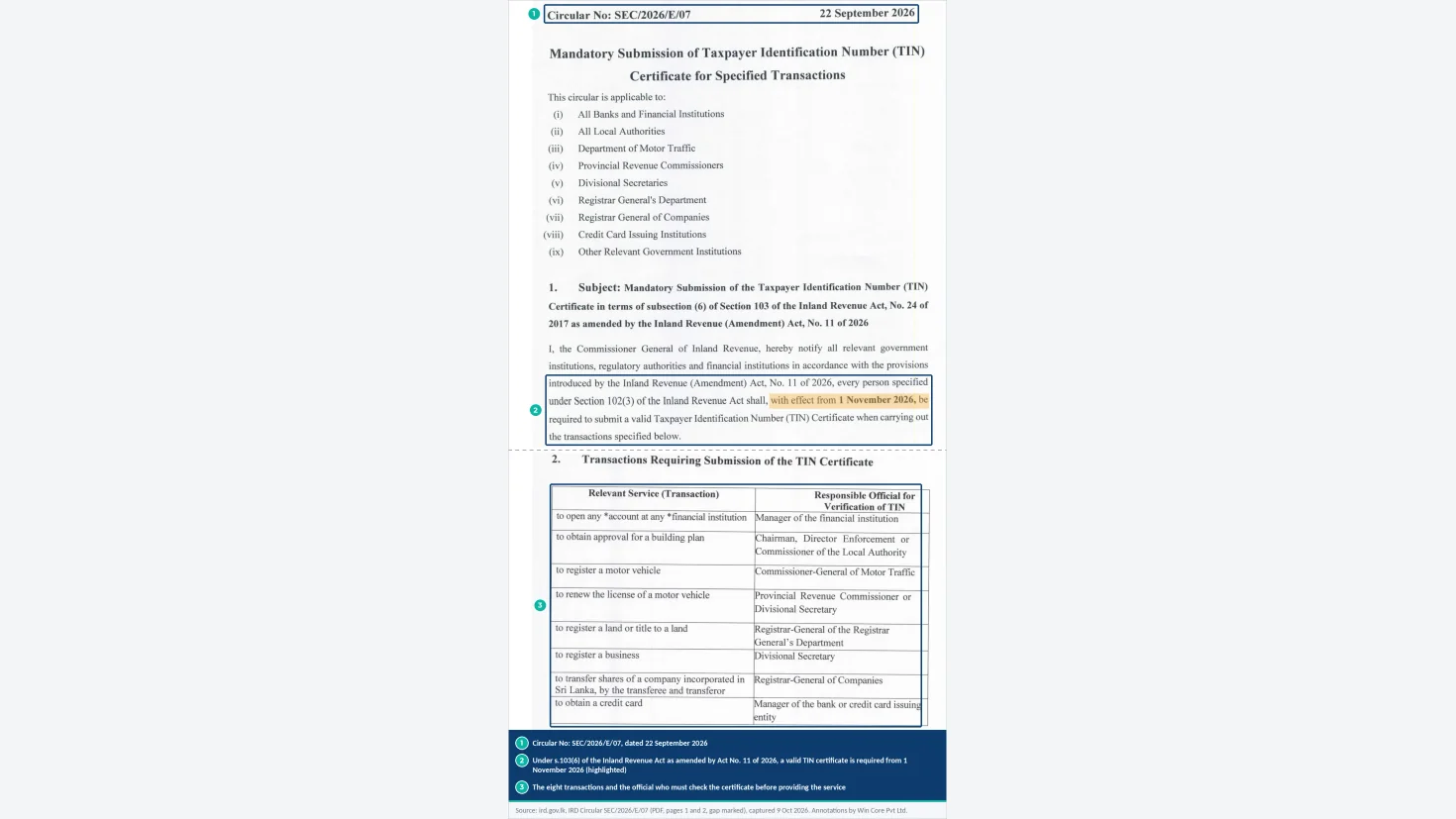
From 1 November 2026 individuals need a TIN certificate for eight transactions. Who needs one, how to get it, and TINs for companies and staff.