
Payroll year end checklist in Sri Lanka: annual and leaver filings
The filings that slip are the yearly and per-leaver ones. Each date, the clause behind it and the penalty for missing it, in one list for your calendar.
On this page
A payroll year end checklist in Sri Lanka has two fixed dates and one moving one. By 30 April, the employer files one electronic APIT annual statement for the year to 31 March (Inland Revenue Act s.86(2)) and serves a T-10 certificate on every employee (s.87(4)(b)). Within thirty days of any leaver's last day, it serves that leaver's T-10 and, where the Payment of Gratuity Act applies, pays the gratuity (s.5(1)). Alongside these, the EPF and ETF returns carry their own surcharge when they are late or wrong: 2 percent a month for EPF since Act No. 2 of 2012, and 1 percent for ETF. For what the March payroll must correct, see the APIT year end adjustment.
Monthly payroll gets done because people expect to be paid. The filings that slip are the ones that come once a year or once per leaver. This article lists them with the clause behind each date and the penalty section for each default. Where a step is practice rather than law, it says so. For the schedule-by-schedule filing workflow, our APIT annual statement and T-10 filing guide goes deeper; this piece puts every year-end and leaver item on one calendar.
The APIT annual statement is due by 30 April, as one electronic filing
An employer deducting Advance Personal Income Tax is a withholding agent. Section 83A(3) applies the withholding provisions to APIT "mutatis mutandis", and s.86(2) requires an annual statement "within thirty days after the end of each year ending on the thirty first day of March". For Y/A 2025/26 that was 30 April 2026; for Y/A 2026/27 it is 30 April 2027.
The IRD's instructions for 2025/2026 add three administrative points:
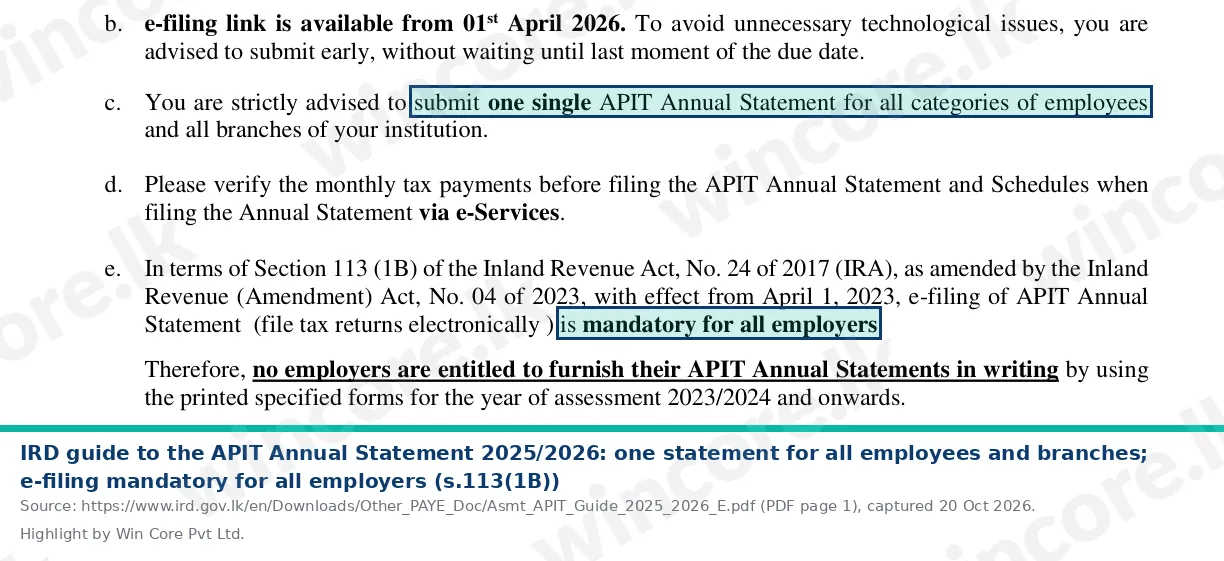
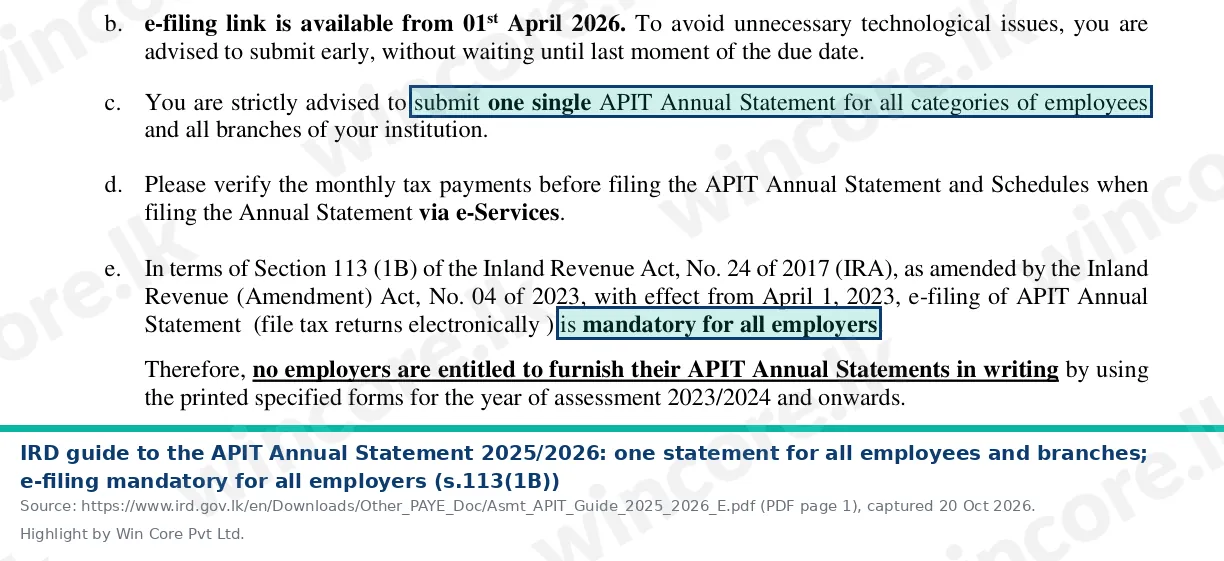
- "You are strictly advised to submit one single APIT Annual Statement for all categories of employees and all branches of your institution."
- E-filing "is mandatory for all employers" under s.113(1B), as amended by Act No. 4 of 2023 with effect from 1 April 2023, so no employer may file on the printed forms from 2023/2024 onwards.
- Verify the monthly tax payments before filing the statement and schedules through e-Services.
When preparing the next payroll cycle, reconcile public holidays and payroll calendar dates with the leave and overtime setup.
Schedules 02 and 03 are where year-end statements go wrong
The statement carries three schedules, and two of them hold people who are easy to forget.
| Schedule | What goes in it | Why it gets missed |
|---|---|---|
| 01 | Employees whose APIT was deducted on remuneration other than once-and-for-all payments; TIN mandatory | Rarely missed, but records without a TIN are rejected |
| 02 | "all employees who have been terminated or ceased their employment during the year of assessment", with their once-and-for-all (terminal) payments | Leavers are no longer on the payroll in April |
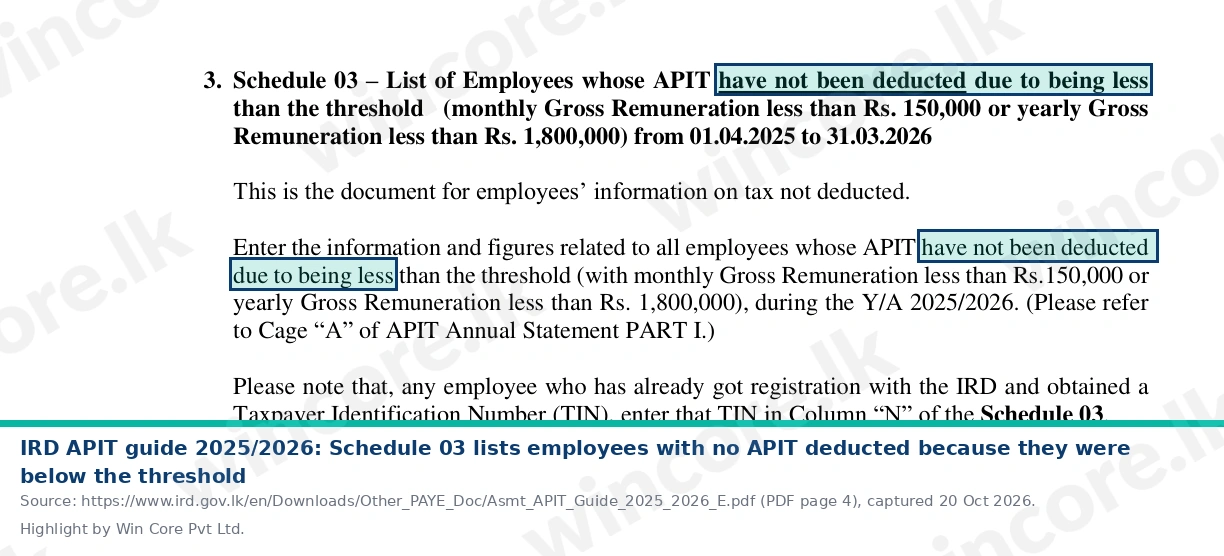
| 03 | Employees whose APIT was not deducted because they were below the threshold | No tax was deducted, so they look irrelevant |
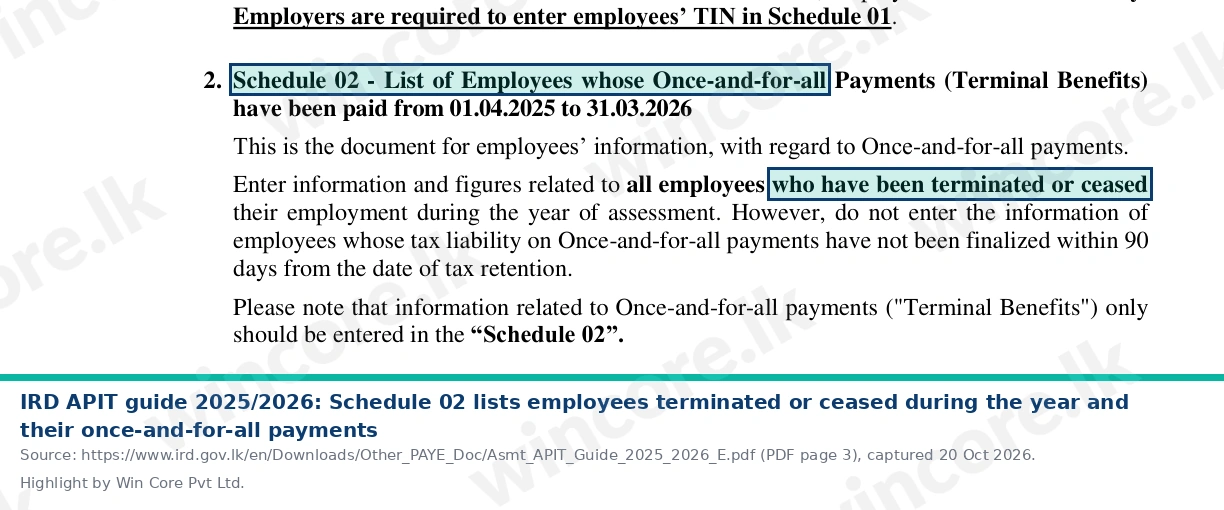
Schedule 03 covers employees with "monthly Gross Remuneration less than Rs. 150,000 or yearly Gross Remuneration less than Rs. 1,800,000" for 2025/2026. Where such an employee already has a TIN, it goes in the schedule too. Schedule 02 has a timing note: do not enter employees "whose tax liability on Once-and-for-all payments have not been finalized within 90 days from the date of tax retention". The guide does not say where those employees go instead, so we keep that as an open point.
Every employee gets a T-10 by 30 April, and a leaver gets one within 30 days
The T-10 is the APIT certificate of income tax deductions, prescribed under s.87. For tax withheld under s.83 or s.83A, s.87(4) says the certificate "(a) shall cover the part of the year during which the employee is employed; and (b) shall be served not later than the thirtieth day of April of the subsequent year or, where the employee has ceased employment with the withholding agent during the year, no more than thirty days from the date on which the employment ceased." Since Act No. 11 of 2026, new s.87(6) adds that the certificate must be served "free of any charge or payment".
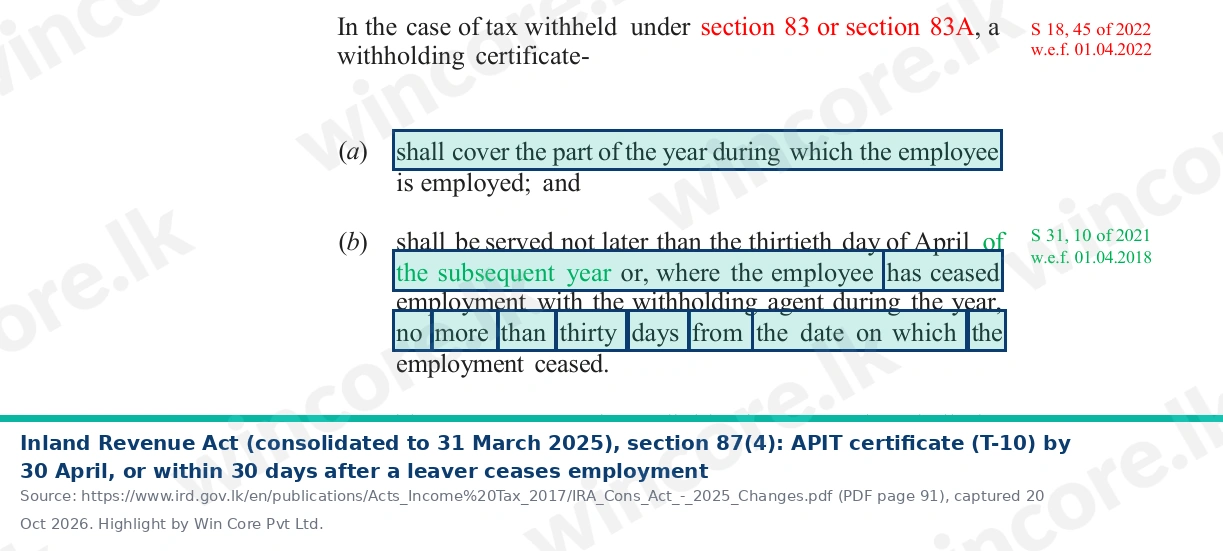
So for employees the certificate is yearly, unlike the monthly certificate under s.87(3) for other withholding. Two practical checks, which are practice rather than law: the T-10 figures should agree with Schedule 01, and a joiner's T-10 from the previous employer sets the opening figures for the cumulative table. Our guide to APIT for staff who join or leave mid-year explains Table 05; you can check a monthly figure with the APIT lookup.
A wrong EPF or ETF return carries its own surcharge, even when payment was on time
Both Funds treat the return separately from the payment.
- EPF, s.31A. An employer who fails to furnish a return "within the specified period or has furnished incorrect or deficient return", and cannot explain the reason to the Commissioner's satisfaction, pays a surcharge on "the amount of such contribution for every completed month or a part thereof" until a duly completed return reaches the Central Bank. The Central Bank reprint still prints "one per cent"; the EPF (Amendment) Act No. 2 of 2012 substituted "two per centum".
- EPF, s.31B. Also inserted in 2012: an employer with at least fifty employees must furnish a monthly return "not later than the end of the succeeding month", by electronic means from 1 July 2012.
- ETF, s.37A. A return not furnished within the period specified by the Act, regulations or a Board direction, or an "incorrect or deficient return", carries 1 percent a month of the contribution to which the return relates.
On our reading, a leaver left on a return after their last month, or a joiner left off it, makes the return incorrect, so the surcharge can run even if every rupee was paid on time. The return periods for smaller employers come from regulations, Board directions and the Funds' forms, which we did not read for this article. The full penalty map for both Acts is in our note on the EPF Act section 16 surcharge and the 2012 changes.
A leaver starts four clocks on the last working day
| Item | Deadline | Source |
|---|---|---|
| Leaver's T-10 | "no more than thirty days from the date on which the employment ceased" | IRA s.87(4)(b) |
| Gratuity, where the employer had 15 or more workmen on any day in the prior 12 months and the workman has 5 completed years | "within a period of thirty days of such termination" | Payment of Gratuity Act s.5(1) |
| APIT on terminal benefits | Deducted when paid, on the terminal benefits table (Table 03) | IRA s.83A; IRD APIT tables |
| EPF and ETF on the final month's earnings | Last day of the following month | EPF s.10; ETF s.16(1) |
The leaver then appears in the next April's Schedule 02. Two further leaver steps are administrative and we did not verify their current forms for this article: certifying the leaver's EPF and ETF benefit claim forms, and telling the Funds the member has left. Each Fund publishes its own forms. Our guide to the Payment of Gratuity Act covers the calculation and who qualifies, and the gratuity calculator runs the half-month-per-year figure. Our separate piece on APIT on gratuity and termination pay (Table 03) will cover the tax on the terminal payment.
Each missed filing has its own penalty section
| Default | Section | Consequence |
|---|---|---|
| APIT annual statement filed late | IRA s.86(2), s.178 (on our reading, through the s.195 definition of "tax return") | Greater of 5 percent of tax owing plus 1 percent a month, or Rs 50,000 plus Rs 10,000 a month or part; capped at Rs 400,000 |
| Statement not in the specified procedure, format or form | s.86(9), s.178A (Act No. 11 of 2026) | Up to Rs 200,000 for a year of assessment; a warning notice comes first, and no penalty if the agent complies within 14 days |
| Statement still not filed after a 30-day notice | s.185A (Act No. 11 of 2026) | Offence: on conviction, a fine up to Rs 400,000, up to six months' imprisonment, or both |
| T-10 not served on time | s.87(4) | We found no penalty section aimed at the certificate; it is a breach of duty |
| EPF return late, incorrect or deficient | EPF s.31A, as amended by Act No. 2 of 2012 | 2 percent of the contribution for every completed month or part |
| ETF return late, incorrect or deficient | ETF s.37A | 1 percent of the contribution for every completed month or part |
| Final EPF or ETF contributions late | EPF s.16; ETF s.27 | Surcharge ladder from 5 to 50 percent of contributions due |
| Gratuity paid after day 30 | Payment of Gratuity Act s.5(4) | Surcharge from 10 percent (up to one month late) to 30 percent (over twelve months) of the gratuity |
The s.178 row is our reading and matches how our APIT filing guide and our other withholding articles treat it. If the APIT itself was paid late, that is a different default: interest at 1.5 percent a month under s.159(1) from the due date, plus 20 percent of the tax due but not paid under s.179(1) if it was still unpaid fourteen days after the due date.
A payroll year end checklist, worked through for one company
Take an invented 32-person engineering consultancy in Kandy closing Y/A 2025/26. Seven staff earned under Rs 150,000 every month, and three people left during the year, one of them after six years.
- By 30 April 2026: one APIT annual statement through e-Services, with Schedule 01 for the 25 staff who had APIT deducted, Schedule 02 for the three leavers and their terminal payments, and Schedule 03 for the seven below the threshold.
- By 30 April 2026: a T-10 for each of the 29 people still employed on 31 March.
- Already done during the year: each leaver's T-10 within thirty days of their last day. The leaver with six years' service was paid gratuity within the same thirty days, because the firm had fifteen or more workmen on some day in the prior twelve months. The other two had under five years and no gratuity was due under the Act.
- Return check: none of the three appears on an EPF or ETF return for a month after they left.
Had the gratuity gone out on day 45, the s.5(4) surcharge would be 10 percent of the sum due, because the delay is within one month of the due date.
What this means for you
Put two dates in the payroll calendar for every year: 30 April for the APIT statement and for the T-10s. Add a thirty-day reminder the day anyone resigns or is dismissed, covering the T-10 and any gratuity. Build Schedule 02 as people leave, not in April, and keep a running list of below-threshold staff for Schedule 03. Before filing, tie each T-10 to Schedule 01. Each month, check that the EPF and ETF returns list only the people actually employed that month. If you would rather hand this over, our payroll services prepare the statement, the T-10s and the monthly returns, and our HR compliance services keep the leaver file in order. For the tax side of terminal payments, our income tax services cover the employer's APIT position. Our EPF calculator checks the final month's contributions.
Checklist: documents needed
- Twelve months of APIT payment references, checked against payroll before filing
- Schedule 01, 02 and 03 files in the current year's IRD template, with TINs for Schedule 01
- A T-10 for every employee on the payroll at 31 March, with delivery evidence
- Leaver file: resignation or termination letter, last day, final pay, T-10 served within 30 days
- Gratuity working and payment proof, or a note of why none was due
- APIT working on any terminal payment
- EPF and ETF returns for each leaver's last month, with no later months
- Joiners' T-10s from previous employers in the same year
FAQ
What is on a payroll year end checklist in Sri Lanka?
The core items are the APIT annual statement and a T-10 for every employee, both by 30 April under Inland Revenue Act ss.86(2) and 87(4). Add accurate EPF and ETF returns, because a wrong return carries its own surcharge, and keep a leaver file so that Schedule 02 can be completed from records rather than memory.
Do employees below the APIT threshold need to be reported?
Yes, they go in Schedule 03 of the APIT annual statement. The IRD's 2025/2026 instructions cover employees whose gross remuneration was below Rs 150,000 a month or Rs 1,800,000 a year, so no APIT was deducted. Leaving them out because their monthly APIT was nil is one of the most common filing gaps.
When must a leaver get a T-10?
A leaver must get the T-10 within thirty days of the date employment ceased, under s.87(4)(b) of the Inland Revenue Act. It covers only the part of the year the person was employed. Since Act No. 11 of 2026, the certificate must also be given free of any charge, so it cannot be held back against a final settlement.
Can we file the APIT annual statement on paper?
No, e-filing has been mandatory for all employers since Y/A 2023/2024. The IRD's instructions rely on s.113(1B) of the Inland Revenue Act, as amended by Act No. 4 of 2023 from 1 April 2023, and say no employer may use the printed forms. A statement filed in the wrong format can also attract the s.178A penalty after a warning.
Is a wrong EPF return penalised if contributions were paid on time?
Yes, it can be. EPF Act s.31A covers an "incorrect or deficient return" as well as a late one, at 2 percent of the contribution for each month or part month since Act No. 2 of 2012. The ETF Act s.37A rate is 1 percent. The surcharge stops when a duly completed return is received.
Does every leaver get gratuity?
No, only where the Payment of Gratuity Act applies. The employer must have employed fifteen or more workmen on any day in the twelve months before the termination, and the workman must have at least five completed years of service. Where both apply, payment is due within thirty days of termination, with a surcharge of 10 to 30 percent if late.
Open points
- Schedule 02 and the 90-day note. The guide does not say where unfinalised once-and-for-all payments go.
- EPF and ETF return periods for smaller employers, and leaver forms. Set by regulations, directions and Fund forms; not read for this article.
- T-10 penalty. We found no penalty section aimed at a late T-10.
- s.178 for the APIT statement. Our reading through the s.195 definition of "tax return"; the Act does not apply s.178 to the annual statement in terms.
Last verified 22 October 2026 against the IRD APIT annual statement instructions for 2025/2026, the Inland Revenue Act (consolidated to 31 March 2025) and Act No. 11 of 2026, and the EPF (Amendment) Act No. 2 of 2012. The ETF Act, Payment of Gratuity Act and the s.178 wording were carried from our 21 October 2026 checks.
This article is general information, not advice for your specific situation.
Talk to us. If you want your year-end APIT statement, T-10s and leaver files checked before 30 April, speak to our payroll team at our contact page.
WinCore Pvt Ltd
References
- Inland Revenue Department. Inland Revenue Act No. 24 of 2017, consolidated to 31 March 2025, ss.83A, 86, 87, 159, 178, 179, 195. https://www.ird.gov.lk/en/publications/Acts_Income%20Tax_2017/IRA_Cons_Act_-_2025_Changes.pdf . Primary (IRD consolidation, not a statutory copy). Accessed 20 and 22 October 2026.
- Inland Revenue Department. Instructions to complete the Annual Statement of Employer and Schedules, APIT, Y/A 2025/2026. https://www.ird.gov.lk/en/Downloads/Other_PAYE_Doc/Asmt_APIT_Guide_2025_2026_E.pdf . Primary (administrative guidance). Accessed 22 October 2026.
- Inland Revenue Department. APIT T-10 Certificate of Income Tax Deductions. https://www.ird.gov.lk/en/Type%20of%20Taxes/Pay%20as%20Your%20Earn_Annual%20Declaration%20of%20Employer/APIT_T10_NEW_2021.pdf . Prescribed form. Accessed 20 October 2026.
- Parliament of Sri Lanka. Inland Revenue (Amendment) Act, No. 11 of 2026, new ss.86(9), 87(6), 178A and 185A. https://www.ird.gov.lk/en/publications/Acts_Income%20Tax_2017/IR_Act_No_11-2026_E.pdf . Primary. Accessed 22 October 2026.
- Central Bank of Sri Lanka. Employees' Provident Fund Act, No. 15 of 1958 (reprint to 31 December 1998, not a statutory reprint), ss.10, 16, 31A. https://www.cbsl.gov.lk/sites/default/files/cbslweb_documents/laws/acts/en/epf_act.pdf . Primary. Accessed 20 October 2026.
- Parliament of Sri Lanka. Employees' Provident Fund (Amendment) Act, No. 2 of 2012, amending s.31A, inserting s.31B and amending s.37, as reprinted in Central Bank of Sri Lanka, Annual Report 2012, Part IV. https://www.cbsl.gov.lk/sites/default/files/cbslweb_documents/publications/annual_report/2012/en/16_Part_04.pdf . Primary text in a CBSL reprint. Accessed 22 October 2026.
- Employees' Trust Fund Board. Employees' Trust Fund Act, No. 46 of 1980 (as amended), ss.16, 27, 37A. https://etfb.lk/wp-content/uploads/2021/03/ETF-Act.pdf . Primary. Accessed 20 October 2026.
- Department of Labour. Payment of Gratuity Act, No. 12 of 1983 (Labour Code reprint, with Act No. 62 of 1992), s.5. https://labourdept.gov.lk/downloads/labour_code/55.pdf . Primary text in the Department's reprint. Accessed 20 October 2026.
Put these insights to work
WinCore specialists can review your current workflow, document gaps, and build a practical 90-day action plan.
Book a free consultationContinue reading
Explore more WinCore analysis to keep your finance, tax, and compliance roadmap moving.

How Sri Lankan employers file the APIT annual statement by 30 April: monthly payments by the 15th, Schedules 01, 02 and 03, employee TINs and T-10 certificates.
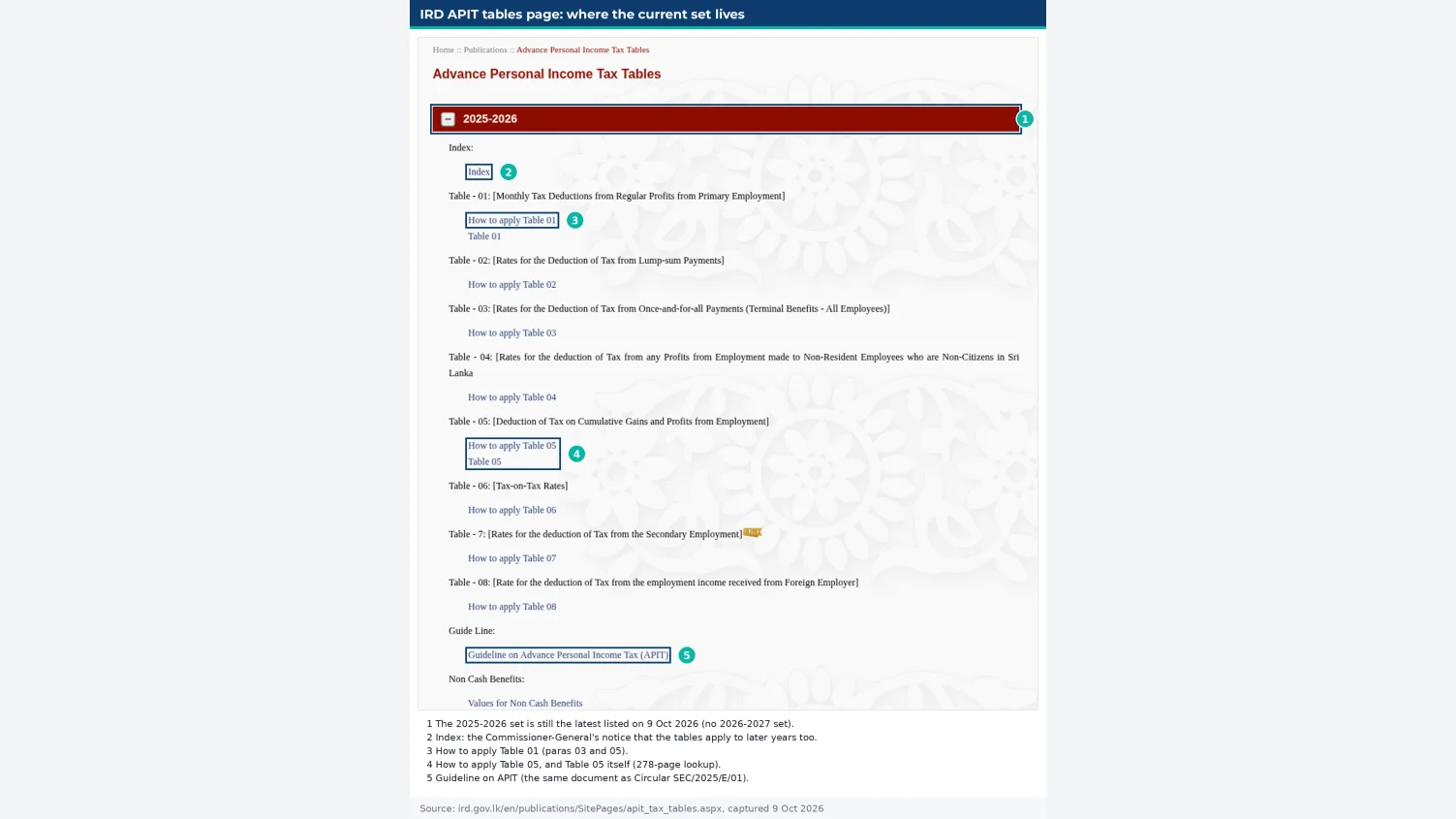
Staff who join or leave mid-year need APIT Table 05, not Table 01. Why it matters, with worked examples and the T-10 annual return steps.
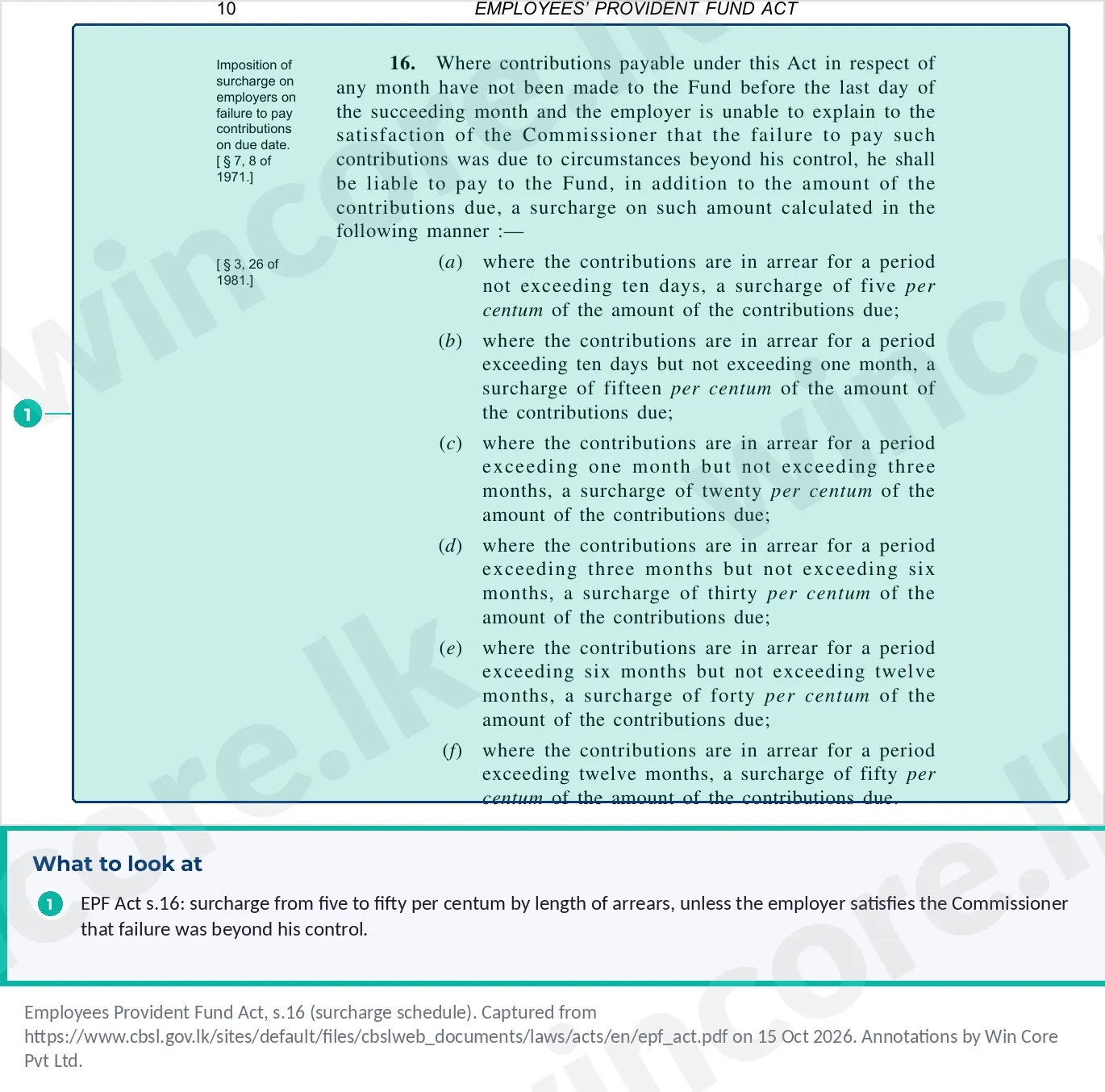
The four sections behind EPF and ETF: rates, the due day, the 5 to 50 percent ladder, who judges 'beyond control', and what Act No. 2 of 2012 changed.