
EPF Act section 16 surcharge: ETF s.27 ladder and 2012 changes
The four sections behind EPF and ETF: rates, the due day, the 5 to 50 percent ladder, who judges 'beyond control', and what Act No. 2 of 2012 changed.
On this page
Last verified against the primary sources on 21 October 2026.
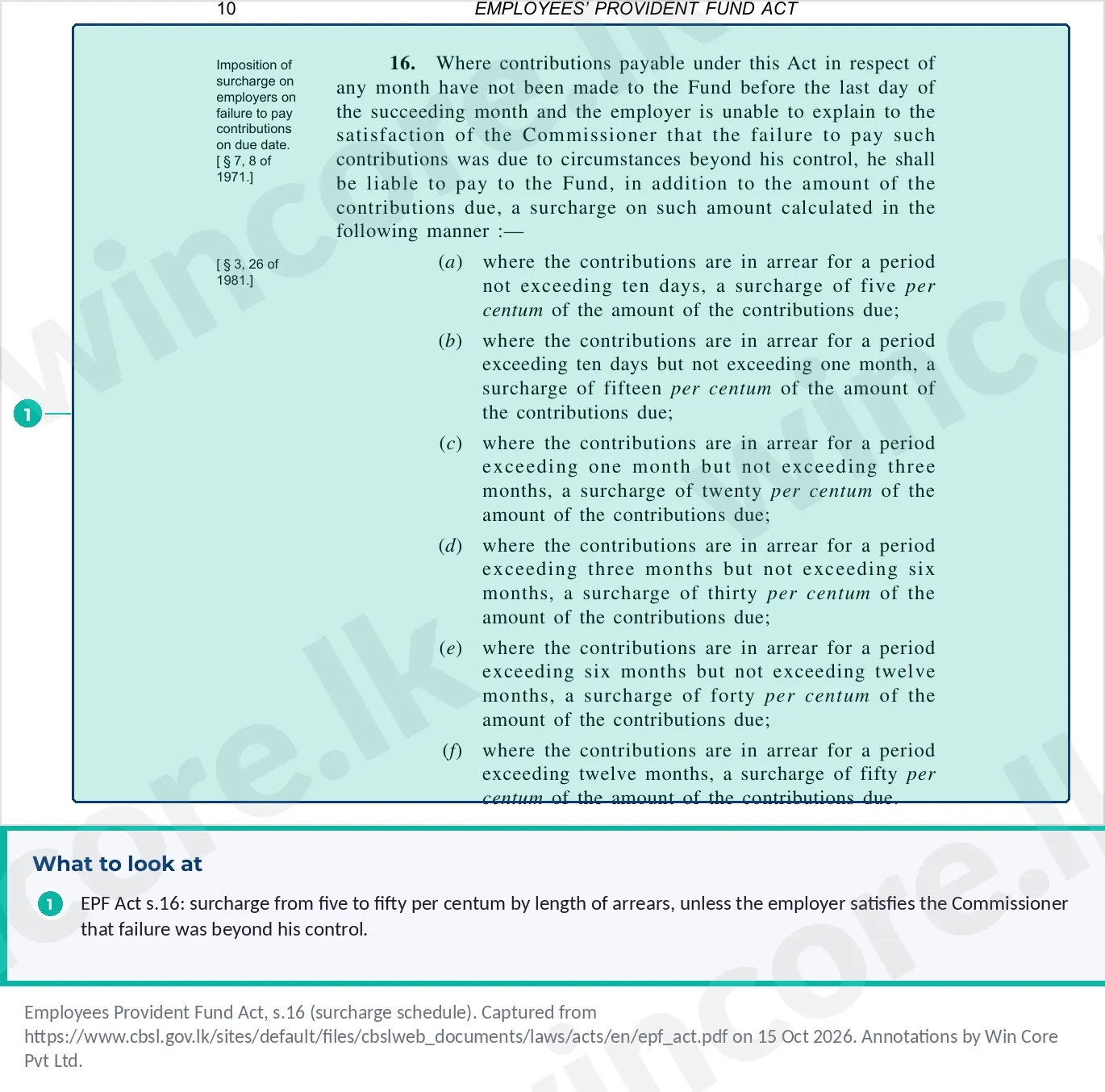
The EPF Act section 16 surcharge applies when a month's contributions are not paid by the last day of the following month and the employer cannot satisfy the Commissioner that the delay was beyond its control. It runs from 5 percent (up to ten days late) to 50 percent (over twelve months) of the contributions due, on top of the contributions. ETF Act section 27 uses the same ladder, judged by the ETF Board. The rates behind it are EPF 8 percent employee and 12 percent employer (s.10) and ETF 3 percent employer (s.16) [1] [2].
This is a Regulation Desk note on the four sections and the amendments that changed what sits around them. For the evergreen guide to rates, deadlines and forms, read our EPF and ETF guide for 2026 and the monthly payment procedures guide. Nothing here changes a figure in either.
Think of the ladder as a set of steps under a weight. The longer the weight sits off the ground, the taller the step you climb to put it back.
Four sections do the work, and the printed reprint is out of date
The instruments are the Employees' Provident Fund Act, No. 15 of 1958, sections 10 (contributions) and 16 (surcharge), and the Employees' Trust Fund Act, No. 46 of 1980, sections 16 (contribution) and 27 (surcharge) [1] [2].
Two cautions on the texts:
- The EPF text most people read is the Central Bank reprint "incorporating amendments up to 31st December, 1998". The Bank says it "is not a statutory reprint". It still prints the return surcharge in section 31A at one percent and the section 37 fine at Rs 1,000 [1]. Both were raised by the EPF (Amendment) Act, No. 2 of 2012 [3]. Act No. 23 of 2021 changed only definitions in section 47 [5].
- The ETF text is the Board's PDF of Act No. 46 of 1980 with Amendments Nos. 3 of 1982, 47 of 1988, 18 of 1993 and 19 of 1993 [2]. We found no later ETF amending Act.
None of the amending Acts we read changes the contribution rates or the section 16 and section 27 ladders.
Contributions are due by the last day of the following month
EPF section 10. "Subject to the provisions of subsection (3) of this section and of section 27" (approved provident funds), the employee contributes eight per centum and the employer "twelve per centum of such employee's total earnings" for the month, "on or before the last day of the succeeding month" [1]. Section 15 makes the employer deduct the employee's share and pay it by the same day. Section 11 lets both elect higher percentages by notice.
ETF section 16(1). The employer alone pays "three per centum of the total earnings" of the employee for each month, "on or before the last day of the succeeding month" [2]. There is no employee share. Section 17 covers an employer who already pays a higher EPF percentage under EPF section 11: it may route three percent from that higher amount to the ETF, and the payment counts as compliance with section 16.
January contributions are therefore due by the last day of February. The EPF Department and ETF Board ask for payment by the last working day; the Acts say last day. Our EPF calculator works out the three amounts.
What counts as "total earnings" is a separate question, covered in our note on which allowances count for EPF and ETF. After the January 2026 rise in the national minimum wage to Rs 30,000, see our note on the minimum wage amendment Act 2025.
The EPF Act section 16 surcharge and ETF s.27 share one ladder
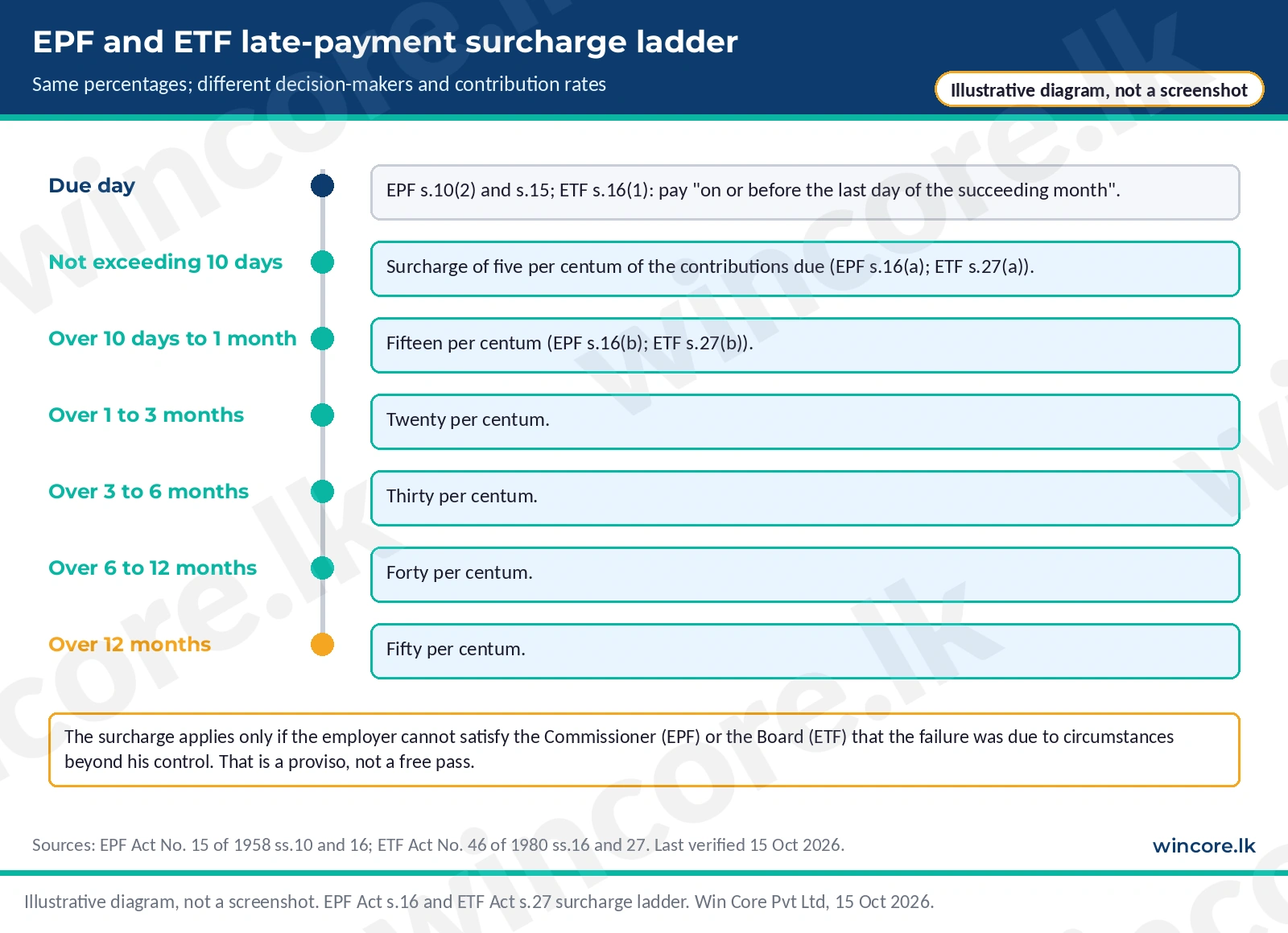
EPF section 16 and ETF section 27 set the same percentages of the contributions due [1] [2]:
| Contributions in arrear for | Surcharge on contributions due |
|---|---|
| Not exceeding ten days | 5 percent |
| Exceeding ten days, not exceeding one month | 15 percent |
| Exceeding one month, not exceeding three months | 20 percent |
| Exceeding three months, not exceeding six months | 30 percent |
| Exceeding six months, not exceeding twelve months | 40 percent |
| Exceeding twelve months | 50 percent |
The surcharge is payable "in addition to the amount of the contributions due". It is a single percentage chosen by how long the arrears run, not a monthly rate that compounds. Under EPF section 17(3) the Prescription Ordinance does not apply to recovering contributions or surcharges, so age alone does not extinguish the claim [1].
Section 27(2A) of the EPF Act applies a parallel surcharge, with the same test, to approved provident funds and approved contributory pension schemes [1].
The "beyond his control" gate is decided by two different bodies
Neither surcharge applies if the employer explains the delay to the right person's satisfaction:
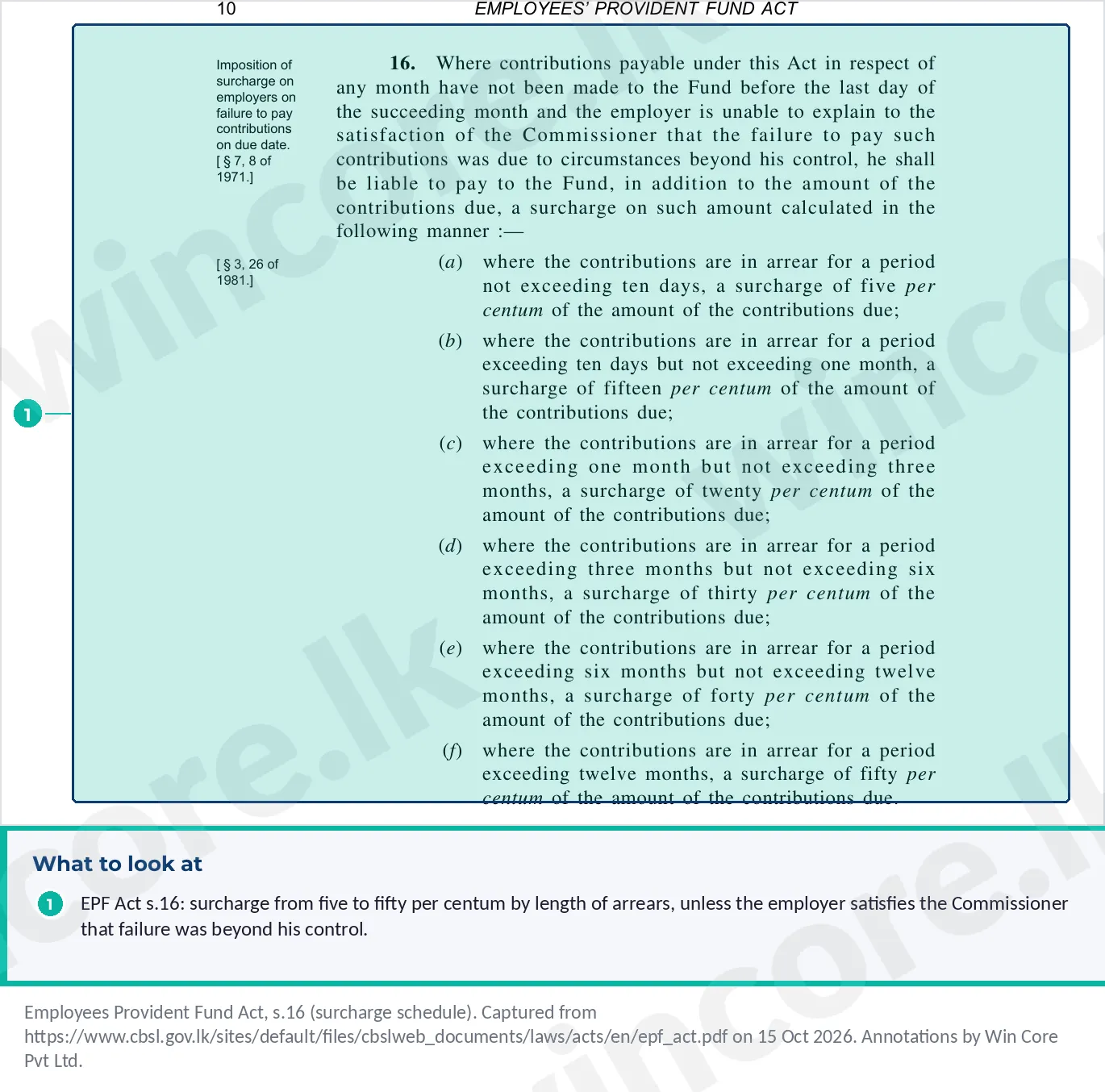
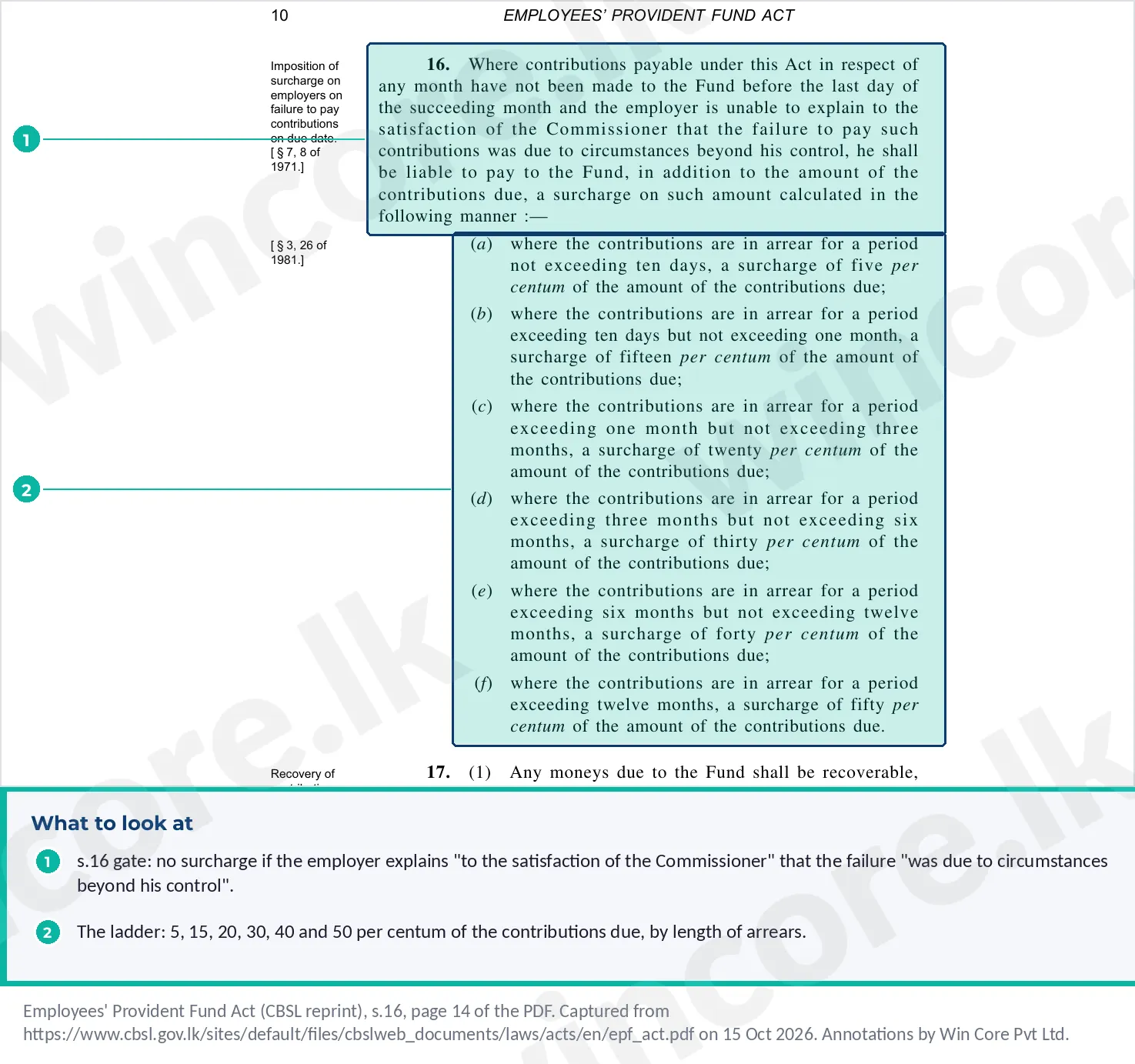
- EPF s.16: where contributions "have not been made to the Fund before the last day of the succeeding month and the employer is unable to explain to the satisfaction of the Commissioner that the failure to pay such contributions was due to circumstances beyond his control" [1].
- ETF s.27: where a contribution "has not been paid to the Fund on the due date and the employer is unable to explain to the satisfaction of the Board" the same thing [2].
So the Commissioner of Labour judges EPF and the ETF Board judges ETF. A bank system outage that persuades one may not persuade the other, and one late month can need two explanations. The burden is on the employer: "unable to explain" leaves the ladder in place. What to put in that explanation, and where a decision can be challenged, is the subject of our note on the EPF surcharge appeal routes.
Act No. 2 of 2012 changed the money around the ladder, not the ladder
The ladder punishes late contributions. Other sections punish other defaults, and these are where the amendments bite. Each line cites the section for that specific default.
| Default | Section | Consequence |
|---|---|---|
| EPF contributions late, gate not passed | EPF s.16 | 5 to 50 percent of contributions due |
| ETF contributions late, gate not passed | ETF s.27 | Same ladder |
| EPF return late, incorrect or deficient | EPF s.31A, rate as amended by Act No. 2 of 2012 s.5 | 2 percent of the contribution for every completed month or part until a complete return arrives (the reprint still shows 1 percent) [3] |
| ETF return late, incorrect or deficient | ETF s.37A (Act No. 18 of 1993) | 1 percent of the contribution for every completed month or part [2] |
| Contravening the EPF Act or regulations | EPF s.37, as amended by Act No. 2 of 2012 s.7 | Fine up to Rs 2,500, or up to six months' imprisonment, or both, plus up to Rs 75 a day for a continuing offence (the reprint still shows Rs 1,000) [3] |
| Contravening the ETF Act or regulations | ETF s.39 | Fine up to Rs 1,000, or up to six months, or both [2] |
| Reducing earnings to cut the employer's EPF share | EPF s.12 | Commissioner directs payment of the difference by written notice [1] |
| Deducting the employer's share or a surcharge from wages | EPF s.20 | Prohibited [1] |
| Any sum due to the EPF | EPF s.17(1) | Recoverable as a debt due to the State by summary procedure [1] |
Act No. 2 of 2012 also inserted section 31B, which requires monthly electronic returns from employers of 50 or more [3]. ETF electronic payment from 15 employees comes from a separate regulation, Gazette 2311/39, enforced from July 2026 contributions. Our note on the three payroll headcount thresholds sets them side by side.
A hypothetical late month, worked through
Take an invented logistics company in Colombo with January 2026 total earnings of Rs 2,000,000 across its staff. It pays January EPF and ETF on 12 March 2026.
- Contributions. EPF is Rs 400,000 (8 percent employee Rs 160,000 plus 12 percent employer Rs 240,000). ETF is Rs 60,000 (3 percent).
- Due day. The last day of February 2026, which is 28 February.
- Arrears. 28 February to 12 March is 12 days: more than ten days, not more than one month. That is the 15 percent step.
- Surcharge if the gate fails. EPF Rs 60,000 (15 percent of Rs 400,000). ETF Rs 9,000 (15 percent of Rs 60,000). Total Rs 69,000, on top of the Rs 460,000.
- Gate. The company may write to the Commissioner and to the ETF Board explaining the delay. Each decides separately.
- Wages. None of the Rs 69,000 may be taken from staff pay (EPF s.20).
Had it paid on 9 March, nine days late, the step would be 5 percent: Rs 20,000 and Rs 3,000. The step from day ten to day eleven triples the cost.
What this means for you
Treat the last day of the following month as a hard date for both funds. If a payment will be late, write down the reason the same day and put it to the Commissioner for EPF and the Board for ETF, because each decides on its own. Check that your returns go in with the contributions, since a late EPF return carries its own 2 percent a month under the 2012 amendment, and do not rely on the 1998 reprint for any penalty figure.
Our payroll services team prepares and remits EPF and ETF each month and keeps the payment evidence on file, and our HR compliance services handle registration and records.
Checklist: documents needed
- Monthly payroll summary showing total earnings per employee
- EPF return (Form C or e-return) and ETF return for each month
- Bank payment confirmations with dates for EPF and ETF
- Any written explanation of a late payment, with its supporting evidence
- Surcharge notices received and replies sent
- Elections under EPF s.11 for higher contribution rates, if any
FAQ
What is the EPF surcharge for late payment in Sri Lanka?
It is 5 to 50 percent of the contributions due, depending on how long they are in arrear, under section 16 of the EPF Act. Up to ten days is 5 percent, over ten days to one month 15 percent, rising to 50 percent beyond twelve months. It is added to the contributions, not taken from them.
Is the ETF surcharge the same as the EPF surcharge?
Yes, ETF Act section 27 uses the same six steps from 5 to 50 percent. The difference is who decides whether the delay was beyond the employer's control: the Commissioner of Labour for EPF and the ETF Board for ETF. The ETF return surcharge is also lower, at 1 percent a month against EPF's 2 percent.
What is the fine for an EPF offence?
The fine is up to Rs 2,500, imprisonment up to six months, or both, plus up to Rs 75 for each day the offence continues, under section 37 as amended by Act No. 2 of 2012. The Central Bank reprint still shows Rs 1,000, because it stops at 1998 amendments.
Can an employer recover the EPF surcharge from employees?
No, section 20 of the EPF Act bars an employer from deducting from an employee's earnings any sum it is liable to pay as a contribution or surcharge. The employee's own 8 percent is the only deduction allowed, and it must reach the Fund by the same due day as the employer's share.
When are EPF and ETF contributions due?
They are due on or before the last day of the month after the month of earnings, under EPF section 10 and ETF section 16(1). January contributions are due by the last day of February. The EPF Department and ETF Board ask for payment by the last working day, which is the safer target.
Open points
- "Before" and "on or before". EPF s.10 says contributions are due "on or before the last day", while s.16 applies the surcharge where they are not made "before the last day". On our reading a payment on the last day is on time, but the wording differs.
- ETF "due date". Section 27 uses "due date" and the Act does not define it; we read it as the s.16(1) date.
- "One month" in the bands. Whether it is a calendar month or thirty days is not spelled out.
- EPF Act No. 12 of 2012. An EPF annual report mentions such an Act on withdrawals; we have not located it. It would not change s.10 or s.16.
- ETF after 1993. We found no amending Act after Nos. 18 and 19 of 1993; if one exists outside the Board's list, the s.39 fine could have moved.
Last verified 21 October 2026 against the CBSL EPF reprint and the ETF Board Act PDF. Act No. 2 of 2012 was read from the CBSL Annual Report 2012 reprint.
Talk to us. If you want a surcharge notice checked, or your EPF and ETF remittances and returns reviewed, speak to our payroll team at our contact page.
WinCore Pvt Ltd
This article is general information on the law as at 21 October 2026 and is not advice on your specific position.
References
- Central Bank of Sri Lanka. Employees' Provident Fund Act (reprint incorporating amendments to 31 December 1998, not a statutory reprint), ss.10 to 12, 15 to 17, 20, 27(2A), 31A and 37. https://www.cbsl.gov.lk/sites/default/files/cbslweb_documents/laws/acts/en/epf_act.pdf . Primary. Accessed 21 October 2026.
- Employees' Trust Fund Board. Employees' Trust Fund Act, No. 46 of 1980 (with Amendments Nos. 3 of 1982, 47 of 1988, 18 of 1993 and 19 of 1993), ss.16, 17, 27, 37A and 39. https://etfb.lk/wp-content/uploads/2021/03/ETF-Act.pdf . Primary. Accessed 21 October 2026.
- Parliament of Sri Lanka. Employees' Provident Fund (Amendment) Act, No. 2 of 2012 (certified 9 February 2012), ss.5 to 7, as reprinted in Central Bank of Sri Lanka, Annual Report 2012, Part IV. https://www.cbsl.gov.lk/sites/default/files/cbslweb_documents/publications/annual_report/2012/en/16_Part_04.pdf . Primary. Accessed 21 October 2026.
- Employees' Provident Fund Act, consolidated text to 2024 (private consolidation), ss.16, 31A, 31B and 37. https://lankalaw.net/wp-content/uploads/2025/03/Employees-Provident-Fund-Consolidated-2024.pdf . Secondary. Used only to cross-check pinpoints in [3]. Accessed 15 October 2026.
- Parliament of Sri Lanka. Employees' Provident Fund (Amendment) Act, No. 23 of 2021 (certified 13 October 2021), s.2. https://employers.lk/wp-content/uploads/2021/12/4i_Employees_-Provident-Fund-Amendment-Act-No.-23-of-2021.pdf . Primary text, hosted by the Employers' Federation. Accessed 15 October 2026.
Put these insights to work
WinCore specialists can review your current workflow, document gaps, and build a practical 90-day action plan.
Book a free consultationContinue reading
Explore more WinCore analysis to keep your finance, tax, and compliance roadmap moving.

The employer's guide to EPF and ETF in Sri Lanka for 2026: who is covered, 8, 12 and 3 percent, what counts as earnings, the due date, the surcharge ladder and forms.

Monthly EPF and ETF payment procedures for Sri Lankan employers: the last working day deadline, Form C and e-returns, ETF electronic payment, surcharges and evidence.
Got an EPF or ETF surcharge notice? Where you can challenge it, the 30-day ETF clock, what to keep on file, and how the disputed amount is shown.