
Payroll headcount thresholds in Sri Lanka: 15 and 50 employees
Fifteen staff opens two gates, gratuity and online ETF; fifty opens EPF e-Returns. What each needs, how each count works and the penalty for missing it.
On this page
Last verified against the primary sources on 22 October 2026.
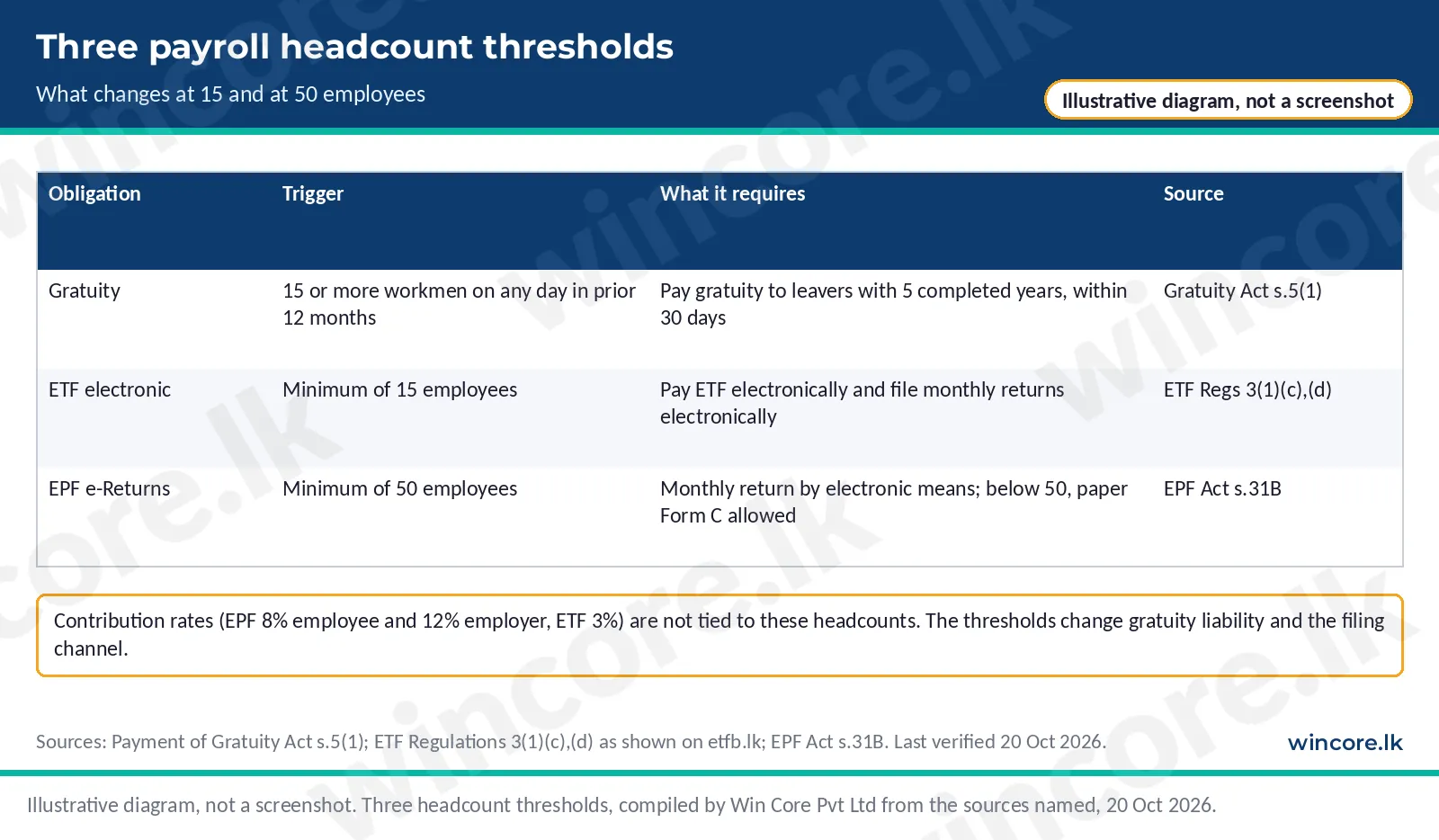
There are three payroll headcount thresholds in Sri Lanka. An employer with fifteen or more workmen on any day in the twelve months before a termination must pay gratuity to a leaver with five completed years (Payment of Gratuity Act No. 12 of 1983, s.5(1)). An employer with a minimum of fifteen employees must pay ETF and file ETF returns electronically, a rule the ETF Board enforces from July 2026 contributions, due by 31 August 2026. An employer with a minimum of fifty employees must send EPF monthly returns electronically (EPF Act s.31B, in force since 1 July 2012). None of the three changes whether you pay EPF and ETF; they change what you owe a leaver and how you pay and file.
Take a hypothetical chain of three bicycle repair shops in Jaffna that had eleven staff last year and expects eighteen by March. Its owner asks a fair question: what actually changes when we hire the fifteenth person, and is anything else waiting at fifty?
Payroll headcount thresholds in Sri Lanka at a glance
| Threshold | Trigger in the text | What it requires | Source |
|---|---|---|---|
| Gratuity | "fifteen or more workmen on any day" in the twelve months before a termination | Gratuity to a leaver with five completed years, within 30 days | Payment of Gratuity Act No. 12 of 1983, s.5(1) [1] |
| ETF electronic | "a minimum of fifteen employees" | Contributions paid electronically and monthly returns furnished electronically | ETF Regulations 1981, reg 3(1)(c) and (d) (Gazette Extraordinary 2311/39 of 22 December 2022), enforced from July 2026 contributions [2] [3] |
| EPF e-Returns | "a minimum of fifty employees" | Monthly return by electronic means | EPF Act s.31B, inserted by Act No. 2 of 2012 [4] |
Gratuity binds at fifteen workmen on any day in the past twelve months
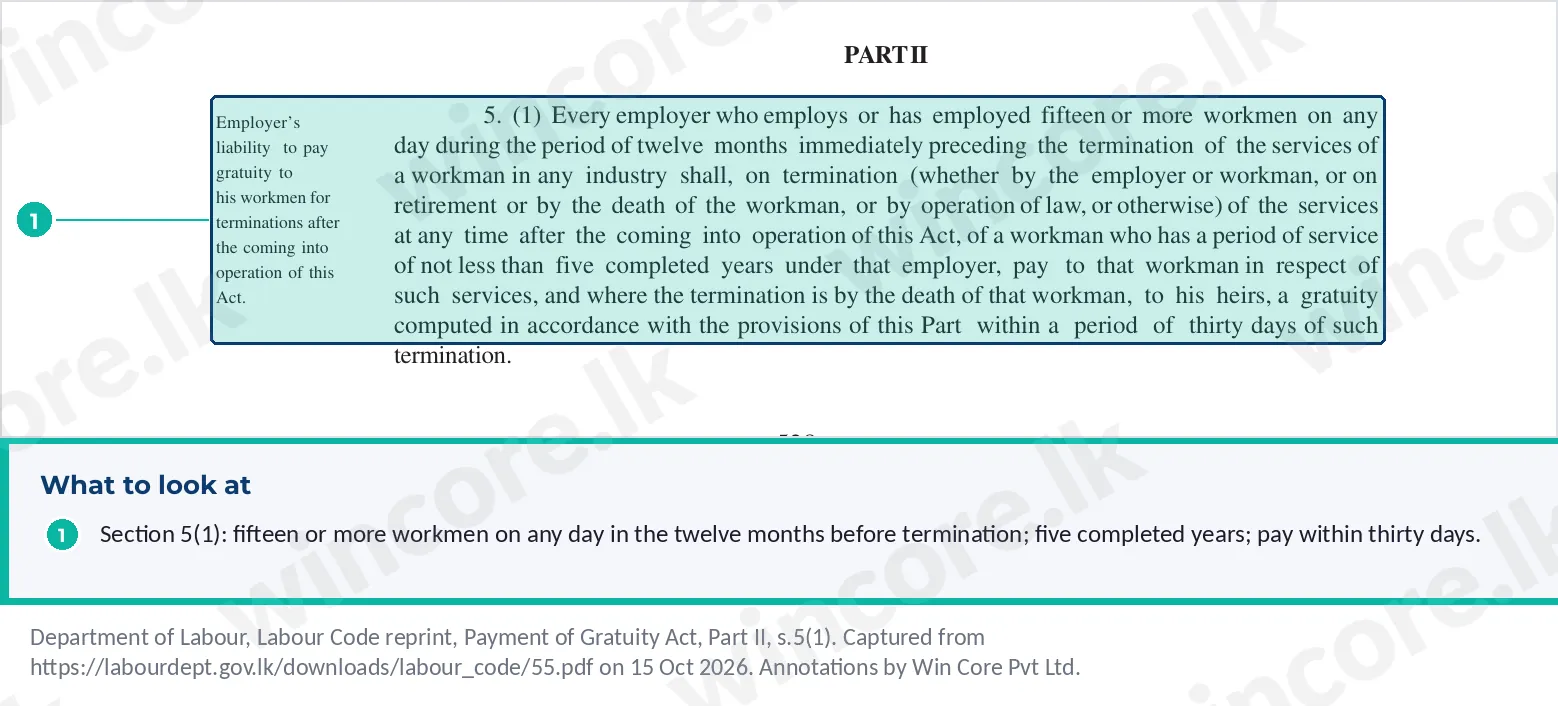
Section 5(1) of the Payment of Gratuity Act is the gate. "Every employer who employs or has employed fifteen or more workmen on any day during the period of twelve months immediately preceding the termination of the services of a workman in any industry" must pay a gratuity when that workman leaves, if the workman "has a period of service of not less than five completed years under that employer", within thirty days of the termination [1].
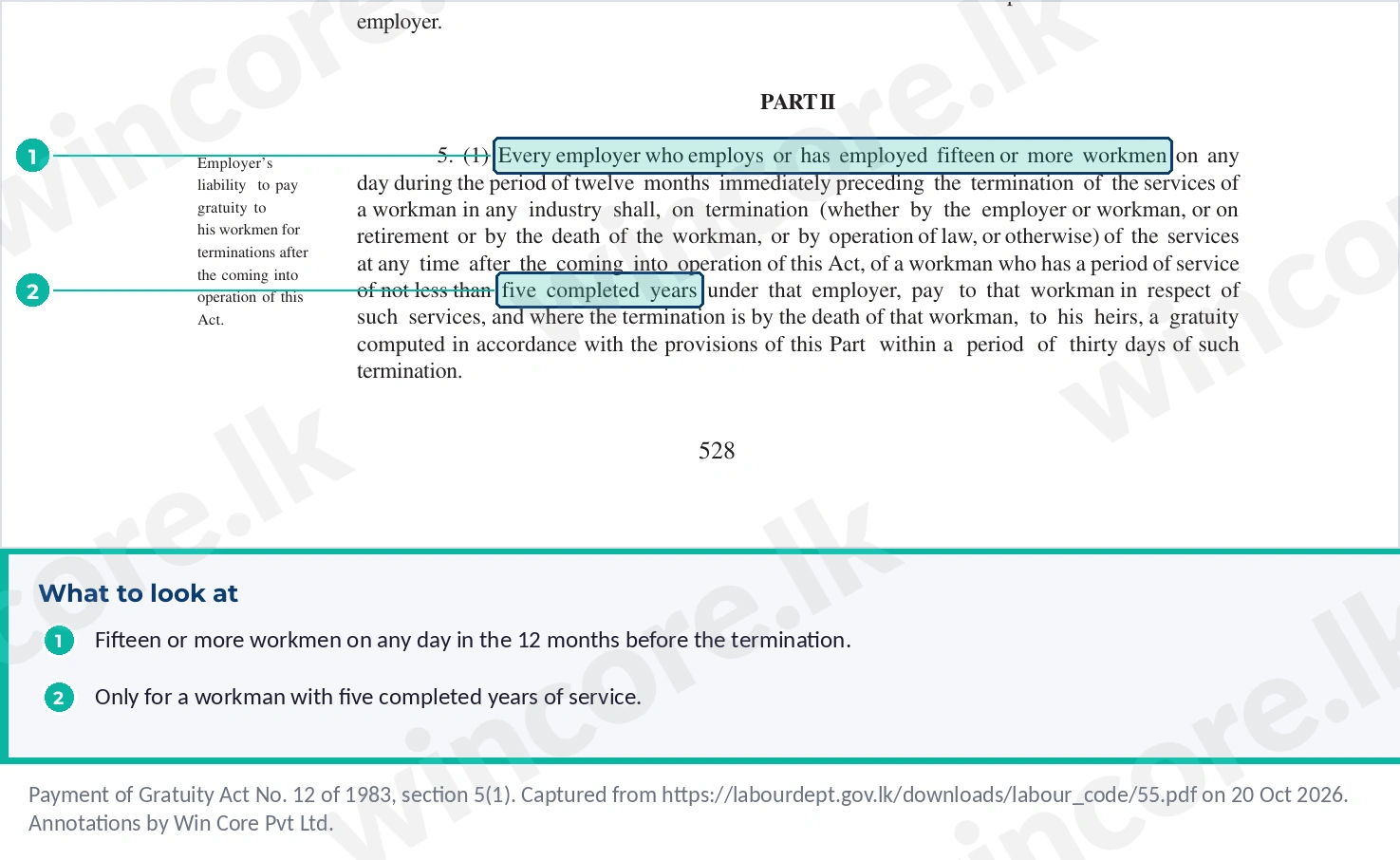
Three features of that wording matter for a growing business.
First, one day is enough. The test is "any day" in the twelve months before the termination. A business that touched fifteen for a week during a busy season, then dropped back to twelve, is inside the gate for anyone who leaves in the following twelve months.
Second, on our reading the count is of all workmen, not of those who qualify. A new hire in their first month counts toward the fifteen. The five-year condition applies to the person leaving, not to the headcount. "Workman" is defined widely in section 20, covering a person who works under a contract with an employer "in any capacity" [1], so consultants who are really workers count too; see our note on consultant or employee misclassification.
Third, termination is broad. Section 5(1) covers termination "whether by the employer or workman, or on retirement or by the death of the workman, or by operation of law, or otherwise" [1]. A resignation counts. For the employer's part when a member leaves or retires, see EPF withdrawal and the employer's role.
The amount is in section 6(2)(a): for a monthly rated workman, "half a month's wage or salary for each year of completed service", at the rate last drawn [1]. Section 7 excludes a domestic servant or personal chauffeur in a private household and a workman entitled to a pension under a non-contributory pension scheme, and section 20 leaves co-operative societies and local authorities out of "employer" [1].
Below fifteen, section 5 does not apply. That is not the same as "no gratuity ever". A contract or collective agreement can still provide one, section 10 applies a more favourable agreement instead of the Act, and section 17 of the Act let a workman of a smaller employer take the question to a labour tribunal, as our note on the Payment of Gratuity Act sets out.
ETF must be paid and filed online at fifteen employees, and the Board enforces it from July 2026
The ETF Board publishes, on its payment of contributions page, regulations made under section 43 of the ETF Act that insert two paragraphs into regulation 3(1) of the ETF Regulations 1981 [2]:
"(c) Where any employer having in his employment a minimum of fifteen employees shall, from 01st February 2023, make such contributions electronically through a computer system of a mobile electronic device."
"(d) It shall be the duty of every employer having in his employment a minimum of fifteen employees to furnish returns monthly to the Board by electronic means. This direction shall come into effect from 01st of February, 2023."
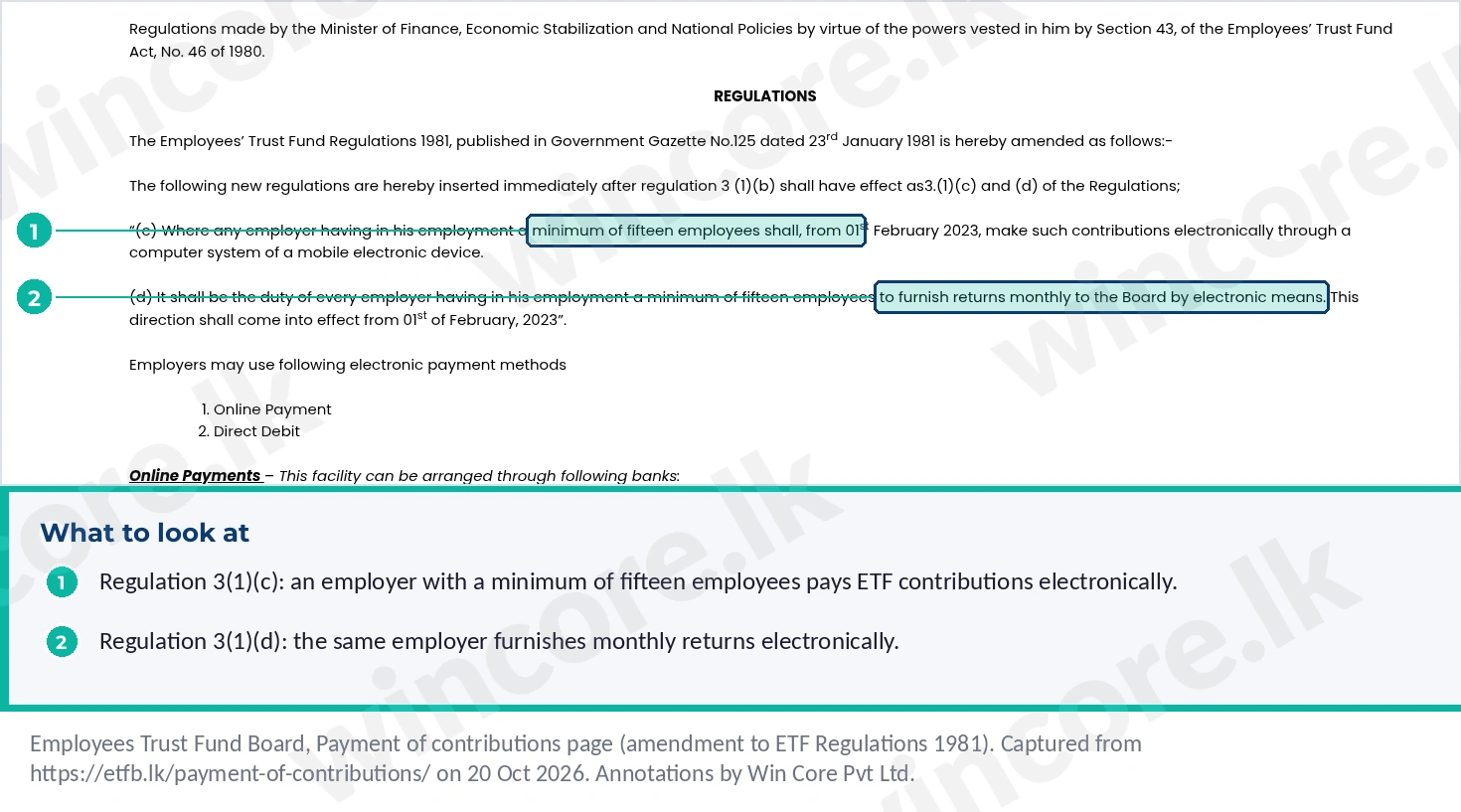
So the regulation's own date is 1 February 2023. The Board's notice on mandatory electronic payment, citing Extraordinary Gazette No. 2311/39 of 22 December 2022, enforces the rule from contributions for July 2026, payable by 31 August 2026; after that, payment by cheque, money order or cash and manual returns "will not be accepted" [3]. Both dates matter: the duty has been in the regulation since 2023, and the Board stopped accepting the old methods from July 2026 contributions. We have read the Board's publications, not the Gazette itself.
The Board's page also splits employers into a "Larger Category" of "Employers who are having 15 or more employees" and a "Smaller Category" of those "having less than 15 employees", who may still use the R4 remittance form [2]. Our monthly EPF and ETF payment guide covers the forms and payment routes.
Note the wording of the test: "having in his employment a minimum of fifteen employees". Unlike the Gratuity Act, there is no look-back period. On our reading, the natural test is the headcount in the month being paid and reported. That is our reading, not a Board ruling.
The contribution itself does not depend on the threshold. Section 16(1) of the ETF Act requires the employer to pay "three per centum of the total earnings" of each employee to whom the Act applies, by the last day of the following month [5]. A three-person business pays ETF too.
EPF returns must go electronically at fifty employees under section 31B
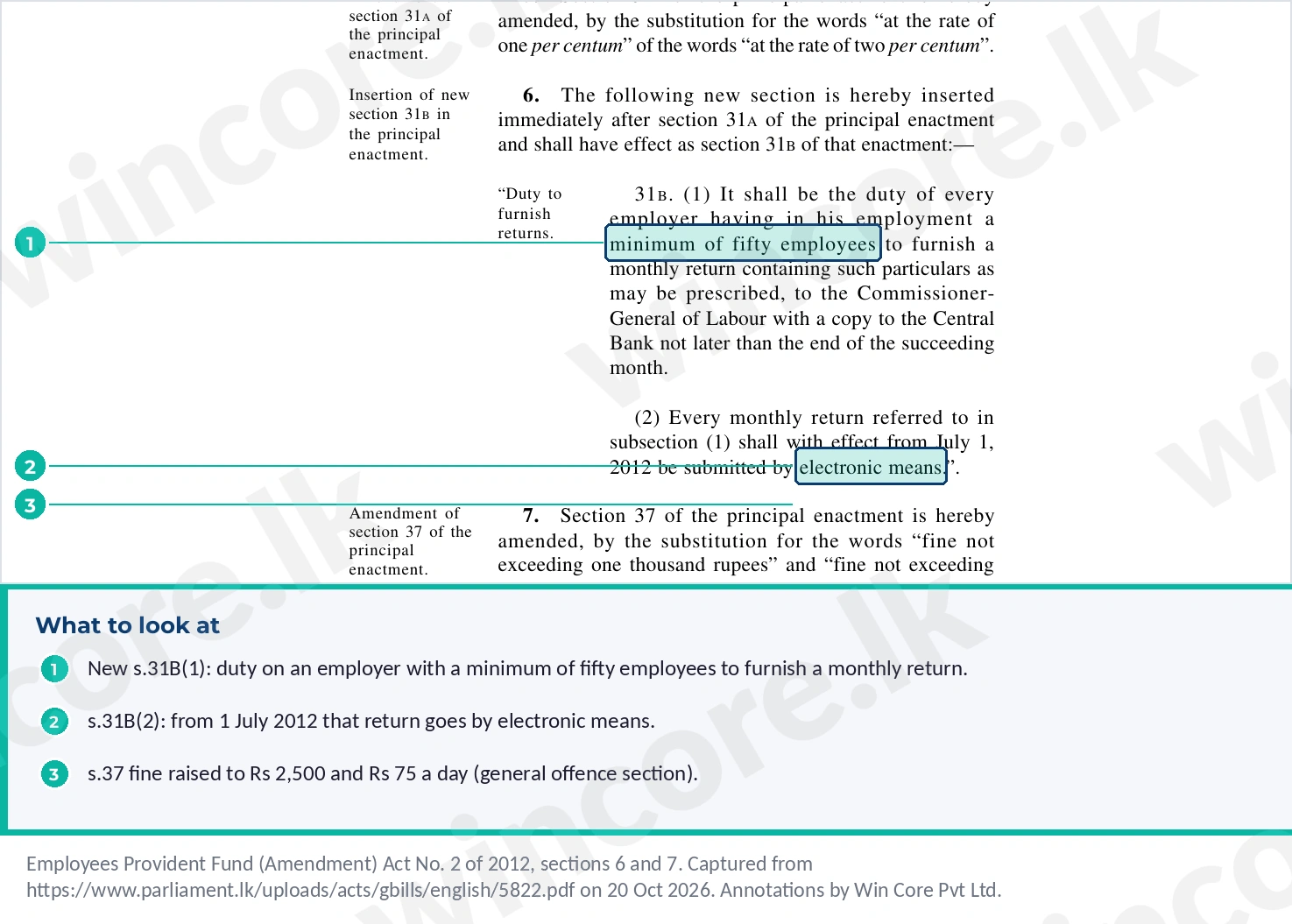
The EPF threshold is in the Act. Section 6 of the Employees' Provident Fund (Amendment) Act No. 2 of 2012 inserted section 31B into the EPF Act No. 15 of 1958 [4]:
"31B. (1) It shall be the duty of every employer having in his employment a minimum of fifty employees to furnish a monthly return containing such particulars as may be prescribed, to the Commissioner-General of Labour with a copy to the Central Bank not later than the end of the succeeding month.
(2) Every monthly return referred to in subsection (1) shall with effect from July 1, 2012 be submitted by electronic means."
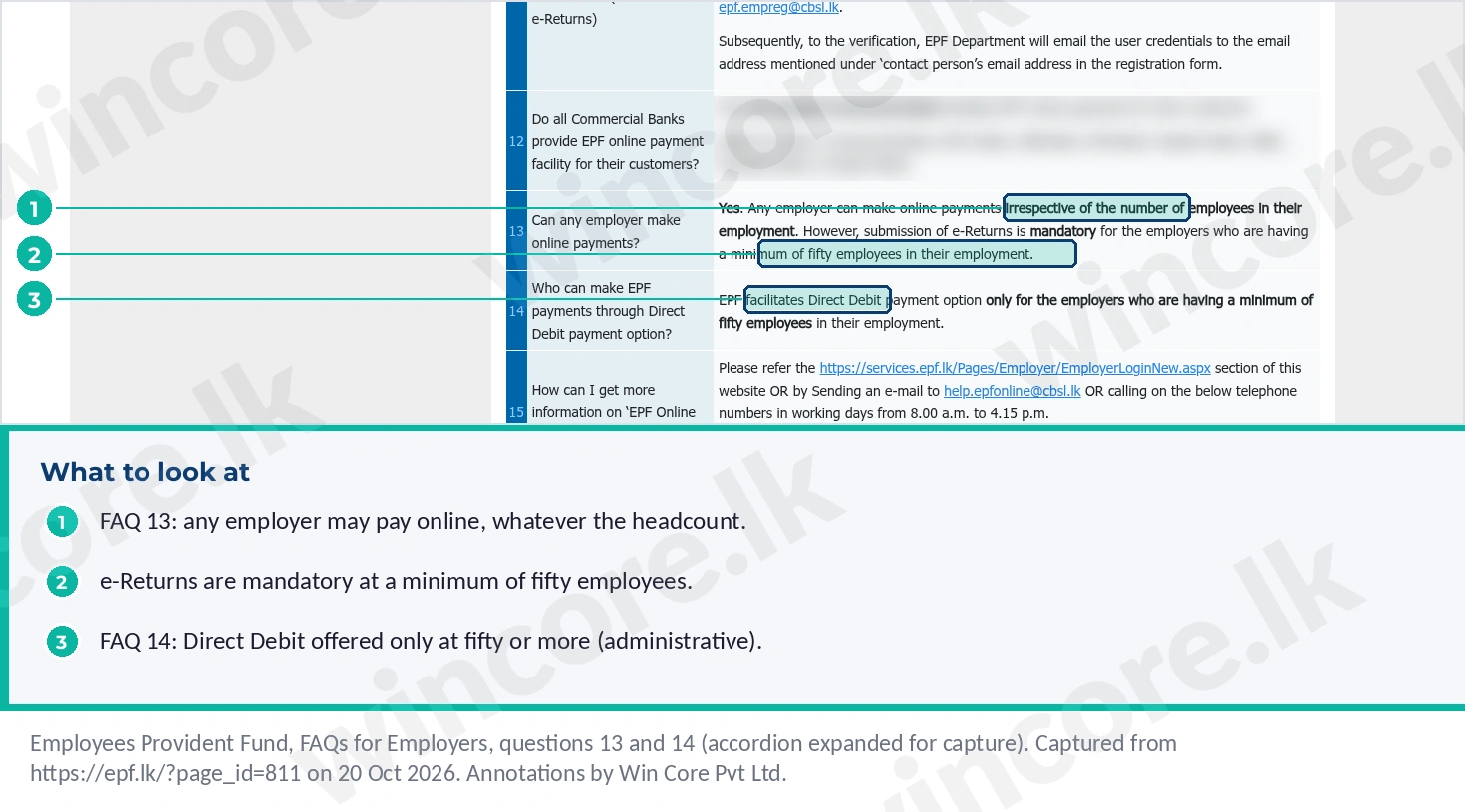
The EPF Department's employer FAQ says the same in plainer words: "Any employer can make online payments irrespective of the number of employees in their employment. However, submission of e-Returns is mandatory for the employers who are having a minimum of fifty employees in their employment." It adds that Direct Debit is offered "only for the employers who are having a minimum of fifty employees" [6]. That second point is an administrative arrangement, not a statutory rule.
Below fifty, paper is still allowed. The EPF Department's remitting contributions page says employers with fewer than fifty employees may submit contribution details on paper Form C, and recommends electronic filing even below fifty [7]. That is a recommendation, and we label it as such. Both epf.lk pages still stated the fifty threshold when we read them on 22 October 2026.
Contributions again do not depend on the threshold. Section 10 of the EPF Act sets the employee's share at eight per centum and the employer's at twelve per centum of total earnings, subject to section 10(3) and section 27 [8]. What counts in "total earnings" is covered in our note on which allowances count for EPF and ETF.
Each default has its own penalty section
| Default | Section | What the section says |
|---|---|---|
| Gratuity paid after day 30 | Gratuity Act s.5(4), s.8(8) | Surcharge to the workman: 10 percent (up to one month from the due date) rising to 30 percent (over twelve months); recoverable with the gratuity [1] |
| ETF contributions paid late | ETF Act s.27 | 5 to 50 percent of the contribution by length of arrears, unless the employer satisfies the Board that the failure was "due to circumstances beyond his control" [5] |
| ETF return late, incorrect or deficient | ETF Act s.37A | 1 percent of the contribution for every completed month or part, where the return is required "by the Act or any regulation made there-under or any direction issued by the Board" [5] |
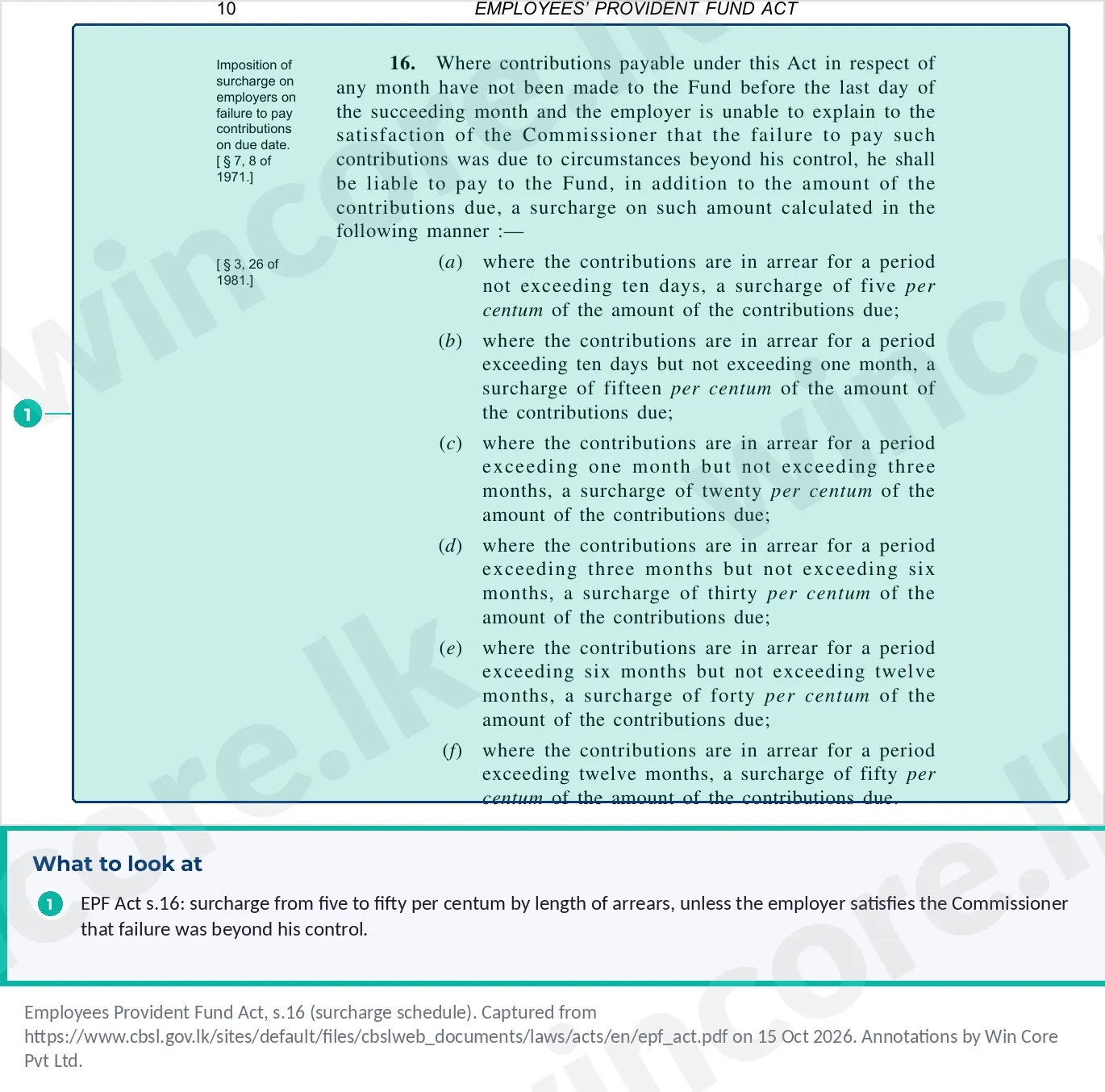
| EPF contributions paid late | EPF Act s.16 | 5 to 50 percent of the contributions due, with the same "beyond his control" test, judged by the Commissioner [8] |
| EPF return late, incorrect or deficient | EPF Act s.31A, rate raised to two per centum by Act No. 2 of 2012 s.5 | 2 percent of the contribution for every completed month or part until a duly completed return is received [4] [8] |
| Offence under the EPF Act | EPF Act s.37, as amended by Act No. 2 of 2012 s.7 | Fine up to Rs 2,500, imprisonment up to six months, or both, plus up to Rs 75 a day while it continues [4] [8] |
Two cautions on that table. On our reading, s.37A reaches an ETF return that regulation 3(1)(d) requires electronically, but whether a paper return sent on time by an employer above fifteen counts as "deficient" is not settled in anything we read. The same applies to a paper EPF return from an employer at fifty or more under s.31A. We keep both open. The full surcharge ladder is in our note on the EPF and ETF surcharge sections.
The three counts use different words, so count each one separately
Gratuity counts "workmen" on "any day" over a twelve-month look-back, so a short peak counts. The ETF and EPF texts say "a minimum of" fifteen or fifty "employees" with no look-back, which on our reading means the month's headcount.
Our bicycle repair chain crosses two gates at fifteen. From that month its ETF must be paid and reported electronically, and every leaver with five completed years is owed a gratuity within thirty days. If it later drops to fourteen, on our reading the ETF rule stops applying for the months it is below fifteen, but the gratuity duty stays for anyone with five completed years who leaves within twelve months after the last day it had fifteen.
Who counts is its own question. Under regulation 2(2) of the EPF Regulations 1958, a director is outside EPF for the directorship itself, and casual work paid by the day, job or journey is not covered employment (regulation 3) [9]. Each Act has its own definition, so a person can count for one test and not another.
What this means for you
- Keep a monthly headcount log with the peak day. For gratuity, the highest headcount on any day in the last twelve months is what matters.
- Provide for gratuity once you reach fifteen. From that point every leaver with five years is owed half a month per year within thirty days. Recognising the liability as it builds is required by the accounting standards (LKAS 19, or Section 28 of SLFRS for SMEs); booking it monthly is practice, not a legal requirement. Our gratuity calculator gives the figure per employee.
- Set up ETF electronic payment before you hire the fifteenth person. Bank and Board set-up takes time, and from July 2026 contributions the Board does not accept cheques or manual returns from larger employers. This is practice, not law, but it avoids a month inside the rule with no channel ready.
- Plan EPF e-Returns ahead of fifty. The EPF Department already recommends electronic filing below fifty, so switching early costs nothing in compliance terms.
- Keep the rates separate from the gates. EPF at 8 and 12 percent and ETF at 3 percent apply at any headcount; our EPF calculator works them out.
Our payroll services run EPF, ETF and gratuity workings for growing employers, our HR services keep the headcount and service records the tests depend on, and our accounting services book the gratuity provision.
Checklist: documents needed
- Monthly headcount log showing the peak day in each month
- Employment start dates for every employee, for the five-year gratuity test
- Last-drawn monthly wage or salary for each long-serving employee
- ETF employer number and the electronic payment arrangement with your bank
- EPF employer number and, at fifty, e-Return registration
- Gratuity provision workings for the year-end accounts
Open points
- ETF Gazette text. The Board's notice cites Extraordinary Gazette No. 2311/39 of 22 December 2022, and the Board's page shows the regulation text with 1 February 2023. We have not read the Gazette itself.
- Paper returns above a threshold. Whether ETF s.37A or EPF s.31A applies to a return sent on time on paper by an employer inside the electronic rule is not settled in what we read.
- "More than 50" or "minimum of fifty". The Department of Labour's chatbot FAQ says "Establishments with more than 50 employees should compulsorily send contributions and details" electronically [10]. Section 31B says "a minimum of fifty employees". At exactly fifty the two differ. The Act governs, so we treat fifty as inside the rule.
- A fourth figure in the 1958 Regulations. Regulation 7(2) of the EPF Regulations 1958 sets different return forms (C(1), C(2), C(3)) for employers averaging not less than 150 employees over three consecutive months [9]. We have not confirmed whether it is still applied alongside s.31B.
FAQ
We have 14 staff. Do we still pay ETF?
Yes, every employer pays ETF for each employee to whom the ETF Act applies, whatever its headcount. Section 16(1) requires 3 percent of that employee's total earnings by the last day of the following month. Reaching fifteen changes only how you pay and report: electronically, with the Board refusing cheques and manual returns from July 2026 contributions.
Does the gratuity threshold count the headcount on the day someone leaves?
No, the gratuity test looks back over the whole twelve months before the termination. Section 5(1) applies if the employer had fifteen or more workmen on any day in that period. A business that had sixteen people for two months and now has twelve still owes gratuity to a leaver with five completed years within that window.
Is EPF online payment compulsory for small employers?
No, online payment is open to any employer but not compulsory below fifty employees. Section 31B makes electronic monthly returns compulsory for employers with a minimum of fifty employees. Below that, the EPF Department accepts paper Form C, although it recommends filing and paying electronically whatever your size.
When did online ETF payment become mandatory?
The regulation dates the duty from 1 February 2023, and the ETF Board enforces it from July 2026 contributions, due by 31 August 2026. Both dates come from the Board: its payment of contributions page carries the regulation text, and its notice citing Gazette 2311/39 sets the July 2026 enforcement. It applies to employers with a minimum of fifteen employees.
Do the thresholds change the 8, 12 and 3 percent rates?
No, the contribution rates apply at any headcount. EPF is 8 percent from the employee and 12 percent from the employer under section 10 of the EPF Act, and ETF is 3 percent from the employer under section 16(1) of the ETF Act. The thresholds decide gratuity liability and the payment and filing channel, not the amount.
Last verified 22 October 2026 against the Gratuity Act reprint and EPF Regulations on labourdept.gov.lk, the ETF Board's page and notice on etfb.lk, Act No. 2 of 2012 on parliament.lk, the EPF and ETF Acts, and the epf.lk employer pages.
Talk to us. If your headcount is about to cross fifteen or fifty, speak to us at our contact page.
WinCore Pvt Ltd
This article is general information on the law as at 22 October 2026 and is not advice on your specific position.
References
- Department of Labour. Labour Code of Sri Lanka, reprint of the Payment of Gratuity Act, No. 12 of 1983 (as amended), ss.5(1), 5(4), 6(2), 7, 8(8), 10 and 20. https://labourdept.gov.lk/downloads/labour_code/55.pdf . Primary. Accessed 22 October 2026.
- Employees' Trust Fund Board. Payment of contributions (text of regulation 3(1)(c) and (d) amending the ETF Regulations 1981; employer categories; R1 and R4). https://etfb.lk/payment-of-contributions/ . Primary (official publication of regulation text). Accessed 22 October 2026.
- Employees' Trust Fund Board. Notice: mandatory electronic payment of contributions, citing Extraordinary Gazette No. 2311/39 of 22 December 2022. https://etfb.lk/wp-content/uploads/2026/04/NOTICE-Mandatory-Electronic-Payment-English.pdf . Primary. Accessed 22 October 2026.
- Parliament of Sri Lanka. Employees' Provident Fund (Amendment) Act, No. 2 of 2012 (certified 9 February 2012), ss.5, 6 and 7. https://www.parliament.lk/uploads/acts/gbills/english/5822.pdf . Primary. Accessed 22 October 2026.
- Employees' Trust Fund Board. Employees' Trust Fund Act, No. 46 of 1980 (as amended), ss.16(1), 27, 37A and 43. https://etfb.lk/wp-content/uploads/2021/03/ETF-Act.pdf . Primary. Accessed 22 October 2026.
- Employees' Provident Fund Department, Central Bank of Sri Lanka. FAQs for Employers, questions 13 and 14. https://epf.lk/?page_id=811 . Primary (administrative). Accessed 22 October 2026.
- Employees' Provident Fund Department. Remitting Contributions. https://epf.lk/?p=171 . Primary (administrative). Accessed 22 October 2026.
- Central Bank of Sri Lanka. Employees' Provident Fund Act, No. 15 of 1958 (reprint incorporating amendments to 31 December 1998, not a statutory reprint), ss.10, 16, 31A and 37. https://www.cbsl.gov.lk/sites/default/files/cbslweb_documents/laws/acts/en/epf_act.pdf . Primary. Accessed 22 October 2026.
- Department of Labour. Employees' Provident Fund Regulations, 1958 (Labour Code copy), regulations 2, 3 and 7. https://labourdept.gov.lk/downloads/labour_code/48.pdf . Primary. Accessed 22 October 2026.
- Department of Labour. Questions and Answers for GIC Chatbot (FAQ), question 10. https://labourdept.gov.lk/wp-content/uploads/2025/01/faq.pdf . Primary (administrative). Accessed 22 October 2026.
Put these insights to work
WinCore specialists can review your current workflow, document gaps, and build a practical 90-day action plan.
Book a free consultationContinue reading
Explore more WinCore analysis to keep your finance, tax, and compliance roadmap moving.
The sections that decide a gratuity claim: who is caught, who is excluded, how much, the day-30 due date and the surcharge Act No. 62 of 1992 added.

Monthly EPF and ETF payment procedures for Sri Lankan employers: the last working day deadline, Form C and e-returns, ETF electronic payment, surcharges and evidence.
The four sections behind EPF and ETF: rates, the due day, the 5 to 50 percent ladder, who judges 'beyond control', and what Act No. 2 of 2012 changed.