
Payment of Gratuity Act Sri Lanka: No. 12 of 1983, clause by clause
The sections that decide a gratuity claim: who is caught, who is excluded, how much, the day-30 due date and the surcharge Act No. 62 of 1992 added.
On this page
Last verified against the primary sources on 21 October 2026.
Under the Payment of Gratuity Act in Sri Lanka (No. 12 of 1983, Part II), an employer that employed fifteen or more workmen on any day in the twelve months before a workman's termination must pay that workman a gratuity if he has five completed years of service, within thirty days of termination. A monthly rated workman gets half a month's last-drawn wage or salary for each completed year. Since Act No. 62 of 1992, payment after day 30 adds a surcharge of 10 to 30 percent, payable to the workman or his heirs [1].
This is a Regulation Desk note on the Act's text and its two amending Acts. For the evergreen employer guide, with worked calculations and the APIT treatment, read our gratuity payment guide. Nothing here changes a figure in it.
Gratuity is a gate with a timer behind it. Size and time open the gate; the clock starts the day the job ends.
Two amending Acts, and Part II is the rule for ordinary employers
The Act came into operation on a date appointed by Order, Gazette Extraordinary No. 238/2 of 29 March 1983 (s.1 and its footnote in the Labour Code reprint) [1]. Part I deals with workmen on land that vested in the Land Reform Commission. Part II, from section 5, is the rule for any industry.
The Labour Code reprint carries two amending Acts in its margin: Act No. 41 of 1990, which inserted sections 7A to 7C for workmen moving into a company that takes over a public corporation or government business undertaking, and Act No. 62 of 1992, which inserted the surcharge in section 5(4) and section 8(8) [1]. The documents.gov.lk Acts index for "Gratuity" lists Acts No. 12 of 1983, 41 of 1990 and 62 of 1992 only, and a keyword search of Extraordinary Gazettes for 2024 to 2026 returned nothing [2]. We found no later amendment, and treat that as a finding of absence, not proof.
The Payment of Gratuity Act in Sri Lanka opens on size and service
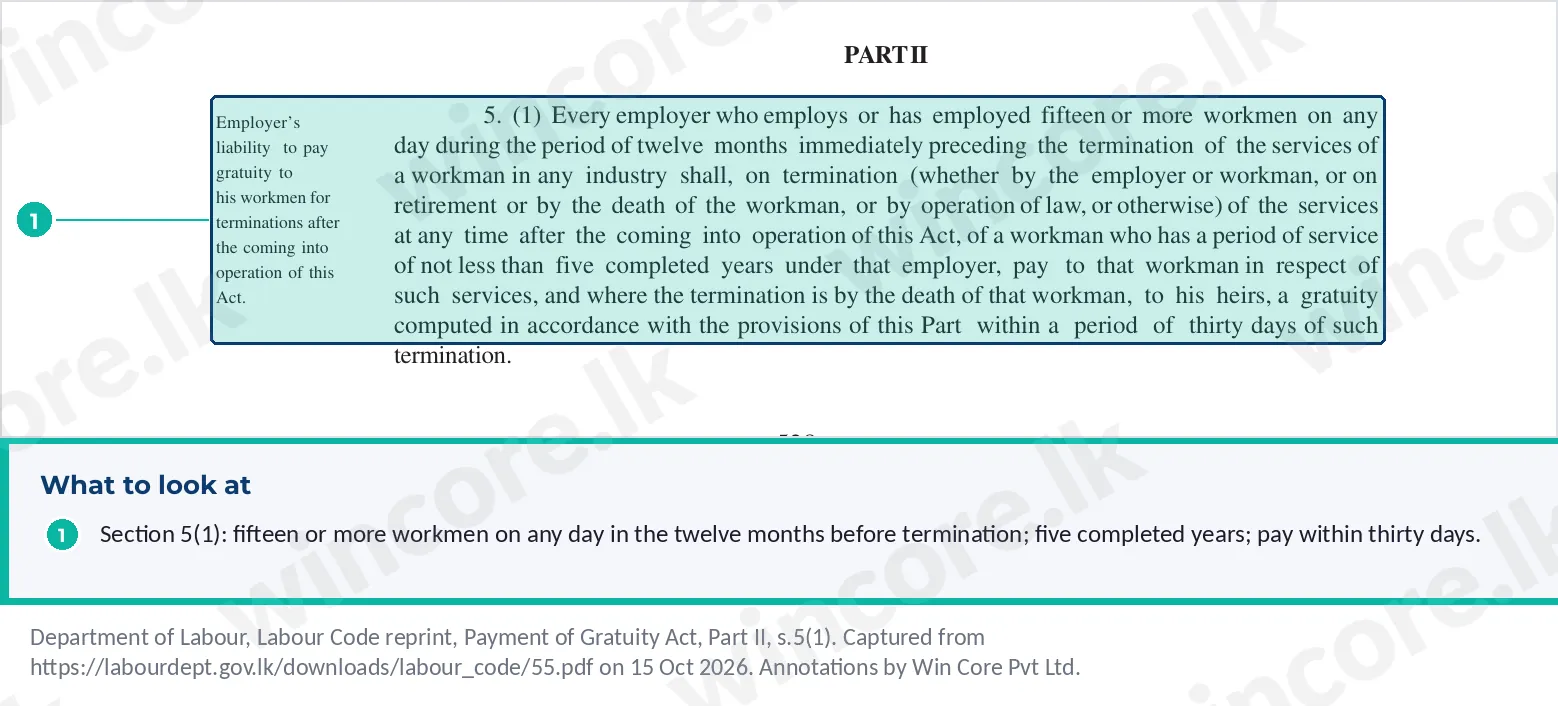
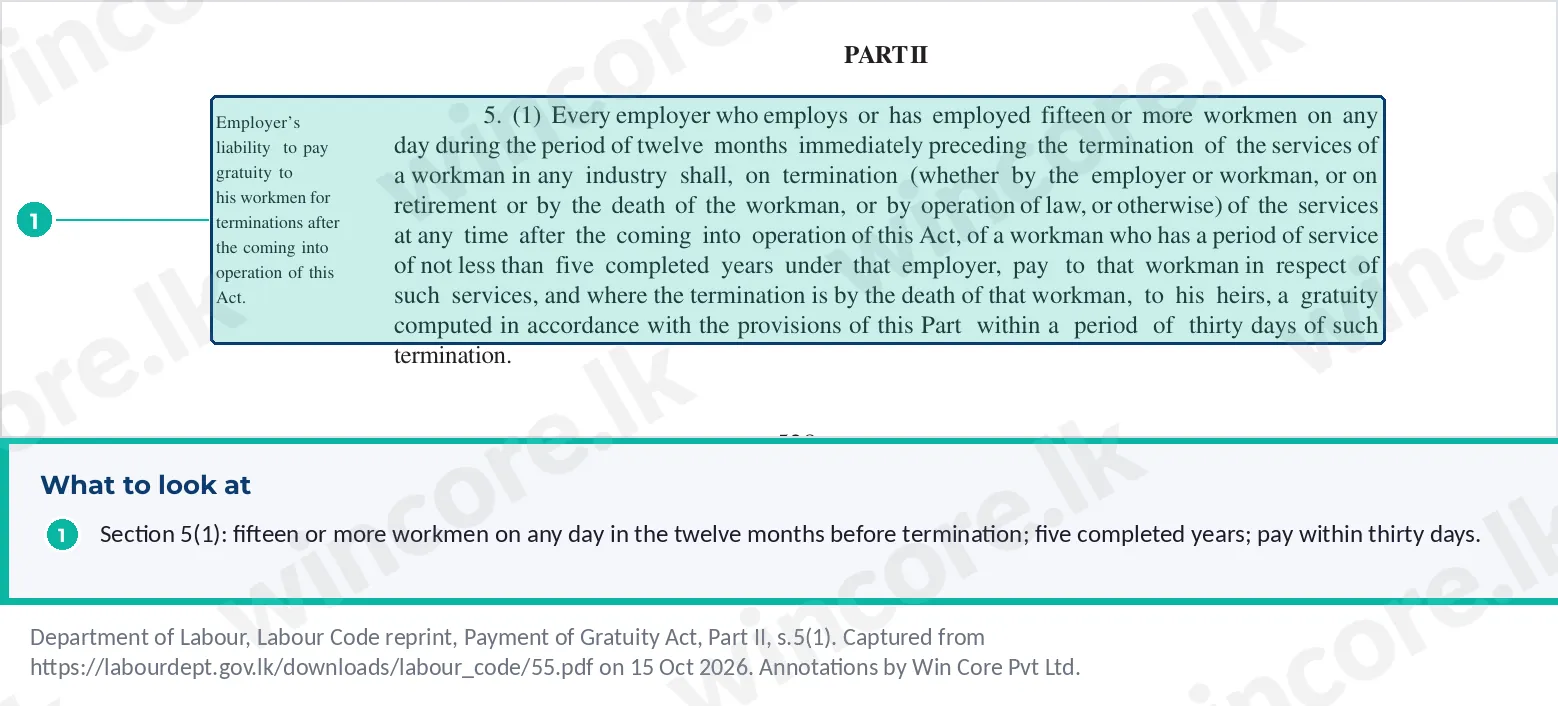
Section 5(1) is the gate. "Every employer who employs or has employed fifteen or more workmen on any day during the period of twelve months immediately preceding the termination of the services of a workman in any industry" must pay a gratuity to "a workman who has a period of service of not less than five completed years under that employer", within thirty days of termination [1].
Four points sit inside that sentence:
- One day at fifteen is enough. The count is any day in the twelve months before that workman's termination, not the headcount on the leaving day. Our note on the three payroll headcount thresholds sets this beside the ETF and EPF counts.
- Every kind of ending counts. Termination "whether by the employer or workman, or on retirement or by the death of the workman, or by operation of law, or otherwise". A resignation qualifies.
- "Completed service" is defined in section 20 as "uninterrupted service" that "includes service which is interrupted by approved leave on any ground whatsoever", and the definition goes on to other permitted interruptions [1].
- Death. Where termination is by death, the gratuity goes to the heirs (s.5(1)), and section 9 sends an unpaid gratuity to the heirs if the workman dies before receiving it.
Who the Act leaves out
The gate has exclusions, and they come from three places [1]:
- Section 7 takes out a workman "employed as a domestic servant or as a personal chauffeur in a private household", and one "entitled to a pension under any non-contributory pension scheme".
- Section 20 defines "employer" to exclude certain co-operative societies and local authorities.
- Under fifteen workmen, section 5 does not apply. Section 17 of the Gratuity Act amended the Industrial Disputes Act so that a workman of an employer with fewer than fifteen workmen can still take "the question whether any gratuity or other benefits are due to him" to a labour tribunal.
So "no gratuity under fifteen" is too strong. On our reading the statutory duty is absent, but a tribunal claim, a contract term or a collective agreement can still produce one.
Half a month a year, at the wage last drawn
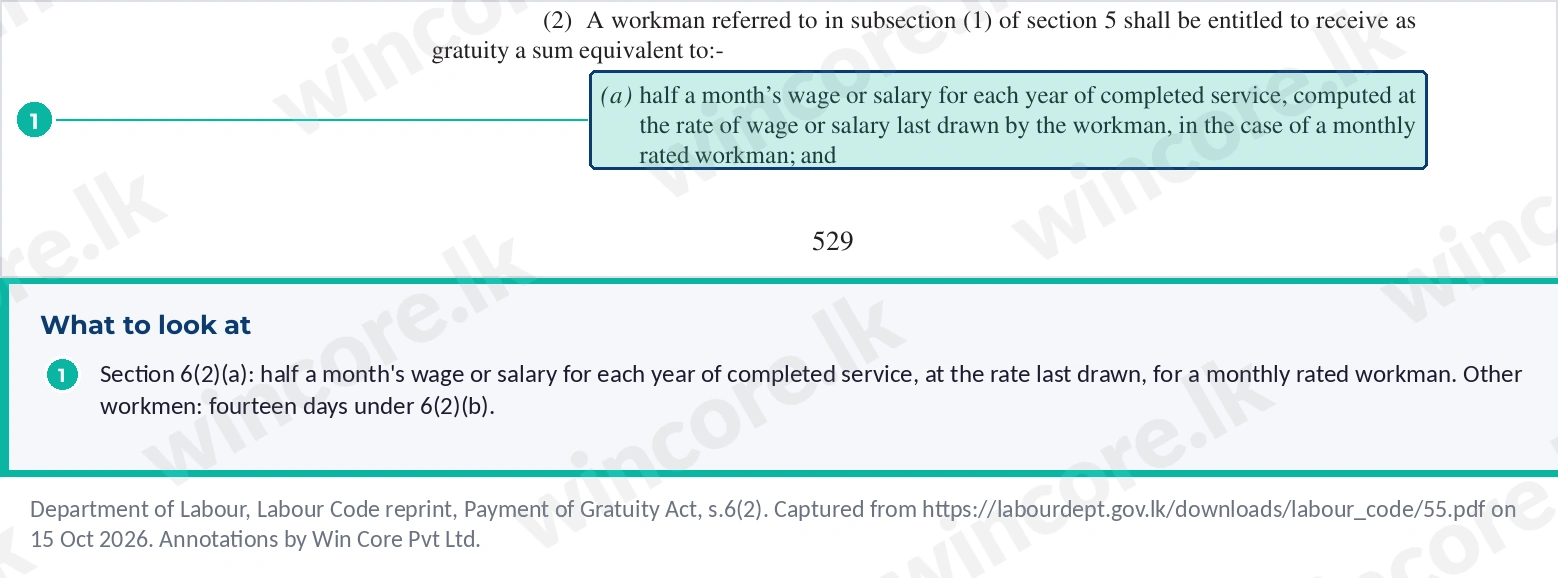
Section 6(2) sets the amount [1]:
| Workman | Gratuity per completed year | Rate used |
|---|---|---|
| Monthly rated | Half a month's wage or salary | Rate last drawn |
| Any other workman | Fourteen days' wage or salary | Rate last drawn |
| Piece rated | Fourteen days, at a daily rate from the last three months' pay | Average over days worked |
Section 20 defines "wage or salary" to cover the basic or consolidated wage or salary, cost of living and similar allowances, and piece rates [1]. Whether a particular allowance such as transport or attendance is "similar" is a judgment on its facts, and our gratuity payment guide suggests recording the basis you use. After the 2026 rise in the national minimum wage, the last-drawn rate for lower-paid staff has moved; see our note on the minimum wage amendment Act 2025.
Three more sections change the number:
- s.10, more favourable terms. Where a collective agreement, an award of an Industrial Court or arbitrator, or another agreement gives a gratuity "more favourable to the workman", that computation applies. The workman cannot take both.
- s.13, forfeiture. Where a workman's services are terminated for fraud, misappropriation of the employer's funds, wilful damage to property, or causing loss of goods, the gratuity is forfeited only "to the extent of the loss or damage".
- s.14, sale of a business. If an employer sells or alienates the land or establishment within five years of becoming the employer, the workman's service under the seller counts toward service under the buyer.
Our gratuity calculator applies the section 6(2) formula.
Act No. 62 of 1992 added a surcharge that goes to the workman
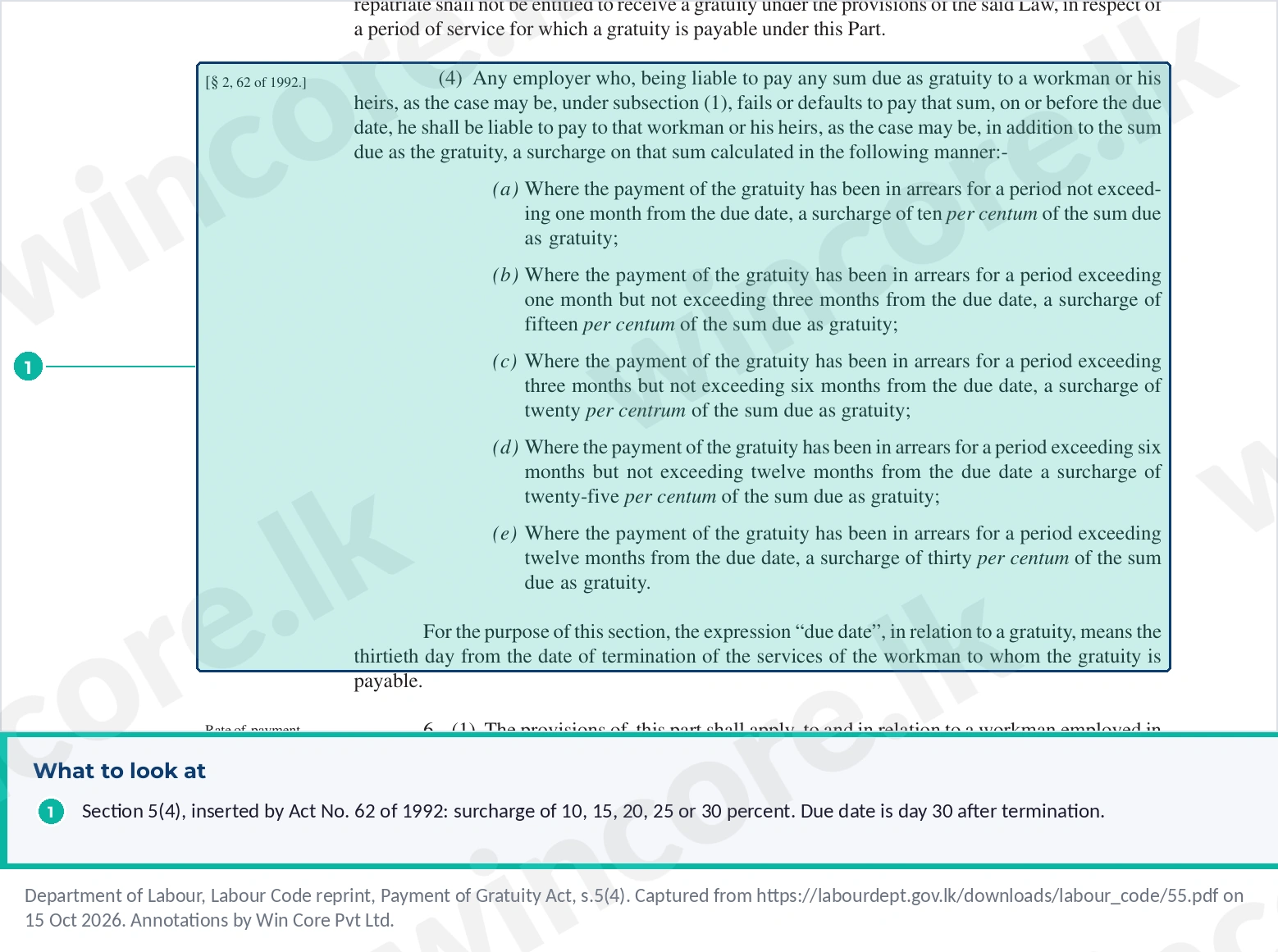
Section 5(4), inserted by section 2 of Act No. 62 of 1992: an employer who "fails or defaults to pay that sum, on or before the due date" is liable to pay "to that workman or his heirs ... in addition to the sum due as the gratuity, a surcharge on that sum" [1].
| Gratuity in arrears from the due date | Surcharge on the gratuity |
|---|---|
| Not exceeding one month | 10 percent |
| Exceeding one month, not exceeding three months | 15 percent |
| Exceeding three months, not exceeding six months | 20 percent |
| Exceeding six months, not exceeding twelve months | 25 percent |
| Exceeding twelve months | 30 percent |
The "due date" is "the thirtieth day from the date of termination". Day 31 is already in the 10 percent band.
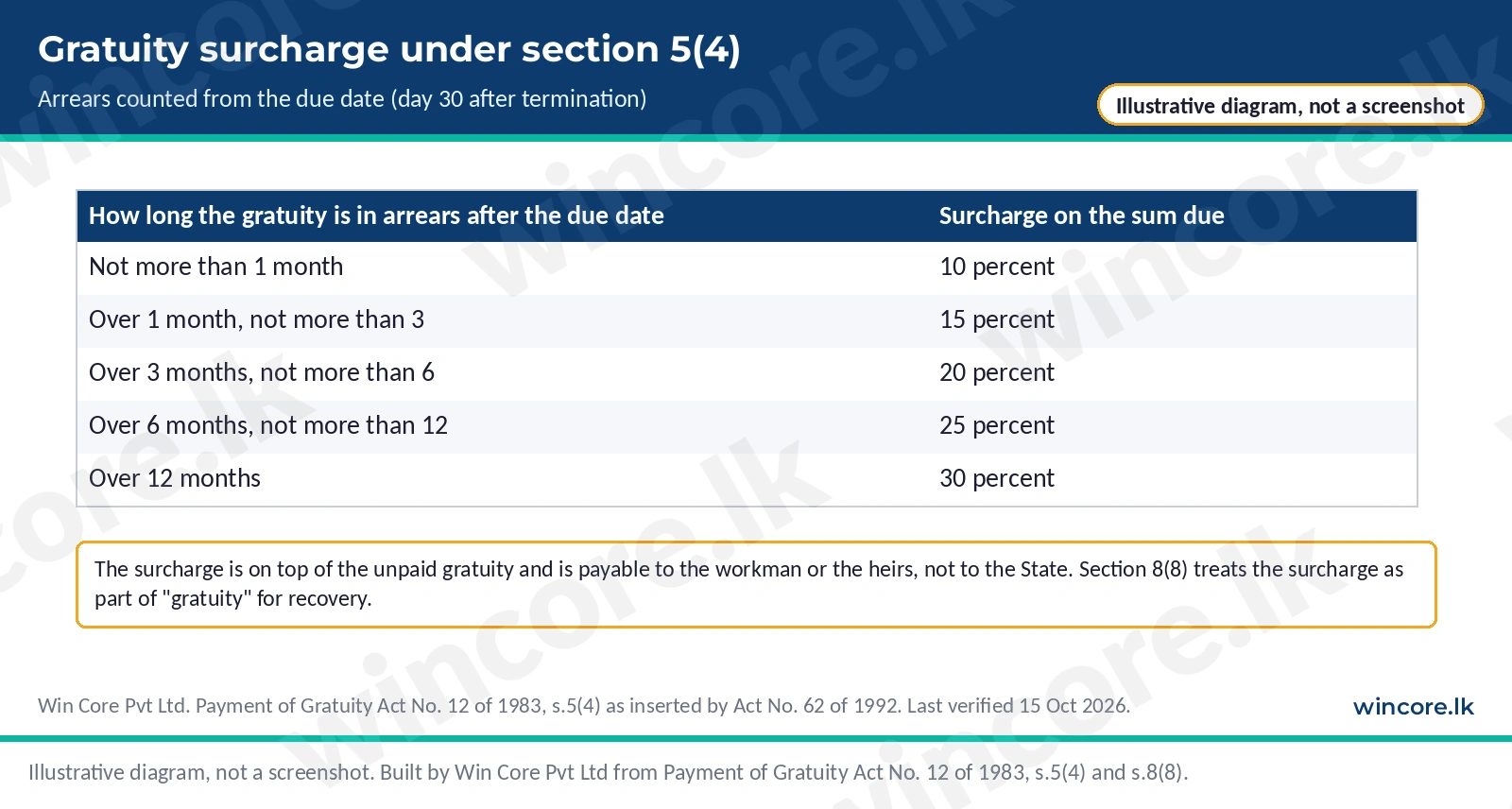
Unlike the EPF and ETF surcharges, which are paid into the funds, this one is the workman's money. Section 8(8) says "gratuity" includes the surcharge for recovery, so under section 8(1) the Commissioner can certify the whole sum to a Magistrate and the unpaid amount is then recovered as if it were a fine [1]. Separately, section 15 makes a contravention of the Act an offence with a fine not exceeding Rs 500, imprisonment up to six months, or both. That fine is small; the surcharge and the recovery route are the real cost of delay.
Does a dispute about the amount stop the clock? The Act does not say so. On our reading section 5(4) runs from day 30 whether or not the amount is contested, so an employer that disputes part of a claim should consider paying the undisputed part on time.
A hypothetical claim, worked through
Take an invented fruit packing house in Badulla that runs about thirty-five staff in the harvest months and keeps ten the rest of the year. A supervisor, monthly rated, resigns after eight completed years. Her last day is 1 June 2026 and her last-drawn salary is Rs 120,000.
- Size. The firm had fifteen or more workmen on at least one day in the twelve months before 1 June. Section 5(1) applies, even though it had ten on her last day.
- Time. Eight completed years: more than five.
- Amount. 8 x half a month x Rs 120,000 = Rs 480,000 (s.6(2)(a)).
- Due date. The thirtieth day from 1 June is 1 July 2026.
- Paid 20 July. In arrears 19 days: not exceeding one month, 10 percent, Rs 48,000 to her on top.
- Paid 15 August. In arrears more than one month and not more than three: 15 percent, Rs 72,000.
- Paid 15 October. In arrears more than three months: 20 percent, Rs 96,000.
APIT on the payment is a separate question; see our sibling note on APIT on gratuity and Tax Table 03, and our income tax advisory services for the employer's withholding.
What this means for you
Count heads across the whole year before you decide the Act does not apply, because one day at fifteen is enough. Diary day 30 from every termination, since the surcharge belongs to the workman and cannot be negotiated away later. Use the last-drawn wage, including cost of living and similar allowances, and check for a collective agreement that pays more. Provide for staff past five years in your accounts.
Our payroll services team calculates and pays gratuities and keeps the provision current, our HR compliance services handle the termination paperwork, and our accounting services carry the liability in the books.
Checklist: documents needed
- Headcount records for every day of the twelve months before the termination
- The workman's appointment letter and service history, including any service with a seller under s.14
- Last three payslips, showing basic, cost of living and other allowances
- Resignation, retirement, termination or death record with the exact last day
- Any collective agreement or award on gratuity
- Payment confirmation dated on or before day 30
FAQ
Is gratuity payable on resignation in Sri Lanka?
Yes, if the employer had fifteen or more workmen on any day in the prior twelve months and the workman has five completed years. Section 5(1) covers termination "by the employer or workman", retirement, death, operation of law "or otherwise". A resignation is a termination by the workman, so the reason for leaving does not remove the duty.
How is gratuity calculated under the Payment of Gratuity Act?
A monthly rated workman gets half a month's last-drawn wage or salary for each completed year of service, under section 6(2)(a). Other workmen get fourteen days' wage per year. Eight years at a last-drawn Rs 120,000 a month gives Rs 480,000. A more favourable collective agreement replaces this formula under section 10.
When must gratuity be paid?
Within thirty days of termination, under section 5(1). Section 5(4) defines the due date as the thirtieth day from the date of termination, and any payment after that attracts a surcharge from 10 percent, rising to 30 percent after twelve months. The surcharge is payable to the workman or his heirs.
Does the Gratuity Act apply to employers with fewer than 15 workers?
No, section 5 applies only where fifteen or more workmen were employed on any day in the prior twelve months. But section 17 amended the Industrial Disputes Act so that a workman of a smaller employer can ask a labour tribunal whether a gratuity is due, and a contract or collective agreement can still require one.
Who gets the gratuity surcharge?
The workman, or his heirs, not the State. Section 5(4) makes the surcharge payable "to that workman or his heirs" in addition to the gratuity, and section 8(8) treats it as part of the gratuity for recovery through a Magistrate. The separate criminal fine under section 15 is up to Rs 500.
Open points
- Allowances. Section 20 includes cost of living and "similar" allowances in "wage or salary"; which other allowances are "similar" is a question of fact.
- Fixed-term contracts. Whether a contract ending by effluxion of time is a "termination" under section 5(1) seems covered by "operation of law, or otherwise", but we have not traced a binding judgment.
- Disputed amounts. The Act does not say whether a dispute pauses the section 5(4) clock; on our reading it does not.
- Later amendments. None found after Act No. 62 of 1992 in the documents.gov.lk index.
Last verified 21 October 2026 against the Labour Code reprint on labourdept.gov.lk.
Talk to us. If you are working out a gratuity on a resignation, retirement or restructuring, or want your gratuity provision checked, speak to us at our contact page.
WinCore Pvt Ltd
This article is general information on the law as at 21 October 2026 and is not advice on your specific position.
References
- Department of Labour. Labour Code of Sri Lanka, Payment of Gratuity Act, No. 12 of 1983 (reprint carrying Acts Nos. 41 of 1990 and 62 of 1992), ss.1, 5 to 10, 13 to 15, 17 and 20, and the footnote naming Gazette Extraordinary No. 238/2 of 29 March 1983. https://labourdept.gov.lk/downloads/labour_code/55.pdf . Primary. Accessed 21 October 2026.
- Department of Government Printing. documents.gov.lk Acts index, keyword "Gratuity" (Acts Nos. 12 of 1983, 41 of 1990 and 62 of 1992), and Extraordinary Gazette keyword search for 2024 to 2026. https://documents.gov.lk/web/acts . Primary (search index). Accessed 15 October 2026.
Put these insights to work
WinCore specialists can review your current workflow, document gaps, and build a practical 90-day action plan.
Book a free consultationContinue reading
Explore more WinCore analysis to keep your finance, tax, and compliance roadmap moving.

Gratuity under the Payment of Gratuity Act: employers of 15 or more, five years' service, the half-month and 14-day formulas, the 30-day deadline, surcharge and tax.
How to lawfully terminate employees in Sri Lanka: disciplinary inquiries, TEWA consent or approval, compensation, final pay and the six-month tribunal limit.
Employer-focused labour law guide for Sri Lanka covering contracts, hours, wages, leave, records, and inspection-ready controls.