
APIT on gratuity in Sri Lanka: Tax Table 03 and termination pay
Gratuity and termination pay skip the monthly APIT tables. What Table 03 retains, when 36 percent applies, the 90 day direction and the Act's own rates.
On this page
Last verified against the primary sources on 22 October 2026.
APIT on gratuity in Sri Lanka is withheld under the Inland Revenue Department's Tax Table No. 03, not the monthly tables. Where a retiring gratuity, commuted pension, compensation under a scheme the Commissioner General has approved and ETF payments together exceed Rs 5,000,000, the employer and the ETF each retain 12 percent of the excess. Compensation under an unapproved scheme and other retirement payments carry 36 percent, unless the year's pay plus those payments is within Rs 1,800,000. The employee then has 90 days to obtain a direction from the IRD. Separately, the Inland Revenue Act taxes the same terminal benefits at 0 percent up to Rs 10,000,000 for the year. Table 03 in the 2025/2026 set is still the latest the IRD lists as at 22 October 2026 [1] [2] [3]. For the employer's part when a member leaves or retires, see EPF withdrawal and the employer's role.
Take a hypothetical employee leaving after twenty years with a last-drawn monthly salary of Rs 400,000, at a company that had fifteen or more workmen on some day in the past year. Is the gratuity taxed with the final salary, or somewhere else? Does the employer withhold anything? This piece works through the answer from Table 03 and the Act.
APIT on gratuity in Sri Lanka has three layers: the Act, the tables and the direction
The Act. Section 83A(1A) of the Inland Revenue Act No. 24 of 2017 requires an employer to deduct APIT from 1 January 2023 "on any payment which falls under section 5 made to his employee, as specified by the Commissioner-General" [1]. The final rates for terminal benefits sit in the First Schedule, paragraph 1(2)(b) and (3) [1].
The tables. The APIT index for 2025/2026 is issued under section 83A(1A) and lists Tax Table No. 03 for "Once-and-for all Payment (Terminal Benefits" for all employees [4]. The IRD's APIT tables page lists sets up to 2025/2026 and no 2026/2027 set when we checked on 22 October 2026, so that table is the one in use [5].
The direction. Table 03 ends by sending the employee to the IRD's Clearance and Directions Unit, which tells the employer what to do with the amount retained [2].
The IRD's APIT circular adds a rule of priority: "if there is any inconsistency between the provisions of the Inland Revenue Act and these instructions, the provisions of the Act shall be applied" [6]. Our separate note on Circular SEC/2025/E/01 covers the circular as a whole.
Table 03 covers payments made because employment ends, not the last payslip
Paragraph 01 of Table 03 lists the payments it applies to [2]:
- "any sum payable in commutation of pension";
- "any sum payable as retiring gratuity";
- "any sum payable as compensation for loss of office or employment";
- "any sum payable from the Employees Trust Fund (ETF) (excluding the share of investment income of the fund, after 31.03.1987)";
- "any sum payable from any Provident Fund, which has not been approved by the Commissioner General of Inland Revenue (CGIR)";
- "any other payments or benefits made in respect of retirement."
It then exempts "Any amount paid from a Provident Fund approved by the CGIR or Regulated Provident Funds"; capital sums paid as compensation or a gratuity in relation to "personal injuries suffered by the person" or "the death of another person"; and "Pension or any retiring benefit paid by the Government or a Department of the Government of Sri Lanka" [2].
So the first step is to label each part of the final payment. The final month's salary stays on the monthly tables, and for someone leaving during the year that means Table 05, as our guide to APIT for mid-year joiners and leavers explains. Leave encashment on termination goes through Table 02, not Table 03, as our lump sum and bonus tax guide sets out. On our reading, it is the reason for the payment, not the fact that it is on the last payslip, that puts it in Table 03.
Table 03 retains 12 percent above Rs 5 million, or 36 percent on unapproved payments
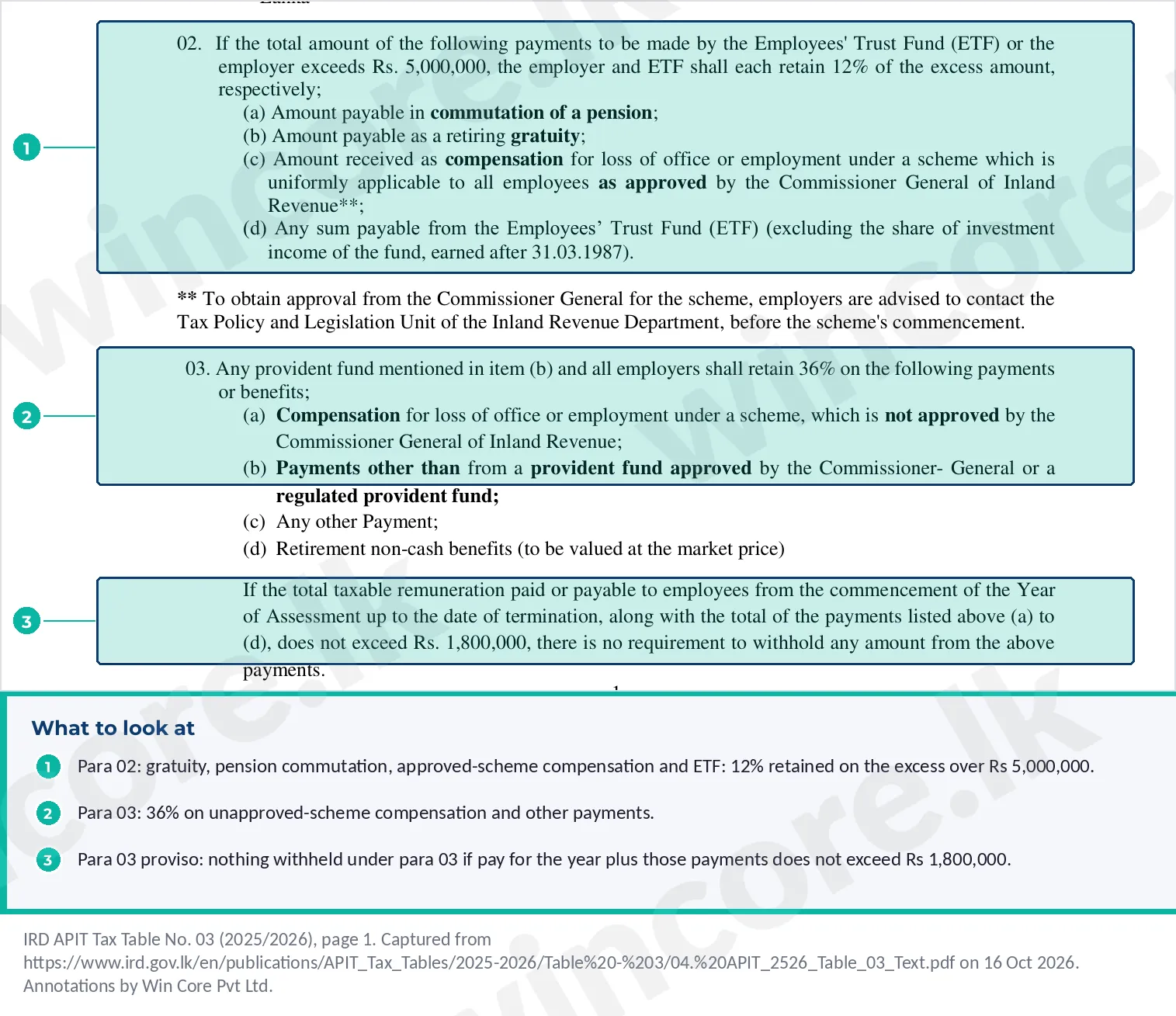
Paragraph 02, the Rs 5 million rule. "If the total amount of the following payments to be made by the Employees' Trust Fund (ETF) or the employer exceeds Rs. 5,000,000, the employer and ETF shall each retain 12% of the excess amount, respectively" [2]. The payments are pension commutation, a retiring gratuity, compensation "under a scheme which is uniformly applicable to all employees as approved by the Commissioner General of Inland Revenue", and ETF payments other than investment income earned after 31 March 1987.
Paragraph 03, the 36 percent rule. Approved provident funds and all employers "shall retain 36% on the following payments or benefits": compensation under a scheme "which is not approved by the Commissioner General of Inland Revenue"; payments other than from an approved or regulated provident fund; "Any other Payment"; and "Retirement non-cash benefits (to be valued at the market price)" [2]. The proviso: "If the total taxable remuneration paid or payable to employees from the commencement of the Year of Assessment up to the date of termination, along with the total of the payments listed above (a) to (d), does not exceed Rs. 1,800,000, there is no requirement to withhold any amount from the above payments" [2].
The difference between the two groups is approval. A compensation scheme approved by the Commissioner General as uniformly applicable to all employees sits in paragraph 02. The same payment without approval sits in paragraph 03 at 36 percent. Table 03 notes: "To obtain approval from the Commissioner General for the scheme, employers are advised to contact the Tax Policy and Legislation Unit of the Inland Revenue Department, before the scheme's commencement" [2]. An approval sought after the money is paid is not what that note describes.
The employer retains, the employee seeks a direction, and 90 days is the limit
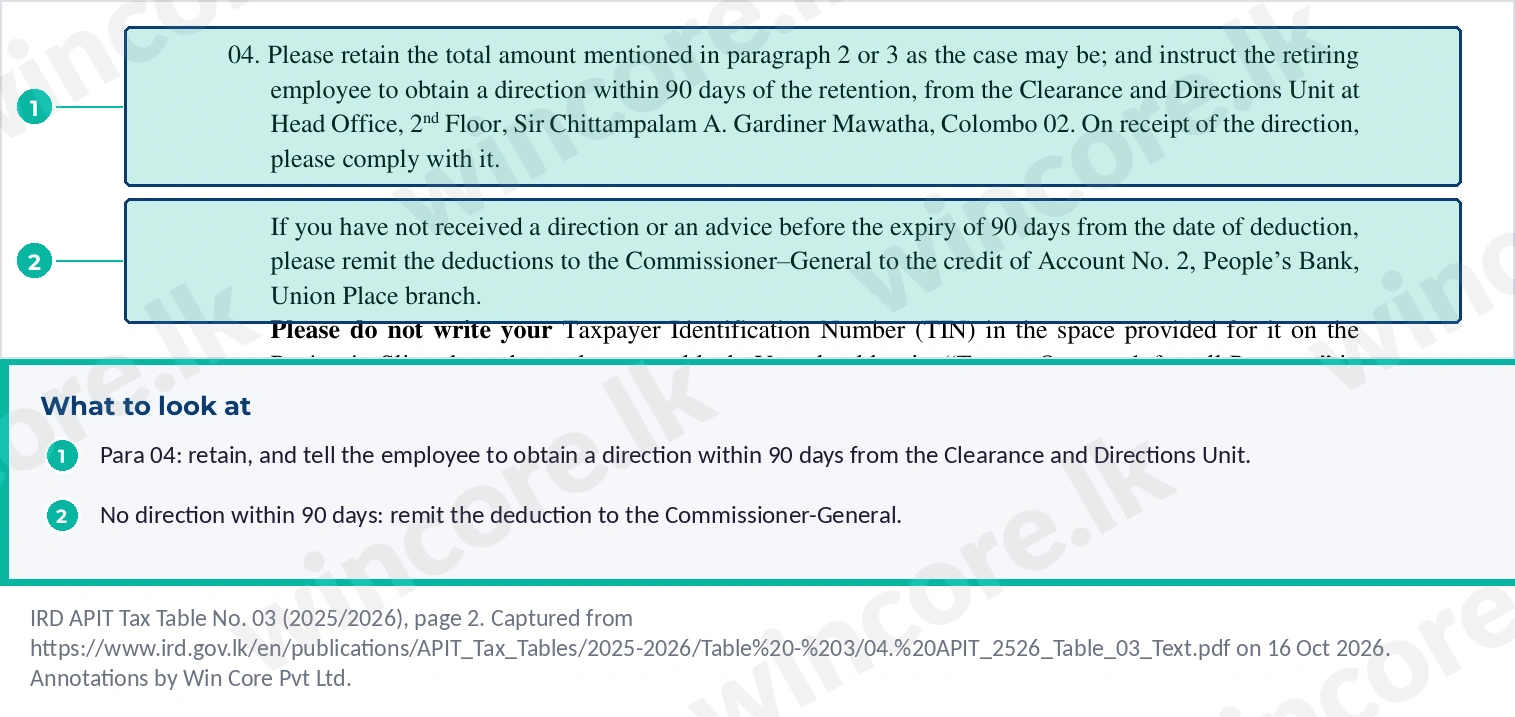
Paragraph 04 is where Table 03 differs most from the monthly tables. "Please retain the total amount mentioned in paragraph 2 or 3 as the case may be; and instruct the retiring employee to obtain a direction within 90 days of the retention, from the Clearance and Directions Unit at Head Office". "On receipt of the direction, please comply with it." And "If you have not received a direction or an advice before the expiry of 90 days from the date of deduction, please remit the deductions to the Commissioner-General" [2]. The payment goes to Account No. 2 at People's Bank, Union Place, with "Tax on Once-and-for-all Payment" as the type of tax and the TIN space left blank [2].
Here a statutory date and an administrative instruction sit side by side. Section 86(1) of the Act requires a withholding agent to pay withheld tax "within fifteen days after the end of each calendar month" [1]. Table 03 tells the employer to hold the amount for up to 90 days pending a direction. We have not found a provision in the Act that extends the section 86(1) date for this case, and the circular says the Act prevails. We keep this open. An employer relying on the 90 day window should keep the instruction given to the employee, the employee's direction request and any IRD letters on file. The payment is reported in Schedule 02 of the APIT annual statement, which is for terminal benefits only, as our APIT deduction guide notes.
The Act taxes terminal benefits at 0 percent up to Rs 10 million, which Table 03 does not mirror
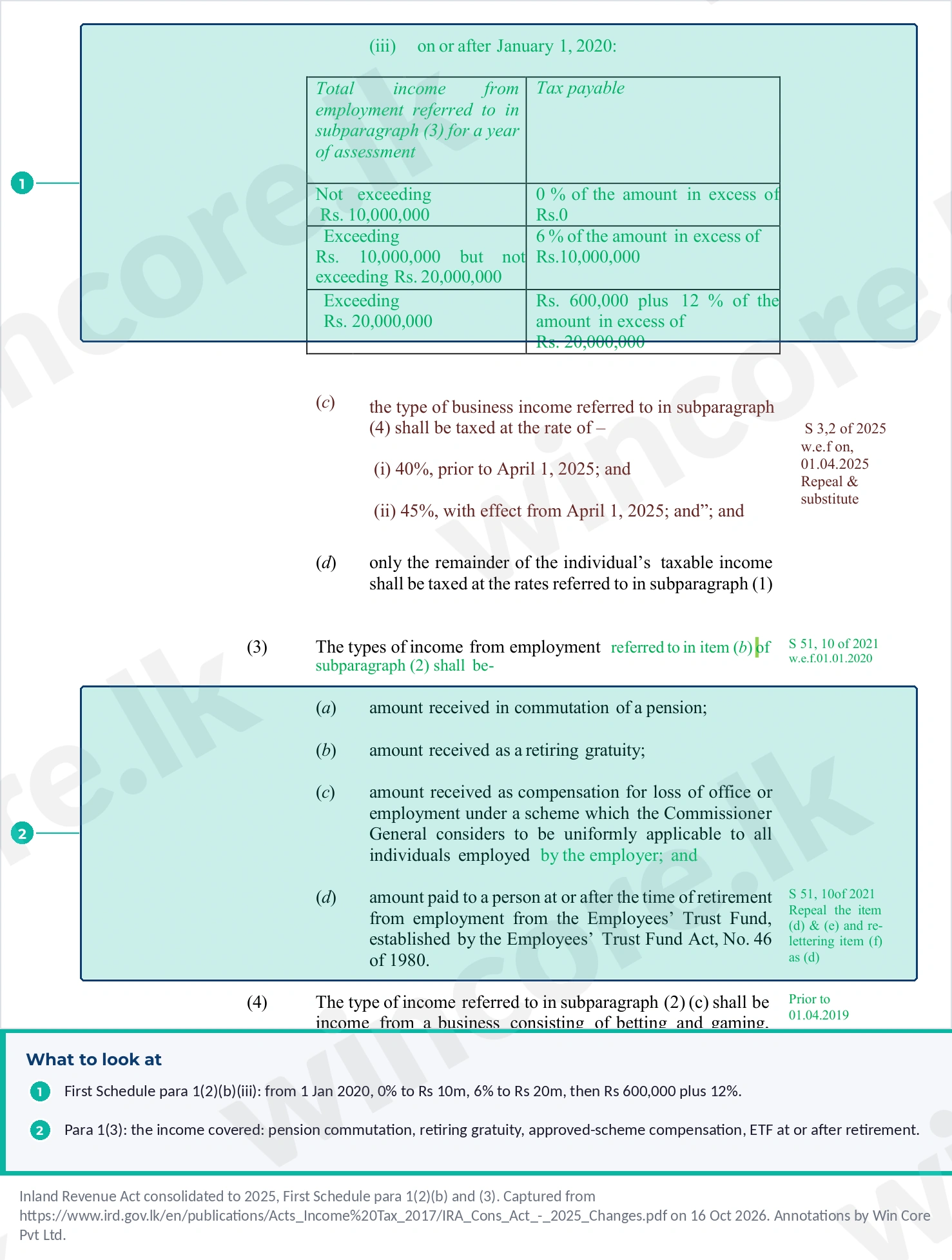
The retention is not the final tax. Paragraph 1(3) of the First Schedule lists the terminal benefits taxed at special rates: "amount received in commutation of a pension"; "amount received as a retiring gratuity"; "amount received as compensation for loss of office or employment under a scheme which the Commissioner General considers to be uniformly applicable to all individuals employed by the employer"; and amounts paid "at or after the time of retirement from employment from the Employees' Trust Fund" [1].
Paragraph 1(2)(b)(iii), "on or after January 1, 2020", taxes the total of those amounts for a year of assessment at 0 percent up to Rs 10,000,000, 6 percent of the amount between Rs 10,000,000 and Rs 20,000,000, and "Rs. 600,000 plus 12 % of the amount in excess of Rs. 20,000,000" above that [1]. The IRD's own tax chart shows the same three steps as the "concessionary rates", and says that unapproved-scheme compensation, payments from unapproved or unregulated funds, other payments and retirement non-cash benefits are taxed at the normal rates, 6 percent rising to 36 percent [7].
Put the two side by side. Table 03 asks for 12 percent of the excess over Rs 5,000,000 to be retained. The Act and the IRD chart tax the same categories at 0 percent up to Rs 10,000,000. We re-read both on 22 October 2026 and they still do not match. On our reading, the retention is provisional, and the direction is how the IRD fixes what is finally due. We have not found a published IRD explanation of how the two figures are reconciled, so we keep it open. The Rs 600,000 figure is internally consistent: 6 percent of the Rs 10,000,000 band from Rs 10m to Rs 20m is Rs 600,000.
Three worked examples show the retention and the final tax apart
All three are hypothetical.
Example 1: a statutory gratuity below Rs 5 million. Twenty years at a last-drawn Rs 400,000. Under section 6(2)(a) of the Payment of Gratuity Act, a monthly rated workman receives "half a month's wage or salary for each year of completed service", at the rate last drawn [8]. Rs 400,000 x 0.5 x 20 = Rs 4,000,000. That is below Rs 5,000,000, so nothing is retained under paragraph 02, and under the Act's rates the total is within the 0 percent step. Our gratuity calculator gives the gratuity figure for other service lengths.
Example 2: gratuity plus approved-scheme compensation above Rs 5 million. Gratuity Rs 4,000,000 plus Rs 2,500,000 compensation under a scheme approved before it started: total Rs 6,500,000. The excess over Rs 5,000,000 is Rs 1,500,000, and 12 percent of it, Rs 180,000, is retained. Under the Act the total is below Rs 10,000,000, so the rate in paragraph 1(2)(b)(iii) is 0 percent. The direction decides what happens to the Rs 180,000.
Example 3: an unapproved ex gratia payment. Salary to the date of leaving in the year Rs 1,200,000, plus a Rs 1,000,000 ex gratia payment under no approved scheme. The total, Rs 2,200,000, exceeds Rs 1,800,000, so the proviso does not apply, and 36 percent of Rs 1,000,000, Rs 360,000, is retained. On the IRD chart, this payment is taxed at the normal rates with the year's other employment income. If the employee has no other income, taxable income is Rs 2,200,000 less the Rs 1,800,000 personal relief, Rs 400,000, and tax at 6 percent is Rs 24,000 for the year, before any APIT already taken on the salary. On our reading, most of the Rs 360,000 retained would come back through the direction; confirm it in the direction itself. Our APIT lookup shows the monthly figures.
Each default has its own section
| Default | Section | What the section says |
|---|---|---|
| Employer does not withhold | Inland Revenue Act s.86(3), (4) | The agent "shall however pay the tax that should have been withheld"; the employee is "jointly and severally liable" [1] |
| Tax withheld but not paid by the due date | Inland Revenue Act s.179(1); s.159(1) | Penalty of 20 percent of the tax due but not paid if it is still unpaid fourteen days after the due date, plus interest at 1.5 percent a month or part of a month from the due date [1] |
| Gratuity paid after day 30 | Payment of Gratuity Act s.5(4), s.8 | Surcharge to the workman of 10 to 30 percent by length of delay; recoverable through a Magistrate [8] |
The gratuity surcharge is a labour law consequence paid to the workman. It is not a tax penalty, and it does not replace one. Who owes a gratuity at all is in our gratuity payment guide, and how the fifteen-workman test counts is in our note on payroll headcount thresholds.
What this means for you
- Label each part of the final payment before you run payroll. Final salary on the monthly tables, leave encashment on Table 02, gratuity, pension commutation and compensation on Table 03.
- Seek approval of any redundancy or retirement scheme before it starts. Without it, compensation falls into the 36 percent group.
- Under Rs 5,000,000 of paragraph 02 payments, nothing is retained. Above it, retain 12 percent of the excess, tell the employee in writing to obtain a direction within 90 days, and keep the paper trail.
- Expect the final tax to follow the Act. The direction is the bridge between the retention and the Act's rates.
Our payroll services run final settlements, and our income tax services handle the IRD direction and the annual statement.
Checklist: documents needed
- The employee's pay to the date of leaving for the year of assessment
- A breakdown of the final payment by type: salary, leave encashment, gratuity, compensation, other
- The gratuity calculation under section 6(2), with the last-drawn salary and completed years
- The Commissioner General's approval of any compensation scheme, with its date
- A copy of the instruction given to the employee to obtain a direction, and its date
- The direction from the Clearance and Directions Unit, or proof that 90 days passed without one
Open points
- Table 03 against the Act. The 12 percent retention above Rs 5,000,000 does not match the First Schedule's 0 percent up to Rs 10,000,000. Re-checked 22 October 2026; no IRD explanation found.
- The 90 day window and section 86(1). We found no provision in the Act that moves the fifteen-day payment date for retained terminal tax.
- "Each retain 12%". Table 03 does not explain how the rule applies when the employer and the ETF each pay part of the total.
- Tables for 2026/2027. The IRD lists no 2026/2027 APIT set as at 22 October 2026. If one is issued, check whether Table 03 changes.
FAQ
Is gratuity taxed with the last month's salary under the monthly APIT table?
No, a retiring gratuity is a once-and-for-all payment that goes through Tax Table 03. Paragraph 01 of the table lists "any sum payable as retiring gratuity". Only the final month's regular pay stays on the monthly tables, and leave encashment goes through Table 02. Label each part of the final payment separately before you run the payroll.
Is gratuity tax free in Sri Lanka?
Up to Rs 10,000,000 a year, gratuity is taxed at 0 percent under the First Schedule to the Inland Revenue Act. Withholding is a separate step: Table 03 asks for no retention while gratuity, approved-scheme compensation, commuted pension and ETF together stay at or below Rs 5,000,000, and 12 percent of any excess above that.
What if our compensation scheme was never approved by the Commissioner General?
Then Table 03 paragraph 03 applies, and the employer retains 36 percent of the compensation. The exception is where the employee's taxable pay for the year to termination plus these payments is Rs 1,800,000 or less. The IRD's tax chart says such payments are taxed at the normal rates, so the direction usually settles the difference.
What happens if the employee never gets a direction from the IRD?
The employer remits the amount retained to the Commissioner General once 90 days pass from the date of deduction. Table 03 paragraph 04 says to pay it to Account No. 2 at People's Bank, Union Place branch, marked "Tax on Once-and-for-all Payment", with the TIN space left blank. Keep proof of the instruction you gave the employee.
Does an approved provident fund payment go through Table 03?
No, Table 03 exempts "Any amount paid from a Provident Fund approved by the CGIR or Regulated Provident Funds". A payment from a fund that is neither approved nor regulated is different: it falls under paragraph 03, with 36 percent retained unless the Rs 1,800,000 proviso applies. Check the fund's approval status before the payment is made.
Last verified 22 October 2026 against Tax Table No. 03 and the APIT tables page on ird.gov.lk, the IRD tax chart, the Inland Revenue Act consolidated to 2025 (First Schedule) and the Gratuity Act on labourdept.gov.lk.
Talk to us. If you are working out the tax on a gratuity, retirement or redundancy payment, speak to us at our contact page.
WinCore Pvt Ltd
This article is general information on the law as at 22 October 2026 and is not advice on your specific position.
References
- Inland Revenue Department. Inland Revenue Act, No. 24 of 2017, consolidated with amendments to 2025, ss.83A, 86, 159, 179 and First Schedule para 1(2)(b) and (3). https://www.ird.gov.lk/en/publications/Acts_Income%20Tax_2017/IRA_Cons_Act_-_2025_Changes.pdf . Primary. Accessed 22 October 2026.
- Inland Revenue Department. Tax Table No. 03, Rates for the Deduction of Tax from Once-and-for-all Payments (Terminal Benefits, All Employees), 2025/2026 set. https://www.ird.gov.lk/en/publications/APIT_Tax_Tables/2025-2026/Table%20-%203/04.%20APIT_2526_Table_03_Text.pdf . Primary. Accessed 22 October 2026.
- Inland Revenue Department. Tax Chart, tax on once-and-for-all payments and terminal benefits from employment. https://www.ird.gov.lk/en/publications/SitePages/tax_chart_2526.aspx?menuid=1404 . Primary (administrative). Accessed 22 October 2026.
- Inland Revenue Department. APIT Tax Tables 2025/2026, Index. https://www.ird.gov.lk/en/publications/APIT_Tax_Tables/2025-2026/Index/01.%20APIT_2526_Index.pdf . Primary. Accessed 16 October 2026.
- Inland Revenue Department. APIT Tax Tables page. https://www.ird.gov.lk/en/publications/sitepages/apit_tax_tables.aspx?menuid=1502 . Primary. Accessed 22 October 2026.
- Inland Revenue Department. Circular SEC/2025/E/01, guideline for employers on APIT, para 12. https://www.ird.gov.lk/en/publications/Circulars_Circulars/SEC_2025_E_01_E.pdf . Primary. Accessed 16 October 2026.
- Inland Revenue Department. Tax Chart, application of concessionary and normal rates on terminal benefits from employment. https://www.ird.gov.lk/en/publications/SitePages/tax_chart_2526.aspx?menuid=1404 . Primary (administrative). Accessed 22 October 2026.
- Department of Labour. Payment of Gratuity Act, No. 12 of 1983, ss.5, 6 and 8 (Labour Code reprint). https://labourdept.gov.lk/downloads/labour_code/55.pdf . Primary. Accessed 22 October 2026.
Put these insights to work
WinCore specialists can review your current workflow, document gaps, and build a practical 90-day action plan.
Book a free consultationContinue reading
Explore more WinCore analysis to keep your finance, tax, and compliance roadmap moving.

Gratuity under the Payment of Gratuity Act: employers of 15 or more, five years' service, the half-month and 14-day formulas, the 30-day deadline, surcharge and tax.

Bonuses and other lump sums are taxed on APIT Table 02, not added to the month's salary. How the method works, what goes on Table 03 instead, and worked examples.
Eight IRD tables, one job each. Why Table 01 and Table 05 agree, how uneven pay is taxed, and where the lookup table and formula differ.