
Lump sum payments and bonus tax in Sri Lanka: the APIT Table 02 calculation for 2026/27
Bonuses and other lump sums are taxed on APIT Table 02, not added to the month's salary. How the method works, what goes on Table 03 instead, and worked examples.

On this page
Last verified against the primary sources on 15 October 2026.
An employee on Rs 200,000 a month receives a year-end bonus of Rs 600,000. If payroll applies a flat guess to the bonus, the deduction will usually be wrong, and the employee is left with a balance or a refund to sort out with the Inland Revenue Department (IRD). If payroll adds the bonus to the month's salary on the monthly table, the deduction will usually be far too high.
The IRD prescribes a method for lump sums such as bonuses: APIT Tax Table 02 [1]. It annualises the payment together with the employee's regular pay for the year, so the bonus is taxed at the rate its slice of the year's income actually reaches. It is not a flat rate and it is not optional.
This guide covers which payments go on Table 02, how the calculation works, why gratuity and other terminal payments go on Table 03 instead, the second-job case, and where bonuses are reported.
Regular pay and lump sums
The IRD tables, introduced from 1 April 2025 by Circular SEC/2025/E/01, separate the two [2]:
Regular employment income (Table 01). Monthly salary, fixed allowances, overtime, commission paid as part of monthly pay, and benefits in kind payable in the month. Table 01 is a monthly table with the Rs 150,000 relief built in [3].
Lump-sum payments (Table 02). Payments outside the regular monthly cycle, for employees with a primary employment declaration or a single job [2]. Some guides call these qualifying payments. Table 02 covers bonuses, incentives, leave encashment, medical expense reimbursements and shares under employee share schemes [1], and Table 01 sends salary arrears there too [3]. In practice that includes:
- annual performance and year-end bonuses
- incentives and commission settled quarterly or annually rather than monthly
- one-off signing or retention bonuses and ex-gratia payments
- leave encashment, including on termination
- salary arrears paid as a lump sum
Not Table 02. Gratuity, compensation for loss of office or employment, commuted pension and ETF payouts are once-and-for-all payments on Table 03 (see below) [4].
How Table 02 works
Table 02 calls the annualised total EGAR. For a lump sum paid this month [1]:
- A: regular pay already paid in the year of assessment, up to and including this month.
- B: regular pay still payable for the rest of the year, to March.
- C: every lump sum paid earlier in the year, being paid now, and payable later in the year.
- D = A + B + C. Apply the annual bands to D: nil to Rs 1,800,000, then 6% less Rs 108,000 up to Rs 2,800,000, 18% less Rs 444,000 up to Rs 3,300,000, 24% less Rs 642,000 up to Rs 3,800,000, 30% less Rs 870,000 up to Rs 4,300,000 and 36% less Rs 1,128,000 above.
- Take off the Table 01 tax on A, the Table 01 tax on B, and any tax already deducted on earlier lump sums this year. The result is the APIT on this payment.
Regular pay keeps going through Table 01 in every month, including the bonus month.
Worked example: a year-end bonus
Employee: Rs 200,000 a month, Rs 2,400,000 a year of regular pay. Bonus Rs 600,000. Primary employment declaration on file.
Table 01 tax on regular pay: 6% × 200,000 less 9,000 = Rs 3,000 a month, Rs 36,000 for the year [3].
Table 02:
- D = Rs 2,400,000 + Rs 600,000 = Rs 3,000,000
- Tax on D: 18% × 3,000,000 less 444,000 = Rs 96,000
- Less Table 01 tax on A and B: Rs 36,000
- APIT on the bonus: Rs 60,000
The employee receives Rs 540,000 of the bonus, before any other deduction. The year's total APIT is Rs 96,000, which matches the tax on Rs 3,000,000 of income: 6% of Rs 1,000,000 plus 18% of Rs 200,000.
A flat guess. At 6%, the deduction would be Rs 36,000, Rs 24,000 short.
Adding it to the month on Table 01. Rs 800,000 in one month gives 36% × 800,000 less 94,000 = Rs 194,000, against Rs 3,000 for a normal month: Rs 191,000 deducted on the bonus instead of Rs 60,000.
The IRD's own Table 02 examples follow the same steps: Rs 170,000 a month with a Rs 600,000 April incentive gives Rs 36,000 on the incentive [1].
Second jobs and missing declarations: Table 07
Table 02 is for employees who have given a primary employment declaration or have one job [2]. Where an employee has more than one employment, or has not given the declaration, the employer applies Table 07 instead: one rate from Table 7.1 on the payment, chosen by the employee's declared income from the primary employment, from nil where combined monthly income is under Rs 150,000 up to 36 percent [5]. If the employee has not disclosed primary employment income, the secondary employer applies the highest rate, 36 percent [5].
There is no 14 percent secondary employment rate. Collect the Primary Employment Declaration from every employee on day one (Circular SEC/2025/E/01 para 8) [2]. Without it, a low earner can be over-deducted at 36 percent.
Gratuity and other terminal payments: Table 03
Gratuity, compensation for loss of office or employment, commuted pension and ETF payouts are once-and-for-all payments taxed on Table 03, not Table 02 [4]:
- Where gratuity, compensation under a scheme the Commissioner-General has approved, commuted pension and ETF together exceed Rs 5,000,000, the employer and the ETF each retain 12 percent of the excess.
- Compensation under an unapproved scheme and other payments carry 36 percent.
- Nothing is retained if the employee's taxable pay for the year up to termination plus these payments is within Rs 1,800,000.
- The employee then obtains a direction from the IRD within 90 days.
The retention is not the final tax. From 1 January 2020, paragraph 1(2)(b)(iii) of the First Schedule to the Inland Revenue Act taxes a retiring gratuity, commuted pension, compensation under an approved scheme and ETF paid at retirement at 0 percent on the first Rs 10,000,000 for the year of assessment, 6 percent on the next Rs 10,000,000, and Rs 600,000 plus 12 percent above Rs 20,000,000; the IRD's 2025/2026 tax chart shows the same rates [6] [11]. Table 03's 12 percent retention above Rs 5,000,000 does not match the Act's 0 percent band, and we have not found an IRD explanation of how the two are reconciled, so we treat it as an open point: the IRD's direction to the employee settles what is finally due.
The exemptions for employment income are in the Third Schedule to the Inland Revenue Act [3]. Our gratuity payment guide covers the employer's obligation to pay.
Leave encashment on termination stays on Table 02 [1]. Work it separately from the gratuity.
Paying and reporting bonus APIT
- Monthly payment. The APIT on the bonus is added to the month's APIT total and paid within fifteen days after the month ends, in practice by the 15th of the following month (s.86(1)) [6]. There is no monthly APIT return.
- Annual statement. Bonuses are remuneration other than once-and-for-all payments, so they are reported in Schedule 01 of the annual statement, filed electronically by 30 April [7] [6]. Schedule 02 is for terminal benefits only.
- T-10 to the employee. The T-10 certificate shows the employee's gross employment income and the tax deducted, including on the bonus, so the employee gets the credit (s.87) [6].
For the full year-end process, see the APIT annual statement and T-10 guide.
Four common errors
Error 1: a flat percentage on the bonus. This understates APIT for most mid and high earners, and overstates it for some.
Error 2: adding the bonus to the month's salary on Table 01. The monthly table treats the whole bonus as if it were paid every month, so the deduction is far too high. Use Table 02.
Error 3: forgetting earlier lump sums. Regular pay stays on Table 01 after a bonus. What changes is the next lump sum: C must include the earlier bonus, and the tax already taken on it is deducted [1].
Error 4: no Primary Employment Declaration on file. Without it the employee falls under Table 07, at 36 percent if primary income is undisclosed [5]. The bonus month is often when the gap is noticed.
Frequently asked questions
Can we split a bonus into monthly payments to reduce the APIT?
No. Each instalment is a lump sum on Table 02, and because C includes every lump sum paid and payable in the year and the tax already taken on earlier lump sums is deducted, the total deducted comes to the tax on the full bonus [1].
What if regular pay changes after the bonus has been taxed?
Table 02 uses the regular pay still payable (B) as projected at the time. A later pay rise can leave the year under or over deducted; Table 05 allows the employer to recompute the year in March and adjust [8].
Is a golden handshake or redundancy payment taxed on Table 02?
No. Compensation for loss of office or employment is a once-and-for-all payment on Table 03: 12 percent of the excess over Rs 5,000,000 for approved schemes, 36 percent for unapproved ones [4].
Does the employer pay EPF and ETF on bonuses?
Bonuses are outside the EPF earnings base, as are overtime payments, according to the EPF Department's FAQ, which is Department guidance, not the Act; the definition of earnings in section 47 of the EPF Act does not mention either [12] [9]. Check the treatment of any unusual payment with the Labour Department before you run it.
Where do I find the IRD's Table 02?
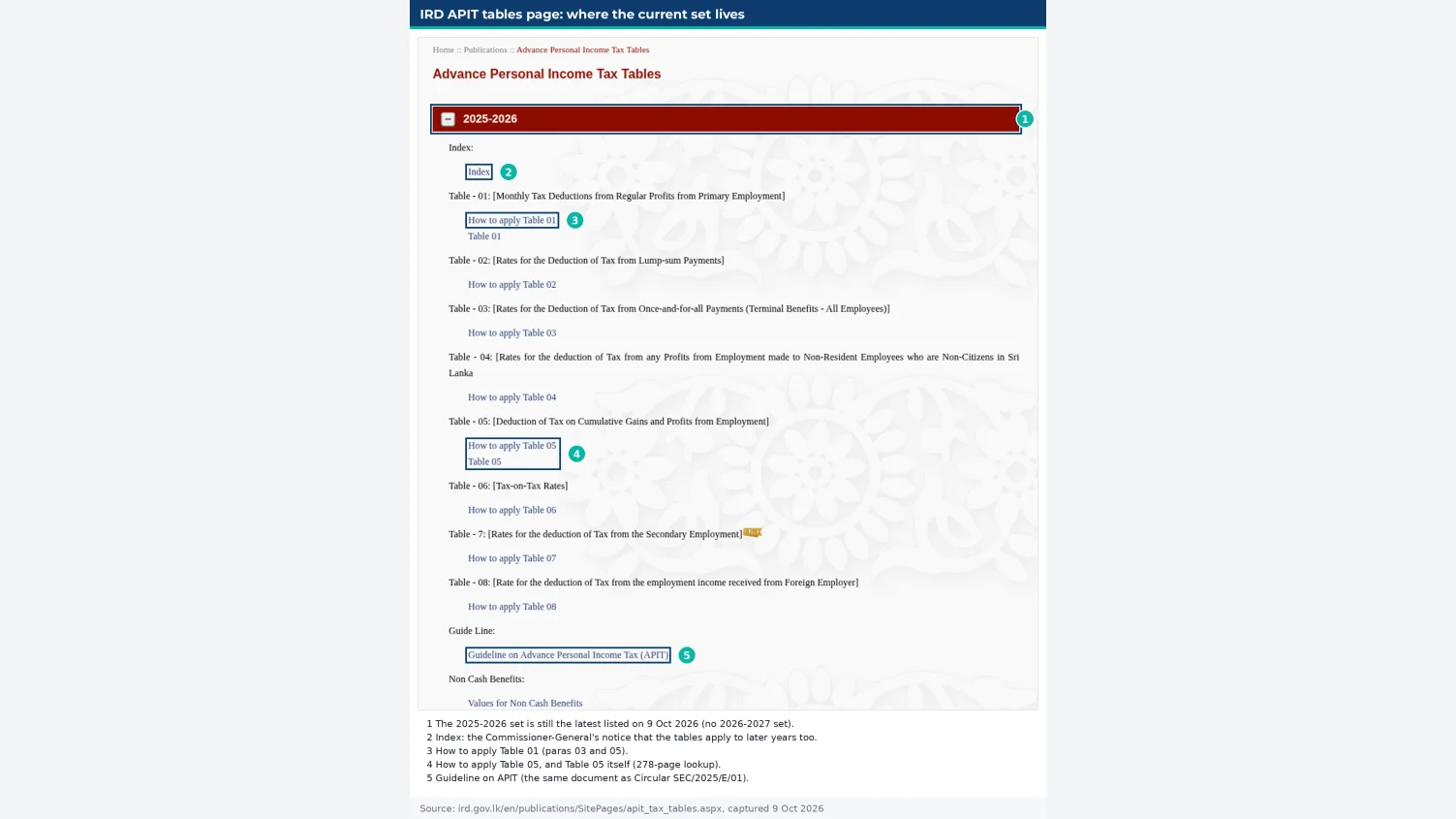
On the IRD's APIT tax tables page [10]. The tables are headed Y/A 2025/26 and apply to later years unless the IRD specifies other tables. See also the APIT deduction guide.
Talk to us. If a bonus run is coming up and you want the Table 02 workings checked before it is paid, our payroll team can go through them with you; book a consultation at our contact page. Our bonus tax calculator is a starting point.
This guide is general information on the law as at 15 October 2026 and is not advice on your specific situation.
References
- Inland Revenue Department. APIT Tax Table 02, Y/A 2025/26, instructions and worked examples 01 to 04. https://www.ird.gov.lk/en/publications/APIT_Tax_Tables/2025-2026/Table%20-%202/03.%20APIT_2526_Table_02_Text.pdf . Primary. Accessed 15 October 2026.
- Inland Revenue Department. Circular SEC/2025/E/01, Guideline for employers on deducting APIT (25 March 2025), Tables 01 to 08 and para 8. https://www.ird.gov.lk/en/publications/Circulars_Circulars/SEC_2025_E_01_E.pdf . Primary. Accessed 15 October 2026.
- Inland Revenue Department. APIT Tax Table 01, Y/A 2025/26, instructions, paras 01, 03, 06 and 07. https://www.ird.gov.lk/en/publications/APIT_Tax_Tables/2025-2026/Table%20-%201/02.%20APIT_2526_Table_01_Text.pdf . Primary. Accessed 15 October 2026.
- Inland Revenue Department. APIT Tax Table 03, Y/A 2025/26, once-and-for-all payments. https://www.ird.gov.lk/en/publications/APIT_Tax_Tables/2025-2026/Table%20-%203/04.%20APIT_2526_Table_03_Text.pdf . Primary. Accessed 15 October 2026.
- Inland Revenue Department. APIT Tax Table 07, Y/A 2025/26, instructions and Table 7.1. https://www.ird.gov.lk/en/publications/APIT_Tax_Tables/2025-2026/Table%20-%207/08.%20APIT_2526_Table_07_Text.pdf . Primary. Accessed 15 October 2026.
- Inland Revenue Department. Inland Revenue Act, No. 24 of 2017, consolidated, ss.86(1) and (2), 87, and First Schedule paragraphs 1(2)(b)(iii) and 1(3) (First Schedule captured 16 October 2026). https://www.ird.gov.lk/en/publications/Acts_Income%20Tax_2017/IRA_Cons_Act_-_2025_Changes.pdf . Primary. Accessed 15 October 2026.
- Inland Revenue Department. Instructions to complete the APIT Annual Statement, Y/A 2025/2026, Schedules 01 and 02. https://www.ird.gov.lk/en/Downloads/Other_PAYE_Doc/Asmt_APIT_Guide_2025_2026_E.pdf . Primary. Accessed 15 October 2026.
- Inland Revenue Department. APIT Tax Table 05, Y/A 2025/26, instructions, para 04. https://www.ird.gov.lk/en/publications/APIT_Tax_Tables/2025-2026/Table%20-%205/06.%20APIT_2526_Table_05_Text.pdf . Primary. Accessed 15 October 2026.
- Central Bank of Sri Lanka. Employees' Provident Fund Act, No. 15 of 1958 (reprint), s.47 definition of earnings. https://www.cbsl.gov.lk/sites/default/files/cbslweb_documents/laws/acts/en/epf_act.pdf . Primary. Accessed 15 October 2026.
- Inland Revenue Department. APIT tax tables web page. https://www.ird.gov.lk/en/publications/SitePages/apit_tax_tables.aspx?menuid=1502 . Primary. Accessed 15 October 2026.
- Inland Revenue Department. Tax chart, Year of Assessment 2025/2026, terminal benefits. https://www.ird.gov.lk/en/publications/SitePages/tax_chart_2526.aspx?menuid=1404 . Administrative guidance. Accessed 22 October 2026.
- EPF Department, Central Bank of Sri Lanka. FAQs for Employers, questions 3 and 4 (components included in and excluded from total earnings). https://epf.lk/?page_id=811 . Department guidance, not the Act. Accessed 22 October 2026.
Put these insights to work
WinCore specialists can review your current workflow, document gaps, and build a practical 90-day action plan.
Book a free consultationContinue reading
Explore more WinCore analysis to keep your finance, tax, and compliance roadmap moving.

APIT deduction for Sri Lankan employers: the five bands, which IRD table applies to bonuses, joiners, second jobs and terminal pay, T-10s and annual statement.
Staff who join or leave mid-year need APIT Table 05, not Table 01. Why it matters, with worked examples and the T-10 annual return steps.
How Sri Lankan employers file the APIT annual statement by 30 April: monthly payments by the 15th, Schedules 01, 02 and 03, employee TINs and T-10 certificates.