
APIT tax tables 2025/26: Circular SEC/2025/E/01 and Table 05
Eight IRD tables, one job each. Why Table 01 and Table 05 agree, how uneven pay is taxed, and where the lookup table and formula differ.
On this page
Last verified against the primary sources on 21 October 2026.
The APIT tax tables 2025/26 in Sri Lanka apply from 1 April 2025, under IRD Circular SEC/2025/E/01 of 25 March 2025, and they continue for later years until the IRD specifies new ones [1] [4]. An employee is liable once pay exceeds Rs 1,800,000 a year or Rs 150,000 a month. APIT is worked on gross pay, with nothing taken off first, not even the employee's 8 percent EPF [2]. Eight tables each do one job. Table 05, the cumulative table, applies where monthly pay is under Rs 150,000 but the year to date passes Rs 1,800,000, and, under the table texts, to joiners, retirees and second employers [1] [3].
APIT is a forecast that corrects itself, but only if payroll uses the right clock. Table 01 deducts as if this month's pay were one twelfth of the year. Table 05 looks at the year to date instead. This piece is about the circular, the two clocks and where they part. For the full payroll routine, see our APIT deduction guide.
Take a hypothetical hotel cashier on Rs 120,000 a month who earns Rs 200,000 a month in the six-month peak season. In April she owes nothing. By March her year has passed Rs 1.8 million. When should her employer start deducting, and how much?
The APIT tax tables 2025/26 apply from 1 April 2025 and carry on until replaced
Circular SEC/2025/E/01, dated 25 March 2025, gives employers "necessary instructions" to deduct Advance Personal Income Tax under the Inland Revenue Act as amended, including by Act No. 2 of 2025, and "is effective for the Y/A 2025/2026 and onwards" [1]. It is a scanned document; we read it by OCR and checked each quote against the page image.
It does not make law. Paragraph 12 says that "if there is any inconsistency between the provisions of the Inland Revenue Act and these instructions, the provisions of the Act shall be applied" [1]. The tables themselves are published by the Commissioner General "By virtue of powers vested in me under section 83A (1A)", and the notice specifies them "for every subsequent years of assessment unless other tables are specified" [4]. So the tables headed 2025/2026 still govern 2026/27 payroll.
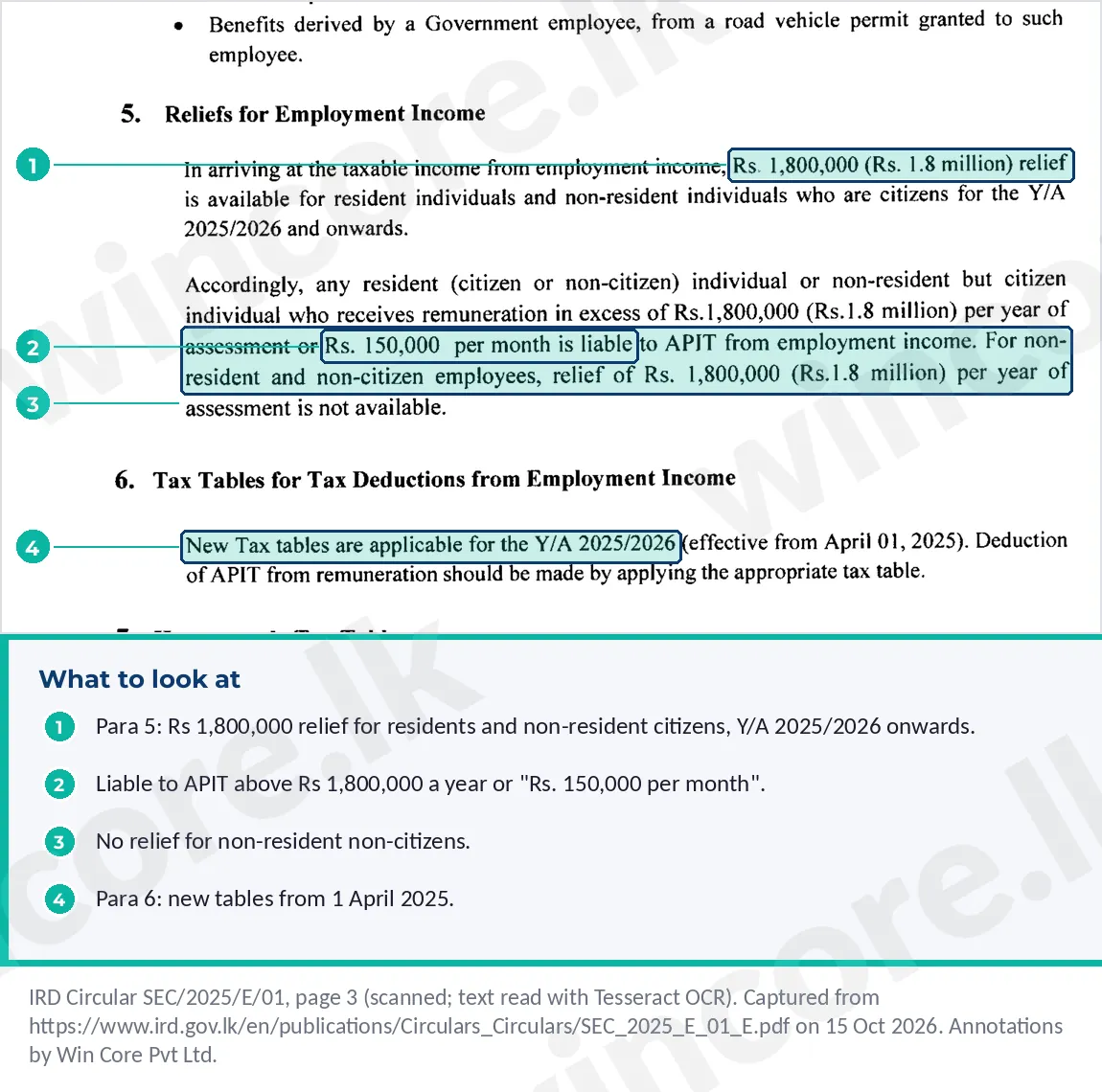
Paragraph 5 gives Rs 1,800,000 relief to resident individuals and non-resident individuals who are citizens, for 2025/26 onwards. Any of them receiving more than Rs 1,800,000 a year "or Rs. 150,000 per month is liable to APIT". For "nonresident and non-citizen employees", the relief "is not available" [1]. The relief and the 6 to 36 percent bands come from Act No. 2 of 2025 [6]; our post on Sri Lanka income tax bands for 2026 sets them out on taxable income.
APIT is worked on gross pay, with no EPF taken off first
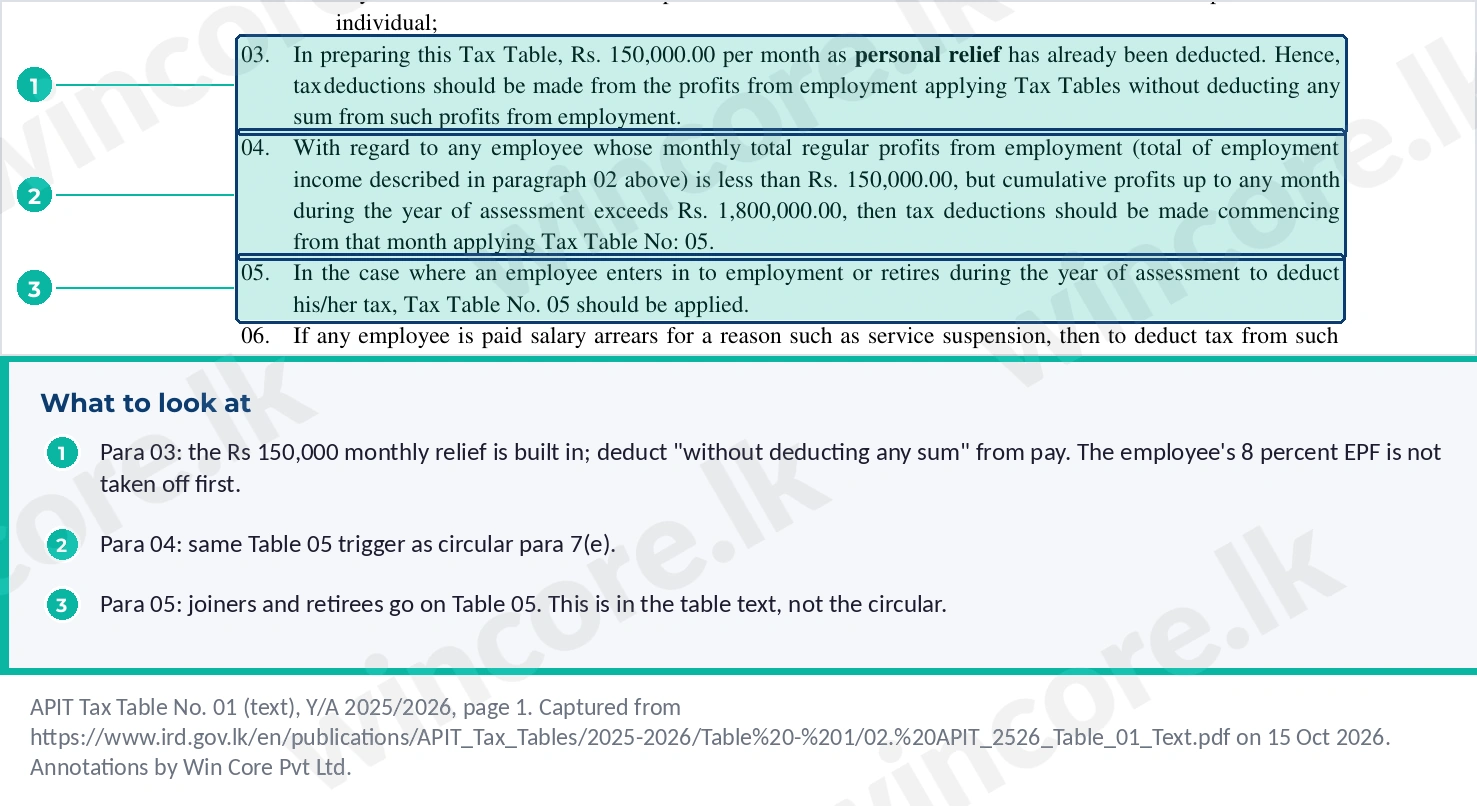
Is APIT worked out after deducting the employee's 8 percent EPF? No. Table 01, paragraph 03, says the Rs 150,000 monthly relief "has already been deducted. Hence, tax deductions should be made from the profits from employment applying Tax Tables without deducting any sum from such profits from employment" [2]. The employee's EPF contribution is part of gross pay and stays in.
The employer's own contribution is different. Paragraph 3 of the circular lists among excluded amounts "Contributions made by an employer to an employee's account with a pension, provident, gratuity or savings fund or savings society approved by the Commissioner-General" [1]. So the employer's 12 percent EPF is not added to pay, and the employee's 8 percent is not taken off it. To estimate take-home pay, try our salary calculator.
Eight tables, and Table 05 has more triggers than the circular lists
Paragraph 7 of the circular assigns the tables [1] [2]:
| Table | When to use it |
|---|---|
| 01 | Regular pay of residents and non-resident citizens with a primary employment declaration or one job |
| 02 | Lump-sum payments to the same group |
| 03 | Once-and-for-all payments (terminal benefits), all employees |
| 04 | Any payment to non-resident non-citizens |
| 05 | Monthly pay under Rs 150,000 whose cumulative total for the year passes Rs 1,800,000 |
| 06 | Employer pays or reimburses the employee's tax |
| 07 | No Primary Employment Declaration, or more than one employment |
| 08 | Foreign employer that has not deducted; the employee pays |
Bonuses follow Table 02, covered in our APIT Table 02 guide to lump sum and bonus tax, and gratuity follows Table 03, covered in our piece on APIT on gratuity and termination pay.
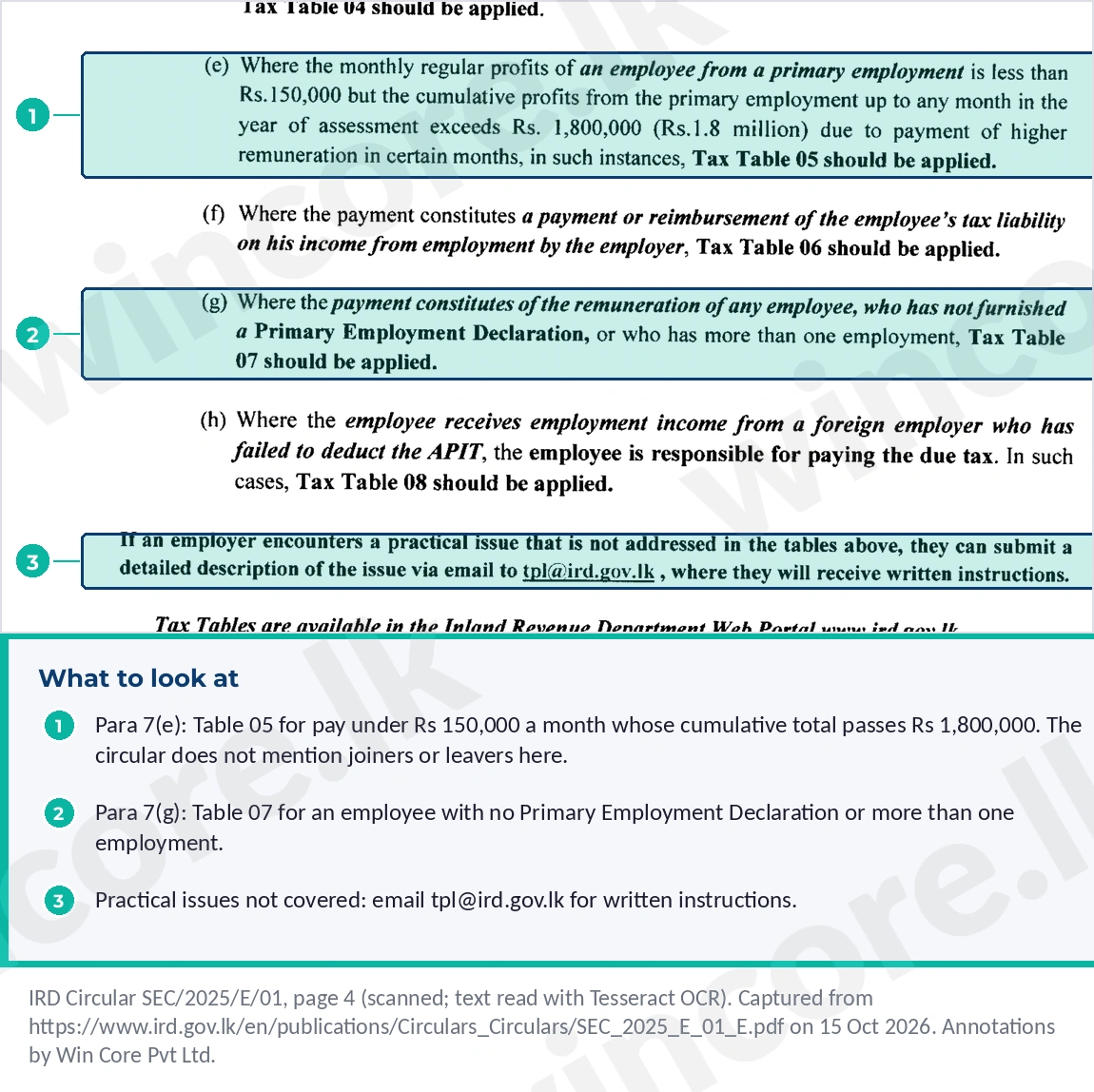
Paragraph 7(e) gives Table 05 one job: an employee whose monthly regular profits from a primary employment are "less than Rs.150,000 but the cumulative profits from the primary employment up to any month in the year of assessment exceeds Rs. 1,800,000 ... due to payment of higher remuneration in certain months" [1].
The table texts give it more. Table 05, paragraph 02, and Table 01, paragraph 05, send to Table 05 an employee who "commences employment or retires" during the year [2] [3]. Table 05, paragraph 03, adds the second employer of someone who left a primary employment, who uses cumulative income "including the employment income from the T-10 of the first employer". Paragraph 04 allows a March true-up where Table 02 has caused over- or under-deduction [3]. The two do not conflict: the circular sends employers to the tables, and closes paragraph 7 by inviting them to email tpl@ird.gov.lk with issues the tables do not address [1]. Our guide to APIT for staff who join or leave mid-year works through the joiner and leaver cases.
What "monthly" means when pay is uneven
Table 05's trigger is monthly pay "less than Rs. 150,000". The cashier earns Rs 200,000 in peak months, so on a literal reading Table 01 applies to those months: 6 percent of Rs 200,000 less Rs 9,000 is Rs 3,000 a month, Rs 18,000 over six months [2].
The IRD's own Example 01 in Table 05 points the other way. An employee whose monthly regular pay is under Rs 150,000 reaches Rs 1,900,000 by February 2026, with a bonus, and moves to Rs 200,000 a month from March. The example applies Table 05 to March: tax on cumulative Rs 2,100,000 is Rs 18,000, "Less: Tax Charged in February 2026 (6,000)", so Rs 12,000 is deducted in March [3]. On our reading, the IRD treats "monthly regular profits" as the employee's usual pay, not each month's pay. That is our reading of an example, not a rule, and it stays open.
Table 01 and Table 05 are the same law on two clocks
Each Table 01 monthly limit is the Table 05 annual limit divided by twelve: Rs 233,333 against Rs 2,800,000, Rs 358,333 against Rs 4,300,000. Each Table 01 deduction times twelve is the Table 05 deduction: Rs 9,000 and Rs 108,000, Rs 37,000 and Rs 444,000, Rs 53,500 and Rs 642,000, Rs 72,500 and Rs 870,000, Rs 94,000 and Rs 1,128,000 [2] [3]. Both reproduce the Act. On Rs 2,800,000 of gross pay, Table 05 gives 6 percent less Rs 108,000, which is Rs 60,000, and the Act gives 6 percent of Rs 1,000,000 taxable income, also Rs 60,000.
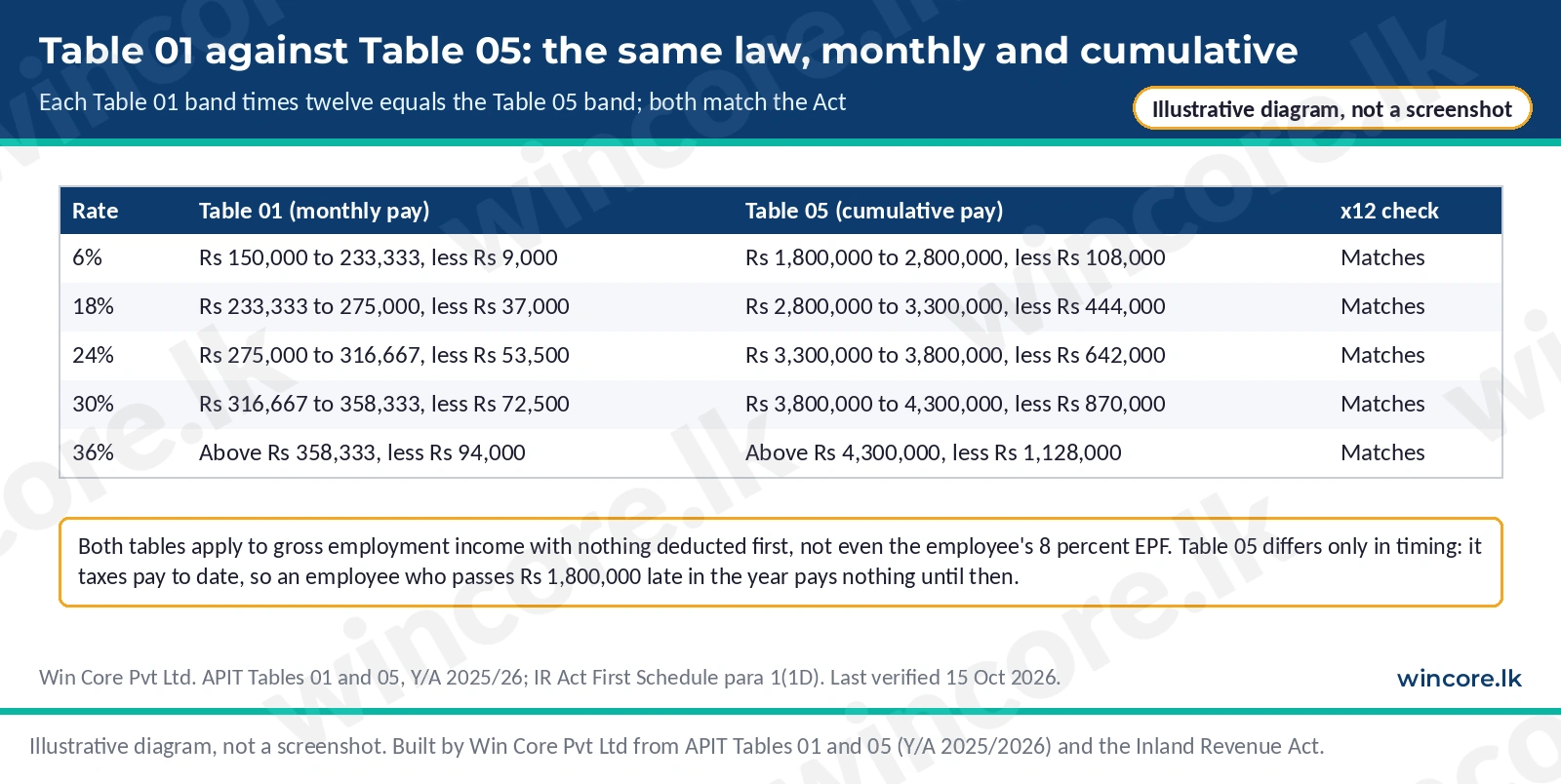
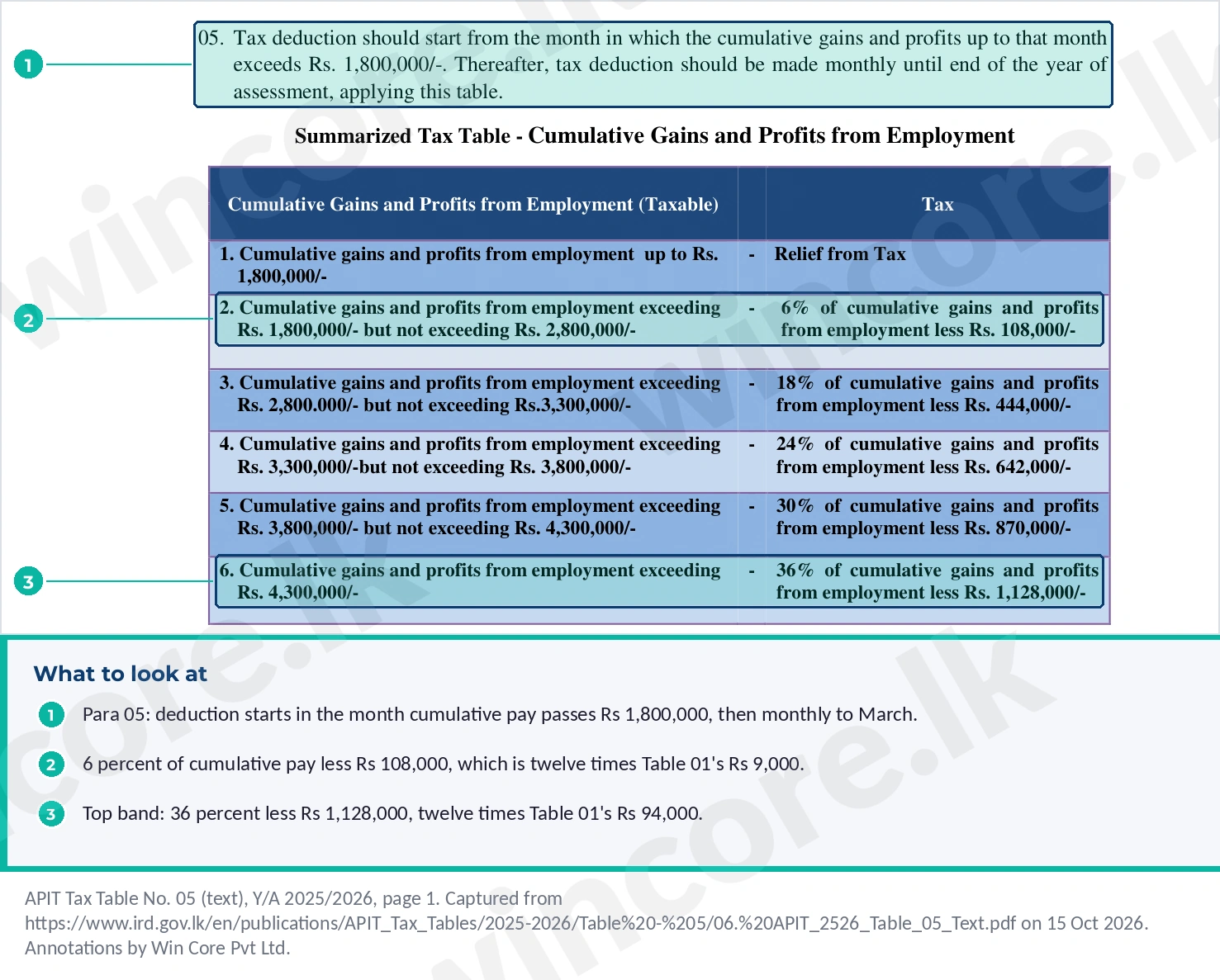
Table 05, paragraph 05, sets the start: "Tax deduction should start from the month in which the cumulative gains and profits up to that month exceeds Rs. 1,800,000/-", then monthly to the end of the year [3].
The lookup tables round by band
Each table comes in two forms: a text with a summarised formula, and a long lookup table in bands. Table 01 lists "299997 - 300000" with a deduction of 18500, which is the formula's 24 percent of Rs 300,000 less Rs 53,500. Table 05 lists "1919801 - 1920000" with 7200, which is 6 percent of Rs 1,920,000 less Rs 108,000 [7] [8]. Because each band is priced at its upper end, pay at the bottom of a band is charged slightly more than the formula gives. The Table 05 bands are Rs 200 wide, so the gap is at most 6 to 36 percent of Rs 200, Rs 12 to Rs 72. Neither text says which governs. The circular tells employers to apply "the appropriate tax table", and on our reading payroll software using the formula is within a band of the lookup table, which is not a deduction error worth disputing either way. To check a monthly figure against the bands, use our APIT lookup tool.
Worked example: a seasonal cashier taxed only in March
The cashier: April to September at Rs 120,000, October to March at Rs 200,000. Cumulative pay is Rs 720,000 at September, Rs 1,720,000 at February and Rs 1,920,000 at March. Under Table 05 nothing is deducted until March, when the tax on Rs 1,920,000 is 6 percent less Rs 108,000, Rs 7,200 [3]. That is also 6 percent of the Rs 120,000 by which the year exceeds Rs 1,800,000, which is her actual liability for the year.
Applying Table 01 to each peak month would instead take Rs 18,000. The Rs 10,800 difference would sit with the IRD until she recovered it. The forecast corrects itself only if payroll switches clocks.
Late remittance costs 20 percent plus interest
Tax deducted in a month must be remitted "on or before the 15th day of the month immediately succeeding that month" [1], as section 86(1) requires [5].
| Default | Section | Consequence |
|---|---|---|
| APIT not deducted | IRA s.86(3), (4), (6) | Employer pays the tax that should have been withheld; the employee is jointly and severally liable; the employer may recover it from the employee |
| APIT paid late | IRA s.159(1) | Interest at 1.5 percent a month or part of a month |
| APIT not paid within fourteen days of the due date | IRA s.179(1) | Penalty of 20 percent of the tax due but not paid |
The 10 percent rate in section 179(2) is for income tax instalments only, and there is no 25 percent surcharge for APIT [5].
What this means for you
If your staff are on steady pay above Rs 150,000, Table 01 does the job. The risk sits with uneven pay, joiners and leavers, where Table 01 over-deducts in good months. Our payroll services team runs APIT monthly and moves staff between tables as the year develops.
- Run APIT on gross pay. Do not take the employee's EPF off first.
- Flag staff on uneven pay who are usually under Rs 150,000, and start Table 05 in the month the year to date passes Rs 1,800,000.
- Use Table 05 for joiners and retirees, with the T-10 from any earlier employer.
- Ask in writing at tpl@ird.gov.lk when the tables do not fit. Our income tax compliance services team can draft the request.
Checklist: documents needed
- Each employee's Primary Employment Declaration, or a note that the job is their only one
- Monthly gross pay records, with employee EPF left in
- A year-to-date pay schedule for every employee, to spot the month cumulative pay passes Rs 1,800,000
- T-10 certificates from earlier employers for joiners
- The current Table 01 and Table 05 texts and lookup PDFs
- Remittance receipts for each month's APIT
- Copies of any written instructions received from tpl@ird.gov.lk
Points the tables leave open
- Whether peak months above Rs 150,000 belong on Table 01 or Table 05. The IRD example points to Table 05; the circular does not say.
- Whether "retires" covers resignation or the end of a contract. The texts do not say.
- Whether the lookup table or the summarised formula governs where they differ by a few rupees.
Frequently asked questions
Is APIT calculated after deducting EPF in Sri Lanka?
No. APIT is worked on gross pay with nothing taken off first. Table 01 says the Rs 150,000 monthly relief is already built in, so tax is deducted "without deducting any sum" from employment income [2]. The employee's 8 percent EPF stays in pay, and the employer's 12 percent is not added to it [1].
What is the APIT tax-free amount per month for 2025/26?
Rs 150,000 a month, or Rs 1,800,000 a year, for residents and non-resident citizens, from 1 April 2025 [1]. Non-resident non-citizens get no relief and are taxed under Table 04. The same tables continue for 2026/27 because the IRD has not specified new ones [4].
When should an employer use APIT Table 05?
Use Table 05 when monthly pay is under Rs 150,000 but the year to date passes Rs 1,800,000, for employees who join or retire during the year, and for a second employer using a T-10 [1] [3]. Deduction starts in the month cumulative pay passes Rs 1,800,000 and runs monthly to March.
When must APIT be paid to the IRD?
On or before the 15th of the month after the month of deduction, under paragraph 10 of the circular and section 86(1) of the Act [1] [5]. Paying late adds interest of 1.5 percent a month from the due date, and a penalty of 20 percent of the tax due but not paid if it is still unpaid fourteen days after the due date.
Which APIT table applies to a foreign employee?
A non-resident who is not a Sri Lankan citizen is taxed under Table 04, on any payment, with no Rs 1,800,000 relief [1]. A resident foreigner is treated like any other resident and uses Table 01, because paragraph 5 gives the relief to residents whether citizens or not.
Talk to us. If you would like us to check your payroll's APIT tables, Table 05 cases or T-10 handling, book a consultation at our contact page.
WinCore Pvt Ltd
This article is general information on the law as at 21 October 2026 and is not advice on your specific position.
References
- Inland Revenue Department. Guideline for Employers on Deducting Advance Personal Income Tax (APIT) from Employment Income, Circular SEC/2025/E/01 (25 March 2025), paras 3, 5, 7, 10 and 12 (scanned; read by OCR). https://www.ird.gov.lk/en/publications/Circulars_Circulars/SEC_2025_E_01_E.pdf . Primary. Accessed 21 October 2026.
- Inland Revenue Department. APIT Tax Table No. 01, Y/A 2025/2026 (text), paras 01 to 05 and summarised table. https://www.ird.gov.lk/en/publications/APIT_Tax_Tables/2025-2026/Table%20-%201/02.%20APIT_2526_Table_01_Text.pdf . Primary. Accessed 21 October 2026.
- Inland Revenue Department. APIT Tax Table No. 05, Y/A 2025/2026 (text), paras 01 to 05, summarised table and Example 01. https://www.ird.gov.lk/en/publications/APIT_Tax_Tables/2025-2026/Table%20-%205/06.%20APIT_2526_Table_05_Text.pdf . Primary. Accessed 21 October 2026.
- Commissioner General of Inland Revenue. APIT Tables, index and publication notice under s.83A(1A) (25 March 2025). https://www.ird.gov.lk/en/publications/APIT_Tax_Tables/2025-2026/Index/01.%20APIT_2526_Index.pdf . Primary. Accessed 21 October 2026.
- Inland Revenue Department. Inland Revenue Act, No. 24 of 2017, consolidated with amendments to 2025, ss.86, 159 and 179. https://www.ird.gov.lk/en/publications/Acts_Income%20Tax_2017/IRA_Cons_Act_-_2025_Changes.pdf . Primary. Accessed 15 October 2026.
- Parliament of Sri Lanka. Inland Revenue (Amendment) Act, No. 2 of 2025. https://www.ird.gov.lk/en/publications/Acts_Income%20Tax_2017/IR_Act_No_02-2025_E.pdf . Primary. Accessed 15 October 2026.
- Inland Revenue Department. APIT Tax Table No. 01, Y/A 2025/2026 (lookup table). https://www.ird.gov.lk/en/publications/APIT_Tax_Tables/2025-2026/Table%20-%201/02.%20APIT_2526_Table_01.pdf . Primary. Accessed 15 October 2026.
- Inland Revenue Department. APIT Tax Table No. 05, Y/A 2025/2026 (lookup table). https://www.ird.gov.lk/en/publications/APIT_Tax_Tables/2025-2026/Table%20-%205/06.%20APIT_2526_Table_05.pdf . Primary. Accessed 15 October 2026.
Put these insights to work
WinCore specialists can review your current workflow, document gaps, and build a practical 90-day action plan.
Book a free consultationContinue reading
Explore more WinCore analysis to keep your finance, tax, and compliance roadmap moving.

APIT deduction for Sri Lankan employers: the five bands, which IRD table applies to bonuses, joiners, second jobs and terminal pay, T-10s and annual statement.
Staff who join or leave mid-year need APIT Table 05, not Table 01. Why it matters, with worked examples and the T-10 annual return steps.

Bonuses and other lump sums are taxed on APIT Table 02, not added to the month's salary. How the method works, what goes on Table 03 instead, and worked examples.